

Connect with us

Business

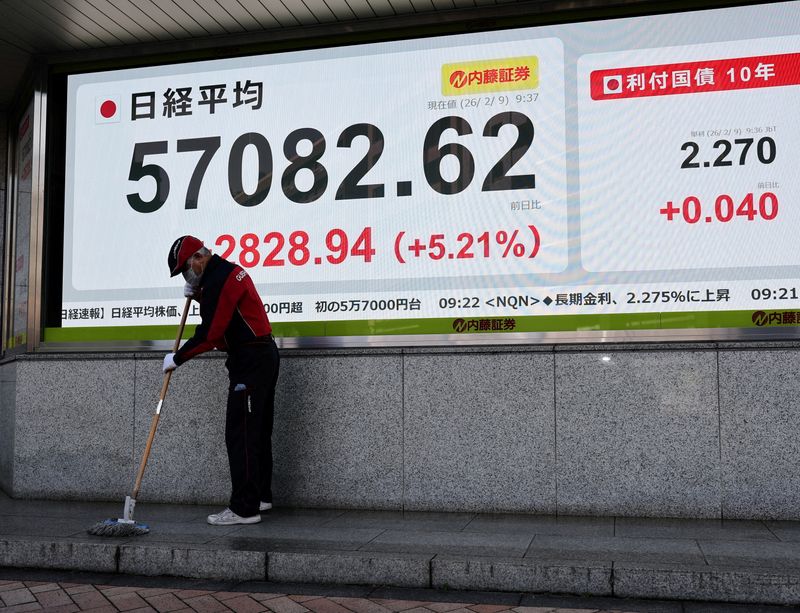
Japan stocks soar to record, super-long bonds steady in nod to Takaichi’s ’responsible’ stimulus

Published

on

Japan stocks soar to record, super-long bonds steady in nod to Takaichi’s ’responsible’ stimulus


Japan stocks soar to record, super-long bonds steady in nod to Takaichi’s ’responsible’ stimulus

Continue Reading
Click to comment

Leave a Reply

Your email address will not be published. Required fields are marked *

Business

China exports surge in first two months of the year despite Trump tariffs

Published

on

China exports surge in first two months of the year despite Trump tariffs

The jump in shipments puts the world’s second largest economy on track to top the record-breaking annual trade surplus it saw in 2025.

Continue Reading

Business

Small businesses sceptical over tariff refunds after US Supreme Court strikes down Trump’s trade levies

Published

on

US tariffs threaten to tip UK, Europe and Asia into recession, warn economists

Small business owners across the United States have expressed scepticism that they will ever see refunds following the landmark ruling by the Supreme Court of the United States striking down large parts of Donald Trump’s sweeping tariff regime.

The court’s decision potentially unlocks as much as $175 billion (£137 billion) in repayments to companies that paid import duties under the controversial policy. However, many entrepreneurs say the legal and administrative complexity involved in claiming those refunds could make the process prohibitively difficult, particularly for smaller firms already strained by rising costs.

The tariffs, which targeted a wide range of imported goods under the former president’s “Liberation Day” trade policy, had sharply increased the cost of materials and products for businesses reliant on global supply chains.

Although the ruling has opened the door to compensation claims, Trump himself acknowledged the issue could remain entangled in litigation “for the next five years”, leaving thousands of companies unsure whether pursuing refunds is even worthwhile.

For many small firms, the economic damage caused by the tariffs has already been felt in higher costs, squeezed margins and delayed investment plans.

Advertisement

Elizabeth Vitanza, who runs a lighting and home furnishings business in Los Angeles with her husband John Ballon, said the impact has been felt across nearly every brand they work with.

“All of the modern brands we carry have raised prices by at least 12 per cent over the past year,” she said. “None of this is pro-business or pro-American.”

When Trump won re-election in 2024, the couple attempted to protect their business by rushing through a large order with a Swedish partner in an effort to beat the incoming tariffs.

Despite the attempt, the shipment was still caught by the new duties.

Advertisement

“We ended up paying a five-figure tariff bill,” Ballon said. “Money we had earmarked to renovate the showroom and possibly increase staff salaries suddenly had to cover unexpected import taxes.”

The couple said the experience had forced them to rethink expansion plans.

“Why would anyone start a business right now?” Vitanza asked. “If I didn’t already have an established one, I wouldn’t.”

Across other sectors, similar stories have emerged of rising costs linked to tariffs on imported raw materials and components.

Advertisement

A furniture manufacturer in Texas said the policy had pushed up the price of imported lumber and specialist cabinet hardware that cannot be sourced domestically.

The company had little choice but to pass on the costs to customers.

“Those materials simply aren’t made in the United States,” the owner said, requesting anonymity. “If tariffs raise those costs, we either increase prices or absorb the loss.”

Outdoor equipment company Granite Gear, based in Minnesota, experienced a similar shock.

Advertisement

Manager Rob Coughlin said the company had faced near-constant uncertainty since the tariffs were introduced.

Before the policy was implemented, Granite Gear paid an 18 per cent import duty on certain goods. When the new tariffs were introduced, the rate surged to 46 per cent before later being reduced to 20 per cent following trade negotiations with Vietnam.

The rapid changes made pricing decisions almost impossible.

“We didn’t even know what our costs would be when products started shipping,” Coughlin said. “How do you go to retailers with a price list when you don’t know the tariffs you’ll be paying?”

Advertisement

Ultimately, the company raised prices between 10 and 20 per cent to offset the additional costs.

Unlike larger brands, Coughlin said smaller companies have far less negotiating power when dealing with retailers.

“Big companies can push back on price increases. Smaller brands like us just don’t have that leverage.”

For companies in niche sectors, the tariffs have also created major financial strain.

Advertisement

Dr Charlie Elrod, founder of a natural livestock health products company, said tariffs on Brazilian imports alone had increased costs by around $1 million over the past year.

For months the company tried to absorb the additional expense rather than pass it on to customers.

Eventually, however, it was forced to raise prices by 5 per cent.

“That helped a bit,” Elrod said, “but profitability has definitely fallen.”

Advertisement

Following the Supreme Court ruling, more than 1,000 companies have launched lawsuits seeking reimbursement for tariffs they argue were collected unlawfully.

In a related development, a US trade court judge recently ordered the federal government to begin processing billions of dollars in refunds to importers affected by the invalidated tariffs.

Yet the practical path to recovering that money remains unclear.

Many businesses say the complexity of filing claims, and the legal costs involved, may outweigh any potential repayment.

Advertisement

Vitanza said her company is carefully tracking tariff payments in the event they decide to file a claim.

“We’re keeping a spreadsheet so that one day we might have everything ready if we pursue reimbursement,” she said. “But we’re not counting on it.”

Howard Trenholme, who owns a bakery and café in Moab, Utah, said the legal complexity makes pursuing refunds unrealistic.

“As an end user buying through multiple suppliers, the process would be incredibly complicated,” he said. “The legal fees alone could wipe out any refund.”

Advertisement

Coughlin from Granite Gear reached a similar conclusion.

“When I compare the refund I might receive with the legal costs involved, it’s simply not worth the risk,” he said.

“I won’t be trying to claim anything. It would probably be a waste of time and money.”

Even with the court ruling, the legacy of the tariff policy continues to affect business planning across the country.

Advertisement

Companies that once relied on stable global supply chains now face a far more uncertain trade environment, with shifting duties and geopolitical tensions complicating long-term decisions.

For many small businesses, the experience has reinforced how vulnerable they are to abrupt changes in government trade policy.

While the Supreme Court decision theoretically opens the door to billions in repayments, entrepreneurs say the practical reality is that many of them may never see that money.

For firms already stretched by rising costs and economic uncertainty, the priority now is simply staying afloat — rather than fighting a potentially years-long legal battle to recover past losses.

Advertisement

Jamie Young

Jamie Young

Jamie is Senior Reporter at Business Matters, bringing over a decade of experience in UK SME business reporting.
Jamie holds a degree in Business Administration and regularly participates in industry conferences and workshops.

When not reporting on the latest business developments, Jamie is passionate about mentoring up-and-coming journalists and entrepreneurs to inspire the next generation of business leaders.

Advertisement
Continue Reading

Business

Nexi S.p.A. (NEXXY) Analyst/Investor Day Transcript

Published

on

OneWater Marine Inc. (ONEW) Q1 2026 Earnings Call Transcript

Paolo Bertoluzzo
CEO, GM & Executive Director

Good morning. Welcome to Nexi Capital Market Day. Welcome to Milan, for those of you that are flying from distance. Welcome to those of you that are here in the room. Thank you for making it. It’s a real pleasure. Welcome to the many that are connected in video if I can, a special welcome to the many new investors that are with us for the first time.

We had many, many conversations with many of you over time in one-to-ones, in meetings, in conferences. But the Capital Market Day is always a special opportunity because you can step back look at it a little bit from distance and actually go through the progress we made so far, how we see the market going forward and most importantly, our plans for the future.

This is what we will be covering today. The key message of this Capital Market Day, the key message of today is obviously in the title. Nexi is today an enduring platform, an enduring business platform even more than a technology

Advertisement
Continue Reading

Business

Oil falls as Trump predicts Middle East de-escalation

Published

on

Oil falls as Trump predicts Middle East de-escalation


Oil falls as Trump predicts Middle East de-escalation

Continue Reading

Business

Hang Seng Index Recovered At 24,765, Bulls Need To Break Above 26,350

Published

on

Hang Seng Index Recovered At 24,765, Bulls Need To Break Above 26,350

Hang Seng Index Recovered At 24,765, Bulls Need To Break Above 26,350

Continue Reading

Business

Asian Paints, other paint stocks rally up to 4% as oil prices post sharpest reversal on Donald Trump’s Middle East war remarks

Published

on

Asian Paints, other paint stocks rally up to 4% as oil prices post sharpest reversal on Donald Trump’s Middle East war remarks
Shares of Asian Paints, Berger Paints, Akzo Nobel, and a host of other paint companies rallied up to 4% on Tuesday after oil prices tumbled more than $20 per barrel from their intraday peak to slip below $100 a barrel on Tuesday. The decline followed comments from U.S. President Donald Trump that the war involving Iran could end very soon.

The turnaround in Brent prices from Monday’s intraday high of $119.50 per barrel marked the steepest fall from an intraday peak to the closing price for the commodity. Crude prices extended losses on Tuesday morning, falling another 10% to trade below the $90-per-barrel level.

Asian Paints shares soared 4% to their day’s high of Rs 2,303 on the BSE, while Berger Paints was up 1%. Akzo Nobel shares gained 3% to Rs 2,791 apiece. On the flipside, Indigo Paints was trading largely flat.

On Monday, oil prices had surged above $100 a barrel, with Brent hitting a session high of $119.50 and WTI touching $119.48, the highest levels since mid-2022. The spike came amid fears of supply disruptions as Saudi Arabia and other producers cut output during the widening U.S.-Israeli war with Iran.

Advertisement

The development is significant for paint manufacturers because crude oil forms a key raw material base for the industry. Many inputs used in paint production are derived from petroleum products. As a result, lower crude prices could reduce input costs and ease pressure on profit margins.


Also Read | Explained: How Sebi’s new rule allowing mutual funds to hold more gold and silver may impact investors

Before Trump’s latest remarks, Qatar’s energy minister had warned that Gulf energy producers could shut down exports within weeks. In an interview with the Financial Times published last Friday, he said such a scenario could push oil prices to $150 per barrel.
Domestic brokerage JM Financial said that every $1 increase in crude prices raises India’s annual import bill by about $2 billion. Prolonged tensions could lift logistics and marine insurance costs, disrupt shipping routes across the Gulf and widen pressure on the country’s trade balance.
The brokerage also noted that the Indian rupee could face near-term depreciation pressure, prompting potential intervention by the RBI through foreign exchange reserves. Higher crude prices could add to inflation risks, push bond yields higher and compress equity valuation multiples.

(Disclaimer: Recommendations, suggestions, views and opinions given by the experts are their own. These do not represent the views of The Economic Times.)

Continue Reading

Business

Uno Minda shares jump over 3% as Jefferies initiates coverage with Rs 1,350 target price

Published

on

Uno Minda shares jump over 3% as Jefferies initiates coverage with Rs 1,350 target price
Uno Minda shares climbed over 3 per cent to hit Rs 1,125.70 on the BSE on Tuesday after Jefferies initiated coverage on the auto component maker with a ‘Buy’ rating and a target price of Rs 1,350, implying about 25 per cent upside from the previous close.

Jefferies said Uno Minda offers excellent exposure to Indian autos backed by a fast-growing, well-diversified and largely powertrain-agnostic portfolio, with nearly 90 per cent of its sales coming from the domestic market.

In its initiation note, Jefferies highlighted Uno Minda’s growth track record and strong earnings outlook, projecting a 17 per cent revenue CAGR, 20 per cent EBITDA CAGR and 25 per cent EPS CAGR over FY26-28, along with an average return on equity of around 20 per cent.

“We believe Uno Minda provides excellent exposure to Indian autos given its fast-growing, well-diversified and largely powertrain-agnostic portfolio, with ~90% domestic sales,” the brokerage said, adding that premium valuations are “justified for the strong growth, low margin volatility and high ROE.”

Advertisement

The report positions Uno Minda as a growth amplifier in the Indian auto component space, noting that the company has delivered 23-25 per cent CAGR in revenue and EPS over FY16-26E, significantly outpacing India’s passenger vehicle and two-wheeler production CAGR of 4-5 per cent.


Also Read | Explained: How Sebi’s new rule allowing mutual funds to hold more gold and silver may impact investors

Jefferies expects this outperformance to continue, driven by rising content per vehicle across segments, capacity expansions in lighting, alloy wheels and airbags, and new growth engines such as sunroofs and EV components.
Uno Minda’s diversified product mix and strong market positions are central to the bull case. “Uno Minda is among the top three players in India in most of its component categories,” Jefferies noted, citing a dominant ~55 per cent market share in both four-wheeler and two-wheeler switches, leadership in passenger vehicle alloy wheels with ~45 per cent share, and top-two positions in lighting and acoustics. The brokerage said the company’s portfolio is well placed to benefit from structural trends such as premiumisation, rising SUV penetration and higher adoption of safety and comfort features.
On valuations, Jefferies acknowledged that Uno Minda’s current 42x FY27 estimated price-to-earnings multiple looks rich in absolute terms but argued that it is in line with the stock’s five-year average of about 43x and supported by the company’s fundamentals.

“We initiate at Buy with Rs 1,350 PT at 42x FY28E PE,” the analysts wrote, flagging slower industry growth and any delay in ramp-up of new capacities as key risks to their positive view.

(Disclaimer: Recommendations, suggestions, views and opinions given by the experts are their own. These do not represent the views of The Economic Times.)

Advertisement
Continue Reading

Business

Global Market | Strait of Hormuz tensions keeping oil markets on edge: Richard Yetsenga

Published

on

Global Market | Strait of Hormuz tensions keeping oil markets on edge: Richard Yetsenga
Global oil markets are grappling with sharp volatility as geopolitical tensions disrupt energy supply routes and spark fears of a broader economic fallout. While crude prices have surged amid the conflict in West Asia, economists say markets are still trying to assess whether the spike is a temporary reaction or the start of a more prolonged supply shock.

Speaking to ET Now, Richard Yetsenga from ANZ Group said the current reaction in oil markets appears to be largely emotional rather than purely driven by fundamentals.

“Oh, it is definitely a knee-jerk reaction. Whether it is sustained or not depends on what actually happens with the conflict. And there is this catch-22 the market is probably in. In one sense the market is saying well the fundamentals look quite poor, 20% of oil through the Strait of Hormuz, it is not operating, that is very bullish for the oil price. On the other hand, implications for the US economy from that are quite poor, inflationary pressure high, gas prices pressure on consumers, political pressure back on President Trump. Does he then back off the military action because of the impact of oil and I think the last 24-48 hours in markets you have seen both sides of this story,” Yetsenga said.

The disruption around the Strait of Hormuz — one of the world’s most critical oil transit chokepoints — has heightened concerns across energy-importing economies, particularly in Asia. With many countries heavily dependent on imported crude, the sudden surge in prices is already forcing governments to consider emergency responses.

Advertisement

Yetsenga noted that most Asian economies are particularly vulnerable because they rely heavily on imported energy.


“Well, you have talked through it right there. Apart from Malaysia, the region is a collection of oil importers and energy importers and that puts them in a very difficult position at the moment. We are only eight or nine days into this conflict, already we are talking about the release from strategic petroleum reserves at a global level, even in some individual economies and then also some sort of supply rationing and already there are challenges with diesel and jet fuel particularly in different parts of the region. This goes into if you like exhibit A) the economic impact of this is potentially quite severe if it is sustained and of course we should be worried about that, but also that economic impact is going to put pressure on the offensive side of this conflict,” he said.
Governments across the region have begun taking precautionary measures. South Korea, for instance, has discussed limits on fuel consumption, while other countries are leaning more heavily on strategic reserves to cushion the immediate supply shock.Despite the intense market speculation that the conflict could end quickly, Yetsenga remained cautious about predicting the timeline of any resolution.

“Sorry, I am not a military strategist. I am not a political expert, that is question for those sorts of people….” he said when asked about expectations of an early end to the war.

However, he acknowledged that financial markets themselves may eventually play a role in shaping political decisions.

“Look, my view is that the pressure that markets put on the administration will ultimately be a factor probably that brings this action to a conclusion. We are only eight days into this or nine days. In previous occurrences it has taken meaningfully longer than this for the Trump administration to back off. So, I think I know the endgame. But the timing honestly we should be transparent is really anybody’s guess,” Yetsenga said.

Advertisement

According to him, the likely outcome is a negotiated halt to hostilities once the United States declares its objectives achieved.

“Oh, the endgame is there is some sort of cessation of hostilities because the US says that we have achieved our objectives and markets will welcome that and go back to some sort of the normalcy that we had before this kicked off the week before last. But, of course, the normalcy also even this year has had Greenland and Cuba and a few other issues in there, so it is still a world which is unsettled but one in which we can be a bit more analytical about,” he added.

For investors and policymakers alike, the coming weeks will likely hinge on whether the conflict escalates further or begins to cool. Until then, energy markets — and the economies that depend on them — remain caught between geopolitical risk and hopes for a swift return to stability.

Advertisement
Continue Reading

Business

Russian drones injure 20 in Ukraine’s Kharkiv, Dnipro

Published

on


Russian drones injure 20 in Ukraine’s Kharkiv, Dnipro

Continue Reading

Business

OpenAI delays ChatGPT ‘adult mode’ rollout to prioritise AI improvements and safety features

Published

on

OpenAI has agreed a multibillion-dollar partnership with Advanced Micro Devices (AMD) to secure massive computing power for its next generation of artificial intelligence models — a direct challenge to Nvidia’s dominant position in the global AI chip market.

OpenAI has confirmed it is postponing the launch of an “adult mode” for ChatGPT, saying the company will instead prioritise improving the platform’s core capabilities and user experience.

The move marks a shift from earlier plans outlined by Sam Altman, who indicated last year that the artificial intelligence developer would allow certain forms of adult content on its flagship chatbot once robust age-verification systems had been introduced.

However, OpenAI has now said that development resources are being redirected toward upgrades that will benefit a broader share of the chatbot’s rapidly expanding user base.

“We’re pushing out the launch of adult mode so we can focus on work that is a higher priority for more users right now,” the company said. “That includes gains in intelligence, personality improvements, personalisation and making the experience more proactive.”

The company added that it still supported the underlying principle behind the proposed feature, allowing adult users greater freedom in how they interact with AI systems, but acknowledged that implementing it safely would require additional work.

Advertisement

“We still believe in the principle of treating adults like adults,” OpenAI said. “But getting the experience right will take more time.”

The decision comes at a time of intense competition in the artificial intelligence sector. Since announcing plans to loosen restrictions on ChatGPT content in late 2025, Altman has repeatedly warned that OpenAI faces a “code red” challenge from rival AI developers.

Among the most prominent competitors are Google DeepMind and Anthropic, both of which are racing to release more capable generative AI systems.

OpenAI’s focus on performance improvements reflects the escalating pressure to maintain leadership in the AI market, where advances in reasoning capability, conversational tone and personalisation are increasingly seen as key differentiators.

Advertisement

The company says ChatGPT now has more than 900 million users worldwide, making it one of the fastest-growing digital platforms in history. Maintaining reliability, safety and usefulness at such scale has become a central priority.

Although the launch of adult mode has been delayed, OpenAI is continuing to develop age-verification and age-prediction systems designed to ensure younger users are protected from inappropriate content.

The technology analyses usage patterns and behavioural signals to estimate whether a user may be under the age of 18. If the system determines that a user is likely to be a minor, stricter safety filters are automatically applied.

These additional safeguards limit exposure to graphic violence, explicit content and sexual role-play scenarios.

Advertisement

The work is also partly driven by regulatory pressures in several countries. In the UK, for example, the Online Safety Act requires platforms hosting potentially harmful or adult material to ensure that under-18s cannot access such content without effective age verification measures.

As a result, any future “adult mode” would likely need to be accompanied by robust compliance systems in multiple jurisdictions before being deployed widely.

The announcement about ChatGPT’s delayed adult mode came as OpenAI faced internal controversy following the resignation of a senior executive linked to its robotics division.

Caitlin Kalinowski stepped down after raising concerns about the company’s partnership with the United States Department of Defense.

Advertisement

Kalinowski said she was troubled by the potential implications of AI technologies being used in areas such as mass surveillance or autonomous weapons systems.

“AI has an important role in national security,” she wrote in a statement on social media platform X. “But surveillance of Americans without judicial oversight and lethal autonomy without human authorisation are lines that deserved more deliberation than they got.”

She emphasised that her concerns related primarily to the speed with which the deal had been announced rather than the concept of national security collaboration itself.

“These are governance concerns first and foremost,” she said. “Issues this significant require clearly defined guardrails before agreements are announced.”

Advertisement

In response, OpenAI said it would update the terms of its defence agreement to ensure that its technology cannot be used for mass domestic surveillance or fully autonomous weapons systems.

A company spokesperson said the partnership was intended to support responsible national-security applications of AI while maintaining clear ethical boundaries.

“We believe our agreement with the Pentagon creates a workable path for responsible national security uses of AI while making clear our red lines: no domestic surveillance and no autonomous weapons,” the spokesperson said.

OpenAI added that it would continue engaging with employees, policymakers and civil society groups to ensure its technology is deployed responsibly.

Advertisement

The delay of ChatGPT’s adult mode reflects the broader challenge facing AI companies as they attempt to balance technological innovation, safety safeguards and regulatory compliance.

As generative AI tools become more widely used for everything from work productivity to creative expression, companies are increasingly under pressure to introduce new features carefully and responsibly.

For OpenAI, the immediate focus appears to be ensuring that ChatGPT’s core intelligence and usability continue to improve — a strategy the company believes will have a greater impact on its hundreds of millions of users than expanding the range of content the chatbot can produce.

Whether adult mode eventually launches may depend on how effectively OpenAI can implement reliable age verification and content moderation systems — a complex technical and legal challenge that is still evolving alongside the rapidly advancing capabilities of artificial intelligence.

Advertisement

Jamie Young

Jamie Young

Jamie is Senior Reporter at Business Matters, bringing over a decade of experience in UK SME business reporting.
Jamie holds a degree in Business Administration and regularly participates in industry conferences and workshops.

When not reporting on the latest business developments, Jamie is passionate about mentoring up-and-coming journalists and entrepreneurs to inspire the next generation of business leaders.

Advertisement
Continue Reading

Trending

Copyright © 2025