Connect with us
DAPA Banner

NewsBeat

‘It’s time to act’: London’s march for unity draws thousands

Published

on

‘It’s time to act’: London’s march for unity draws thousands

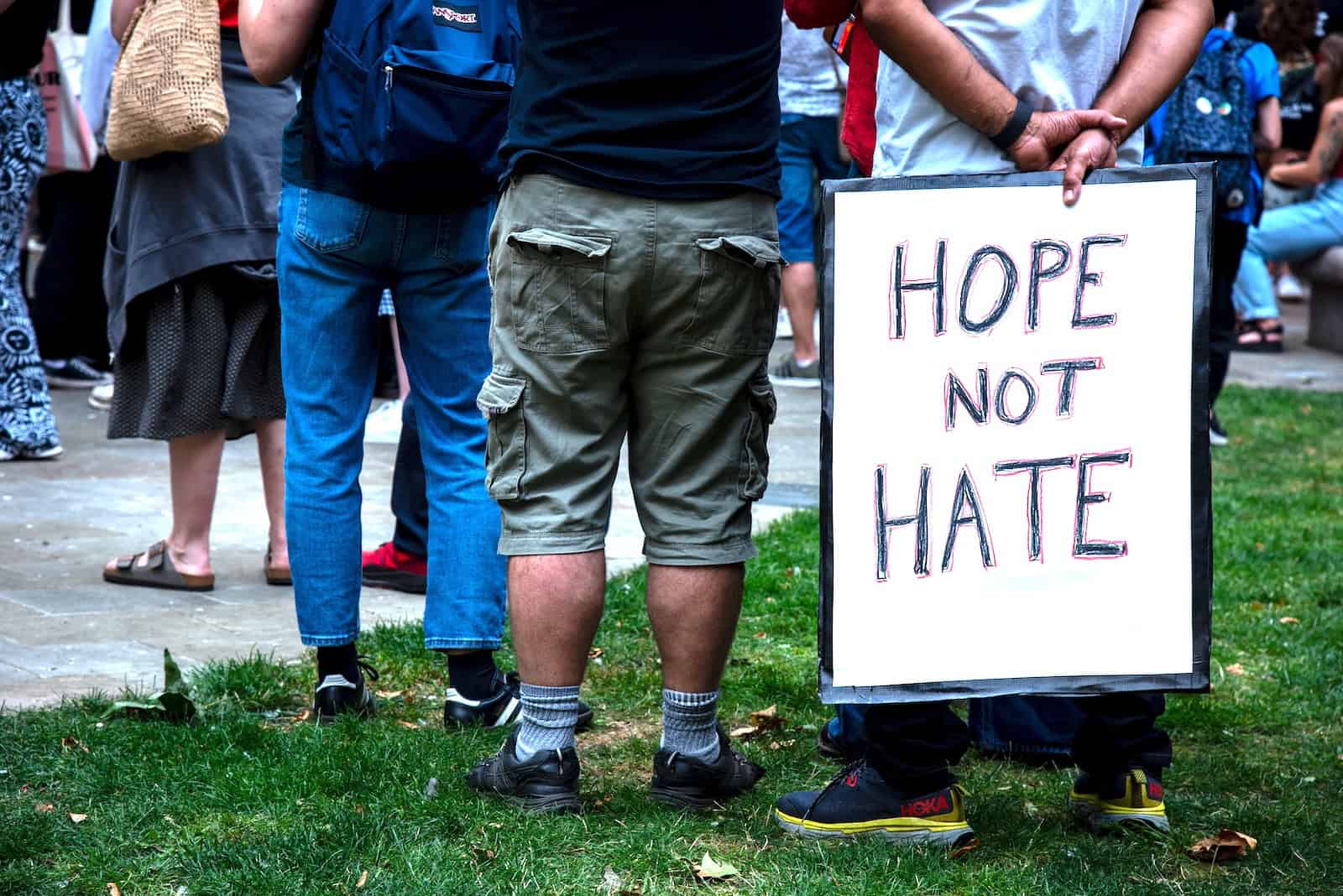
Tens of thousands of people gathered in central London on Saturday for a peaceful protest described as one of the largest ever demonstrations against the far right in the UK.

The march took place amid growing evidence of democratic backsliding under right-wing governments – as highlighted in a report published today by the Civil Liberties Union for Europe.

High-profile figures including actor Sir Lenny Henry, singer Paloma Faith and comedian Steve Coogan were among those taking part the march, which was organised by the Together Alliance – a coalition of more than 500 organisations campaigning for unity over division. 

Advertisement

Together Alliance said that more than half a million people took part in the march, although police estimates put the figure at nearer 50,000. The demonstration, it added, was in response to last September’s far-right ‘Unite the Kingdom’ march, which saw crowds of more than 100,000.

“We believe that the majority of British people stand against the hatred and division and racism that was being encouraged at that demonstration,” said Sabby Dhalu, joint secretary of the Together Alliance. “It’s time to act.” 

With anti-racism placards in hand, demonstrators marched from Park Lane to Trafalgar Square, via Whitehall. Along the way were performances by Self Esteem, Jessie Ware and UB40. Politicians also addressed crowds, among them Green Party leader Zack Polanski, Your Party leader Jeremy Corbyn and Diane Abbott, a former Labour MP now sitting as an independent.

People want a different vision of society – one which places dignity, compassion and human rights at its heart

One attendee, a member of the campaign group Cut the Ties to Fossil Fuels, came wearing the grim reaper costume, and said that he’d come as the oil industry. “Big oil are one of the major funders of Reform UK,” he told the Guardian. “We’re here to make that link that we need to cut the ties to fossil fuels.”

Advertisement

The Metropolitan Police said that two protesters were arrested on suspicion of criminal damage and causing a public nuisance after allegedly attempting to climb pillars near Trafalgar Square. Separately, 18 people were arrested at a demonstration outside Scotland Yard on suspicion of supporting Palestine Action. The UK government proscribed the pro-Palestine group as a terrorist organisation in 2025 – a move ruled as unlawful by the High Court in February. The government is appealing. 

The human rights group Amnesty International UK described Saturday’s march as a “historic demonstration”, adding that protesters were calling for “a different vision of society – one which places dignity, compassion and human rights at its heart”.

Main image: Shutterstock

Advertisement

Be part of the solution

At Positive News, we’re not chasing clicks or profits for media moguls – we’re here to serve you and have a positive social impact. We can’t do this unless enough people like you choose to support our journalism.

Give once from just £1, or join 1,800+ others who contribute an average of £3 or more per month. Together, we can build a healthier form of media – one that focuses on solutions, progress and possibilities, and empowers people to create positive change.

Support Positive News

Source link

Advertisement
Continue Reading
Click to comment

You must be logged in to post a comment Login

Leave a Reply

NewsBeat

Who is calling the shots in Iran?

Published

on

Who is calling the shots in Iran?

Following the last round of talks between the United States and Iran in Islamabad, Iran’s foreign minister and negotiator Abbas Araghchi declared in a post on X on April 17 that the Strait of Hormuz was “completely open”. This came after he also signalled that his government could be flexible over the issue of nuclear enrichment as well as Iran’s support for its proxies in the region.

Then came an abrupt correction. Mohammad Bagher Zolghadr, a former commander in the Islamic Revolutionary Guards Corps (IRGC) who was recently appointed as secretary of the Supreme National Security Council, is understood to have complained to the IRGC, submitting a report that criticised Araghchi for “deviation from the delegation’s mandate”.

The negotiating team was called back to Tehran. Araghchi was attacked by state-run media which said his post had “provided the best opportunity for Trump to go beyond reality, declare himself the winner of the war and celebrate victory.” And the Strait of Hormuz was declared closed.

This episode demonstrates the new reality in the Islamic Republic, where the IRGC increasingly calls the shots in all matters of statecraft and government. The rest of the state is a façade at most.

Advertisement

Over the six weeks of war, Iran’s former leadership has been decimated: the supreme leader, Ali Khamenei, was killed in a US strike on the first day of US and Israeli attacks. Many of his senior colleagues have also been killed. Iran is no longer best understood as a state with a powerful militia. It has become, more precisely, a powerful militia with a state – a political order with the IRGC at its core.

The other traditional centres of power – the government and the clergy – have effectively been relegated to mere front organisations. Amid the fog of war, even the new supreme leader, Mojtaba Khamenei, appears merely as a legitimising ornament. In any case, Khamenei is reported to have been severely injured in the attack that killed his father and is apparently taking no part in government.

So who is running the country? The answer points unmistakably to the IRGC and its leader, Ahmad Vahidi.

Guardians of the revolution

The IRGC was created after the 1979 revolution, precisely because Ayatollah Ruhollah Khomeini and his allies did not trust the conventional state apparatus to defend the revolution. Over time it grew beyond its role as guardians of the revolution into an all-encompassing, all-channel network. It became a military, an intelligence service, an economic conglomerate and a regional expeditionary network. Its internal security force, the Basij, gave it an arm of mass social control inside Iran. The Quds force was set up to export the revolution across Iran’s proxies in Lebanon, Iraq, Syria, Yemen and beyond.

Advertisement
Iran’s foreign minister, Abbas Araghchi, and parliamentary speaker, Mohammad Bagher Qalibaf, arriving in Pakistan for ceasefire negotiations with the US, April 11 2026.
Pakistan Ministry of Foreign Affairs via AP

Far from destroying this architecture, sanctions deepened it. They led to the creation of front companies linked to the IRGC doing illicit deals and operating circuits of patronage that enriched those closest to the centre of power. What emerged was a parallel state that gradually outgrew the formal one.

The IRGC is organised as a network with a core and a periphery. Its central hub decides strategy. This is surrounded by a network of decentralised cells capable of operating with a high degree of autonomy. This is called Iran’s “mosaic defence doctrine”. And it was built to operate precisely the way it is now: to keep fighting amid attempts at decapitation and disruption.

A new leader emerges

After IRGC chief Mohammad Pakpour was killed on the opening day of the conflict, Ahmad Vahidi, a former interior minister and a founding member of the IRGC, has emerged to take his place. After being appointed in an emergency capacity after his predecessor was killed, he has consolidated effective control as the civilian presidency has been hollowed out.

A poster in Tehran shows Iranian fighters holding a net over the Strait of Hormuz reading 'The Strait of Hormuz remains closed'
In central Tehran, a poster with the words: ‘The Strait of Hormuz remains closed’ spells out Iran’s uncompromising position.
EPA/Abedin Taherkenareh

With the new supreme leader apparently incapacitated and the clergy sidelined, Vahidi and his group of allies – IRGC commanders and security council hardliners such as Ali Akbar Ahmadian and Mohammad Bagher Zolghadr – have set the mandate and red lines for the ceasefire talks.

The IRGC’s red lines are clear: it will not surrender uranium enrichment altogether; it wants to preserve its missile program and the axis of resistance; it wants sanctions to lifted and access to Iranian assets overseas that are presently frozen. Room for negotiation only exists on technical details about enrichment levels, timelines for lifting sanctions or the language of any deals that are agreed.

Advertisement

In times of war, states tend to centralise as civilian institutions shrink. Hard men tend to rise, especially after many of the influential political pragmatists, such as Ali Larijani, the former secretary of the security council, were deliberately taken out by Israel.

The IRGC was not suddenly conjured by this war, but prepared by decades of institutional entrenchment, economic capture and delegated coercion. The IRGC’s military dictatorship in the making needed this war to consolidate its influence over competing nodes in the network – most importantly the clergy.

This has profound consequences for the negotiations. Instead of being straightforward bargaining between statesmen, Washington’s real estate moguls turned negotiators are speaking to Iranian counterparts who are on a short lead held by the IRGC. Progress in negotiations should not be judged by what Iran’s diplomats say in public, but by what the guard allows to be implemented in practice.

Trump and Israel’s failed decapitation strategy leaves a potent system in place that feels emboldened by the desperation in the White House to find a diplomatic off-ramp. To think that this war-hardened system of hardliners will capitulate is wishful thinking.

Advertisement

The past few days have made it clear that the IRGC is now a militia with a state using the civic and military institutions of the Islamic Republic as its outer skin. While there is room for negotiation to build a mutually acceptable deal, the US administration needs to be realistic about where the IRGC’s red lines are and what card it actually has to play against a resilient network with a very high threshold for pain.

Source link

Advertisement
Continue Reading

NewsBeat

Man died from ‘cocaine effects’ at Oakdale Golf Course

Published

on

Man died from 'cocaine effects' at Oakdale Golf Course

Donovan Tanaka Mkutchwa, 26, was found dead on Oakdale Golf Course in Harrogate on Thursday, January 29.

Coroner Mark Armitage gave Mr Mkutchwa’s cause of death as being from the effects of cocaine.

He told Northallerton Coroners’ Court that Mr Mkutchwa’s body was identified by a police officer on the scene.

The coroner adjourned the inquest to a later date after the brief hearing on Tuesday (April 21).

Advertisement

Mr Mkutchwa’s family has described him as a “deeply loved son, brother and friend whose life was complex but whose character and potential should not be forgotten”.

A family spokesperson previously told The Press the death of Mr Mkutchwa, who grew up in Harrogate and attended Harrogate Grammar School, has left an “unimaginable void” in the lives of his loved ones.

Donovan Tanaka Mkutchwa as a schoolboy (Image: Family)

Speaking after the hearing on Tuesday, the family spokesperson said they “acknowledged that [Mr Mkutchwa’s] death has been attributed to cocaine use”, but added: “As a family, we do not consider the current explanation to be complete or sufficiently supported by the known circumstances.

“There remain material gaps in the factual narrative that require careful and thorough examination.

Advertisement

“In particular, there is no clear or coherent account of how [Mr Mkutchwa] came to be at the golf course, nor how he could have ingested a substance in a quantity said to be fatal without any apparent intervention, incident, or witness account in what is understood to be a public setting.”

The family spokesperson said there were also “specific factual matters that remain unexplained” such as Mr Mkutchwa’s personal items, including his phone, jacket and head covering, not being accounted for.

‘We will continue to engage fully with the inquest,’ says family

They added that Mr Mkutchwa’s clothing was found to be “heavily soiled with mud” when his body was found and there were “visible blood spots present on his t-shirt”.

“These are material factors that, in our view, require proper forensic consideration and explanation within the evidential record,” the family spokesperson said.

Advertisement

“Taken together, these issues raise legitimate questions about the sequence of events leading up to his death and whether all relevant circumstances have been fully established.

“We therefore expect that the inquest process will rigorously examine all available evidence, including toxicology, forensic findings, timeline reconstruction, witness testimony, and any potential third-party involvement, to ensure that no line of inquiry is left unexplored.

“We will continue to engage fully with the inquest and reserve our position pending the outcome of a comprehensive and evidence-based investigation.

“Our focus remains on establishing a clear and complete account of what occurred in the period leading up to our son’s death.”

Advertisement

They urged anyone with information about his death to contact North Yorkshire Police quoting reference number 12260017377.

Mr Mkutchwa’s death followed him being released from a four year and 10-month jail sentence which he received in May 2024 after pleading guilty to four drug dealing charges. He was arrested after being stopped by police in Harrogate in May 2023, when he was already serving a suspended sentence for drugs offences.

Current guidelines in England state that offenders sentenced to four years or more are eligible for release halfway or 40 per cent of the way through their sentence. Some serious offenders are released at the two-thirds point, according to the Sentencing Council.

The family spokesperson said that while Mr Mkutchwa “did have a run-in with the law in recent years”, he had “taken responsibility and paid for those offences through the court system”.

Advertisement

They said the family believes Mr Mkutchwa “was in a period of reflection and was working toward reshaping and rebuilding his life” before his death.

“Like many young people, mistakes can happen,” they said of Mr Mkutchwa’s jail sentence. “But those mistakes do not define the whole of a person’s life. Donovan had faced the consequences and was looking toward turning things around and moving forward.”

  • The Samaritans say that whatever you’re going through, you can call them for free, at any time, from any phone, on 116 123.

Source link

Advertisement
Continue Reading

NewsBeat

Ready to take charge: three innovative types of energy storage

Published

on

Ready to take charge: three innovative types of energy storage

Energy storage is a crucial component of the UK’s power network, but these systems range radically in terms of scale and function. From mammoth molten salt-filled thermal storage units to systems that use liquid air, here’s the latest in storage tech

Renewable energy is all very well, but how do you keep the lights on when the sun doesn’t shine and the wind doesn’t blow? It’s a hackneyed complaint, but it contains a germ of truth.

As Nathan Ritson, technical manager at renewable energy supplier Good Energy, says, “With the good old British weather, you find you’re over-generating at certain times, and under-generating at others.” Solar and wind already account for over one-third of the UK’s electricity, and that proportion is growing rapidly. But their inherent intermittency is an ongoing issue.

Advertisement

A key part of the solution is to store surplus electricity. Batteries can play a vital role here, explains Ritson, both in the commercial and domestic space. Grid-scale battery storage is becoming increasingly common too, balancing supply and demand across the country.

The ability to store surplus electricity is becoming crucial, as more renewables come online. YoungNH

Advertisement

But batteries aren’t the only storage game in town. Here are three emerging technologies that may well play a valuable supporting role in keeping our lights on in the future.

Spinning into the future with flywheels 

Flywheels have been around for a while. Leonardo da Vinci conceptualised one. Three centuries later, Scottish engineer James Watt was using them to help his steam engines run smoothly. The basic principle is that a source of power – for example renewables – sends a rotor spinning, storing energy as motion that can later be released to generate electricity.

Independent energy consultant Eugene Bryce lists the flywheel’s advantages: it can last for decades, unlike batteries, which degrade much sooner; it’s super-efficient (up to 90%); and it can be charged and discharged very rapidly. The latter makes it ideal to deliver power as and when needed, which is precisely what today’s electricity grid requires.

Advertisement

Less ideal is the fact that its upfront costs are relatively high, and you’d need an awful lot of flywheels to store enough power to light a city. But in combination with batteries, says Bryce, they could prove useful indeed.

They’re starting to appear as storage devices across the globe; the world’s largest has just been connected to the grid in China’s Shanxi province. A cutting-edge example of the technology, the Dinglun Flywheel Energy Storage Power Station consists of 120 high-speed magnetic levitation (MAGLEV) flywheels, with a combined capacity of 30MW. That’s enough electricity to power around 10,000 UK homes.

A better way to power your home
Could you generate more of your own electricity with a bespoke solar system? Good Energy helps households move towards greater energy independence, lower bills, and less exposure to price spikes
Get a quote

Making power out of thin air 

Advertisement

Liquid air sounds like a contradiction in terms, but it could have a place in the energy storage landscape. Unlike the flywheel, this is a relatively new technology, first mooted seriously in the 1970s.

Essentially, it works like this: air is taken in and compressed to a very high pressure using surplus electricity. The pressurised air is then cooled, via a complex form of heat exchanger, until it reaches a liquid state. When energy is needed again, the liquid is pumped out as a gas and used to drive turbines to generate electricity – a little like steam does in a conventional power station.

As the demand for energy storage has grown, it’s spurred fresh interest in this method. Now the world’s first commercial-scale application is taking shape in Manchester, where liquid air specialists Highview Power are building a plant due to come online in 2027. It will make money by using electricity when it’s cheapest to create the storage solution, and then release the air to generate power when demand is high relative to available supply.

Energy storage specialist Shaylin Cetegen of the Massachusetts Institute of Technology told the BBC that, while the initial economics may seem challenging, liquid air “stands out as a particularly cost-effective option for large-scale storage”.

Advertisement

The ‘heatcube’ design uses renewable electricity to heat up tanks of salt when prices are low. Image: Kyoto Group

Some like it hot 

Advertisement

How can solar power produce electricity in the dead of night? It sounds like a riddle – and the answer is … salt.

Molten salt, to be precise. In Spain, Morocco and elsewhere, concentrated solar plants use vast arrays of mirrors to heat thermal oil to the point where it can produce steam to drive turbines and so generate electricity. Some plants focus the heat on special mixtures of salts, which can retain it for long periods of time – including overnight. When electricity is required, the hot molten salt is pumped to a steam generator, producing super heated steam to drive turbines.

Liquid air sounds like a contradiction in terms, but it could have a place in the energy storage landscape

But electricity isn’t the only type of energy that industry needs – heat is often essential, and there is growing interest in using salt to store it for industrial processes. One promising application comes courtesy of Norway’s Kyoto Group. Its ‘heatcube’ design uses renewable electricity to heat up tanks of salt when prices are low. The heat, in the form of steam, can then be used on-site – to sterilise goods as part of food production, for example.

It’s one of a range of innovations – using salt, sand or other mediums – that promise to revolutionise the way we generate and store heat for industry and, conceivably, domestic use, too. But it’s salt that is capturing a significant amount of attention. Storage expert Robert Barthorpe of the University of Sheffield told The Guardian: “[Molten salt] is a fantastic technology, offering high temperatures at industrial scale. [It’s] going to be an important part of the energy mix.

Advertisement

Illustration by Studio Ianus

Source link

Advertisement
Continue Reading

NewsBeat

Robbins defends actions in Mandelson case after being fired by Starmer

Published

on

Robbins defends actions in Mandelson case after being fired by Starmer

When Sir Olly took over in the Foreign Office on January 20, Lord Mandelson had already gone through the Cabinet Office’s “due diligence” process, approval had been given by the King, the US had agreed to him, he was already allowed in the building and was being granted access to “highly classified briefings” on a case-by-case basis – without his security clearance being confirmed.

Source link

Continue Reading

NewsBeat

No 10 considered giving Starmer aide Doyle diplomat job, sacked official says

Published

on

No 10 considered giving Starmer aide Doyle diplomat job, sacked official says

Responding to the Sunday Times report in December about Lord Doyle’s previous campaigning for Morton, after his peerage was announced, No 10 told the newspaper the pair’s past association was “thoroughly investigated, including through several interviews with Matthew Doyle, prior to his appointment”.

Source link

Continue Reading

NewsBeat

Girl, 12, dies in Mirassol after hair becomes stuck in pool drain at friend’s house

Published

on

Daily Record

Laura Pereira Camargo was rushed to hospital as paramedics believed she might have been submerged in the pool for five to 10 minutes

A 12-year-old girl has tragically passed away after she played with friends in a swimming pool. It is believed her hair was sucked into the pool’s drain, trapping her underwater for several minutes.

Laura Pereira Camargo from Brazil became stuck in the pool during the horrific incident at her pal’s house in Mirassol on Friday (17 April). Firefighters on the scene believe the schoolgirl may have been submerged for around five and 10 minutes before they managed to pull her from the pool.

Advertisement

The youngster was immediately given first aid at the scene. Laura was then rushed to an urgent care unit in cardiac arrest, but survived the ordeal as paramedics managed to revive her.

She was then transferred to a hospital in São José do Rio Preto in a critical condition before sustaining multiple organ failure and bacterial pneumonia.

After fighting for her life for two days, she sadly died on Sunday (19 April) evening. Her funeral and burial are due to take place in Mirassol today (Tuesday), as reported by NeedToKnow.

Advertisement

Police have recorded the case as an accidental death and are now reviewing the safety conditions of the outdoor pool.

Laura was the only child of a devoted family and the daughter and granddaughter of deacons at the Christian Congregation in Brazil.

A talented piano player, she had recently celebrated her parents’ 20th wedding anniversary with them.

Her father, Elias, previously described her as “our special gift from God” in a social media post.

Heartfelt tributes have poured in online.

One friend wrote: “May the Lord give you strength in this moment of sorrow. We are with you in this time of grief and will continue praying for you.”

Source link

Advertisement
Continue Reading

NewsBeat

Blue’s Duncan James: ‘I’m living with my mum at age 48 – there’s just one big problem’

Published

on

Blue's Duncan James: 'I'm living with my mum at age 48 - there's just one big problem'
Duncan James is on a mission to save the nation from badly chilled beer – as long as his mum doesn’t drink it first (Picture: Matt Crossick/Cover Media)

There are many positives to living with your mum the age of 48 – fun, advice, companionship.

But according to pop star Duncan James, there is one downside – she nicks all the beer from his fridge while he’s away on tour.

‘I went to the fridge to get my beer, and my mum was: “Oh, I’ve drunk them all. I had my friends over and we had the lot,”‘ Duncan says, laughing. ‘She did message me while I was away to tell me it was delicious. She said she couldn’t resist it.’

For Duncan, it is personal as he’s on a mission to save the nation from the dreaded warm beer.

Advertisement

As Blue return to the spotlight with their reunion tour, he has teamed up with Coors to launch the Coors Cold Coorus – a playful new music video celebrating one of life’s great moments: when your beer is finally cold enough to drink.

New research from Coors reveals only 16% of Brits put beers in the fridge for the right amount of chill time before guests arrive, while more than half (55%) end up accidentally freezing them.

Olly Murs Performs At The O2 Arena, London
Duncan lives with his mum Fiona after moving in during Covid (Picture: Joseph Okpako/WireImage)

Which is why Coors’ packaging helps drinkers out. Its iconic mountain graphic is printed using thermochromic ink, turning blue when the beer reaches peak cold.

‘There is nothing worse than warm beer. Coors cans turn the mountains blue when the beer is at peak chill, which is perfect for me as Duncan from Blue. But that also extends to the pub, as Coors glasses turn blue too when it’s the right temperature. It’s a brilliant feature,’ Duncan says.

‘Having travelled all over the world, I am very lucky to have sampled lots of beers. But you can’t beat a nice cold beer on a summer’s day for that perfect refreshing drink. Whether that’s for yourself – or your mum’s mates.’ 

Advertisement

Duncan moved in with mum Fiona during Covid because he had just sold his flat in London and she was alone. But after the pandemic passed, the two were having such a nice time together that he decided to buy a shared house for them both. 

The pop star has partnered with Coors to launch the Cold Coorus – a surprise new song and music video announcing the exact moment your beer reaches peak (Picture: Matt Crossick/Cover Media)

‘I didn’t want to leave my mum on her own, so we now have a big, beautiful townhouse in Surrey. I have my own floor, she has her own floor.

‘I am away with work and touring a lot of the time, and – yes – I know she drank my beer, but I did come home to bacon and eggs when I returned recently, so that was lovely,’ he adds.

Duncan has enjoyed the move from London to a more relaxed pace in the home counties. 

He has a large private garden and, when they moved in a year ago, he invited his neighbours around for a barbecue, served them cold beers and introduced them to his mum and bandmate Anthony Costa.

Advertisement

He recently returned from skiing in the Dolomites, Italy, where he thoroughly enjoyed cold beers up the mountain, and he is looking forward to a summer of beer gardens and festivals, including Live at Chelsea at the Royal Hospital Chelsea in June, where he is performing with Blue.

And Duncan has launched a new track in conjunction with Coors designed to help serve beer at the right temperature. Fans place their Coors in the fridge and DM “BLUE” to Coors on Instagram or Facebook.

DreamFest 2025
He’s better known for a different iconic Blue (Picture: Joseph Okpako/WireImage)

A few hours later, Duncan slides into their DMs with the Coors Cold Coorus – confirming the moment the famous Coors mountains have turned blue and their beer is ready.

‘It’s an anthem to let people know when their beer is chilled at the right temperature. It’s a fun nod back to the noughties, it’s a lovely catchy tune, and I’m enjoying being part of this important mission to make sure the nation’s beer is cold,’ Duncan says.

But while a beer is usually a celebratory ritual, it can also bring back more poignant memories.

Advertisement

When asked who he could share a beer with – alive or dead – Duncan thought carefully before naming his best friend Tara Palmer-Tomkinson, who passed away nine years ago at the age of 45.

‘I really miss her. She was such a huge part of my life. She was so much fun to be with and always there for a really good laugh.

‘I met her on CD:UK in 2001. She had just come out of the jungle on I’m a Celebrity… Get Me Out of Here!, and we were performing. I bumped into her backstage and we got on like a house on fire.

DreamFest 2025
Duncan wishes he could share a beer with his late friend Tara (Picture: Joseph Okpako/WireImage)

‘She shook my hand in a very formal fashion, but I could feel something in my palm. She’d written on a piece of paper in eyeliner: “Hi Duncan, here’s my phone number. Give me a call. Love, Tara.” I will never forget that. From that moment, we became the best of friends.

‘She had this wonderful energy and a naughty, impish sense of humour that I really related to. I just miss her so much and wish I could sit down and have a beer with her,’ he adds.

Advertisement

Duncan James partnered with Coors to launch the Cold Coorus – a surprise new song and music video announcing the exact moment your beer reaches peak chill.

Fans can message “BLUE” to Coors on Instagram or Facebook and receive the video when the mountains have turned blue and it’s ready to drink.

Got a story?

If you’ve got a celebrity story, video or pictures get in touch with the Metro.co.uk entertainment team by emailing us celebtips@metro.co.uk, calling 020 3615 2145 or by visiting our Submit Stuff page – we’d love to hear from you.

Advertisement

Source link

Continue Reading

NewsBeat

US and Iran signal new ceasefire talks in Islamabad as truce nears end

Published

on

US and Iran signal new ceasefire talks in Islamabad as truce nears end

ISLAMABAD (AP) — The United States and Iran have signaled they will hold a new round of ceasefire talks in Pakistan, two regional officials said Tuesday, as leaders on both sides warned they were prepared for more fighting if a fragile two-week truce expires without a deal.

Neither the U.S. nor Iran has publicly confirmed the timing of the talks in Islamabad, with Iranian state television denying any official was already in Pakistan’s capital.

Pakistan-led mediators received confirmation that the top negotiators, U.S. Vice President JD Vance and Iran’s parliament speaker Mohammad Bagher Qalibaf, will arrive in Islamabad early Wednesday to lead their teams in the talks, the regional officials told The Associated Press.

The officials spoke on condition of anonymity because they were not authorized to brief reporters.

Advertisement

A ceasefire that began April 8 was set to expire Wednesday.

Both sides remain dug in rhetorically. U.S. President Donald Trump has warned that “lots of bombs” will “start going off” if there’s no agreement before the ceasefire deadline, and Iran’s chief negotiator said that Tehran has “new cards on the battlefield” that haven’t yet been revealed.

The ceasefire seemed likely to be extended if talks resume. White House officials have said that Vance would lead the American delegation, but Iran hasn’t said who it might send. Iranian state television on Tuesday broadcast a message saying that “no delegation from Iran has visited Islamabad … so far.”

Iranian state TV long has been controlled by hard-liners within Iran’s theocracy. The on-screen alert likely reflects the ongoing internal debate within Iran’s theocracy as it weighs how to respond to the U.S. Navy’s seizure of an Iranian container ship over the weekend.

Advertisement

US says its forces board sanctioned oil tanker

On Tuesday, the U.S. said its forces boarded an oil tanker previously sanctioned for smuggling Iranian crude oil in Asia. The Pentagon said in a social media post that U.S. forces boarded the M/T Tifani “without incident.”

The U.S. military did not say where the vessel had been boarded, though ship-tracking data showed the Tifani in the Indian Ocean between Sri Lanka and Indonesia on Tuesday.

The statement added that “international waters are not a refuge for sanctioned vessels.”

The U.S. military on Sunday seized an Iranian cargo vessel, the first interception under blockade of Iranian ports. Iran’s joint military command called the armed boarding an act of piracy and a violation of the ceasefire.

Advertisement

Strait of Hormuz control key to negotiations

The U.S. imposed the blockade to pressure Tehran into ending its stranglehold on the Strait of Hormuz, a key shipping lane through which 20% of the world’s natural gas and crude oil transits in peacetime.

Iran’s grip on the strait has sent oil prices soaring. Brent crude, the international standard, was trading at close to $95 per barrel on Tuesday, up more than 30% from Feb. 28, the day that Israel and the U.S. attacked Iran to start the war.

Before the war began, the Strait of Hormuz had been fully open to international shipping. Trump has demanded that vessels again be allowed to transit unimpeded through the waterway.

European Union transportation ministers were meeting in Brussels on Tuesday to discuss how to protect consumers after the head of the International Energy Agency warned that Europe has “ maybe six weeks ” of jet fuel supplies remaining.

Advertisement

Over the weekend, Iran said that it had received new proposals from Washington, but also suggested that a wide gap remains between the sides. Issues that derailed the last round of negotiations included Iran’s nuclear enrichment program, its regional proxies and the strait.

Qalibaf on Tuesday accused the United States of wanting Iran to surrender. He said that, on the contrary, Iran has been preparing “to reveal new cards on the battlefield.”

“We do not accept negotiations under the shadow of threats,” he wrote in an X post.

Pakistan hopeful talks will proceed

Pakistani officials have expressed confidence that Iran will also send a delegation for more talks.

Advertisement

Pakistani Foreign Minister Ishaq Dar met with the ambassador from China, which is a key trading partner with Iran, while the Foreign Ministry in Beijing said the conflict was at a “critical stage of transition between war and peace.”

Security has been tightened across Pakistan’s capital, where authorities have deployed thousands of personnel and increased patrols along routes leading to the airport.

The arrangements appear stricter than those put in place during the first round of talks held in Islamabad on April 11 and 12, suggesting the possibility of high-level participation, if negotiations make progress, said Syed Mohammad Ali, an Islamabad-based security analyst.

Historic Israel-Lebanon talks also set to resume

Meanwhile, historic diplomatic talks between Israel and Lebanon were set to resume on Thursday in Washington, an Israeli, a Lebanese and a U.S. official said. All three spoke on condition of anonymity to discuss the behind-the-scenes negotiations.

Advertisement

The Israeli and Lebanese ambassadors met last week for the first direct diplomatic talks in decades. Israel says the talks are aimed at disarming Hezbollah and reaching a peace agreement with Lebanon.

A 10-day ceasefire began on Friday in Lebanon, where fighting between Israel and Iranian-backed Hezbollah militants broke out two days after the U.S. and Israel launched joint strikes on Iran to start the war. Fighting in Lebanon has killed more than 2,290 people.

Since the war started, at least 3,375 people have been killed in Iran, according to authorities. Additionally, 23 people have died in Israel and more than a dozen in Gulf Arab states. Fifteen Israeli soldiers in Lebanon and 13 U.S. service members throughout the region have been killed.

___

Advertisement

Magdy reported from Cairo and Gambrell from Dubai, United Arab Emirates. David Rising and Huizhong Wu in Bangkok; Sam McNeil in Brussels and Russ Bynum in Savannah, Georgia, contributed to this story.

Source link

Advertisement
Continue Reading

NewsBeat

Woman ‘terrified’ as man forced her into car and drove her to petrol station

Published

on

Wales Online

At the petrol station she was able to get help and the police arrived

A jealous thug assaulted his partner after she messaged her former husband about their child. He would obsessively check her phone and threatened to “cut the brakes” on her car.

Advertisement

Sean Hood, 42, of Newport, had been in a relationship with the victim for six months and she described him as “normal” at the beginning but he quickly became “toxic” in his behaviour. He would demand to see his partner’s mobile phone, made her delete male friends on Facebook and made threats against her.

A sentencing hearing at Cardiff Crown Court on Tuesday heard the defendant would frequently accuse his partner of infidelity and limited the amount of time she could spend on her phone. Make sure you never miss Wales’ biggest updates by getting our daily newsletter.

The victim said she used to go out with friends but this stopped during her relationship with Hood, who frequently threatened her.

Prosecutor Jac Brown said one occasion the defendant threatened to “cut the brakes” on the victim’s car and then mocked her for believing him.

Advertisement

On February 14, Hood was “angry” towards the victim and she attempted to de-escalate his behaviour. He left the property and the victim locked the door, but he tried to gain access and threatened her. She said she felt she had no choice but to let him back in and he threw a set of keys at a vase, causing it to smash.

On February 15, the victim was on her phone and placed it down the arm of the sofa. The defendant accused her of trying to hide the phone and demanded to inspect it.

He went upstairs and found messages between the victim and her ex-husband about their child. Hood became angry and accusatory and called the victim a liar. He threw her phone at her and hit her in the leg.

The defendant barged into the victim and caused her to hit her back against a board. Hood began to hit himself by punching his head and punched a door out of anger. He then threatened the victim, saying: “If you don’t get in the car I’ll drag you to it.”

Advertisement

The victim was terrified and anxious about what might happen to her, as the defendant drove her to a Tesco petrol station, telling her: “You’ll see exactly what I am like.”

When they got to the petrol station, the victim was able to get help from a member of staff as Hood repeatedly tried to phone her.

The police were then called and the defendant was arrested, and in his interview he accused the victim of fabricating the allegations. He then breached his bail conditions by attempting to contact her and turning up at her workplace.

Hood, of Broadmead Park, later pleaded guilty to controlling/coercive behaviour, assault by beating and damaging property. The court heard he has two previous convictions dating back more than 20 years.

Advertisement

In a victim personal statement read to the court the victim said: “I have been suffering as a result of the actions of Sean Hood and what he has put me through. In our relationship of just over six months I became disengaged and disassociated. I emotionally shut down. I have become isolated and stopped speaking to my friends because he didn’t like them.

“I feel like I am in fight or flight mode. He would constantly spam my phone with no caller ID. My confidence has been knocked massively. I feel I have become introverted. I used to be bubbly but I have become depressed and very anxious.

“I feel I am living with this trauma every day and I can’t see an end to it. I am suffering with panic attacks which make me feel drained and I feel hypersensitive to dangers.”

In mitigation, Kevin Seal said his client has already served the equivalent of a four-month sentence while on remand. The defence barrister said the defendant has lost his job and has been unable to see his children.

Advertisement

Sentencing, Recorder Greg Bull KC said: “Your behaviour was totally unacceptable and resulted in an assault.”

Hood was sentenced to an 18 month community order. The defendant was ordered to carry out 26 sessions of the Building Better Choices programme, a three-month GPS trail monitoring requirement, and 150 hours of unpaid work. He must also pay a £50 fine and was given a five-year restraining order to protect his victim.

Get daily breaking news updates on your phone by joining our WhatsApp community here. We occasionally treat members to special offers, promotions and ads from us and our partners. See our Privacy Notice.

Source link

Advertisement
Continue Reading

NewsBeat

Sexual predator pleaded guilty to attempted rape and burglary

Published

on

Sexual predator pleaded guilty to attempted rape and burglary

Andrew Pennington, 62, of High Street in Rawcliffe, near Goole, appeared at Hull Crown Court on Thursday (April 16).

He pleaded guilty to attempted rape, indecent assault, burglary and burglary with intent to steal – the majority of which relate to an incident in 1998.


Recommended reading:

Advertisement

Pennington had entered a woman’s home in Beverley on July 23, 1998, and jumped out and attacked her after she returned from work, Humberside Police said.

He tried to remove her clothing, threatening her with rape and violence, before he was disturbed by a lodger at the address who had also returned home.

A force spokesperson described how Pennington, who fled the scene, was initially pursued by the lodger who eventually lost sight of him.

At the time, an investigation was opened but due to forensic limitations, no suspect was identified.

Advertisement

But this changed when officers from Humberside Police’s Major Crime Review Team re-examined the case in September 2025.

Upon reviewing the case, the team discovered Pennington’s previous convictions – finding that in 2017, he had been convicted and sentenced for a rape which had occurred in 1988 in North Yorkshire.

Pennington’s DNA has also been identified at the scene of three domestic burglaries in Humberside from 1997.

A police spokesperson said: “He had been interviewed and admitted the burglaries and was later convicted.

Advertisement

“Detectives identified similarities in his pattern of offending which appeared to be sexually motivated.”

Following a review of the evidence, DNA was identified from samples recovered from clothing worn by the victim from the 1998 incident, which was a match to Pennington.

He was questioned by police in March and admitted to the attempted rape and burglary offence relating to the incident, along with a second burglary offence which occurred in 1997, in which he forced entry to a property and stole underwear, cash and photographs from inside.

Detective Constable Eleanor Henrickson who lead the investigation said: “Pennington is a sexual predator who broke into a woman’s home and attacked her, thinking only of his own sick sexual desires.

Advertisement

“Whilst prosecution was originally not an option due to a lack of evidence, I am pleased that justice will now be served.

“I hope this case sends a stark message to anyone that has ever committed an offence and thinks they have got away with it.

“We will keep searching and we will do everything in our power to hold you accountable for your crimes.

“Nobody should be made to feel unsafe in their own home and I want to praise the victim for her courage in coming forward and her patience over the years, I hope that today’s result gives her some sense of justice.

Advertisement

“I also want to encourage any victims of sexual offences, no matter how long ago they happened, to please come forward.

“We will listen and we will support you.”

Specialist support networks and organisations are there to speak to and advise survivors of any type of abuse confidentially.

You can also contact police via its non-emergency 101 line or via 999 in an emergency.

Advertisement

Source link

Continue Reading

Trending

Copyright © 2025