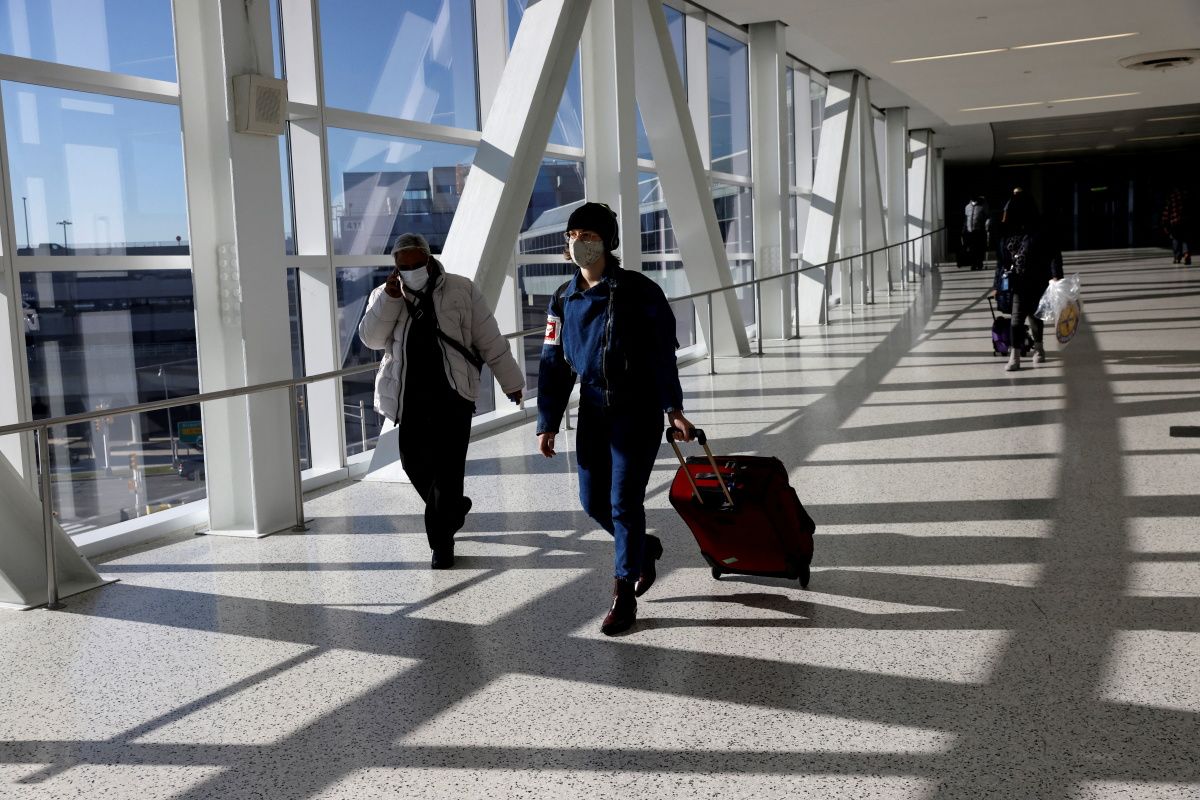
Travelers at John F. Kennedy International Airport (JFK) faced mixed TSA security wait times Tuesday, March 17, 2026, with some terminals seeing lines exceeding 30 minutes while others cleared in under 5 minutes. Real-time data from the official JFK Airport website showed significant variation across the airport’s terminals during peak spring break travel, compounded by lingering staffing pressures from the partial government shutdown now in its second month.
As of mid-morning EDT (late evening KST), general security lines stood at: Terminal 1 — 1 minute; Terminal 4 — exceeds 30 minutes; Terminal 5 — 20 minutes; Terminal 7 — 1 minute; Terminal 8 — 29 minutes. TSA PreCheck lanes offered faster access, with waits of no wait at Terminal 1, 7 minutes at Terminal 4, 10 minutes at Terminal 5, and 6 minutes at Terminal 8. Terminal 7 had no PreCheck listed. These figures update in real time on the airport’s site, reflecting checkpoint conditions over recent minutes.
The disparities highlight Terminal 4 and Terminal 8 as hotspots, often due to high international traffic and major carriers like Delta, JetBlue, and American Airlines operating there. Terminal 4, a key hub for international arrivals and departures, frequently sees longer lines from global passengers navigating additional screening protocols. In contrast, Terminals 1 and 7 — serving airlines like Aer Lingus and British Airways — moved quickly Tuesday.
The ongoing partial government shutdown has exacerbated delays at JFK and other major U.S. airports during the busy spring break season. Staffing shortages from unpaid TSA agents and call-outs have led to longer processing times, though JFK’s lines appeared more manageable Tuesday than earlier in the week. Reports from March 12-14 indicated waits up to 36 minutes at Terminal 4 and 33 minutes at Terminals 5 and 8, with PreCheck holding under 10 minutes. By March 17, some improvement occurred in non-peak terminals, but international-heavy checkpoints remained strained.
Average daily waits at JFK typically range 14-20 minutes for standard lines, climbing to 18-35 minutes during peaks like 6-9 a.m. and 4-7 p.m. Early mornings (5-8 a.m.) often see 24-minute averages due to business travel surges. Historical data suggests off-peak overnight hours dip below 15 minutes, but spring break crowds and shutdown effects push variability higher.
Advertisement
Passengers can monitor conditions via multiple sources. The JFK Airport website provides terminal-specific real-time updates, refreshed every few minutes, including PreCheck and estimated gate travel times post-security. The MyTSA app offers 15-minute interval estimates based on crowd-sourced and official data, though shutdown-related disruptions may affect accuracy. Third-party sites like Way.com and OnAirParking aggregate live feeds, reporting averages around 14-19 minutes recently.
To minimize delays, experts recommend arriving 2-3 hours early for domestic flights and 3+ hours for international, especially now. Enrolling in TSA PreCheck or CLEAR expedites screening: PreCheck allows kept-on shoes, laptops in bags, and shorter dedicated lanes, while CLEAR uses biometrics for front-of-line access. Programs remain operational despite earlier shutdown pauses. T4 Reserve at Terminal 4 lets passengers book free security slots in advance.
Additional tips include reviewing TSA guidelines on liquids (3-1-1 rule), avoiding prohibited items, and using mobile boarding passes. The airport advises checking flight status via airline apps, as security waits can compound with gate changes or delays.
JFK’s five active terminals handle over 60 million passengers annually, making efficient security crucial. While Tuesday’s data showed relief in some areas, the shutdown’s impact persists, with no immediate resolution in sight after recent failed Senate votes. Travelers should plan conservatively and use live tools for updates.
Advertisement
As spring break continues, JFK remains a high-volume hub where preparation pays off. Real-time monitoring and expedited programs offer the best defense against unpredictable lines.
C. Stephen Tusa – JPMorgan Chase & Co, Research Division
Presentation
C. Stephen Tusa JPMorgan Chase & Co, Research Division
Advertisement
All right. We’re moving along with Mark Okerstrom from CFO of Fortive. Thank you so much for joining us here in lovely Washington, D.C.
Mark Okerstrom Senior VP & CFO
Yes, thanks. Great to be here.
Advertisement
Question-and-Answer Session
C. Stephen Tusa JPMorgan Chase & Co, Research Division
Advertisement
Yes. Just wanted to start off with a basic kind of background on what’s happening out in the world today, I kind of have to ask the question about exposures and anything that’s going on in the world that is a concern or impact for Fortive. Middle East wise?
Mark Okerstrom Senior VP & CFO
Yes. Listen, I’d say we’re on track on the Fortive accelerated strategy, on track in terms of our strategic initiatives. The Middle East for us is a small portion of our revenue. It’s low single digits percentage of our revenue. We are seeing strong demand for products into the Middle East.
Advertisement
So Fluke Industrial Scientific that does gas sensors, again, seen strong demand, some challenges getting shipments into the Middle East. But again, generally, it’s a pretty small portion, and it’s — for better, for worse, it seems like it’s an opportunity as opposed to a risk for us.
C. Stephen Tusa JPMorgan Chase & Co, Research Division
And how are you guys putting the Middle East and what’s happening over there aside. How are things kind of trending over the course of the quarter, kind of quarter-to-date, point-of-sale trends, software sales, anything like that?
The National Audit Office has praised the Government for acting quickly on the at-risk steel maker
The British Steel steelworks in Scunthorpe(Image: PA Archive/PA Images)
The Government has been praised for quickly intervening to save the Scunthorpe steelworks when it was at risk of closure – but there is a warning that the £377m cost of the initial deal is set to rise.
A new report from the National Audit Office (NAO) said the deal to save the blast furnaces prevented job losses and the likely wider economic shock if primary steel making had stopped in the UK. But it warns that Ministers went into the deal with “without a clear exit strategy” and the rescue package could cost £1.5bn by 2028, with ongoing operations costing around £1.3m a day.
Jingye, the owner of British Steel, and the Department of Business and Trade (DBT) had been in talks around transitioning to electric arc furnaces between 2022 and 2025, but had not reached an agreement.
Last March, Jingye announced it was losing £700,000 a day due to challenging market conditions, tariffs, and high environmental costs, and was considering the closure of the blast furnaces. This would have led to a large number of job losses at Scunthorpe and affected customers in the supply chain, such as Network Rail, said the report.
Advertisement
As well as the £377m to keep British Steel operating, £15m was spent on advisers and £359 million to the company for operating activities such as paying for raw materials, payroll, and other costs.
Gareth Davies, head of the NAO, said: “DBT was able to act quickly to save British Steel’s Scunthorpe furnaces from closure, avoiding heavy job losses and serious impacts on major UK infrastructure and construction projects.
“However, the trade-off is the significant cost of maintaining operations, and uncertainty over how long this will continue. “DBT should learn from this experience to be better prepared for future interventions.”
Alasdair McDiarmid, assistant general secretary of the Community union said: “The Labour Government took decisive action to secure the blast furnaces at Scunthorpe, saving thousands of jobs in the process. Following years of neglect, Labour are investing to protect our steelmaking capabilities and to start rebuilding our strategically important industry.
Advertisement
“Should the Government have sat on its hands and allowed British Steel to collapse, the financial and social impacts would have been catastrophic. The Government made the right decision to invest now because local economies would have been decimated, our nation would have been less secure and we would have seen a massive and long-term increase to the welfare bill.”
The Nissan Murano is seen at the New York International Auto Show on April 16, 2025.
Danielle DeVries | CNBC
DETROIT — Nissan Motor plans to join fellow Japanese automakers Toyota Motor and Honda Motor in exporting U.S.-produced vehicles to Japan following changes to the country’s vehicle import rules reached through a trade deal last year by the Trump administration.
Advertisement
The company on Tuesday said it will import the midsize Nissan Murano, built in Smyrna, Tennessee, to Japan beginning early next year. It marks the first American-made Nissan sold in Japan since the 1990s, according to a Nissan spokeswoman.
“With the introduction of this model, Nissan aims to further strengthen its product lineup in Japan and meet the diverse needs of Japanese customers,” Nissan CEO Ivan Espinosa said in a statement.
Nissan is the latest Japanese automaker to announce such plans after changes to regulations meant automakers could more easily import vehicles from the U.S. to Japan. Those rules were put in place as part of a trade deal that also included easing U.S. tariffs enacted by President Donald Trump.
Under the new Japanese regulations that were confirmed last month, U.S.-made vehicles don’t have to meet the country’s vehicle certification as long as they comply with American standards.
Advertisement
Nissan confirmed plans to import the Murano from the U.S. with the steering wheel on the left-hand side of the vehicle, which is typical for Americans but not in the Japanese market.
Automakers typically have to tailor vehicles to meet safety and other regulations for different countries globally. They can range from things such as lighting and side mirrors to more complex parts such as the location of the steering wheel.
Toyota, Honda and Nissan stocks
Advertisement
Nissan’s decision follows Toyota announcing plans in December to begin exporting the Camry sedan, Highlander SUV and Tundra pickup from the U.S. to Japan beginning this year.
Honda — Japan’s second-largest automaker behind Toyota — earlier this month also announced plans to export the U.S.-built Acura Integra Type S and Honda Passport TrailSport Elite SUV to Japan beginning in the second half of this year.
While plans for such exports from the U.S. to Japan likely help with trade relations between the countries, the number of vehicles to be imported may not be meaningful, experts said.
About 95% of the Japanese market is made up of locally produced vehicles, leaving less than a quarter of a million units for imports from all around the world, and a majority of those are from Germany, according to Sam Fiorani, vice president of global vehicle forecasting for AutoForecast Solutions.
Advertisement
Vehicles sold under U.S. brands, including models built in other countries, are a small fraction of that group, including roughly 8,700 Jeeps and 500 Cadillacs, according to Fiorani.
Many of the vehicles planned to be imported to Japan also are considered big or not mainstream for Japanese consumers, according to Stephanie Brinley, a principal automotive analyst at S&P Global Mobility.
“These vehicles are still — with the exception of the Integra — are relatively large for Japan. I think they’re still going to be niche, low-volume products within that market,” she said. “But because they are a little bit different and a little bit bigger, they can position them as a special halo product in Japan.”
This week, the Federal Reserve is expected to hold rates steady for a second straight meeting, though markets will closely watch Fed Chair Jerome Powell’s remarks for cues on the path forward.
The international oil benchmark, Brent crude, remains above $100 a barrel, stoking inflation fears and dampening hopes for further rate cuts. In early trading, gold futures in New York were down 1% to $5,009.90 a troy ounce. Silver, meanwhile, was down 2.6% to $79.22 an ounce.
UBS Group AG (UBSS:CA) European Financials Conference 2026 March 17, 2026 10:00 AM EDT
Company Participants
Todd Tuckner – Group CFO & Member of Executive Board
Conference Call Participants
Advertisement
Giulia Miotto – Morgan Stanley, Research Division
Presentation
Giulia Miotto Morgan Stanley, Research Division
Advertisement
Right. Good afternoon, everyone. I’m pleased to be joined today by Todd Tuckner, UBS’ CFO. Thank you for being with us, Todd.
Question-and-Answer Session
Advertisement
Giulia Miotto Morgan Stanley, Research Division
And let’s start with the polling question. So what do you think will be the primary driver of share price performance for UBS in 2026? We have a few choices. So clarity on capital, which hopefully is a few weeks away, earnings upgrades, wealth management inflows, U.S. or Asia and new additional buyback in the second half or macro driven? A very clear skill, fantastic. We will get there shortly. Or shall we comment first given there is such a clear — so we’re — let’s start with capital. We are nearing the end of the too big to fail. At least in April, we should get some sort of proposal. So what can you tell us?
Todd Tuckner Group CFO & Member of Executive Board
Advertisement
Well, look, Giulia, first of all, thanks for having me, and hello, everyone. For sure, on the issue of capital reform, we have been advocating pretty consistently for outcomes that are internationally aligned, targeted specifically to the Credit Suisse issues and proportionate. And in fact, that was the tenants outlined by the Swiss government itself when it developed a framework for financial stability reform 2 years ago. Unfortunately, when the proposals were issued in June of last year, they were sort of none of the above. And as a result, they — if those proposals were adopted as currently worded, we believe it would make us a pronounced outlier versus peers in terms of the level of capital and equity
The Yorkshire firm said an acquisition made last year had boosted its performance
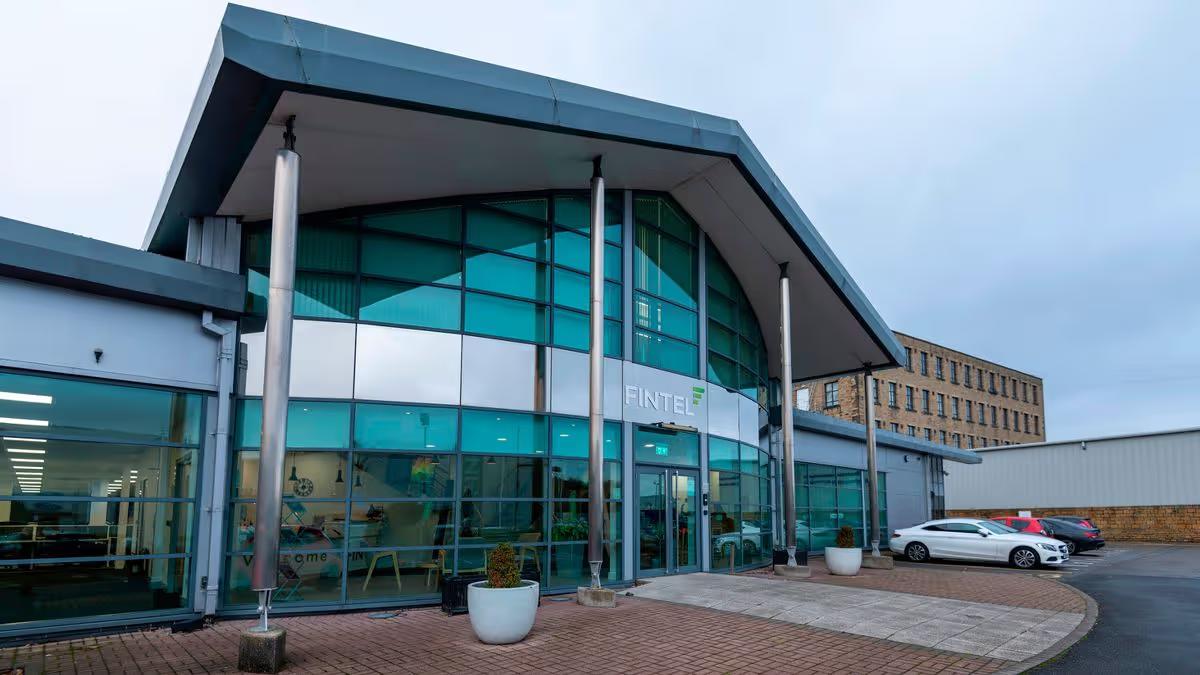
Fintel House, the firm’s Huddersfield headquarters.(Image: Supplied by Ally Bayne of MHP Group. Ally.Bayne@mhpgroup.com)
Financial services company Fintel has hailed a “defining” year after publishing accounts in which its turnover increased by almost 10%.
The Huddersfield firm has issued results for 2025 in which its revenues went from £78.3m to £85.9m. Operating profit also increased, to come in at £12.5m.
Fintel said that SaaS (software as a service) and subscription revenue had gone up 9.6% to £48.7m, and its EBITDA margin had increased to 30.1%. It highlighted the role played by the acquisition of Rayner Spencer Mills Research during the year, which contributed £3.4m of revenue and £1.1m of EBITDA to the results.
Fintel’s net debt rose during the year to stand at £31.1m, but it said it had a strong balance sheet with £17.3m of cash and £72.5m of available headroom within its credit facility, providing flexibility for further organic and inorganic investment.
Advertisement
CEO Matt Timmins said: “2025 has been a defining year for Fintel, creating a simpler, more unified and scalable platform that sets the foundation for the next phase of our growth. Technology, data and regulation continue to reshape the UK retail financial services market, and Fintel’s unique combination of market-leading software, enriched proprietary datasets and insights, and distribution platforms, places us at the centre of this transformation.
“Looking ahead, our ambition is clear: to build the most connected, insight rich and intelligent platform in the sector, enabling better decisions and better outcomes across the entire advice ecosystem.
“We have entered the new financial year with clear strategic momentum, high levels of recurring revenues and a stronger platform enabling opportunities for organic growth, underpinned by deep customer relationships. Fintel has made a strong start to FY26, with trading in line with the board’s expectations; the group is poised to accelerate its strategy to deliver long term value for advisers, partners and shareholders alike.”
The company is proposing to pay a final dividend of 2.5 pence per share, resulting in a full year dividend of 3.8 pence per share. That would be an increase of 4.1% on the previous year.
Uber Technologies Inc. (NYSE: UBER) shares surged more than 5% in midday trading Wednesday, March 18, 2026, building on momentum from recent announcements of major robotaxi collaborations and expanding autonomous vehicle ambitions that have investors betting on the ride-hailing giant’s future in driverless mobility.
The Uber logo is seen on the trading floor at the New York Stock Exchange (NYSE) in Manhattan, New York City
As of around 11:00 a.m. EDT, UBER traded at approximately $78.50, up $3.84 or 5.14% from Tuesday’s close of $74.66, according to real-time data from Yahoo Finance and other platforms. Volume approached 5 million shares in the opening hours, signaling strong interest amid broader market gains. Pre-market trading had already shown strength, with shares quoted as high as $76.28 before the bell.
The rally follows a series of high-profile developments in Uber’s autonomous strategy. Earlier this month, Uber announced partnerships to deploy robotaxis, including a deal with Amazon’s Zoox unit to integrate self-driving vehicles into the Uber app in select cities, starting with plans for Los Angeles and San Francisco by 2027. The collaboration, paired with Nvidia’s technology for scaling to 28 global cities, positions Uber as a leader in commercializing Level 4 autonomy without owning the fleet.
Additional announcements included robotaxi launches with Motional in Las Vegas, collaborations with Nissan and Wayve in Japan, and ongoing expansions in other markets. Analysts have described these as “deal after deal” moves that bolster Uber’s platform as the go-to marketplace for autonomous rides, potentially reducing driver costs and boosting margins long-term.
“Uber is doubling down on robotaxis with bold partnerships,” one analyst noted in a recent report. The moves come after a period of underperformance, with shares down about 12% over the prior three months amid concerns over Q1 2026 guidance and broader market pressures on growth stocks.
Advertisement
Despite the recent dip, Uber’s fundamentals remain solid. The company guided for first-quarter gross bookings growth of 17% to 21% year-over-year on a constant-currency basis, reflecting resilience in mobility and delivery segments. Uber continues to benefit from network effects, with increasing trip volumes and higher average bookings per trip.
Analyst sentiment leans strongly positive. Consensus ratings hover at Buy, with average price targets ranging from $103.81 to $107.64 across firms like Jefferies, Evercore ISI, Wedbush and others. Some targets reach as high as $150, while the low end sits at $70. Recent upgrades and reiterations emphasize Uber’s path to profitability through platform scale, acquisitions like Getir Türkiye, and autonomous upside.
The stock’s 52-week range spans roughly $60.63 to $101.99, with an all-time high of $100.10 reached in October 2025. Current levels place UBER below that peak but well above lows, supported by a market capitalization exceeding $150 billion.
Challenges persist, including regulatory scrutiny over pricing practices — with reports of U.S. probes into potential AI-driven surveillance pricing — and competition in delivery and mobility. Uber and peers like Lyft have faced questions about dynamic pricing algorithms, though no major resolutions have emerged.
Advertisement
Uber’s diversification into freight, advertising and other verticals adds revenue streams beyond core rides. The company’s focus on higher-margin opportunities, including Uber Eats enhancements and luxury services like “Uber Elite,” contributes to improving profitability metrics.
Market observers note that autonomous vehicle progress remains a key catalyst. Partnerships with established players like Zoox (Amazon), Motional, Nissan and Wayve reduce capital intensity for Uber while accelerating deployment. Nvidia’s involvement in compute and mapping further enhances scalability.
As trading continues March 18, attention turns to whether UBER can sustain gains toward recent highs or encounter resistance near $80. Broader tech sector performance and any fresh autonomous updates could influence direction.
Uber, founded in 2009 and public since 2019, has evolved from a ride-hailing disruptor to a multifaceted mobility platform. CEO Dara Khosrowshahi has emphasized becoming the “Amazon of transportation,” leveraging the app’s reach for diverse services.
Advertisement
With ongoing robotaxi momentum and analyst backing, UBER’s recent surge underscores investor confidence in its ability to navigate regulatory and competitive landscapes while capitalizing on emerging technologies.
Oliver Coppard wants the South Yorkshire People’s Network to bring together improved buses, trams and trains under one unified branding
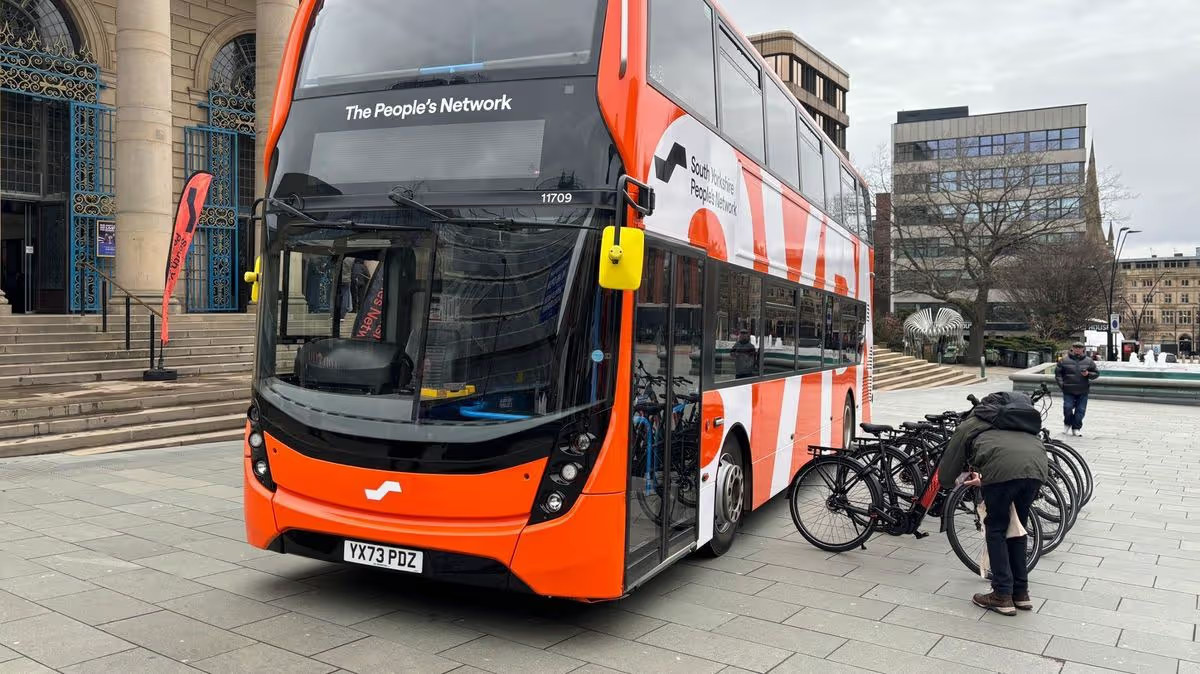
Launch of the South Yorkshire People’s Network(Image: Copyright Unknown)
South Yorkshire mayor Oliver Coppard has unveiled a “vision” for public transport in his area that would bring buses, trams and trains under his control with one unified branding.
Mr Coppard has described the South Yorkshire People’s Network as a ‘once-in-a-generation’ change, with potential schemes extending over the next two decades. They include opening a new tram train station at the Magma centre, bus franchising in Doncaster and Sheffield next year, a new e-bike subscription scheme and an extension of free bus travel for all under 18s from Barnsley to Sheffield.
But he stressed that the document is a ‘vision’ rather than a plan – with many of the schemes aspirations that current do not have funding attached – and highlighted hopes for the 2030s and 2040s, including more fast trains between Sheffield and Leeds, expansion of the area’s tram network, all rail stations in South Yorkshire becoming step free and improvements to the Penistone line.
Mr Coppard said the People’s Network – which has been inspired by the Bee Network in Greater Manchester – would be built around the principles of freedom and chose, prioritising people, affordability, safety, matching the area’s growth ambitions and being fit for the future. A unifying colour scheme of molten orange, grey and asphalt black aims to reflect the area’s industrial heritage.
Advertisement
Mr Coppard said: “Transport isn’t just about getting from A to B. A proper public transport network gives people real freedom and choice about how they travel and move, connects people to opportunity and opens up new horizons.
South Yorkshire mayor Oliver Coppard (Image: Copyright Unknown)
“But public transport in South Yorkshire has been broken for too long. I promised to make change happen, to give South Yorkshire back the world class public transport system we once had, and that’s exactly what we’re doing.
“That’s why we’re putting in a huge investment to fix our public transport system, backed by even greater ambition, so that we can build something that truly works for all of us across South Yorkshire; a real People’s Network.”
Information sessions are being planned in Sheffield, Rotherham, Barnsley and Doncaster this week to give local residents more information on the scheme.
Advertisement
Support for the vision has come from Jason Prince, director of the Urban Transport Group, Henri Murison, chief executive of the Northern Powerhouse Partnership, and former Sheffield MP Lord Blunkett, author of the White Rose transport plan.
Lord Blunkett said: “We have a real opportunity to transform the way people travel, improving connections to support economic growth and open up opportunities for individuals and businesses alike. A transport network that works for everyone is essential to the future of South Yorkshire, as it was in the past, and the vision is a vital step towards achieving this.”
The Relative Strength (RS) Rating for Enphase Energy (ENPH) stock entered a new percentile Tuesday, with an increase from 80 to 83. Looking For The Best Stocks To Buy And Watch? Start Here This unique rating measures market leadership by showing how a stock’s price movement over the last 52 weeks measures up against that of other stocks on…



















































You must be logged in to post a comment Login