Business
Jobs report shows wage gains outpace inflation in February data

National Economic Council Director Kevin Hassett lauds President Donald Trump’s State of the Union address on ‘Kudlow.’
The Labor Department’s latest jobs report showed that American workers’ wage gains are continuing to outpace stubbornly high inflation.
The Bureau of Labor Statistics released its jobs report for February Friday, which showed that workers’ average hourly earnings rose faster than expected last month.
Employees on private nonfarm payrolls saw their average hourly earnings rise by 15 cents, or 0.4%, on a monthly basis to $37.32 an hour. That outpaced the expected increase of 0.3% that was projected by LSEG economists.
Average earnings rose 3.8% in February compared with a year ago, up from 3.7% in January. LSEG economists estimated that the annual increase in earnings would be unchanged at 3.7% in February.
US ECONOMY SHED 92K JOBS IN FEBRUARY, WELL BELOW EXPECTATIONS

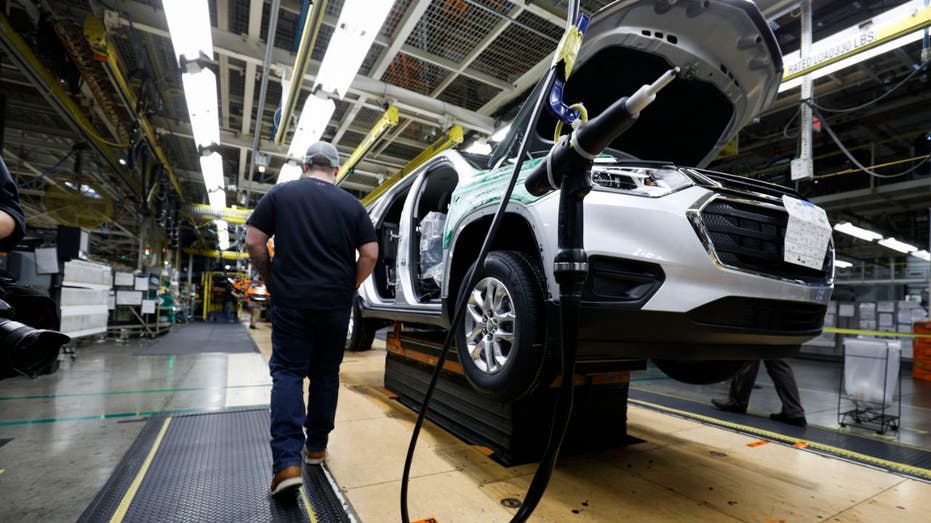
Wages rose 3.8% on an annual basis in February, beating economists’ expectations of a 3.7% rise. (Bill Pugliano/Getty Images)
The BLS data also showed that the average workweek was unchanged at 34.3 hours, in line with the estimate of LSEG economists and unchanged from January. Among workers in the manufacturing sector, the average workweek declined slightly by 0.1 hour to 40.1 hours, while overtime was unchanged at three hours.
The rising wages and relatively steady workweeks come as stubborn inflation has persisted above the Federal Reserve’s long-run target of 2%. The Fed’s preferred inflation gauge, the personal consumption expenditures (PCE) index, rose to 2.9% on an annual basis in December. Core PCE, which excludes volatile food and energy prices, was up 3% from a year ago in December.
A separate inflation gauge, the consumer price index (CPI), was up just 2.4% on a year-over-year basis in January and trended down after a 2.7% reading in December. Core CPI was up 2.5% from a year ago in January.
Inflation creates severe financial pressures for households, particularly those with lower incomes that are forced to pay relatively more for essentials.
FED’S FAVORED INFLATION GAUGE SHOWED CONSUMER PRICE GROWTH REMAINED ELEVATED IN DECEMBER
Wage gains rising faster than inflation helps protect earners’ purchasing power by reducing the amount that’s eroded by inflation-induced price hikes, though that dynamic is limited by elevated inflation.
They can also signal competition among employers for qualified workers. The unemployment rate was little changed in February, rising from 4.3% to 4.4% from the prior month.
“Jobs in the private sector, along with ongoing reductions in federal government staffing, led to lower payroll employment in February. But the unemployment rate remains low because of the southern border shutdown. That is why wage growth remains healthy with a 3.8% rise,” said Lawrence Yun, chief economist at the National Association of Realtors.
FED DISSENT GROWS AS SOME OFFICIALS WEIGH RETURN TO INTEREST RATE HIKES AMID STUBBORN INFLATION
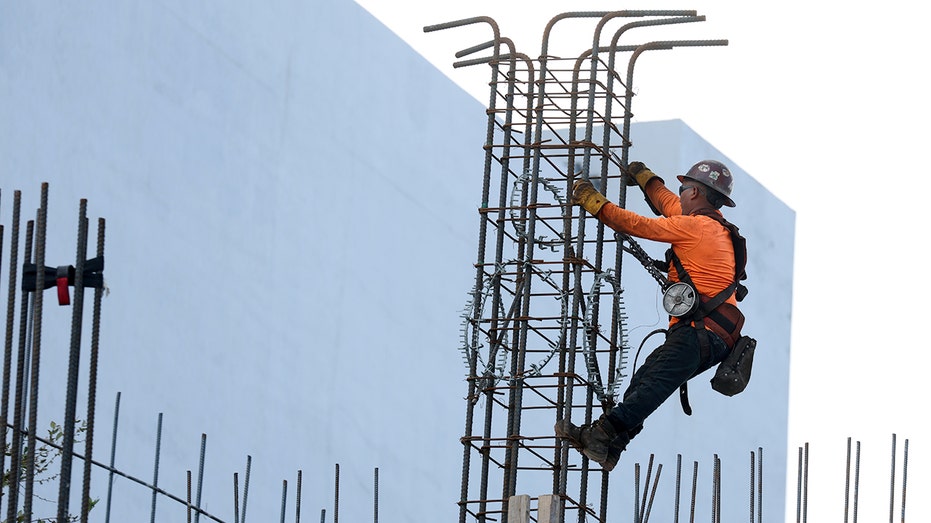
Pressure in the labor market has contributed to the higher wage growth. (Joe Raedle/Getty Images)
Andy Bregenzer, head of U.S. regional and small business banking and co-head of commercial bank at TD, said it was “disappointing to see January’s hiring momentum come into question with February’s slowdown” and emphasized that small businesses need to stay disciplined in this economic environment.
“What we continue to hear from small business owners is that while hiring pressure may ease modestly if jobs growth slows, wages and competition for skilled workers remain elevated. This is the environment where small business owners need to stay disciplined and balance growth plans with careful cost management.”
Gregory Daco, chief economist at EY-Parthenon, noted that wage dynamics were “firmer than expected” and said the 3.8% annual wage growth underscored that “labor cost pressures remain sticky even as job growth falters.”
GET FOX BUSINESS ON THE GO BY CLICKING HERE
He cautioned that “forward-looking indicators point to continued moderation in wage growth going forward, with the private sector quits rate remaining near its lowest level since early 2016 outside of a recession, and business surveys continue to signal restraint in compensation plans.”
Daco said that given the expectation of subdued labor demand, his firm’s outlook sees wage growth easing toward 3.5% in the second half of 2026.