
Business
Josh D’Amaro picked to succeed Bob Iger

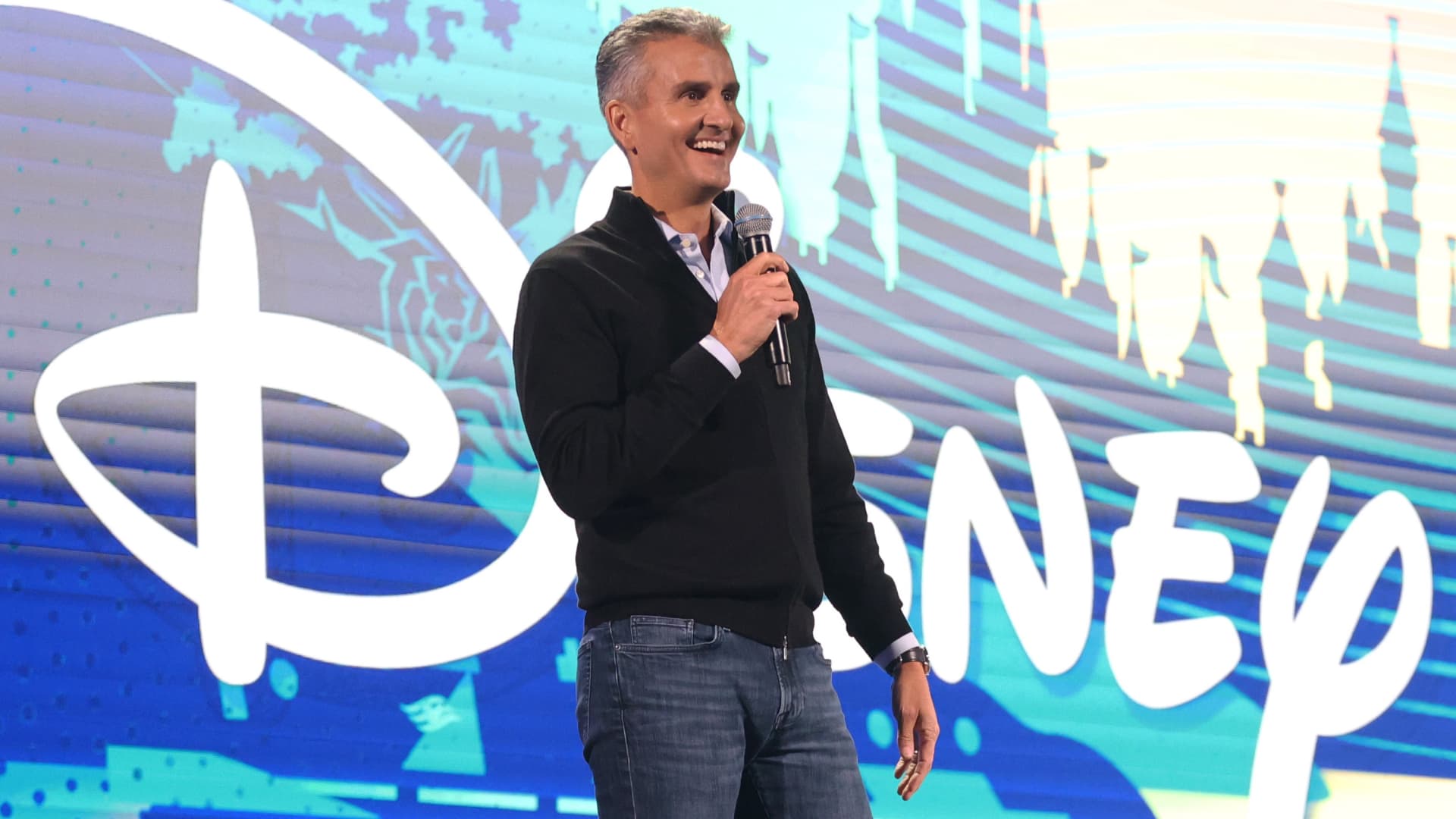

Disney has named Josh D’Amaro, chairman of Disney Experiences, as its next CEO, succeeding Bob Iger and clinching a closely watched succession race at the Mouse House.
Investors, industry insiders and onlookers have long awaited the announcement of who will take over as the next leader of one of the most storied U.S. companies. The appointment marks the second time in six years that Disney has selected a successor to Iger — his previous pick in parks boss Bob Chapek devolved into a public spectacle of corporate governance that saw Iger reclaim the CEO spot and restart the clock on retirement.
D’Amaro’s appointment will be effective as of March 18 at Disney’s annual meeting. Iger will serve as a senior advisor and Disney board member until he retires from the company on Dec. 31.
“Josh D’Amaro is an exceptional leader and the right person to become our next CEO,” Iger said in a statement. “He has an instinctive appreciation of the Disney brand, and a deep understanding of what resonates with our audiences, paired with the rigor and attention to detail required to deliver some of our most ambitious projects. His ability to combine creativity with operational excellence is exemplary and I am thrilled for Josh and the company.”
For the last several years, the Disney board — led by former Morgan Stanley CEO James Gorman — has been vetting candidates for the top job, primarily among Disney’s executive ranks. Iger’s four direct reports — D’Amaro, ESPN Chairman Jimmy Pitaro and Entertainment Co-Chairmen Dana Walden and Alan Bergman — all interviewed with the succession committee as early as 2024, CNBC previously reported.
Speculation narrowed to D’Amaro and Walden in recent months.
“We looked at all comers, we wanted whoever got this job to be the best person,” Gorman told CNBC’s Julia Boorstin Tuesday.
Walden, meanwhile, was named president and chief creative officer on Tuesday as part of the transition announcement. Also effective March 18, Walden is set to report directly to D’Amaro and focus on the storytelling and content engine of Disney.
Josh D’Amaro, Chairperson of Walt Disney Parks and Resorts, speaks during Day 2 of the D23 Brazil: A Disney Experience at Transamerica Expo Center on November 09, 2024 in Sao Paulo, Brazil.
Ricardo Moreira | Getty Images
D’Amaro steps into the role at Disney after a period of leadership uncertainty and mixed reception from Wall Street on the state of Disney’s business. On Monday Disney reported quarterly earnings and revenue that topped expectations — boosted by its theme parks and streaming — yet the stock lost 7%. Iger told investors he was confident in the changes made at Disney over the last three years and its path to future success.
In particular, the experiences unit that houses the theme parks, resorts and cruises, reported more than $10 billion in quarterly revenue during the period for the first time. The division’s growth has left it with plenty of room to run.
The company is planning to develop a new theme park and resort in Abu Dhabi — separate from its commitment to invest $60 billion in its theme parks over the next decade — and is looking to capitalize on its dominance of the box office in 2025. But front and center remains the state of the entertainment business, as Disney navigates the erosion of traditional TV and puts its efforts behind marquee content and fueling profitability in the streaming business.
It will be up to Iger’s successor to steer Disney into its next phase.
Following in Iger’s footsteps
Bob Iger, CEO of The Walt Disney Company, appears at the Disney Entertainment Showcase at D23: The Ultimate Disney Fan Event in Anaheim, California, Aug. 9, 2024.
Araya Doheny | Getty Images Entertainment | Getty Images
Leading a media and theme park conglomerate like Disney is no easy task. Neither is taking over for Iger.
The storied CEO has been at the helm of Disney for roughly 20 years, pieced together by two stints. Iger first served as Disney’s CEO for 15 years — following a career at Disney’s broadcast network, ABC, and then in leadership roles at the parent company — before first stepping down in 2020.
In one swift announcement, Disney announced that Chapek, who had most recently served as chairman of Disney Parks, would take over as CEO. Iger’s announcement had come earlier than expected, and his successor pick generally surprised the industry.
During Iger’s first tenure at the helm, he oversaw acquisitions and revitalized the company into a powerhouse. When he left in 2020, his list of accomplishments was lengthy and included the recently launched streaming service Disney+, which initially amassed subscribers at a quick rate.
However, the handoff to Chapek was mired in drama and overshadowed by the Covid pandemic, which spurred stay-at-home orders that closed movie theaters and theme parks, although it was a boon to streaming.
Disney’s stock had soared early during the pandemic as its streaming subscriber numbers rose. But by late 2021, under Chapek, Disney’s share price began to fall as the company reported earnings misses and slower streaming growth compared with Wall Street expectations.
In late 2022, as criticism of Chapek’s management of Disney mounted, Iger reclaimed the top job. The announcement propelled the company’s stock, even as Iger’s agenda would include a restructuring of the company he’d left behind less than two years earlier.
In his second stint as CEO, Iger focused less on acquisitions and more on a massive restructuring that put into place $5.5 billion of cost cuts, enacted layoffs and created three main divisions of the company: Disney Entertainment; ESPN and Sports; and Parks, Experiences and Products.
“I’m incredibly proud of all that we’ve accomplished over the past three years to set Disney on the path to continued growth. I’m inspired and energized by the opportunities ahead for this wonderful company,” Iger told investors on Monday.
Iger also fended off an activist campaign, steered the TV and streaming business to profitability, returned Disney back to the top of the box office and announced a sweeping investment in its theme parks, arguably its most ironclad business.
Finding the next Bob
Disney CEO Bob Iger gives a thumbs-up on the court before a game between the LA Clippers and the Phoenix Suns at Intuit Dome in Inglewood, California, Oct. 24, 2025.
Jordan Teller/isi Photos | Isi Photos | Getty Images
While Iger worked to get the business back on track, the question of succession once again loomed large.
Soon after returning as CEO, Iger told CNBC he had no intention of staying on longer than two years.
Like previous times in which Iger said he intended to step down, his tentative departure date got pushed down the road. By mid-2023 Disney extended Iger’s deal by two years and said it would name a successor by early 2026.
The CEO said as part of his contract extension he wanted to “ensure Disney is strongly positioned” for the next person to take on the role.
“The importance of the succession process cannot be overstated,” Iger said in the statement at the time.
— CNBC’s Julia Boorstin contributed to this report.


Sends reported Q1 2026 updates sharing news on digital cards, app redesign, ClearBank integration, and fintech industry recognition.
Sends, a fintech platform operated by Smartflow Payments Limited, announces its business updates for the first quarter of 2026, marked by steady product development, infrastructure improvements, and active participation in the fintech community.
During the first quarter, Sends introduced customisable digital cards for personal accounts available in Apple Wallet and Google Wallet. Giving customers more flexibility and control over their experience with Sends is one of teams priority. At the same time, Sends continued to expand its product roadmap, with corporate digital and physical cards currently in development and expected to be launched soon, strengthening the offering for business clients.
Another important milestone for the quarter is the redesign of the Sends mobile application. The updated app includes new features, improved navigation, and an improved overall user experience. The new version is scheduled to be available for download starting 20 April 2026, representing a significant step forward in the platform’s usability and functionality.
Sends has also made progress on the infrastructure side through its integration with ClearBank to improve account opening services. This integration supports faster onboarding processes and provides reliable service delivery.
Beyond product and technical developments, Sends remained actively engaged in the fintech community. The company participated in Pay360, where it hosted a stand and presented its solutions to industry peers and partners. CEO Alona Shevtsova also spoke at the event, sharing insights on current trends and the future of digital payments.
In addition, Sends CEO, Alona Shevtsova, was recognised in the Women in FinTech Powerlist by Innovate Finance, highlighting her contribution to the industry and leadership within the fintech space.
Commenting on the results, Alona Shevtsova, CEO of Sends, said: “This quarter has been focused on building and improving — from launching new features for our customers to strengthening our infrastructure and engaging with the industry. We are continuing to move forward step by step, with a clear focus on delivering practical and reliable financial solutions.”
As Sends enters the next quarter, the company will continue working on expanding its product range, including the upcoming launch of corporate cards, and further enhancing its platform.
Sends is a trade name of SMARTFLOW PAYMENTS LIMITED, registered in England and Wales (Company No.11070048). For more information, visit sends.co.


With over three years of finance and consulting experience, Nikola is laser focused on finding value in North American public equities and ETF’s. His professional experience includes corporate credit risk analysis, consulting for government entities, and venture capital analysis in the med-tech space. More recently, Nikola has helped investors narrow down better options for ETF’s – every asset manager seems to have similar offerings these days. Nikola is not a licensed financial advisor and nothing in his commentary here on Seeking Alpha should be regarded as advice. All of his opinions are his own, and not on behalf of any other entities.
Analyst’s Disclosure: I/we have no stock, option or similar derivative position in any of the companies mentioned, and no plans to initiate any such positions within the next 72 hours. I wrote this article myself, and it expresses my own opinions. I am not receiving compensation for it (other than from Seeking Alpha). I have no business relationship with any company whose stock is mentioned in this article.
Seeking Alpha’s Disclosure: Past performance is no guarantee of future results. No recommendation or advice is being given as to whether any investment is suitable for a particular investor. Any views or opinions expressed above may not reflect those of Seeking Alpha as a whole. Seeking Alpha is not a licensed securities dealer, broker or US investment adviser or investment bank. Our analysts are third party authors that include both professional investors and individual investors who may not be licensed or certified by any institute or regulatory body.

TD Cowen raises AerCap stock price target on strong sales activity
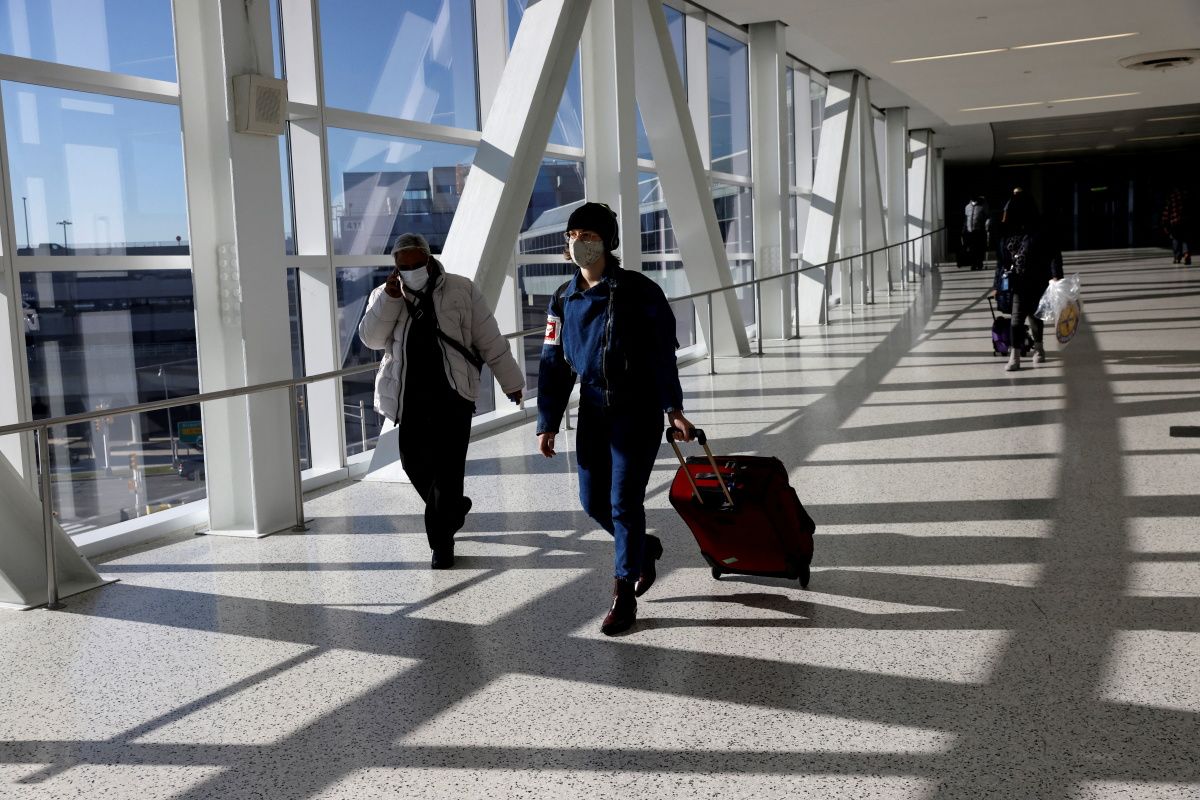
NEW YORK — Travelers at John F. Kennedy International Airport faced moderate security lines Monday as TSA wait times ranged from as little as 1 minute to around 24 minutes depending on the terminal, according to real-time data from the airport’s official website and monitoring services.
As of mid-morning on April 13, 2026, general security lines showed the shortest waits in Terminal 1 at approximately 1 minute and Terminal 7 at 5 minutes. Terminal 4 reported around 12 minutes for standard lanes, while Terminal 5 stood at 13 minutes and Terminal 8 reached 24 minutes — the longest among active checkpoints. TSA PreCheck lanes moved significantly faster, often under 10 minutes or with no wait reported in several terminals.
Airport officials noted that posted times represent estimates and can change rapidly based on passenger volume and TSA staffing levels. The technology used for these figures is most accurate when lines remain within designated queue areas, and staff actively monitor extensions beyond checkpoints to provide updated information.
JFK, one of the nation’s busiest gateways handling millions of passengers annually, typically sees average security waits of 15 to 35 minutes on regular days. Peak periods — generally 5-9 a.m. and 3-7 p.m. — can push general lines toward 30-45 minutes or longer during high-traffic surges, while off-peak hours like early morning before 7 a.m. or late evening after 8 p.m. often drop to 10-15 minutes.
Monday’s moderate conditions align with typical post-weekend patterns, though international flights concentrated in Terminal 4 and domestic-heavy Terminal 5 can create uneven distribution. Delta Air Lines, JetBlue, American Airlines and other carriers operating out of JFK advise passengers to arrive at least two to three hours before international departures and 90 minutes to two hours for domestic flights to account for potential variability.
TSA PreCheck and CLEAR services continue to offer substantial time savings for enrolled travelers. PreCheck lanes frequently clear in 1-9 minutes, making membership particularly valuable during busier periods. CLEAR, which uses biometric screening to expedite the initial identification step, pairs well with PreCheck for even smoother experiences at participating checkpoints.
Travelers without expedited options should prepare for standard screening protocols, including the 3-1-1 liquids rule, removal of laptops and large electronics, and potential additional checks. TSA staffing shortages have occasionally contributed to fluctuating lines in recent months, though airport and federal officials report ongoing efforts to maintain efficient throughput.
Social media and passenger reports on platforms like Reddit and Instagram reflect mixed experiences. Some early-morning travelers Monday praised quick passages through Terminal 4 and 1, while others in Terminal 8 noted longer queues during mid-morning hours. Occasional complaints of lines exceeding posted estimates highlight the importance of checking multiple sources before heading to the airport.
The MyTSA mobile app from the Transportation Security Administration provides additional real-time crowd-sourced data and general airport delay information. Passengers can also monitor the official JFK website, which updates security wait times regularly throughout the day. Third-party trackers like takeofftimer.com and airlineairport.com offer supplementary estimates, though official airport figures remain the most authoritative.
JFK’s five terminals each operate independent security checkpoints, meaning wait times can differ dramatically depending on departure location. Terminal 4, a major international hub for Delta and others, often sees higher volumes but benefits from multiple lanes. Terminal 8, used primarily by American Airlines, has shown longer waits at times due to concentrated domestic and some international traffic.
Beyond security, travelers should factor in additional time for check-in, baggage drop, customs and border protection for international flights, and ground transportation to the airport. Traffic on major routes like the Van Wyck Expressway and Belt Parkway can add significant delays, especially during weekday rush hours. Ride-share services, taxis and the AirTrain provide options, but planning ahead is essential.
Airport authorities recommend downloading the JFK app or visiting jfkairport.com for the latest updates on security, gates, parking and other services. Real-time flight status information helps passengers adjust arrival times based on any delays.
For frequent flyers, enrolling in TSA PreCheck or Global Entry can dramatically reduce stress and time at security. These programs use pre-screening and biometrics to expedite the process, with many users reporting near-instant clearance even on busier days.
Monday’s relatively manageable lines come amid a busy spring travel season, with spring break crowds largely passed but summer vacation planning underway. International travel continues to rebound strongly, adding pressure to terminals handling overseas flights.
TSA emphasizes that wait times are estimates and encourages patience and compliance with screening procedures to keep lines moving efficiently. Prohibited items or secondary screenings can create temporary backups, though most passengers clear without issue when prepared.
As the day progresses, afternoon and evening rushes may increase volumes, particularly if multiple wide-body international departures align. Travelers departing later Monday or early Tuesday should monitor updates closely.
JFK remains a vital economic engine for the New York region, supporting tourism, business travel and cargo operations. Efficient security processing plays a key role in maintaining its reputation as a world-class gateway despite occasional challenges from high passenger throughput.
Passengers with questions about specific terminals or needing accessibility assistance can contact airport customer service or airline representatives. Ground staff and TSA officers are positioned to help direct travelers and manage flow.
For those connecting through JFK or arriving from other flights, internal transit times between terminals via AirTrain or walking should also be considered when calculating overall airport time.
In summary, current TSA security wait times at JFK on April 13, 2026, remain within typical moderate ranges for a weekday, with most terminals under 25 minutes for general screening and under 10 minutes for PreCheck. Travelers are advised to check real-time sources, arrive with ample buffer time, and use expedited programs when possible to ensure a smooth experience.
Whether heading out on business, leisure or international adventures, staying informed about JFK’s dynamic security environment helps minimize stress in one of the world’s busiest airports.
Leerink reiterates Spyre stock rating on positive trial data

The Australian share market has fallen after Middle East peace talks broke down at the weekend and the United States said it would begin its own blockade of the Strait of Hormuz.
ALX Oncology names Jeff Knight as chief development officer

.webp?t=1743769456)
Sean Connolly will step down on June 1.

About 100 people missed their flights because of border control queues at Milan’s Linate airport.

UBS financial advisor Ryan Lynch and Laffer Tengler Investments CEO and CIO Nancy Tengler discuss the Meta and Google verdict and analyze oil markets on ‘Mornings with Maria.’
Meta is pushing back against a pair of verdicts that awarded plaintiffs hundreds of millions. The company has vowed to appeal the New Mexico and California rulings, and has already taken countermeasures against attorneys looking to recruit plaintiffs on the very social media platforms that they’re looking to fight.
In New Mexico, a jury found Meta liable for misleading customers about the safety of its platforms. The New Mexico Department of Justice celebrated the victory, which made the southwestern state the first in the country to score that kind of legal win. The jury in New Mexico ordered Meta to pay $5,000 per violation, totaling $375 million in civil penalties.
The California case was focused on a 20-year-old California woman, identified as K.G.M., who alleged the platforms fueled addictive use as a minor and contributed to her depression and suicidal thoughts through their engagement-driven design. In that instance, Meta was ordered to pay a total of $4.2 million.

Meta is pushing back against two landmark rulings on teens’ and children’s safety online. (SeventyFour/iStock/Getty Images / Getty Images)
“We think we have strong grounds on appeal on a number of counts,” Ethan Davis, VP and Head of Global Litigation Strategy at Meta, told Fox Business. “We think these cases threaten to erode fundamental principles of free speech. And so we are optimistic about our chances on appeal.”
Davis told Fox Business that Meta did not believe the cases should have been brought under Section 230, a part of the Communications Decency Act of 1996 that protects platforms from being liable for the content of posts. There have been debates about how Section 230 has been applied to social media platforms, particularly in the wake of the COVID-19 pandemic when some saw the censoring of posts as a reason to get rid of the protections for big tech companies.
“If you look at court decisions, they’ve recognized a number of times that you cannot hold a platform liable based on the content that’s on that platform or on that platform’s publishing decisions,” Davis said. “These cases are about the content that teens are seeing on the platforms and that falls squarely within what Section 230 is designed to apply to.”
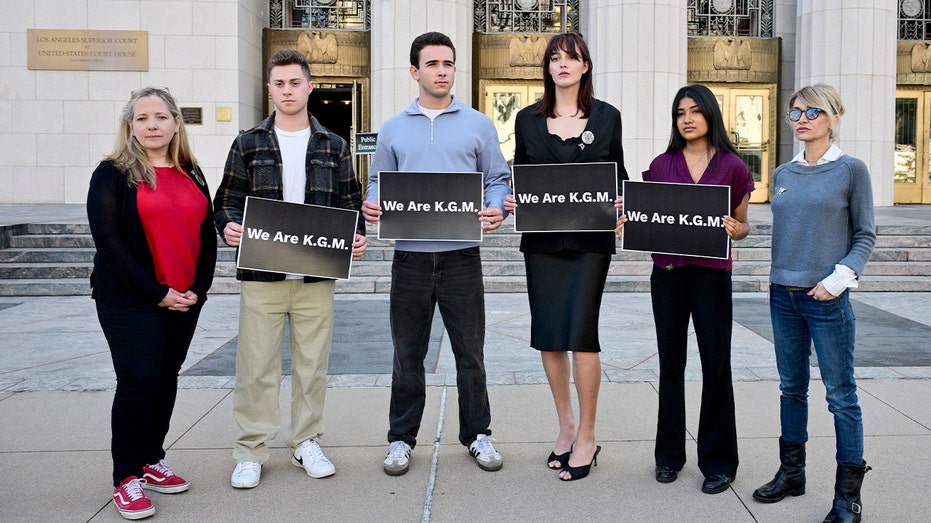
Supporters of “K.G.M.” pose with signs outside the Los Angeles Superior Court during a social media trial over whether platforms were deliberately designed to be addictive to children in Los Angeles, Feb. 25, 2026. (Frederic J. Brown/AFP Via Getty Images / Getty Images)
JILLIAN MICHAELS: BIG TECH BUILT A DIGITAL DRUG — AND OUR KIDS ARE HOOKED
Even as some attorneys argue that the social media platforms have caused harm, they have used those same tools to recruit clients. The ads have since been removed by Meta.
One removed ad read, “Anxiety. Depression. Withdrawal. Self-harm. These aren’t just teenage phases — they’re symptoms linked to social media addiction in children. Platforms knew this and kept targeting kids anyway,” according to Axios. The outlet noted that almost all the ads ran on both Facebook and Instagram, with some appearing in Threads and Messenger.
“It makes no sense to allow these plaintiff lawyers to use our platform to recruit plaintiffs to bring cases against us when the very crux of their complaint against us is that our platforms are harmful,” Davis said.

Meta plans to appeal court rulings on teen safety. (Jonathan Raa/NurPhoto via Getty Images / Getty Images)
CLICK HERE TO DOWNLOAD THE FOX NEWS APP
Meta has taken steps in the past to make its platforms safer for young users by creating teen accounts, which allow parents to have oversight of their children’s social media experience. Additionally, in February, Meta rolled out a new system that sends parents alerts if their teens repeatedly try to search for terms related to suicide and self-harm.
With Meta’s appeals looming, the cases could become a testing ground for the limits of Section 230 and whether social media companies can be held financially accountable for the effects their platforms have on younger users.

Sends shares Q1 2026 business update and product progress

Justin Sun wants World Liberty Financial to unmask its X admin

Cloud9, FlyQuest notch wins at LCS Spring


-

 Politics3 days ago
US brings back mandatory military draft registration
-

 Fashion3 days ago
Weekend Open Thread: Veronica Beard
-
 Sports3 days ago
Man United discover Nico Schlotterbeck transfer fee as defender reaches Dortmund agreement
-

 Tech6 days ago
How Long Can You Drive With Expired Registration? What Florida Law Says
-

 Politics23 hours ago
World Cup exit makes Italy enter crisis mode
-

 Crypto World4 days ago
Canary Capital Files SEC Registration for PEPE ETF
-

 Business3 days ago
Tesla Model Y Tops China Auto Sales in March 2026 With 39,827 Registrations, Beating Cheaper EVs and Gas Cars
-

 Crypto World5 days ago
Bitcoin recovers as US and Iran Agree a Ceasefire Deal
-

 Politics3 days ago
Malcolm In The Middle OG Turned Down ‘Buckets Of Money’ To Appear In Reboot
-

 Fashion6 days ago
Let’s Discuss: DEI in 2026
-
 NewsBeat15 hours ago
Pep Guardiola and Gary Neville agree over Arsenal title problem that benefits Man City
-

 Business3 days ago
OpenAI Halts Stargate UK Data Centre Project Over Energy Costs and Copyright Row
-

 Business2 days ago
Ireland Fuel Protests Enter Day 5 as Blockades Spark Shortages and Government Prepares Support Package
-

 Politics3 days ago
LBC Presenter Mocks Trump Over Iran War Failures
-

 Crypto World3 days ago
Federal judge blocks Arizona from bringing criminal charges against Kalshi
-

 Tech4 days ago
A version of Windows 10 released a decade ago is now eligible for additional security patches
-
 NewsBeat1 day ago
JD Vance announces ‘no agreement’ with Iran over nuclear weapons fear
-
 Entertainment5 days ago
Alfred Hitchcock’s 10 Most Suspenseful Masterpieces, Ranked
-

 Business3 days ago
IMF retains floor for precautionary balances at SDR 20 billion
-
Business3 days ago
Coreweave CSO Venturo sells $5.5m in class a common stock
You must be logged in to post a comment Login