

Business
Luigi Mangione seeks ‘extreme emotional disturbance’ defense in CEO killing case




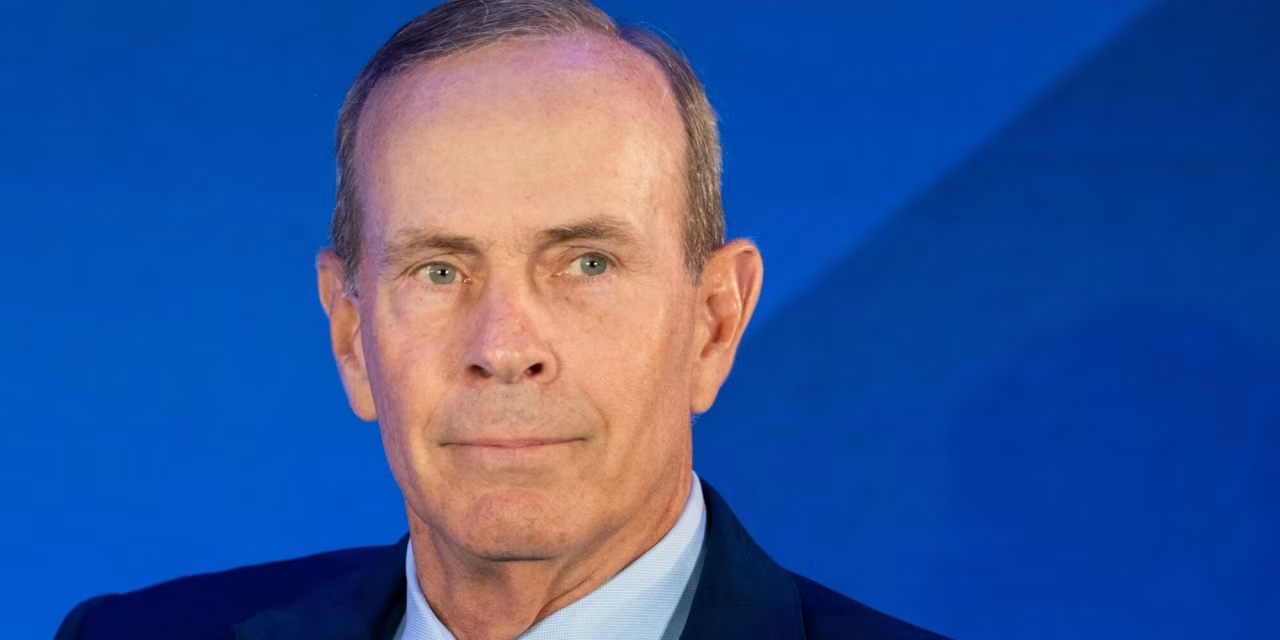
Chevron Chief Executive Mike Wirth spoke with Trump administration officials earlier this week about a pressing matter: how to keep the U.S. oil giant’s massive operations in Kazakhstan from becoming collateral damage in the Ukraine-Russia war.
A recent Ukrainian drone attack hit four tankers, including one chartered by Chevron, in the Black Sea near Novorossiysk. The Russian port is a key oil export hub and the termination point for a pipeline, partly owned by Chevron, that feeds 2% of the world’s daily oil supplies. Crude loadings have since been restricted at the pipeline, forcing Kazakhstan to curb oil production because it has limited storage capacity.
Copyright ©2026 Dow Jones & Company, Inc. All Rights Reserved. 87990cbe856818d5eddac44c7b1cdeb8

US, Japan join Philippines in South China Sea drills

Above The Noise: Look Beyond AI Pullback
Business
Royal Expert Says Meghan Markle Uneasy as King Charles Seeks to Mend Harry Rift Fully Behind Closed Doors

A royal historian says Meghan Markle remains uncomfortable with the terms on which King Charles III appears willing to repair his relationship with Prince Harry, even as the monarch’s recent private reunion with the Sussex family in Gloucestershire signaled the most significant step yet toward reconciliation in years.
A quiet reunion after four years apart
Harry, Meghan and their two children, Prince Archie and Princess Lilibet, met privately with King Charles and Queen Camilla on July 10 at Highgrove House, the king’s country residence in Gloucestershire, Buckingham Palace confirmed. The gathering marked the first time the whole family had come together since Queen Elizabeth II’s Platinum Jubilee celebrations in 2022, and the first time Charles had seen his grandchildren in person in more than four years.
The palace described the visit as strictly private and said no photographs would be released, a decision consistent with how the family has handled previous low-key meetings between Harry and his father. The reunion followed Harry’s earlier trip to Birmingham that week for an event marking the one-year countdown to the Invictus Games, the international sporting competition for wounded and ill service members that Harry founded. Notably absent from the Highgrove gathering were Prince William and Catherine, Princess of Wales, a detail that drew its own round of commentary from royal watchers given the strained relationship between the two brothers.
Buckingham Palace’s confirmation of the meeting came after a difficult stretch for Harry on another front: the High Court dismissed his long-running lawsuit against Associated Newspapers Limited, the publisher of the Daily Mail and Mail on Sunday, in the same week.
Expert says reconciliation is happening on Charles’ terms
Royal historian Marlene Koenig, speaking to the Mirror, said the circumstances surrounding the Highgrove meeting suggest the king is choosing to manage any reconciliation with his son carefully and privately, rather than through public statements or media appearances. Koenig pointed to the fact that Buckingham Palace and the royal household appeared to control the narrative around the visit, with no details leaking beforehand, as evidence of that approach. She also said Harry’s desire to reconnect with his home country runs deeper than any lingering tension with Meghan, telling the outlet, “It is inevitable that Harry would want to spend more time in his homeland.”
According to Koenig, Meghan has not shared that same enthusiasm for reintegrating with royal life and its expectations, a dynamic she said has shaped how the couple has approached visits to the UK since stepping back from royal duties in 2020. Koenig also drew a comparison to past royal marriages that broke down, including those of King Charles and Diana, Princess of Wales, and Prince Andrew and Sarah Ferguson, suggesting the family has become more attentive to giving younger royals time to build relationships before marriage as a result of those earlier experiences.
Security concerns shaped the visit
The path to the Highgrove reunion was not straightforward. Ahead of the meeting, it remained publicly unclear whether Meghan and the children would join Harry in the UK at all, given his previously stated hesitation about bringing his family to Britain over security concerns. Harry has been engaged in a long-running dispute with the British government over the level of publicly funded protection he receives during UK visits, a fight that included a failed legal appeal in 2025 challenging the government’s decision to reduce his security detail after he and Meghan relocated to California.
According to Britain’s PA news agency, the family ultimately flew in from an undisclosed location in Europe for the Friday gathering, with plans reportedly shifting in the days beforehand. The Sussex family was believed to be staying at Althorp House, the Northamptonshire estate where Harry’s mother, Princess Diana, grew up and is buried, according to the Mirror.
A cautious, incremental thaw
British broadcaster Helena Chard told Fox News Digital that the king’s willingness to see his grandchildren reflects his personal priorities amid ongoing health challenges. Charles has been undergoing treatment since being diagnosed with a form of cancer in February 2024. Chard said the king’s medical situation has shaped how he weighs family relationships, telling the outlet, “family matters more than ever” despite years of public estrangement between father and son.
Royal commentators have also pointed to the broader pattern of contact between Harry and his father in recent years as evidence that any reconciliation remains gradual and largely private. The Highgrove meeting followed an earlier, lower-profile encounter between Harry and Charles over tea at Clarence House the previous September, itself described at the time as their first in-person meeting in roughly a year and a half.
Neither Buckingham Palace nor representatives for the Sussexes have offered public detail beyond confirming that the Highgrove meeting took place, and both sides have generally avoided commenting further on the substance of the visit. Royal watchers say that reticence is likely intentional, part of an approach aimed at keeping any reconciliation out of the public eye rather than turning it into a media narrative.
Whether the Highgrove reunion marks the beginning of more frequent contact between the king and the Sussex family, or remains an isolated gesture tied to Harry’s UK travel for Invictus Games events, remains to be seen. For now, commentary from royal historians like Koenig suggests the relationship continues to be shaped less by grand public gestures and more by cautious, incremental steps taken largely behind closed doors — with Meghan’s own comfort level with that process still, by these accounts, an open question.

Sunday’s New York Times Connections puzzle offered a relatively gentle challenge, according to solvers and puzzle trackers, with one weather-themed category proving the biggest stumbling block for players working through today’s grid. Here’s a full breakdown of today’s puzzle, along with hints for anyone still working through it before checking the answers.
How Connections works
Connections, one of the Times’ most popular daily word games alongside Wordle, presents players with 16 words or short phrases that must be sorted into four hidden groups of four. Each group shares a connection — sometimes a straightforward category, other times a wordplay trick or shared cultural reference — and the puzzle rates each group by difficulty using color coding: yellow for the most straightforward group, followed by green, then blue, and finally purple for the trickiest and most conceptual connection. The game resets daily at midnight in each player’s local time zone.
Today’s category hints
For players who want a nudge before seeing the full solution, today’s puzzle broke down as follows. The yellow group centered on early childhood milestones — moments parents typically celebrate during a baby’s development. The green group involved once-common gadgets and formats that, while nostalgic, would no longer be considered cutting-edge technology today. The blue group gathered different expressions for rainy weather, ranging from familiar phrases to more old-fashioned or regional terms. The purple group, as usual the hardest of the four, hinged on multiple meanings of a single short word rather than a spelling trick, requiring players to think broadly about the many things that can be described as a “shell.”
Today’s Connections answers
With the hints out of the way, here is the complete solution to Sunday’s puzzle:
The yellow group — developmental milestones — consisted of CRAWLING, FIRST WORDS, ROLLING OVER and SOLID FOOD.
The green group — outdated or nostalgic technology — consisted of BLACKBERRY, DISCMAN, DVD PLAYER and PLASMA TV.
The blue group — ways to describe rain — consisted of APRIL SHOWERS, LIQUID SUNSHINE, SCOTCH MIST and WET WEATHER.
The purple group — things that can be called a “shell” — consisted of CARAPACE, GAS STATION, PASTRY CRUST and ROWING BOAT. The connection ties together a tortoise’s carapace, the Shell gas station brand, a pastry shell used in baking, and a rowing shell, the traditional term for a narrow racing boat.
A puzzle that rewarded pattern recognition
According to Forbes contributor Erik Kain, who tracks the puzzle’s daily difficulty rating through the Connections Bot scoring system, Sunday’s grid rated a 1 out of 5 on the difficulty scale, putting it among the easier puzzles the Times has published recently. Kain suggested solving the categories in the order yellow, green, blue and purple offered the smoothest path through the grid, noting the puzzle balanced simple verb-based groupings with trickier conceptual links that became clear only after ruling out the more obvious categories.
TechRadar’s Johnny Dee, who also covered the puzzle, said several of the entries caught him off guard before he worked out the connection, particularly the “shell” theme tying together unrelated-looking words. Describing his early confusion over one of the trickier entries, Dee wrote, “I thought CARAPACE was an Ecuadorian cyclist,” before realizing the word’s more literal meaning as a hard protective shell. He also noted that “liquid sunshine” struck him as an unusual way to describe rainy weather, despite it being one of several regional or colloquial synonyms grouped in the blue category.
Strategy for future puzzles
Puzzle trackers who cover Connections daily generally recommend a similar approach: start by identifying the group that feels most obvious, since locking in a confident answer early reduces the number of remaining words to sort through. From there, players are encouraged to look for structural patterns, such as words that could belong to multiple categories, before committing to their final guesses. Purple groups in particular tend to reward players who look past a word’s most literal or common meaning, since the Times frequently uses that slot for puzzles built around double meanings, wordplay or less obvious cultural references, as Sunday’s “shell” theme demonstrated.
A companion puzzle, Connections: Sports Edition
Sunday also brought a new installment of Connections: Sports Edition, a spinoff of the main puzzle launched by the Times for sports-focused solvers. According to Parade, puzzle number 671 organized its four groups around Ohio-based sports organizations, terms associated with boats, identifiers tied to America’s pastime — a common nickname for baseball — and hockey-related organizations. As with the standard Connections puzzle, the Sports Edition resets daily at midnight and uses the same yellow-green-blue-purple difficulty structure.
Part of a growing puzzle lineup
Connections has become one of several daily games the Times uses to drive its Games subscription business, alongside Wordle, Strands, the Mini Crossword and the newer Connections: Sports Edition. The core Connections puzzle debuted in 2023 and has since built a dedicated daily following, with solvers frequently sharing their results — without spoiling specific answers — using the game’s colored emoji grid, a format that mirrors the viral sharing behavior that helped make Wordle a cultural phenomenon in the years prior.
Players who want to track their performance over time, or who missed today’s puzzle and want to catch up, can access past Connections grids through a Times Games subscription, which also unlocks the full daily archive across the paper’s other word and logic puzzles.
For now, Sunday’s puzzle closes out as a comparatively easy one by recent standards, according to Forbes’ difficulty tracking, giving players a smoother path to a completed grid heading into the new week.

WisdomTree: Prospects Dimmed By Hormuz Crisis Reigniting

Robinhood HOOD Markets might have found another dance partner in the prediction-markets business.
The company is in talks with digital-currency exchange Crypto.com to expand the brokerage firm’s foothold in prediction markets, according to people familiar with the matter.
Copyright ©2026 Dow Jones & Company, Inc. All Rights Reserved. 87990cbe856818d5eddac44c7b1cdeb8

This Is When the Federal Debt Actually Matters

ORLANDO, Fla.—Minutes into the assignment, the teams lose a member. Management needs them for another project. Design a logo. Don’t use the color blue. Only senior associates can use scissors. Except all the senior associates are out sick. Make it an animal corresponding to a KPMG founder. Make sure the lion or owl is in business attire.
So went the training exercise for KPMG summer interns.
In a new program this summer, KPMG brought nearly 1,000 of its audit and assurance interns to the accounting firm’s sprawling $450 million training facility near the Orlando, Fla., airport for several days of training in critical thinking and judgment. The logo challenge was one of several exercises designed to use those skills, alongside a scavenger hunt and a whodunnit fraud exercise.
The purpose isn’t fun and games. Accounting jobs are among the most vulnerable to artificial-intelligence capabilities. KPMG estimates that, in two to three years, no humans will perform routine testing of things like payroll and revenue contracts.
Copyright ©2026 Dow Jones & Company, Inc. All Rights Reserved. 87990cbe856818d5eddac44c7b1cdeb8

“Primark isn’t as cheap any more.”
It is something I keep hearing shoppers say when I ask them whether they shop at the fast-fashion giant.
“It’s definitely got more expensive,” says 19-year-old student Eshal Malik as she browses the jewellery at Primark with a friend.
But that might be about to change. Primark said on Monday that it was lowering prices on hundreds of clothing items, including jeans, jumpers and socks.
“It’s the kind of headline you’d expect from M&S or Next,” says retail analyst Natalie Berg, explaining that price cuts like this from such a low-cost retailer are surprising.
“You don’t want to join a race to the bottom,” she says. “But when Shein is selling dresses for £3, you’ve got to respond, right?”
Primark, which has more than 190 UK stores, has been experiencing a drop in like-for-like sales, a key measure in the retail industry.
The announcement of price cuts comes ahead of parent company Associated British Foods’ plan to spin off the business onto the London stock market next year.
The level of competition among fashion retailers has “evolved dramatically” over the past few years, and Chinese online marketplaces Shein and Temu are now competing for Primark’s customers, says Berg.
But there is also competition from other online retailers like TikTok Shop and Vinted, she says.
By slashing prices on some core items, Primark is likely hoping to woo shoppers with low-cost staples, in the same way that supermarkets attract customers with cheap milk and bananas, Berg says.

Emotional Jonquel Jones wins all-star MVP, dedicates honoor to late aunt

Who Owns Fisher & Paykel Refrigerators And Where Are They Made?

XRP HOLDERS ARE ABOUT TO GET REWARDED – END OF YEAR PREDICTIONS VS LONG TERM PRICE POINTS!


-

 Fashion2 days ago
Weekend Open Thread: Brooks Brothers
-

 Politics7 days ago
Democrats look to World Cup watch parties to register thousands of voters
-

 News Videos7 days ago
Big Money Is Entering XRP
-

 Tech5 days ago
Sail Virtually Aboard The “Itanic” With IA-64 Emulator
-
 Tech5 days ago
Turtle Beach Command Series KB7 review: a nifty screen-equipped gaming keyboard
-

 Crypto World5 days ago
Grayscale Files For Worldcoin ETF, WLD Registers Sharp Rise
-

 NewsBeat6 days ago
Unregistered fitter used Gas Safe logo on business flyers
-
 Business4 days ago
New Jersey voter registration controversy explained: How 6,600 noncitizens got on the rolls, and what happens next
-
 Entertainment5 days ago
Johnny Depp’s R-Rated Gothic Cult Classic Gets New Release Ahead of Sydney Sweeney Remake
-

 Crypto World3 days ago
Ethics, other provisions in crypto Clarity Act to be further discussed
-

 Tech6 days ago
Watch Flock Safety CEO Garrett Langley discuss the future of surveillance at TechCrunch Disrupt 2026
-
 NewsBeat5 days ago
Shanghai science forum photos show China’s AI and robotics advances in rivalry with US
-

 Crypto World6 days ago
Circle’s President Sold Over 360,000 Shares, The Filings Explain Why
-

 Tech6 days ago
Subway Sandwich Computers Get a Second Life as Gaming Machines
-

 Sports2 days ago
2026 3M Open leaderboard: Scottie Scheffler finds putter in Round 1, sits three back
-

 News Videos3 days ago
The Peugeot Family: How 200 Years of an “Old Money” Dynasty Died in A Boardroom
-

 Fashion2 days ago
16 Dresses for the High Summer Event
-

 Tech7 days ago
How To Use Claude’s Reflect Dashboard And Learn When It’s Time To Touch Grass
-

 Tech6 days ago
The 35 Best Board Games for Family Game Night
-

 Entertainment6 days ago
Stephen Colbert Returns to Social Media After Late Show End
You must be logged in to post a comment Login