

Business
Lysol Maker Reckitt to Offload Sanctions-Hit Russian Hygiene Business


U.K. consumer goods company Reckitt Benckiser RKT said it agreed to divest of its hygiene arm in Russia, which has been dragging on sales due to changes to European Union sanctions on the country.
The maker of Durex condoms and Mucinex cold medicine said Friday that it was selling the Russian hygiene unit to Arnest Management. It didn’t disclose financial terms of the deal, but said the business represented around 1% of Reckitt’s net revenue in 2025.
Copyright ©2026 Dow Jones & Company, Inc. All Rights Reserved. 87990cbe856818d5eddac44c7b1cdeb8

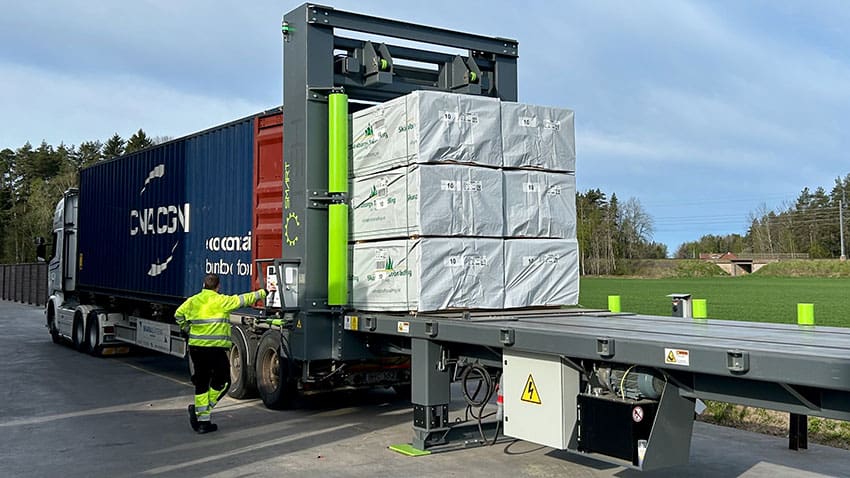
Businesses have spent years making their operations more efficient. Production lines are automated. Warehouse management systems track inventory in real time. Software optimizes routes and schedules. Robots move goods through distribution centers.
Yet in many facilities, one of the final steps in the process is still largely manual: getting goods into a truck or shipping container.
That may seem like a small part of the operation. But when the same process repeats dozens of times a day, loading can become a significant bottleneck – one that affects labor costs, vehicle utilization, safety, and how much a business can ultimately ship.
The weak link in the chain
A warehouse can process orders quickly, have goods ready for dispatch, and still struggle to increase throughput if vehicles cannot be loaded at the same pace.
Traditional loading depends on forklifts and manual handling. Products are moved into position, loaded individually or in batches, and arranged to make the best use of the available space. The process becomes even more challenging when cargo is heavy, long, awkward to handle, or has to be loaded into a container or trailer with limited access.
A few extra minutes per shipment may not seem like much – until they are multiplied across a day, a week, or a year.
Loading can determine how many vehicles a facility processes daily, regardless of how efficient the rest of the operation is.
The real cost of inefficient loading
The most obvious cost is the time employees spend loading. The costs that ripple outward from there tend to matter more.
A truck waiting at a dock is an underutilized asset – and so is the driver who isn’t out completing the next delivery, and the loading point that could be turning over another vehicle instead.
During busy periods, delays can create queues and disrupt delivery schedules. The cost can also appear as overtime, additional shifts, or pressure to invest in more loading infrastructure simply to handle demand that the existing facility may already have the physical capacity to serve. These costs move well beyond the warehouse and into the transport operation as a whole.
The cost is not only financial. Loading and unloading involve repetitive physical work, heavy products, and frequent forklift movement. As businesses face ongoing challenges recruiting and retaining warehouse workers, relying heavily on manual labor for physically demanding tasks becomes harder to sustain.
There are safety considerations too. Every additional manual handling step creates another opportunity for an incident or injury.
Automating loading rarely means removing people entirely – more often it means cutting the repetitive, physically demanding parts of the job. More consistent loading times also make the operation easier to plan, measure, and scale.
Different transport needs, different automation
There’s no single loading solution for every business. A company shipping large volumes internationally in containers has different requirements from a distribution center loading multiple trailers for domestic deliveries.
Cargo type, vehicle, facility layout, and required throughput all shape the right approach. For some businesses, automating container loading addresses a major export bottleneck. For others, the bigger opportunity is automating trailer loading.
Automating container loading for export operations
Container loading can be especially time-consuming when cargo has to be moved in piece by piece, often requiring repeated forklift trips into and out of the loading area.
An automated container loading system can change this by allowing cargo to be prepared on a loading platform and then moved into the container in one continuous movement, rather than requiring repeated manual handling.
This can significantly reduce loading time and the amount of manual work involved.
For businesses shipping timber, metal products, construction materials, and other heavy or bulky goods, the benefits extend beyond speed. Faster loading can reduce truck waiting times, free up the loading area for the next vehicle, and create a more efficient process for handling high volumes of cargo.
Automating truck loading for faster distribution
Road transport creates a different set of challenges. Distribution centers and manufacturing facilities may load several trailers every day, often within tight delivery windows. When the same manual process is repeated across dozens of vehicles, even small delays quickly become a capacity problem.
Automated truck loading systems can reduce the amount of manual intervention required to move cargo into a trailer, helping improve truck turnaround and increase the number of vehicles a facility can process using its existing infrastructure.
For high-volume businesses, faster loading does not just mean a truck leaves sooner. It improves utilization across loading docks, vehicles, drivers, and warehouse staff.
More capacity without a bigger facility
When businesses need more throughput, the obvious response is to expand: a larger warehouse, more loading docks, more employees, or more vehicles. All of that adds real capacity, but it also means more space and higher fixed costs – long before anyone checks whether the current facility is even running at full capacity.
Before committing to that kind of expansion, it’s worth asking how much more the current site – the same warehouse, docks, and vehicles – could handle if loading itself weren’t the constraint.
If a facility can reduce the time needed to load each vehicle, it may be able to process more shipments during the same working day without expanding its physical footprint.
Businesses have invested heavily in improving production, inventory management, warehousing, and transportation. Cargo loading deserves that same attention. For companies still relying heavily on manual loading, it may be the part of the operation with the greatest untapped potential – and one of the fastest ways to get more out of the facility they already have.
Business
Canadian Politician Accidentally Reads AI Chatbot’s Own Instructions Aloud in New Brunswick Legislature


A Canadian provincial politician has become the latest example of an unedited AI-generated passage slipping into a formal public setting, after video surfaced showing him reading a chatbot’s own instructional text aloud during a speech to his province’s legislature.
A mid-speech digression that went unnoticed
Bill Oliver, a Progressive Conservative member of the Legislative Assembly of New Brunswick who represents the Kings Centre district, was addressing a matter involving the Office of the New Brunswick Advocate during a floor speech last month. Partway through his remarks, Oliver appeared to read directly from what looked like an AI chatbot’s formatting note rather than his own prepared remarks. “Here’s a more natural, flowing version of that section that reads like a legislative speech,” Oliver said, a line widely recognized as the kind of meta-instruction large language models often include when presenting a rewritten passage back to a user, rather than content meant to be spoken aloud as part of the finished text.
The moment came shortly after Oliver had delivered a substantive point about the risks associated with creating new government advocacy offices, noting that citizens often develop expectations that exceed the powers actually granted to those offices. That portion of his remarks read as a standard piece of legislative rhetoric. It was the section immediately following it — the apparent AI formatting note — that drew attention once footage began circulating widely online.
From unnoticed gaffe to viral clip
Although the speech was delivered last month, the moment went largely unnoticed at the time. Footage of the exchange was posted to the New Brunswick subreddit this week and quickly began circulating on Reddit and Threads, drawing criticism from users who said the mix-up reflected poorly on the quality of preparation behind the speech. The clip was subsequently picked up by the Canadian Broadcasting Corporation and the Toronto Star, which covered the moment as part of a broader conversation about how political and professional figures are increasingly relying on AI tools to draft public remarks, sometimes without adequately reviewing the output before delivering it.
Commenters reacting to the footage compared the standard expected of Oliver to the level of scrutiny typically applied to professionals in fields like law, where similar AI-related mistakes have drawn public criticism in the past. Some online commenters went further, calling for Oliver to resign over the incident, though no formal calls for his removal have been reported through official channels within the New Brunswick legislature.
Part of a broader pattern of AI slip-ups
Oliver’s moment adds to a growing list of instances in which unedited AI-generated text has slipped into professional or public-facing work, spanning fields including law, journalism, academia and now provincial politics. Observers who track these incidents note that the phrases most likely to expose AI involvement tend to be meta-commentary the tool generates about its own output, such as offering “a revised version” or “a more conversational tone,” language intended for the person prompting the AI rather than for a public audience.
Some researchers who study workplace AI use have pointed to broader cultural dynamics behind these kinds of incidents. Prior research on professional AI use has found that workers frequently avoid disclosing their use of AI tools out of concern that colleagues might view the practice as lazy or as a sign that their work could be easily replaced, a dynamic some analysts say may contribute to insufficient review of AI-assisted material before it is finalized or delivered publicly.
New Zealand grapples with similar questions, without a similar mishap
The incident in New Brunswick has drawn comparisons to an unrelated but related conversation playing out in New Zealand’s Parliament, where officials have been considering how AI tools should factor into official submissions, though not because of any similar public misstep. David Wilson, Clerk of the New Zealand House of Representatives, said there was nothing inherently wrong with people using AI tools to help refine their written submissions to Parliament, so long as the views ultimately expressed remained genuinely their own. According to Wilson, the central concern for lawmakers and officials isn’t the technology itself, but whether a given submission still reflects a person’s own thinking rather than content generated wholesale by an AI system.
No indication of any rule violation
Coverage of the New Brunswick incident has generally framed the episode as a question of accountability and review quality rather than a breach of any specific legislative rule. No formal violation of assembly procedure has been reported in connection with Oliver’s remarks, and the broader criticism directed at him has centered on the appearance of insufficient preparation rather than any claim that using AI tools to draft political speeches is itself against the rules.
A reminder about reviewing AI output
The episode has been widely cited as a cautionary example for professionals across fields who use AI tools to help draft written or spoken material. Commentators covering the incident have generally offered the same basic takeaway: AI-generated text should always be reviewed in full before being published or spoken publicly, since large language models frequently embed their own formatting notes, alternative phrasing options or other meta-commentary directly within their output, material that is meant to guide the person using the tool rather than to be presented as finished content.
As of this week, Oliver had not issued a public statement addressing the footage or explaining how the apparent AI-generated line made its way into his prepared remarks. The Legislative Assembly of New Brunswick has likewise not indicated whether the incident will prompt any formal review of how AI tools are used in preparing official speeches or submissions. For now, the episode continues to circulate as one of the more visible recent examples of an unedited AI artifact reaching a public, official setting — a reminder, as several outlets covering the story have noted, that even brief lapses in review can turn an ordinary AI-assisted speech into an unintended viral moment.
Business
Upstate NY School District Pauses Plan to Add Humanoid Robot to High School Classroom Amid Fierce Backlash

A school district in western New York has paused its plan to place a humanoid robot in a high school classroom this fall, following intense public backlash and pressure from the state’s education department over student privacy concerns and questions about the technology’s readiness for classroom use.
A pilot program put on hold
Salamanca City Central School District announced Friday afternoon in a Facebook post that its pilot project with tech company Realbotix had been paused while officials “work through enhanced student data privacy agreements” with the state education agency and continue engaging with community members. The announcement came just hours after state Education Commissioner Betty Rosa sent a letter to Salamanca Superintendent Mark Beehler expressing reservations about the plan. “The Department remains concerned about the effect that a humanoid robot may have within a high school classroom,” Rosa wrote, according to the letter, which followed a meeting between the department and district officials earlier in the week.
Rosa’s letter reflected broader unease she said extended well beyond her own office. “Many parents, teachers, and stakeholders are understandably concerned about the presence of artificial intelligence technology in classrooms, particularly when it involves robots that resemble humans,” she wrote.
What the district had planned
The district had intended to introduce the robot to high school students this fall alongside a related artificial intelligence teacher’s assistant program that would let students interact with a digital avatar of the robot through their laptops. The local school board approved the $57,590 investment at a meeting last month.
The robot, which Realbotix had named Sally, was designed to have a lifelike appearance featuring silicone skin, long brown hair, and a wide range of upper-body movements and facial expressions, though it would remain seated in a stationary position rather than moving around the classroom. According to Realbotix, students would have been able to access the robot’s avatar from their own devices during or after class for academic help, including uploading photos of homework for feedback or receiving real-time translation support in more than 100 languages. Students approaching the robot in person during class would use a unique identification code, which the district said would allow the system to track and manage individual student conversations with the avatar.
A company with an unusual background
Education represents an entirely new business line for Realbotix, a Toronto-based company formerly known as Tokens.com. In April 2024, the company acquired Simulcra, the Las Vegas-based parent company behind RealDoll, a maker of hyperrealistic sex dolls. That connection became a central point of criticism once the Salamanca plan drew wider public attention.
Realbotix CEO Andrew Kiguel defended the program’s intent in a statement provided to New York Focus, the nonprofit news outlet that first reported on the district’s plans. “We fully respect any decision the school makes and encourage thorough due diligence by all parties involved,” Kiguel said, adding that the company wanted the program to be “demonstrably safe, fully district-approved, and strongly supported by teachers.” He emphasized the robot’s intended role directly, saying, “We stand firmly behind [the program] as a supportive tool designed to assist teachers and students, not replace them.”
Union pushback centers on the company’s ties
The state’s largest teachers union emerged as one of the most vocal critics of the plan. New York State United Teachers President Melinda Person issued a statement this week arguing that Realbotix’s background made it fundamentally unsuited for a classroom setting. “A robot built by a company associated with sex dolls has no business in our classrooms,” Person said, adding that robots, regardless of how lifelike their design, cannot provide the human connection students need in order to thrive. Person said the union intended to actively resist what she described as the “thoughtless expansion” of this kind of technology, both in Salamanca and in classrooms across the state more broadly.
District officials had defended safety measures
Before the program was paused, Superintendent Beehler had defended the plan’s safeguards during a school board meeting on Tuesday. In a presentation to trustees, Beehler said the robot and its companion avatar system would operate on a closed network with no internet connection, and that Realbotix would not have access to personally identifiable student information under the arrangement.
A divided community response
Reaction to the plan split sharply among parents and community members after the district posted a recording of Tuesday’s board meeting on Facebook. Some residents voiced support for giving students early exposure to emerging technology, with one commenter writing that experience with AI tools represented a skill that would make students more employable later in their careers. Others pushed back forcefully, questioning why the district couldn’t simply hire an additional traditional teacher instead, and raising broader concerns about AI’s environmental impact and its tendency to produce inaccurate information.
Neither Salamanca City Central School District nor the state Education Department could be immediately reached for comment following Friday’s announcement. With the program now on hold while the district works through expanded student data privacy agreements and continues community engagement, it remains unclear whether the robot will ultimately be introduced to Salamanca classrooms this school year, on a revised timeline, or not at all. The episode adds to a broader, ongoing debate playing out in school districts nationwide over how quickly artificial intelligence tools, including those designed to closely resemble humans, should be integrated into K-12 classrooms, and what safeguards should be in place before that happens.
Business
Vatican’s Official ‘Click to Pray’ App Has Leaked 700,000 Users’ Data for Six Months Despite Warnings

The Vatican’s official prayer app has been quietly exposing the personal data of more than 700,000 users worldwide for at least six months, according to a security researcher who says repeated attempts to warn the app’s operators went unanswered.
A widely used app with a basic security flaw
“Click to Pray” is the official prayer app of the Pope’s Worldwide Prayer Network, offering daily prayers and papal content to users through iOS, Android and a web browser. According to the app’s own website, it is used in nearly every country in the world. In January, a security researcher who goes by the handle “BobDaHacker” discovered a flaw known as an insecure direct object reference, or IDOR, in the app’s underlying code at clicktopray.org.
The vulnerability allowed any internet user, without any special technical skill, to query a single exposed application programming interface endpoint and retrieve basic personal information belonging to every account holder on the platform, as well as staff accounts belonging to employees of the Pope’s Worldwide Prayer Network itself. Cybersecurity outlet Dark Reading independently tested and confirmed the vulnerability remained live as of its reporting.
How the flaw worked
When users sign up for Click to Pray, they provide a first and last name, an email address, a password and an optional country field. Behind the scenes, each new account is assigned a sequential numerical user ID. Because the app’s API endpoint failed to verify whether a request was authorized before returning data, anyone who supplied a valid user ID, in sequence, could retrieve that account’s name, email address and country of origin in plain text, along with information on whether an account had been deleted or carried administrative privileges. Researchers say the flaw would have allowed someone to systematically collect data from all of the platform’s more than 719,000 registered accounts.
BobDaHacker described the underlying issue as one of the most common categories of web application vulnerabilities. “IDORs are incredibly common. Broken Access Control has been the number one vulnerability category in the OWASP Top 10 since 2021,” the researcher said, referring to the industry-standard list of the most critical web application security risks maintained by the Open Worldwide Application Security Project. The researcher attributed the recurring nature of such flaws to a common gap in how web development frameworks handle security: most frameworks automatically verify whether a user is logged in, but leave it up to individual developers to separately verify whether that user is authorized to view a specific piece of data, a step that is easy to overlook under time pressure.
Months of silence from Vatican-linked officials
According to the researcher’s own account, the vulnerability was first reported to nine email addresses associated with Click to Pray and the Pope’s Worldwide Prayer Network on Jan. 3, but none of those messages received a response. Dark Reading said it separately reached out to the Pope’s Worldwide Prayer Network in an attempt to help get the issue fixed, and, after failing to get a response, contacted La Machi Communication for Good Causes, the Spanish-language communications agency that designed and built the app, but had not received a reply as of publication.
Reflecting on the lack of response after months of waiting, the researcher wrote in a blog post documenting the findings, “I guess my email wasn’t in their prayers.”
Not the app’s first security lapse
This isn’t the first time Click to Pray has faced scrutiny over its handling of user data. In 2019, cybersecurity firm Fidus Information Security discovered that the app’s companion Bluetooth-connected eRosary device, priced at roughly $110, was returning users’ login PINs in plain text through its API, a flaw the firm reportedly identified within about 10 minutes of testing. A Vatican spokesperson confirmed at the time that the earlier flaw had been fixed. The latest disclosure suggests that lessons from that earlier episode may not have carried over fully into the app’s current infrastructure.
Why the exposed data matters
While the leaked information, primarily names, email addresses and country data, may seem limited compared to breaches involving financial or medical records, researchers warned it still carries real risk. BobDaHacker noted that Click to Pray’s user base likely skews toward older, less tech-savvy users who tend to place significant trust in anything associated with the Vatican, making the exposed accounts a potentially attractive target for phishing campaigns. A scammer with access to the leaked email addresses could impersonate the Pope’s Worldwide Prayer Network directly, sending messages designed to appear as official Vatican communications in order to trick recipients into clicking malicious links or revealing further personal information.
A broader pattern across industries
Security researchers say the Click to Pray incident reflects a pattern seen across organizations of all sizes and sectors, not just religious institutions or smaller communications firms. BobDaHacker emphasized that any organization collecting personal data from hundreds of thousands of users takes on a responsibility to protect it, regardless of its mission or size. Notably, the Vatican issued its own formal personal data protection regulation, Decree No. DCLVII, in April 2024, which outlines requirements for security measures, risk analysis and incident reporting procedures. The existence of that decree has done little to prevent the current exposure, underscoring the gap that can exist between written policy and actual technical implementation.
As of this report, the vulnerability remained active, and neither the Pope’s Worldwide Prayer Network nor La Machi Communication for Good Causes had issued a public response addressing the flaw or confirming a timeline for a fix. Security researchers tracking the disclosure say the case illustrates a broader industry challenge: making basic cybersecurity practices, including having a clear channel for reporting vulnerabilities, as standard and expected for organizations of every kind as having a functioning contact page. Until Click to Pray’s operators address the underlying authorization flaw, cybersecurity researchers say the personal information of hundreds of thousands of users worldwide remains freely accessible to anyone who knows where to look.

The upcoming issues, expected to collectively raise over Rs 25,000 crore, include a mix of fresh equity issuances and offer for sale (OFS) component, merchant bankers said.
“With markets stabilising and investor sentiment improving, companies that were waiting on the sidelines are now moving ahead with their IPO plans,” said Bhavesh Shah, MD & Head-Investment Banking at Equirus Capital.
Among the largest offerings, Zepto plans to raise up to Rs 8,010 crore through a fresh issue, along with an OFS of up to 11.34 crore equity shares.
Housing finance company Truhome has proposed a Rs 3,000-crore IPO, comprising a fresh issue of up to Rs 1,500 crore and an OFS of an equal amount.

Elevate Campuses intends to raise Rs 2,550 crore entirely through a fresh issue, while Shiprocket has filed for a Rs 2,342.35-crore IPO, including a fresh issue of up to Rs 1,100 crore and an OFS worth Rs 1,242.35 crore.
Other companies preparing to hit the capital markets include Innovatiview India (up to Rs 2,000 crore, entirely through OFS) and Milky Mist Dairy Food (Rs 1,553 crore).In addition, Dhoot Transmission, ARCIL (Asset Reconstruction Company India Ltd), Ardee Industries, Gaja Alternative Asset Management, Rays of Belief, Hy-Tech Engineers, Shankesh Jewellers and Learnfluence Education are also planning to launch their maiden public offerings.
The fresh pipeline comes amid sustained activity in the primary market, reflecting improving investor sentiment and healthy demand for new listings.
Market participants expect IPO activity to remain buoyant as companies look to capitalise on favourable fundraising conditions.
So far this year, 36 companies have launched their IPOs, including nine that hit the primary market this month. Moreover, Manipal Health Enterprises and Juniper Green Energy are set to open their public issues on July 29 and July 30, respectively. MV Electrosystems is also scheduled to launch its IPO next week.
Looking ahead, Shah said the long-term outlook for India’s IPO market remains strong despite periodic volatility.
“The primary market has undergone a structural transformation, with equity becoming an increasingly preferred source of growth capital. While there will always be tactical pauses driven by market volatility, the underlying pipeline remains very strong. I continue to expect India to raise around USD 20 billion through IPOs this calendar year,” he said.
He added that well-priced IPOs are likely to continue delivering healthy returns, while aggressively valued offerings may witness limited upside, as investors become increasingly selective rather than indiscriminately bullish.
Business
Kyoto Man, 61, Arrested for Allegedly Sickening Neighbors With 7 Years of Loud Guitar and Radio Noise

KYOTO — A 61-year-old unemployed resident of Kyoto’s Nishikyo Ward was arrested Thursday on suspicion of inflicting injury after allegedly subjecting his neighbors to more than seven years of round-the-clock radio and electric guitar noise, causing several nearby residents to develop insomnia, depression and tinnitus.
Years of noise, despite repeated warnings
According to Kyoto Prefectural Police, the suspect, identified as Kazunori Yokoi, is accused of playing radio broadcasts and amplified electric guitar music at his home between June 2019 and July 2026, causing four nearby residents to develop health problems, including sleep deprivation and psychological distress. Police said complaints and emergency calls from neighbors date back to around 2017, with the disturbance growing steadily worse in the years that followed. Nishikyo Police Station officers had issued Yokoi guidance and formal warnings over the noise on multiple occasions, but police said the situation never improved.
Investigators said Yokoi placed a radio near a window of his home, left the window open, and kept the radio playing continuously, 24 hours a day. He also allegedly played electric guitar through an amplifier for extended stretches, from early morning until late afternoon or evening, according to police.
Measured noise levels rivaled a subway train
When officers measured the noise coming from Yokoi’s residence, they recorded levels reaching as high as 80 to 90 decibels, a volume police and city officials compared to standing inside a moving subway train car. Sustained exposure to noise at that level is widely recognized by health experts as capable of contributing to sleep disruption and elevated stress over time, particularly when it occurs continuously over months or years rather than in isolated incidents.
Among those affected, three residents in their 60s to 80s were exposed to the noise between June 2019 and this past July and reportedly developed sleep deprivation and depression as a result, according to police. A fourth resident, a woman exposed to similar noise between April 2025 and July of this year, is suspected of having developed tinnitus, a persistent ringing or buzzing sensation in the ears, as a result of the prolonged exposure.
Recorded evidence and a large seizure
Frustrated neighbors reportedly began recording the disturbances themselves, with audio captured in May of last year documenting what appeared to be an electric guitar echoing from Yokoi’s residence, according to reporting citing Japanese broadcaster TBS News. That kind of resident-gathered evidence, alongside the noise measurements taken by police, formed part of the basis for Thursday’s arrest.
Officers from Nishikyo Police Station searched Yokoi’s home and other associated locations as part of the investigation, seizing dozens of items connected to the alleged noise disturbances. Reports on the seizure have varied slightly, with some accounts citing more than 40 electric guitars removed from the property, while others cite a broader total of 76 items, including guitars and amplifiers, taken during the search.
Suspect denies intent to cause harm
Following his arrest, Yokoi offered a partial denial of the allegations against him. According to Mainichi, when confronted by police, he said, “That is not true.” Separately, according to reporting from Tokyo Reporter citing TBS News, Yokoi did not dispute that the noise itself had occurred, but pushed back specifically against the characterization that he had intended to harm his neighbors, telling investigators that any suggestion of deliberate intent to inflict injury was “wrong.”
A case built on Japan’s inflicting-injury statute
Japanese police pursued the case under a legal provision covering the infliction of injury, an approach sometimes used in cases where prolonged environmental disturbances, such as sustained noise, are found to have caused documented physical or psychological harm to victims, rather than treating the matter solely as a civil nuisance or lesser noise-ordinance violation. The years-long pattern of documented complaints, official warnings, and eventual medical symptoms reported by multiple neighbors appear to have supported prosecutors’ and police’s decision to escalate the case to a criminal injury investigation rather than continuing to rely on administrative guidance alone.
Not an isolated pattern in Japan
Cases involving prolonged noise disturbances rising to the level of criminal prosecution have occurred in Japan before, though they remain relatively uncommon. In one earlier case that drew international attention, a woman in western Japan was sentenced to prison after deliberately directing loud stereo music toward a neighbor’s home for almost three years, a dispute that similarly resulted in the neighbor developing insomnia and other health complaints before authorities intervened. While the specific circumstances differ, such cases illustrate how sustained, targeted or persistently unaddressed noise complaints can, in some instances, escalate from neighborhood disputes into formal criminal matters under Japanese law.
As of Thursday, Yokoi remained in police custody following his arrest, with the investigation continuing under Nishikyo Police Station’s jurisdiction. Police have not indicated whether additional charges may follow, nor have prosecutors announced a timeline for formally charging or arraigning Yokoi in connection with the case. The four residents identified as affected by the yearslong noise exposure have not been publicly named, consistent with standard practice in cases involving alleged victims of ongoing harassment or health-related harm.
For now, the case stands as a striking example of how a years-long neighborhood noise dispute, despite repeated police warnings that failed to resolve the underlying behavior, ultimately escalated into a criminal investigation once documented health effects among multiple residents became part of the evidentiary record.

Paramount Skydance and Warner Bros Discovery have agreed to pause their $110bn (£82.8bn) merger until June 2027 while a judge weighs upon a legal challenge against the tie-up.
The pause follows lawsuits from 12 US states and the Writers Guild of America (WGA), who argue the deal would harm competition and lead to higher prices for consumers.
The decision comes just days after European regulators approved the deal, on the condition Paramount would end a major film distribution partnership with Universal Pictures in the region.
With the deal on hold in the US, emergency court hearings have now been cancelled.
Despite the court freeze, Paramount and Warner Bros insist that combining their operations is essential to compete with digital streaming giants and tech conglomerates.
Paramount hailed the agreement as a “significant win”, stating it provides a “direct path to a trial based on the evidence”.
The company added that a trial is the “fastest” way to prove the merger is “good” for competition, consumers, and creators. The US Department of Justice approved the deal in June.
But state officials and Hollywood unions argue that merging two major studios gives one company too much control.
They argue the move would reduce bargaining power for writers and crews, shrink project options, and ultimately limit choices for viewers.
WGA head Tom Fontana previously warned it would suppress wages and eliminate opportunities for up-and-coming writers.
“It remains our view that this merger is unlawful, and we will continue the fight to block it,” the Block the Merger Coalition said in a statement on 24 July.
Paramount insists viewers will benefit, vowing to release 30 films in cinemas every year – doubling its current turnout.
With preliminary court battles now bypassed, legal teams for both sides must submit a proposed trial schedule by 31 July.
Until a judge reaches a final verdict – or until 1 June 2027 – Paramount and Warner Bros will remain completely separate, competing operations.

Some entrepreneurs find one successful path and stay on it. Timothy Caraboolad has taken a different approach.
Throughout his career, he has moved between construction, real estate development, design, and cannabis retail. The common thread has never been the industry. It has been solving real problems with practical solutions.
From managing renovation projects in the Boston area to developing luxury homes in South Florida, Caraboolad has stayed closely involved in every detail. His career shows how hands-on experience can shape better business decisions and stronger customer experiences.
Who Is Timothy Caraboolad?
Timothy Caraboolad is an entrepreneur, real estate developer, and designer based in Palm Beach, Florida. He also spends time in Aspen, Colorado, Boston, Massachusetts, and Martha’s Vineyard.
His interest in building began early. Growing up in Boston, he worked alongside his father, Geoffrey Caraboolad, at Metric Construction Corporation. Rather than learning from books alone, he learned on active construction sites.
“I learned early that good projects don’t happen by accident,” Caraboolad says. “They come from paying attention to the small things every single day.”
That early experience taught him how construction, planning, budgeting, and teamwork fit together long before he started his own companies.
After earning a Bachelor’s Degree in International Business from Rollins College, he combined formal business education with years of practical experience in the field.
How Timothy Caraboolad Started in Real Estate Development
Before launching his own business, Caraboolad managed residential renovation projects throughout Brookline and Newton, Massachusetts. Those projects helped him understand both the technical side of development and the expectations of homeowners.
He later founded Arc Design, a luxury residential development and design company.
Unlike many developers who step away after planning begins, Caraboolad stayed involved throughout every phase.
“I’ve always wanted to be part of every decision,” he explains. “From development planning to choosing finishes, every detail affects how someone experiences a home.”
That approach became one of the defining characteristics of his work.
Rather than treating design, construction, and customer experience as separate jobs, he viewed them as connected parts of the same process.
Why Native Sun Wellness Was Different
One of the biggest turning points in Caraboolad’s career came from a deeply personal experience.
While supporting his mother during her battle with breast cancer, he saw how confusing it was for patients to legally purchase medical cannabis in Massachusetts.
Instead of accepting the system as it was, he looked for a way to improve it.
In 2017, he founded Native Sun Wellness with the goal of creating a more welcoming and educational experience for patients.
“My family experienced how difficult the process could be,” Caraboolad says. “That made the mission personal. We wanted patients to feel informed, respected, and comfortable from the moment they walked through the door.”
Working alongside his father, he helped establish multiple retail locations across Massachusetts, including a flagship dispensary in South Boston.
He later founded Holland Brands to focus on developing recreational cannabis retail locations throughout the state.
Although the industries were different, the business philosophy stayed consistent.
“When you remove unnecessary friction for customers, you build trust,” he says. “That’s true whether you’re building a home or helping someone navigate a healthcare experience.”
What Is Timothy Caraboolad Doing Today?
Today, Caraboolad has returned to the work that first inspired him.
Through Lad Design, based in South Florida, he develops high-end custom homes with a strong focus on timeless architecture, craftsmanship, and thoughtful execution.
His current work includes luxury spec homes in the SoSo neighborhood of West Palm Beach.
For Caraboolad, success comes from staying involved instead of managing projects from a distance.
“I still enjoy walking a job site,” he says. “Seeing a project take shape never gets old. That’s where the best decisions are made.”
His background allows him to see projects from several perspectives at once. He understands construction, design, business operations, and the homeowner’s experience.
That combination helps guide decisions throughout the entire development process.
What Can Entrepreneurs Learn From Timothy Caraboolad?
Looking across Caraboolad’s career, one pattern stands out. Every new business started with an unmet need.
Arc Design focused on thoughtful luxury development.
Native Sun Wellness addressed a difficult customer experience.
Holland Brands expanded retail opportunities.
Lad Design continues that same mindset by creating carefully designed homes that emphasize quality over shortcuts.
“I’ve never been interested in building something just because everyone else is doing it,” Caraboolad says. “The goal is to create something that lasts and genuinely improves the experience for the people using it.”
That philosophy has allowed him to move successfully across industries without losing sight of his core values.
Outside of work, Caraboolad enjoys downhill skiing, offshore and fly fishing, mountain and road cycling, golf, tennis, and hiking. Spending time outdoors helps him recharge while maintaining the focus needed for complex development projects.
His career continues to evolve, but the foundation remains the same: practical experience, careful execution, and a commitment to building businesses that solve real problems. Whether developing luxury homes or improving customer experiences in entirely different industries, Timothy Caraboolad has consistently approached entrepreneurship with the mindset of a builder first and a business owner second.

Why this strategist says U.S. institutional erosion is overstated
Business
Samsung, SK Group’s $950 Billion AI Deals With US Tech Giants Draw Questions Over What the Math Really Means

South Korea unveiled a sweeping $950 billion package of artificial intelligence chip and infrastructure deals involving Samsung Electronics, SK Group and major U.S. technology firms this week, a announcement Seoul’s government hailed as proof of the country’s central role in the global AI supply chain. But the figure has quickly drawn scrutiny from industry analysts and journalists who say the number blends revenue, expenditures and undisclosed estimates in ways that make it difficult to verify.
A high-profile summit in San Francisco
The deals were announced following an AI summit hosted by South Korean President Lee Jae Myung in San Francisco on July 24, which brought together top executives from Nvidia, Broadcom, Microsoft, Anthropic and other major U.S. technology firms alongside leaders from Samsung, SK Group, Hyundai Motor Group and Naver. At the summit, Lee unveiled what he called the “San Francisco AI Declaration,” outlining Seoul’s broader ambitions for technological cooperation with the United States, describing plans to make the country’s “dynamic AI ecosystem” available to help expand global markets for both industrial and personal AI applications. South Korea’s presidential office described the overall $950 billion figure as a landmark achievement demonstrating the country’s position as a key player in the global AI supply chain.
How the $950 billion breaks down
According to figures released by South Korea’s government, the total combines roughly $200 billion tied to a memorandum of understanding between Samsung Electronics and Broadcom, approximately $500 billion connected to SK Group’s collaboration with Nvidia, and an additional $250 billion representing the government’s own estimate of SK’s broader collaborations with other major technology firms including Microsoft, Anthropic and Amazon Web Services. Hyundai Motor Group separately announced plans to collaborate with Nvidia, Waymo and Google DeepMind in the physical AI sector, though it did not disclose specific dollar figures tied to that cooperation.
The Samsung-Broadcom agreement covers memory, foundry and advanced packaging collaboration through 2030, with Samsung set to supply high-bandwidth memory for Broadcom’s next-generation AI accelerators while also producing Broadcom’s communication semiconductors using sub-2-nanometer manufacturing processes. A Samsung Electronics official described the agreement as comprehensive in scope but declined to specify how the $200 billion figure splits between memory supply and foundry or packaging orders, noting the estimate reflects the companies’ projected activity over five years rather than a confirmed order.
The larger SK Group figure centers on a letter of intent between SK Telecom and Nvidia to build an AI data center, or “AI Factory,” with up to 2 gigawatts of capacity beginning in 2027, alongside a long-term agreement for SK Hynix to supply next-generation AI memory, including high-bandwidth memory, to Nvidia.
Why the numbers have drawn skepticism
Despite the scale of the announcement, industry observers and business sources have raised questions about how the figures were calculated. Notably, the disclosed totals combine revenue Korean companies expect to earn selling semiconductors to U.S. firms with the money those same Korean companies plan to spend purchasing American-made graphics processing units, a structure some in the industry say inflates the headline number. One source from the business community, speaking about SK’s dealings with Nvidia specifically, characterized the practice of combining outbound sales figures with inbound purchases as reflective of a broader pattern of exaggeration currently common across the AI industry.
Beyond the revenue-and-expenditure blending, most of the individual company-level breakdowns behind the $950 billion figure have not been disclosed. Aside from the specific numbers tied to Broadcom and Nvidia, the government has not detailed how much of the total stems from any other individual company relationship, including the roughly $250 billion attributed broadly to SK’s collaborations with Microsoft, Anthropic and Amazon Web Services. SK has said the overall scale is not significantly overstated but has not released company-by-company figures to support that claim.
Industry context: some deals seen as inevitable
Some industry insiders have suggested that, given how few global suppliers exist for advanced memory chips, much of the projected business between major U.S. technology firms and South Korea’s two dominant memory producers was effectively predetermined regardless of Friday’s announcement. An SK official acknowledged that the company’s collaborations with Nvidia and other partners on semiconductors and data centers have been ongoing for some time, while arguing that publicly disclosing the scale of those relationships for the first time still carries meaningful value in demonstrating actual demand for South Korean semiconductors.
SK’s chairman defends the announcement
SK Group chairman Chey Tae-won pushed back directly against suggestions that the figures were overstated, framing the announcement as conservative relative to the company’s actual scope of activity. “The AI plan grows bigger the more we touch it,” Chey said, adding that he suspects the announced figures may understate the true scale of the projects already underway. He emphasized that the disclosures reflected work grounded in realistic planning rather than speculative announcements.
Part of a broader state-backed AI push
Friday’s announcement builds on an already ambitious state-driven AI strategy from President Lee’s government. Last month, Lee unveiled three large state-backed initiatives centered on Samsung Electronics and SK Hynix aimed at building semiconductor production clusters, physical AI ecosystems and AI data centers, representing more than $576 billion in investment on their own. Lee is also scheduled to attend a separate Silicon Valley meeting involving South Korea’s National Pension Service, the world’s third-largest pension fund, and U.S. venture capital firms, part of a broader effort to attract international investment into South Korean startups.
With most of the underlying company-specific figures still undisclosed, and questions lingering over how much of the $950 billion reflects genuinely new business versus previously expected transactions between a small number of global chip suppliers and buyers, further clarity is likely to depend on future corporate disclosures from Samsung, SK Hynix and their U.S. partners as the various memorandums of understanding and letters of intent move toward finalized contracts in the years ahead.

Mamdani examines legal options for arresting Netanyahu

Football: WAFCON kicks off in Morocco with record 16-nation line-up

A second arrest in the 2025 FedEx robbery

Renter of Home in Anne Heche Crash Denies Settlement With Son

No Jackpot Winner as $257 Million Prize Rolls Over to $269 Million Monday Draw

Weekend Open Thread: Staud – Corporette.com

Bitcoin Treasuries are COLLAPSING and That’s Bullish! (Here’s Why)

Worst Financial Advisor Ever – Impractical Jokers #shorts #prank #funny

LEC 1 || VBU SEM 5 Financial Management Important Questions 2026 || 100% Most Expected Questions
-

 Fashion2 days ago
Weekend Open Thread: Brooks Brothers
-

 News Videos7 days ago
Big Money Is Entering XRP
-

 Crypto World5 days ago
Grayscale Files For Worldcoin ETF, WLD Registers Sharp Rise
-

 Tech6 days ago
Sail Virtually Aboard The “Itanic” With IA-64 Emulator
-
 Tech5 days ago
Turtle Beach Command Series KB7 review: a nifty screen-equipped gaming keyboard
-

 NewsBeat6 days ago
Unregistered fitter used Gas Safe logo on business flyers
-
 Business4 days ago
New Jersey voter registration controversy explained: How 6,600 noncitizens got on the rolls, and what happens next
-
 Entertainment5 days ago
Johnny Depp’s R-Rated Gothic Cult Classic Gets New Release Ahead of Sydney Sweeney Remake
-

 Crypto World4 days ago
Ethics, other provisions in crypto Clarity Act to be further discussed
-

 Tech6 days ago
Watch Flock Safety CEO Garrett Langley discuss the future of surveillance at TechCrunch Disrupt 2026
-
 NewsBeat5 days ago
Shanghai science forum photos show China’s AI and robotics advances in rivalry with US
-

 Crypto World6 days ago
Circle’s President Sold Over 360,000 Shares, The Filings Explain Why
-

 Tech6 days ago
Subway Sandwich Computers Get a Second Life as Gaming Machines
-

 Sports2 days ago
2026 3M Open leaderboard: Scottie Scheffler finds putter in Round 1, sits three back
-

 News Videos3 days ago
The Peugeot Family: How 200 Years of an “Old Money” Dynasty Died in A Boardroom
-

 Fashion2 days ago
16 Dresses for the High Summer Event
-

 Tech7 days ago
How To Use Claude’s Reflect Dashboard And Learn When It’s Time To Touch Grass
-

 Tech6 days ago
The 35 Best Board Games for Family Game Night
-

 Entertainment6 days ago
Stephen Colbert Returns to Social Media After Late Show End
-

 Crypto World5 days ago
Andrew Cuomo joins OKX board as crypto exchange expands in U.S.
You must be logged in to post a comment Login