

Connect with us

Business

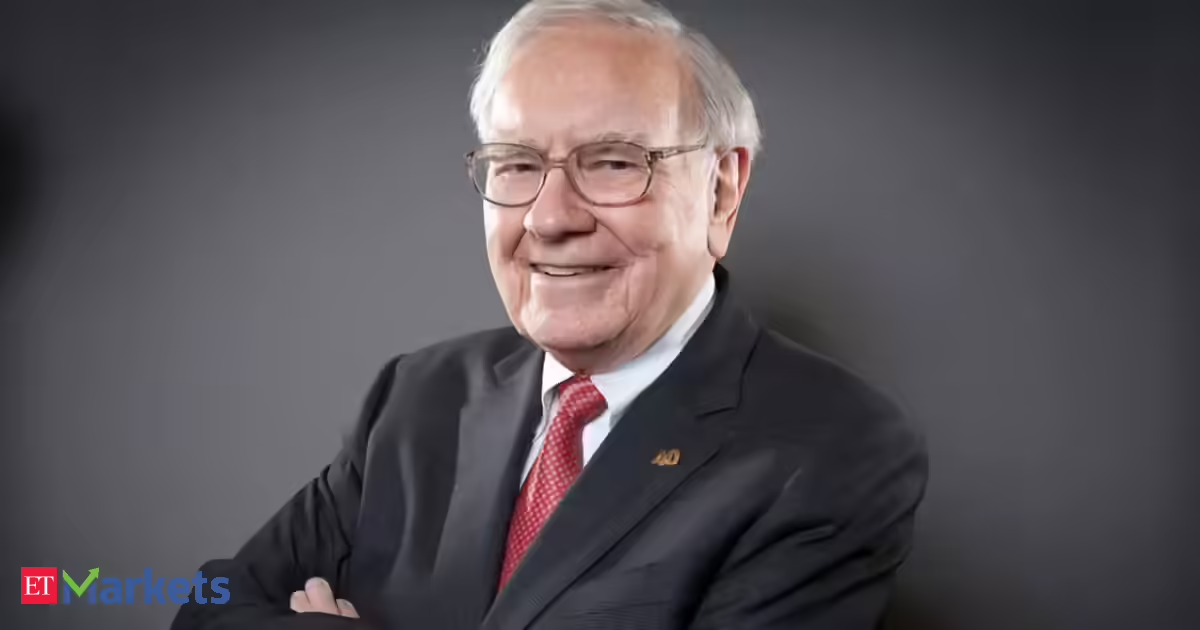
Market quote of the Day by Warren Buffett: ‘Stock market is designed to transfer money from the active to the patient’

Published

on

Market quote of the Day by Warren Buffett: ‘Stock market is designed to transfer money from the active to the patient’
With markets moving at lightning speed, flooded with updates, alerts, finfluencers, and chatter, Warren Buffett’s famous observation feels like a timely and much-needed reminder. His words highlight a simple yet powerful truth about investing: Success often depends less on how frequently you trade and more on how long you can stick to a well-thought-out strategy.

Today, every market move is tracked, earnings reports reviewed, and geopolitical events quickly connected to potential market impact. The temptation to react—to buy, sell, or reshuffle portfolios at the first sign of volatility—is ever-present. Yet Buffett’s message reminds investors to cut through the noise and focus on the long game.

When investing is driven by short-term swings, emotions often take over. Fear can prompt premature selling, while excitement or FOMO during rallies may lead to chasing overpriced stocks. Over time, such behavior erodes returns and increases transaction costs, taxes, and stress, all of which undermine long-term wealth creation.

Patience, on the other hand, lets compounding work its magic. Strong businesses rarely grow in a straight line — earnings and competitive advantages build over years, not weeks, and market leadership evolves gradually, not overnight.

Advertisement

Investors who remain patient give quality companies with strong fundamentals the time to execute, expand market share, and enhance profitability. This long-term mindset often distinguishes consistently successful investors from those who struggle.


Buffett’s quote also underscores the psychological advantage patience provides. Markets reward those who stay calm amid uncertainty. Whether facing an economic slowdown, interest rate changes, political developments, or sudden market corrections, patient investors focus on fundamentals rather than reacting to every headline.
In the present day and age, Buffett’s words are a timely reminder that investing is not a sprint. The ability to wait, stay disciplined, and trust a well-thought-out strategy often separates average outcomes from exceptional results. Patience is not about doing nothing, it is a deliberate choice that fuels long-term financial success.

Continue Reading
Click to comment

Leave a Reply

Your email address will not be published. Required fields are marked *

Business

Heineken to cut up to 6,000 jobs as beer demand falters

Published

on

Heineken to cut up to 6,000 jobs as beer demand falters


Heineken to cut up to 6,000 jobs as beer demand falters

Continue Reading

Business

Workday Stock Falls. Wall Street Isn’t Taking Kindly to Co-Founder’s Return as CEO.

Published

on

Workday Stock Falls. Wall Street Isn’t Taking Kindly to Co-Founder’s Return as CEO.

Workday Stock Falls. Wall Street Isn’t Taking Kindly to Co-Founder’s Return as CEO.

Continue Reading

Business

Strategic expansion, digital & offline pharmacies driving growth: Dr Suneeta Reddy, Apollo Hospitals

Published

on

Strategic expansion, digital & offline pharmacies driving growth: Dr Suneeta Reddy, Apollo Hospitals
Apollo Hospitals posted robust quarterly results, driven by strong revenue growth across its healthcare and pharmacy businesses. The company reported a revenue of ₹6,477 crores, marking a 17% increase, which translated into an EBITDA of ₹965 crores—a 27% improvement. Net profit rose 35% to ₹502 crores, reflecting the impact of higher volumes in high-end specialties and operational efficiency.

Dr Suneeta Reddy, MD of Apollo Hospitals, highlighted the hospital segment’s performance: “Hospital did very well. A growth of 14% in revenues with a revenue of ₹3,183 crores, EBITDA at ₹790 crores representing a 17% increase in EBITDA and profits for the hospital of ₹422 crores representing a 21% improvement in profit.”

Occupancy rates for the quarter stood at 67.1%, slightly below expectations. “There was a 4% improvement in ALOS, which meant that we came down to 3.14 days. If we had been at four days ALOS, we would technically have been at 72% occupancy. So, we have carefully managed to reduce average length of stay to enable patients to really go home faster and to reduce their bills,” said Dr Reddy.

Apollo’s expansion plans remain aggressive. During the quarter, the company opened 100 beds in Pune and 40 beds in Defence Colony. By the first quarter of the next fiscal year, Apollo expects to open 1,035 beds across several new facilities, including Belenus Hospital in Sarjapur (Bangalore), Sonarpur (Kolkata), and Sandhya Elite (Hyderabad), with further expansion planned in Gurgaon.

Advertisement

Regarding profitability, Dr Reddy explained the company’s margin performance: “If you look at healthcare services, we are at a very healthy 24.8%. Apollo Health and Lifestyle is at 10.2%. They have grown their EBITDA margin by 141 basis points. Apollo Healthco is at 4.5%, but that is a different retail business. Offline pharmacies are at 7.8%.”


The pharmacy segment continues to grow strongly, with Healthco adding 185 physical pharmacies this quarter, bringing the total to 7,113—the largest pharmacy network in India. “They have a private label share of 15.53%, which is giving them the margin of 7.8, a very healthy margin, which has improved by 12 basis points. The offline continues to grow with the GMV of ₹525 crores for the quarter, and they have three sources of revenue—insurance, doctor consult, diagnostics, and delivering pharmaceutical products at home—all of them growing at somewhere 23% but growing strongly at 20%,” she added.
The company’s Health and Lifestyle business, despite being loss-making, showed strong growth with a 20% revenue increase and a 39% jump in EBITDA. Dr Reddy expects the segment to turn profitable in the next quarter: “If you look at the different lines of the business, they are all profitable. A little bit of focus on admin costs, etc., they should be profitable, and they are growing the diagnostics scale, which is giving them a healthy 10.8% margin. That margin trajectory will grow.”On the international front, Apollo is focusing on project work and consultancy rather than setting up hospitals overseas. “We have got about ₹20 crores of revenue from the work that we do and project in,” Dr Reddy noted.

Apollo’s capital expenditure plan for expansion includes 1,385 new beds at an estimated cost of ₹2 crores per bed, totaling ₹3,000 crores for the current phase, with another ₹3,000 crores planned for the next phase. Regarding other business verticals, Dr Reddy said: “Healthco is now, it will become a separate company. It is fully capitalised, requires no further capital. Apollo Health and Lifestyle is looking at some restructuring that will bring it capital for growth…Apollo is always there to support them with capital for growth.”

With strong operational performance and strategic expansion plans across hospitals, pharmacies, and lifestyle businesses, Apollo Hospitals continues to reinforce its position as a leader in India’s healthcare sector.

Advertisement
Continue Reading

Business

Snowflake Stock and 2 More Software Plays to Buy on a ‘Too Harsh’ Software Drop

Published

on

Snowflake Stock and 2 More Software Plays to Buy on a ‘Too Harsh’ Software Drop

Snowflake Stock and 2 More Software Plays to Buy on a ‘Too Harsh’ Software Drop

Continue Reading

Business

Opinion: Fewer sharks, more angels please

Published

on

Opinion: Fewer sharks, more angels please

OPINION: It’s time to lose the pitch theatre and offer real angelic investing.

Continue Reading

Business

Emad Yassa on Building a Career That Spans Healthcare and Global Impact

Published

on

Emad Yassa on Building a Career That Spans Healthcare and Global Impact

Emad Yassa is a healthcare entrepreneur and nonprofit founder with more than three decades of professional experience across clinical practice and international philanthropy.

Yassa is the Founder and Chairman of Touch of Love International (TOLI), a nonprofit organisation focused on economic empowerment through micro-loans in underserved communities.

Born and raised in Egypt, Emad studied physical therapy at Cairo University, graduating in 1985. During his university years, he was also a competitive athlete and earned a silver award in single rowing. In 1989, he relocated to the United States, where he began building his career in outpatient physical therapy.

In 1995, Emad founded Physical Therapy and Rehab in West Hills, California. The clinic grew steadily and reflected his hands-on approach to leadership and patient care. After moving to Colorado Springs in 2005, he worked with Cheyenne Mountain Rehab before launching Dynamic Physical Therapy in 2007. He led the practice for over fifteen years, guiding it through growth, operational challenges, and long-term stability. In August 2023, he sold the business to focus full time on his nonprofit work.

Emad founded Touch of Love International in 2006, alongside his clinical career. The organisation provides small micro-loans to individuals and families in Egypt, Kenya, Ethiopia, Uganda, and Nicaragua. His work centres on dignity, accountability, and long-term self-reliance rather than short-term aid.

Advertisement

Today, Emad is recognised for his disciplined leadership style, cross-sector experience, and commitment to building systems that create lasting impact.

A Conversation with Emad Yassa on Building Businesses, Purpose, and Long-Term Impact

Q: You began your career in Egypt. What shaped your early direction?

I grew up in Egypt and studied physical therapy at Cairo University. I was focused on discipline early on. Sports played a big role for me. I rowed competitively and won a silver award while at university. That experience taught me structure and endurance. Those lessons stayed with me long after graduation.

Q: What prompted your move to the United States in 1989?

I wanted broader professional opportunities and exposure to a different healthcare system. Moving countries was challenging, but it pushed me to adapt quickly. I learned how to work within new regulations, new cultures, and higher expectations.

Q: Your first business came in 1995. How did that start?

I founded Physical Therapy and Rehab in West Hills, California. At the time, I was very hands-on. I treated patients, managed operations, and learned the business side through experience. It taught me how important systems and consistency are.

Advertisement

Q: Why did you relocate to Colorado Springs?

In 2005, I moved to Colorado Springs and worked with Cheyenne Mountain Rehab. It gave me a different perspective on practice management and team dynamics. That experience helped prepare me to launch my next clinic.

Q: Dynamic Physical Therapy became a long-term chapter. What made it different?

I founded Dynamic Physical Therapy in 2007. By then, I understood how to build a practice that could last. We focused on steady growth and patient trust. I led the clinic for over fifteen years, which required constant adjustment as healthcare evolved.

Q: You sold the business in 2023. Why then?

It was a deliberate decision. I had already started Touch of Love International years earlier, but I wanted to give it my full attention. Selling the practice allowed me to shift my focus completely.

Q: Tell us about the origin of Touch of Love International.

I founded TOLI in 2006. The idea was simple. Small loans can change lives if they are given responsibly. We work in Egypt, Kenya, Ethiopia, Uganda, and Nicaragua. The focus is self-reliance, not dependency.

Advertisement

Q: How does your business background influence your nonprofit work?

Very directly. Structure, accountability, and follow-through matter in any organisation. I approach the nonprofit with the same discipline I used in healthcare.

Q: How do you define leadership today?

Leadership is about consistency and responsibility. It is showing up, making hard decisions, and building something that lasts beyond you.

Advertisement
Continue Reading

Business

Roobet Shows That Online Takes the Edge

Published

on

Roulette, a game that conjures images of glamorous casinos and elegant bets on a spinning wheel, has evolved significantly over the years.

Gaming now transcends the physical realm. If you want the thrill of spinning today, you no longer need to live near a casino or plan a trip. That excitement, which once required time and travel, can now be accessed wherever you are.

Let’s be clear – this isn’t about good versus bad, or old versus new. Physical casinos are undeniably fun. Online gaming simply builds on that fun, offering more flexibility and choice.

Physical casinos are where it all began, and they are big business. There are over 6,500 operational physical casinos across more than 95 countries, and the worldwide land-based casino market was estimated at $107.5 billion in 2024.

While there is no doubt that physical casinos remain an important part of the gaming and gambling industry, online gaming offers something different and unique.

Online platforms remove many of the practical barriers that come with physical casinos. There’s no need to plan around opening hours and no requirement to live near one. The benefits of gaming online are reflected in consumer behavior, with the number of users spinning with online casinos rising by 19% between 2023 and 2024.

Advertisement

If you love a particular land-based casino, you have to be there in person, operating on its schedule. Your experience is tied to that place.

But if you have a favorite online casino, you can play from almost anywhere. The experience fits around your life, not the other way around. Platforms like Roobet are built and designed around this ethos, enabling players to jump straight into games without friction.

Another great strength of online casinos is their ability to leverage technology to tackle operational challenges. For example, over 70% of major gambling platforms use AI to detect fraud and support responsible gambling measures, helping to ensure a secure and fair environment for players.

At the same time, these platforms use AI to create a more personalized experience. By analyzing session length, play styles, and preferred game formats, they can recommend games and bonuses that are tailored to each player’s preferences. The result is a more personalized, engaging gaming experience.

Advertisement

Delivering this level of personalization at scale is extremely difficult for physical casinos. Online, it’s built into the design. Platforms like Roobet use this approach to create experiences that feel intuitive, helping players spend more time enjoying the games they love.

Importantly, licensed online platforms also operate under strict regulatory standards, with identity checks, secure payments, and responsible-gaming tools helping to keep players safe while they play.

Variety is another asset of online casinos. While physical casinos are limited by floor space, online platforms have no such constraints.

Online platforms can offer thousands of games across every style imaginable. Think of classic slots, live games, Crash, and everything in between.

Advertisement

Whatever type of game you enjoy, there’s almost certainly an online version waiting for you.

Stake has more than 2,000 games. Betpanda has over 6,000. Roobet alone offers more than 7,000 games, including popular titles like Gates of Olympus, Sweet Bonanza, Crazy Time, and Roobet Originals such as Crash and Mission Uncrossable. That scale of choice means whatever kind of game you enjoy, there’s almost always something new to try.

Alongside variety, online platforms can offer more frequent bonuses and rewards. Lower overheads mean better value for players, whether through promotions, loyalty perks, or higher overall returns.

In simple terms, players tend to get more chances to play and more entertainment for their time.

Advertisement

Physical casinos remain iconic. A stay and spin at places like the Bellagio or Caesars is special. But those experiences aren’t available to everyone, all the time.

Online gaming expands the spinning experience. It offers more choice, more rewards, more freedom, and more accessibility, all without losing the thrill that made casinos popular in the first place.

Online, the fun is endless, seamless, and safe.

Advertisement

Continue Reading

Business

January 2026 Stock Market Overview

Published

on

January 2026 Stock Market Overview

In January 2026, the SET Index rose by 5.2% to close at 1,325.62 points, with an average daily trading value of 46,496 million THB, marking a 19.2% increase year-on-year. Foreign investors were notably active, contributing a net purchase of 4,345 million THB, leading to a total of 10,547 million THB over two months, while the investor composition showed foreign investors at 53.37%.

The IMF upgraded its global growth forecast to 3.3%, propelled by advancements in AI and government stimulus, amidst a stable U.S. interest rate of 3.50–3.75%. No new companies listed on SET or mai, but 2025 recorded the highest dividends and share buybacks in history, with high dividend yield stocks achieving a total return of 11.32%.

1. Market Overview

  • Date: January 2026
  • SET Index: Closed at 1,325.62 points, a 5.2% increase compared to the end of 2025, aligning with trends in major regional markets .
  • Average Daily Trading Value: 46,496 million THB, up 19.2% year-on-year .

2. Key Statistics

  • Foreign Investment: Net foreign purchases amounted to 4,345 million THB, marking a total of 10,547 million THB over two consecutive months of net buying, the first since July 2023 .
  • Investor Composition:
    • Foreign Investors: 53.37%
    • Domestic Retail Investors: 29.63%
    • Domestic Institutional Investors: 10.56%
    • Securities Firms: 6.44% .

3. Economic Trends

  • Global Economic Outlook: The IMF revised its global growth forecast for 2026 to 3.3% from 3.1%, driven by AI advancements and government stimulus policies .
  • Interest Rates: The Federal Reserve maintained interest rates at 3.50–3.75%, with mixed opinions among board members regarding future rate cuts .

4. Sector Performance

  • Top Performing Sectors: Technology, industrial goods, and resources outperformed the SET Index compared to the end of 2025 .
  • No New Listings: No new companies registered for trading on SET or mai during January .

5. Market Reactions

  • Geopolitical Concerns: Commodities rallied due to geopolitical tensions, while global markets experienced volatility following news of a potential new Fed chair appointed by Trump, which raised concerns about future monetary policy .
  • Upcoming Events: A significant event is the Thai general election on February 8, 2026, historically correlated with positive returns for the SET Index in the month before and after elections .

6. Dividend and Share Buyback Trends

  • Record Payouts: 2025 saw the highest recorded dividends and share buybacks in history, with high dividend yield stocks (SETHD) achieving a total return of 11.32% .

This summary encapsulates the essential aspects of the stock market and economic conditions in January 2026, highlighting significant trends, investor behaviors, and forecasts impacting the market.

Source : Presentation summarizing the stock market situation in January 2026

Advertisement
Continue Reading

Business

BHEL shares fall 6% after Rs 4,422 crore OFS opens for subscription

Published

on

BHEL shares fall 6% after Rs 4,422 crore OFS opens for subscription
Shares of PSU Bharat Heavy Electricals (BHEL) fell around 5% to Rs 259.3 on Wednesday morning after the government launched an Offer for Sale (OFS) to sell up to 5% stake in the company to raise around Rs 4,422 crore. The floor price for the OFS has been fixed at Rs 254 per share, which is at a discount of 8% to Tuesday’s closing price of Rs 276.05.

Under the offer, the Centre will first sell a 3% stake, with an option to sell an additional 2% if the issue is oversubscribed.

The offer opened for subscription on Wednesday for non-retail investors, while retail investors can place their bids on Thursday.

If fully subscribed at the floor price, the sale of 17.41 crore shares, or 5% stake, would fetch the government Rs 4,422 crore.

Advertisement

The base issue size comprises over 10.44 crore shares, or 3% stake, in BHEL, plus a greenshoe option to sell over 6.96 crore shares or 2%.


The government holds 63.17% in BHEL.
So far in the current fiscal year, the government has raised Rs 8,768 crore through PSU disinvestments.Sensex, Nifty today: Catch all the LIVE stock market action here

BHEL reported a sharp turnaround in its December-quarter performance, with net profit more than tripling on the back of higher execution and operating leverage. The state-owned engineering major posted a net profit of Rs 382 crore for the third quarter ended December 2025, compared with Rs 125 crore in the same period last year, marking a 206% year-on-year jump.

Revenue from operations rose 16% YoY to Rs 8,473 crore from Rs 7,277 crore a year earlier, reflecting improved project execution and a stronger order pipeline. Total income for the quarter, including other income, stood at Rs 8,700 crore, up from Rs 7,393 crore in the year-ago period.

Advertisement
Continue Reading

Business

Ares management director Bhutani buys $1.27 million in shares

Published

on


Ares management director Bhutani buys $1.27 million in shares

Continue Reading

Trending

Copyright © 2025