Connect with us

Business

McVitie’s owner Pladis sees profits fall but vows to continue its global investment after ‘resilient’ year

Published

on

Business Live

Snacking giant revenues up but was affected by ‘inflation, currency volatility, pressure on household budgets’

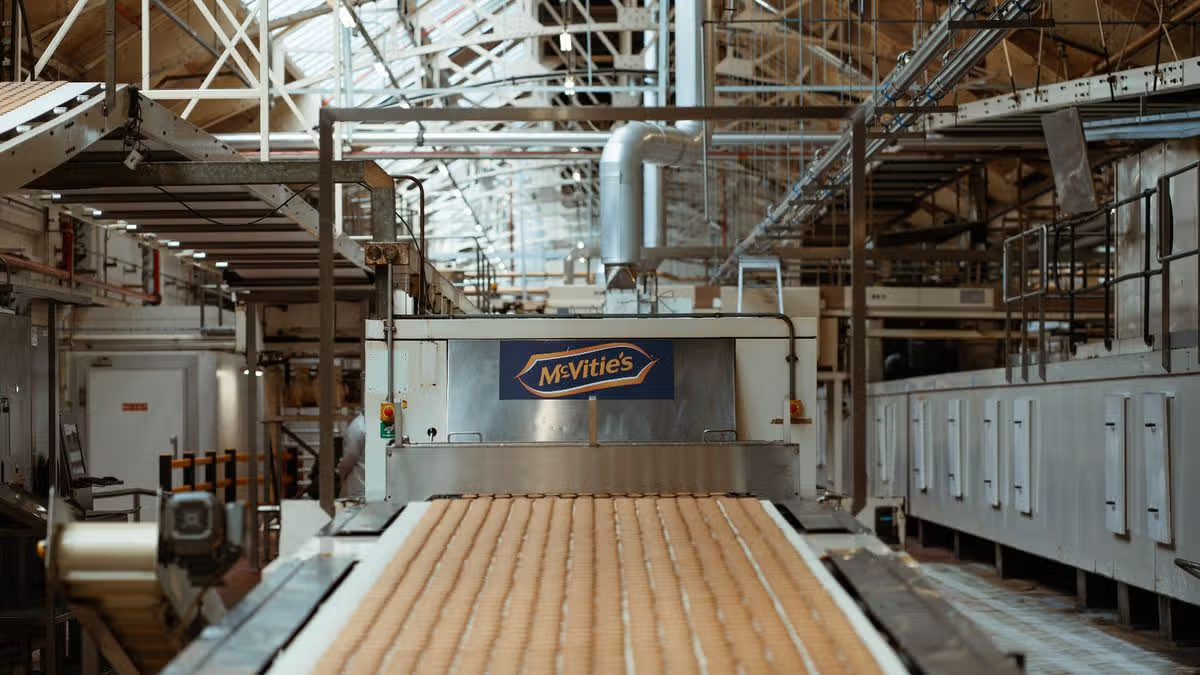
The Jaffa Cake production line at the McVitie’s plant in Stockport, Greater Manchester, which is owned by Pladis

The Jaffa Cake production line at the McVitie’s plant in Stockport, which is owned by Pladis(Image: Three Crows & Co)

McVitie’s and Jacob’s owner Pladis has vowed to continue investing in its factories and brands despite seeing a fall in profits as inflation and economic uncertainty continue to bite.

The global snacking giant reported revenues for 2025 of £3.3bn, up 1.2% on 2024. Operating profits fell from £344.4m to £301.6m, while overall pre-tax profit fell from £181m to £49m.

Chairman Murat Ülker said: “Our external context in 2025 was shaped by commodity inflation, currency volatility, pressure on household budgets, and intense competition across our markets.” But he said revenue growth showed “continued progress across both mature and growth markets… demonstrating the enduring relevance of our brands.”

He said: “Through a focus on productivity, waste reduction and careful management of operating costs, we continued to strengthen the resilience of our business.”

Advertisement

And he added: “Alongside our heritage, we continue to invest in innovation, technology and new capabilities so that our brands remain relevant to changing consumer expectations while staying true to the qualities that made them trusted in the first place.”

The year also saw Pladis commit to a £68m investment at its UK sites. That included a £21m investment at its Jaffa Cake factory in Stockport, as well as a £33m overhaul of its Jacob’s Cream Crackers bakery in Aintree, Liverpool. The company also investment £2m at its Carlisle biscuit factory, creating dozens of jobs.

The group also invested £8.6m in its Cairo site and another £4.6m in a BN production line in France. 2025 also saw Pladis mark the 100th anniversary of McVitie’s Chocolate Digestives.

Sridhar Ramamurthy, chief financial officer at Pladis, said: “Pladis delivered a resilient performance in 2025, growing revenue to £3.3 billion and maintaining market-leading positions in the UK, Türkiye, Saudi Arabia, Egypt and elsewhere. This reflects the enduring strength of our branded portfolio and the focus and commitment of our teams around the world. It was achieved in a year that tested every part of the food industry – from commodity inflation and currency volatility to broader macroeconomic headwinds.

Advertisement

“Our private, family-owned structure gives us the freedom to take a long-term view, beyond the reporting cycle. That perspective shapes how we invest in the business: in 2025, we invested £100 million in capital expenditure to support efficiency, capacity and resilience, while continuing to innovate across our priority brands.

“We are building from a strong commercial platform and our priorities remain clear: to keep building our brands, bring innovation to scale, accelerate digitalisation and manage cost, cash and capital with rigour. That combination of long-term investment and financial discipline is central to strengthening our competitiveness and creating value over time so that we can continue bringing happiness with every bite.”

Pladis was founded in 2016 and today employs more than 15,000 people in more than 110 countries. Its brands include Carr’s, Flipz, GODIVA, Ülker and BN, and it bills itself as “the world’s fourth-largest sweet biscuit manufacturer, the seventh-largest chocolate manufacturer and the eighth-largest savoury biscuit manufacturer”.

Since the year end, Pladis has continued its efforts to grow the McVitie’s brand in China, which it sees as a key growth market.

Advertisement
Continue Reading
Click to comment

You must be logged in to post a comment Login

Leave a Reply

Business

Harvey Nichols takeover ‘dubious’, says Paul Smith chairman

Published

on

Harvey Nichols takeover 'dubious', says Paul Smith chairman

The executive chairman of Paul Smith has questioned the ethics of Frasers Group’s £43.3m takeover of Harvey Nichols, completed through a pre-pack administration in August that is expected to leave suppliers recovering less than 15 per cent of their debts.

“I personally find this whole thing about pre-pack administrations just dubious in terms of ethics and the way business gets done,” Ewan Venters, who was appointed chair of the fashion house last October, told the BBC Big Boss podcast.

Frasers, which is controlled by the billionaire Mike Ashley, bought the luxury department store through the pre-pack process. Critics argue such deals can leave creditors carrying unpaid debts.

Free newsletters
Advertisement

The stories that matter to UK business, straight to your inbox.

Advertisement

According to the latest estimates from administrators, Harvey Nichols’ unsecured creditors, which include Victoria Beckham, Jimmy Choo and Canada Goose, will receive less than 15 per cent of the £270.5m they were owed, leaving suppliers with less than 15p in the pound. Other unsecured creditors include Jo Malone, Puig and Estée Lauder.

Filings show Paul Smith was owed £96,537.50. Preferential creditors such as HM Revenue & Customs are expected to be repaid in full.

“I find it all a bit odd and I don’t think that’s a kind way of doing business,” Venters said. He conceded, however, that Harvey Nichols may have been “about to go to the wall and maybe Mike and his team will … keep it going”.

Venters said kindness was too often seen as a “soft” characteristic in business. “Kindness doesn’t mean just soft. But I think put the value of kindness at the heart of doing business, and I think you do business in a better way, with better results, with a happier outcome. All too often you just see very unkind behaviour which I don’t think leads to a healthier society.”

Advertisement

Pre-pack administrations, in which a company’s business or assets are sold before an administrator is formally appointed, have faced scrutiny over creditor involvement and sales below market value, according to a House of Commons Library briefing.

Frasers declined to comment.

The deal preserved more than 1,000 jobs and secured the immediate future of Harvey Nichols’ UK stores, including its Knightsbridge flagship. The retailer had failed to make a profit for years under its former owner, the Hong Kong billionaire Sir Dickson Poon, who faces losses of £100m from the sale.

The takeover had already raised concern among brand partners, with Frasers reportedly forcing its way into the auction process this summer. The Sports Direct owner’s reputation was previously damaged by Matches Fashion, which was placed into administration in 2024 weeks after Frasers acquired it, putting hundreds of jobs at risk and leaving suppliers unpaid.

Advertisement

In luxury, brands are struggling to attract Gen Z customers, with slower UK sales compounded by the former Conservative government scrapping VAT-free tourist shopping.

Ashley has long sought to move his retail group, which includes Flannels and House of Fraser, upmarket. This summer Frasers increased its stake in Hugo Boss to just below the 50 per cent needed for majority control and installed its chief executive, Michael Murray, as chairman. In July it disclosed a stake in Burberry.

Paul Smith, founded in 1970, reported a near tripling in pre-tax losses to £16.7m in its latest annual accounts. Slower demand and problems in its wholesale operation have contributed to six years of losses.

Venters said he had brought a “more razor-like focus” to the business, including expanding its direct-to-consumer arm and efforts to “right size the wholesale trade and the costs associated with it.”

Advertisement

He said previous management teams had “taken their eye off the ball” and missed the “disruptive behaviour” in the wholesale market, including consolidation that has allowed larger retailers to demand bigger discounts and promotional support. “You end up with a cost base that is higher than you need to service that, and a real conundrum as to how you still get growth.”

Venters said this year would be “a step change”. “We will still be a lossmaking business but we will probably nearly halve the losses in the first year of recovery. And we can see a growth plan that gets us back into profitability and where the business needs to be.”

Jamie Young
About the author

Jamie Young

Jamie Young is Senior Reporter at Business Matters, covering SME finance, employment law and Westminster policy since 2016. He has reported on every Budget and Autumn Statement since 2018, helped make sense of the ‘covid era’ and the bounce-back loan scheme from launch through the fraud investigations, and broke the magazine’s coverage of the 2024 late-payment reforms. He joined Business Matters straight from completing his BA in Administration from Exeter University and is NCTJ-qualified. Reach him at jyoung@cbmeg.co.uk

Advertisement

Advertisement
Continue Reading

Business

UK ranks fourth of 13 countries

Published

on

UK ranks fourth of 13 countries

A business owner in the UK taking £160,000 a year in salary and dividends would face the fourth-highest overall tax bill among 13 developed economies once inheritance tax is included, according to a study published on Sunday by financial education specialists Investing Insiders.

The analysis puts the UK total at £324,982.81. Only Japan, at £370,215.53, France, at £367,817.47, and Ireland, at £348,409.11, generated higher bills. Seven of the 13 countries in the study produced a tax burden of less than £100,000.

Investing Insiders modelled the finances of the same hypothetical individual across each G7 nation and other popular destinations for Britons moving abroad. The calculations covered income tax, dividend tax, inheritance tax and investment taxes, with all figures converted into sterling for a like-for-like comparison.

Free newsletters
Advertisement

The stories that matter to UK business, straight to your inbox.

Advertisement

The business owner persona pays themself a £60,000 salary, receives a £100,000 dividend, makes £20,000 of pension contributions and puts £20,000 into an ISA. The individual also inherits a £1.2m estate from a parent, made up of a £950,000 home, £200,000 in ISAs and investments and £50,000 in other assets.

The business owner was one of four personas the firm assessed. According to the published findings, an average earner on £39,039 faced the UK’s third-lowest burden among the 13 countries, while a £99,000 earner ranked fifth highest and a high earner on £207,000 ranked third highest, at £1,250,381.75. The United States ranked lowest across all scenarios.

Investing Insiders said the study aimed to find which countries allow residents to keep more of their money. It cited a 17 per cent increase over the past year in searches about emigrating or moving abroad. Office for National Statistics figures show 246,000 British nationals left the UK in the year ending December 2025.

On income alone, the UK business owner in the study would take home £31,303.40 from their wage and £63,713.79 from their dividend, along with the full £815 earned from investments, which are tax free inside an ISA. That leaves £44,982.81 in income-related taxes, the sixth highest of the 13 countries.

Advertisement

Ireland topped that measure, with the equivalent of £66,356.11 in tax. France was second at £49,530.10, almost £17,000 less than Ireland.

The study found the UK compared more favourably on pension tax relief. On £20,000 of contributions, it said the government would add £5,486.50 in relief and a further £1,946 could be claimed back through a tax return, taking the total to £27,432.50.

On the £1.2m estate, the study calculated a UK charge of £280,000, the fourth highest in the comparison, which lifted the overall bill to £324,982.81.

Australia, Canada, New Zealand, Portugal and the United States charge nothing on the inheritance in the study’s model, meaning a UK heir would pay £280,000 more than one in those countries. Spain and Italy would each charge less than 5 per cent of the UK figure, according to the analysis.

Advertisement

The firm said inheritance tax accounted for almost 90 per cent of overall charges for its highest-earning UK persona.

The study follows other research and campaigning on the tax treatment of business owners. A Make UK and Bishop Fleming survey this month found that one in five family manufacturers are weighing an overseas sale because of inheritance tax changes.

In June, more than 90 founders and 19 MPs wrote to the Chancellor warning that cumulative tax rises were prompting entrepreneurs to relocate abroad. Concern over wealth leaving the country predates both, with research in 2024 pointing to the largest exodus of millionaires globally from Britain.

Jamie Young
About the author
Advertisement

Jamie Young

Jamie Young is Senior Reporter at Business Matters, covering SME finance, employment law and Westminster policy since 2016. He has reported on every Budget and Autumn Statement since 2018, helped make sense of the ‘covid era’ and the bounce-back loan scheme from launch through the fraud investigations, and broke the magazine’s coverage of the 2024 late-payment reforms. He joined Business Matters straight from completing his BA in Administration from Exeter University and is NCTJ-qualified. Reach him at jyoung@cbmeg.co.uk

Advertisement

Continue Reading

Business

Oracle: Dismiss The Overblown Credit Fears

Published

on

Oracle: Dismiss The Overblown Credit Fears

Oracle: Dismiss The Overblown Credit Fears

Continue Reading

Business

M.P. Evans Group PLC (MPEVF) Q2 2026 Earnings Call Prepared Remarks Transcript

Published

on

OneWater Marine Inc. (ONEW) Q1 2026 Earnings Call Transcript