
Business
Menstrual products prices skyrocketing from inflation, tariffs

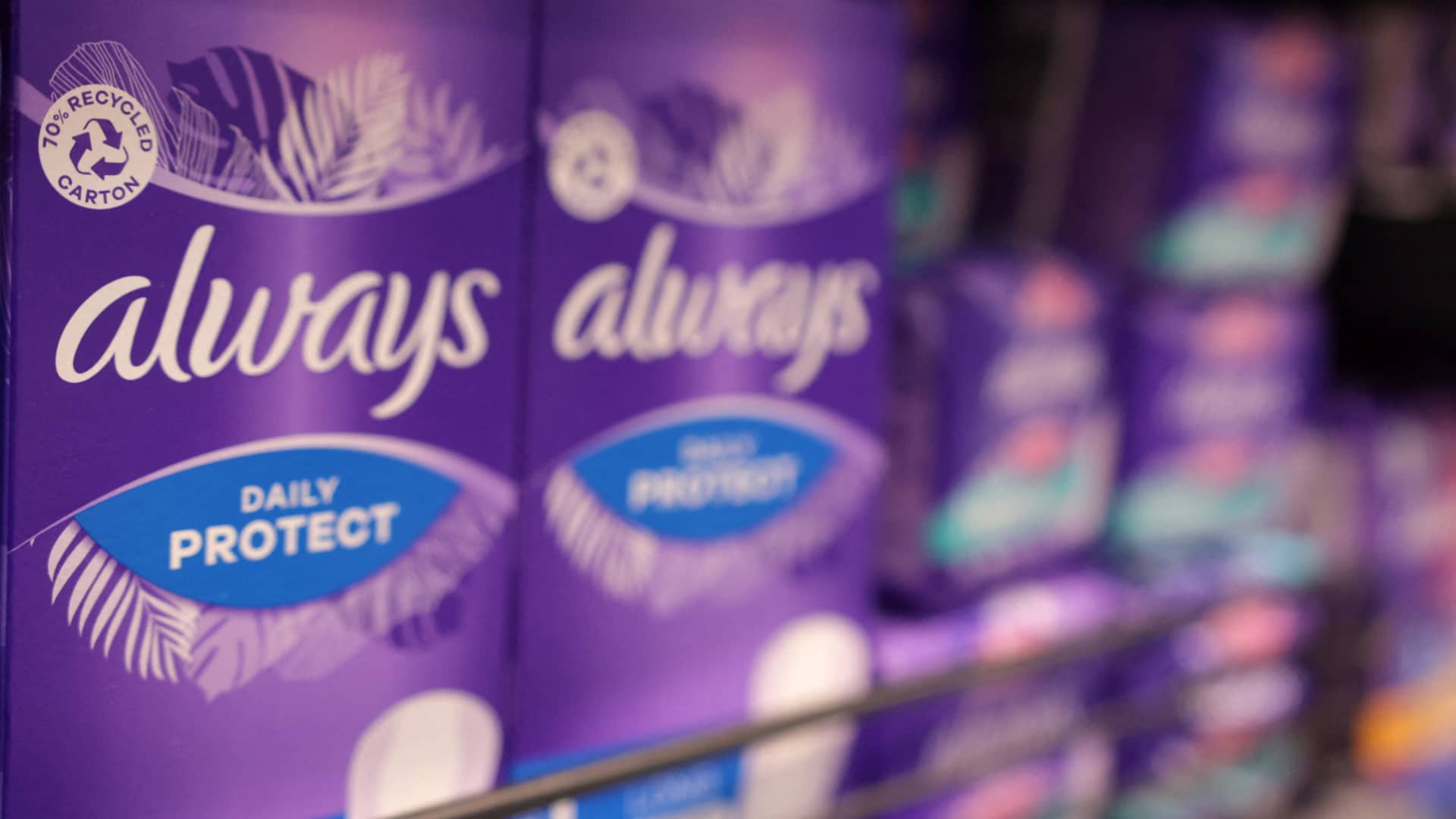
Always products are displayed on a shelf in a supermarket in Sarajevo, Bosnia and Herzegovina October 29, 2024.
Dado Ruvic | Reuters
Rising inflation and ever-changing tariff policies have led to higher prices across store shelves over the past few years, squeezing consumers’ budgets.
An often overlooked example: menstrual products.
The average price of menstrual products, including sanitary pads and tampons, has risen nearly 40% since 2020, from roughly $5.37 per unit to $7.43 per unit, according to February data from Chicago-based market research firm Circana.
Dollar sales from menstrual products have grown by nearly 30% over that same period, according to Circana.
But at the same time, sales of menstrual products — which broadly includes pads, tampons, liners and more — have seen a roughly 6% decrease since 2022, falling incrementally each year, according to data from NielsenIQ.
The data analytics company noted that items across the store have seen average unit price increases, with the dollar volume of consumer packaged goods at large rising 2.7% year-to-date. Those price increases are in line with climbing inflation, with the latest consumer price index in February showing a 2.4% annual rise.
The latest CPI data found that inflation in personal care products in the U.S. has jumped dramatically, up 22.1% in February from January 2020.
But because menstrual products are a necessity for a large portion of the population, those costs may be hurting consumers.
“I do think that we’re at a point where consumers in general are having to choose whether they can buy food for their family, or buy prescriptions for their family. Some things that we do typically define as a necessity, people are finding alternatives for or going without,” said Sarah Broyd, a partner with consultancy firm Clarkston Consulting.
Broyd said the gap between higher prices and declining sales shows consumers may be searching for alternatives out of necessity.
Menstrual products haven’t just been hit by inflation, either. According to government data, the U.S. collected $115 million through tariffs on menstrual products containing cotton in 2025, compared with just $42 million in 2020.
The U.S. imported the majority of its menstrual products from Canada, China and Mexico in 2024, according to the World Bank. President Donald Trump has imposed tariffs on all three of those countries at varying levels over the past year.
Those added costs come on top of the so-called “pink tax,” where some states place a sales tax on menstrual products. According to 2025 data from Statista, Tennessee, Mississippi and Indiana have the highest sales tax on menstrual products at 7%. Products that are deemed “medical devices” are often excluded from sales taxes.
‘A subscription service to be a woman’
For 30-year-old Dafna Diamant, the rising price of menstrual products has become noticeable at the cash register and a drag on her monthly expenses.
The New York resident said she’s noticed her usual pack of roughly 18 tampons rise to somewhere around $25, especially over the past year.
“It’s crazy, and it just feels like as a woman, you have to pay sometimes $50 every couple months,” Diamant told CNBC. “And for some people, it takes a toll on the income.”
Diamant said she feels particularly frustrated because it’s not a monthly expense she can go without. She often buys store-brand period products at retailers like CVS and Walgreens, yet she said she’s still shocked by the sticker price.
“It still feels like a subscription service to be a woman,” Diamant told CNBC. “You have to pay every month to be fertile.”
Even larger companies have felt the effects. Procter & Gamble, the parent company of menstrual product brand Always, said in July that it was raising prices on 25% of its personal care and household products due to a $1 billion total annual tariff impact. It manufactures its Always products across facilities in Maine, Utah and Canada, according to the company.
P&G declined to comment for this story.
Kimberly-Clark, the maker of menstrual product brand Kotex, said on an earnings call in April that the company incurred a total of $300 million in gross costs from tariffs, with more than half of that related to tariffs on China. The company did not respond to CNBC’s requests for comment.
Broyd, the partner at Clarkston Consulting, said menstrual products have been hit with a “triple whammy” of rising raw material costs, inflation across energy and supply chains, and cross-border friction from tariffs.
“When you think about plastic and pulp and some of the main components of feminine care products, they’re largely probably coming from overseas and then getting hit with that much more of tariffs,” Broyd said.
She added that these tariffs are on top of already alleged higher levies on other women’s products, the subject of Congress’ Pink Tariffs Study Act introduced last year by Democrats to determine whether the U.S. tariff system is “regressive” or has a “gender bias.”
As prices continue to shoot up, Broyd said she believes companies will continue to reevaluate their portfolios and potentially sell off their feminine care segments to focus on businesses with higher margins. In November, Edgewell Personal Care sold its feminine care business to a company in Sweden for $340 million.
“You’re seeing these more niche, more startup type brands that are popping up in stores. … That’s the biggest growth,” Broyd said. “People that have the ability to flex up and buy more organic or products that they trust, they’ll spend that price premium. But for other consumers that don’t have the discretionary income to do that, they’re going to trade down and go private label, or go without.”
The rise of reusables
Diamant said she and her friends are now trying period underwear instead of single-use products to streamline their expenses.
A growing number of people have been trying reusable period products, primarily because they’re environmentally friendly and cheaper.
Major manufacturers have often relied on brand loyalty for their products, which could take a hit if consumers turn to alternatives.
“If you’re in fem care, you’re going to be using Kotex for 40 years. If you’re in Depend, you’re going to be using Depend for 40 years, right?” Kimberly-Clark CEO Michael Hsu said on a November earnings call. “There is long-duration frequency. There’s a lot of expenditure for consumers, and so because of that, they want to have an ongoing relation with us.”
Saalt, a reusable period products company offering cups, discs and underwear, said it estimates that 16% to 20% of U.S. consumers have tried or used reusable menstrual products, consisting of mostly younger consumers.
“Affordability is huge,” CEO Cherie Hoeger told CNBC. “When you look at our product, a cup or disc can last 10 years, and our product is only in the $30 price range. … They’re able to save up to $1,800 on the lifespan of that cup or disc, and that’s on the low end.”
Saalt, which launched in 2018, hit revenues of eight figures in its third year of business, Hoeger said. The company declined to disclose details of its financials, but she said demand has grown year-over-year since it launched.
Among Generation Z, Hoeger said the top reason for switching to reusables is pricing.
“They usually have some affinity toward sustainability and climate change, but it’s never their number one,” Hoeger said.
The rise of reusables may be contributing to the declining sales of single-use period products over the past few years. It also coincides with recent studies indicating that tampons could contain lead or other harmful ingredients. The Food and Drug Administration investigated the presence of metals and determined there was no risk.
Riding that momentum, other companies like Knix, MeLuna, Flex and more have entered the reusables space and garnered growing market share as consumers search for alternatives.
“Affordability is the crux; it’s the root problem,” Hoeger said. “Without affordability for these period products, you have real economic consequences for women to happen.”



Peru’s electoral board calls for audit of election results

The Middle East conflict has worsened food security concerns in Southeast Asia. ASEAN nations are addressing vulnerabilities through regional cooperation, with South Korea emerging as a key partner, supporting agricultural technology, rice reserves, smart farming, and bilateral agreements to strengthen long-term food security resilience.
Key Points
• The Middle East conflict has intensified food security concerns across Southeast Asia, threatening fertiliser supplies and supply chains. ASEAN has prioritized food security since the 1970s, though most member countries score poorly in sustainability and adaptability, with vulnerabilities worsened by El Niño and ongoing global conflicts.
• South Korea actively supports ASEAN food security through partnerships including the ASEAN Plus Three Emergency Rice Reserve, AFACI agricultural research initiatives, and digital farming systems, while also providing humanitarian rice assistance to disaster-affected countries like Myanmar.
• Bilateral cooperation between South Korea and ASEAN nations focuses on agrotechnology, including smart greenhouses in Indonesia, low-emission rice cultivation in Thailand, and livestock health monitoring in Malaysia, reinforcing sustainable agricultural development aligned with the UN Sustainable Development Goals.
Food Security Challenges in Southeast Asia
The ongoing conflict in the Middle East has intensified food security concerns across Southeast Asia, particularly due to fertiliser shortages and supply chain disruptions. Malaysia and neighboring countries now face rising food prices and potential shortages. While immediate economic pressures demand urgent attention, long-term structural reforms are equally critical. ASEAN has recognized food security as a regional priority since the 1979 ASEAN Food Security Reserve agreement, and the 2025 ASEAN Summit reinforced this commitment through the “2045 ASEAN document,” which identifies food security and poverty eradication as central goals for the region’s future development.
South Korea as a Strategic Partner in Regional Food Security
South Korea has emerged as a vital partner in strengthening ASEAN’s food security framework, both regionally and bilaterally. Through the ASEAN Plus Three Emergency Rice Reserve, South Korea has demonstrated consistent commitment, including donating 3,000 metric tonnes of rice following Myanmar’s 2026 earthquake. At the multilateral level, South Korea supports key initiatives such as AFACI and AFSIS, promoting agricultural research, sustainable farming, and ICT-based data management systems. These efforts reflect a broader multidimensional partnership aimed at enhancing ASEAN-led food security strategies through technology, knowledge-sharing, and institutional cooperation.
Bilateral Cooperation and the Path Forward
Technology upgrading and agri-innovation remain central to South Korea’s bilateral engagements with ASEAN members. Collaborative projects include low-emission rice cultivation in Thailand, smart greenhouses and improved cold chain logistics in Indonesia, and livestock health monitoring research in Malaysia, following a formal MoU between both nations’ agriculture ministries. Singapore benefits through diversified food imports and joint agricultural research. Building on these established frameworks aligns with the Sustainable Development Goals and positions ASEAN to better withstand future food security challenges. Continued and expanded cooperation with partners like South Korea will be essential for achieving long-term regional resilience.
Other People are Reading

GameStop GME 6.33%increase; green up pointing triangle is preparing a takeover offer for the online marketplace eBay EBAY 0.57%increase; green up pointing triangle, The Wall Street Journal reported. If the videogame retailer succeeds, it won’t be buying your dad’s eBay.
Founded in 1995 as an online auction house for hobbyists by the billionaire computer scientist Pierre Omidyar, eBay has traveled a bumpy road over the past three decades, remaking itself several times in the process.
Copyright ©2026 Dow Jones & Company, Inc. All Rights Reserved. 87990cbe856818d5eddac44c7b1cdeb8

Abortion pill makers ask US Supreme Court to restore mail-order access
Business
Alerus Financial Corporation 2026 Q1 – Results – Earnings Call Presentation (NASDAQ:ALRS) 2026-05-02

Q1: 2026-04-29 Earnings Summary
EPS of $0.89 beats by $0.30
| Revenue of $76.40M (10.23% Y/Y) beats by $2.62M

Seeking Alpha’s transcripts team is responsible for the development of all of our transcript-related projects. We currently publish thousands of quarterly earnings calls per quarter on our site and are continuing to grow and expand our coverage. The purpose of this profile is to allow us to share with our readers new transcript-related developments. Thanks, SA Transcripts Team
Business
Donegal Group Inc. 2026 Q1 – Results – Earnings Call Presentation (NASDAQ:DGICA) 2026-05-02
Q1: 2026-04-30 Earnings Summary
EPS of $0.32 misses by $0.08
| Revenue of $236.00M (-3.74% Y/Y) misses by $4.93M
Seeking Alpha’s transcripts team is responsible for the development of all of our transcript-related projects. We currently publish thousands of quarterly earnings calls per quarter on our site and are continuing to grow and expand our coverage. The purpose of this profile is to allow us to share with our readers new transcript-related developments. Thanks, SA Transcripts Team
Seeking Alpha’s transcripts team is responsible for the development of all of our transcript-related projects. We currently publish thousands of quarterly earnings calls per quarter on our site and are continuing to grow and expand our coverage. The purpose of this profile is to allow us to share with our readers new transcript-related developments. Thanks, SA Transcripts Team

Trump says there is possibility US could restart strikes on Iran


White House dinner shooting suspect seeks end of suicide precautions


North Korea’s Kim casts youth as vanguard of state goals amid Russia war

Tank Defends Chris Brown Amid Criticism About His Musical Range

instamoney loan app review | insta money app se loan kaise len | instamoney loan app real or fake
UK airlines face major flight schedule changes this summer due to jet fuel supplies

Manchester United reach agreement with Casemiro over contract clause amid transfer speculation

US brings back mandatory military draft registration

Steven Gerrard disagrees with Gary Neville over ‘shock’ Chelsea and Arsenal claim | Football
instamoney loan app review | insta money app se loan kaise len | instamoney loan app real or fake

You have 72h left to get your money out of Crypto & RUN

RBI Grade B CHARGE 2026 | Financial Markets & Risk Management | Finance
-

 Tech5 days ago
Register Renaming | Hackaday
-

 Politics5 days ago
Drax board avoid their own AGM, accused of greenwashing & environmental racism
-

 Tech6 days ago
Why Blue Badges Disappeared From Toyota Hybrids
-

 Tech5 days ago
Images of Samsung’s rumored smart glasses have leaked
-
 Sports6 days ago
IPL 2026: Ruturaj Gaikwad registers slowest fifty of the season, enters all-time unwanted list | Cricket News
-
 Tech1 day ago
Trump’s 25% EU auto tariff breaches Turnberry Agreement that also covers semiconductors and digital trade
-

 NewsBeat7 days ago
LK Bennett closes all stores after entering administration
-

 Fashion4 days ago
Kylie Jenner’s KHY Enters a New Era with ‘Born in LA’
-

 Business4 days ago
Most Commercial Energy Audits Miss the Real Losses
-

 Crypto World4 days ago
CFTC’s AI will review U.S. crypto registration applications, chairman tells CoinDesk
-

 Business5 days ago
(VIDEO) Charlize Theron Climbs Times Square Billboard to Promote New Netflix Thriller ‘Apex’
-

 Business4 days ago
Barclay Brothers Avoid Bankruptcy: HSBC Drops High Court Petitions After IVA Deal
-
 Sports1 day ago
Paul Scholes issues Marcus Rashford reality check as agreement emerges over Man United star
-

 Tech7 days ago
Microsoft to roll out Entra passkeys on Windows in late April
-

 Tech7 days ago
OpenAI’s Sam Altman apologizes for not reporting ChatGPT account of Tumbler Ridge suspect to police
-
 Entertainment5 days ago
Alicia Keys Calls Out Music Industry ‘Boys Club’
-
 Business3 days ago
Tesla Officially Registers Elon Musk’s Stock: What Investors Need to Know
-

 Tech7 days ago
OpenAI CEO apologizes to Tumbler Ridge community
-

 Tech4 days ago
Get Ready for More Brain-Scanning Consumer Gadgets
-

 News Videos7 days ago
16 Cryptos Just Became LEGAL Commodities (Full List)
You must be logged in to post a comment Login