











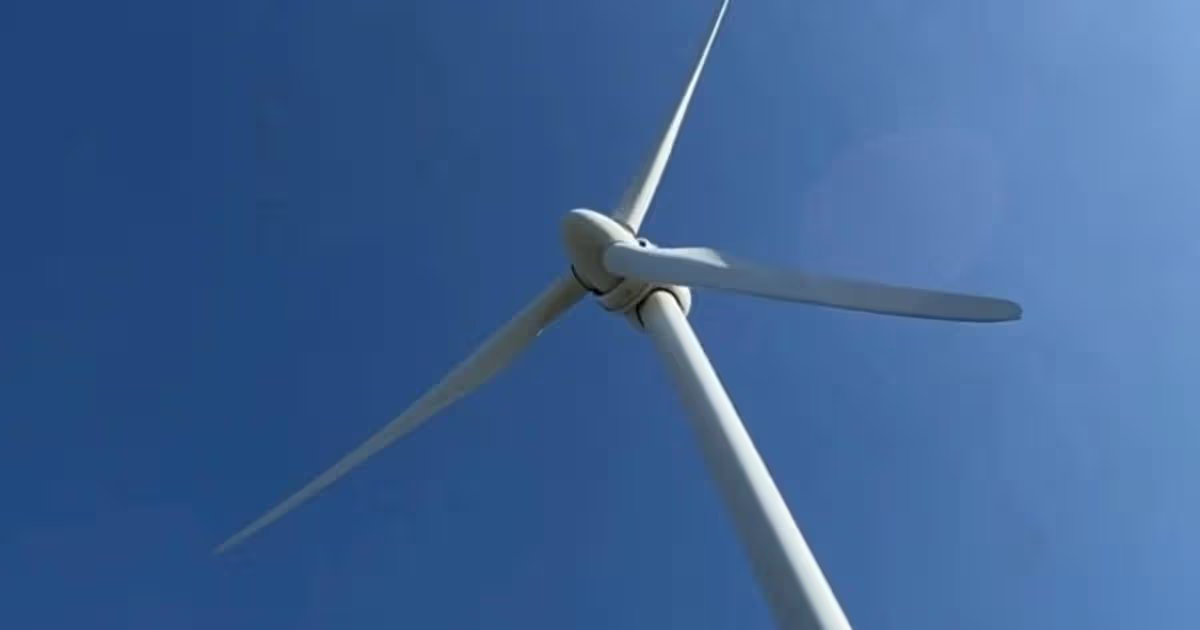
RenewableUK Cymru has published its manifesto ahead of the Senedd Election in May

Renewables(Image: Local Democracy Reporting Service)
The next Welsh Government needs to deliver a joined up clean power strategy to avoid the risk of losing billions in investment and the creation of thousands of high-skilled jobs.
Ahead of the Senedd Election representative body for the sector, RenewableUK Cymru, has published its manifesto which outlines how Wales could unlock a £10bn of economic opportunity for Welsh businesses, create 8,000 secure, well-paid jobs, and deliver affordable, home-grown energy – providing government and industry work together in a formal clean power partnership.
The manifesto, entitled, Cymru Clean Power: Call for Government 2026, highlights that electricity demand in Wales is projected to double – potentially triple – by 2050.
READ MORE: Largest ever number of renewable projects in Wales backed in UK Goverment auction roundREAD MORE: The verdict on the promise of £14bn of rail investment in Wales over the long-term
Two planned AI growth zones – one in south Wales and the other in north Wales – alone could require as much electricity as a city the size of Cardiff. Electrified heavy industry, electric vehicles and heat pumps will all add to that demand. However, the manifesto highlights that most of Wales’ electricity still comes from imported gas, exposing households and businesses to volatile global prices.
The manifesto says that the choice facing voters and politicians is clear: “continue importing fossil fuels or build a home-grown clean energy system that powers jobs, industry and communities across Wales.”
RenewableUK Cymru’s analysis also shows that by accelerating large-scale wind, solar and tidal projects, would also deliver average salaries of £49,000 — around £10,000 above the Welsh average, generate up to £183m in community benefit funding over the next decade and protect households from price volatility by reducing reliance on imported gas
It also highlights that Wales must also modernise its grid network that connects power to homes, businesses and industry. It warns that without increased capacity, new renewable projects will stall and investment decisions will drift elsewhere.
Jessica Hooper, director of RenewableUK Cymru, said: “As parties set out their priorities for Wales, energy is our defining economic choice. Clean energy is one of the UK’s fastest-growing industries. Wales has the natural resources, the projects in the pipeline, and investors ready to go. But without a grid fit for the future, that opportunity will not be realised.
“A Cymru clean power partnership would turn potential into delivery – securing affordable, home-grown energy, billions in investment, thousands of well-paid jobs and millions in funding for communities across Wales.”
Last week Plaid Cymru leader, Rhun ap Iorwerth, said if elected the party’s intention is to require minimum community-ownership stake of between 15 and 25% for all energy projects over 10 megawatt, or equivalent means of capturing community benefits, while also increasing the number of communities who have the capacity and ability to buy in to projects at scale,
It would also establish a national energy body for Wales that would be responsible for developing large-scale projects – embedding meaningful community ownership, and supporting smaller-scale community energy initiatives.
There have been projects, like Alwen Forest windfarm that has just been consented, with a 20% community ownership stake, but that took eight years to work through. It is not clear whether the sector would be willing to invest in Wales at the scale required with such community ownership thresholds.
In terms of distribution lines ( a devolved matter), that are mainly required in rural areas to connect renewable projects to the National Grid, Plaid would prohibit the use of large steel lattice pylons lines 132 kilovolt or below, with a clear presumption in favour of under grounding, with overhead alternatives permitted only where installation is via low wooden poles or equivalent, less intrusive infrastructure.
Putting cables underground would be far more expensive option and could potentially deter invest. RenewablesUK Cymru points to research shows burying power lines can cost up to five times more than overhead lines. It add this would have significant implications for bill payers and that a “pragmatic, cost-effective approach” to grid modernisation will be essential.
The Plaid leader said: “Plaid Cymru supports renewable energy unequivocally just as we believe that the wellbeing of communities has to be at the heart of the Welsh Government’s energy strategy.
A Plaid Cymru government will require a minimum community-ownership stake of between 15 and 25% for all energy projects over 10 megawatt, or corresponding means of capturing community benefits as a key condition for consent.
“We propose a single national energy body for Wales responsible for developing large-scale projects, embedding meaningful community ownership, and supporting smaller-scale community energy initiatives – all framed by the clear remit of retaining more of the value of Welsh renewables in Wales and helping to reduce energy bills over the medium to long term.”
Plaid has dropped a previous pledge to achieved net zero carbon emissions in Wales by 2035. Mr ap Iorwerth said: “I think most people now can see that 2035 isn’t realistic. We are very close. Time rolls by, and we have to take a pragmatic look at that. I think everything points to needing to be a point in the future where we need to keep an eye on the prize.”