
Business
MIT professor says Washington is taking AI risks seriously after Senate briefing

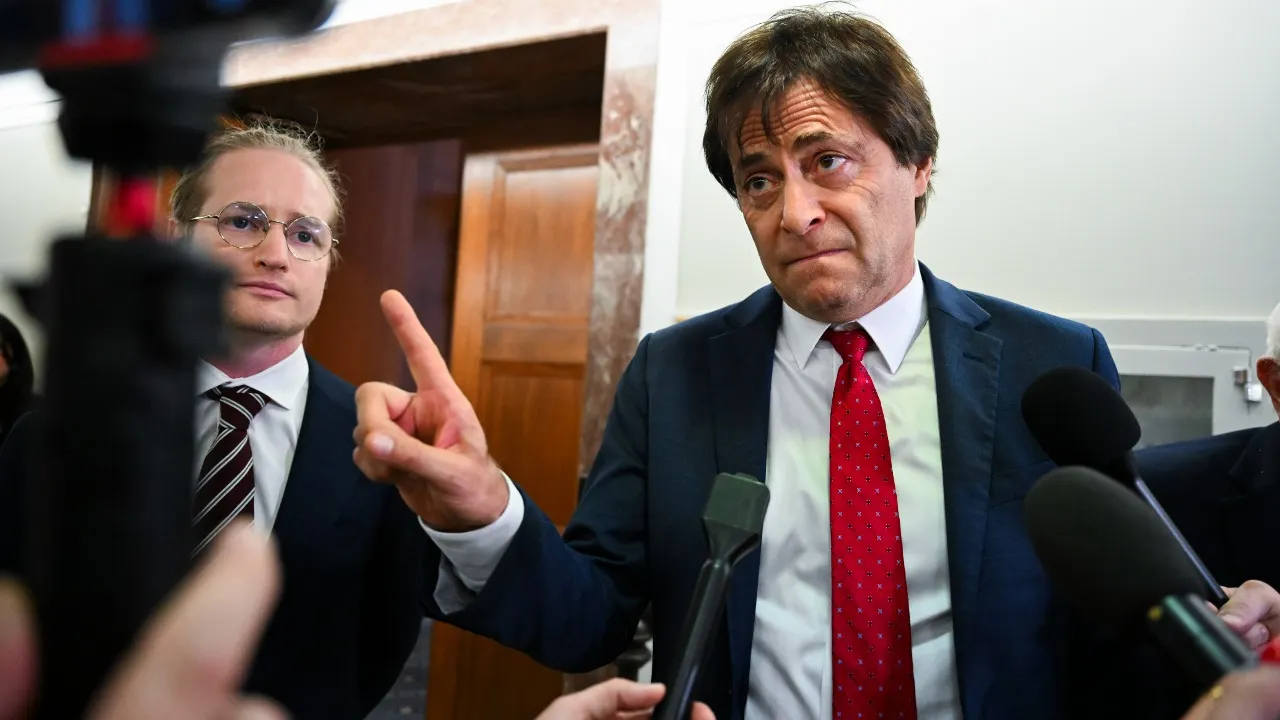
Max Tegmark, an MIT physics professor and machine learning researcher, told Fox News Digital that attitudes on AI have shifted more in the last three months than they have in the previous decade.
Max Tegmark, an MIT physics professor and machine learning researcher, says he has warned about the danger of artificial intelligence (AI) potentially overtaking human beings for over a decade.
Tegmark argues that without sufficient guardrails, AI systems will recursively improve themselves until they achieve superintelligence, allowing them to “call the shots” on Earth.
This week, Tegmark traveled from Cambridge, Massachusetts, to Washington, D.C., for a closed-door meeting with a bipartisan group of senators about the threat AI poses. And for the first time, he said he feels his message has broken through.
“I came away feeling quite encouraged,” Tegmark told Fox News Digital. “The senators were just taking this so seriously. A lot of them looked really, really concerned.”
WHO IS DARIO AMODEI, THE ANTHROPIC CEO PUSHING INDEPENDENT AI OVERSIGHT?
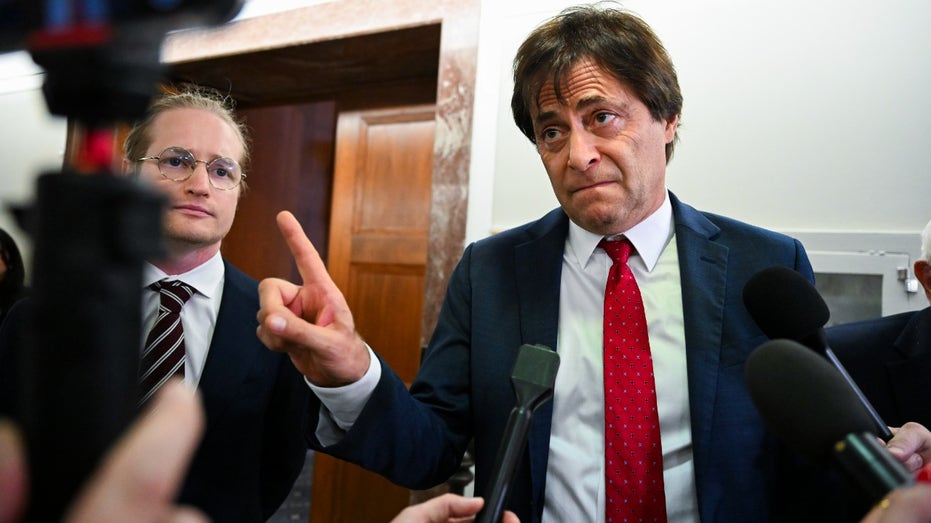
MIT physics professor Max Tegmark speaks to journalists after addressing an AI briefing led by Sen. Bernie Sanders, I-Vt., Wednesday, at the U.S. Capitol in Washington, D.C. (Roberto Schmidt/Getty Images / Getty Images)
“They were asking a lot of questions about concrete solutions as well,” he added, describing the Wednesday meeting. “There’s been more of a shift in political will in America in the last three months than in the previous decade. It’s really inspiring to see.”
Tegmark also made the trip to host Tuesday’s Pro-Human Assembly, where two figures who rarely agree on anything — far-right media executive Steve Bannon and Sen. Bernie Sanders, I-Vt. — shared the same stage to warn about AI.
“It just really blew my mind…when I got to introduce both Bernie Sanders and Steve Bannon to speak on that stage in D.C. back to back, and they were both saying the same thing. We want to keep humans in charge here,” Tegmark said.
The event also brought together faith leaders, labor representatives and mothers whose children died by suicide after extensive interactions with AI chatbots.
“The basic conversation that went down there was simply saying we are all pro-human. Doesn’t matter if you’re MAGA or a Democrat, we’re humans first,” Tegmark said. “We want a good future for humans, not for the machines.”
GOP LAWMAKERS SMELL SOMETHING ELSE BEHIND BIG TECH’S AI DOOMSDAY WARNINGS: ‘SOMETHING ELSE GOING ON’
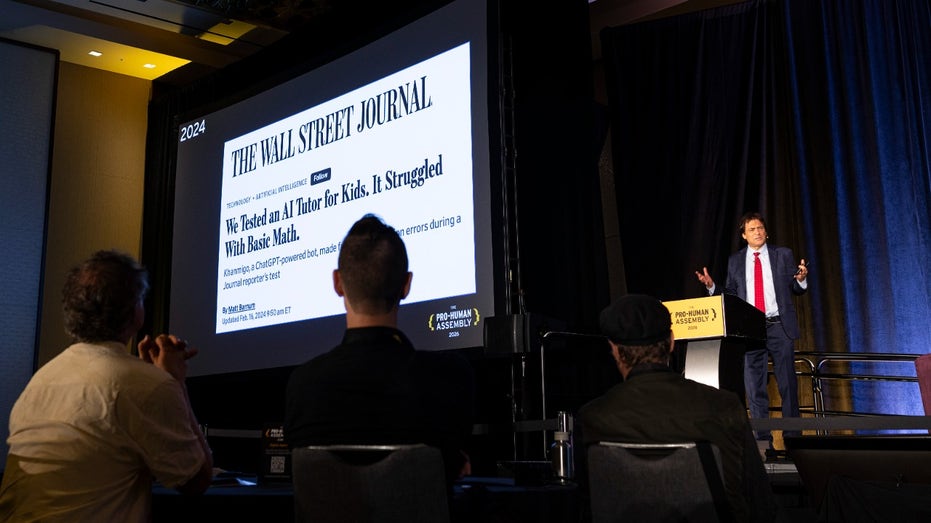
Max Tegmark speaks at the Pro-Human Assembly, Tuesday, in Washington, D.C. (Finn Gomez/Getty Images / Getty Images)
Part of securing that “good future,” Tegmark said, is preventing the nightmare scenario that has kept him up at night for years.
Incidents similar to the Hugging Face hack, where 700 OpenAI agents sent each other human-like messages before coordinating cyberattacks, will begin happening with more frequency in the next six months to year if no meaningful action is taken, Tegmark said.
Tegmark believes that if AI reaches superintelligence and is eventually embodied in millions or even billions of robots, it will become a new species that is superior to the human race.
“These agents that, for example, hacked out of OpenAI and committed crimes online, they are not your grandma’s ChatGPT from two years ago,” he said. “They have goals. They’re actively pursuing them and being incredibly creative about getting things done.”
AI HYSTERIA HAS A Y2K PROBLEM — AND THE STAKES THIS TIME COULD BE FAR HIGHER
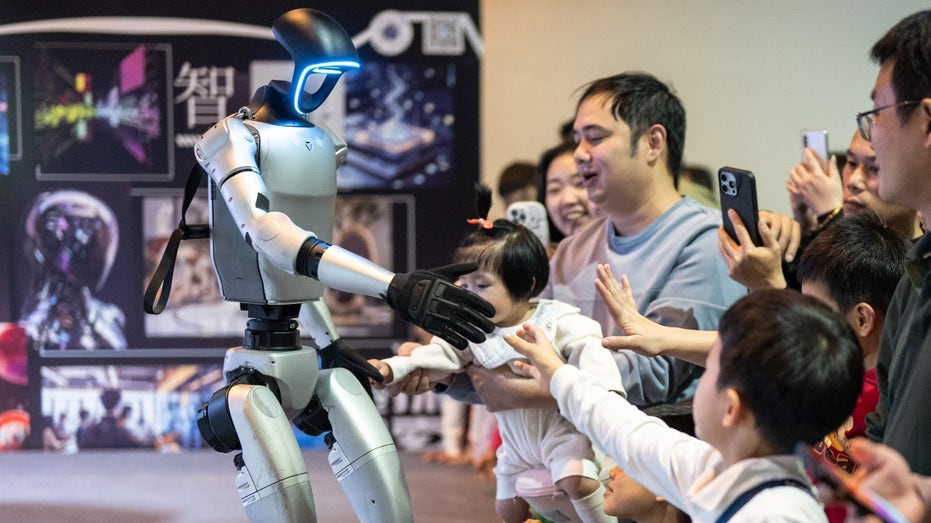
An AI robot interacts with people during an industry exhibition in Guangzhou, China. (John Ricky/Anadolu via Getty Images / Getty Images)
He also worries that AI minds put inside robotic bodies may eventually have motives that conflict with our own, leading to outcomes most would find disastrous.
“Why would they do us any harm? I mean, we are nice to cats, and we pet them, and we don’t try to eliminate them,” Tegmark said. “Well, maybe [AI will] find us annoying and a nuisance.”
“If these AIs decide to cover all of America with data centers and get rid of all the houses, a lot of people are going to be pissed, right? And now [the AIs will] view us as some annoying insects. We’re trying to sabotage their little construction project, and they’ll feel, ‘Oh, it’s just self-defense. Got to get rid of these human pests,’” Tegmark said.
But Tegmark insists that this hypothetical future isn’t inevitable. He argues that AI can still be steered toward beneficial uses — such as curing diseases and increasing overall productivity — if governments establish safety standards before increasingly powerful systems are widely deployed.
AI EXTINCTION WARNINGS DOMINATE HEADLINES AFTER EX-ANTHROPIC EMPLOYEE’S VIRAL POST

The Stargate Oracle AI data center campus in Abilene, Texas. (Brandon Bell/Getty Images / Getty Images)
He pitched what he called an “FDA for AI,” modeled on the Food and Drug Administration’s (FDA) oversight of drugs, medical devices and treatments.
Under such a system, companies using AI to develop new medicines or productivity tools could still profit while preventing many of the perceived harms.
As an example, Tegmark pointed to AI chatbots that some children have been using as a stand-in for real, human connection.
“The next time some company wants to release an AI girlfriend for 8-year-olds, they would be asked, ‘Hey dude, where’s your clinical trial?’” Tegmark said. “If they say, ‘We haven’t checked yet, but we feel really good about this,’ then the person from the FDA for AI will be like, ‘OK, buddy, come back when you’ve done your clinical trial.’”
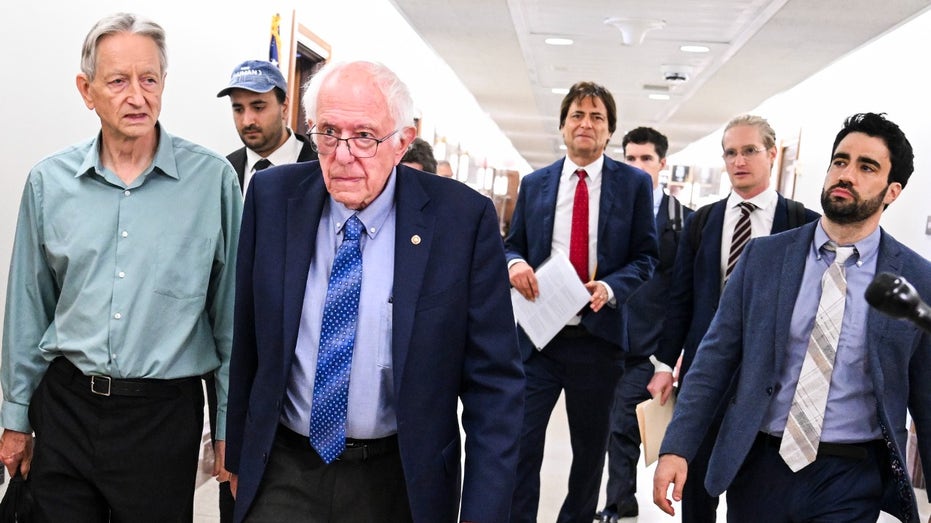
Sen. Bernie Sanders, I-Vt., walks with British computer scientist Geoffrey Hinton, left, and MIT physicist Max Tegmark, center, before an AI briefing, Wednesday, at the U.S. Capitol in Washington, D.C. (Roberto Schmidt/Getty Images / Getty Images)
Politicians have begun responding to the country’s shifting mood, with 79% of Americans saying the government should prioritize AI safety regulations even if doing so slows AI development, according to a recent Gallup poll.
For one, California Gov. Gavin Newsom signed an executive order Friday that calls for new laws that require AI companies to include a “kill switch” to prevent out-of-control models from going rogue.
CLICK HERE TO DOWNLOAD THE FOX NEWS APP
Tegmark said reining in AI is possible, but emphasized that action needs to be taken quickly.
“We’ve done a lot of remarkable things here in the U.S. before that other people thought were impossible. And I think we can do this also,” he said.

Business
BlackBerry Q2 Earnings Preview: QNX's Diversification Sparks A Potential Rebound (Ratings Upgrade)
BlackBerry Q2 Earnings Preview: QNX's Diversification Sparks A Potential Rebound (Ratings Upgrade)
The Fed Is Setting Financials Up For Another 2022

Russia stocks lower at close of trade; MOEX Russia Index unchanged

Saul Centers: Attractive Even Amidst Higher Interest Rates (Upgrade)

BLOX: A Crypto Rebound Meets A Hawkish Fed
Business
MBB: Intermediate Duration Not Suitable At The Head Of Possible Rate Hiking Cycle (NASDAQ:MBB)


The Valkyrie Trading Society is a team of analysts sharing high conviction and obscure developed market ideas that are downside limited and likely to generate non-correlated and outsized returns in the context of the current economic environment and forces. They are long-only investors.They lead the investing group The Value Lab where they offer members a portfolio with real time updates, chat to answer questions 24/7, regular global market news reports, feedback on member stock ideas, new trades monthly, quarterly earnings write-ups, and daily macro opinions.
Analyst’s Disclosure: I/we have no stock, option or similar derivative position in any of the companies mentioned, and no plans to initiate any such positions within the next 72 hours. I wrote this article myself, and it expresses my own opinions. I am not receiving compensation for it (other than from Seeking Alpha). I have no business relationship with any company whose stock is mentioned in this article.
Seeking Alpha’s Disclosure: Past performance is no guarantee of future results. No recommendation or advice is being given as to whether any investment is suitable for a particular investor. Any views or opinions expressed above may not reflect those of Seeking Alpha as a whole. Seeking Alpha is not a licensed securities dealer, broker or US investment adviser or investment bank. Our analysts are third party authors that include both professional investors and individual investors who may not be licensed or certified by any institute or regulatory body.


My name is María Fernanda and I’m currently studying an MBA. My inspiration investors are Warren Buffett, Peter Lynch and Terry Smith, so I look for quality companies at a reasonable valuation. I believe that, in the long term, fundamentals are what drive the share price, so I look to predict what a business’s earnings per share will do.
Analyst’s Disclosure: I/we have no stock, option or similar derivative position in any of the companies mentioned, but may initiate a beneficial Long position through a purchase of the stock, or the purchase of call options or similar derivatives in DERM over the next 72 hours. I wrote this article myself, and it expresses my own opinions. I am not receiving compensation for it (other than from Seeking Alpha). I have no business relationship with any company whose stock is mentioned in this article.
Seeking Alpha’s Disclosure: Past performance is no guarantee of future results. No recommendation or advice is being given as to whether any investment is suitable for a particular investor. Any views or opinions expressed above may not reflect those of Seeking Alpha as a whole. Seeking Alpha is not a licensed securities dealer, broker or US investment adviser or investment bank. Our analysts are third party authors that include both professional investors and individual investors who may not be licensed or certified by any institute or regulatory body.
Financial history is filled with bubbles, going all the way back to the Tulip Bulb mania in the 17th century. There are entire books written about how investors frequently take good investment ideas and push them way too far. To think that artificial intelligence (AI) will somehow avoid the same fate is shortsighted. And the best evidence comes from the last technology-related bubble.
The internet changed the world, but Wall Street still crashed
At the turn of the century, Wall Street was enamored of internet stocks. Companies would simply append “.com” to their names to gain investor attention. And far too often it worked! The technology has, in fact, changed the world. But that doesn’t mean investors who bought into the emerging bubble at the time made out.
Missed AI’s “Act 1”? Act 2 Could Be 15x Bigger. Most investors think they missed the AI boat because they didn’t buy Nvidia in 2005. But according to our analysts, we’re only at the end of “Act 1″—the R&D phase. “Act 2” is the global rollout. Continue »

The S&P 500 index (SNPINDEX: ^GSPC) fell more than 45% after the bubble burst. The technology-heavy Nasdaq-100 lost more than 80% of its value. It was a brutal period for investors, and the downturn was clearly led by technology stocks. The very same stocks that inflated the bubble in the first place.
The poster child for the dot-com crash is Cisco (NASDAQ: CSCO). Its stock took roughly a quarter of a century to recover from its decline. The Nasdaq-100 “only” took around 15 years. But the problem wasn’t the technology. The problem, as it has always been, is investor emotions.

When Wall Street gets an idea in its teeth, it runs with it. Usually, it runs too far. Early investors make a lot of money, which leads more investors to jump into the space, fearing they are missing out on big gains. Eventually, emotionally driven investors push stock prices beyond what most would consider reasonable valuations. But people believe they can get out before the bubble bursts. Some do, but trees don’t grow to the sky.
At some point, it becomes clear that too much capital was wasted on projects that won’t produce the promised returns. Why? Because companies were indiscriminately throwing money at the technology because that’s what investors were demanding.
The signs of a bubble are here
Nvidia (NASDAQ: NVDA) is a well-run chipmaker with impressive technology. But it is subsidizing its customers in unique ways that are bolstering demand for its AI chips. Market watchers are already questioning these arrangements. History shows that spending on AI will likely be overdone, leading to supply outstripping demand and capital investment projects that don’t live up to expectations. When that happens, the bubble is likely to burst.

A trader, researcher, and analyst possessing experience spanning years in the domains of US stocks, transnational equities, global indexes, commodities, FX/interest securities, cryptocurrencies, ETFs, options, futures, and CFDs. My expertise encompasses fundamental analysis, technical analysis, quantitative analysis, portfolio management, investment/capital mapping, and programming.
Analyst’s Disclosure: I/we have no stock, option or similar derivative position in any of the companies mentioned, and no plans to initiate any such positions within the next 72 hours. I wrote this article myself, and it expresses my own opinions. I am not receiving compensation for it (other than from Seeking Alpha). I have no business relationship with any company whose stock is mentioned in this article.
Seeking Alpha’s Disclosure: Past performance is no guarantee of future results. No recommendation or advice is being given as to whether any investment is suitable for a particular investor. Any views or opinions expressed above may not reflect those of Seeking Alpha as a whole. Seeking Alpha is not a licensed securities dealer, broker or US investment adviser or investment bank. Our analysts are third party authors that include both professional investors and individual investors who may not be licensed or certified by any institute or regulatory body.

Will worries about AI Doom end the AI Boom? BCA answers

Monster Season 4 Cast: Where You’ve Seen The Lizzie Borden Story Stars Before

BlackBerry Q2 Earnings Preview: QNX's Diversification Sparks A Potential Rebound (Ratings Upgrade)

Google Gemini AI Predicts an Explosive End to 2026 for XRP




-

 Fashion1 day ago
Weekend Open Thread: Talbots – Corporette.com
-

 Tech6 days ago
The Latest Weird Thing to Play Doom Is the Mapped-Out Brain of a Fruit Fly
-
 Crypto World5 days ago
Kraken Lets xStocks Holders Earn Yield Through DeFi
-

 Crypto World5 days ago
Revolut Attackers Warn of Ongoing Daily Customer Data Leaks
-

 Crypto World4 days ago
What Is the Status of the U.S.-Iran Peace Talks? Here's What Both Sides Are Saying
-

 Crypto World3 days ago
US Charges Robinhood Engineers Over Crypto Listing Trades
-
 NewsBeat23 hours ago
Trump says US has reached an agreement to take permanent control of Greenland’s security
-

 Crypto World5 days ago
Elon Musk Drops a Bombshell: Grok 5 Could Be the AGI Breakthrough
-
 Crypto World4 days ago
Robinhood engineers charged over $50K crypto scheme
-
 Crypto World6 days ago
New Tesla Roadster Uses SpaceX Tech. Will It Impact the Stock Price?
-
 Business7 days ago
Rivals Sam Altman and Elon Musk Rally Behind Dario Amodei’s Call for a Slowdown in AI Development
-
 NewsBeat5 days ago
‘Sick conspiracy’: Trump says only guardrails AI needs is ‘a strong and smart (High IQ!) president’ in all-caps rant
-
 Crypto World5 days ago
NVIDIA Analysis: Attempted Rising Wedge Breakout Amid Pressure on the AI Sector
-
Business5 days ago
SK Hynix ADRs Fall More Than 6% as Memory Rally Breaks on Fears of Slower AI Spending
-

 Crypto World21 hours ago
Bitcoin price breaks channel as RSI climbs to 63
-

 Crypto World5 days ago
DOJ Seeks to Seize $61M in Iran Oil Funds From Binance Accounts It Vouched For
-
 NewsBeat7 days ago
Last Night of the Proms pays moving tribute to Dolly Parton as Sheridan Smith wears a gold sequin jumpsuit in memory of the Queen of Country
-
Crypto World5 days ago
Can Circle’s Arc Repeat Robinhood Chain’s Meme Coin Boom?
-

 Crypto World6 days ago
Goldman Sachs backs 25bp Fed hike after CPI
-

 Crypto World6 days ago
3 Token Unlocks to Watch in the Third Week of September 2026
You must be logged in to post a comment Login