
Business
Mortgage rates rise to 6.71%: Freddie Mac


Payne Capital Management President Ryan Payne joins ‘Mornings with Maria’ to discuss the surge of private equity in sports. Billionaires like Jeff Bezos and Bob Iger are investing billions as professional sports team valuations skyrocket.
Mortgage rates rose to the highest level in more than a year, mortgage buyer Freddie Mac said Thursday.
Freddie Mac’s latest Primary Mortgage Market Survey, released Thursday, showed the average rate on the benchmark 30-year fixed mortgage rose to 6.71% from last week’s reading of 6.66%. It was the highest reading since July 31, 2025, when the average rate on the 30-year fixed mortgage was 6.72%.
The average rate on a 30-year loan was 6.5% a year ago.

The average rate on the 30-year fixed mortgage rose to 6.71% on Thursday, according to Freddie Mac. (Daniel Acker/Bloomberg via Getty Images)
SLOWING LABOR MARKET CREATES NEW HURDLE FOR FIRST-TIME HOMEBUYERS FACING AFFORDABILITY SQUEEZE
“Purchase demand has remained relatively stable indicating steady interest from buyers adapting to evolving market conditions,” said Sam Khater, Freddie Mac’s chief economist.
The average rate on a 15-year fixed mortgage rose to 6.04% from last week’s reading of 5.98%.
GET FOX BUSINESS ON THE GO BY CLICKING HERE
Mortgage rates are affected by several factors, including the Federal Reserve and geopolitics. Though mortgage rates are not directly affected by the Fed’s interest rate decisions, they closely track the 10-year Treasury yield. The 10-year yield hovered around 4.74% as of Thursday afternoon.

Mortgage rates are affected by several factors, including the Federal Reserve and geopolitics. (Al Drago/Bloomberg via Getty Images)
Mortgage rates have risen since the start of the conflict between the U.S. and Iran earlier this year.
“The Middle East conflict has put upward pressure on oil prices, fueling inflation and pushing it further from the Fed’s 2% target,” said Realtor.com senior economist Jiayi Xu. “When the conflict appeared to be nearing resolution, bond yields declined and mortgage rates followed suit. But the latest escalation in Middle East tensions has driven oil prices higher, reviving inflation concerns and pushing yields and mortgage rates back up.”

Business
iPhone 18 Pro’s A20 Chip Leak Points To 7-Core GPU, 18% Speed Boost Ahead Of Sept. 9 Launch Event In Cupertino

CUPERTINO, Calif. — A new wave of leaks surrounding Apple’s upcoming A20 Pro processor suggests the chip powering the iPhone 18 Pro lineup could deliver a significant jump in graphics performance, just days before Apple is expected to formally unveil the new devices at its Sept. 9 launch event.
The leaks stem primarily from a Weibo user known as “Fried White Rice,” who reconstructed an alleged layout of the A20 Pro chip by mapping the positions of solder balls on a circuit diagram and overlaying them with die-level imagery. While this type of indirect analysis is far from an exact science, several outlets covering the leak noted that the account has a degree of credibility based on prior reporting.
According to the reconstructed diagram, the A20 Pro is expected to feature a seven-core GPU, up from the six-core graphics configuration found in the current A19 Pro chip, representing roughly a 16% increase in the number of graphics cores. The layout also points to a wider 96-bit memory interface for LPDDR5X RAM, a substantial jump from the 64-bit interface used in the prior generation, a change that would meaningfully expand the chip’s available memory bandwidth.
Because graphics performance tends to scale closely with memory bandwidth, several outlets covering the leak suggested that the combination of an additional GPU core and a 50% wider memory interface could translate into graphics performance gains considerably larger than the core count increase alone would suggest. Macworld’s analysis of the leak estimated that, when accounting for both the added core and the wider memory bus, real-world GPU performance gains could land somewhere in the range of 20% to 30%, though the outlet cautioned that such projections remain speculative pending official confirmation from Apple.
The leaked diagram also pointed to changes in the chip’s cache memory architecture. According to the analysis, the smaller efficiency CPU cores are expected to share an 8-megabyte Level 2 cache, up from 6 megabytes on the A19 Pro, while the chip’s more powerful performance cores are expected to retain an unchanged 16-megabyte L2 cache. The overall CPU core configuration is expected to remain consistent with the prior generation, featuring two high-performance cores paired with four efficiency cores.
Separately, a specific performance figure has circulated from another Weibo-based leaker, Fixed Focus Digital, who claimed in supply-chain commentary that the A20 Pro would run up to 18% faster than the A19 Pro while delivering up to 30% better power efficiency. That figure has been cited widely across coverage of the chip, though it has also drawn scrutiny from some technology analysts.
Writing for Yellow, technology journalist Jason Cross pushed back on how the 18% figure has been broadly interpreted, arguing that the number more likely describes performance characteristics of TSMC’s underlying 2-nanometer manufacturing process rather than representing a confirmed, chip-specific performance benchmark for the A20 Pro itself. The A20 Pro is expected to be the first Apple processor built on TSMC’s 2-nanometer node, replacing the 3-nanometer process used in Apple’s current generation of chips, and Apple is expected to be among the first major customers to use that new manufacturing process at scale.
Beyond performance figures, the leaks also point to a broader restructuring of the chip’s physical packaging. Reports have suggested Apple plans to integrate RAM more closely with the CPU, GPU and Neural Engine using TSMC’s Wafer-Level Multi-Chip Module packaging technology, a change from the current design in which memory dies are stacked. Under the new approach, memory dies would instead be placed beside the main system-on-chip rather than stacked directly on top of it.
The leaked die imagery did not include clearly labeled details for the chip’s Image Signal Processor or Neural Engine components, leaving their exact size and configuration unconfirmed based on the available images. Some analysts covering the leak speculated that the Neural Engine could see a substantial size increase in this generation, potentially even doubling in scale, drawing a comparison to a similar expansion Apple made to its Neural Engine architecture within its M6 chip used in Mac computers.
The A20 Pro is expected to power both the standard iPhone 18 Pro and the larger iPhone 18 Pro Max, and is also rumored to be used, potentially in a modified configuration, within Apple’s long-anticipated first foldable iPhone, sometimes referred to in early reporting as the iPhone Ultra. Given the thinner form factor and more constrained thermal environment expected within a foldable device, some analysts have suggested Apple could disable one of the chip’s GPU cores in that specific model to manage heat and battery life, a pattern the company has followed previously with other space-constrained device variants, such as its decision to disable one A19 Pro GPU core within the iPhone Air.
Cost estimates tied to the new chip have also circulated alongside the performance leaks. According to reporting cited by Yellow, Apple may pay close to $280 per A20 chip unit, representing an increase of roughly 80% compared with what the equivalent A19 chip reportedly cost the company, a jump that reflects both the more advanced manufacturing process and the added complexity of the chip’s new packaging approach.
Apple has not confirmed any of the technical specifications circulating in these pre-launch leaks, and as with all unofficial supply-chain and circuit-diagram-based reporting, the details should be treated as informed speculation rather than confirmed fact until Apple formally unveils the new devices. The company is widely expected to introduce the iPhone 18 Pro, iPhone 18 Pro Max, and potentially its first foldable iPhone alongside at least seven other new devices during its scheduled Sept. 9 event.
Should the leaked specifications prove accurate, the resulting graphics performance improvements could meaningfully benefit demanding mobile games, graphics-intensive applications, and on-device artificial intelligence processing tied to Apple’s ongoing Apple Intelligence initiative, an area where the company has increasingly emphasized the importance of local, on-device computing power rather than relying solely on cloud-based processing. Independent testing following the device’s official release will ultimately be needed to confirm whether the new A20 Pro chip delivers on the performance gains suggested by this week’s leaked circuit diagrams.

Goldman Sachs chief economist Jan Hatzius previews the upcoming July CPI inflation report and discusses the Federal Reserves interest rate trajectory, and the state of the U.S. economy on ‘The Claman Countdown.’
EXCLUSIVE: Goldman Sachs is making progress on its new 800,000-square-foot campus in Dallas as it deepens its presence in the city, which has emerged as a key regional financial hub.
The firm has a longstanding presence in the Dallas metro area, where it has its second-largest base of employees in the U.S. behind only its New York City headquarters, and the new campus will allow Goldman Sachs to combine two offices into one facility where all the firm’s various business units can be situated and collaborate.
Ericka Leslie, chief administrative officer at Goldman Sachs, told FOX Business in an interview after visiting the new campus in Dallas as construction continues that “I can’t say it enough, I think Dallas is a great place to do business, it really is. The building is beautiful.”
“We’re in two buildings now, we’re going to be able to combine everybody into this state-of-the-art space, and it’s right next to the Perot museum, and the city itself is very vibrant. So we’re looking forward to it, and we’re going to grow there,” Leslie said. “It’s a growth opportunity for us inside of the United States, and it’s a really vibrant place to do business.”
WHY MAJOR FINANCIAL FIRMS ARE EXPANDING TEXAS PRESENCE BEYOND TRADITIONAL WALL STREET HUB
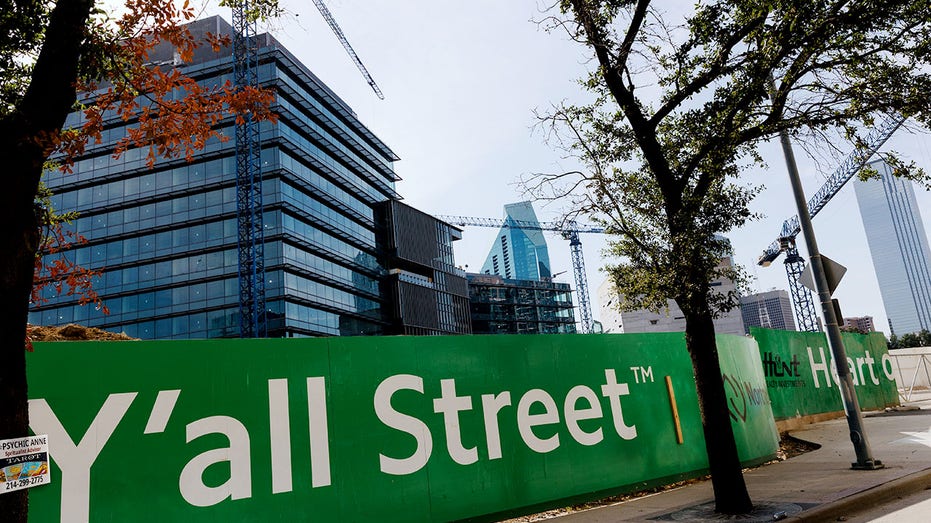
The new Goldman Sachs campus in downtown Dallas is under construction, with a projected opening in January 2028. (Shelby Tauber for The Washington Post via Getty Images)
The new campus will include an auditorium as well as a wide range of amenities, including a wellness center, fitness facility, a backup daycare, multiple spaces offering cafeteria or cafeteria-like services, a coffee bar and outdoor spaces with trees and shade.
Employees will be able to park underneath the building and a retail space will be built across the street that offers additional options nearby for those working at the new campus.
“I find people want to leave their desk, so to speak, and go to another place, but maybe they only have 30 minutes free, and they want to grab a coffee or have a conversation with people,” Leslie said.
“There are a lot of places where you can meet up and sit down and be outside or be inside. And I think that’s really important to people because it gets hot there in the summer, people don’t want to have to walk around outside, it’s completely air-conditioned.”
GOLDMAN SACHS TO CONTRIBUTE $1,000 TO TRUMP ACCOUNTS FOR ELIGIBLE CHILDREN OF EMPLOYEES

The new campus will offer views overlooking downtown Dallas and the Perot Museum, including from outdoor areas. (Goldman Sachs)
The new campus will also have a park outside that’s about an acre and a half in size, which Leslie said crews were working on when she visited the site.
“The outside of the building is mostly complete, and they have to do that in order to start fitting out the inside of the building and air conditioning it, so that will begin fairly shortly. We’re looking for a launch around January 2028,” Leslie said.
She noted that stiff competition for work crews amid the construction boom in the Dallas area has contributed to some delays, though the new campus is still expected to open on schedule.
“The project is mostly on time. It’s slightly delayed, there’s quite a bit of development going on in Dallas right now, and so we’re seeing small delays,” she said, adding that the company expects to be occupying the space in January 2028.
Y’ALL STREET LAUNCHES: TEXAS STOCK EXCHANGE GOES LIVE IN DALLAS

The new Goldman Sachs campus in Dallas will allow the firm to consolidate and grow its presence in the region. (Goldman Sachs)
Leslie noted that Goldman Sachs was one of the firms that contributed to the launch of the Texas Stock Exchange in Dallas, which went fully live for the first time in late July, while other companies are looking to move into the area or are considering doing so.
She added that as more companies are attracted to downtown Dallas, she sees the city becoming more of an urban center with people choosing to live within the city rather than commuting in from the suburbs.
Goldman Sachs CEO David Solomon told CNBC in an interview this week that the firm’s headcount in New York City has remained at a little less than 10,000 and hasn’t grown in about 20 years, while it has expanded its overall U.S. headcount with growth in places like Dallas and Salt Lake City. Solomon said that “talent plays a role in it – where is talent available – but also policy, taxes, environment.”
| Ticker | Security | Last | Change | Change % |
|---|---|---|---|---|
| GS | THE GOLDMAN SACHS GROUP INC. | 1,035.52 | +30.92 | +3.08% |
Leslie echoed that sentiment, telling FOX Business that “We like to go to places where you can attract young talent, and New York has always been a place where people want to work when they first get out of college.”
“But I was really surprised walking the Katy Trail [in Dallas] and seeing the number of people that are just starting out in their careers and out walking, getting exercise. I can’t emphasize this enough, there were thousands of people – I almost couldn’t make my way, I had to keep going around people,” she said. “It was a really nice thing to see.”
GET FOX BUSINESS ON THE GO BY CLICKING HERE
“I think more and more you’re going to end up seeing places where you’ve got really robust talent pools, you have a lot of universities, and it’s going to be a place where we’re going to attract young people,” Leslie added. “I think Dallas has a really bright future.”


The San Francisco 49ers and the Los Angeles Rams are heading to Australia, marking the longest-ever distance two NFL teams have traveled for a game.
It’s all part of the league’s push to expand American football globally. A record nine international regular-season games will be played in 2026 – kicking off in Melbourne, the city’s first NFL game, and followed by inaugural match-ups in Rio de Janeiro and Paris. The schedule also brings professional football to London, Madrid, Munich and Mexico City.
NFL owners have already approved 10 international games for the 2027 season – the maximum number of games the league can play outside the United States per its current collective bargaining agreement with players.
While NFL games are consistently the most-watched programming on television, the vast majority of the league’s interest is American. For some context, last year’s Week 1 game in Sao Paulo, Brazil — streamed on YouTube — between the Kansas City Chiefs and the San Diego Chargers drew 18.5 million viewers in the U.S. and just 1.2 million viewers internationally.
That delta is what’s driving NFL Commissioner Roger Goodell to seek global growth. Goodell has previously said he’d like to have up to 16 international games on the schedule. He also recently said he had “no doubt” a team would eventually be permanently located outside the U.S.
NFL boss Roger Goodell speaks at a press conference before Super Bowl LX between the Seattle Seahawks and the New England Patriots.
Maximilian Haupt | Picture Alliance | Getty Images
“We are committed to continue to grow every year in what we’re doing,” NFL Executive Vice President Peter O’Reilly said in a conference call for reporters on Wednesday. “We learn in each new market and then build upon that. That will be true as we move forward. As the commissioner said, we have aspirations to go beyond that. We want to do it the right way – to go to the right markets at the right time.”
The NFL has a designed strategy to grow the game internationally. One key part is the league’s relatively little-known Global Markets Program. Launched in 2022, the program gives NFL teams specific international marketing rights to build brand awareness and fandom.
Every team owns at least one market. When games are played abroad, the teams that own those markets are the de facto “home team.” The Rams own marketing rights in Australia. Later this year, when the 49ers play in Mexico – a region where they own rights – they’ll be the home team.
NFL clubs can apply for rights to international markets by submitting proposals to the International Committee for review each spring. The markets are often mildly based on geography. For example, the Rams own marketing rights in countries more easily accessible by West Coast teams, such as Australia, China, Japan, South Korea, New Zealand and — like the 49ers — Mexico. It also owns rights in the United Arab Emirates.
Other franchises’ rights are more driven by their specific owners’ wishes. The Detroit Lions own Austria, Brazil, Canada, Germany and Switzerland. The Los Angeles Chargers have Greece – and only Greece. Chargers owner Dean Spanos has Greek heritage.
The NFL has chosen a team-led strategy to grow fandom internationally because it wants buy-in from its franchise owners, O’Reilly said.
“It’s one part of a larger strategy,” O’Reilly said. “Having a favorite team is a key driver of lifelong fandom. Giving the clubs the option to apply, you want them to align with markets they’re going to get behind. For the vast majority, those markets align with the markets we’re committed to. It allows clubs the freedom to tailor to their priorities … working with our folks on the ground. “
Entering this season, 62 regular-season NFL games have been played outside the United States.
But there’s no certainty the NFL’s international strategy will significantly increase the sport’s popularity.
Some of the challenge lies in time zone differences. Primetime games timed for a U.S. market mean taking the field in the middle of the night in Europe and in the morning in Australia.
The Rams and Niners are kicking off at 10:35 a.m. local time on a Friday next week.
It’s difficult to grow a sport globally when start times need to cater toward Americans. The NFL has found 9:30 a.m. ET to be a sweet sport start time for European games – but TV ratings for those games have consistently been lower than Sunday afternoon and night contests.
It’s also an open question of just how popular this international movement is with players, who must take long plane rides and battle jet lag with time differences.
While the 49ers left Wednesday for Australia, the Rams aren’t arriving in the country until next week, 24 hours before game time.

Alibaba vs. Meituan: quality value against model-based upside

A ChargePoint electric vehicle charging station in Hudson, New York, US, on Tuesday, Sept. 3, 2024.
Angus Mordant | Bloomberg | Getty Images
ChargePoint Holdings CEO Rick Wilmer believes a surge in the electric vehicle charging company’s stock Thursday is just “the beginning of the momentum,” he told CNBC.
Shares of ChargePoint increased more than 70% during afternoon trading after the company significantly beat Wall Street’s second-quarter expectations for its 2027 fiscal year and guided toward continued improvements in its performance.
It’s the most notable increase since it underwent a reverse stock split last year to raise its share price and maintain compliance with the New York Stock Exchange’s minimum trading price requirement of $1 per share.
“The growth is starting to accelerate,” Wilmer told CNBC during an interview Thursday morning. “It’ll be driven substantially by the new products and technology we’re putting into the market.”
ChargePoint, unlike some EV charging companies, does not actually own and operate its chargers. It provides hardware, software and services to customers, such as businesses, that want to offer chargers to their employees or customers.
The company after markets closed Wednesday reported revenue of $116.1 million and a loss per share of 35 cents during the quarter. That compared with analyst expectations of $105.2 million in revenue and a loss of 85 cents, according to average estimates compiled by LSEG.

ChargePoint stock over one day
Its performance was assisted by a one-time tariff refund of approximately $4.2 million in the quarter, but the company said its normalized gross margin would have still set a new record without the benefit.
“We’ve now had our fourth consecutive quarter of year-over-year growth, and this quarter we just reported yesterday was obviously another good growth quarter,” Wilmer said. “And now [we’re] expecting that to accelerate, especially as we move into next year.”
As part of its growth plan, the company has been introducing faster high-performance chargers, known as “Level 3,” in Europe, as well as next-generation products for the U.S., including Level 2 and Level 3 chargers.
The company also is using artificial intelligence to improve charging times for its customers, reduce how long it takes to develop software and improve efficiency across its business, Wilmer said.
Wilmer’s optimism comes despite a slowdown in all-electric vehicle sales during the past year, following the elimination of federal support for the industry in the U.S., including the end of an up to $7,500 consumer benefit for purchasing an EV.
“I think, altogether, the down cycle, or the doom and gloom, has been a bit overstated. I think there’s a lot more positivity at the ground level,” Wilmer said. “I just think in the end, better products can win.”
U.S. automakers are continuing to sell EVs, and demand in the used vehicle market is strong amid high gas prices, but the move to non-gas-powered vehicles has been significantly lower than many companies and analysts previously expected.
ChargePoint is toward the end of a three-year business plan spearheaded by Wilmer that focused on reducing cash burn and profits, including cutting net losses from $125.3 million three years ago to $35.6 million during its most recent quarter.
The company has not disclosed when it plans to be profitable, but Wilmer said the company is on its way to achieve a profit on an earnings before interest, taxes, depreciation and amortization basis.
“We’re approaching that quickly, and we want to get there ASAP,” he said Thursday.
ChargePoint’s third-quarter guidance for its 2027 fiscal year included revenue between $105 million and $115 million, which would be a mid-point increase of roughly 4% year-over-year.

Zoox CEO Aicha Evans discusses the launch of paid autonomous robotaxi rides in Las Vegas and addresses NHTSA safety concerns, vehicle production targets and plans for expanding the driverless service on ‘The Claman Countdown.’
Zoox announced Thursday that its driverless robotaxis will begin transporting passengers to and from Harry Reid International Airport in Las Vegas, marking the company’s first airport service.
The Amazon-owned company told FOX Business that, beginning Thursday, riders can book trips between Harry Reid International Airport and the Las Vegas Strip.
“Bringing autonomous transportation to one of the country’s busiest airports requires true partnership, and we are grateful to the Clark County Department of Aviation and the state of Nevada for their continued support as we help shape the future of mobility,” said Ron Thaniel, Zoox’s senior director of policy and regulatory affairs.

A Zoox robotaxi driving down the Las Vegas Strip in front of the Luxor Hotel & Casino. (Zoox Inc.)
WAYMO EXPANDS DRIVERLESS ROBOTAXI SERVICE TO 3 MAJOR US CITIES
Zoox will pick up and drop off passengers at designated curbside locations at the airport, with pickup and drop-off points varying by each of the two passenger terminals.
The robotaxis use lights and audio cues to help riders locate them in busy pickup areas, and passengers can pair their devices via Bluetooth to listen to their own music during the ride.
The vehicles seat four passengers and feature carriage-style seating, with two rows facing each other. The company said there is enough room for roughly one piece of luggage per person if the vehicle is full.

Zoox robotaxi drives down Las Vegas Boulevard. (Zoox Inc.)
ZOOX ROBOTAXI REDESIGN BRINGS BIG RIDER UPGRADES
On July 31, the National Highway Traffic Safety Administration granted Zoox a temporary exemption from certain federal motor vehicle safety standards, clearing a key regulatory hurdle for the company to begin charging for rides.
The exemption was necessary because the vehicles lack traditional driver controls, including a steering wheel and pedals, that are required under federal safety standards.
After receiving the federal government’s blessing, Zoox launched paid robotaxi rides in Las Vegas on Aug. 10. The company also operates in San Francisco, where its service remains in the testing phase.

Interior of a Zoox robotaxi, which has four seats.
CLICK HERE TO DOWNLOAD THE FOX NEWS APP
Destinations within the app include the Las Vegas Convention Center, the Sphere, the T-Mobile Arena and many major resorts on the Strip.
According to Zoox’s website, the company is looking to begin offering paid rides in 10 other cities, including Seattle, Austin, Dallas, Houston, San Diego and Los Angeles.


CAMDEN, NJ. — The Campbell’s Co. is adding electrolytes to its V8 Energy line. The V8 Energy with Electrolytes line is offered in drink mix sticks and ready-to-drink (RTD) canned formats.
The drink mixes are made with magnesium and vitamins A, C, E and B.
The RTD cans are formulated with potassium, electrolytes and B vitamins.
Both formats are available in lemon lime, strawberry passionfruit and white peach flavors, and each flavor contains 80 milligrams of caffeine.
The cans are available online through Amazon and Walmart. The drink mixes will launch online later this year. Both products will roll out in retailers in 2027, according to the company.
The launch follows the limited-time launch of V8’s yuzu lemon Energy with Electrolytes beverage in March.


We primarily focus on GARP (Growth at reasonable Price) opportunities in industrial, consumer, and technology sectors. Please click the “Follow” button to receive our latest research. If you have any questions, feel free to reach out to us through the comments section of our articles or SA messaging functionality.Closely associated with Harshit Krishali
Analyst’s Disclosure: I/we have no stock, option or similar derivative position in any of the companies mentioned, and no plans to initiate any such positions within the next 72 hours. I wrote this article myself, and it expresses my own opinions. I am not receiving compensation for it (other than from Seeking Alpha). I have no business relationship with any company whose stock is mentioned in this article.
Seeking Alpha’s Disclosure: Past performance is no guarantee of future results. No recommendation or advice is being given as to whether any investment is suitable for a particular investor. Any views or opinions expressed above may not reflect those of Seeking Alpha as a whole. Seeking Alpha is not a licensed securities dealer, broker or US investment adviser or investment bank. Our analysts are third party authors that include both professional investors and individual investors who may not be licensed or certified by any institute or regulatory body.
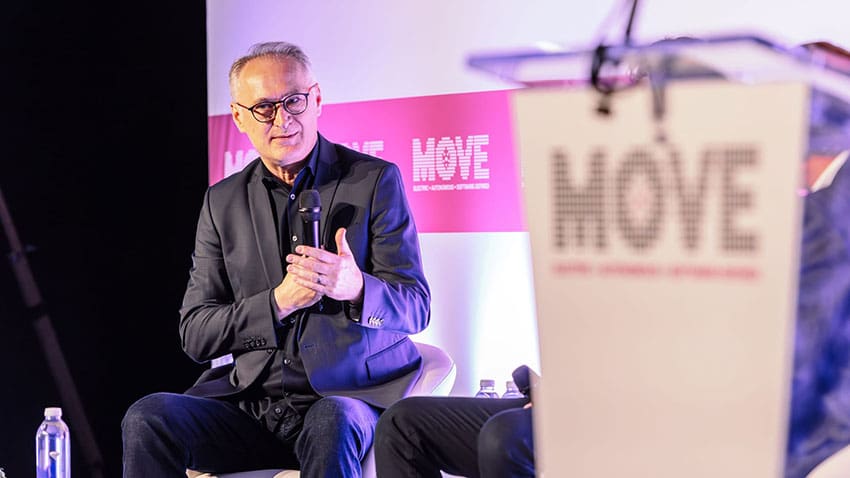
Big ideas are easy to describe. Making them work across complex products, global teams and large organizations is much harder.
That is where Ned Curic has spent much of his career.
Across nearly three decades, Curic has worked in aerospace, enterprise technology, software, connected vehicles and automotive product development. His career has included roles at Northrop Grumman, Microsoft, Toyota, Amazon and Stellantis.
Today, he is responsible for Product Development & Technology and is a member of the Stellantis Leadership Team.
The common thread across those roles is not simply innovation. It is the work required to turn new technology into systems that can operate reliably, integrate with other technologies and scale across real products.
How Ned Curic Built a Career Around Complex Systems
Curic began his career in 1996 in Engineering Systems at Northrop Grumman.
Aerospace and defense engineering leaves little room for disconnected thinking. Systems must work together. Decisions made in one area can affect performance elsewhere. Reliability, architecture and integration matter as much as individual components.
That systems perspective became useful as Curic moved into other industries.
After a short period in the financial sector, he joined Microsoft in 2000. His work there covered consulting, product, security and advisory roles.
The breadth mattered.
Product development is rarely only a software problem or only an engineering problem. Security, architecture, customer requirements, infrastructure and operating constraints all interact. Curic’s time at Microsoft gave him exposure to those different layers during a period of major change in enterprise technology.
Why Automotive Became a Systems and Software Challenge
Curic entered the automotive industry in 2013 as Group Vice President and Chief Technology Officer at Toyota Motor North America.
By then, vehicles were becoming more dependent on software, connectivity and data. That created a different engineering challenge.
A vehicle may contain many technologies, but customers experience one product. Software cannot be treated as an isolated feature. Hardware, software, data, interfaces and services need to work as a system.
For established manufacturers, this also creates an industrial challenge. New ideas have to move beyond demonstrations and prototypes. They have to meet requirements for reliability, safety, cost, manufacturing and long-term support.
That shift from individual technologies to integrated platforms became an important part of Curic’s automotive career.
Building Toyota Connected and New Product Capabilities
In 2015, Curic became Co-founder, Executive Vice President, Technical Director and Board Member of Toyota Connected.
The move reflected a broader change taking place across the automotive industry. Connected services were becoming part of the product itself, rather than an optional layer added after vehicle development.
Building that capability required more than developing individual applications.
Data systems, software platforms, customer experiences and vehicle technologies had to be connected. Teams with different disciplines also had to work across organizational boundaries.
The challenge was therefore both technical and operational: create new capabilities while making sure they could function inside the requirements of a global automotive business.
That experience placed Curic directly in the transition from traditional vehicle engineering towards more software-intensive product development.
Bringing Consumer Technology Into the Vehicle
Curic joined Amazon in June 2017 as Vice President of Alexa Automotive.
Voice technology had already gained traction in homes. Bringing it into vehicles created a different set of constraints.
Automotive systems need to operate in changing environments. They interact with existing vehicle functions. Interfaces have to reduce friction rather than create more of it. New services also need to integrate with technology that may have been designed years earlier.
Curic’s work at Amazon placed him at the intersection of consumer software and automotive engineering.
It was another example of a recurring challenge in his career: taking technology that works in one environment and adapting it for a much more complex product system.
Product Development and Technology at Stellantis
At Stellantis, Curic is responsible for Product Development & Technology and is a member of the Stellantis Leadership Team.
The scale of that responsibility changes the nature of innovation.
A new technology is not successful simply because a prototype works. It has to move through engineering, integration, validation and production. It may need to work across different vehicle programmes, markets, brands and regulatory environments.
That requires end-to-end accountability.
Architecture decisions need to account for how technologies will interact later. Engineering teams need clear ownership across boundaries. Product development must consider how new capabilities can be industrialized rather than developed as isolated experiments.
Artificial intelligence adds another layer. AI can support engineering work, improve development processes and help teams handle growing product complexity. But useful deployment still depends on strong data, clear systems architecture and disciplined engineering judgement.
What Ned Curic’s Career Says About Industrializing Innovation
Curic’s career shows that bringing a major idea to life is rarely about one breakthrough moment.
It is usually a systems problem.
The work happens between concept and production. It involves deciding how technologies fit together, who owns each decision, how teams collaborate and whether a solution can perform reliably at scale.
Curic studied Informatics and Computer Science and earned his MBA from Pepperdine University’s George L. Graziadio School of Business and Management in 2012. That combination of technical and business training fits the type of problems he has worked on throughout his career.
From engineering systems to connected platforms and global automotive product development, his work has increasingly centered on one question: how do you take promising technology and make it work across the full product lifecycle?
That is a more demanding task than generating ideas. It is also where many of the most important technology decisions are made.

Amy Ingham
Amy Ingham is a reporter at Business Matters, covering UK business news with a focus on breaking news, business policy, late payments and insolvency. She joined the magazine in 2026 after completing the NCTJ Diploma in Journalism at Harlow College’s journalism school. Her recent reporting includes British Steel’s nationalisation and its impact on SME suppliers, the decline in late payments by large firms, and Insolvency Service director disqualifications. Reach her at aingham@cbmeg.co.uk.
Business
Victoria’s Secret Shares Plunge 15% Despite Earnings Beat On Weak Q3 Profit Outlook Ahead Of Holiday Season

REYNOLDSBURG, Ohio — Shares of Victoria’s Secret & Co. tumbled Thursday, falling $12.72, or 15%, to $72.09 as of 12:19 p.m. ET, after the lingerie and apparel retailer’s soft third-quarter profit outlook overshadowed a strong second-quarter earnings beat and an improved full-year revenue forecast.
The company reported second-quarter adjusted earnings per share of 95 cents, well ahead of the 75-cent consensus estimate compiled by analysts. Revenue rose 10% year over year to $1.61 billion, roughly in line with the $1.62 billion Wall Street had projected. Adjusted operating income for the quarter came in at $124 million, a significant improvement from the $55 million reported during the same period a year earlier.
Comparable sales climbed 9% during the quarter, topping the consensus projection of 8.8% growth. That figure, however, marked a notable deceleration from the 13% comparable-sales growth Victoria’s Secret delivered in the first quarter, a slowdown that added to investor unease heading into Thursday’s trading session.
The steep share-price decline was driven primarily by the company’s disappointing forward guidance for the current quarter. Victoria’s Secret projected third-quarter revenue of between $1.57 billion and $1.6 billion, modestly ahead of the Street’s $1.56 billion estimate. But the company’s third-quarter operating income outlook fell well short of expectations, with the midpoint of its guidance at just $15 million, compared with a Wall Street estimate of $24.4 million heading into the report.
Management attributed part of the gap to a planned increase in strategic marketing investment during the current quarter. Victoria’s Secret CEO Hillary Super framed the additional spending as a deliberate choice tied to the company’s broader turnaround strategy rather than a sign of weakening fundamentals.
“We see significant opportunity ahead and are doubling down on what is working,” Super said. “We are increasing our strategic marketing investment to expand our reach, deepen customer connection, and build on the brand heat we are creating.”
Complicating the picture further, Victoria’s Secret disclosed that its second-quarter operating income had been boosted by more than $140 million in one-time tariff refunds, a benefit that will not recur in future quarters and that masked the underlying trajectory of the company’s core profitability during the period just reported.
Despite the weak near-term profit outlook, Victoria’s Secret raised its full-year 2026 guidance on both revenue and operating income. The company lifted its full-year revenue guidance to a range of $7.1 billion to $7.18 billion, up from a previous range of $7.03 billion to $7.13 billion, and roughly in line with the $7.14 billion analyst consensus. Victoria’s Secret also raised its 2026 adjusted operating income guidance to a range of $560 million to $590 million, up from a prior range of $550 million to $580 million.
Guggenheim analyst Simeon Siegel acknowledged the strength of the quarter’s bottom-line results even while flagging concerns about the trajectory implied by the company’s updated guidance. Siegel described the results as featuring a “strong bottom-line beat,” while noting that the guidance implied fourth-quarter earnings appeared to be tracking below where Wall Street had previously expected them to land.
Thursday’s decline stands in sharp contrast to the stock’s performance over the preceding months. Shares of Victoria’s Secret had surged 57% year to date through Wednesday’s close, reflecting substantial investor confidence in the company’s ongoing turnaround efforts under Super’s leadership. That rally had been fueled in part by a blowout first-quarter earnings report released earlier this year, when the company posted net sales of $1.56 billion, up 15% year over year, alongside adjusted earnings per share of 60 cents that nearly doubled analyst expectations of 32 cents at the time. Multiple analysts, including those at JPMorgan, Morgan Stanley, UBS and Telsey Advisory, had raised their price targets on the stock in the weeks leading up to Thursday’s report, reflecting elevated expectations heading into the print that may have amplified the market’s disappointment once the softer third-quarter guidance was disclosed.
Market analysts characterized Thursday’s selloff as reflecting a guidance-quality concern rather than a fundamental deterioration in the company’s underlying business. One analysis from Investing.com described the situation as “a guidance-quality problem, not an earnings-collapse problem,” noting that while the company’s full-year outlook actually improved following the report, the market’s attention centered squarely on the softer near-term operating income trajectory implied for the third quarter.
The broader stock market provided little cover for Victoria’s Secret’s decline Thursday, with the S&P 500 trading essentially flat and the Dow Jones Industrial Average edging modestly higher during the session, underscoring that the drop in Victoria’s Secret shares was driven almost entirely by company-specific factors rather than broader market conditions.
Victoria’s Secret has continued to face scrutiny over its underlying operating margin trends even amid periods of strong top-line growth. In a separate analysis of an earlier quarterly report this year, market commentators noted that the company’s operating margin had weakened to 10.1%, down from 12.7% in the same quarter a year earlier, a decline attributed to rising marketing and administrative expenses that offset gains from higher sales. That pattern of strong revenue growth paired with margin pressure has become a recurring theme in the market’s response to the company’s recent earnings reports.
Victoria’s Secret shares have proven notably volatile over the trailing 12 months, with the stock recording 42 separate moves greater than 5% in either direction over that period, according to data compiled by market analysts, reflecting the market’s heightened sensitivity to each successive earnings report as investors continue evaluating the progress of the company’s broader turnaround strategy.
The company’s third-quarter results will be closely watched heading into the critical holiday shopping season, when Victoria’s Secret’s increased marketing investment is expected to be tested against the backdrop of broader consumer spending patterns and continued competitive pressure within the intimate apparel and beauty retail sector. With full-year guidance now raised despite the softer near-term outlook, investors and analysts are likely to continue debating whether Thursday’s sharp share-price decline represents a buying opportunity tied to a temporary spending-driven dip in profitability, or a more meaningful signal of margin pressure that could persist as the company continues investing in its turnaround efforts under Super’s leadership.

‘I Wouldn’t Call it a War’: Vance Downplays Iran Conflict

Kim Zolciak’s Son Indicted On 7 Charges After Arrest

Bitcoin (BTC): The HIDDEN Macro Pattern No One Is Showing You.. (CALLED EVERY BULL RUN!)

Weekend Open Thread – Corporette.com

Weekend Open Thread: Brooks Brothers

London Mayor Sadiq Khan handed a peerage by Keir Starmer alongside 15 other Labour figures… just days before the PM leaves No10
Bitcoin (BTC): The HIDDEN Macro Pattern No One Is Showing You.. (CALLED EVERY BULL RUN!)

Nifty , Crypto & Gold Trading Analysis II 29th Aug II Super Trader Lakshya Live

From Brokenness to Bill Gates: My Path to Happiness & Financial Freedom #shorts
-

 Fashion6 days ago
Weekend Open Thread: Maeve – Corporette.com
-

 Crypto World7 days ago
Bitcoin’s 22% rally now needs real demand to outlast Treasury liquidity boost
-

 Business7 days ago
Apple Confirms September 9 Keynote and Reveals Its Full Pre-Order Schedule
-

 Crypto World20 hours ago
CLARITY Act could advance within weeks, Atkins says
-

 Business7 days ago
Salesforce Stock Soars 19% as Blowout Earnings and Agentforce AI Growth Silence Software Skeptics
-

 Business6 days ago
Onto Innovation Stock: AI’s Next Bottleneck Is Yield (NYSE:ONTO)
-

 Crypto World6 days ago
Bitcoin price tests $82K resistance as Brandt stays long
-
 Tech5 days ago
Hugging Face built a $4.5 billion empire on free AI models. Now Nvidia is buying it for $12.9 billion
-

 Business6 days ago
iPhone 18 Pro Pre-Orders Could Shift to Saturday as Apple Reportedly Avoids September 11 Anniversary
-

 Crypto World2 days ago
Elon Musk Says Grok 4.7 Lands in 10 Days and Will Beat Every Model
-

 Crypto World7 days ago
Truflation calls for Fed rate cut after PCE forecast
-
 Entertainment6 days ago
‘Adults’ Creators Break Down Season 2’s Most Shocking Moments and Tease a Potential Season 3
-

 Tech7 days ago
The fix for the AI agent that hijacked a company’s DNS: it can propose the change, but it can’t approve it
-

 News Videos4 days ago
Charlie Munger on Robinhood: No one should believe that Robinhood’s trades are free
-

 Tech6 days ago
PaperCut releases second emergency patch for exploited flaws
-

 Tech5 days ago
Tamagotchi Ring Takes the 30-Year Digital Pet and Places it on Your Finger
-

 Tech5 days ago
As the influencer economy drives retail sales, Seattle startup raises $22M to play matchmaker
-

 Crypto World2 days ago
Bitcoin slips below $77.5K as macro pressure offsets ETF inflows
-

 Crypto World15 hours ago
Kalshi seeks CFTC approval for WTI perpetual
-
 NewsBeat5 days ago
Trump posts AI video of ‘Lake America’ being protected by an army of bequiffed ‘Donald Ducks’
You must be logged in to post a comment Login