
Business
Nasdaq Ticks Higher as Wall Street Awaits Retail Earnings and Weighs Fed’s Next Move at Jackson Hole Meeting


NEW YORK — The Nasdaq Composite edged higher Monday morning, climbing 25.30 points, or 0.095%, to 26,754.47 as of 9:36 a.m. EDT, as investors weighed the Federal Reserve’s next policy move ahead of this week’s Jackson Hole symposium and braced for a slate of major retail earnings reports expected to offer fresh insight into the health of the American consumer.
The modest gain came after U.S. stock futures wavered heading into Monday’s open. Futures on the Dow Jones Industrial Average slipped 0.2%, while S&P 500 futures gained 0.1% following the benchmark index’s third consecutive weekly advance. Nasdaq-100 futures had risen 0.5% ahead of the opening bell, reflecting a relatively calm week on Wall Street heading into a stretch that market participants expect to bring renewed volatility.
Big-box retailers including Walmart, Target, Lowe’s and Home Depot are scheduled to report quarterly results this week, providing investors with a closely watched read on consumer spending patterns during the critical back-to-school shopping season. The reports come at a moment when broader consumer sentiment data has shown signs of deterioration, adding weight to how markets are likely to interpret the retail sector’s performance.
Traders have recently pulled back the odds of a September interest rate cut from the Federal Reserve following its Jackson Hole meeting to less than one-third, according to market pricing, as a mix of inflation and jobs data has painted an increasingly mixed economic picture. Oil prices have remained a key variable for both markets and the central bank, with Brent crude closing in on $90 a barrel as fighting between Israel and Iran-backed Hezbollah dealt a fresh setback to efforts aimed at ending overlapping conflicts in the Middle East.
Monday’s modest advance followed a softer finish to last week. On Friday, the S&P 500 eased 0.2% from its record high, while the Dow Jones Industrial Average shed 108 points, or 0.20%, to close at 53,732 points, and the Nasdaq 100 slipped 0.1%. Declines on the Dow were led by Salesforce, down 2.25%, Cisco Systems, down 1.67%, and Amgen, down 1.28%. Those losses were partially offset by gains in Walt Disney, up 2.05%, Chevron, up 1.16%, and UnitedHealth, up 0.61%.
Friday’s pullback came alongside weaker-than-expected economic data. The University of Michigan’s preliminary August consumer sentiment index fell to 51.0, down from 55.2 in July and well below the 55 economists had forecast, marking a roughly 8% monthly decline that ended two consecutive months of improving sentiment. Survey director Joanne Hsu attributed much of the decline to worsening expectations for future business conditions. “Consumer sentiment fell about 8% this August, ending two consecutive months of improvement. While views of personal finances saw only minor declines, expected business conditions sank 11% for the short run and 17% for the long run,” Hsu said. She added that the decline was broad-based across political affiliations, noting that “decreases in sentiment were seen across the political spectrum, with Republicans exhibiting the strongest month-to-month decline in August.”
Inflation expectations also ticked higher in the same survey, with one-year expectations rising to 4.3% in August from 4.2% in July, a figure that remains well above the 3.4% level that prevailed before the recent conflict involving Iran began affecting global energy markets.
Retail sales data released last week added to the mixed economic picture. July retail sales declined 0.6%, a significant miss relative to the 0.1% increase economists polled by Dow Jones had expected, following a 0.2% gain in June. Excluding automobile sales, retail sales fell 0.3% in July, compared with expectations for a 0.2% gain. Collin Martin, head of fixed income research and strategy at the Schwab Center for Financial Research, described the miss as notable. “The retail sales report came in much softer than expected,” Martin said, though he noted the weakness partly reflected lower gasoline prices and declining auto sales rather than a broader pullback in consumer spending.
Despite the softer data, individual stock stories have continued to draw investor attention within the technology and semiconductor space. Storage and semiconductor makers including Sandisk and Micron Technology rallied in premarket trading Monday. Sandisk in particular has been a standout performer in 2026, having risen roughly sixfold this year on the back of surging memory demand tied to the broader artificial intelligence buildout. JPMorgan recently upgraded the stock to overweight from neutral, setting a $2,250 price target that implies significant additional upside from recent trading levels, citing the company’s positioning within a tightening global memory supply chain.
With no major economic data releases scheduled for Monday itself, according to a market preview from Charles Schwab, investor attention is expected to shift more heavily toward Tuesday’s slate, which includes July housing starts and building permits data, July industrial production figures, and earnings reports from Home Depot, Baidu and Toll Brothers.
The overall market backdrop entering this week reflects a delicate balancing act for investors: continued strength in artificial intelligence-linked technology and semiconductor stocks against a softening consumer picture, elevated oil prices tied to escalating Middle East tensions, and diminishing expectations for near-term Federal Reserve rate cuts. How that combination resolves is likely to depend heavily on the coming week’s retail earnings reports and any signals Federal Reserve officials offer regarding the path of monetary policy during the Jackson Hole symposium, an annual gathering of central bankers and economists that has historically served as a venue for significant policy signaling.
As of Monday morning’s modest gain, the Nasdaq remained close to the record territory it has approached in recent sessions, even as broader market indicators suggest investors remain cautious heading into a week likely to bring more clarity on both the health of American consumers and the Federal Reserve’s next policy steps.

Business
BSE shares drop 3% after second downgrade in two days. Nuvama lists CAS among 3 key headwinds

BSE shares dropped to Rs 3,235 apiece on Tuesday morning, the lowest level seen by the stock in around five months. Shares of the stock have now fallen more than 10% over five consecutive sessions of losses.
Nuvama on BSE share price
Nuvama downgraded its rating on the shares of BSE to ‘Hold’ and slashed its target price to Rs 3,240 apiece from Rs 4,090 apiece. The latest target price implies around 3% downside potential from the stock’s previous closing price of Rs 3,332 apiece.
The brokerage highlighted three headwinds for the stock exchange that converge in the ongoing financial year 2027. Here are the 3 key headwinds.
1) CAS has reset volumes, impairing expiry-day decay trading dynamics
The newly introduced closing auction session (CAS) has led to huge confusion among traders, resulting in lower participation. Nuvama highlighted that BSE’s index option premium volumes (ADPTV) of Rs 18,100 crore are the lowest since January 2025.

The premium per contract, which had spiked 54% to Rs 2,605 in the first week of August, has fully unwound, and premium-to-notional is back to 11.1 bps versus 10.9 bps in July, it added, noting that the key issue is lower trading velocity and participation loss.
“Earlier, option premiums decayed predictably into expiry, enabling repeated participation through short duration trades. CAS introduces uncertainty in final settlement due to auction-based closing, reducing the predictability of this decay path. This weakens theta-harvesting strategies and reduces leverage for buyers that previously relied on rapidly falling premiums, and reduces seller interest due to uncertainty of option decay—impacting a large part of the ecosystem,” Nuvama said.The damage is visible as BSE expiry-day contracts fell 33% versus 24% for non-expiry, the brokerage highlighted.
2) Bank guarantee norms are second leg
RBI’s bank guarantee norms are the second leg, and they arrive precisely as CAS impact could heal, according to Nuvama. Tighter collateral requirements may raise capital intensity for intermediaries, reducing turnover efficiency in high-frequency strategies that drive contract volumes, it added.
The brokerage feels that the impact is likely gradual but could cap recovery into FY28.
3) Market share gains are nearing saturation
Nuvama highlighted that BSE’s contract share of nearly 51.5% is already high, but ADPTV’s share remains lower at around 36%, due to a lower mix of non-expiry-day contribution. This is limiting incremental upside from further share gains, according to the brokerage.
“With contract MS at 50% and incremental levers exhausted, we see no near-term trigger. The gap to ADPTV share of 36.3% is structural due to higher concentration near expiry,” it further said.
Nuvama cut BSE’s EPS estimates by 6.3% for FY27 and 15% for FY28. However, it sees a recovery in VIX as the largest swing factor, suggesting that a move in VIX towards 16–18 could materially lift premium per contract and ADPTV even without a recovery in contracts.
Faster-than-expected adaptation to CAS, deeper closing-auction liquidity, regulatory recalibration of CAS mechanics, and stronger non-expiry participation could also drive volumes above Nuvama’s revised assumptions.
Jefferies on BSE share price
Nuvama’s downgrade comes a day after Jefferies downgraded the counter to ‘underperform’ from ‘hold’ and trimmed the target price to Rs 2,940 from Rs 3,520.
Jefferies flagged risks to BSE’s revenue from domestic proprietary traders, who account for around 50% of notional turnover. It sees headwinds from the STT hike, RBI’s bank guarantee norms and the Closing Auction Session (CAS).
Also read | BSE shares tumble 5% after Jefferies downgrades stock to ‘underperform’. Here’s why
BSE share price
BSE shares have fallen over 9% in a week and 8% in a month, although the stock is overall up 25% in 2026 so far. After hitting a 52-week low of Rs 2,021.50 apiece in September last year, BSE shares more than doubled in eight months to hit a 52-week high of Rs 4,447 apiece in May this year. The stock has now fallen more than 27% since then to trade at Rs 3,235 apiece on Tuesday morning.
In the longer term, BSE shares have delivered stellar returns of 1,038% in three years and more than 2,500% in five years. The company has a market capitalisation of more than Rs 1.3 lakh crore.
(With inputs from agencies)
(Disclaimer: Recommendations, suggestions, views and opinions given by the experts are their own. These do not represent the views of The Economic Times.)

The number of job vacancies has fallen to its lowest level in more than five years as smaller businesses cut back on recruitment, the latest official figures indicate.
Vacancy numbers dipped slightly over the May-to-July period to 707,000, according to the Office for National Statistics (ONS), which said small firms were citing labour and operating costs as reasons for scaling back hiring.
The ONS said the labour market was “little changed overall”, with the unemployment rate remaining at 4.9%.
Growth in regular earnings – which excludes bonuses – picked up slightly, rising at an annual pace of 3.5% in the three months to June.
Booming copper prices and record iron ore volumes drove BHP to a $13.7 billion profit, with the miner to pay out its biggest dividend since 2022.

BCI Minerals has taken another step toward downstream processing at its Mardie salt project despite a spate of other companies failing in their attempts to produce sulphate of potash.

Tencent shares slide as Mizuho cuts price target on AI returns concerns

Major parties appear poised to sign off on changes to gambling laws, but some MPs say the reforms do not go far enough.

Yes. Corporate subscriptions are available for teams and organisations, with discounted rates as user numbers increase. Pricing starts from $1,625 + GST per user.
Get in touch
to discuss the right option for your organisation.
Business News subscriptions are used by executives, investors, consultants and professionals who need to stay informed and make better decisions about the WA market. When you subscribe you’ll get
- Unlimited access to WA’s most trusted business journalism
- Data & Insights — detailed profiles of WA companies, people, projects and deals
- MyBN — a personalised feed based on the companies, people and sectors you follow
- Special publications and industry reports
- Daily and weekly email newsletters
Data & Insights is a research tool built specifically for the WA market. It draws on more than 30 years of Business News reporting, updated regularly to reflect what’s happening now. Use it to:
- Look up detailed profiles of WA companies, including financials, directors and ownership
- Find decision-makers and track their career movements
- Research live and completed projects across WA industries
- Monitor deals, appointments and market activity
- Access industry rankings and league tables
Data & Insights is updated daily by our dedicated research team, which uses the latest announcements, ASX filings and editorial coverage to keep our person, company, list and project records up to date.
Business News welcome all opportunities to make our dataset accurate, complete and current, so if you have an update request, please email the team at
general@businessnews.com.au, and we’d be happy to assist.
MyBN
is part of every subscription. It’s your personalised view of Business News. You can follow the companies, people, sectors and projects that matter to you, and get a news feed and alerts tailored to your interests. You can save articles to read later and retain only what you need.
Only subscribers have full access to all content on the Business News website.
If staying informed about the WA economy is part of your job, and/or you’re looking for networking opportunities in WA, Business News is built for you.
Business News subscribers are:
- Executives and directors tracking competitors, clients and market movements
- Investors and advisers researching companies, deals and industry trends
- Consultants and professionals staying across sectors relevant to their clients
- Business owners looking for leads, context and market intelligence
Most Business News publications cover national or global markets. Business News is focused entirely on Western Australia, which means the journalism, the data and the intelligence are all built around WA companies, people and projects — not adapted from a national feed. Data & Insights, included with every subscription, combines more than 30 years of WA-specific editorial research with live business data. There’s no comparable product for the WA market.
The Morning Digest Email provides a comprehensive wrap of the major headlines, relevant to WA business, and includes with a snapshot of the overnight news covering oil, gold and ASX-listed companies.
The Afternoon Wrap Email focuses on the news covered by our team of journalists during the course of the working day, including exclusive stories and analysis, all of which relates to WA business and the local economy.
The BN Weekender Email contains a wrap of the Business News from the week that was, highlighting the top stories in each area of WA business.
Sign up for free.
We’re happy to help.
Get in touch
and our team will come back to you.

Labour councillor Rosy Moore, from Cambridge City Council, which is the lead authority, said: “We’ve been so successful that all of our [grant] money is booked to be spent, as it were, that’s all in the pipeline.
“So we’ve actually written to the department and asked if they could extend it for us because our partnership is working so well.”
Brain said he learned of the scheme through a representative at the door.
“We were very sceptical, but we went online and we checked them out, and then we checked whether it was a legitimate thing through the government website,” he said.
“We registered, and then we got a call from a contractor that had been appointed, they came and did a survey, and we were still very, very sceptical, but we worked through the process.
“They answered the questions. There was no hard sell or a hard push, and because they’d satisfied my scepticism, we went ahead.”
Asked if he thought it was too good to be true and a scam, Brain said: “All the way through, to be honest with you… it was only at the end, once the process had been done and they’d sent me the handover package, that I thought, ‘Well, you know, it does seem too good to be true, but you know, we were a beneficiary from it, thankfully.’”

Evercore ISI Names Top Off-Price Retail Stocks to Watch
Shares in Macmahon Holdings were sold off early on Tuesday, despite meeting or exceeding market guidance for the tenth consecutive year.

Cincinnati Open: Serena and Venus Williams beaten on doubles return

Russia says UK ‘will pay’ for supplying drones to Ukraine
BSE shares drop 3% after second downgrade in two days. Nuvama lists CAS among 3 key headwinds


-

 Fashion4 days ago
Weekend Open Thread: Ann Taylor
-
 NewsBeat6 days ago
Communication cards help banking customers access services or report scams
-
 Sports4 days ago
This U.S. Amateur is a glimpse into golf’s future in more ways than you think
-
 NewsBeat3 days ago
Myanmar says over 300,000 Rohingya refugees verified for repatriation as exodus enters ninth year
-

 Sports3 days ago
Birmingham 2026: Day 6 Timetable for Irish Athletes
-

 Politics3 days ago
SEQ Code: The Three Letter Boarding Pass Code That Could Give You The Worst Seat
-
 Entertainment6 days ago
Keke Palmer Subtly Hints At Sean Evans Drama With Cryptic Post
-

 Fashion7 days ago
Coffee Break: The Fonteyn Jane Flat
-

 Tech6 days ago
Zoom Screen-Sharing Bug Let People Fully Take Over Other Devices On A Call
-

 Fashion7 days ago
Should you refinance your debt? Pros, cons, and real numbers
-

 Fashion7 days ago
Claire Life: Kicking Off MVAAFF With the C Suite Luncheon Featuring Phylicia Rashad, Letoya Luckett, and More!
-
 Crypto World6 days ago
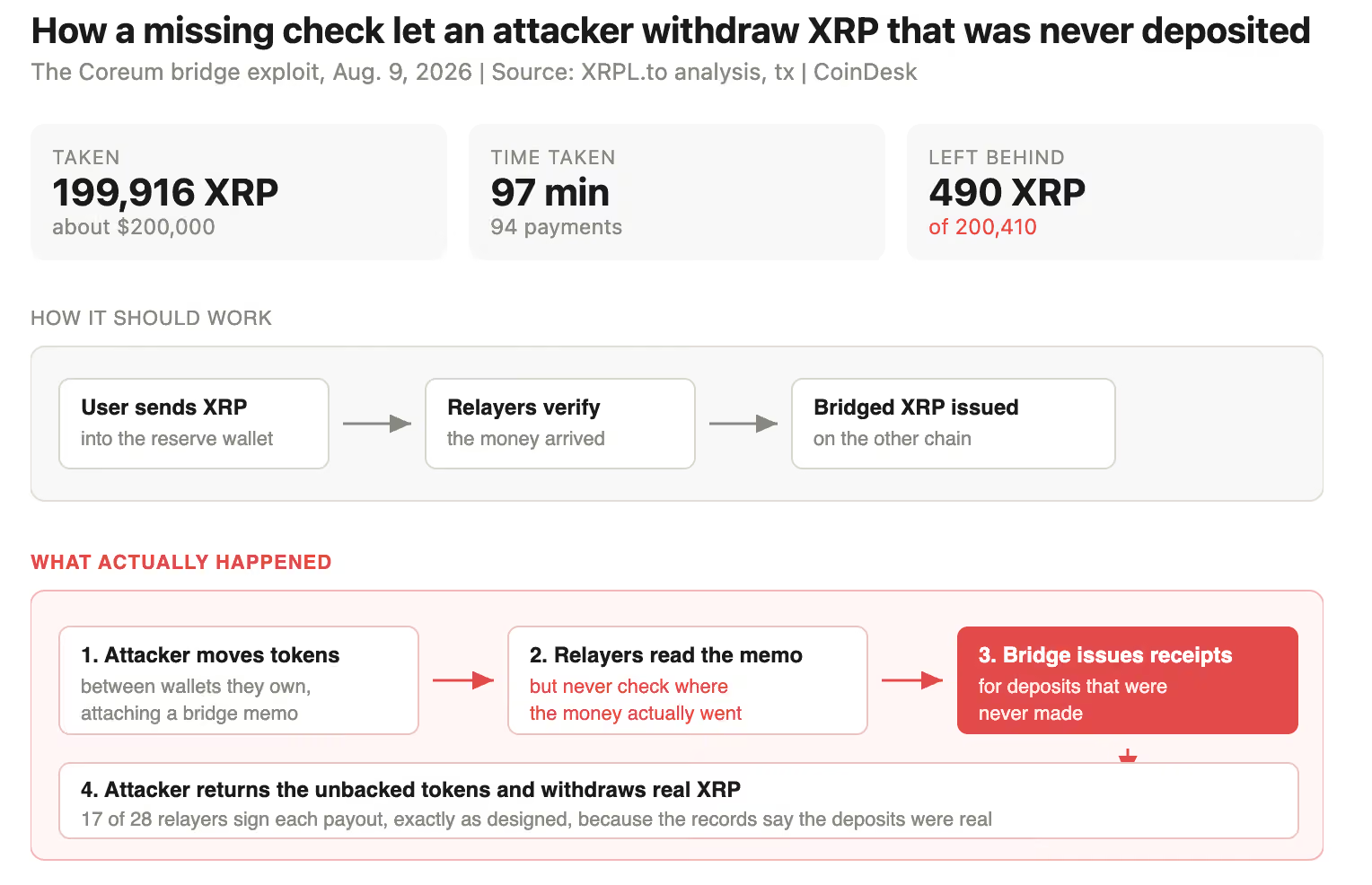
XRP bridge drained after software mistook fake deposits for real ones
-
 Tech4 days ago
11 Ways to Rank Your Videos
-

 Sports6 days ago
DeQuan Jones in ‘high spirits’ after successful leg surgery
-

 Fashion7 days ago
French Rose Gown with Cape Sleeves
-
 Entertainment7 days ago
Star Wars Officially Continues ‘The Last Jedi’ With a New Spin-Off
-

 Tech5 days ago
DeepSeek Harness launches as open source rival to Claude Code, alongside V4-Pro on API with higher prices
-
 Crypto World6 days ago
Perplexity AI Predicts an XRP Scenario Few Analysts Are Discussing
-

 Politics7 days ago
In the Chris Kaba case, the police watchdog capitulated to the mob
-

 Tech6 days ago
SpaceXAI’s Grok Bot turns agents into persistent digital coworkers that can operate your apps for $120-per-month
You must be logged in to post a comment Login