Cineworld unit in Leigh has been vacant since January 2025
Chris Gee and Local Democracy Reporter
04:00, 03 Mar 2026
The former Cineworld cinema at The Loom retail park(Image: Local Democracy Reporting Service)
A former cinema in Leigh town centre is set to be converted into a large DIY store.
Advertisement
The proposal, recently lodged with Wigan council, is for the former Cineworld cinema at The Loom retail park, Spinning Jenny Way.
In December, 2024, Cineworld announced that the cinema would close and the unit has since been vacant since January, 2025. Cineworld opened at The Loom in 2011.
A supporting letter on behalf of applicant Realty Income Ltd, to change the use of the building to retail, has been published on the council’s planning portal.
It said: “The proposal is made to accommodate a national multiple retailer of DIY, trade and home improvement goods at the site. We note that there are no existing retailers of ‘bulky goods’ in or at the edge of Leigh town centre.
Advertisement
“In addition, the former B&Q store on Kirkhall Lane, to the north of the town centre, has recently closed down. On the basis that the B&Q store (which is significantly larger than the site) previously served the town, we conclude that the proposal is very unlikely to result in any adverse impacts upon the vitality and viability of Leigh town centre.
“Furthermore, the context demonstrates that there is an identified need to accommodate a new retailer of ‘bulky goods’, which would improve local consumer choice and trade in the wider retail catchment.”
The letter added that the reuse of the former cinema will contribute towards objectives to revitalise Leigh, attract investment and provide services and amenities which meet a demonstrable unmet need in the area.
The application seeks permission for the change of use of the former cinema to enable the unit to be used for retail purposes.
Advertisement
The proposal will result in a net loss of floorspace at the site, as a result of the removal of the first floor level.
The application works including minor alterations to the existing elevations of the building, the creation of a dedicated service yard, suitable for access by large HGVs, the creation of four oversized spaces for large vans and two disabled bays.
Those changes would result in the net loss of 72 parking bays at the site.
The new Home Bargains store store opened in Leigh last month on the site of the town’s former B&Q store, off Kirkhall Lane.
Advertisement
The Cineworld building application will be considered by planners at Wigan council in the coming weeks.
To find all the planning applications, traffic diversions, road layout changes, alcohol licence applications and more in your community, visit the Public Notices Portal.
Climate tech firm Zevero has secured $7 million in new funding as global demand for robust carbon data and ESG reporting continues to accelerate.
The latest investment, which brings the company’s total funding to $14 million, includes backing from Spiral Capital, Gazelle Capital and Deep 30. It follows a period of rapid expansion, with Zevero reporting 400% year-on-year growth in annual recurring revenue and a doubling of its customer base.
The company has also strengthened its offering through the recent acquisition of sustainability advisory firm Inhabit, enabling it to move beyond emissions tracking into active decarbonisation support for clients.
Zevero’s platform uses artificial intelligence to automate the collection and calculation of emissions data across Scope 1, 2 and 3 — the three key categories used to measure an organisation’s carbon footprint.
By building a continuous, reusable dataset, the platform allows companies to integrate sustainability metrics into core business functions such as product design, procurement and investment planning, rather than treating them as standalone reporting exercises.
Advertisement
Chief executive Shigeo Taniuchi said the shift reflects a broader transformation in how organisations approach sustainability.
“Businesses are increasingly being asked to manage sustainability the way they manage finance,” he said. “Yet many are still treating it as an annual project rather than a continuous system. Our goal is to make climate data actionable, reliable and embedded in decision-making.”
The funding comes amid tightening global regulatory requirements around climate disclosure. Frameworks such as the UK Sustainability Reporting Standards and Japan’s SSBJ standards are pushing companies to apply the same level of rigour to environmental reporting as they do to financial accounts.
This shift is increasing demand for platforms capable of delivering auditable, real-time data, particularly as supply chain transparency and carbon border adjustment mechanisms (CBAM) begin to affect international trade.
Advertisement
George Wade, co-founder and chief commercial officer, said carbon data is rapidly becoming a strategic input rather than a compliance obligation.
“Organisations don’t just need software to collect the data, they need guidance to turn it into something the business can act on,” he said.
The new funding will be used to accelerate product development and support Zevero’s international expansion, particularly across Asia-Pacific and continental Europe, where regulatory and commercial pressures are intensifying.
The company is already working with major organisations including Asahi Group and the Tokyo Metropolitan Government, as well as a growing number of clients in manufacturing, FMCG and consumer sectors.
Advertisement
Investors say the company’s combination of technology and embedded expertise gives it a strong position in a market that is becoming increasingly crowded but also more critical to business operations.
Spiral Capital’s Tomokazu Okuno said the platform addresses one of the most pressing challenges facing organisations today, gaining visibility into emissions and acting on that insight.
The investment highlights a broader trend in climate technology, where funding is increasingly flowing towards solutions that deliver measurable operational value rather than purely compliance-focused tools.
As businesses navigate the transition to a low-carbon economy, the ability to track, verify and act on emissions data is becoming a core capability.
Advertisement
For Zevero, the next phase will be scaling its platform globally while maintaining the balance between automation and expert insight, a combination it believes is essential to turning climate data into meaningful action.
With regulatory demands rising and investor scrutiny intensifying, platforms that can bridge the gap between reporting and real-world impact are likely to play a central role in the next stage of the sustainability transition.
Jamie Young
Jamie is Senior Reporter at Business Matters, bringing over a decade of experience in UK SME business reporting.
Jamie holds a degree in Business Administration and regularly participates in industry conferences and workshops.
When not reporting on the latest business developments, Jamie is passionate about mentoring up-and-coming journalists and entrepreneurs to inspire the next generation of business leaders.
Seeking Alpha’s transcripts team is responsible for the development of all of our transcript-related projects. We currently publish thousands of quarterly earnings calls per quarter on our site and are continuing to grow and expand our coverage. The purpose of this profile is to allow us to share with our readers new transcript-related developments. Thanks, SA Transcripts Team
Professor Dylan Jones-Evans has undertaken an analysis as part of an alternative strategy for the future of the game in Wales
Welsh rugbyy.(Image: 2025 Getty Images)
Welsh rugby is far more than a sport – it is a national economic asset, but for far too long, the debate around Welsh rugby has been framed as if it were simply about results on the pitch, boardroom rows, or the latest financial crisis at the Welsh Rugby Union.
But the evidence now makes clear that this is much bigger than that, and Welsh rugby is not just a sporting institution; it is one of Wales’s most significant national economic assets.
Recently, Rob Regan, who is currently working on an alternative strategy for Welsh rugby, asked me to examine its economic impact on the nation. While most of the data was available, some had to be extrapolated from other sources because various organisations here in Wales had not conducted the necessary research. Nevertheless, the overall results are striking, and for the first time, we now possess information on this important subject.
The available data indicate that Welsh rugby provides a direct annual economic impact of at least £225m and up to £250m through the professional game and matchday activity alone. When a cautious estimate for the grassroots game is included, this amount increases to between £240m and £270m. Furthermore, if the broader social and well-being benefits of the community game are considered, the total national value of Welsh rugby could plausibly range from £370m to £430m annually.
That matters because it shifts the conversation, as it is no longer solely about whether Welsh rugby is managed well enough to win matches, but about whether a nationally significant asset is being adequately protected.
At the core of the direct economic case is the professional game. The Welsh Rugby Union (WRU) had a turnover of £106.1m in 2024-25, while the broader regional professional game is estimated to add another £40m to £60m annually. Together, this creates a direct professional rugby economy of approximately £150 million each year.
But the true significance of Welsh rugby goes far beyond the WRU’s balance sheet. International matches at the Principality Stadium generate one of Wales’s strongest visitor economies, with each major home international contributing approximately £10.5m to £11m in matchday economic impact at current prices. This results in an annual visitor economy of about £63m to £66m from six major fixtures. Of course, this does not include income from other events hosted at the stadium, such as concerts.
Crucially, much of this is new money entering Wales, with about 35% of visitors coming from outside Wales, and their spending accounts for around 70% of total economic output. It is also worth noting that the WRU is apparently holding a more recent report on the stadium’s impact from last year and has yet to publish it, so this estimate could be revised once it finally does.
Advertisement
That is why the stadium is so important, as the Principality is not just a venue but a key gateway for outside money into the Welsh economy. Data indicates it supports around one in ten tourism jobs in Cardiff and also sustains hospitality, retail, and broader city-centre activity. Building a replacement stadium to similar standards today would probably cost close to or over £1 billion, making it effectively irreplaceable.
Then there is the issue that few public discussions have properly addressed, which is Welsh rugby’s “hidden” asset base. The WRU’s share of the retained commercial interest in Six Nations Rugby Limited is estimated to be worth between £500m and £570m.
That value does not appear transparently in the way most people understand a balance sheet, but it is real in economic terms. It originates from the CVC deal in 2021, which implied a valuation of about £2.55bn for Six Nations Rugby, with later estimates suggesting the competition might now be worth between £3.5bn and £4bn. On that basis, the WRU’s effective economic interest is substantial.
The Wales rugby brand is valued at around £109m in 2023, but that figure should probably now be seen as a ceiling rather than a current valuation, due to Wales’s decline on the field over the past three years. This also indicates that the worth of Welsh rugby’s commercial assets is not assured but relies on maintaining competitiveness, public trust, and a healthy development pipeline.
Advertisement
And that is where the findings become most uncomfortable, as despite all the large numbers associated with Welsh rugby, community rugby remains underfunded. The grassroots game is described as the foundation upon which the professional game, the national team, the brand, and the matchday economy all ultimately depend.
Yet the WRU directly allocates only £3.3m of its own funds to community clubs and affiliated organisations, around 3% of annual revenue. Even when the wider community rugby department is included, spending remains modest compared with the economic and social value grassroots rugby appears to generate.
That imbalance lies at the heart of the argument, and the report emphasises that Welsh rugby’s governance issues are inseparable from its economic challenges. They are one and the same problem. If the community game continues to weaken, the pathway becomes narrower. A narrower pathway leads to poorer national performance, which in turn results in declining audiences, weakened brand value, and reduced commercial worth of Welsh rugby’s stake in the Six Nations.
Hence, the key conclusion is unavoidable. Welsh rugby is not just a sport facing significant difficulties, but a vital national asset under pressure, with its economic value encompassing the visitor economy, regional development, the community club network, and Wales’s international profile. Once these assets diminish, many of them cannot be easily restored.
Advertisement
The question, therefore, is no longer whether Welsh rugby has economic significance, as the evidence shows it does, but whether the current structures and management can protect something so vital to Wales before further damage occurs.
“The Middle East war continues to trigger a broad macroeconomic shock across global markets, forcing investors to reprice inflation, rates, growth, and liquidity conditions simultaneously,” analysts at Saxo Bank said. “Gold is being sold because it remains one of the few liquid assets still showing gains over the past year.”
Diesel prices are jumping every day. The cost for a gallon nearing the highest recorded average of $5.816 back in 2022. Some heating oil businesses are having to change their day-to-day operations because of price hikes.
LONDONDERRY, NH – Home heating oil firms are facing mounting cost pressures as rising crude and diesel prices tied to Middle East tensions squeeze margins and disrupt operations across New England.
The recent spike follows a cold winter that boosted demand for heating oil, leaving both consumers and suppliers exposed to higher costs. Businesses say they are trying to avoid passing those increases on to customers, even as expenses climb sharply.
Advertisement
“We had to lower our prices to be able to get the phones to start ringing more. People are holding off on auto deliveries because the prices are so high, and we can’t blame them on that,” said Andrew Chesney, owner of Southern New Hampshire Energy.
Heating oil providers say volatility in energy markets is complicating planning, as rising crude prices coincide with surging diesel costs needed to fuel delivery fleets.
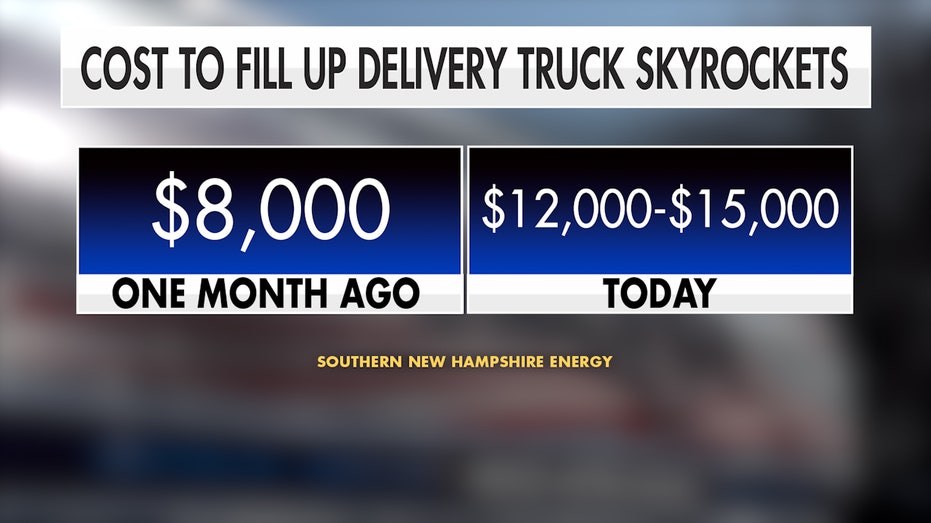
Chesney said a month ago it cost around $8,000 to fill up one of their delivery trucks with diesel, and today it’s between $12,000 and $15,000. Between filling up four trucks and getting all the necessary oil and fuel, it costs Southern New Hampshire Energy around $50,000 a day.
The cost of filling up a delivery truck jumped thousands over the past month. (Kailey Schuyler / Fox News)
“We’re trying to cut corners where we can to save the people money, but it’s hard to also on our end. We’re not making a huge profit at all,” said Chesney.
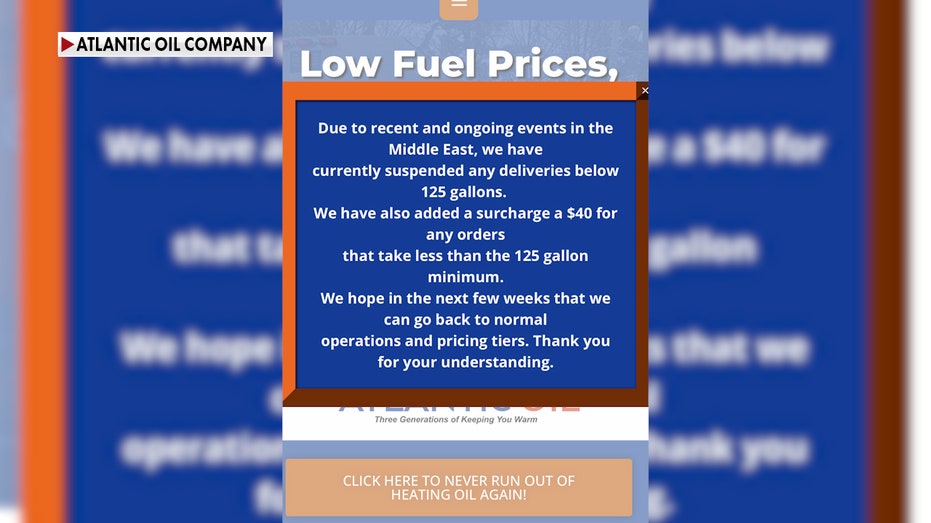
Some companies are implementing new policies to manage rising costs. In Massachusetts, Atlantic Oil Company posted a disclaimer on their website saying: “Due to recent and ongoing events in the Middle East, we have currently suspended any deliveries below 125 gallons. We have also added a surcharge of $40 for any orders that take less than the 125 gallon minimum.”
Atlantic Oil company sets limit on oil delivery amid Middle East conflict (Kailey Schuyler / Fox News)
“I have people come in, long-time customers saying, ‘you know, I can’t really pay for this,’ and we try to help them. We say, ‘you know, we could, take some payment now,’ because in the summer you won’t need to pay for your oil, typically,” said Ted Triandafilou, General Manager of Atlantic Oil Company.
Advertisement
Triandafilou said his company is experiencing a similar jump in diesel costs.
“Depending on the size of the truck, we have multiple trucks of different sizes. So it could be over. As of now, it’s over $12,000 to fill the truck up as it may have been, you know, $5,000-$6,000 about a month ago.”
“We really don’t know where it’s going to go from here and prices are increasing and decreasing anywhere from 10 cents to 25 cents a day right now with everything going on in the world,” said Chesney.
Advertisement
“Prices change daily just like gas prices typically do, and a lot of time, I’ve seen … the prices go up in the morning – let’s say, jump 20, 30 cents, crazy numbers – and then slowly during the day, they’ll drop back down, but by the close of the market, they’re back up again,” said Triandafilou. “It’s getting to the point where I don’t even bother displaying the price outside because I’d just be running out and changing it again.”
According to AAA, the average cost for a gallon of diesel on March 20 was $5.15, approaching the record average of $5.80 in 2022.
“The last time we saw diesel prices this high was in 2022 after Russia invaded Ukraine,” said AAA spokesperson Mark Schieldrop. “The current situation is a little bit different because we’re seeing significant impacts on production. We are also seeing all those cargo flows out of the Strait of Hormuz being impacted. So, there are some long-term impacts here.”
Schieldrop said that the record could be broken if the conflict continues. Even if the conflict ended today, the prices wouldn’t drop tomorrow.
Advertisement
“It is true that prices shoot up like a rocket and then tend to drift down like a feather,” said Schieldrop. “It’s going to take a sustained period of time, and many analysts believe that the impact could be lasting for more than a year, even if the conflict ends in the short term.”
Schieldrop says it can be tough to cut corners on gasoline prices to save money.
“We urge folks to try to drive less. That’s a tough bargain for folks who have to drive, but stacking your trips, trying to drive more economically,” said Schieldrop. “Easing up on the gas pedal, drive a little slower, follow the speed limit, and you can increase your fuel economy pretty dramatically.”
Advertisement
For homeowners, demand may ease in the coming months as warmer weather reduces heating needs. But for businesses, the seasonal slowdown brings its own challenges.
Southern New Hampshire Energy heating oil cost seen at $4.89 on March 20. (Kailey Schuyler / Fox News)
“We’re actually coming into our slower season. So everyone’s going to be holding off on getting home heating oil till winter,” said Chesney.
“So it’s going to start slowing down for our employees, and we’re going to go through a struggle ourselves running a business and keeping things going till the prices lower down.”
Companies like Southern New Hampshire Energy are relying on other services, including plumbing, heating and cooling, to offset seasonal declines in fuel demand.
“Support local. We’re a family-owned and operated company. We’re not a corporate company, so we structure our business on family. And we’re just a small business trying to make our way through life right now,” said Chesney.
Postal workers across the UK have accused Royal Mail of encouraging practices designed to make delivery performance appear stronger than it is, as the company faces mounting scrutiny over persistent delays.
Employees speaking anonymously said managers routinely instructed them to “take the mail for a ride”, a phrase used to describe removing undelivered letters from view during inspections so delivery rounds appear complete.
The allegations come ahead of a parliamentary session where Royal Mail executives are due to be questioned by MPs over the deterioration in service levels, which has affected millions of customers.
Workers from multiple delivery offices told the BBC that when they raised concerns about workload, particularly the growing volume of parcels compared with letters, they were often told to prioritise parcels and temporarily remove letters from sight.
In some cases, undelivered mail was reportedly placed into trolleys and moved elsewhere in the depot during inspections, before being returned for delivery the following day.
Advertisement
One worker described the practice as “embarrassing and deceitful”, adding that it allowed managers to claim rounds had been completed even when letters had not been delivered.
Others said the approach was used to avoid scrutiny from senior management and external inspectors, effectively masking operational shortfalls.
Royal Mail has a legal obligation to deliver first-class mail six days a week, but recent performance has fallen significantly short of regulatory targets.
In the 2024–25 financial year, the company delivered just 77% of first-class mail on time, against a target of 93%. Second-class performance also missed its benchmark, reaching 92.5% compared with a 98.5% target.
Advertisement
The regulator Ofcom has already fined Royal Mail £37 million in recent years and warned that further penalties are likely if service levels do not improve.
Royal Mail has strongly rejected the allegations, stating that the claims “do not reflect how our delivery operations work”.
A spokesperson said the company would investigate any specific cases raised and insisted that the vast majority of mail, around 92%, is delivered on time. It added that where local issues arise, efforts are made to restore normal service quickly.
However, the Communication Workers’ Union (CWU) said the problems stem from deeper structural issues, including low pay, staffing shortages and what it described as a “toxic managerial culture”.
Advertisement
The union warned that recruitment and retention challenges have left many delivery offices understaffed, placing unsustainable pressure on workers and contributing to declining service standards.
The ongoing delays are having tangible consequences for the public, with reports of missed hospital appointments, delayed legal documents and disrupted personal communications.
Workers say morale has deteriorated sharply, with many reporting stress, sickness absence and a sense that workloads are “impossible” to complete.
In areas where Royal Mail has piloted a new delivery model, including reduced frequency for second-class mail, staff told the BBC conditions had not improved, with some suggesting the system had worsened operational pressures.
Advertisement
Royal Mail, however, maintains that the pilot has increased delivery reliability, claiming the proportion of addresses receiving mail each day has risen from around 92% to 97%.
The dispute highlights the wider challenges facing the UK’s postal system, as traditional letter volumes decline and parcel deliveries, driven by e-commerce, become the dominant part of the business.
Royal Mail has argued that delivery rules must evolve to reflect this shift, including reducing the frequency of second-class deliveries to improve efficiency and financial sustainability.
For now, the allegations of hidden mail add a new layer of controversy to an already embattled service, with MPs expected to press for answers on both operational practices and the long-term future of the UK’s universal postal obligation.
Advertisement
Amy Ingham
Amy is a newly qualified journalist specialising in business journalism at Business Matters with responsibility for news content for what is now the UK’s largest print and online source of current business news.
Oxford spinout Stateful Robotics has raised $4.8 million in pre-seed funding as it looks to solve one of the most persistent challenges in robotics: enabling machines to operate reliably over extended periods in unpredictable real-world environments.
The round was led by Amadeus Capital Partners and Oxford Science Enterprises, with additional backing from serial entrepreneur Stan Boland, founder of autonomous vehicle company Five.
The funding will be used to accelerate deployment of Stateful’s platform, which introduces a new layer of “long-horizon intelligence” — allowing robots to remember past events, adapt to changing conditions and plan tasks over hours or days rather than moments.
While recent advances in large language models and foundation AI systems have significantly improved robots’ ability to perceive and interpret their surroundings, most systems still struggle when environments change.
Unexpected obstacles, shifting lighting conditions or operational disruptions can quickly derail robotic systems that lack the ability to learn from past experiences.
Advertisement
Stateful Robotics aims to address this limitation by building what it describes as a persistent, evolving model of each deployment environment. By continuously integrating data on tasks, performance and historical outcomes, the platform allows robots to anticipate challenges and adapt in real time.
Professor Nick Hawes, co-founder and chief scientist, said traditional systems treat each decision in isolation.
“Stateless systems cannot remember previous incidents or how work actually flows through a site,” he said. “Our platform builds a shared model of tasks and environments that enables robots to adapt to disruption and complete missions safely without constant supervision.”
The company was co-founded by chief executive Kirsty Lloyd-Jukes, previously CEO of Latent Logic, an Oxford spinout acquired by Waymo, alongside leading academic researchers including Professor Nick Hawes, Professor David Parker and Dr Bruno Lacerda.
Advertisement
Their work builds on more than a decade of research at the University of Oxford in areas such as autonomy, decision-making under uncertainty and probabilistic verification.
Lloyd-Jukes said the key challenge facing robotics is not immediate decision-making, but longer-term planning.
“Most robots are good at ‘what now’, but fail at ‘what next’, especially when ‘next’ spans hours or days,” she said. “By maintaining a live model of each deployment, we ensure robots perform reliably and consistently across complex environments.”
Investors believe the technology could help unlock large-scale commercial adoption of robotics across sectors such as logistics, infrastructure, energy and healthcare.
Advertisement
Dr Manjari Chandran-Ramesh of Amadeus Capital said the evolution of robotics, from static industrial arms to mobile systems operating in human environments, requires a new form of intelligence capable of reasoning over time and context.
Similarly, Oxford Science Enterprises highlighted what it sees as a critical bottleneck in the industry: the inability of current systems to handle long-term planning and operational complexity.
Stateful Robotics is already working with pilot customers in sectors including logistics and infrastructure, where reliability and safety are critical to scaling automation.
The new funding will support expansion of its engineering team, further development of its performance engine and broader commercial rollout with industrial partners.
Advertisement
The spinout also reflects the continued strength of the UK’s deep-tech ecosystem, with Oxford University Innovation playing a key role in supporting the company’s formation and early development.
As robotics hardware becomes increasingly mature, attention is shifting to the software and intelligence layers required to make systems truly autonomous.
Stateful Robotics is betting that solving the “memory and planning” problem will be the key to turning promising prototypes into dependable, large-scale solutions, and, in doing so, unlocking the next phase of the automation revolution.
Amy Ingham
Amy is a newly qualified journalist specialising in business journalism at Business Matters with responsibility for news content for what is now the UK’s largest print and online source of current business news.



























































You must be logged in to post a comment Login