

Business
New York, Gov Hochul imposes nation’s first statewide AI data center moratorium


‘The Big Money Show’ panelists unpack New York Gov. Kathy Hochul’s concerns about the impact of data centers.
New York Gov. Kathy Hochul on Tuesday issued the nation’s first statewide temporary ban on new AI data centers in a sweeping move critics have long warned could drive tech investment and jobs out of New York.
The moratorium, which the Democrat signed as an executive order, will remain in effect for up to one year as demand for massive hyperscale data centers has surged across the state.
Hochul said the initiative would require large data centers to shoulder more of the infrastructure costs they create and is intended to protect New Yorkers from rising utility bills and other financial risks associated with the industry’s rapid expansion.
“As data center development threatens to hike up utility bills, deplete our natural resources, and create uncertainty for New Yorkers, it’s my responsibility to take action and lead,” Hochul said during Tuesday’s signing and news conference announcing the moratorium.
META EXPANDS LOUISIANA DATA CENTER IN $50B AI PUSH, BOOSTING RURAL COMMUNITY

Gov. Kathy Hochul issued the first statewide moratorium on new hyperscale data centers in New York. (Michael Nagle/Bloomberg via Getty Images, File / Getty Images)
Critics have long warned the move could divert billions in AI infrastructure investment to competing states, depriving New York communities of construction jobs, tax revenue and the type of land deals that have recently generated windfalls for rural landowners in places like Pennsylvania.
“Gov. Hochul’s statewide moratorium on data centers will ensure that those investments, jobs, and economic activity flow elsewhere rather than to New York,” Dan Diorio, executive vice president of state policy and government affairs for the Data Center Coalition, said in a statement to Data Center Knowledge.
Under Hochul’s plan, future data center developers would be required to either generate their own electricity or pay higher rates to avoid shifting the cost of major grid upgrades onto residents.
The state is also proposing a fund that would require developers to help finance upgrades to New York’s aging electric grid, invest in clean energy projects or contribute to an insurance pool intended to protect consumers.
In addition, Hochul is pursuing legislation to repeal sales tax exemptions for large data centers.
AMAZON ANNOUNCES $20B INVESTMENT IN RURAL PENNSYLVANIA FOR AI DATA CENTERS

Rows of servers fill a massive data center in Texas. (Paul Moseley/Fort Worth Star-Telegram/Tribune News Service, File / Getty Images)
Local governments will also receive a state-developed playbook designed to help communities negotiate with technology companies seeking to build nearby.
However, the announcement comes as some communities have reportedly profited from the AI infrastructure boom.
According to the Wall Street Journal, 96 Pennsylvania households collectively received more than $500 million after selling roughly 17,000 acres of rural land to QTS, a data center developer owned by Blackstone. The families sold their land for an average of about $330,000 per acre, receiving roughly $5.5 million each on average.

A data center is seen in Ashburn, Va. (Lexi Critchett/Bloomberg, File / Getty Images)
During the one-year moratorium, New York will prepare a Generic Environmental Impact Statement (GEIS) to establish statewide standards for future AI data center development.
The study will examine issues including electricity demand, impacts on the power grid, water use and quality, air quality, and other potential environmental impacts of the construction.
CLICK HERE TO GET FOX BUSINESS ON THE GO
Once completed, new AI data centers would be required to comply with those statewide environmental and community standards before receiving approval.
While the review is underway, the state will not issue new discretionary environmental permits for covered data center projects.
The Data Center Coalition did not immediately respond to FOX Business’ request for comment.


Hands off super: Miller to PM
Business
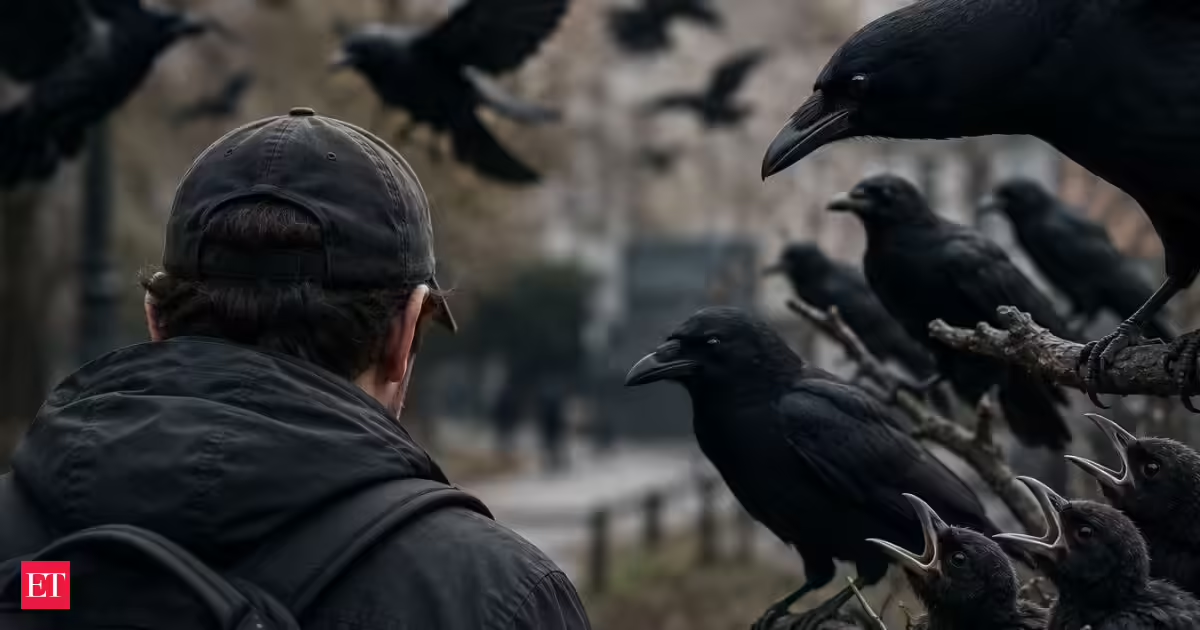
Don’t scare a crow: Crows hold grudges for nearly a decade, they never forget a face, and even teach their chicks to hate the same face
Also Read: Cyclospora parasite outbreak: America’s ‘Chief elder officer’ has just shared how to protect yourself and your loved ones from ‘explosive diarrhea’
Behind these odd, unsettling encounters lies a piece of science that most people never think about: crows can recognise a human face, remember what that face did to them, and hold on to the grudge for close to two decades. They even teach their chicks to hate the same face. For anyone who has ever startled, trapped, or annoyed a crow, that is not comforting news.
Brains Behind The Beak
Crows are not just noisy backyard birds. They mimic human speech, use tools to solve problems, and recognise individual human faces even in a crowded street. They also gather in groups that look strikingly like funerals when a member of their flock, known as a murder, is killed.
That same intelligence gives crows an unusually long memory for insults. A crow can live for about a dozen years, but a grudge against a specific person can outlive the bird that started it, passed down to chicks and flockmates who never even met the original offender.

When Payback Follows You Home
Gene Carter, a computer specialist in Seattle, found this out the hard way. He once chased away crows that were bothering a robin’s nest and threw a rake into the air to scare them off. What followed was nearly a year of retaliation. The birds waited outside his kitchen, dive-bombed him on his way to his car, and tracked him down every single day at his bus stop.
“They were waiting for me at the bus stop every single day,” he said.He told The New York Times the birds followed him for several blocks on his walk home from the stop, swooping at him the whole way. The harassment ended only after he moved out of the neighbourhood.
Spring Is Attack Season
Most crow attacks are not really personal, experts say. They spike in spring and early summer, when parent crows are guarding nests full of chicks and treat anyone who walks too close as a threat.
But grudges built outside nesting season can last far longer than a single breeding cycle. Dr John Marzluff, a professor who has spent years studying how humans and crows interact, has tracked one grudge for 17 years and counting. In 2006, he trapped seven crows on the University of Washington campus while wearing an ogre mask, then released them. The experience rattled the birds and the flockmates who watched it happen.
To measure how long the memory lasted, Marzluff and his team kept putting on the same ogre mask and walking across campus over the following years. Each time, crows responded with loud, aggressive calls that researchers describe as “scolding.” By around the seventh year of the experiment, roughly half the crows he came across were cawing furiously at the mask, even though most of them had not even been born when the original trapping happened.
How A Bird Remembers A Face
Crows owe this to extremely sharp eyesight, tuned to pick up fine details in shapes, patterns and movement, including the layout of a human face. When a crow has a strong experience with a person, whether being trapped and harassed or being fed and cared for, its brain links that specific face to that specific outcome.
The bird is not learning to fear people in general. It is learning to fear, or trust, one particular face. What makes crows especially difficult to shake off is that this information does not stay with one bird. When a crow reacts to a threatening face, other crows watching nearby pick up on the alarm and store that same face as dangerous, spreading the warning through the whole flock without the newer birds ever having a bad experience themselves.
Experts stress that none of this is malice. It is simply how a crow’s brain is built to keep it and its flock safe: notice a face, remember what it did, and pass the word along. The same memory works in reverse too. Crows also remember people who feed them or leave out clean water, and tend to treat those humans kindly for years afterwards. A handful of unsalted peanuts left out regularly, experts say, may be a cheaper way to stay on a crow’s good side than moving house.
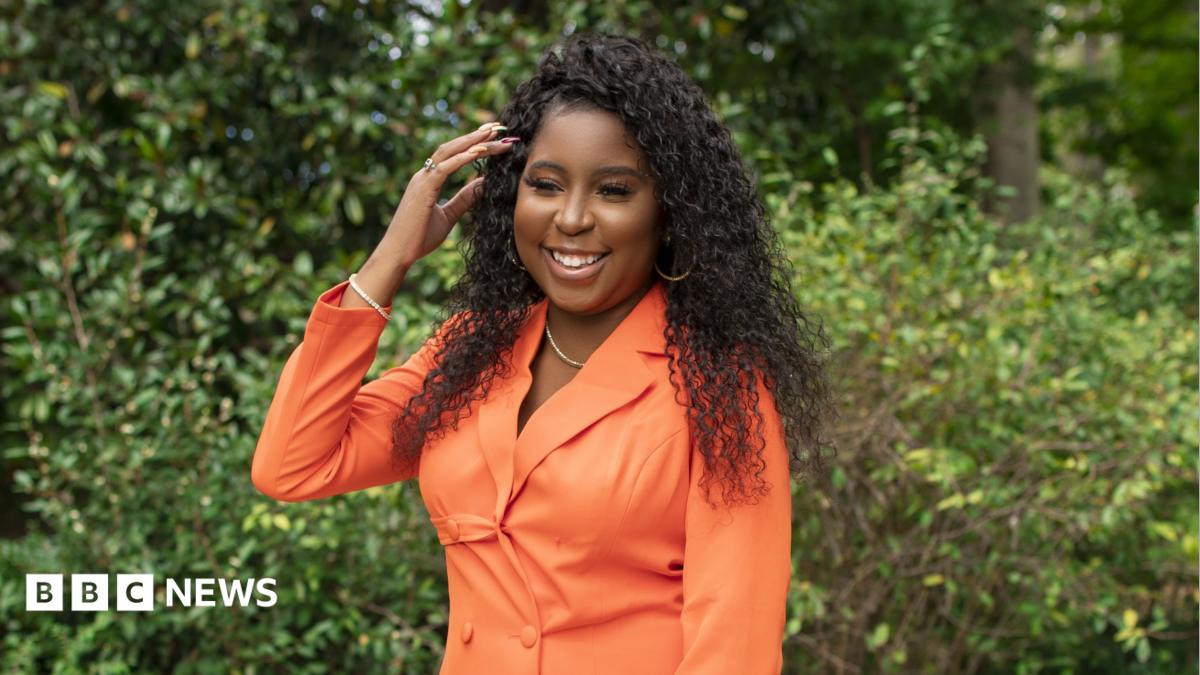
Nicola Grant, chief people officer at UK insurance provider Hiscox, says she’s noticed a broader shift in how people think about their careers.
Increasingly, individuals – particularly earlier in their careers, she says – want to build a breadth of experience faster, rather than follow a single, linear path. They are building a portfolio of skills.
She’s also found there’s a greater willingness among younger employees to move if they feel their development is slowing, or their options are limited.
“Expectations have changed; people want variety, pace and to build skills that will remain relevant,” she says, “It’s about a desire for growth.”
“That ultimately benefits both the individual and the organisation,” she adds.
Lucy Kemp, a strategic brand and communications leader at the IT company La Fosse and an employee experience specialist, agrees.
To her, lily padding is the future of work, not just a trend, as people who follow the tactic try to reach more senior roles and higher pay.
“Younger people have seen that loyalty doesn’t pay off,” says Kemp. “They want to shape their own careers, based on skills they value.
“There’s a different sense of achievement compared to older generations, a completely different experience of work,” she says.
Kemp also points out that learning in the office from peers isn’t occurring as much since the pandemic, with people working from home and AI taking over basic tasks.
Instead, people are looking at skills that will be relevant in five years’ time. And they’ll get them by switching to a project on another team, a switch to another sector, or a job at another company, Kemp says. “People just want to learn something new and have a purpose.”
That’s how Harris-Nelson feels. “I see my career as an ongoing journey rather than a destination,” she says. “I’m always learning and growing.”

Zelniker Dorfman Private Wealth senior vice president Ryan Lynch joins ‘Mornings with Maria’ to discuss AI-driven market gains, Q2 earnings, inflation and what could influence the Federal Reserve’s next interest rate move.
Olive Garden is bringing back its fan-favorite “Never Ending Pasta Pass,” the company announced this week.
Consumers can nab one of the 10,000 passes for $100, plus tax, on July 16 at 2 p.m. ET. Passholders are able to receive 13 weeks of unlimited pasta, sauces and protein toppings in addition to the chain’s unlimited soup or salad and breadsticks.
The product debuted in 2014 and was last offered in 2019.

An image of Olive Garden’s popular Never-Ending Pasta Pass offering. (Olive Garden)
OLIVE GARDEN PLANS NATIONWIDE ROLLOUT OF LIGHTER PORTIONS MENU FOLLOWING SUCCESSFUL TESTING
“Bringing it back felt like the right way to recognize the loyalty of so many guests who have kept it top of mind all these years,” said Jaime Bunker, Olive Garden’s senior vice president of marketing.
The promotion will only last until all 10,000 passes are claimed. The Never-Ending Pasta Pass isn’t available for redemption with to-go orders, but its in-restaurant redemptions are unlimited.
| Ticker | Security | Last | Change | Change % |
|---|---|---|---|---|
| DRI | DARDEN RESTAURANTS INC. | 195.74 | -0.95 | -0.48% |
Olive Garden’s corporate parent, Darden Restaurants, in late June forecast full-year profit below Wall Street estimates and reported lower-than-expected fourth-quarter sales, as higher input costs and increased marketing expenses weighed on margins amid persistent inflationary pressures.
The company, which also owns restaurants Cheddar’s Scratch Kitchen and Chuy’s among others, now expects annual earnings per share from continuing operations between $11.10 and $11.35, below an expectation of $11.40 per share, according to data compiled by LSEG.

A meal of spaghetti and meatballs served at an Olive Garden restaurant in Maryland. (Deb Lindsey for The Washington Post via Getty Images)
It expects annual same-restaurant sales to grow 2.5% to 3.5%, the midpoint of which is above analysts’ estimates of 2.81%.
GET FOX BUSINESS ON THE GO BY CLICKING HERE
Darden reported overall sales of $3.72 billion for the fourth quarter ended May 31, missing analysts’ estimate of $3.73 billion.
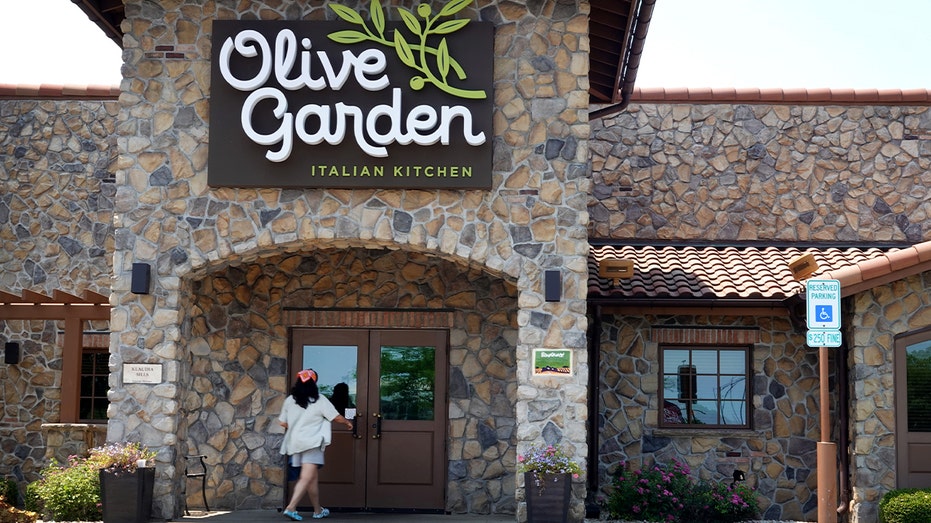
A sign hangs on the front of an Olive Garden restaurant on June 22, 2023, in Chicago, Illinois. (Scott Olson/Getty Images)
Its total operating costs and expenses rose 10.7% to $3.20 billion in the fourth quarter from the prior year.
Reuters contributed to this report.

Japan manufacturers stay upbeat on chip demand, services hit by costs
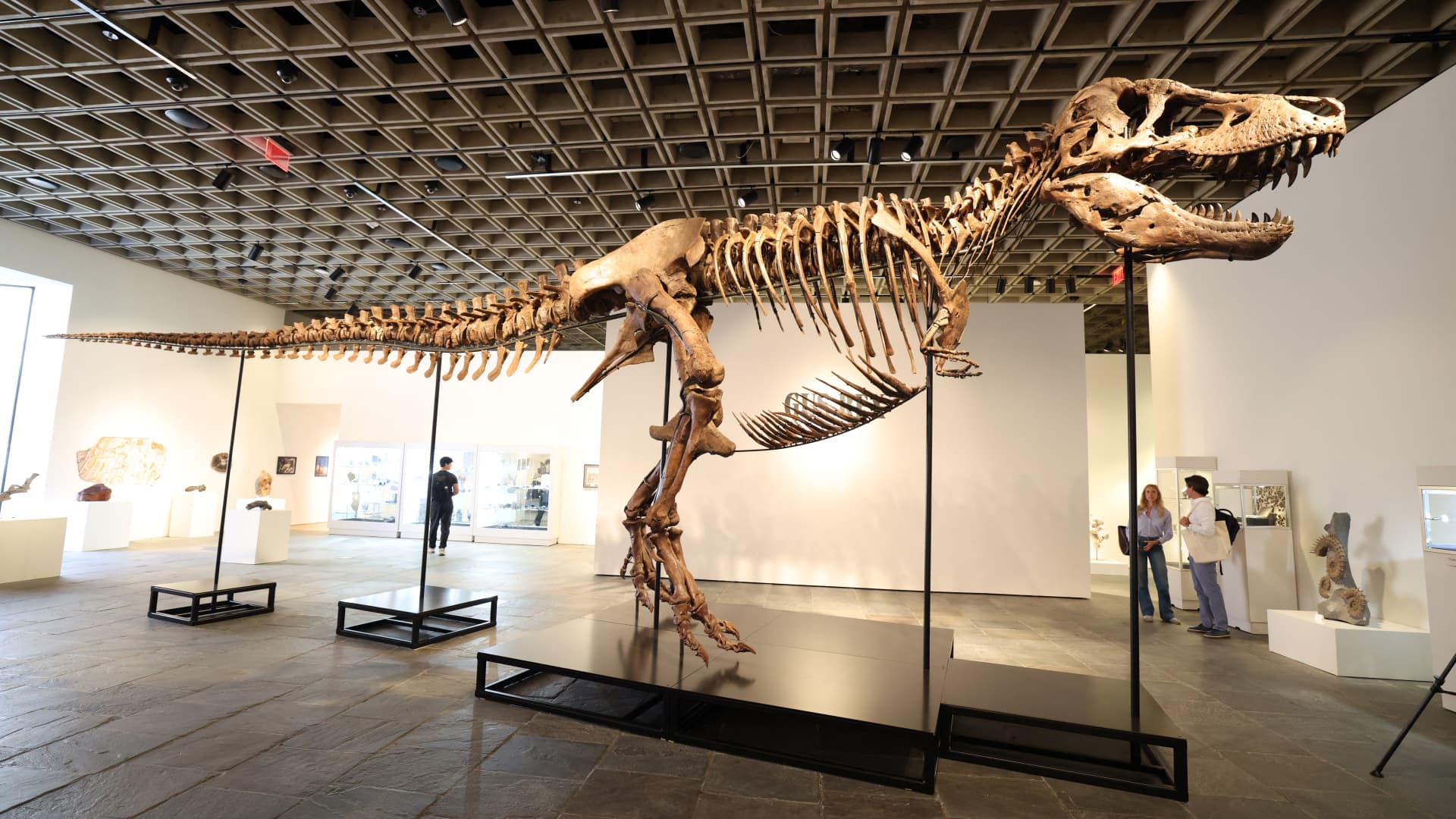
“Gus”, a mounted Tyrannosaurus Rex skeleton, one of the largest T. rex ever found, is pictured during a press preview at the Sotheby’s Breuer building in New York, on July 1, 2026.
Timothy A. Clary | Afp | Getty Images
A Tyrannosaurus rex specimen sold at Sotheby’s for $50.1 million, becoming the most expensive dinosaur ever sold at auction.
Riding a boom in dinosaur prices at auction, the T. rex, named “Gus,” blew past its price estimate of $20 million to $30 million after a 10-minute bidding war between seven bidders. It broke the record sale by Sotheby’s of a Stegosaurus skeleton nicknamed “Apex” in 2024 for $44.6 million, bought by billionaire hedge funder Ken Griffin.
Gus was discovered in South Dakota and is about 67 million years old. Touted as one of the most complete dinosaur specimens ever found, Gus has 183 fossil bone elements and is about 61% complete by bone count. It is about 38 feet long, about 12.5 feet tall and has a skull length of 54 inches, making it one of the largest T. rex fossils ever found, according to Sotheby’s.
Gus also displayed a number of injuries, including fractured and healed bones in several ribs and gastralia, as well as bite marks to several skull bones.
“Gus is not only an exceptional find, but a specimen that’s been excavated, documented, prepared and cared for with real excellence,” said Cassandra Hatton, Sotheby’s vice chairman and worldwide head of science and natural history.
Dinosaur fossils have become one of the fastest growing segments of the collectibles market, as the wealthy search for rare stores of long-term value and auction houses look to categories beyond art to diversify their sales. A T. rex named “Stan” sold at Christie’s in 2020 for $31.8 million.
While the success of Gus is likely to encourage the sale of more dinosaur bones, paleontologists and other experts warn that there are few safeguards for authenticity or verification in the industry.

7 Numbers Behind The General Misery For Consumers

Arista Networks CEO Jayshree Ullal disposes of $43.9m in stock
Form 4 Disc Medicine Inc For: 14 July


New center will offer more than 30,000 square feet of combined office and R&D space.

Anthropic commits $10 million to Canadian AI research across eight institutions

Ethereum Is Betting Everything on This Roadmap
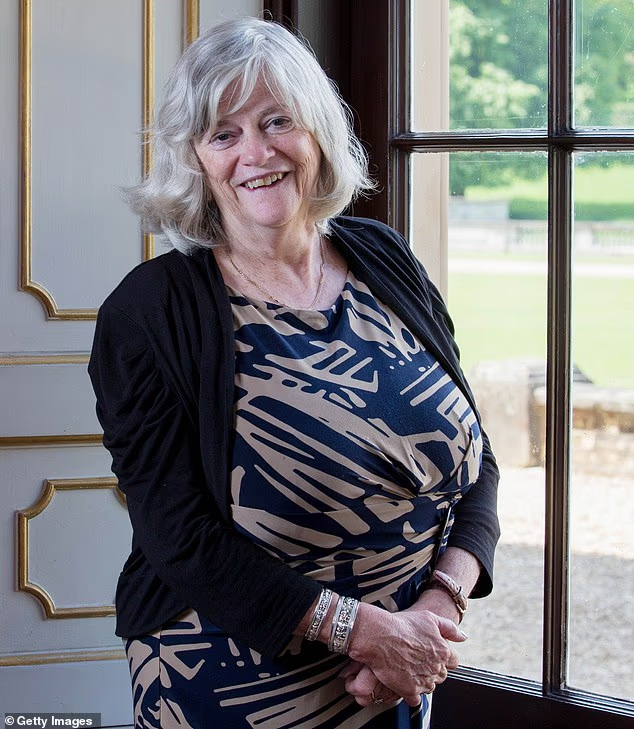
Ann Widdecombe ‘murder’ suspect is being probed over Left-wing extremism: Fears he plotted to kill others – including Reform MPs


-

 Fashion6 days ago
Loro Piana Fall 2026 Enters Houston’s Art Scene
-

 Fashion4 days ago
Weekend Open Thread: Nutriplenish Leave-In Conditioner
-
 Sports5 days ago
2026 Genesis Scottish Open Thursday TV coverage: Round 1
-

 Tech7 days ago
Anthropic brings Claude Cowork to mobile and web as usage data shows most users aren’t coding
-

 Sports5 days ago
Super Eagles star Moses Simon opens up on Liverpool transfer regret
-

 Tech5 days ago
Character.AI enters the microdrama arena with its own productions, but there’s a twist
-

 News Videos4 hours ago
XRP BOMBSHELL… XRP OMBOARDED FOR TRANSACTIONS!!!
-

 Tech19 hours ago
Get Your ESP32 Sunny Side Up With This Solar Dev Board
-

 Tech4 hours ago
Dark Secrets Emerge When Jailbreaking LLMs
-

 News Videos6 days ago
Crypto Just Entered Its Most Important 6-Month Candle (Could Decide Everything!)
-

 Tech7 days ago
Keychron is stepping outside keyboards with a $349 Thunderbolt 5 dock aimed at power users
-

 Business7 days ago
ASX 200 Slides Over 0.6% as Rare Earths and Lithium Stocks Tumble Amid Global Semiconductor Sell-Off Today
-
 NewsBeat6 days ago
Major update after Huntingdon train attack as man enters plea
-
 Business7 days ago
Will Trent shares rebound after Q1 update triggers 13% crash? Here’s what technical charts indicate
-

 Business7 days ago
SpaceX Shares Slide Nearly 6% Amid Post-IPO Volatility and Starship Test Focus
-
 Sports6 days ago
39-year-old Djokovic wins five-hour thriller to enter Wimbledon semis | Other Sports News
-

 Tech6 days ago
Level Infinite Launches Gangstar Mirage City in India with Pre-Registrations
-

 News Videos1 day ago
how to make coin bank box with cardboard #scienceproject #money #diy #shorts
-

 Tech6 days ago
Entra passkey enrollment vishing targets Microsoft 365 users
-
 Tech1 day ago
Cloudflare Precursor Watches Your Mouse and Keyboard To Decide If You Are Human
You must be logged in to post a comment Login