Connect with us
DAPA Banner

Business

Next Welsh Government must look to deliver an M4 Relief Road says business body the CBI

Published

on

Business Live

In its Senedd Election manifesto CBI Wales is also calling for the next Welsh Government to devise its own industrial strategy

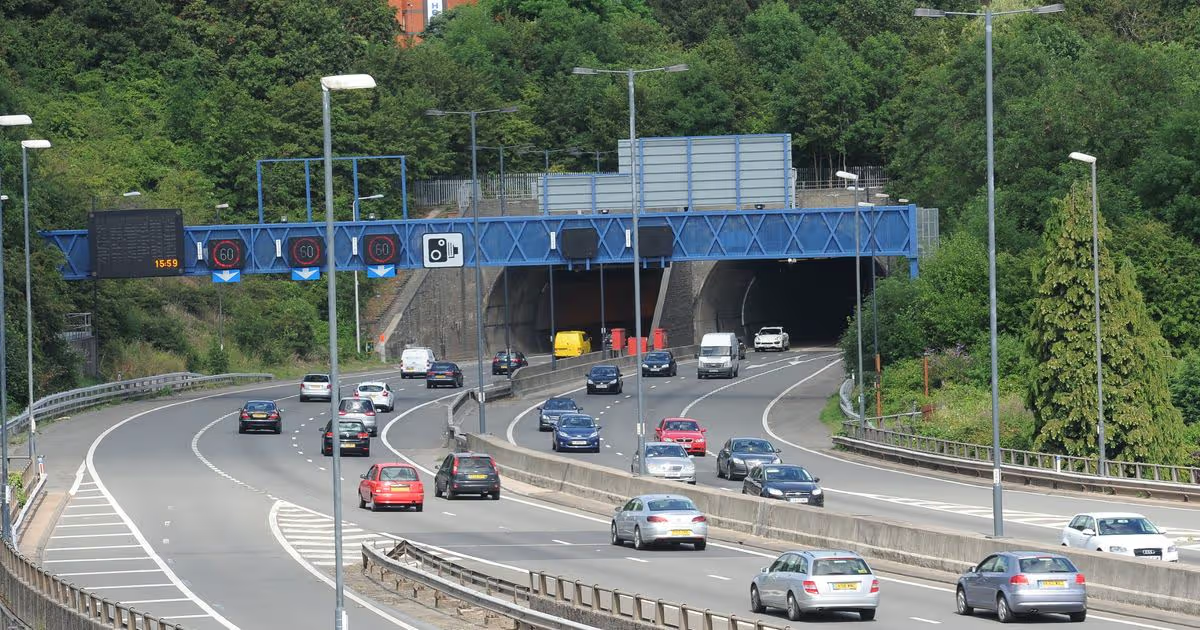
The Brynglas Tunnels(Image: South Wales Echo)

The next Welsh Government should look to build an M4 Relief Road as part of a suite of measures to boost productivity, says business body CBI Wales.

Seven years after plans for a £1.3bn M4 Relief Road – aimed at easing traffic congestion on the existing motorway between Cardiff and Newport, particularly around the Brynglas Tunnels – were rejected by then First Minister Mark Drakeford, CBI Wales is calling for a fresh look at the project in its Senedd election manifesto. It is also calling for improvements to the other main road route linking Wales and England, the A55 in North Wales.

The business membership body had lobbied hard for the so called 14-mile black route, a new section of motorway south of Newport running partly through the Gwent Levels from Castleton to Magor.

The funding model for the project, estimated at £1.3bn, would have combined the Welsh Government’s capital borrowing powers with a £500m facility from the UK Government.

Advertisement

With inflation any new project would likely cost more than £2bn. Any new funding model would require significant UK Government backing. While the CBI’s position is not to add to the cost of running businesses, any new relief road could potentially having a toll, even if a nominal amount.

Numerous versions of an M4 Relief Road were also previously rejected, including proposals before devolution in the 1990s and by the Labour-Plaid coalition Welsh Government in 2009. Those rejections resulted in improvements to the existing motorway, including increased lane capacity. Mr Drakeford went against the recommendation of an independent planning inspector by rejecting the black route on cost and environmental grounds.

Following the decision planning protection for the proposed route -which had been in place for 25 years to prevent other developments – was removed by the Welsh Government.

READ MORE: Swansea Council to fight WRU in court as announcement escalates Welsh rugby warREAD MORE: The man overseeing plans to transform the centre of Swansea

Advertisement

Revisiting an M4 Relief Road, even along the original black route, would require a new legal and public inquiry process. However, most of the publicly-owned land for the route has not been sold or developed on, while the section that would have run through ABP’s Port of Newport, is still available.

When rejecting the project, Mr Drakeford established the Burns Commission to explore public transport investments that could alleviate traffic on the M4, particularly through Newport. Chaired by Lord Burns, the commission recommended five new train stations between Cardiff and the Severn Tunnel. Last month, the UK Government confirmed it would fund these stations, although additional funding will need to be secured in the next spending review ahead of the 2029 General Election.

While supportive of the M4 Relief Road while in Mr Drakeford’s cabinet, First Minister Eluned Morgan is not considering revisiting the project as a manifesto pledge. The Welsh Conservatives have committed to delivering a new relief road.

In Made in Wales: A Manifesto to Support Firms & Create Jobs 2026–30, the CBI calls for prioritising and fast-tracking infrastructure projects that unlock economic growth, including transport links (such as the A55 and M4 Relief Road) and digital infrastructure (achieving full-fibre broadband and 5G coverage, especially in rural areas).

Advertisement

Director of CBI Wales Russell Greenslade

Director of CBI Wales Russell Greenslade said the case for an M4 Relief Road remains pressing with congestion on the existing and ageing M4 remaining a major concern for businesses. He added: “From a transportation and connectivity point of view, the more we have, the better, and an M4 Relief Road would be an example of that. It is not just the M4, but also the A55 in North Wales, which, to quote some of our members, can often be like a car park.

“There is a lot of growth happening in Newport with the compound semiconductor cluster. If we are going to attract more people to work there, then the transportation network needs to be improved. This feedback comes directly from our members and informs our manifesto. The message from business and investors is that infrastructure is needed if we want to grow the economy, though we are not advocating any particular route (M4 Relief Road) solution.”

While not as developed as the black route, there was also the proposed blue route, running through Newport and upgrading existing road infrastructure such as the Southern Distributor Road.

In its wide-ranging manifesto, the CBI calls on leaders to drive forward technology and innovation, remove planning system bottlenecks, invest in infrastructure, and reduce Wales’ high youth unemployment by giving young people access to skills, opportunities, and mental health support.

Advertisement

It also calls for the next Welsh Government to develop its own industrial strategy, aligning Welsh and UK policies to leverage economic growth. Last year, the UK Government published its own ten-year industrial strategy based on eight industry pillars, including fintech and renewable energy.

The business group urges party leaders to work in partnership with businesses to capitalise on Wales’ enterprise, world-class universities, colleges, skilled workforce, and abundant natural resources to bring jobs and prosperity to every corner of Wales. By leveraging pension fund backing, it said the investment capacity of the Development Bank of Wales should be scaled up to £2bn to support the growth of indigenous businesses.

It also calls for the establishment of a long-term Welsh innovation funding framework. This it said could involve merging and coordinating grants from agencies like Innovate UK (though non devolved), Medr, and Business Wales into a single, predictable fund that businesses can tap over a multi-year horizon.

The business body also highlights grid infrastructure capacity issues and consenting bottlenecks that” prevent renewables projects or factories from connecting to networks quickly.” It stresses that well-resourced planning is needed to avoid applications being ‘stuck’ for months or years awaiting approval.

Advertisement

The manifesto also calls for every 16–24-year-old to be offered access to paid placements integrated with mental health support, alongside more flexible, employer-led skills routes aligned with real job opportunities. While it does not specify how it would be measured, the manifesto also “challenges party leaders to transform Wales into “one of Europe’s most competitive and sustainable small economies by 2035.”

Mr Greenslade said: “Welsh businesses have shown great resilience and a fierce competitive streak in dealing with both the high cost of doing business and the uncertainty experienced over the past decade. This election is an opportunity for party leaders to make Wales one of Europe’s most competitive and sustainable small economies by 2035.

“A new Welsh industrial strategy that capitalises on the UK’s modern industrial strategy, and other UK policies on technology such as AI, can be a game-changer in raising innovation and productivity, bringing prosperity and high-quality jobs to every corner of Wales. Getting more young people into work will improve their mental health and tackle skills shortages that limit firms’ prospects.

“Enterprising businesses, a world-class education sector, abundant natural resources, and a superb geographical advantage can all give Welsh businesses a competitive edge. Working with business, party leaders must focus on what unites Wales to drive long-term sustainable growth.”


Advertisement
Continue Reading
Click to comment

You must be logged in to post a comment Login

Leave a Reply

Business

Prolonged conflict could send crude prices soaring to $125: Peter McGuire

Published

on

Prolonged conflict could send crude prices soaring to $125: Peter McGuire
Crude oil markets are showing signs of stabilising around the $100 per barrel mark, but beneath the surface, volatility remains intense. What was once considered a spike is now increasingly being treated as a near-term base, driven by geopolitical tensions and shifting market sentiment.

Peter McGuire, CEO, Australia-Trading.com summed up the recent turbulence: “It has been a volatile 12 hours… the market is whipsawing. A 100 might be the new home… it will probably hover around that 100 handle.”

Markets React Swiftly to Political Signals
Oil prices have been highly sensitive to developments linked to former US President Donald Trump, initially falling before rebounding above $100. This suggests that traders are actively recalibrating positions based on evolving geopolitical cues rather than fundamentals alone.McGuire explained: “The market has taken on board the announcements… that is the price discovery. The overall theme is consolidation… maybe we are at the tail end, or more fireworks could come.”

The reaction across asset classes reflects a cautious tone, with equities bouncing while precious metals remained largely flat.Supply Disruptions Could Linger
Even if tensions ease quickly, the road to supply normalisation may be slow. Disruptions already underway are expected to impact global supply chains, particularly in Asia.”It could take six weeks to three months… supply disruption will impact Asia and India,” McGuire noted, highlighting the potential inflationary and growth-related consequences.

Oil’s Next Move: Relief or Rally?
The direction of crude prices now hinges on how the geopolitical situation evolves in the coming days. In a best-case scenario, a peace deal could remove the risk premium from oil prices. “You could see $5 to $15 stripped out quickly if things normalise,” McGuire said.

Advertisement

However, the risks on the upside remain significant if tensions escalate. “You could add another $20… possibly 125 if conflict expands,” he warned, especially if more Middle Eastern nations get involved.

A Market Driven by Uncertainty
For now, oil markets remain tightly linked to geopolitical headlines. While near-term volatility may ease slightly, the broader outlook is still uncertain.

The $100 level is no longer just a milestone—it reflects a fragile balance between stability and escalation, with global markets watching every development closely.

Advertisement
Continue Reading

Business

Palo Alto Networks: Buy Other Battered Cybersecurity Stocks Instead (NASDAQ:PANW)

Published

on

Palo Alto Networks: Buy Other Battered Cybersecurity Stocks Instead (NASDAQ:PANW)

This article was written by

With combined experience of covering technology companies on Wall Street and working in Silicon Valley, and serving as an outside adviser to several seed-round startups, Gary Alexander has exposure to many of the themes shaping the industry today. He has been a regular contributor on Seeking Alpha since 2017. He has been quoted in many web publications and his articles are syndicated to company pages in popular trading apps like Robinhood.

Analyst’s Disclosure: I/we have no stock, option or similar derivative position in any of the companies mentioned, and no plans to initiate any such positions within the next 72 hours. I wrote this article myself, and it expresses my own opinions. I am not receiving compensation for it (other than from Seeking Alpha). I have no business relationship with any company whose stock is mentioned in this article.

Seeking Alpha’s Disclosure: Past performance is no guarantee of future results. No recommendation or advice is being given as to whether any investment is suitable for a particular investor. Any views or opinions expressed above may not reflect those of Seeking Alpha as a whole. Seeking Alpha is not a licensed securities dealer, broker or US investment adviser or investment bank. Our analysts are third party authors that include both professional investors and individual investors who may not be licensed or certified by any institute or regulatory body.

Advertisement
Continue Reading

Business

BofA Names Top US Mid-Cap Bank Stocks

Published

on


BofA Names Top US Mid-Cap Bank Stocks

Continue Reading

Business

Oil back above $100 as conflicting claims emerge on US-Iran talks

Published

on

Oil back above $100 as conflicting claims emerge on US-Iran talks

Global energy prices plunged on Monday after Trump said he had postponed strikes on Iranian power plants.

Continue Reading

Business

Morning Bid: Little relief from Trump

Published

on

Morning Bid: Little relief from Trump


Morning Bid: Little relief from Trump

Continue Reading

Business

Huntington Bancshares: I'm Paying Attention

Published

on

Huntington Bancshares: I'm Paying Attention

Huntington Bancshares: I'm Paying Attention

Continue Reading

Business

OnlyFans Owner Dies at 43 After Cancer Battle

Published

on

Leonid Radvinsky

MIAMI – Leonid Radvinsky, the low-profile Ukrainian-American entrepreneur who transformed OnlyFans into a multibillion-dollar subscription platform dominating the adult entertainment industry, died March 20, 2026, after a private battle with cancer. He was 43.

Leonid Radvinsky
Leonid Radvinsky

OnlyFans confirmed the death in a statement Monday, saying Radvinsky “passed away peacefully after a long battle with cancer.” The company emphasized that his family has requested privacy. At the time of his death, Forbes estimated his net worth at $4.7 billion, placing him among the world’s richest individuals and on the Forbes 400 list of wealthiest Americans.

Radvinsky acquired a majority stake in Fenix International Ltd., OnlyFans’ parent company, in 2018 from its British founders. Under his ownership, the platform exploded in popularity, especially during the COVID-19 pandemic, as creators — many in adult content — turned to direct subscription models. By 2024, OnlyFans reported billions in gross revenue, with users spending $7.2 billion on the site and Radvinsky personally receiving roughly $1.9 million per day in profits at peak times. He had extracted about $1.8 billion in dividends by early 2025.

Here are five key things to know about Leonid Radvinsky:

1. **Immigrant Success Story**: Born in Odesa, Ukraine, around 1982 or 1983, Radvinsky moved to Chicago as a child. He studied economics at Northwestern University, graduating summa cum laude and serving as class valedictorian. Early exposure to computers came from programming in BASIC on his grandfather’s i386 PC, sparking a lifelong passion for technology.

Advertisement

2. **Pioneer in Adult Web Businesses**: Before OnlyFans, Radvinsky built his fortune in online adult entertainment. While a student, he founded Cybertania, a porn website referral business. He later created MyFreeCams through his holding company MFCXY Inc., one of the early cam sites that let users pay for live explicit content. These ventures laid the groundwork for his larger success.

3. **OnlyFans Majority Owner and Transformative Leader**: Radvinsky bought a 75% stake in Fenix International in 2018 for an undisclosed sum. He kept an extremely low public profile, rarely giving interviews and avoiding the spotlight despite the platform’s cultural impact. OnlyFans grew to millions of creators and hundreds of millions of fans, allowing performers to monetize directly and bypassing traditional industry gatekeepers. Reports in 2025 indicated he was exploring a sale that could value the company at up to $8 billion.

4. **Philanthropist and Open-Source Advocate**: Despite his reclusive nature, Radvinsky described himself on personal websites as an angel investor, company architect and open-source software supporter. He donated millions to causes including cancer research at Memorial Sloan Kettering, the University of Chicago Medicine and animal welfare groups. In 2024, he made a $23 million grant for cancer research. He also invested heavily in open-source technologies and promoted tools empowering digital identity control.

5. **Private Family Man**: Radvinsky married Katie Chudnovsky in 2008. The couple had four children and lived primarily in Florida, where he maintained a low-key existence. He rarely discussed his personal life publicly, and his family has continued that request for privacy following his death. He was known among close circles as an aspiring helicopter pilot and Elixir programming language enthusiast.

Advertisement

Radvinsky’s death comes as OnlyFans navigates questions about its future ownership. Shares in the LR Fenix Trust have held his stake since 2024, and any sale or succession plans remain undisclosed. The platform, while controversial for its heavy reliance on adult content, also hosts non-explicit creators including musicians, athletes and influencers seeking direct fan connections.

Industry analysts say Radvinsky’s business model fundamentally changed how adult performers earn a living by cutting out intermediaries and giving creators control over pricing and content. Critics, however, have pointed to concerns over exploitation, underage access issues and the platform’s role in broader societal debates about online pornography.

Born into a Jewish family in Ukraine, Radvinsky maintained ties to his heritage and supported causes linked to Ukraine and Israel, though he avoided public political statements. His early career included work in spam-related online businesses, drawing scrutiny in some reports, but he focused later on building legitimate, scalable tech companies.

Colleagues and those familiar with his work described him as a sharp strategist who preferred results over recognition. His personal site lr.com portrayed him as an “economist by training and entrepreneur by trade,” highlighting contributions to open-source movements and investments in multiple online giants.

Advertisement

The timing of his death, shortly after reports of potential sale talks and large dividend payouts, has fueled speculation in business circles about OnlyFans’ next chapter. The company has not announced leadership changes or strategic shifts.

Radvinsky’s passing highlights the often-hidden figures behind major internet platforms. While OnlyFans gained mainstream attention through celebrity endorsements and pandemic-driven growth, its owner operated in the shadows, letting the technology and creators take center stage.

Tributes from the adult industry and tech community poured in Monday, praising his role in empowering independent creators while acknowledging the controversies surrounding the platform. Fans and critics alike noted the platform’s resilience and cultural footprint.

As of March 24, 2026, OnlyFans continued normal operations. The company said it remains committed to its mission of helping creators earn directly from their content.

Advertisement

Radvinsky is survived by his wife, children and extended family. Funeral arrangements have not been made public in line with the family’s privacy request.

His life traced an arc from immigrant child coding on an old PC to billionaire architect of one of the internet’s most profitable and debated platforms — a story of technological ambition, business acumen and personal discretion.

Continue Reading

Business

Labour trumps cost as top business barrier: CCIWA

Published

on

Labour trumps cost as top business barrier: CCIWA

Labour shortages have overtaken rising operating costs as the most commonly reported barrier to business growth, according to the latest CCIWA survey.

Continue Reading

Business

BGC class action continues in court

Published

on

BGC class action continues in court

Lawyers for thousands of disgruntled customers and BGC have returned to court to hash out initial issues before heading towards a resolution of the major dispute.

Continue Reading

Business

No quick end to conflict, global markets to stay on edge: Adrian Mowat

Published

on

No quick end to conflict, global markets to stay on edge: Adrian Mowat
Global financial markets remain gripped by volatility as rapidly shifting geopolitical developments continue to unsettle investor sentiment. Hopes of a quick resolution between the United States and Iran have been tempered by conflicting signals, leaving markets struggling to find direction. A brief relief rally faded almost as quickly as it appeared, underscoring the fragile confidence that currently defines global trading conditions.

Adrian Mowat, EM-Equity Strategist noted that the market’s reaction reflects a rational assessment of the situation. He explained that the initial optimism stemmed from a temporary pause in potential US military action targeting Iran’s power infrastructure, which could have triggered significant retaliation, especially across the Gulf region. However, the narrative quickly changed after indications of possible negotiations were contradicted, eroding investor confidence. According to him, there are currently no clear signals from the United States, Iran, or even Israel that suggest a rapid resolution to the conflict.

Crude oil prices have emerged as the clearest indicator of this uncertainty, with Brent climbing back above $104 per barrel. The sharp move highlights persistent concerns around supply disruptions, particularly given the strategic importance of the Strait of Hormuz and recent attacks on energy infrastructure. Mowat observed that while the world has ample oil and natural gas supplies, logistical and geopolitical constraints have effectively trapped these resources. He believes that once the conflict eventually subsides, global markets could be flooded with energy supplies, potentially pushing Brent prices below $60 in a short span. For now, however, the market remains highly reactive, with traders navigating short-term momentum and hedging strategies, fully aware that sentiment could shift dramatically with any new development.

For India, the situation presents a complex mix of risks and opportunities. While a sustained decline in oil prices would typically support macroeconomic stability and attract foreign capital, structural concerns continue to weigh on investor sentiment. Mowat pointed out that uncertainty surrounding the impact of artificial intelligence on the IT sector remains a key overhang, especially given the sector’s significant weight in Indian indices. This has contributed to the relative underperformance of Indian markets compared to peers such as South Korea and Taiwan, where semiconductor-driven growth has taken center stage. Additionally, the weakness in the Indian rupee has added another layer of concern, as rising energy import costs strain the country’s balance of payments despite relative insulation in the domestic energy sector.

Advertisement

Developments in global bond markets are also adding to the complexity. A significant shift in expectations around US monetary policy has been observed, with markets now contemplating the possibility of rate hikes instead of cuts. Mowat highlighted that if such a scenario materialises, US 10-year bond yields could move above 4.5% or even higher. He views this as part of a broader, multi-year realignment of global financial markets following the prolonged period of near-zero interest rates after the Global Financial Crisis. This transition, he suggested, represents a structural reset rather than a temporary fluctuation.


On the geopolitical front, Mowat expressed scepticism about the likelihood of a complete pullback in US policy toward Iran. He indicated that such a move would be difficult to position as a strategic success, particularly given Iran’s growing influence and its demonstrated ability to disrupt global trade routes using relatively low-cost means. The possibility that Iran could exert greater control over key shipping lanes, including the Strait of Hormuz, remains a significant concern for global markets.
Despite the prevailing uncertainty, certain sectors are beginning to show signs of opportunity. Financial stocks, both globally and in India, have undergone a sharp correction, driven largely by concerns around rising credit costs. However, Mowat believes these fears may be overstated and sees value emerging in the sector, especially if geopolitical tensions begin to ease. He noted that major European financial institutions have already seen significant declines from their peak levels, suggesting that a large portion of the risk may already be priced in.Looking ahead, equities are likely to remain the preferred asset class over the next few months, provided there is some easing of geopolitical tensions. Mowat does not see a particularly strong case for precious metals in the current environment and expects bond yields to continue trending higher. He emphasised that global economies have demonstrated remarkable resilience in recent years, having weathered multiple shocks including the pandemic, the Ukraine conflict, and an inflation surge. In this context, the current market environment does not exhibit the same level of structural imbalance that led to the sharp corrections seen in 2022.

A potential de-escalation in the Gulf region, coupled with the resumption of smoother energy flows through critical shipping routes, could pave the way for a meaningful recovery in equities. Mowat pointed out that similar rebounds have occurred in the past, including the strong recovery following last year’s sell-off triggered by geopolitical developments.

From a sectoral perspective, investors are increasingly gravitating toward areas with clear demand visibility. Semiconductors remain a key focus, driven by persistent supply shortages and their central role in the AI ecosystem. Financials also appear attractive at current levels, particularly in a scenario where macroeconomic stability improves. However, the uncertainty surrounding the long-term impact of AI on software businesses continues to weigh on sentiment, especially in markets like India.

In the near term, markets are likely to remain highly sensitive to geopolitical headlines, with oil prices, bond yields, and currency movements acting as key indicators. Until there is greater clarity on the trajectory of the conflict and its broader economic implications, volatility is expected to remain the defining feature of global markets.

Advertisement
Continue Reading

Trending

Copyright © 2025