Connect with us
DAPA Banner

Business

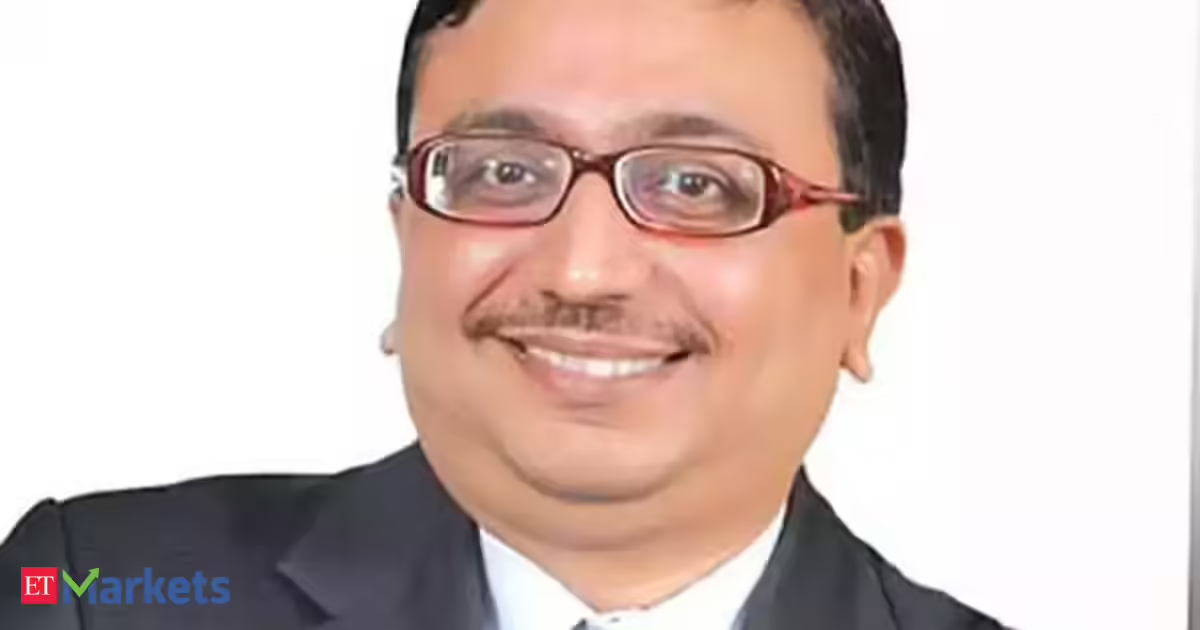
Nischal Maheshwari bets on PSU banks, flags microfinance reset as structural positive

Published

on

Nischal Maheshwari bets on PSU banks, flags microfinance reset as structural positive
In a conversation with ET Now, market expert Nischal Maheshwari outlined a selective and valuation-conscious strategy across microfinance, banks, metals, autos, power and defence, arguing that while opportunities exist, investors must remain tactical.

On microfinance, which has seen renewed interest amid regulatory changes, Maheshwari said the recent state-level legislation signals both the sector’s importance and its structural challenges. “This is a very interesting thing brought in by a state. It shows how important microfinance is in the states,” he said, adding that the industry plays a key role in the MSME and lower-ticket economy. However, he flagged the issue of over-lending: “There are huge issues as far as multiple loans are concerned… people are giving more loans to the same borrowers and they in turn default.” The move to restrict borrowers to two loans, he believes, could help stabilise the system. “Some issues are getting sorted and this will help the industry overall,” he noted, describing the legislation as beneficial “for both sides.”

On banking, Maheshwari maintained that PSU lenders continue to hold an edge over private peers. “PSUs continue to outshine… valuations are much cheaper,” he said, pointing out that growth and asset quality are now comparable. He also linked volatility to foreign investor flows. “FIIs have been major holders in IT and banks, and that is where we are seeing the selling.”

Metals, in his view, demand agility rather than long-term conviction. “One year is too long a call on the metal sector… you have to play quarter by quarter,” he said, citing global volatility. While non-ferrous stocks have largely played out, “for the moment ferrous looks interesting,” he added, suggesting steel may offer better near-term opportunities.

Advertisement

On commercial vehicles, Maheshwari acknowledged early signs of recovery but urged caution on capex trends. “CV seems to be in a good spot,” he said, though private capex remains subdued. Replacement demand, however, could drive the cycle. “The five-year fleet renewal is coming up… replacement demand is going to be very strong,” he said, adding, “I am positive on the CV cycle.”


In the energy space, he sees a tactical opportunity in upstream PSUs amid geopolitical risks. “Upstream guys like Oil India, ONGC could be a good trading play,” he said, while suggesting a cautious stance on OMCs “for the moment.”
Maheshwari was blunt on so-called value retailers. “I do not know how you call them value because they are hugely overvalued,” he remarked, citing high multiples and moderating growth. “Anywhere the PEG is two or three, so nothing catches my focus in the sector.”On power, he differentiated between product and service plays. “Product-wise, there is nothing cheap out there… people are discounting well ahead two-three years of growth,” he said. However, “T&D players are reasonably priced,” making services a relatively better bet. He also highlighted data centres as a structural demand driver with “strong visibility for the next three to five years.”

Autos remain a relative outperformer. “One of the bright spots in the overall gloomy market… autos would be the top bet at the moment,” he said.

On defence, however, he advised restraint. “The outlook is very good but it is already getting priced in… prices are marked to perfection,” he cautioned, adding that while existing investors can hold, “I do not see any reason to buy it fresh.”

Advertisement
Continue Reading
Click to comment

You must be logged in to post a comment Login

Leave a Reply

Business

ECB Holds Rates Steady Amid Iran Chaos. Why Central Banks Are Following the Fed.

Published

on

ECB Holds Rates Steady Amid Iran Chaos. Why Central Banks Are Following the Fed.

ECB Holds Rates Steady Amid Iran Chaos. Why Central Banks Are Following the Fed.

Continue Reading

Business

CBAK Energy shareholders approve redomicile merger and company regains Nasdaq compliance

Published

on


CBAK Energy shareholders approve redomicile merger and company regains Nasdaq compliance

Continue Reading

Business

UK targets 50% domestic steel production with new import tariffs

Published

on

British manufacturers are facing fresh uncertainty as Donald Trump’s sweeping new steel and aluminium tariffs threaten more than £2.7 billion ($3.43bn) worth of UK exports to the United States — a move that is already prompting order cancellations, price hikes, and long-term strategic questions for exporters.

The UK government has unveiled a major intervention in the steel market, setting an ambitious target to produce up to 50 per cent of the steel used domestically while imposing steep new tariffs on imports in a bid to protect the struggling industry.

Under the plans, import quotas will be reduced by 60 per cent from July, with any steel brought into the UK above those limits facing a punitive 50 per cent tariff. The move represents one of the most assertive steps taken by ministers in recent years to bolster domestic manufacturing capacity amid intensifying global competition.

Announcing the measures in Port Talbot, Business Secretary Peter Kyle said the strategy was designed to both strengthen UK industrial resilience and counter what he described as “anti-competitive behaviour” in global steel markets.

He confirmed the government aims to increase the proportion of British steel used in the UK economy from around 30 per cent to 50 per cent, although no specific deadline has yet been set for achieving the target.

The introduction of a 50 per cent tariff on excess imports marks a significant escalation in trade policy. While tariffs are paid by importing firms, the additional costs are typically passed through supply chains, potentially raising prices for manufacturers, construction firms and ultimately consumers.

Advertisement

Ministers insist the policy is not protectionist but rather a necessary safeguard in a market distorted by global overcapacity and subsidised production, particularly from overseas producers able to undercut UK manufacturers.

A transitional arrangement is being considered to soften the immediate impact, with contracts agreed before 14 March potentially exempt from the new tariffs for imports arriving between July and September.

The UK steel sector has broadly welcomed the announcement, having long called for stronger measures to shield it from cheaper imports and volatile global pricing.

Gareth Stace, head of industry body UK Steel, said the strategy represents a long-overdue shift in policy.

Advertisement

He said the UK had lacked a coherent industrial plan for steel for years, despite its central role in national security, infrastructure delivery and the transition to low-carbon energy systems. He added that a clear domestic strategy was essential if the sector is to survive and grow in an increasingly competitive global market.

Trade unions also cautiously backed the move. The GMB said the announcement was welcome but stressed that key questions remain around ownership structures, particularly at major sites such as Scunthorpe, and the long-term technological direction of the industry.

However, the policy has drawn sharp criticism from opposition figures, who argue the tariffs risk increasing costs across the wider economy.

Andrew Griffith warned that higher import costs could ripple through key sectors such as construction, potentially reducing infrastructure investment and placing additional pressure on UK manufacturers already facing tight margins.

Advertisement

The concern reflects a broader economic tension: while tariffs may support domestic producers, they can also raise input costs for downstream industries that rely on competitively priced materials.

The intervention comes at a critical moment for the UK steel industry, which has faced years of financial strain driven by high energy costs, global oversupply and shifting demand.

Although recent government support has helped reduce energy costs for intensive users, UK producers still face higher bills than many European and US competitors. That gap could widen further if global energy markets remain volatile.

Fears are growing that the ongoing conflict in the Middle East could push oil and gas prices higher for longer, increasing operating costs for energy-intensive industries such as steelmaking.

Advertisement

The government’s push to increase domestic steel production also reflects broader strategic concerns. Ministers are keen to ensure the UK retains sovereign capability in critical industries, particularly as geopolitical tensions expose vulnerabilities in global supply chains.

This is underscored by the government’s direct involvement in key steel assets, including sites in Scunthorpe and Rotherham, where public funds are currently being used to maintain operations that might otherwise have ceased.

At the same time, investment in new technology is beginning to reshape the sector. At Port Talbot, Tata Steel is developing an electric arc furnace, which will recycle scrap metal to produce steel with significantly lower carbon emissions — a key component of the UK’s net zero ambitions.

The success of the government’s strategy will ultimately depend on whether it can strike a balance between protecting domestic producers and maintaining competitiveness across the broader economy.

Advertisement

While boosting local production could strengthen supply chain resilience and support jobs, the risk remains that higher costs could dampen demand and investment elsewhere.

For now, the policy signals a decisive shift towards a more interventionist industrial strategy — one that places steel at the heart of the UK’s economic, environmental and national security priorities.


Amy Ingham

Amy is a newly qualified journalist specialising in business journalism at Business Matters with responsibility for news content for what is now the UK’s largest print and online source of current business news.

Advertisement

Continue Reading

Business

General Mills’ struggles continue

Published

on

General Mills’ struggles continue

CEO sees “difficult financial results behind us.”

Continue Reading

Business

(VIDEO) Kevin Hart Demands ‘Redo’ After Viral Wax Figure at Tennessee Museum Sparks Hilarious Backlash

Published

on

Kevin Hart

Comedian Kevin Hart turned a potentially flattering moment into comedy gold when he roasted his own wax figure at the Hollywood Wax Museum in Pigeon Forge, Tennessee, calling it an “attack” and demanding a complete redo. The figure, unveiled recently, went viral this week after Hart posted a scathing yet humorous reaction on Instagram on March 14, 2026, drawing millions of views and thousands of comments from fans who agreed the likeness fell short.

Kevin Hart

The wax statue depicts Hart in a black T-shirt, black pants, leather jacket and a prominent long gold chain, with arms outstretched in a pose meant to capture his energetic stage presence. But the resemblance drew immediate criticism for inaccuracies in facial features, proportions and overall vibe. Hart, 46 (turning 47 soon), shared a video of the figure set to the theme from “Curb Your Enthusiasm,” overlaying text reading “I know that ain’t Kevin Hart.”

“WTTTTFFFFF …. What did I do to these people…. This is an attack…. Who in the f–k is this??????” Hart captioned the post. “At this point these museums are just trying to make me cry 🥺😂😂😂😂….. This s–t has to stop…. I demand a redo damn it!!!!!!!”

The Instagram reel quickly amassed over 13 million views, nearly 371,000 likes and more than 26,000 comments within days. Fans flooded the replies with jokes, comparisons and memes. Some likened the figure to a mix of Cuba Gooding Jr. and other celebrities, while others quipped about the height being the only accurate detail. Actress Jameela Jamil commented that it was “the worst one I’ve ever seen of anyone.” Even Hart’s frequent collaborator Dwayne “The Rock” Johnson chimed in playfully, posting he had “no notes” on the figure, adding to the lighthearted roasting.

Advertisement

Hart’s reaction exemplifies his signature self-deprecating humor, turning what could have been an embarrassing oversight into viral entertainment. The comedian, known for films like “Jumanji: Welcome to the Jungle” and stand-up specials, has a history of embracing internet memes and fan interactions, often amplifying moments that poke fun at himself.

The Hollywood Wax Museum in Pigeon Forge, a popular tourist spot in the Smoky Mountains, features celebrity replicas but is separate from the more renowned Madame Tussauds chain, which has its own Hart figures in locations like New York and Hollywood. Those Madame Tussauds versions have generally received better reviews, though wax figures occasionally spark debates over accuracy across museums.

This isn’t the first time a celebrity wax statue has gone viral for the wrong reasons. Past examples include figures of Zac Efron, Kendall Jenner and others that drew criticism for looking off-model. Museums typically use reference photos, measurements and artist sculpting, but results vary based on execution and updates over time.

Hart’s post highlights ongoing challenges in capturing likenesses, especially for expressive performers whose energy comes from movement and facial animation rather than static poses. The figure’s stiff posture and facial structure failed to convey Hart’s trademark charisma, leading fans to speculate on whether it was rushed or based on outdated references.

Advertisement

Despite the mockery, the incident underscores Hart’s enduring popularity. His ability to laugh at himself keeps him relatable amid a career spanning stand-up, acting and producing. Recent projects include his HartBeat Productions slate and upcoming comedy specials, maintaining his status as one of Hollywood’s highest-paid comedians.

The viral moment also spotlights social media’s role in amplifying celebrity news. Hart’s direct engagement—posting personally rather than through a publicist—fueled the spread, turning a local museum unveiling into a global conversation.

As of March 19, 2026, neither the Hollywood Wax Museum nor Hart has announced plans for revisions, though his “demand a redo” plea suggests he may push for one. In the meantime, the figure remains on display, likely drawing curious visitors eager to see the “attack” in person.

For Hart, the episode is another chapter in a career built on turning mishaps into punchlines. Whether the museum heeds his call remains to be seen, but the comedian has already won the internet round with his quick-witted response.

Advertisement
Continue Reading

Business

Why the average age of a first-time buyer has risen

Published

on

Why the average age of a first-time buyer has risen

The average age of a first-time buyer in England has risen from 29 to 34.

Continue Reading

Business

Gaffney, APEI SVP, sold $150k in stock

Published

on


Gaffney, APEI SVP, sold $150k in stock

Continue Reading

Business

Angelina Jolie Eyes Life Abroad After Oscars Absence, Amid Ongoing Winery Dispute with Brad Pitt

Published

on

Brad Pitt and Angelina Jolie

LOS ANGELES — Angelina Jolie skipped the 2026 Academy Awards earlier this month, a decision sources close to the actress described as unsurprising given no eligible projects and her shifting priorities away from Hollywood’s spotlight. The Oscar winner, who last attended the ceremony in 2024 for her directorial work, instead focused on personal transitions, including plans to relocate abroad later this year as her youngest children approach adulthood.

Brad Pitt and Angelina Jolie

Jolie, 50, has been candid about feeling disconnected from the United States in recent interviews, stating she no longer “recognizes” the country due to changes in freedom of expression and social climate. Sources told People magazine in late 2025 that she is “excited” about moving overseas once custody arrangements with ex-husband Brad Pitt allow greater flexibility. Her twins, Knox and Vivienne, turn 18 in July 2026, potentially freeing her from Los Angeles residency requirements tied to the long-running divorce.

The actress listed her historic $25 million Cecil B. DeMille estate in Los Angeles for sale after renovations, with pre-qualified buyers touring the property. Plans call for splitting time between New York—home to her sustainable fashion venture Atelier Jolie—and Europe or Cambodia, where she holds citizenship and has deep humanitarian ties through her work with refugees.

Jolie’s humanitarian efforts remain central. Recent reports noted her visits to conflict zones, though specifics on 2026 activities were limited. Her UNHCR ambassadorship continues to drive advocacy, often drawing her away from entertainment circles.

Professionally, Jolie is in a transitional phase with new projects gaining traction. Her latest film, “Couture,” a fashion-world drama directed by Alice Winocour, was acquired by Vertical for North American theatrical release later in 2026 following its world premiere at TIFF in 2025. Jolie stars as Maxine, a filmmaker facing breast cancer who enters a romance during Paris Fashion Week chaos. The ensemble includes Louis Garrel, Ella Rumpf and newcomer Anyier Anei, exploring themes of women’s resilience, solidarity and shared struggles across cultures and professions.

Advertisement

Rumors of a real-life romance between Jolie and co-star Garrel surfaced after public dinners, but sources close to the actress told TMZ on March 2 that the pair are not dating. “It’s strictly professional,” one insider said, emphasizing her focus on work and family post-divorce.

Jolie has not been in a relationship since finalizing her divorce from Pitt in December 2024 after an eight-year legal battle, according to a source cited by People. “She’s too busy focusing on her work and her six children,” the source said. “She hasn’t had a boyfriend.”

Family dynamics drew attention when eldest son Maddox dropped “Pitt” from his last name in credits for “Couture,” where he contributed to production. The move, reported in late February, fueled speculation about strained ties, with some Pitt associates claiming it reflected Jolie’s influence. Maddox, now in his 20s, has increasingly aligned with his mother’s projects.

The divorce settlement, reached after years of custody, property and winery disputes, has not fully quelled tensions. Brad Pitt is pushing to depose Russian businessman Yuri Shefler regarding dealings related to their French winery, Château Miraval, according to court documents obtained by TMZ on March 17. The ongoing litigation centers on ownership and sales rights, with Pitt seeking clarity on transactions involving the multimillion-dollar asset. Sources described Jolie as “mentally drained” by the protracted fight, which has spanned nearly a decade since their 2016 separation.

Advertisement

Despite personal challenges, Jolie’s career shows momentum. She is reuniting with “Mr. & Mrs. Smith” director Doug Liman for an untitled spy thriller, signaling a return to high-profile acting. Additionally, “Sunny,” an action-thriller directed by Eva Sørhaug and inspired by mafia classics, is in production, marking her first action role in years after projects like “Eternals” and “The Eternals” in 2021.

Atelier Jolie continues to thrive as a platform for ethical fashion, blending Jolie’s advocacy with creative output. The New York-based collective emphasizes sustainability and artisan collaboration, reflecting her shift toward entrepreneurial and philanthropic endeavors over traditional stardom.

Jolie’s evolution from blockbuster star to multifaceted figure—actress, director, humanitarian and businesswoman—defines her 2026 chapter. Skipping awards season aligns with her preference for privacy and meaningful work amid life changes. As she prepares for potential relocation, upcoming releases like “Couture” and ongoing advocacy suggest she remains influential, even from afar.

With children growing independent and legal battles simmering, Jolie appears poised for a new era prioritizing global perspectives over Hollywood drama.

Advertisement
Continue Reading

Business

Who is Atanu Chakraborty and why did HDFC Bank lose Rs 1 lakh crore?

Published

on

Who is Atanu Chakraborty and why did HDFC Bank lose Rs 1 lakh crore?
Dalal Street witnessed a sharp selloff on Thursday, led by a steep fall in HDFC Bank, India’s largest private lender. The share price plunged by up to 9%, erasing over Rs 1 lakh crore in market value in a single session and marking its worst single-day decline since March 2020.

The trigger was the resignation of part-time Chairman and independent director Atanu Chakraborty. In his letter, Chakraborty cited developments and practices at the bank over the past two years that did not align with his personal values and ethics. “This is the basis of my aforementioned decision,” he wrote.

He highlighted that his tenure coincided with key milestones, including the merger with HDFC, which transformed the institution into one of the largest financial conglomerates in the country. While he also noted that the full benefits of the merger are yet to materialise, the move cemented HDFC Bank’s position as the second-largest lender in India.

A near 9% fall in a heavyweight like HDFC Bank underscores the significance of the development and the influence of the individual at the centre of it. Here’s a closer look at Atanu Chakraborty.

Advertisement

Atanu is a retired 1985-batch IAS officer from the Gujarat cadre, who served as the Economic Affairs Secretary in the Ministry of Finance, Government of India, until his retirement in April 2020. He has also represented India as an alternate Governor on the World Bank Board and was a member of the Central Board of Directors of the Reserve Bank of India. His appointment as Union Economic Affairs Secretary was approved by the Appointments Committee of the Cabinet.


He holds a BTech degree in Electronics and Communication Engineering from the National Institute of Technology, Kurukshetra. He further pursued a postgraduate diploma in Business Finance from ICFAI, Hyderabad, and completed his MBA from the University of Hull in the United Kingdom.
HDFC Bank moved swiftly and appointed Keki Mistry, former CEO of HDFC, as interim part-time chairman with approval from the Reserve Bank of India. Following the development, the lender organised a conference call.

What did Keki Mistry say?

Addressing analysts a day after the surprise exit, interim chairman Keki Mistry said there was “no power struggle within the bank” and stressed that the board had not witnessed any kind of complete difference in opinion in its meetings.

“None of us is aware of the issues raised by Chakraborty in [his] letter,” Mistry said, adding that there had been no discussion regarding governance within the board.

Mistry added that the lender’s leadership remained aligned, dismissing suggestions of internal discord. The management team does and will continue to work cohesively, he said, adding that there has been no discussion regarding governance within the board.

Advertisement

Mistry added, “I would never remain on the board if there were any governance issues,” while asserting that the institution remained “very, very strong on ethics.”

The interim chairman also sought to reassure investors and stakeholders, saying there were no material matters at this point in time and that the board remained committed to safeguarding investor confidence.

Mistry also emphasised that the resignation had no bearing on the bank’s business performance. “What happened yesterday has nothing to do with operational profitability,” he added.

(Disclaimer: Recommendations, suggestions, views and opinions given by the experts are their own. These do not represent the views of The Economic Times)

Advertisement
Continue Reading

Business

Real estate could be the big winner in the private credit exodus

Published

on

Real estate could be the big winner in the private credit exodus

Continue Reading

Trending

Copyright © 2025