Connect with us

Business

NSE IPO attracts 150+ anchor investors, raises Rs 6,746 crore

Published

on

NSE IPO attracts 150+ anchor investors, raises Rs 6,746 crore
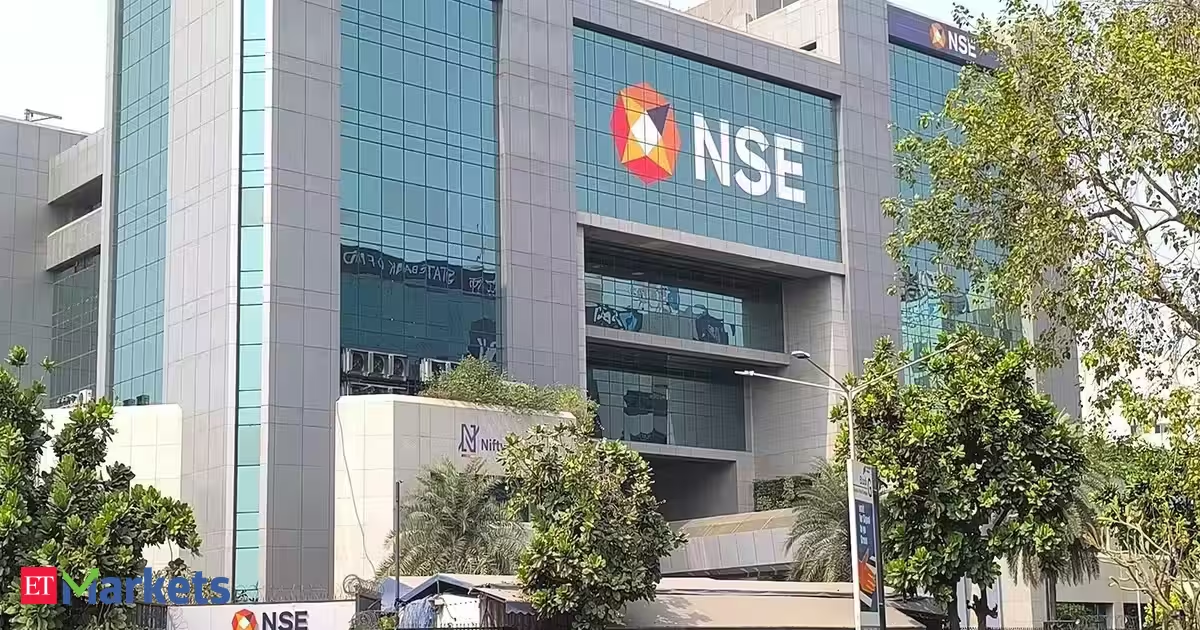
Mumbai: The National Stock Exchange‘s (NSE) share sale Wednesday drew more than 150 anchor investors, with overseas funds collectively garnering 43% of the stock on offer for this category of bidders before the issue opens for the public Thursday.

Bidders for the anchor book included sovereign wealth funds, global asset managers and long-only funds from the US, Europe and Asia, which helped the country’s biggest bourse garner ₹6,746.18 crore. The NSE said in an exchange filing that anchor investors got 37.8 million shares at ₹1,785 apiece.

Foreign portfolio investors accounted for ₹2,883 crore, or 43% of the anchor book. More than 20 foreign long-only funds participated, with the list including Singapore sovereign wealth fund GIC, Abu Dhabi Investment Authority and Norges Bank.

Other global investors included Fidelity, Goldman Sachs Asset Management, Eastspring Investments and HSBC Global Asset Management, people aware of the bids told ET. The IPO will remain open for the public from Thursday and close on Sep 21.

Advertisement

Read more: NSE IPO: Every Rs 10 move in shares could swing Radhakishan Damani’s wealth by nearly Rs 40 crore


Domestic institutional demand was also broad-based, with more than 25 mutual funds and 11 insurance and pension companies investing around ₹3,588 crore, or 53% of the anchor book.
Mutual fund houses participating in the anchor book were SBI Mutual Fund, ICICI Prudential Mutual Fund, HDFC Mutual Fund, Nippon Mutual Fund, Axis Mutual Fund, Aditya Birla Sun Life Mutual Fund, Kotak Mutual Fund, UTI Mutual Fund, Mirae Asset Mutual Fund and Franklin Templeton participated in the anchor book.Read more: Rupee languishes at six-week low ahead of Fed outcome, RBI limits losses

LIC, NSE’s largest shareholder with a 10.72% stake, invested more than ₹500 crore through LIC, LIC Mutual Fund and LIC Pension Fund. The investment comes even as LIC’s existing holding is larger than the stake being offered in the IPO.

The SBI group, which is selling a 1% stake in NSE through State Bank of India and SBI Capital Markets, is also investing in the exchange through SBI Mutual Fund, SBI General, SBI Life and SBI Pension Fund. Its combined investment exceeds ₹400 crore.

NSE IPO Tracker: Catch all the highlights here

Advertisement

Several existing investors also participated in the anchor book, adding to their exposure to NSE ahead of the IPO.

Continue Reading
Click to comment

You must be logged in to post a comment Login

Leave a Reply

Business

Backstreet Surveillance on the Future of Commercial Security

Published

on

Backstreet Surveillance on the Future of Commercial Security

The company has built its reputation around commercial surveillance systems, mobile surveillance trailers, security consulting, and expert system design. Its approach focuses on helping businesses choose and apply security technology based on the needs of each site.

Backstreet Surveillance works with a range of commercial security tools. These include high-definition cameras, motion detection, remote access, low-light technology, facial recognition, and licence plate recognition. Its systems are designed to support monitoring, recording, theft prevention, operational oversight, and security planning.

A key part of the company’s work is system design. Backstreet Surveillance looks beyond individual cameras and considers how equipment should work together across a commercial property. The company also provides installation support and troubleshooting to help customers use their systems effectively.

Free newsletters
Advertisement

The stories that matter to UK business, straight to your inbox.

Advertisement

Beyond its security systems, Backstreet Surveillance has developed a wider industry presence through educational content. Its YouTube channel, Backstreet Surveillance | The Security Experts, covers surveillance technology and practical security topics. The company is also connected with the podcast Beyond the Demo | The Ground Truth.

By combining commercial security experience with practical technology and industry education, Backstreet Surveillance has positioned itself as a knowledgeable voice in the evolving surveillance sector.

How did Backstreet Surveillance develop its focus on commercial security?

Our work has become centred on the needs of businesses and commercial properties. These locations often have more complex security requirements than a simple camera installation can solve.

A commercial site may have several entrances, vehicle access points, parking areas, warehouses, outdoor spaces, or areas that need different levels of monitoring. We focus on understanding those needs first and then designing a system around them.

Advertisement

Why is system design so important in commercial surveillance?

The camera itself is only one part of the system. Where it is placed, what it needs to capture, how it performs in different lighting, and how people access the footage all matter.

That is why we place a strong emphasis on expert design and application. A business can invest in advanced equipment, but the system still needs to be planned correctly to be useful.

How has surveillance technology changed the way businesses manage security?

There are more tools available now to give businesses better visibility.

Remote access is one example. It gives operators the ability to view their cameras even when they are away from the property. Motion detection can also help teams focus attention on activity rather than constantly watching a screen.

Advertisement

High-definition video has improved the level of detail available as well. That can be especially valuable when a business needs to review an event later.

What role does licence plate recognition play in commercial security?

Licence plate recognition can be useful for businesses that need to monitor vehicles entering or leaving a site.

That may include parking areas, commercial properties, industrial locations, or facilities with controlled access. It gives businesses another source of information when vehicle activity is important to their security plan.

As with any security technology, the value depends on how and where it is used.

Advertisement

Why has low-light performance become an important feature?

Commercial properties do not stop needing security when daylight ends.

Parking areas, warehouses, yards, entrances, and other exterior locations may need monitoring throughout the night. Cameras that perform well in low-light conditions can help maintain image quality during those hours.

Durability also matters. Outdoor equipment has to be able to operate in different weather conditions and environments.

Where do mobile surveillance trailers fit into modern security planning?

Mobile surveillance trailers provide flexibility.

Advertisement

Not every location needs or can support a permanent security installation. Construction sites, temporary work areas, large outdoor properties, and changing commercial environments may need surveillance for a certain period of time.

A mobile system can allow businesses to place security technology where it is needed without treating every situation as a permanent installation.

How does Backstreet Surveillance approach customer support?

Support is an important part of the process because installing equipment is not the end of the job.

Businesses need to understand how their systems work. They may need help with installation, settings, remote access, troubleshooting, or future changes.

Advertisement

We have always viewed those practical questions as part of the overall security experience. The goal is for the system to work as intended in the real environment where it is being used.

Why has Backstreet Surveillance invested in educational content?

Commercial security can become technical very quickly. There are many camera types, system features, recording options, and technologies to consider. Educational content gives us a way to explain those subjects in practical terms.

Our Backstreet Surveillance | The Security Experts YouTube channel is one way we share that information. The Beyond the Demo | The Ground Truth podcast also creates space for wider conversations about security technology and what happens beyond a simple product demonstration.

What do you think businesses should consider before choosing a surveillance system?

They should begin with the problem they are trying to solve. A business should think about what areas need to be monitored, what level of detail is required, whether remote access matters, what happens at night, and whether vehicles or large outdoor spaces are involved.

Advertisement

The best starting point is not simply asking which camera has the most features. It is understanding what the system needs to accomplish.

What is next for the commercial security industry?

We expect security systems to continue becoming more connected and more flexible.

Businesses are looking for clearer images, easier access to information, better monitoring tools, and systems that can adapt to different environments.

The technology will keep developing, but good design will remain important. A strong commercial surveillance system still depends on matching the right tools to the right application.

Advertisement

Continue Reading

Business

Former Dragons’ Den star invites entrepreneurs to pitch products

Published

on

Business Live

Nick Jenkins, founder of Moonpig.com, says the event is ‘a great opportunity’ for business owners

Moonpig founder and former Dragon's Den star Nick Jenkins

Moonpig founder and former Dragon’s Den star Nick Jenkins

Entrepreneurs are being offered the opportunity to pitch their businesses to a former Dragons’ Den star at a free event in Wiltshire next month.

The owners of early-stage, product-based companies who are preparing for their first investment are being invited to pitch their proposal – in return for “constructive feedback” – to a panel that includes Nick Jenkins, founder of Moonpig.com, at the West Wiltshire Business Expo.

Mr Jenkins, who starred in the hit BBC show for two series, said he was “excited” to be “helping Wiltshire businesses on their journey”.

The former ‘Dragon’ has lived in Wiltshire since 2010 and founded the online greeting cards and gifting company Moonpig in 1999 after an eight-year career as a commodity trader with Glencore in Moscow.

Advertisement

The business grew to five million customers before it was sold in 2011 for £120m and floated on the London Stock Exchange in 2021 with a valuation of £1.2bn. Mr Jenkin’s current investment portfolio features low-carbon tech and biotech businesses.

He will be joined on the panel by Monty George, co-founder of Wiltshire online furniture brand Furniturebox, which has a turnover exceeding £25m and recently opened a £3m state-of-the-art distribution centre in Chippenham.

“The Dragons’ Den [session] is a great opportunity for the founders of Wiltshire businesses to fine tune their business pitches and get ready for their first investments.” said Mr Jenkins.

Mr George, who started Furniturebox with his friend Dan Beckles in 2015 while still at school, said: “I’m delighted to be taking part in the Dragons’ Den panel at the West Wiltshire Business Expo.

Advertisement

“Having started Furniturebox at 17, I understand first-hand many of the challenges young entrepreneurs face when building a business. I’m looking forward to sharing some of the experiences and lessons I’ve learned along the way and to hopefully offering some useful advice to those taking their own ideas forward.”

The West Wiltshire Business Expo, which is free to attend, is organised by the Trowbridge Chamber CIC, one of the largest business groups in Wiltshire, in partnership with the Federation of Small Businesses (FSB).

Speakers include the CEOs and directors of some of Wiltshire’s largest businesses, including Apetito, Nutricia, Good Energy, Danone, Wiltshire Farm Foods and Wiltshire College & University Centre. The leader of Wiltshire Council and a number of West Wiltshire MPs are also attending.

The event is taking place at The Civic in Trowbridge on Thursday, October 8. Entrepreneurs looking for pitching practice and business advice are being asked to email dragons@trowbridgechamber.com to request an application form for the event.

Advertisement

Free tickets to the West Wiltshire Business Expo can be booked via Eventbrite.

Continue Reading

Business

Investing In The Hardware Powering Physical AI

Published

on

Black robotic arm elevating a golden AI microchip against soft pink gradient background illustrating advanced artificial intelligence hardware and precision robotics engineering

Investing In The Hardware Powering Physical AI

Continue Reading

Business

Bank of England set to hold interest rates despite rising UK inflation

Published

on

Business Live

Economists have warned that pressure to increase rates is mounting as inflation rises to a five-month high

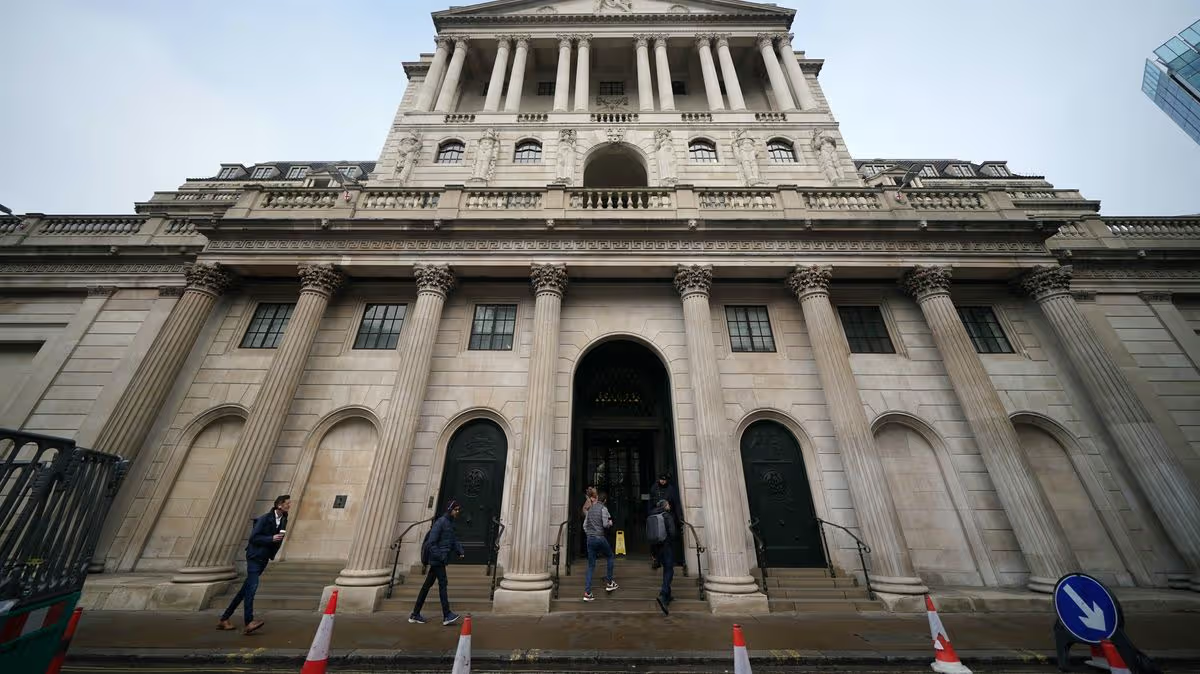
File photo dated 14/12/23 of the Bank of England in London. Barring a big surprise in February's inflation figures, not much is expected to change when the Bank of England's decision-makers release their latest interest rates decision on Thursday. The Monetary Policy Committee (MPC) will meet during the week to decide if the economy is showing the signs it wants to see before starting to cut rates. Issue date: Sunday March 17, 2024.

The Bank of England will announce its latest interest rate decision on Thursday(Image: 2024 PA Media, All Rights Reserved)

The Bank of England is expected to maintain interest rates at 3.75 per cent, though economists have cautioned that pressure to increase rates is building as inflation climbs. Most economists believe the Bank’s Monetary Policy Committee (MPC) will choose to leave interest rates unchanged at its forthcoming meeting on Thursday.

Advertisement

It would mark the sixth consecutive occasion the MPC has held rates steady, having remained at the same level since December.

Experts believe policymakers will persist with a “wait-and-see” strategy, particularly regarding the Middle East conflict and its impact on the UK economy.

Nevertheless, three members of the nine-strong MPC – Huw Pill, Megan Greene and Catherine Mann – voted to raise rates to four per cent at the previous meeting, and economists anticipate the same outcome at the next one.

This comes amid a backdrop of rising prices across the UK, with Consumer Prices Index (CPI) inflation climbing to 3.1 per cent in August, up from 2.9 per cent in July, according to the most recent official data.

Advertisement

This represented a five-month peak and demonstrates that CPI inflation has drifted further from the Bank of England’s two per cent target rate.

Numerous economists are predicting the cost of living will rise further, with households confronting another increase in their energy bills from next month, which could prompt the Bank to lift interest rates in the coming months.

Experts have said that services inflation — which reflects pricing trends within the UK’s dominant sector — held steady at 3.4 per cent in August, suggesting an absence of so-called second-round effects, such as escalating wage demands and broader increases in shop prices.

Nevertheless, inflation is widely anticipated to climb once Ofgem’s next energy price cap comes into effect in October, which will push household energy bills up by four per cent for a typical dual-fuel household.

Advertisement

Thomas Pugh, chief economist at RSM UK, said: “The rise in inflation in August is just the start of a new upward trend as higher energy, food and memory chip prices continue to make their way through supply chains.

“We now see inflation peaking at almost four per cent in early 2027, before gradually dropping back to two per cent in 2028. The MPC will hold this week, but inflation at four per cent is realistically too hot to ignore.”

Charlotte O’Leary, associate economist for the National Institute of Economic and Social Research (Niesr), said the MPC would also be keeping a close eye on the recent surge in oil prices, with Brent crude oil rising above 107 dollars a barrel this week.

“Nevertheless, with limited evidence of second-round effects so far, we expect the MPC to hold rates on Thursday,” she said.

Advertisement

“However, mounting inflationary pressures, alongside resilient growth data, may eventually grant scope to raise rates without materially damaging the economy.”

Economists for Pantheon Economics said there is a possibility the MPC “toughens its language” at the next rates announcements “to open up the possibility of a November hike if energy prices keep ramping up”.

“A four per cent inflation peak would already be too hot to hold, but further energy price rises could take inflation even higher,” they said. “The MPC needs to be ready.”

Last week, the European Central Bank lifted its interest rates for the second time this year, cautioning that the Iran war continues to generate inflationary pressure.

Advertisement

Meanwhile, the US Federal Reserve is broadly anticipated to raise its rates for the first time since 2023 on Wednesday evening.

Continue Reading

Business

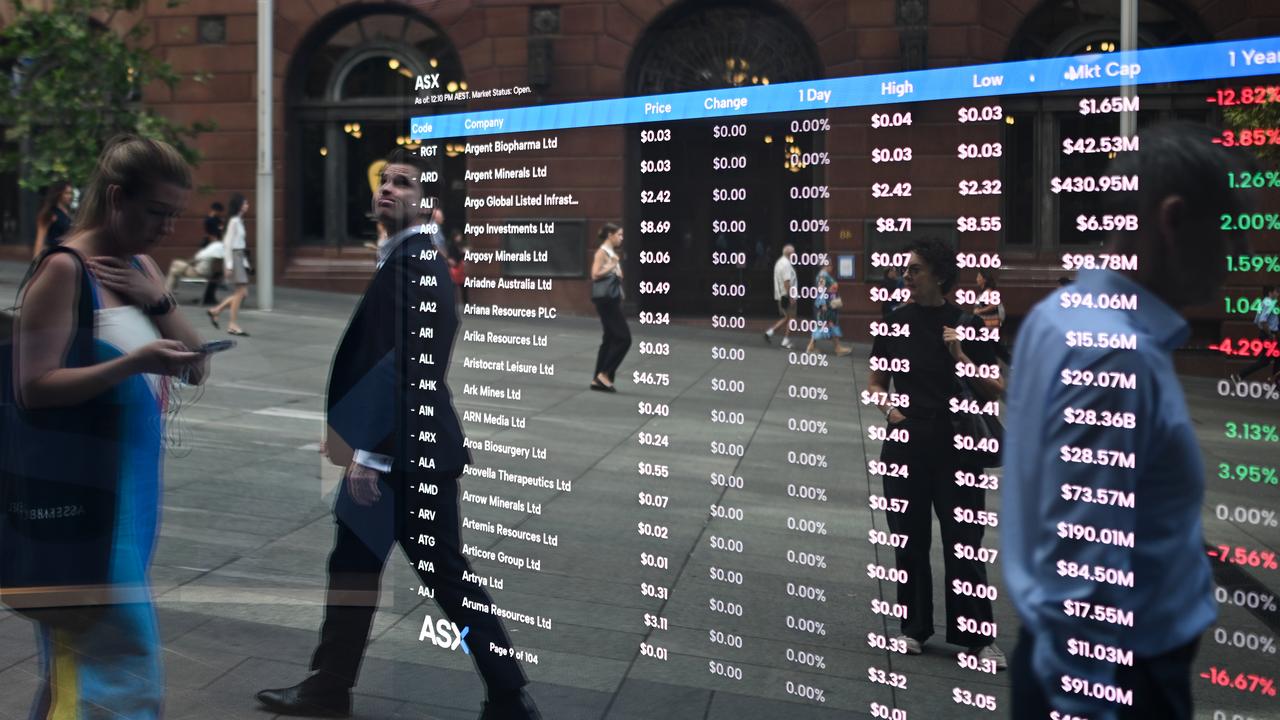
Aussie shares lift as Fed rate call calms bond market

Published

on

Aussie shares lift as Fed rate call calms bond market

Yes. Corporate subscriptions are available for teams and organisations, with discounted rates as user numbers increase. Pricing starts from $1,625 + GST per user.
Get in touch
to discuss the right option for your organisation.

Business News subscriptions are used by executives, investors, consultants and professionals who need to stay informed and make better decisions about the WA market. When you subscribe you’ll get

  • Unlimited access to WA’s most trusted business journalism
  • Data & Insights — detailed profiles of WA companies, people, projects and deals
  • MyBN — a personalised feed based on the companies, people and sectors you follow
  • Special publications and industry reports
  • Daily and weekly email newsletters

Data & Insights is a research tool built specifically for the WA market. It draws on more than 30 years of Business News reporting, updated regularly to reflect what’s happening now. Use it to:

  • Look up detailed profiles of WA companies, including financials, directors and ownership
  • Find decision-makers and track their career movements
  • Research live and completed projects across WA industries
  • Monitor deals, appointments and market activity
  • Access industry rankings and league tables

Data & Insights is updated daily by our dedicated research team, which uses the latest announcements, ASX filings and editorial coverage to keep our person, company, list and project records up to date.

Business News welcome all opportunities to make our dataset accurate, complete and current, so if you have an update request, please email the team at
general@businessnews.com.au, and we’d be happy to assist.

Advertisement

MyBN
is part of every subscription. It’s your personalised view of Business News. You can follow the companies, people, sectors and projects that matter to you, and get a news feed and alerts tailored to your interests. You can save articles to read later and retain only what you need.

Only subscribers have full access to all content on the Business News website.

Advertisement

If staying informed about the WA economy is part of your job, and/or you’re looking for networking opportunities in WA, Business News is built for you.

Business News subscribers are:

  • Executives and directors tracking competitors, clients and market movements
  • Investors and advisers researching companies, deals and industry trends
  • Consultants and professionals staying across sectors relevant to their clients
  • Business owners looking for leads, context and market intelligence

Most Business News publications cover national or global markets. Business News is focused entirely on Western Australia, which means the journalism, the data and the intelligence are all built around WA companies, people and projects — not adapted from a national feed. Data & Insights, included with every subscription, combines more than 30 years of WA-specific editorial research with live business data. There’s no comparable product for the WA market.

Advertisement

The Morning Digest Email provides a comprehensive wrap of the major headlines, relevant to WA business, and includes with a snapshot of the overnight news covering oil, gold and ASX-listed companies.

The Afternoon Wrap Email focuses on the news covered by our team of journalists during the course of the working day, including exclusive stories and analysis, all of which relates to WA business and the local economy.

The BN Weekender Email contains a wrap of the Business News from the week that was, highlighting the top stories in each area of WA business.
Sign up for free.

Advertisement

We’re happy to help.
Get in touch
and our team will come back to you.

Advertisement
Continue Reading

Business

No Official Price Tag Yet for Wednesday’s Global Salesforce Outage, But Here’s How the Costs Could Add Up

Published

on

Salesforce has bought word processing startup Quip for $582 million. Here, a woman stands near a Salesforce sign during the company's annual Dreamforce event, in San Francisco, Nov. 18, 2013.

SAN FRANCISCO — Salesforce Inc. has not disclosed a dollar estimate for how much Wednesday’s global service outage cost the company or its customers, and no independent analyst had published a specific figure as of Wednesday afternoon, leaving the financial toll of the disruption an open question even as the technical incident itself has been resolved.

The outage began around 7:50 a.m. UTC, roughly 3:50 a.m. Eastern time, according to Salesforce’s own status page, and affected customers across all three of the company’s operating regions, with reports of disruption spanning the United States, United Kingdom, Germany, France, India and Japan. Salesforce said the root cause traced to an internal login service, where incoming requests were stalling while waiting for a response, consuming available server resources and cascading into broader access failures across the platform. The company said it validated a fix on a test instance and began rolling it out fleetwide by roughly 10:56 a.m. UTC, with independent monitoring services logging the core disruption at around four hours and 22 minutes, though shorter, related incidents continued to appear on the company’s status tracker later in the day.

Quantifying the financial impact of a cloud outage like Wednesday’s is notoriously difficult, and companies rarely disclose precise figures even after an incident is fully resolved. Unlike a factory shutdown or a single retailer’s website going dark, Salesforce’s customer relationship management platform underpins day-to-day operations for a vast and varied customer base, one that Salesforce itself has described as including major global companies such as Amazon, Walmart, Coca-Cola, Toyota and IBM. An outage affecting that platform generates costs on at least two separate ledgers: the direct hit to Salesforce’s own business, largely through service-level agreement credits and reputational damage, and a far larger, harder-to-measure set of costs borne by the customers who rely on Salesforce to run sales, service and marketing operations.

Salesforce’s own scale offers one way to think about the stakes involved, even without a specific outage-cost figure attached. The company reported fiscal second-quarter revenue of $11.35 billion, up 11% year-over-year, with full-year revenue guidance raised by $200 million following that report. Spread across a full fiscal year, that revenue run rate implies Salesforce generates tens of millions of dollars in revenue on a typical day, though a service disruption does not translate directly into lost revenue on a one-to-one basis, since most Salesforce customers pay through annual or multiyear subscription contracts rather than per-use billing, meaning a several-hour outage does not necessarily reduce the total amount Salesforce ultimately collects from an affected customer.

Advertisement

The more significant financial exposure from an incident like Wednesday’s typically falls on Salesforce’s customers rather than on Salesforce itself. Businesses that rely on the platform for order processing, customer service ticketing, sales pipeline management and marketing automation can face lost productivity, delayed transactions, and in some cases direct revenue loss if the outage prevents customer-facing sales or support functions from operating during the disruption window. Because those costs are dispersed across thousands of individual Salesforce customers rather than concentrated at Salesforce itself, they are rarely aggregated into a single public estimate, and no such aggregate figure had been published in connection with Wednesday’s incident as of the most recent available reporting.

The timing of Wednesday’s outage added a further layer of reputational, if not directly quantifiable, cost. The disruption struck on the second day of Dreamforce, Salesforce’s flagship annual conference in San Francisco, an event expected to draw more than 40,000 in-person attendees and more than 200,000 additional registrants online, with more than 400 sessions this year built around Salesforce’s push into AI-driven “Agentic Enterprise” software. An outage occurring in the middle of an event explicitly designed to showcase the platform’s reliability to customers, prospects and partners carries a cost in credibility and marketing impact that is difficult to translate into a specific dollar figure, even if it does not appear directly on Salesforce’s income statement.

Financial markets offered one immediate, if imperfect, gauge of investor sentiment following the outage. Salesforce shares had already closed Tuesday at $255.65, down 1.46% from Monday’s close of $259.43, a decline that occurred before the outage began and therefore cannot be attributed to the incident itself. Shares slipped a further roughly 0.5% in Wednesday premarket trading, changing hands around $254.40, though broader market conditions, including anticipation ahead of the Federal Reserve’s interest rate decision, were also weighing on technology stocks more broadly that morning, making it difficult to isolate how much of Wednesday’s modest share price movement, if any, reflected the outage specifically.

Wednesday’s disruption was not an isolated event in Salesforce’s recent history. The company has experienced a series of significant outages over the past year and a half, including a June 2025 incident that took its Heroku platform-as-a-service offline for more than six hours alongside disruptions to Commerce Cloud, Marketing Cloud, Tableau, Service Cloud and MuleSoft, and an earlier four-day disruption that crippled core customer service functions including Email-to-Case and Web-to-Case features. None of those prior incidents resulted in a publicly disclosed cost estimate either, consistent with the broader industry pattern of treating outage costs as commercially sensitive or simply too diffuse to calculate with precision.

Advertisement

Absent an official disclosure from Salesforce or a published third-party analysis, the true financial toll of Wednesday’s outage, spanning lost productivity across its global customer base, any service credits owed under customer contracts, and the harder-to-quantify reputational cost of the disruption occurring during Dreamforce, is likely to remain an estimate rather than a confirmed figure, unless Salesforce chooses to address the matter directly in a future earnings call or regulatory filing.

Continue Reading

Business

Brookfield to invest up to $600 million in India’s ACME green fuels business

Published

on


Brookfield to invest up to $600 million in India’s ACME green fuels business

Continue Reading

Business

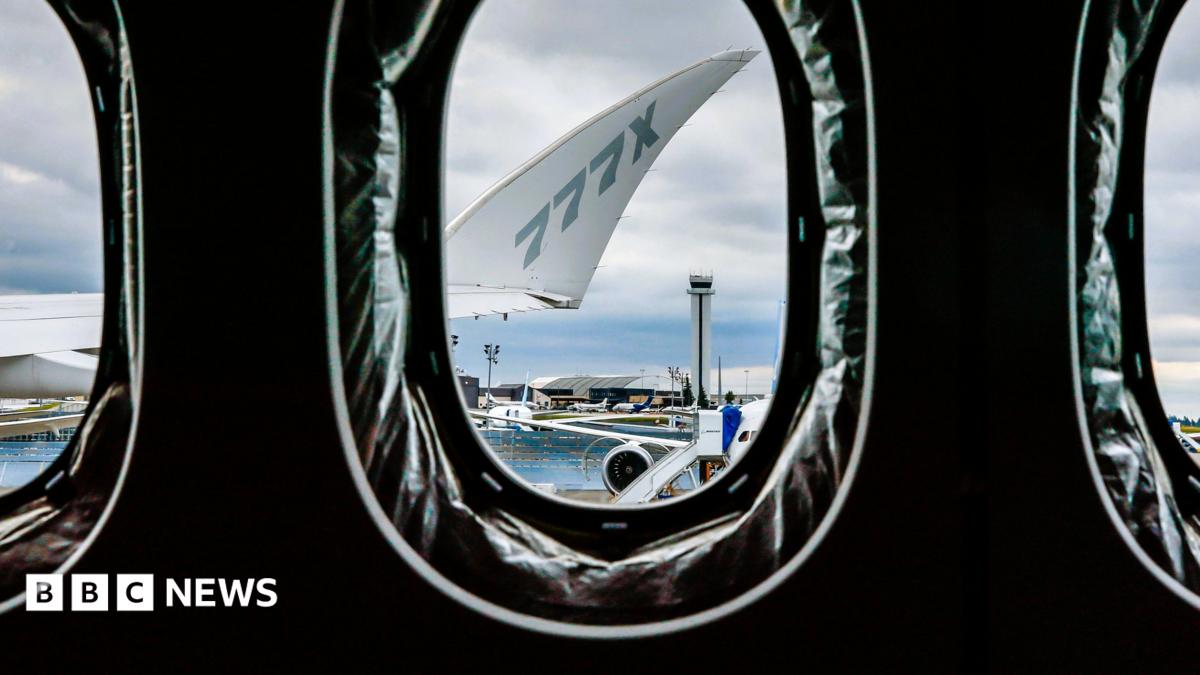
Why so few companies make aircraft windows

Published

on

Water is sprayed on the overheating tank in Los Angeles in May.

Cockpit windows, Vermont says, are “totally different”.

They are generally made of glass, which is chemically reinforced by adding potassium to it. This involves swapping smaller sodium ions for larger potassium ions, which helps to fill out the molecular structure of the glass, meaning that when it cools during production, it compresses into an extra strong, tight formation as it cools.

Some of the latest aircraft feature cockpit windows that are also curved, to make the plane more streamlined, which improves fuel efficiency. But curved cockpit windows are challenging to make – the slightest distortion or defect is clearly visible to the pilot.

Quality control checks are used to ensure no such impediments exist in the final product.

Advertisement

All aircraft windows must be resistant to impacts but cockpit windows, at the front of the plane, are especially vulnerable to bird strikes, says Vermont: “The issue is not the speed of the bird, the issue is the speed of the aircraft.”

Saint-Gobain uses numerical simulations and “physical tests representative of a sizeable bird impact” to test its windows against this threat.

“Typically, if you go through a hailstorm or if you hit a large enough bird, the external ply will crack,” says Vermont. “The cockpit window is designed for that.”

A London to Londonderry flight was recently affected by a cracked cockpit window. While a mid-air emergency was declared, the plane landed safely. “There can be [such] cases,” says Vermont, though he adds that Saint-Gobain’s windows have not been involved in any recently.

Advertisement

“You’re obviously dealing with a surface that is interfacing with two very different environments,” says Stengel. “That’s why these are more highly-engineered products.”

Continue Reading

Business

Cook govt's events ROI nothing to celebrate, Sandra Brewer says

Published

on

Cook govt's events ROI nothing to celebrate, Sandra Brewer says

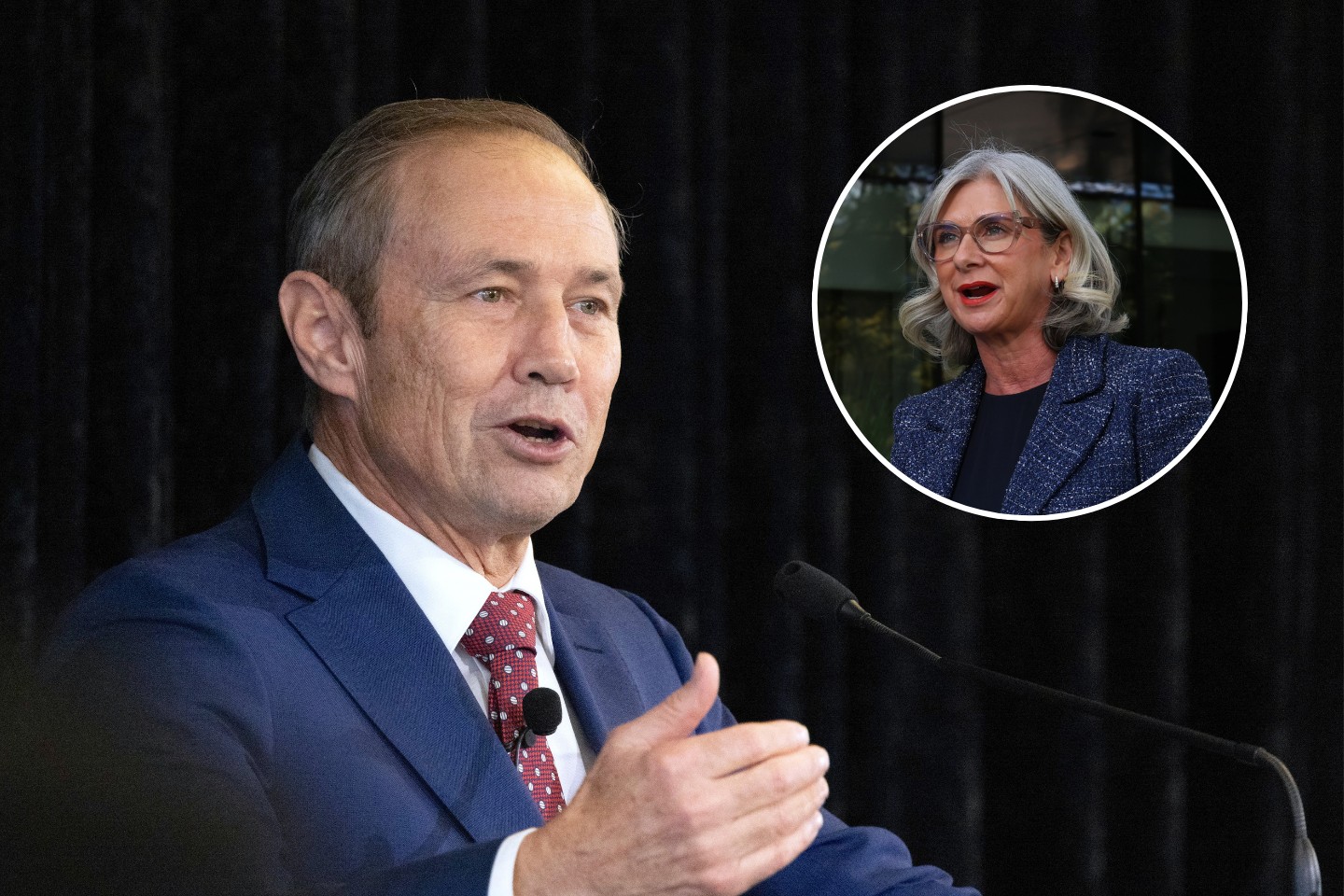
Shadow Treasurer Sandra Brewer says the state government’s $2.80 return for every dollar spent on major events pales in comparison to Mark McGowan’s “bold” tourism strategy back in the early 2000s.

Continue Reading

Business

Preserving Tradition Through Purpose and Craft

Published

on

Preserving Tradition Through Purpose and Craft

Those lessons shaped a career that has spanned sacred writing, Hebrew calligraphy, Judaica art, and education. Today, his work continues to focus on preserving Jewish heritage while sharing those traditions with future generations through teaching and craftsmanship.
“I have always believed that making a positive difference in people’s lives is what matters most,” Rabbi Karro says.

From Russia to a Life of Learning in Jerusalem

Rabbi Steve Karro was born in Russia before moving to Jerusalem with his family at the age of 10. The move marked the beginning of a lifelong commitment to Jewish education and personal growth.

Free newsletters
Advertisement

The stories that matter to UK business, straight to your inbox.

Advertisement

He attended Hebrew school before continuing his studies at Yeshiva Ponevezh in Bnei Brak, where he immersed himself in rabbinical studies. During this time, he earned his rabbinical diploma while also developing a passion for Hebrew calligraphy and art.

For Rabbi Karro, education was never simply about acquiring knowledge. It was about preparing to serve others.

“Learning never really ends,” he says. “The more we learn, the more we can share with others.”

That philosophy continues to influence both his work and his outlook on life.

Advertisement

A Career Dedicated to Sacred Writing and Art

After completing his studies, Rabbi Karro devoted his career to sacred writing and traditional Jewish craftsmanship. His work includes writing Torah scrolls, mezuzot, and tefillin, as well as restoring older Torah scrolls so they can continue serving communities for generations.

Every project requires careful attention to detail and respect for traditions that have remained largely unchanged for centuries.

Alongside his work as a scribe, Rabbi Karro is also a Judaica artist who creates oil paintings and Hebrew calligraphy inspired by Jewish history and culture. Together, these disciplines allow him to combine creativity with preservation.

“I believe making good changes is important,” he says. “Every piece of work should leave something positive behind.”

Advertisement

Why Teaching Has Always Been Part of the Mission

While craftsmanship has defined much of Rabbi Karro’s professional life, education has always been equally important.

Throughout his career, he has shared his knowledge of Hebrew calligraphy, sacred writing, and Jewish tradition with others, believing that preserving knowledge is just as important as preserving artifacts.

He hopes that by teaching others, these skills and traditions will continue long into the future.

“Teach what I learned so more people will be able to do good for our universe,” he says.

Advertisement

Rather than keeping specialized knowledge to himself, Rabbi Karro sees education as an opportunity to multiply positive influence.

Staying Focused Through Challenges

Every career brings obstacles, and Rabbi Karro has faced his share of personal challenges.

He has spoken about experiencing attempts to damage his identity and reputation. Instead of allowing those experiences to define him, he remained committed to his values, faith, and work.

“Many challenges came when enemies tried to take my identity away and put me through worldwide embarrassment,” he says. “I’m still standing and going with God and what I have always believed in.”

Advertisement

His response has been to continue creating, teaching, and helping others rather than becoming distracted by negativity.

That resilience has become one of the defining characteristics of his journey.

Building a Legacy Through Service

For Rabbi Karro, success has never been measured by recognition alone. Instead, he believes lasting impact comes from helping people and preserving traditions that matter.

Whether restoring a Torah scroll, teaching a student, or creating a work of art, he approaches each opportunity with the same sense of purpose.

Advertisement

“When I make a happy difference in people’s lives,” he says, “that is what matters most.”

He also believes that good actions inspire more good actions.

“My goal is to duplicate my good actions so others continue believing they are important and can make positive changes.”

That philosophy has guided his work for decades and continues to shape his future.

Advertisement

Looking Ahead While Preserving the Past

Today, Rabbi Steve Karro continues his work as a Hebrew calligrapher, Judaica artist, educator, and scribe. His career reflects a deep respect for history while emphasizing the importance of passing knowledge from one generation to the next.

Although his work centers on ancient traditions, his message is timeless. He believes every person can make a meaningful contribution by acting with integrity, serving others, and remaining committed to lifelong learning.

“When your close family is happy, others around them become happier too,” he says.

For Rabbi Karro, preserving tradition has always been about more than protecting the past. It is about ensuring future generations inherit the knowledge, values, and craftsmanship needed to continue making a positive difference.

Advertisement


Advertisement
Continue Reading

Trending

Copyright © 2025