

Business
Nvidia, software reports pose next tests for AI-sensitive stock market



America First Policy Institute’s Erika Donalds reveals how AI is being used to help students learn in-depth about topics from VR headsets on ‘Making Money.’
NEW DELHI – The massive AI summit in India this week looked, on the surface, like a familiar spectacle: world leaders and technology executives converging in New Delhi, headline-grabbing investment numbers, and carefully worded joint statements. It was the largest global AI summit to date, and the first hosted in the Global South.
I was on the ground through the summit’s closed-door sessions, bilateral events, and formal signings. While most coverage focused on press releases and piecemeal deal announcements, something far more strategic was unfolding.
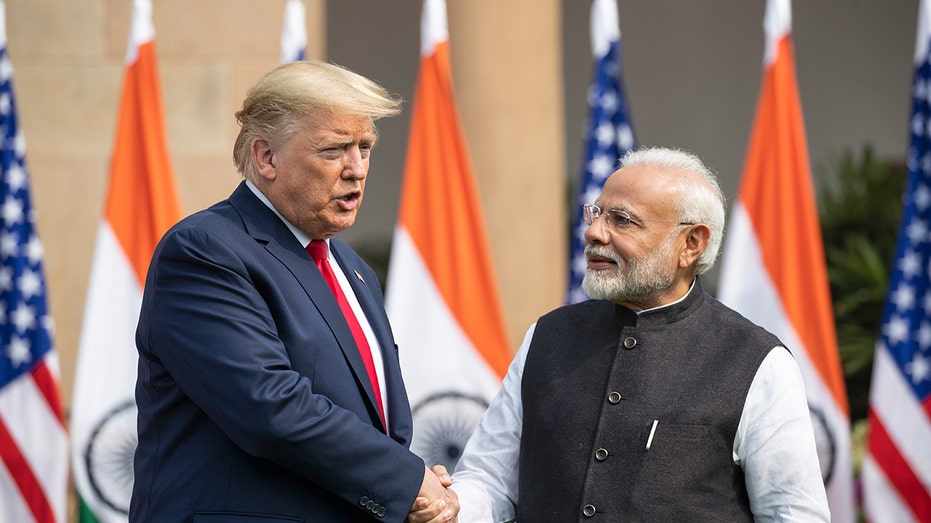
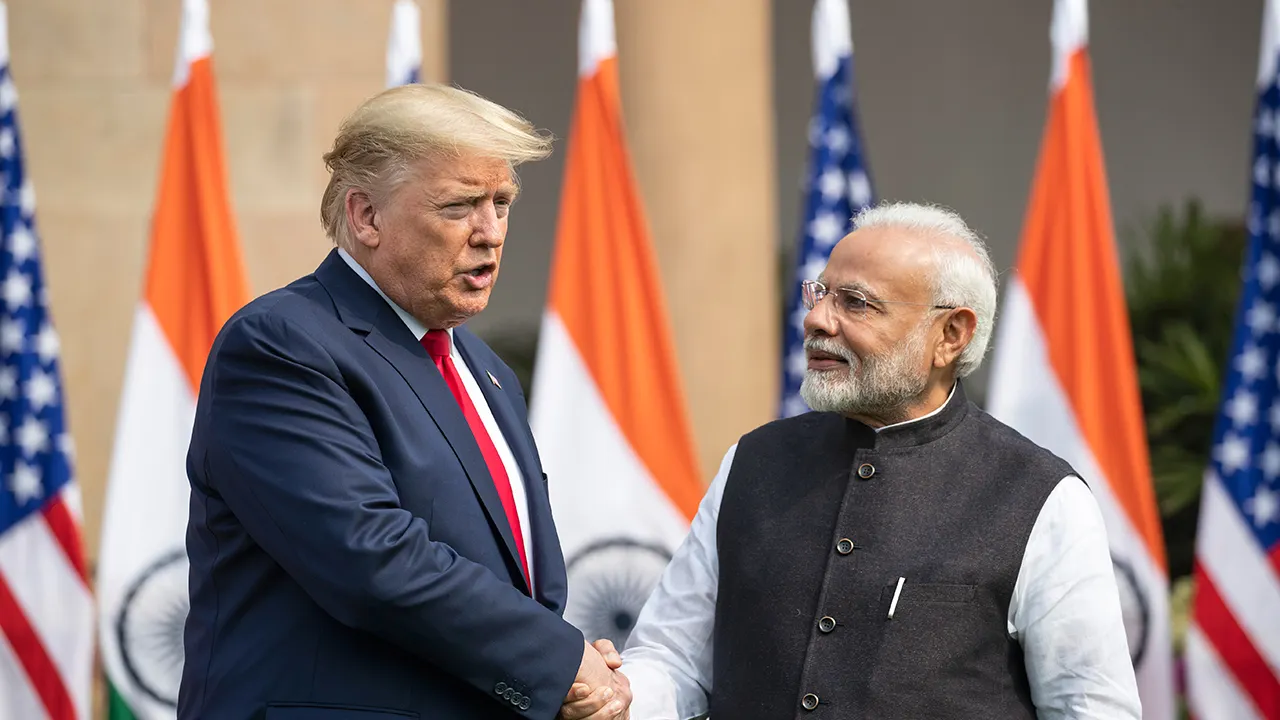
FILE-U.S. President Donald Trump and Indian Prime Minister Narendra Modi shake hands before their meeting at Hyderabad House, Feb. 25, 2020, in New Delhi, India. (AP Photo/Alex Brandon, file) (AP Photo/Alex Brandon, file / AP Newsroom)
In the span of a few days, the United States quietly assembled a full playbook for the Global South—how emerging economies adopt artificial intelligence, how that adoption is financed, how it is secured. The United States paired AI diffusion with supply-chain security and anchored both in India, signaling a shift in how it intends to project technological leadership at a moment when domestic politics are pulling inward. This system has two parts.
The first is the supply chain and critical resources side with Pax Silica. U.S. Under Secretary of State for Economic Affairs Jacob Helberg, U.S. Ambassador to India Sergio Gor, and White House Office of Science and Technology Policy Director Michael Kratsios all showed up in New Delhi to sign an agreement welcoming India into the Pax Silica. The declaration formalizes cooperation across critical minerals, semiconductor manufacturing, energy, and data-center infrastructure, explicitly tying economic resilience to national security.
AI RAISES THE STAKES FOR NATIONAL SECURITY. HERE’S HOW TO GET IT RIGHT
Helberg framed the effort as a response to what he called “weaponized dependency,” arguing on stage that “economic security is national security” and that sovereignty in the modern era comes from the ability to build—”from minerals deep in the earth to silicon wafers to the intelligence that powers AI systems.” Ambassador Gor followed by stating plainly that India’s participation was “not symbolic” but “strategic and essential,” linking the initiative directly to broader U.S.–India trade, technology, and defense coordination. The language was unusually direct.
The second arm came moments later, in a press conference that received comparatively little attention. Director Kratsios outlined a new AI exports stack, what amounts to a new phase of U.S. AI policy: a coordinated effort to export the American AI ecosystem at scale, supported by financing, standards-setting, and deployment assistance. “We want to share the great American technology stack with the world,” he said, emphasizing that leadership in AI will be determined not only by who invents, but by whose systems are adopted widely enough to become defaults.
FOX Business correspondent Madison Alworth joins ‘Varney & Co.’ to break down White House A.I. czar David Sacks’ warning that overregulation could cause the U.S. to lose the global artificial intelligence race.
That framing helps explain why this was launched in New Delhi and not Washington. India designed the summit around adoption rather than abstraction, with leaders from the Global South, frontier AI firms, and multilateral lenders present by design. Indian officials emphasized execution constraints and sovereignty rather than values alignment. IT Minister Ashwini Vaishnaw focused on semiconductor talent shortages, noting that the global industry will require “roughly one million additional skilled professionals” and that India is addressing this through nationwide programs spanning hundreds of universities, alongside free access to advanced chip-design tools from firms such as Synopsys, Cadence, and Siemens.
AMERICA HAS TO RESPOND WITH A UNITED FRONT TO CHINA’S MASSIVE ECONOMIC WARFARE
All U.S. officials present highlighted India’s role as critical. Most emerging economies plug into a single link of the technology value chain: minerals, low-cost assembly, or consumption. India operates across the stack. U.S. officials repeatedly emphasized that India brings scale in engineering talent, active participation in advanced chip design, a growing domestic AI product ecosystem, population-level deployment potential and the capacity to absorb large-scale infrastructure investment in data centers and energy. That makes India not just a market, but a stabilizing node—both for AI diffusion and for diversifying supply chains that have become increasingly concentrated.
The summit underscored a problem in the Global South that Washington has often avoided stating directly. Artificial intelligence is no longer a standalone sector. It is an infrastructure layer of the future economy. Infrastructure requires secure inputs, energy, standards, skilled labor, and sustained capital. Countries that cannot deploy AI at scale will have little influence over how it is governed. They will inherit systems designed elsewhere. Regulation without participation offers neither sovereignty nor stability.
CLICK HERE FOR MORE FOX NEWS OPINION
The U.S. response outlined in New Delhi reflects a recognition of that reality. The American AI ecosystem is being positioned as a foundation others can build on, rather than a closed platform they must rent. Financing tools across multiple agencies—including the U.S. Development Finance Corporation and Export-Import Bank—are being aligned to lower adoption barriers. Partner-country firms are being integrated and cross-sold in the system rather than excluded from it. Standards, particularly for next-generation AI agents, are being shaped early, with Kratsios noting that interoperability will determine whether AI scales smoothly or fragments.
Pax Silica and the AI export program – these two tracks are meant to move together, forming a loop between capability and resilience.
CLICK HERE TO DOWNLOAD THE FOX NEWS APP
It was clear from over $250 billion in AI deals announced in New Delhi that markets appear to recognize the direction of travel. Microsoft has committed to invest approximately $50 billion in AI infrastructure across the Global South by the end of the decade. OpenAI and AMD announced partnerships with India’s Tata Group tied to AI infrastructure and deployment. Blackstone participated in a $600 million raise for Indian AI infrastructure firm Neysa, while Nvidia expanded its venture partnerships across India. Indian conglomerates Reliance and Adani separately outlined large-scale data-center investments measured in multiple gigawatts of capacity.
As domestic politics in the United States become more consuming ahead of the midterms, the White House is clearly moving to lock in a parallel agenda abroad—one that does not depend on legislative cycles or headline battles at home. The Global South, where AI adoption will determine growth trajectories and political alignment for decades, is now central to that effort. The United States is no longer relying on innovation alone to sustain technological leadership. It is constructing an adoption architecture, securing its physical foundations, and extending both outward at a moment when the US moves to an inward focus.


Greenland prime minister says ’no thanks’ to Trump’s hospital ship

Technical strategist says S&P 500 "appears coiled for a significant move" soon

Lufax earnings ahead Monday as China fintech eyes leadership shift

New Gold in spotlight as final earnings loom before merger

U.S.-Iran talks expected Friday if Iran sends nuclear proposal soon, Axios reports

Nestle: Ice Cream Exit Reflects Strategic Execution


Swiss official says country may have to accept US tariffs as permanent

US trade chief says no countries have said they will withdraw from tariff deals
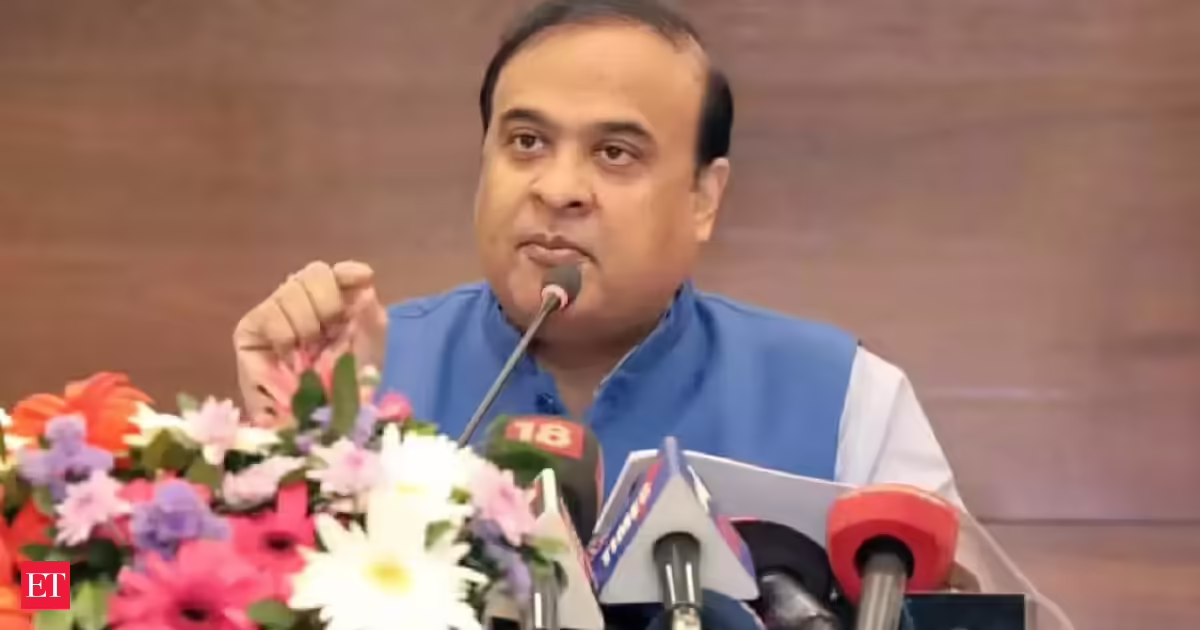
Among the NDA constituents in the state, the BJP, Asom Gana Parishad (AGP), United People’s Party Liberal (UPPL) and Bodoland People’s Front (BPF) have members in the assembly. Rabha Hasong Joutha Sangram Samiti (RHJSS) and Janashakti Party (JP) are also part of the NDA, but they do not have any MLAs.
“Our NDA alliance is complete. We know who will contest where; it is a done deal. There is no issue in stitching the alliance,” Sarma told reporters at the state BJP headquarters.
“After every process is complete, the state leadership will meet Union Home Minister Amit Shah with the list of probable candidates,” he added.
On January 7, Sarma had said the BJP was likely to formalise its seat-sharing agreement with its allies by February 15.

On December 5 last year, he had said the finalisation was expected to be over by January 15.
The elections for the 126-member assembly are expected to take place in March-April. This will be the first election after the delimitation exercise, done in 2023.Post delimitation, many seats and their geographical boundaries have been changed, while some non-reserved seats were reserved and vice versa. This has led to complications within the ruling and opposition coalitions.
At present, the BJP has 64 members in the assembly, while AGP has nine, UPPL has seven, and the BPF has three.
In the opposition camp, the Congress has 26 MLAs, AIUDF has 15, and CPI(M) has one. There is one Independent legislator as well.

US women’s hockey coach John Wroblewski’s emotional moment recalled by player

Poem: The Attraction of Blackberries
Snooker bad boy Quinten Hann left Stephen Hendry shocked by what he did between matches


-

 Video6 days ago
Bitcoin: We’re Entering The Most Dangerous Phase
-

 Crypto World5 days ago
Can XRP Price Successfully Register a 33% Breakout Past $2?
-

 Video3 days ago
XRP News: XRP Just Entered a New Phase (Almost Nobody Noticed)
-

 Fashion2 days ago
Weekend Open Thread: Boden – Corporette.com
-

 Sports6 days ago
GB's semi-final hopes hang by thread after loss to Switzerland
-

 Politics8 hours ago
Baftas 2026: Awards Nominations, Presenters And Performers
-
 Tech5 days ago
The Music Industry Enters Its Less-Is-More Era
-

 Business5 days ago
Infosys Limited (INFY) Discusses Tech Transitions and the Unique Aspects of the AI Era Transcript
-

 Entertainment4 days ago
Kunal Nayyar’s Secret Acts Of Kindness Sparks Online Discussion
-

 Video5 days ago
Financial Statement Analysis | Complete Chapter Revision in 10 Minutes | Class 12 Board exam 2026
-

 Tech4 days ago
Retro Rover: LT6502 Laptop Packs 8-Bit Power On The Go
-
 Sports3 days ago
Clearing the boundary, crossing into history: J&K end 67-year wait, enter maiden Ranji Trophy final | Cricket News
-

 Business3 hours ago
Mattel’s American Girl brand turns 40, dolls enter a new era
-

 Entertainment4 days ago
Dolores Catania Blasts Rob Rausch For Turning On ‘Housewives’ On ‘Traitors’
-

 Business4 days ago
Tesla avoids California suspension after ending ‘autopilot’ marketing
-
 NewsBeat7 days ago
The strange Cambridgeshire cemetery that forbade church rectors from entering
-

 Politics5 days ago
Eurovision Announces UK Act For 2026 Song Contest
-

 Crypto World4 days ago
WLFI Crypto Surges Toward $0.12 as Whale Buys $2.75M Before Trump-Linked Forum
-

 Crypto World3 days ago
83% of Altcoins Enter Bear Trend as Liquidity Crunch Tightens Grip on Crypto Market
-

 Video2 hours ago
Bajaj Housing Finance: Good Time To Enter ?? Complete Analysis !!