

Business
Oil Prices Rise, Dow Drops Amid Fears Over Iran War

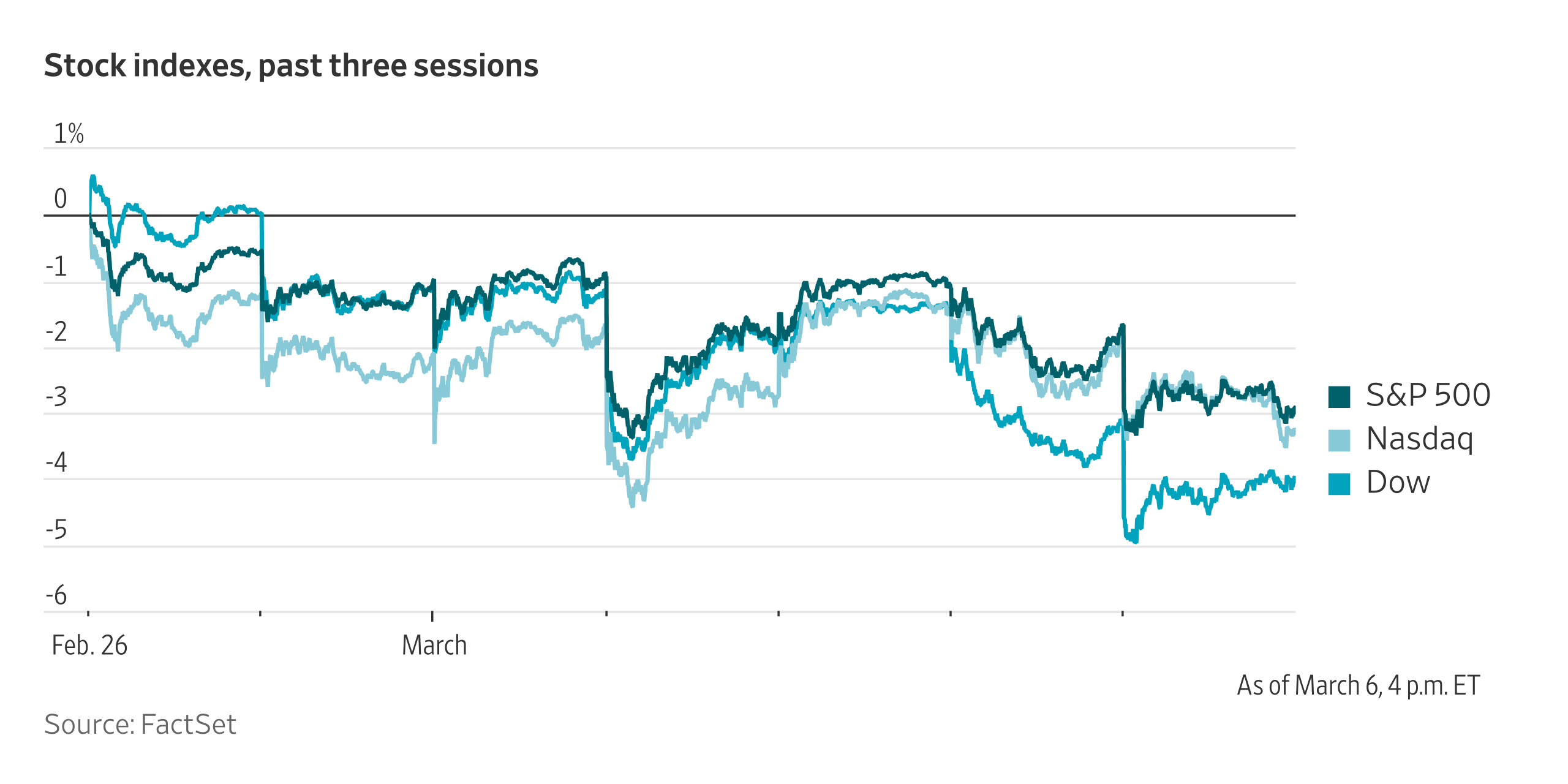
Oil prices jumped above $100 a barrel and stocks sold off as investors braced for deeper economic fallout from the Iran war.
Brent crude, the global oil benchmark, surged nearly 30% overnight, hitting its highest intraday level since mid-2022. It later pared some gains ahead of a G-7 meeting, where finance ministers were expected to discuss the possibility of releasing oil from reserves. Gulf oil producers are cutting production as their facilities come under attack and shipping remains paralyzed.
The Dow industrials dropped more than 700 points, while the S&P 500 and Nasdaq composite also fell more than 1%. Overseas, Asian stock markets skidded, with South Korea’s benchmark index down 6% and Japan’s Nikkei 225 falling about 5%.


Check out what’s clicking on FoxBusiness.com.
Ford is recalling more than 83,000 vehicles in two separate actions due to issues that could increase the risk of a crash, federal regulators said.
The first recall affects 35,772 model year 2025-2026 Explorer SUVs and the dynamic bending light feature, according to the notice filed with the National Highway Traffic Safety Administration.
The affected vehicles have an incorrect headlamp control module software calibration that results in the right headlight turning in the opposite direction of a vehicle turn.

A model year 2025 Ford Bronco Sport. (Ford Motor Co.)
FORD RECALLS 1.74 MILLION VEHICLES DUE TO REARVIEW CAMERA BLACKOUTS, ISSUES
“When turning the steering wheel on a left curve, the driver’s side (LHS) bending light correctly follows the turn, while the passenger side (RHS) light bends away from the curve,” the recall report said. “Conversely, when turning on a right curve, the left-hand light follows the steering wheel and bends to the right, while the right-hand light bends inward towards the left.”
The report said a headlight that turns incorrectly could result in increased glare to other drivers and increase the risk of a crash.
FORD IN DEEP WATER AFTER SWEEPING RECALLS HIT EVERY MODEL SINCE 2020 – WITH ONE EXCEPTION
Ford said it is not aware of any accidents or injuries related to the issue.
Updates to fix the headlight control module software will be available over the air or through dealerships at no charge. Owner notification letters are expected to be mailed March 23.
In a separate action, Ford is recalling 47,804 vehicles due to issues with the engine gas recirculation (EGR) valve that could lead to a loss of motive power, most likely at low speeds, which Ford said increases the risk of a crash.

Ford issued two separate recalls for certain model year 2025-2026 Explorers and certain 2025 Ranger, Mustang, Maverick, Explorer, Escape, Bronco, Bronco Sport, Lincoln Nautilus and Corsair vehicles. (Jeff Kowalsky/Bloomberg via Getty Images )
FORD BUILDS ONE-OF-A-KIND EXPLORER FOR POPE LEO XIV
The recall affects certain model year 2025 Ranger, Mustang, Maverick, Explorer, Escape, Bronco, Bronco Sport, Lincoln Nautilus and Corsair vehicles with 1.5-liter, 2.0-liter or 2.3-liter engines.
Ford said it is not aware of any accidents, injuries or fires related to the condition.
CLICK HERE TO GET FOX BUSINESS ON THE GO
The automaker said a fix is still under development. Owners will be notified by mail once a remedy is available and will need to take their vehicles to a Ford or Lincoln dealer for a free repair.

American Tower director Robert D. Hormats to step down after annual meeting

In recent years, the way people approach their jobs has undergone a significant transformation.
Advances in technology, changing expectations from employees, and the experiences of recent years have all contributed to a shift in how organisations structure their work environments. One of the most notable developments is the growing popularity of hybrid work models, which allow employees to split their time between working remotely and spending time in a physical office.
This shift represents a broader cultural change in how businesses view productivity and flexibility. Rather than requiring employees to be present in the office every day, many organisations now recognise that different tasks and working styles benefit from different environments. As a result, companies are experimenting with new approaches that combine the advantages of both remote and office-based work.
Why Flexible Work Models Are Gaining Popularity
Many businesses have found that flexible working arrangements provide benefits for both employers and employees. From a recruitment perspective, offering flexibility has become an important way to attract skilled professionals. Job seekers increasingly value roles that allow them greater control over their working patterns, and companies that offer this flexibility often stand out in competitive industries.
Productivity is another key factor. For tasks that require focus and minimal interruption, working from home can often be more efficient. Meanwhile, the office remains a valuable environment for collaboration, brainstorming, and team discussions. A hybrid approach enables organisations to use each setting for its strengths.
Businesses may also benefit financially. Reduced office occupancy can lead to lower operational costs, while employees save time and money by commuting less frequently. These practical advantages have made hybrid working an appealing option for many companies.
Rethinking the Modern Office
As working patterns evolve, organisations are reconsidering the role of the office itself. Instead of being a place where employees simply sit at desks for the entire workday, offices are increasingly designed as spaces for collaboration and interaction.
Modern workplaces often feature flexible layouts with shared desks, breakout areas, and meeting rooms that encourage teamwork. Social spaces and informal seating areas can also help foster creativity and connection among colleagues. This shift reflects the idea that when employees come into the office, their time should be focused on activities that benefit from face-to-face interaction.
To support these changes, many companies are also reviewing their workplace strategies. Resources such as guidance on hybrid working can help organisations understand how to balance remote and office-based work effectively while ensuring that teams remain productive and connected.
The Role of Technology
Technology is a central component of successful hybrid workplaces. Cloud-based platforms allow employees to access files, software, and systems from almost anywhere, making it possible to collaborate even when team members are not in the same location.
Communication tools have also become essential. Video conferencing, instant messaging, and project management platforms help teams stay connected and organised. When used effectively, these technologies ensure that remote workers remain fully involved in discussions, projects, and decision-making processes.
However, technology alone is not enough. Organisations must also develop clear communication practices so that everyone knows when and how to connect with colleagues, regardless of where they are working.
Supporting Employee Wellbeing
One of the biggest advantages of hybrid working is the potential improvement in work–life balance. Employees can often organise their schedules more effectively, allowing them to manage personal commitments while maintaining professional responsibilities.
At the same time, businesses must be mindful of potential challenges. Remote workers can sometimes feel disconnected if communication is limited, and the absence of clear boundaries between work and home life may lead to longer working hours. Establishing clear expectations and encouraging regular check-ins can help ensure that employees feel supported and engaged.
A Long-Term Shift in Workplace Culture
Hybrid working is increasingly seen as a long-term evolution rather than a temporary adjustment. Organisations that successfully adopt this model are often those that focus on flexibility, strong communication, and thoughtful workplace design.
By recognising that productivity does not depend solely on location, businesses can create environments where employees feel trusted, motivated, and able to perform at their best. As workplace expectations continue to evolve, hybrid models are likely to remain an important part of the future of work.

.webp?t=1773146097)
New frozen food products will include appetizers and entrees.

Acclaimed artistic director Kate Champion will leave Black Swan State Theatre Company after programming five seasons.

Check out what’s clicking on FoxBusiness.com.
A federal appeals court on Monday officially finalized the termination of the Saving on a Valuable Education (SAVE) plan, the Biden program that significantly lowered repayment rates for millions of student loan borrowers.
The judgment, issued by the U.S. Court of Appeals for the 8th Circuit, reverses a lower court’s February dismissal of a Republican-led legal challenge against the SAVE plan. That ruling was issued by Judge John Ross of the U.S. District Court for the Eastern District of Missouri.
Originally introduced in 2023 under former President Joe Biden, the SAVE plan was hailed as the “most affordable repayment plan ever created” for federal student loan borrowers. The program was the first and only plan in history that prevented the balance from ever growing by subsidizing 100% of all unpaid monthly interest.
More than 7 million student loan borrowers reportedly remain enrolled in the SAVE plan as of the fourth quarter.
TRUMP ADMINISTRATION SERVES FINAL BLOW TO END BIDEN’S SAVE STUDENT LOAN PROGRAM
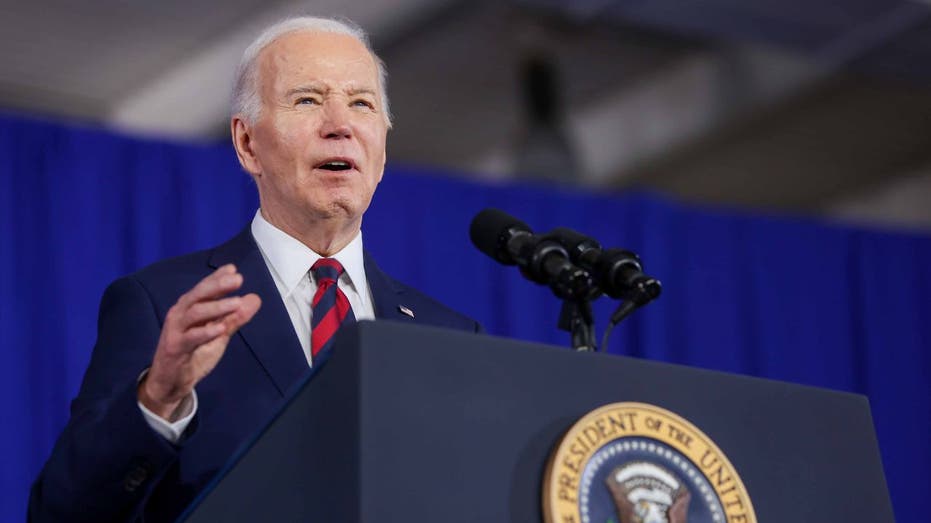
President Joe Biden speaks at the Pieper-Hillside Boys & Girls Club in Milwaukee, Wisconsin on March 13, 2024. (Alex Wroblewski for The Washington Post via Getty Images) / Getty Images)
Student loan borrowers enrolled in the SAVE plan have been urged to explore switching to a new repayment program.
Among alternative options, the Income-Based Repayment (IBR) plan sets monthly payments at 10% to 15% of discretionary income over a 20 to 25-year period.
TRUMP ADMINISTRATION AGREES TO SPEED UP STUDENT LOAN FORGIVENESS UNDER NEW COURT DEAL

Student loan borrowers are urged to seek alternative repayment plans following Monday’s decision. (iStock / iStock)
Under the Big Beautiful Bill Act (OBBBA), passed last year under President Donald Trump, the Repayment Assistance Plan (RAP) will become available starting July 1, 2026. RAP uses a sliding scale of 1% to 10% of a borrower’s total Adjusted Gross Income (AGI) and requires 30 years of payments for all participants.
Borrowers pursuing Public Service Loan Forgiveness (PSLF), a federal program that cancels remaining student debt after 10 years of qualifying public service, should verify their eligibility and file an application to reclaim credit for the months when their SAVE plan progress was effectively frozen.

Education Secretary Linda McMahon giving a speech in front of the American flag. (Darren McCollester / Getty Images)
GET FOX BUSINESS ON THE GO BY CLICKING HERE
Monday’s decision has effectively resolved a years-long legal battle between Republican-led states and the federal government. The ruling comes after nearly 8 million borrowers paused payments under “litigation forbearance” following an earlier injunction, and it follows a brief period of confusion when a lower court attempted to dismiss the case after a settlement with the Trump administration.

Brent futures traded up 11 cents, or 0.13% higher, at $87.91 a barrel at 0129 GMT. U.S. West Texas Intermediate (WTI) traded 7 cents higher and was last up 0.08%, at $83.52 a barrel.
Both contracts dropped immediately after the WSJ report, reversing early gains in WTI.
The IEA’s proposed drawdown would exceed the 182 million barrels of oil that IEA member countries put onto the market in two releases in 2022 when Russia launched its full-scale invasion of Ukraine, the WSJ said, citing officials familiar with the matter.
The IEA and the White House did not immediately respond to Reuters’ requests for comment.

The U.S. and Israel pounded Iran on Tuesday with what the Pentagon and Iranians on the ground called the most intense airstrikes of the war.
The U.S. military also “eliminated” 16 Iranian mine-laying vessels near the Strait of Hormuz on Tuesday, the U.S. Central Command said, as U.S. President Donald Trump warned any mines laid in the Strait by Iran must be removed immediately. Trump has repeatedly said the U.S. is prepared to escort tankers through the Strait of Hormuz when necessary. However, sources told Reuters the U.S. Navy has refused requests from the shipping industry for military escorts as the risk of attacks is too high for now.
“We continue to expect crude oil to remain highly volatile, driven by headlines while trading within a wide range between $75ish and $105ish in the sessions ahead,” Tony Sycamore, market analyst with IG in Sydney, said in a note.
Both contracts plunged more than 11% on Tuesday, the steepest percentage drop since 2022, a day after Trump predicted a quick end to the war, and after surging to a session high above $119 a barrel, their highest since June 2022, on Monday.
G7 officials have since gathered online to discuss a potential release of emergency oil stockpiles to soften the market blow.
French President Emmanuel Macron will host a video call with other G7 country leaders on Wednesday to discuss the impact of the conflict in the Middle East on energy and measures to address the situation.
Abu Dhabi state oil giant ADNOC has shut its Ruwais refinery in response to a fire at a facility within the complex following a drone strike, according to a source, marking the latest energy infrastructure disruption due to the U.S.-Israeli war on Iran.
Saudi Arabia, the world’s largest oil exporter, is seen boosting supplies via the Red Sea, although they are still far below the levels needed to compensate for the drop in flows from the Strait of Hormuz, shipping data showed.
The kingdom is relying on the Red Sea port of Yanbu to help it boost exports to avert steep production cuts as its neighbours Iraq, Kuwait and the United Arab Emirates have already reduced output amid the U.S.-Israeli war with Iran.
Energy consultancy Wood Mackenzie said the war is currently cutting Gulf oil and oil products supply to the market by some 15 million barrels per day which could raise crude prices to $150 per barrel.
“Even a quick resolution probably implies weeks of disruption for energy markets yet,” Morgan Stanley said in a note.
Reflecting higher demand, U.S. crude, gasoline and distillate stocks fell last week, market sources said, citing American Petroleum Institute figures on Tuesday.


NAPLAN testing has resumed after it was temporarily halted due to technical problems.
1.3 million Australian school students were affected by the technical problems, which made it difficult for them to access the test.
NAPLAN Testing Resumes
According to ABC News, NAPLAN testing, an Australian Curriculum Assessment and Reporting Authority (ACARA) spokesperson has since apologised for the technical difficulties students encountered while trying to access the test, which is now conducted digitally.
“NAPLAN testing has now resumed following a widespread issue earlier this morning, which affected students being able to log on to the online platform to complete their assessments,” the spokesperson said.
“We apologise for the disruption to students and schools and thank them for their patience,” the spokesperson added. “The issue has now been resolved, and schools have been informed they can resume testing.”
The Guardian reports that ACARA previously said that they were aware of the technical issues parents and carers were complaining about.
A number of schools likewise took to social media to announce that that testing would be paused.
“Due to technical issues with the Naplan online server, a number of schools, including ours, were unable to access Naplan today,” Erskine Park high school in Sydney announced. “An updated timeline will be shared.”
What is NAPLAN?
NAPLAN is an annual numeracy and literacy test conducted for students in years 3, 5, 7 and 9.
While year 3 tests are still completed on paper, The Guardian notes that testing has been done online for the other years since 2022.
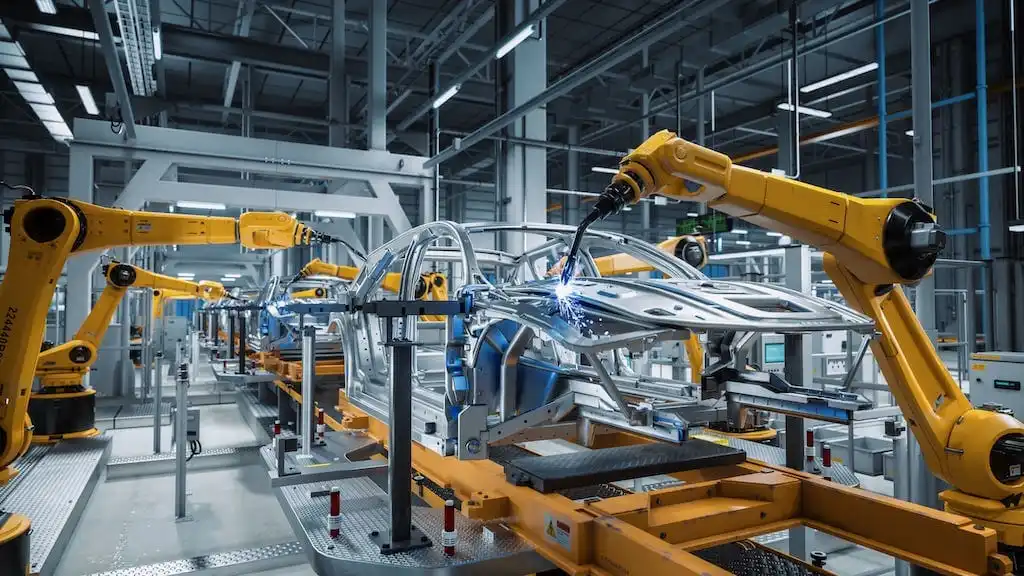
The world’s factory floors are undergoing a seismic transformation. According to a comprehensive new market analysis by MarketsandMarkets, the global industrial robotics market, currently valued at USD $16.89 billion, is on a firm trajectory to reach USD $29.43 billion by 2029, registering a compound annual growth rate (CAGR) of 11.7% over the forecast period.
📊 Market Growth
- The global industrial robotics market is valued at USD $16.89 billion and projected to reach USD $29.43 billion by 2029.
- Growth is driven by AI integration, automation platforms, and evolving manufacturing philosophies.
- CAGR forecast: 11.7% through 2029.
🤖 Key Trends
- AI-powered robots now perform real-time decision-making and predictive maintenance.
- Industry 5.0 emphasizes human-robot collaboration and worker wellbeing, beyond Industry 4.0’s focus on connectivity and automation.
- Major companies (Amazon, Bosch, Google, ABB) are already deploying Industry 5.0 technologies.
👥 Collaborative Robots (Cobots)
- Fastest-growing segment, expanding at 31% growth rate (2021–2022).
- Cobots are cheaper (USD $3,000–$10,000) compared to traditional robots (USD $15,000–$75,000).
- Attractive to SMEs due to affordability and safe human collaboration.
The findings point to a convergence of artificial intelligence, advanced automation platforms, and next-generation manufacturing philosophies that together are fundamentally altering how goods are produced across virtually every sector of the global economy.
The Engine Powering Growth: AI, Industry 4.0, and the Rise of Industry 5.0
At the heart of this expansion lies the accelerating integration of artificial intelligence into robotics systems. According to the report, AI-driven algorithms now enable industrial robots to perceive their environments, recognize objects, and make real-time decisions based on data collected from onboard sensors, capabilities that were largely experimental just a decade ago.
Major robotics manufacturers have moved quickly to commercialize these advances. OMRON Corporation has deployed the AI-enabled Omron i4 robot, which autonomously diagnoses and reports maintenance needs without human intervention. FANUC CORPORATION launched the CRX-10iA, a collaborative robot featuring a tablet-based user interface and an autonomous vision system. Universal Robots A/S extended its high-payload lineup with the UR16e, a versatile robotic arm engineered for a wide range of industrial applications.
The report also highlights the growing momentum of Industry 5.0, the next evolution beyond the well-known Industry 4.0 paradigm. Where Industry 4.0 focused on connectivity, automation, and data exchange, Industry 5.0 places human-robot collaboration at its core. The European Commission has positioned this concept as a deeper vision that centers on workers’ wellbeing alongside production efficiency. Companies, including Amazon, Bosch, and Google, are already operationalizing these technologies to boost productivity and manufacturing flexibility. In May 2023, ABB launched a fully automated miniature circuit breaker production line in China as a real-world demonstration of Industry 5.0 principles, incorporating AI-based visual recognition and flexible feeding systems.
Collaborative Robots: The Fastest-Growing Segment
While traditional industrial robots continue to dominate the market by volume and revenue, it is the collaborative robot segment, or “cobots,” that is drawing the most attention from analysts and investors alike. According to MarketsandMarkets, the collaborative robots market is growing at a remarkable rate of 31% from 2021 to 2022, significantly outpacing the broader market average.
Cobots are designed to work safely alongside human operators on the production floor, making them particularly attractive to small and medium-sized enterprises (SMEs) that have historically been priced out of automation investments. A single collaborative robot system currently costs between USD $3,000 and $10,000, compared to USD $15,000 to $75,000 for a full industrial robotic system. Universal Robots has taken a proactive approach to supporting SME adoption, offering clients tools to calculate return on investment (ROI) from automation before committing capital.
Articulated Robots and Automotive: The Market’s Twin Pillars
Despite the cobot surge, articulated robots are expected to retain the largest share of the overall industrial robotics market through 2029. Valued for their long reach, flexibility, and ability to operate in hard-to-access spaces, articulated robots are essential in automotive applications such as spot welding and painting. Their adoption is also expanding rapidly into pharmaceuticals and cosmetics, where they support picking, packaging, laboratory pipetting, and drug inspection processes.
In May 2024, ABB introduced two new flagship models, the IRB 7710 and IRB 7720, expanding its modular large robot portfolio to a total of 46 variants capable of handling payloads ranging from 70 to 620 kilograms.
The automotive industry is projected to account for the largest end-use share of the industrial robotics market through 2029. Automakers rely on robotics to ensure the quality and repeatability demanded by high-volume vehicle assembly lines. Companies including BMW, Nissan, and Bajaj Auto have already transitioned from traditional industrial robots to collaborative robots for material handling and dispensing operations. The Gestamp Group of Spain has implemented KUKA Systems’ fully automatic arc welding system at its Bielefeld facility, while KUKA Germany itself supplies at least 18 varieties of robots to the auto industry. In North America, Acieta has embedded more than 4,400 industrial automotive manufacturing robots across plants throughout the continent.
Asia Pacific Leads the World, With China at the Forefront
Geographically, the Asia Pacific holds the largest share of the global industrial robotics market and is expected to maintain that position throughout the forecast period. The region has adopted industrial robotics systems at a faster pace than any other global region, driven by its status as the world’s primary manufacturing hub.
🌏 Regional Leadership
- Asia Pacific leads globally, with China as the largest market.
- Adoption driven by low costs, supportive policies, and labor shortages.
- Emerging markets like India show strong growth, especially in electronics manufacturing.
Leading nations, including Japan, China, South Korea, and Taiwan are at the forefront of robotics adoption, particularly across the automotive, electronics, and machinery sectors. China remains the single largest market for both traditional and collaborative robots, both importing and domestically manufacturing robotic systems at scale. The report attributes this dominance to several structural factors, including low production costs, favorable government policies toward foreign direct investment, and growing automation driven by labor shortages in key manufacturing segments.
India and other emerging Asian economies are also identified as significant growth markets during the forecast period, particularly in electronics manufacturing, where demand for semiconductor-integrated robots is rising sharply.
Barriers Remain: Cost, Complexity, and Integration Challenges
The market’s strong growth trajectory is not without its headwinds. The report identifies high initial investment costs as the primary restraint facing industrial robotics adoption, particularly for SMEs operating in low-volume or seasonally irregular production environments. The total cost of a robotic automation project extends beyond the hardware itself, encompassing integration fees and additional components such as end effectors and vision systems.
⚠️ Challenges
- High upfront costs and integration complexity hinder adoption.
- Risk of over-automation leading to underutilized systems.
- Successful deployment requires expert integrators, detailed planning, and workforce training.
The report also cautions against over-automation, citing the example of the U.S. automotive industry, which historically relied more heavily on automation than Japan. This approach led to cost overruns as product lines evolved, leaving many robots underutilized or obsolete.
On the technical side, integration complexity remains a persistent challenge. Deploying cobots successfully requires close coordination between robotics professionals, production engineers, and floor operators. Cobots must be versatile enough to handle products with varying designs and sizes, demanding frequent reprogramming and rigorous testing. The report identifies detailed planning, expert robotics integrators, and comprehensive workforce training as the key ingredients for overcoming these barriers.
Key Players Shaping the Competitive Landscape
- Dominant companies: FANUC, ABB, Yaskawa, KUKA, Mitsubishi Electric.
- Example: Yaskawa partnered with Oishii Farm (US) to expand into agricultural automation.
The industrial robotics market features a concentrated group of dominant players who have leveraged both organic growth and strategic acquisitions to consolidate their positions. The leading companies identified in the report include:
FANUC CORPORATION (Japan), ABB (Switzerland), Yaskawa Electric Corporation (Japan), KUKA AG (Germany), and Mitsubishi Electric Corporation (Japan).
In a notable strategic move in May 2024, Yaskawa Electric Corporation announced a capital and business alliance with Oishii Farm Corporation, a U.S.-based agricultural startup specializing in strawberry production. The partnership signals a broader ambition for Yaskawa to evolve into a leading global agriculture and food automation company, leveraging its “i3 Mechatronics” solution concept to bring industrial-grade automation to the food production sector.
Outlook: A Market at an Inflection Point
- Robotics has moved beyond early adoption into mainstream manufacturing.
- Falling cobot costs, AI maturity, and Industry 5.0 principles are accelerating adoption.
- Competitive advantage will hinge on integration sophistication and workforce adaptability.
The picture painted by MarketsandMarkets is of an industry that has moved decisively past early-adopter status and is now entering a period of rapid mainstream penetration. The combination of falling cobot costs, maturing AI capabilities, supportive government policies across Asia Pacific and Europe, and the philosophical shift toward human-centered manufacturing embedded in Industry 5.0 is together creating conditions for sustained, broad-based growth.
For manufacturers who have yet to commit to automation, the data suggests the window for competitive parity may be narrowing. For those already on the factory floor, the next battleground will be integration sophistication, workforce adaptability, and the ability to extract full value from systems that are growing more intelligent by the year.
The industrial robot is no longer a symbol of a distant automated future. According to this analysis, it is very much the machinery of the present.
Other People are Reading


Starboard Value sees greater growth opportunities for the company.

The best pressure washers for cleaning cars, decking and patios

Ford recalls over 83,000 vehicles in two separate safety actions

Polymarket taps Palantir as prediction markets meet Wall Street surveillance


-
Business5 days ago
Form 8K Entergy Mississippi LLC For: 6 March
-

 News Videos2 days ago
10th Algebra | Financial Planning | Question Bank Solution | Board Exam 2026
-

 Tech6 days ago
Bitwarden adds support for passkey login on Windows 11
-

 Fashion4 days ago
Weekend Open Thread: Ann Taylor
-

 Crypto World1 day ago
Paradigm, a16z, Winklevoss Capital, Balaji Srinivasan among investors in ZODL
-
 Sports5 days ago
499 runs and 34 sixes later, India beat England to enter T20 World Cup final | Cricket News
-

 Sports3 days ago
Three share 2-shot lead entering final round in Hong Kong
-

 Sports3 days ago
Braveheart Lakshya downs Lai in epic battle to enter All England Open final | Other Sports News
-

 Politics5 days ago
Top Mamdani aide takes progressive project to the UK
-

 Business11 hours ago
ExxonMobil seeks to move corporate registration from New Jersey to Texas
-

 NewsBeat5 days ago
Piccadilly Circus just unveiled ‘London’s newest tourist attraction’ and it only costs 80p to enter
-

 Entertainment4 days ago
Hailey Bieber Poses For Sexy Selfies In New Luscious Lip Thirst Traps
-

 Business2 days ago
Search for Nancy Guthrie Enters 37th Day as FBI Probes Wi-Fi Jammer Theory
-
 NewsBeat1 day ago
Pagazzi Lighting enters administration as 70 jobs lost and 11 stores close across Scotland
-

 Tech2 days ago
Despite challenges, Ireland sixth in EU for board gender diversity
-
Entertainment6 days ago
Harry Styles Has ‘Struggled’ to Discuss Liam Payne’s Death
-

 Crypto World6 days ago
New Crypto Mutuum Finance (MUTM) Reports V1 Protocol Progress as Roadmap Enters Phase 3
-

 Tech6 days ago
ACIP To Discuss COVID ‘Vaccine Injuries’ Next Month, Despite That Not Being In Its Purview
-

 Business1 day ago
Search Enters 39th Day with FBI Tip Line Developments and No Major Breakthroughs
-
 NewsBeat6 days ago
Good Morning Britain fans delighted as Welsh presenter returns to host ITV show