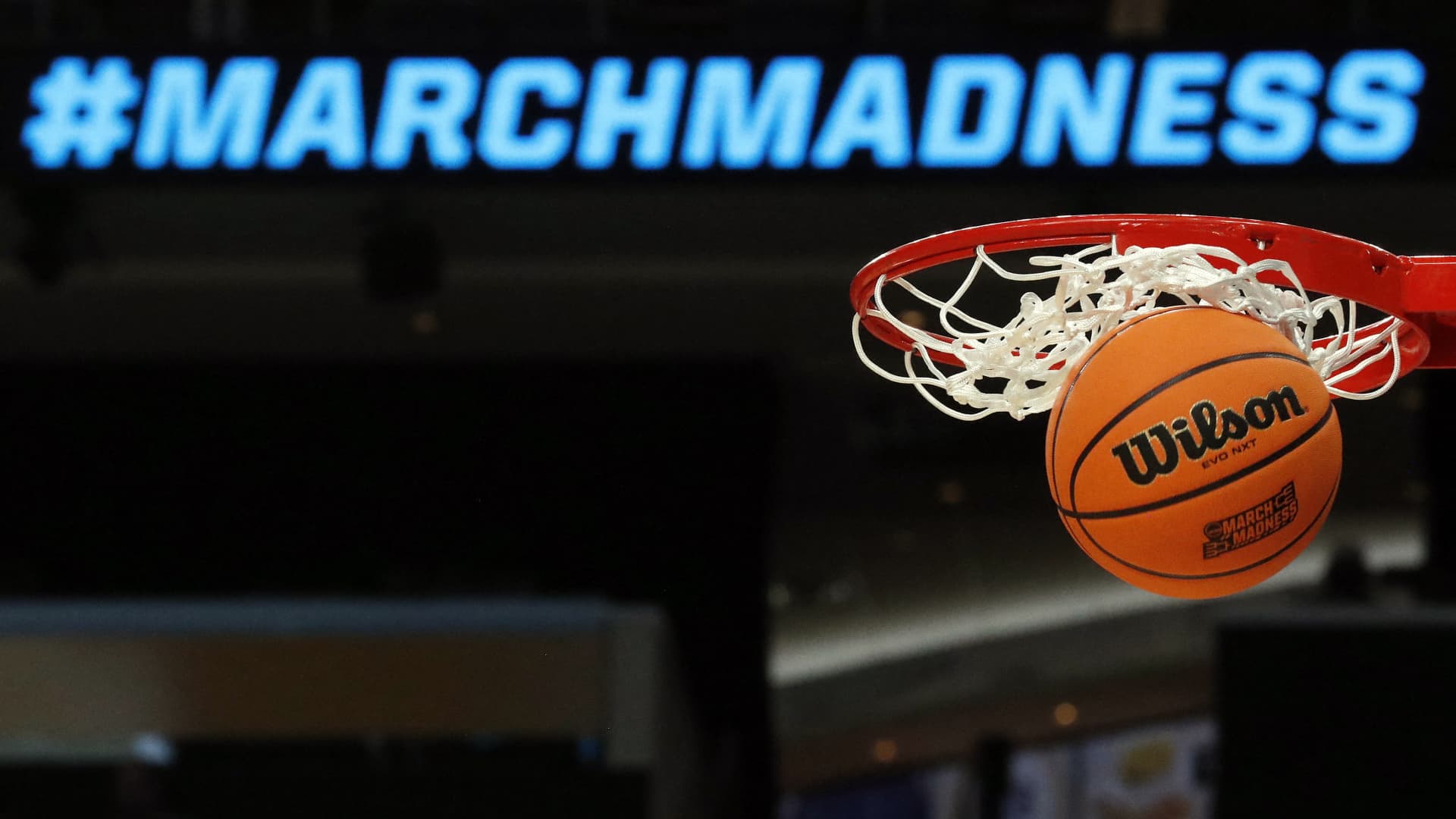
A basketball finds nothing but net during practice before a 2024 NCAA Tournament game at PPG Paints Arena in Pittsburgh.
Charles LeClaire | Reuters
Prediction markets saw strong results from the Super Bowl, but it was just an appetizer for a banquet of sporting events in 2026 that are expected to drive surging volumes in event contracts.
Advertisement
Kalshi saw record downloads during Super Bowl week, up 1,544% from the same time period last year, according to a report from market intelligence firm Sensor Tower. Daily active users jumped more than 1,100% to nearly 2 million on the day of the big game, the firm said.
That was almost three times the daily active users on sportsbook BetMGM, co-owned by MGM and Entain, which had 81% growth to 680,000 daily active users. Polymarket reported 59,000 daily active users and 264% growth over the previous year.
More than $1 billion was traded on Kalshi for the Super Bowl, up 2,700% according to the company. Founder and CEO Tarek Mansour told CNBC Tuesday that consumers are drawn by having lots of trading options for the game in one place.
“Our culture markets were huge this weekend. You know, ‘What [Bad] Bunny was going to perform’ was over $100 million in trading,” he said.
Advertisement
Though prediction markets enable users to buy event contracts for a wide swath of financial, weather, pop culture and other events, sports have been driving the action and the profits.
Robinhood CEO Vlad Tenev is pushing back against any investor concerns the Super Bowl was as good as it gets for trading on sports prediction markets.
“What we’re actually seeing is surprising us,” Tenev said on his company’s fourth-quarter earnings call on Tuesday. “In January, for instance, NBA contracts surpassed NFL in trading activity on our platform.”
Major sports events keep rolling, with the Winter Olympics offering a variety of betting options through Feb. 22. This weekend, fans will also get an eyeful during the NBA All-Star Weekend.
Advertisement
March brings college basketball madness, with the NCAA Tournament taking off with Selection Sunday on March 15. The entire tournament typically brings in more gambling dollars than Super Bowl.
And then there’s the World Cup, kicking off 104 games in mid-June.
Kalshi has been aggressive in marketing, outspending Polymarket in the United States by about 19 times and outspending DraftKings by about 35%, according to Sensor Tower estimates.
Still, the American giants in sports betting remain dominant. DraftKings saw 5 million daily active users for the Super Bowl and FanDuel had 4.2 million, according to the Sensor Tower data.
Advertisement
The CEOs of sportsbook market leaders FanDuel and DraftKings both told CNBC just before the game that they don’t see any cannibalization of their traditional sports betting business. They instead see real opportunity with sports and event contracts in states that haven’t legalized sports wagering.
Tenev said events contracts are the “fastest growing business in the company’s history.” Robinhood reported a 300% rise in “other revenue,” which is largely comprised of event contracts.

And the growth is accelerating. Robinhood reported 12 billion event contracts in 2025, and it’s already seen 4 billion contracts so far in 2026.
Disclosure: CNBC and Kalshi have a commercial relationship that includes a minority investment.
BorgWarner Inc. (BWA) Q4 2025 Earnings Call February 11, 2026 9:30 AM EST
Company Participants
Patrick Nolan – Vice President of Investor Relations Joseph Fadool – President, CEO & Director Craig Aaron – Executive VP & CFO
Conference Call Participants
Advertisement
Colin Langan – Wells Fargo Securities, LLC, Research Division Chris McNally – Evercore ISI Institutional Equities, Research Division Joseph Spak – UBS Investment Bank, Research Division James Picariello – BNP Paribas, Research Division Dan Levy – Barclays Bank PLC, Research Division Luke Junk – Robert W. Baird & Co. Incorporated, Research Division Mark Delaney – Goldman Sachs Group, Inc., Research Division Alex Potter – Piper Sandler & Co., Research Division
Presentation
Operator
Advertisement
Good morning. My name is Michael, and I will be your conference specialist. At this time, I would like to welcome everyone to the BorgWarner 2025 Fourth Quarter and Full Year Results Conference Call.
[Operator Instructions] I would now like to turn the call over to Patrick Nolan, Vice President of Investor Relations. Mr. Nolan, you may begin your conference.
Patrick Nolan Vice President of Investor Relations
Advertisement
Thank you, Michael. Good morning, everyone, and thank you for joining us today. We issued our earnings release earlier this morning. It’s posted on our website, borgwarner.com, both on our homepage and our Investor Relations homepage. With regard to our upcoming Investor Relations calendar, we will be attending multiple investor conferences between now and our next earnings release. Please see the Events section of our IR page for a full list.
Before we begin, I need to inform you that during this call, we may make forward-looking statements, which involve risks and uncertainties as detailed in our 10-K. Our actual results may differ significantly from the matters discussed today.
During today’s presentation, we’ll highlight certain non-GAAP measures in order to provide a clearer picture of how the core business
Children are routinely exposed to adverts for weight-loss injections, diet products and cosmetic procedures online, according to a new report by Dame Rachel de Souza, who has called for tougher regulation of social media platforms.
The report, based on a survey of 2,000 children aged 13 to 17 alongside focus groups, found that young people were being “bombarded” with content promoting body transformation, despite restrictions on certain types of advertising.
Respondents reported seeing ads for weight-loss drugs and diet products, as well as skin-lightening treatments, some of which are illegal to sell in the UK. Others described beauty and cosmetic content, including promotions for lip fillers and aesthetic procedures, as “unavoidable” across major social media platforms.
Dame Rachel said the content was “immensely damaging” to young people’s self-esteem and urged ministers to consider a ban on targeted social media advertising to children.
“We cannot continue to accept an online world that profits from children’s insecurities and constantly tells them they need to change,” she said. “Urgent action is needed to create an online environment that is truly safer by design.”
Advertisement
The findings come amid the rollout of the Online Safety Act, which aims to make the internet safer for users, particularly children, by placing duties on platforms to remove harmful material quickly.
Dame Rachel’s report suggests amending the Act to introduce a clearer “duty of care” obliging platforms to prevent children from being shown body-image related advertising in the first place. She also recommended changes to Ofcom’s Children’s Code of Practice to explicitly protect young users from “body stigma” content.
Ofcom said such material is already covered under its existing code. “Body stigma content can be incredibly harmful to children, which is why our rules require sites and apps to protect children from encountering it and to act swiftly when they become aware of it,” a spokesperson said. The regulator added it would not tolerate technology firms “prioritising engagement over children’s online safety”.
The commissioner also called for stronger enforcement of rules governing the online sale of age-restricted products and suggested the government consider limiting children’s access to certain social media platforms altogether.
Advertisement
Dr Peter Macaulay, senior lecturer in psychology at the University of Derby, said restricting advertising to children was a necessary step but not sufficient on its own. “We also need stronger platform accountability, improved enforcement of age-appropriate design standards and better education to help children critically navigate online pressures,” he said.
A government spokesperson said ministers had always been clear that the Online Safety Act was “not the end of the conversation” and confirmed that a national consultation had been launched on further measures, including the possibility of banning social media use for under-16s.
The debate highlights growing concern among policymakers about the commercial drivers behind youth-facing content, as platforms face mounting pressure to demonstrate that their business models do not undermine children’s mental health.
Amy Ingham
Amy is a newly qualified journalist specialising in business journalism at Business Matters with responsibility for news content for what is now the UK’s largest print and online source of current business news.
The tobacco company said Tuesday the board had evaluated various credible candidates for Jobin’s succession but decided to give him up to two more years in the role he has held since April 2021. It will continue the search for a successor, the company said.
COLOMBO, Sri Lanka — Australia opened their T20 World Cup 2026 campaign with a ruthless 67‑run victory over Ireland, combining a muscular batting display with a suffocating bowling performance to underline their title credentials in Group B.
(VIDEO) Australia Thrash Ireland by 67 Runs in Colombo to Launch T20 World Cup Campaign in Style
Sent in to bat after stand‑in captain Travis Head won the toss at the R. Premadasa Stadium, Australia posted an imposing 182 for 6 before skittling Ireland for just 115 in 16.5 overs. The result not only delivered two points but also handed Australia a hefty early boost to their net run rate in a group where every decimal could prove crucial.
Stoinis and Inglis power Australia to 182
Australia’s innings began in chaotic fashion when Head, leading the side in the absence of the injured Mitchell Marsh, was run out for 6 after a mix‑up with opening partner Josh Inglis. Inglis had already survived a chance — dropped at point — and capitalised on his reprieve with an aggressive, counter‑punching cameo.
Inglis and Cameron Green quickly wrested back momentum from Ireland. The pair kept the powerplay run rate above 10 an over, mixing clean hitting down the ground with sharp running between the wickets. Green raced to 21 off 11 balls before miscuing to mid‑wicket, but by then Australia had 64 on the board at the end of six overs, with the Irish seamers struggling for control on a placid surface.
Inglis continued to attack, racing to 37 off just 17 balls with a flurry of boundaries through point and over extra cover. His dismissal, holing out after earlier striking George Dockrell for four, briefly checked Australia’s charge, and a quiet middle phase followed as new batsmen adjusted to a pitch that began to slow and grip.
Advertisement
Matt Renshaw and Marcus Stoinis then rebuilt the innings in a decisive fifth‑wicket stand worth 61. Renshaw played the anchor role with 37 from 33 balls, rotating the strike and allowing Stoinis to dictate terms. Stoinis, who top‑scored with 45 from 29 deliveries, picked his moments to accelerate, driving powerfully down the ground and muscling a six over mid‑wicket while still collecting the majority of his runs in hard‑run ones and twos.
Glenn Maxwell’s brief stay offered flashes of intent without a big payoff, but Australia’s refusal to panic after losing early wickets meant they always had a platform to launch from. Late nudges and hustled doubles in the final overs ensured Australia reached 182, a total that looked slightly above par once the ball began to hold in the surface.
For Ireland, Mark Adair and Barry McCarthy fought hard in the death overs to prevent a 190‑plus score, but the damage from the powerplay and the Stoinis‑Renshaw partnership left them facing a daunting chase.
Ellis and Zampa rip through Ireland
Ireland’s reply unravelled almost immediately. Captain Paul Stirling, their most experienced and explosive batter, retired hurt for 1 in the opening over after what appeared to be a hamstring issue, dealing a psychological blow to a side already up against it.
Advertisement
Australian seamer Nathan Ellis took full advantage of the unsettled top order. Renowned for his clever changes of pace and skiddy trajectory, Ellis struck twice inside the first few overs, removing both set batters and exposing Ireland’s middle order before they could settle. By the end of the powerplay, Ireland had slumped to 40 for 4, their chase effectively in ruins.
Curtis Campher (4), Benjamin Calitz (2) and Gareth Delany (11) all fell cheaply during a brutal collapse that left Ireland tottering at 43 for 5 by the seventh over. Any hopes of a miracle hinged on wicketkeeper Lorcan Tucker and all‑rounder George Dockrell, who mounted the only meaningful resistance of the innings.
The pair added 46 for the sixth wicket, with Dockrell in particular showing composure and intent. He compiled a spirited 41 off 29 balls, finding gaps and punishing anything short or wide. Tucker supported with 24 as the duo briefly quieted the Australian fielders and forced Travis Head to juggle his bowling options.
But Adam Zampa, who had been held back specifically for the middle overs, quickly reasserted Australia’s control. The leg‑spinner broke the stand by removing Tucker, drawing him into a miscued stroke. Once that partnership ended, Ireland’s lower order crumbled.
Advertisement
Zampa and Ellis then turned the screw in tandem. Zampa’s drifting leg‑breaks and sharp googlies dismantled the middle order, while Ellis continued to choke off scoring opportunities with a mix of cutters and yorkers. Both bowlers finished with identical figures of four wickets apiece, underlining their dominance and leaving Ireland shot out for 115 with more than three overs unused.
Dockrell was the last semblance of resistance before the tail fell away, underscoring how little support Ireland’s top order offered in the face of Australia’s relentless attack.
Bowling discipline sets the tone
Australia’s performance with the ball was as clinical as their batting was controlled. Ellis’ 4 for 12 stood out not just for the wickets but for the pressure he applied; his economy and accuracy forced Ireland’s batters into high‑risk shots far earlier than they would have liked.
Zampa’s 4 for 23 demonstrated once again why he is central to Australia’s white‑ball plans. On a surface that rewarded patience and changes of pace, he consistently attacked the stumps, forcing errors from batters unsure whether to commit forward or back.
Advertisement
Xavier Bartlett and Matthew Kuhnemann provided useful support, tightening the screws from the other end and ensuring Ireland never found a passage of play in which they could counter‑attack freely. In the field, Australia were sharp, with direct hits and diving stops adding to Ireland’s sense of suffocation.
Perfect start to Group B campaign
The 67‑run margin sends Australia to the top of Group B on net run rate and serves as a statement of intent to the rest of the tournament. Coming into the World Cup with key players missing and questions about depth, they answered emphatically on both fronts: the batting card produced multiple contributions, and the attack functioned as a well‑drilled unit.
For Ireland, the defeat leaves them winless after two matches and with serious concerns over both form and fitness. Stirling’s hamstring issue looms as a major worry, and the fragility of the top order under pressure was laid bare. Their bowlers showed patches of discipline, particularly in the latter half of Australia’s innings, but the early overs with both bat and ball ultimately proved decisive.
As the tournament moves forward, Australia will look to build on the momentum of this comprehensive opening victory, while Ireland face a quick turnaround to resurrect their campaign and repair both confidence and combinations.
Advertisement
Australia may have needed four days to get on the park, but once they did, they wasted no time reminding everyone why they remain perennial contenders in global T20 cricket.
A McDonald’s cheeseburger, fries, and soda arranged in Celina, Texas, US, on Tuesday, Sept. 2, 2025.
Jake Dockins | Bloomberg | Getty Images
McDonald’s is expected to report its fourth-quarter earnings after the bell on Wednesday.
Advertisement
Here’s what Wall Street analysts surveyed by LSEG are expecting the company to report:
Earnings per share: $3.05 expected
Revenue: $6.84 billion expected
The fast-food giant, often viewed as a bellwether of consumer spending, has been warning for more than a year that low-income consumers are spending less. In response, McDonald’s has embraced discounted offerings, from rolling out a value menu to relaunching Extra Value combo meals.
One bright spot for McDonald’s and the broader fast-food segment has been high-income diners, who are trading down from fast-casual restaurant options. Buzzy promotions have won over those consumers and boosted the chain’s sales, too; the fourth quarter included the return of Monopoly, as well as the Grinch meal, timed for the holiday season.
Analysts are projecting that McDonald’s same-store sales will rise 3.9%, fueled by a 5.4% increase in the U.S., according to StreetAccount estimates.
Despite the rebound in its sales, McDonald’s shares have risen only about 4% over the last year, hurt by broader concerns about the consumer and the rise of GLP-1 drugs.