Connect with us

Business

Premier League and FA-backed Exeter playing fields project gets under way

Published

on

Business Live

The ambitious scheme was approved following a public consultation last year

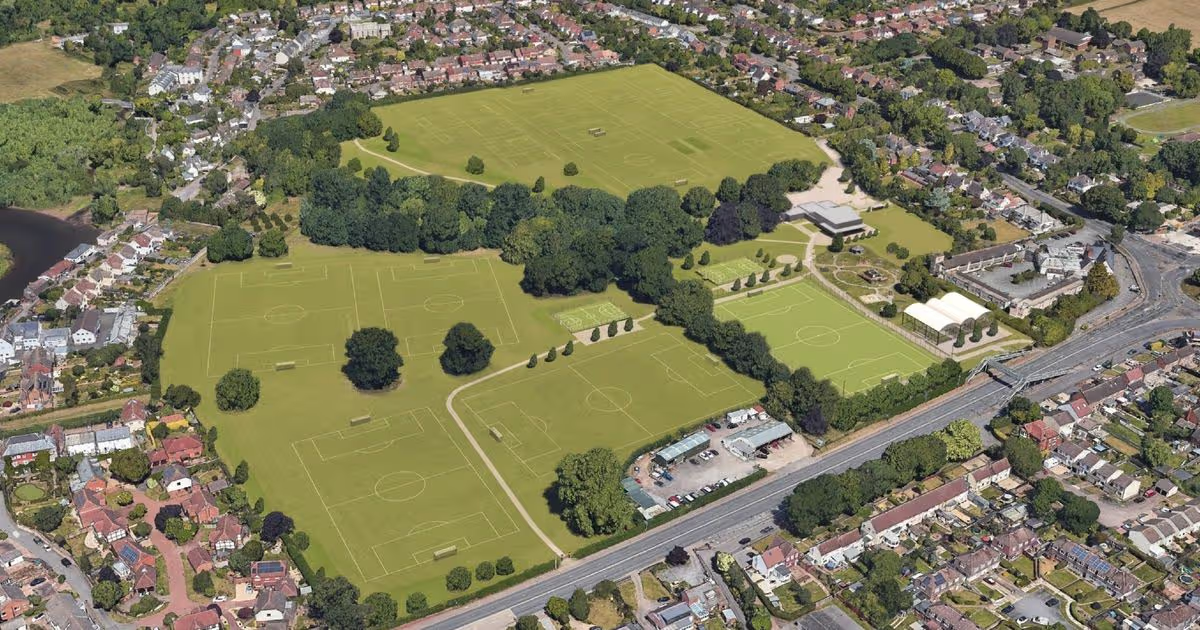
King George V Playing Fields

King George V Playing Fields(Image: Exeter City Council)

A multimillion-pound project to improve one of Exeter’s much-loved green spaces for current and future generations is under way. Exeter City Community Trust (ECCT) – the partner charity of Exeter City Football Club – has started work at the 40-acre King George V Playing Fields on Topsham Road.

The charity has secured almost £2m from the Premier League, the FA and government’s Football Foundation towards the ambitious project.

Phase one of the work includes two new Football Foundation PlayZones; a 3G pitch; and refurbishment to the existing pavilion to include accessible changing rooms and community-use rooms.

The project start follows a public consultation last year, which informed the design and direction of the plans.

Advertisement

The site is a priority within Exeter City Council’s Playing Pitch Strategy, which reviews current and future demand for formal sports facilities.

The fields will be leased to ECCT, which is working in partnership with the council, on a 50-year agreement.

Jamie Vittles, chief executive of ECCT, said: “We are delighted to bring this project to life and grateful to the many organisations, including Exeter City Council, Fields in Trust and the Football Foundation, who have worked closely with us to make it a reality.

“The incredible contribution from the Football Foundation brings a serious external investment into Exeter, helping us provide the best facilities for our whole community.”

Advertisement

The fields are one of hundreds established across the UK following the death of King George V in 1936 to “promote and assist in the establishment of playing fields for the use and enjoyment of the people”. They are legally protected by the Fields in Trust charity, whose mission is to preserve and safeguard the land for public benefit.

Mr Vittles added: “We are taking our role as custodians of this valuable green space very seriously. This is about creating an accessible and improved space, which meets the requirements of 21st century lifestyles, whilst preserving a wonderful natural resource and creating a community asset which will be here for many generations to come.”

The project has been through a full planning process with Exeter City Council, with approval granted in August last year.

As part of the scheme, 65 new trees will be planted to create a community orchard. Those behind the project say the new trees will offset the felling of two oaks, one of which they say has been “severely damaged” by squirrels stripping down the bark.

Advertisement

The second phase of the project is due to include the provision of Padel courts, an extension to the existing pavilion to incorporate a community café and social space, woodland trails and walkways, and further improvements to grass pitches.

Duncan Wood, lead councillor for leisure and healthy living, said: “The local community and everyone who uses King George V will benefit from the improvements that are being planned by ECCT, and this shows what can be done by working collaboratively with our parters in the city.”

Continue Reading
Click to comment

Leave a Reply

Your email address will not be published. Required fields are marked *

Business

Australian shares creep lower as tech stocks tumble

Published

on

Australian shares creep lower as tech stocks tumble

Australia’s share market has edged lower as a rout in tech stocks counterbalanced a rally in energy stocks and miners.

Continue Reading

Business

Panel backs $5m Mount Hawthorn apartment

Published

on

Panel backs $5m Mount Hawthorn apartment

Plans for a $5 million mixed use development on a side street parallel to Scarborough Beach Road in the middle of Mount Hawthorn have been approved by the development authority.

Continue Reading

Business

Anthropic Claims Chinese AI Firms Illegally Copied Claude in Massive ‘Distillation Attacks’

Published

on

Anthropic CEO Dario Amodei

Anthropic has accused several China-based companies of using its AI model Claude without authorization. This immediately re-ignited debates over AI ethics, intellectual property, and competitive control.

Moreover, the allegations center on so-called “distillation attacks,” a practice that can replicate AI capabilities through illicit means.

Understanding Distillation Attacks in AI

Anthropic CEO Dario Amodei

Gizmodo explains that distillation is a standard AI process where a “teacher” model provides outputs that a “student” model uses to learn, often producing smaller or more efficient AI systems.

Anthropic distinguishes distillation attacks as attempts to extract model knowledge without permission, bypassing legal and contractual safeguards.

According to Anthropic’s Monday blog post, Shanghai-based companies MiniMax, Moonshot, and DeepSeek conducted such attacks. MiniMax reportedly processed more than 13 million exchanges, while Moonshot and DeepSeek processed 3.4 million and 150,000, respectively.

Advertisement

Undoubtedly, these activities allegedly violated service terms and regional access rules. They also sparked concerns over ethical AI deployment and intellectual property protection.

Legal and Ethical Implications of ‘Distillation’

Anthropic emphasized that these actions are not criminal but constitute breaches of contractual agreements and U.S. export controls. Circumventing restrictions allows foreign labs, including those linked to government influence, to erode competitive advantages intentionally designed to safeguard American AI innovations.

OpenAI has also raised alarms over similar practices, accusing DeepSeek of “free-riding” on U.S.-based AI research.

AI Volatility

DeepSeek is set to launch its new flagship model, DeepSeek V4, imminently. Analysts warn that its release could increase volatility in AI-driven markets, especially on Wall Street, where investor sensitivity to emerging technologies remains high.

Advertisement

With China’s AI sector expected to boom, the AI industry in the country would remain high for the next few years.

Of course, Anthropic should also be consistent in its claims against Chinese AI firms while dealing with Claude’s ethical limits on military use.

Originally published on Tech Times

Advertisement
Continue Reading

Business

AD FEATURE: Why many businesses are getting it wrong in the rush to utilise AI

Published

on

AD FEATURE: Why many businesses are getting it wrong in the rush to utilise AI


Bluestonex says successful AI adoption isn’t about moving fastest – it’s about building the right foundations

Continue Reading

Business

Earnings revival set to lift Indian markets in FY27: Manish Gunwani

Published

on

Earnings revival set to lift Indian markets in FY27: Manish Gunwani
As India navigates the evolving dynamics of corporate earnings and global technological disruption, investors are keenly watching whether the recent earnings revival can sustain itself. According to Manish Gunwani, from Bandhan AMC, FY27 could mark a stronger period for corporate earnings, driven by nominal GDP growth and rupee depreciation.

“From a top-down perspective, FY27 should be better on earnings because of two-three things. One is that the nominal GDP will pick up partly because inflation will go up. So, we kind of bottomed out nominal GDP at 8-9%. It will be 10-11% going forward. And corporate earnings obviously have a decent correlation to nominal GDP,” Gunwani explained in an interview to ET Now.

He highlighted that rupee depreciation against the dollar and other Asian currencies is a key factor supporting earnings, particularly for pharma, IT, refining, and oil and gas companies. “Rupee depreciation is good for earnings. So, whether it is pharma, IT, refining, oil and gas—whatever—all that benefits from rupee depreciation. Overall, basis earnings should do better.”

However, Gunwani cautioned that recent market action has been influenced more by global uncertainty around artificial intelligence than by earnings themselves. “If you see, it is not that earnings have been knocked off in the past two-three weeks, but the terminal value of a lot of businesses is under question. So, to my mind at least in the near term, that is a bigger question rather than earnings honesty,” he said.

Advertisement

When asked about sectoral leaders for the potential earnings uptick, Gunwani noted that both domestic and export-oriented sectors are poised to benefit. “Since nominal GDP domestically is up, I guess the domestic sector should do better—banking and whoever is either an exporter or import substitution or pricing of dollars. So, for example, whether it is pharma, IT, refining, metals, all those sectors should benefit from the fact that they effectively have a lot of dollar earnings, and today you are converting that at, let us say, 90-91 rather than 86-87 one year back. So, it is going to be pretty broad-based to my mind.”


He emphasized that while earnings potential is improving, market sentiment is heavily influenced by AI’s impact on IT services. “I do not think earnings is driving this market right now. The whole global market is trying to grapple with what are the sectoral impacts of AI. If it starts from IT services, does it mean that there will be a broad-based slowdown in India because obviously IT services is the biggest export sector we have?”
Gunwani expressed caution regarding traditional IT services companies, noting disruption in areas such as BPO, application development, and infrastructure services. “No, obviously on hindsight we will find some companies doing much better. Question is, is it possible to differentiate those companies adjusted for valuation? Some of these companies are obviously growing faster today, but then they are also valued like that. So, as a stock, out of 10 IT services stock, will there be differentiation in next one year? Obviously, there will be. But is it honestly very easy to pick the winner stock? I think it is very difficult when it is such a sectoral disruption that is happening.”On foreign investor flows, Gunwani remains optimistic. “I am a bit more optimistic right now on foreign flows. One is the rupee has taken a fair amount of beating, probably the worst performing major currency in last six months. Even if IT services is disrupted, if you see the monthly data on services which includes GCC and all other things, that still seems quite strong. So, it is not like our current account is under stress. Now, our capital account has been under stress because foreigners have been selling, but also because Indians have been buying a lot of gold and silver.”

He added that recent volatility in gold and silver prices could help stabilize the capital account, alongside potential shifts in global dollar flows. “Whether it is debt, equity, FDI, I do think that the prospects of getting foreign flows look much-much better at this point of time,” he concluded.

With earnings revival on the horizon, domestic sectors poised for growth, and global AI disruption casting a shadow over IT, investors may need to navigate a complex landscape, balancing short-term uncertainty with medium-term opportunity.

Advertisement
Continue Reading

Business

Trump's new global tariff comes into effect at 10%

Published

on

Trump's new global tariff comes into effect at 10%

The president threatened to raise the tariff to 15% but has not yet issued an official directive to increase the rate.

Continue Reading

Business

Market volatility to persist amid geopolitical and tariff uncertainty: Amnish Aggarwal

Published

on

Market volatility to persist amid geopolitical and tariff uncertainty: Amnish Aggarwal
Indian markets are navigating through a period of heightened uncertainty, with global cues signaling a weak start to the week. Tariff concerns, particularly related to the US, continue to weigh on investor sentiment.

Amnish Aggarwal from Prabhudas Lilladher, noted the volatility in trade relations with the US. “The situation of your trade parameters with the US remains very volatile. Now, we have got some interim arrangement, but as we have seen over the last one year, nothing can be said with certainty because this is not only the India problem, this is a bit of a geopolitical problem as far as your tariffs are concerned. At this point, I would be very cautious on how the deal with the US will pan out. Something like, if we do not lose from the situation we are in, that should be satisfactory for the country. I would be more gung-ho on some of the other deals we have done, which includes the EU, where we are getting much better terms of trade. Based on the tariff policies of the US and other geopolitical factors, I believe that overall market volatility will continue in the near term.”

On the impact of artificial intelligence on IT services, Aggarwal highlighted the uncertainty surrounding business models and profitability. “It is very uncertain because it is not the beginning of AI or the transformation, it is not the end of it, but it has just started getting noticed and having some impact. We are not in a stage where growth rates of companies have started plummeting or there is margin pressure. So, this is a big reset. I do not think it is going to get settled in a quarter or two. One needs to wait and watch how deep and big the impact could be. The market actually hates uncertainty. I do not see any big green shoots for IT in the near term, and that is why we have been underweight on IT services for at least a couple of years.”

Turning to financial services, Aggarwal discussed the value unlock potential in digital lending platforms. “One needs to look at it from three angles. It aims at utilizing the cash flows the company is throwing, and because you are into telecom, we have got the digital platform and tech stack already there. They are extending it to make it bigger than today. The bigger issue is how your screening process is and how you control lending, collections, and delinquencies. Given the money they are allocating and the reach through their mobile network, they have a fair chance to scale it up. As far as value unlocking is concerned, it is too premature to presume. But for a company throwing in so much cash, it is a good extension and usage of cash. This is not going to be the first initiative, as other segments like data centers will also play a major role over time. The impact on financials and value unlocking will take a long period.”

Advertisement

On IDFC First Bank, which recently saw a 16% hit to its stock, Aggarwal emphasized perspective over panic. “We do not have a formal rating on the stock, but the hit of 590 crores is not that big relative to the balance sheet. However, it raises questions on the process and systems prevalent in the organization, which they need to address. Usually, there is initial panic, but if they manage the situation well and the deposit franchise is intact, things should recover over time.”


In the auto sector, Aggarwal observed a mixed but generally positive momentum. “The auto sector changed gears immediately post-GST. The past three to four months have been fairly robust. Two-wheelers were already doing okay, but for PVs, the major push came later. Logically, the momentum should continue, but last month Maruti showed flattish volumes for small cars, while M&M did well in SUVs. Entry-level cars might show some fatigue, but two-wheelers and commercial vehicles continue to do well. The farm sector has been strong, though El Nino may impact the upcoming monsoon and tractor demand. Overall, selectivity is key in the auto space.”
Aggarwal also shared his view on metals. “In the ferrous space, demand is good, and profitability is likely to improve in Q4. From current levels, incremental returns are possible. For non-ferrous, like aluminium, we have already seen the best, with companies like Hindustan Zinc moving up on price action. Ferrous remains the space where we are still positive.”

Continue Reading

Business

Canaccord Genuity initiates Americas Gold and Silver stock coverage with buy rating

Published

on


Canaccord Genuity initiates Americas Gold and Silver stock coverage with buy rating

Continue Reading

Business

UBS downgrades Enhabit stock rating to neutral on buyout deal

Published

on


UBS downgrades Enhabit stock rating to neutral on buyout deal

Continue Reading

Business

Albanese Says Australia Will Agree to Remove Former Prince Andrew From Line of Succession

Published

on

Australia's Prime Minister Anthony Albanese: his left-leaning Labor government is nearing the end of its three-year term and must hold an election by May 17
AFP

Anthony Albanese has shown support for the potential removal of Andrew Mountbatten-Windsor from the line of succession.

Currently, the former Prince Andrew is eighth in line to the throne, behind Prince William and his three children, as well as Prince Harry and his two children.

Australia to Support Andrew’s Removal From Line of Succession

According to 9News, Albanese showed his support through a letter written to UK Prime Minister Keir Starmer.

“In light of recent events concerning Andrew Mountbatten-Windsor, I am writing to confirm that my Government would agree to any proposal to remove him from the line of royal succession,” Albanese said in his letter.

He added, “I agree with His Majesty that the law must now take its full course and there must be a full, fair and proper investigation.”

Advertisement

Andrew had been arrested on his 66th birthday on suspicion of misconduct in public office. He was later released under investigation.

Regarding the accusations against the former prince, Albanese said that “These are grave allegations and Australians take them seriously.”

Consent of Commonwealth Realms Required

As previously reported here on IB Times Australia, the consent of all the Commonwealth realms is required before Andrew can be removed from the line of succession.

According to the BBC, the removal requires an act of Parliament approved by MPs and peers. It would then come into effect once the King gives his royal assent.

Advertisement

The royal to be removed from the line of succession was former Edward VIII, who abdicated the throne to marry Wallis Simpson.

The act of Parliament, which was done in 1936, removed his descendants as well from the line of succession.

Continue Reading

Trending

Copyright © 2025