Connect with us

Business

President Donald Trump wants ‘lowest interest rates in the world’

Published

on

President Donald Trump wants 'lowest interest rates in the world'

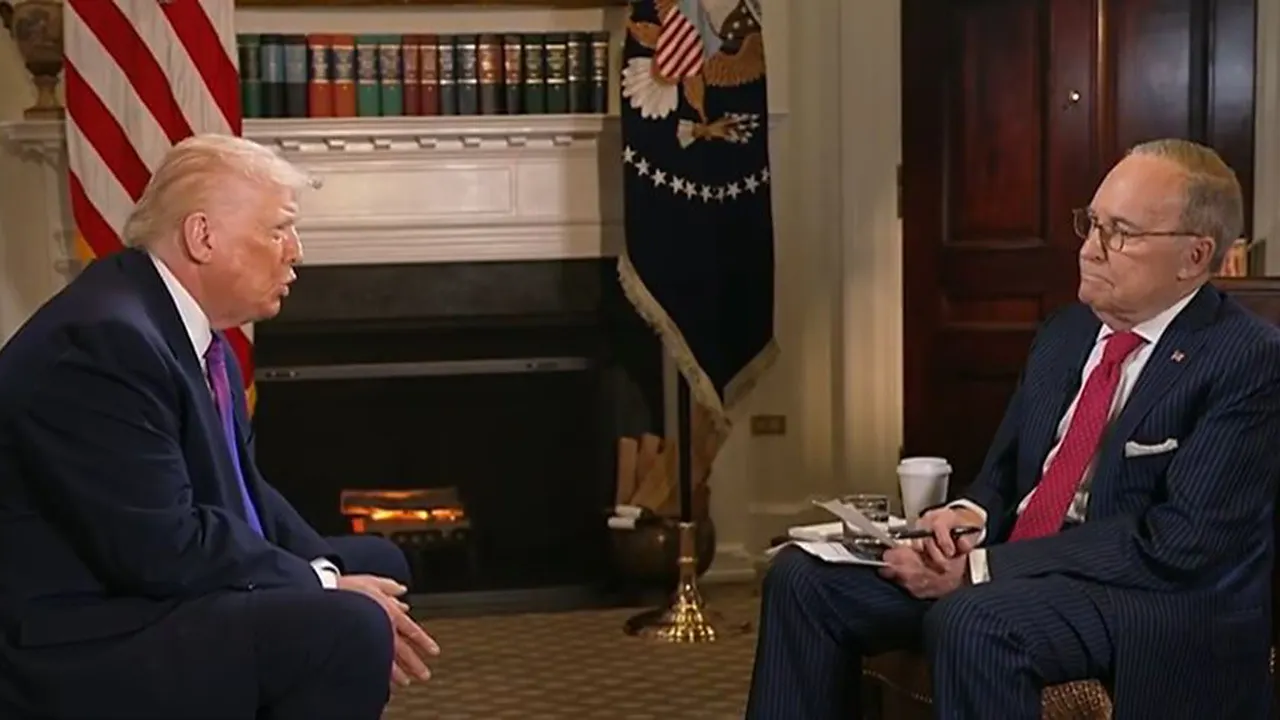
President Donald Trump said the U.S. should have the “lowest interest rates in the world” and argued that rate cuts would significantly reduce federal borrowing costs during an interview Tuesday on FOX Business’ “Kudlow.”

“This country should have the lowest interest rates in the world,” Trump told host Larry Kudlow. “We keep the world going.”

Advertisement

Trump tied interest rates to government interest expenses, saying that changes of a few points could significantly alter federal finances.

DOW CLOSES ABOVE 50,000 FOR FIRST TIME

President Donald Trump and Larry Kudlow

President Trump sat down for a wide-reaching interview with Larry Kudlow on “Kudlow” Tuesday, touting his economic successes in his second term. (FOX Business / FOXBusiness)

“Every point is $600 billion,” Trump said. “All he has to do if we went down two points, we don’t have a deficit anymore,” he claimed.

Market milestone

Trump also pointed to recent market milestones as evidence of economic strength, telling Kudlow he remembers predictions that the Dow Jones Industrial Average reaching 50,000 would be considered a “miracle” by the end of a presidential term.

Advertisement

“I remember when I first won, they said if he gets the Dow up to 50,000 by the end of his fourth year, he will have done miracles,” Trump said. “And we’re at the end of the first year.”

Trump added, “We’ve had a very good run, and we want to keep it going.”

INSIDE THE TRUMP ADMINISTRATION’S AI ‘TECH FORCE’ DESIGNED TO MODERNIZE THE GOVERNMENT

President Donald Trump with American Flag

President Donald Trump speaks with reporters before departing from the White House in Washington, D.C., Friday, en route to his Mar-a-Lago residence in Palm Beach, Fla. (Andrew Caballero-Reynolds/AFP via Getty Images / Getty Images)

Trump credited falling energy prices for easing costs, telling Kudlow he recently saw gas prices as low as $1.85 in Iowa and saying prices in other parts of the country had “broken $2 a gallon.”

Advertisement

“And that’s like a major tax cut,” Trump said.

In the interview, Trump pushed back on the idea that strong growth should automatically prompt tighter monetary policy, arguing that markets and policymakers react negatively to inflation concerns.

“We’re old enough to remember when the stock market, when there was good news, the market went up and was bad news, the market went down,” Trump said. “That’s the way it should be.”

Trump suggested that dynamic has shifted, claiming markets can fall on positive economic news because of inflation fears and expectations about rates.

Advertisement

NAVARRO SAYS TRUMP’S TARIFF BET DEFIED WALL STREET PANIC AS DOW SURGED PAST 50,000

“They have the yips,” Trump said, comparing the reaction to golfers who “can’t sink a three-foot putt” when they hear the word inflation. “Well, growth doesn’t mean inflation.”

“We have to go back to the old system when we have good news, the market should go up, and we have bad news, the market should go down,” Trump said, adding, “We’ll take care of inflation as it comes.”

Advertisement

Warsh nomination

Trump praised Kevin Warsh, his nominee connected to the Federal Reserve, in the interview’s discussion of monetary policy, saying Warsh would be influential.

“I think he’s somebody that’s going to be a real influencer,” Trump said. “I think he agrees with what I’m saying.”

Trump argued the U.S. has historically maintained comparatively low borrowing costs.

“Let’s go back again. Another 20, 25 years. We were always the lowest interest rate,” Trump said. “We used to pay like almost nothing.”

Advertisement

FED’S POWELL EITHER CORRUPT OR INCOMPETENT WITH BUILDING PROJECT, TRUMP TELLS KUDLOW

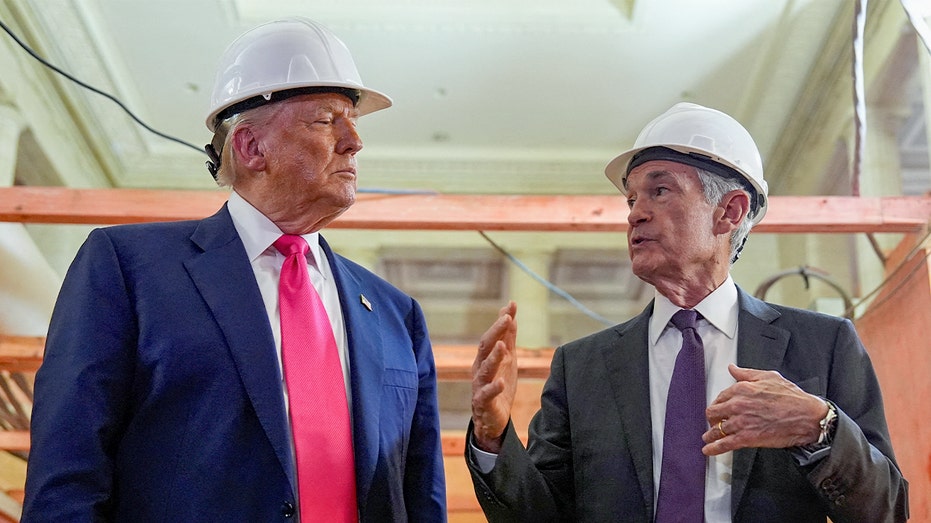
Donald Trump and Jerome Powell

President Donald Trump and Federal Reserve Chair Jerome Powell speak during a tour of the Federal Reserve Board building last summer. The building is currently undergoing renovations in Washington, D.C.  (Kent Nishimura/Reuters / Reuters)

He then contrasted that with today, claiming, “Now we’re like number 38 because we have had stupid people running our country.”

Switzerland tariffs

Trump illustrated his view by recounting a dispute with Switzerland, which he said benefited from low tariffs and trade imbalances with the United States.

“We had an incident with a very nice country, Switzerland,” Trump said. “They were paying no tariffs, sending stuff over here like nobody could believe. And we had a $42 billion deficit and we weren’t taking anything.”

Advertisement

“I said, ‘You may be a small country, but we have a $42 billion deficit with you,’” he added.

Trump said he initially imposed a 30% tariff on Swiss imports before later raising it to 39% following pushback from Swiss officials.

The U.S. later agreed to lower tariffs on certain Swiss goods to 15% from 39% under a trade framework announced last year, Reuters reported.

In a wide-ranging exchange with Kudlow, Trump sharply criticized Federal Reserve Chair Jerome Powell, arguing rates should be lower.

GET FOX BUSINESS ON THE GO

“He’s so bad that, I mean, interest rates should have been cut. We should be two points lower,” Trump said.

Kudlow closed the interview by thanking the president for his time.

Advertisement
Continue Reading
Click to comment

Leave a Reply

Your email address will not be published. Required fields are marked *

Business

Earnings momentum and trade clarity to drive markets: Vikas Khemani

Published

on

Earnings momentum and trade clarity to drive markets: Vikas Khemani
The Q3 earnings season has largely met expectations, with strong performance in mid and smallcap companies, according to market experts. In a discussion with ET Now, Vikas Khemani, from Carnelian Asset Management, highlighted that the earnings momentum remains intact.

“Now, we have been saying in our previous discussion, in our previous interaction that we have been very positive on the earnings outlook and that is what has happened, in last two quarters sequentially earnings have been better. So, by and large earnings have been in line with the expectations and even especially in the mid and smallcap space earnings have been very good and nothing changes from our perspective. We think this momentum will continue,” Khemani said.

He added that recent resolutions in the US trade deal and tariff uncertainties have further bolstered corporate confidence, especially among exporters in the mid and smallcap space.

Reflecting on the broader market outlook for 2026, Khemani expressed optimism. “I have said in our previous discussion that 2026 would be a better year than 2025 for the simple reason. If you see, we started 2025 with a lot of negativity or noise or negative news… When all these things were happening, India was going through a significant monetary stimulus as well as the fiscal stimulus and that was obviously working very well at the economic level. There was uncertainty around a little bit of on the export due to tariffs which also has got lifted. Also, in this crisis what India has been able to do is FTAs, long pending FTAs with the other countries, likes of EU and the New Zealand and other parts of the world. So today, we are sitting on a situation where you have good monetary and economic stimulus and all the broader uncertainties are behind. There will always be uncertainty in the market something or other, there is no doubt on that, but broadly there is not much uncertainty on the growth and as more and more people get comfortable around this environment and meanwhile in this period the valuations have come down, a lot of froth which has got kind of cleared, so you will see markets doing well. Now, how much it does well it all depends a lot more on the liquidity which I think should get better this year especially from the foreign investor perspective. So, I am quite optimistic about the market in 2026.”

Advertisement

When asked about the lagging mid and smallcap sectors, Khemani explained that recovery typically starts with largecaps before extending to smaller companies. “It always happens that once the recovery happens it always led by the largecaps and the mid and smallcap follows through… A) they tend to accelerate. I mean, the volatility in the earning with the change in the macro environment generally tends to be far more pronounced than in any largecap or large company and that happens in the share prices as well. So, I am quite optimistic that this environment is going to be good for mid and smallcap. Now whether it really meaningfully picks up in two months, three months, six months, I do not know but directionally we are finding interesting ideas, risk-reward looks very good.”


On investment strategy, Khemani emphasized stock-specific valuations rather than broad index levels. “See, looking at the broad indices cannot be the right answer, you have to look at individual stock specific and you have to see in the context of the potential growth… So, always you have to see valuation in the context of the growth and the ROEs business model company generates and that is how we always evaluate, we do not get carried away by the broader noise and you have seen over the years how our stock picks have been… we have never believed only in the consensus calls, we have taken contra… I mean against the consensus calls but once we are convinced about the potential growth and the risk-reward of the story, then we do take the sizable bets.”
Khemani also discussed the consumption sector, highlighting selective exposure in consumer discretionary stocks, automobiles, and auto ancillaries. “Like I said that it is linked to the macro environment which we saw last 12 to 18 months and with that lag it happened… in last six-eight months we have meaningfully kind of played that out especially in a consumer discretionary space, even automobiles we take as part of the consumption and that we have fairly large exposure… you look at companies, what are the growth drivers, you do not necessarily play only the first order impact, you can play also second order impact where you understand the risk-reward given the valuations.”Looking ahead, Khemani confirmed a focus on mid and smallcaps within his portfolio. “We have product which is more mid and smallcap focused, we have flexicap product where we are definitely right now almost 60% mid and smallcap… Some of the spaces which could stand out in this year would be chemicals… Auto, auto components look pretty decent. The building materials product looks very decent. So, consumer discretionary space you can find lots of ideas. Within banking and financial services you are finding… we think that is more likely to play out. So again, you look at different-different segments… line towards AI related enabled companies, there we are kind of playing out more.”

With optimism around earnings, macro stability, and selective sector plays, experts like Khemani suggest that 2026 could offer better opportunities for investors, particularly in mid and smallcap spaces, while staying alert to market volatility.

Continue Reading

Business

Tariffs and falling demand leave Scotch distillers under pressure

Published

on

Whisky

Growing numbers of Scottish spirits producers are showing signs of financial strain as weakening export demand, rising costs and trade barriers squeeze margins across the sector.

Research by restructuring specialist BTG Begbies Traynor found that 69 Scottish distillers were facing “significant” or “critical” financial distress at the end of the year, up from 49 in the previous quarter.

According to the Scotch Whisky Association, Scotland is home to more than 150 whisky distilleries, alongside more than 90 producing gin and a smaller number making vodka, rum and liqueurs.

Thomas McKay, managing partner of BTG in Scotland, said producers were facing a “perfect storm of lowering demand, rising production costs and increased tariffs in key markets”.

Exports to the United States and China, two of Scotch whisky’s most important markets, have been dented by tariffs and duties, while domestic trends have also shifted.

Advertisement

Several UK pub groups have reported that customers are increasingly trading down from spirits to cheaper alternatives such as beer or soft drinks. At the same time, broader societal changes, including declining alcohol consumption among younger consumers, have weighed on volumes.

McKay noted that demand for Scotch whisky and gin peaked during the pandemic in 2020, when lockdown consumption surged both in the UK and internationally.

“When that demand fell away, the resulting oversupply pushed prices down, just as additional export costs to the US began to rise sharply,” he said.

Distillers have also been hit by steep increases in energy and labour costs over the past two years, further eroding profitability.

Advertisement

The challenges have already prompted retrenchment. Last month, craft brewer BrewDog announced plans to close its distillery and spirits arm, underscoring the pressure across the wider drinks sector.

The strain is not confined to Scotland. Export volumes of French wine and spirits fell last year to their lowest level in 25 years.

Industry body FEVS said shipments dropped 3 per cent year-on-year to 168 million cases, the weakest performance since the turn of the century. The value of sales declined 8 per cent to €14.3 billion, the poorest showing on that measure for five years.

Tariffs imposed by the United States under President Trump, as well as duties in China, were cited as key headwinds.

Advertisement

Gabriel Picard, chairman of FEVS, said that new trade agreements between the European Union and India, as well as Mercosur countries in South America, could help support exports in the year ahead. However, he warned that sales of cognac and wine to the US and China could deteriorate further.

For Scotland’s distillers, the coming year is likely to test resilience. With costs elevated, export markets volatile and domestic consumers tightening belts, the industry that has long been one of Britain’s flagship exporters is confronting one of its most challenging trading environments in decades.


Amy Ingham

Amy is a newly qualified journalist specialising in business journalism at Business Matters with responsibility for news content for what is now the UK’s largest print and online source of current business news.

Advertisement

Continue Reading

Business

Google Goes Long With 100-Year Bond Sale. We’ve Seen This Before.

Published

on

Google Goes Long With 100-Year Bond Sale. We’ve Seen This Before.

Google Goes Long With 100-Year Bond Sale. We’ve Seen This Before.

Continue Reading

Business

Heineken to cut up to 6,000 jobs as beer demand falters

Published

on

Heineken to cut up to 6,000 jobs as beer demand falters


Heineken to cut up to 6,000 jobs as beer demand falters

Continue Reading

Business

Workday Stock Falls. Wall Street Isn’t Taking Kindly to Co-Founder’s Return as CEO.

Published

on

Workday Stock Falls. Wall Street Isn’t Taking Kindly to Co-Founder’s Return as CEO.

Workday Stock Falls. Wall Street Isn’t Taking Kindly to Co-Founder’s Return as CEO.

Continue Reading

Business

Strategic expansion, digital & offline pharmacies driving growth: Dr Suneeta Reddy, Apollo Hospitals

Published

on

Strategic expansion, digital & offline pharmacies driving growth: Dr Suneeta Reddy, Apollo Hospitals
Apollo Hospitals posted robust quarterly results, driven by strong revenue growth across its healthcare and pharmacy businesses. The company reported a revenue of ₹6,477 crores, marking a 17% increase, which translated into an EBITDA of ₹965 crores—a 27% improvement. Net profit rose 35% to ₹502 crores, reflecting the impact of higher volumes in high-end specialties and operational efficiency.

Dr Suneeta Reddy, MD of Apollo Hospitals, highlighted the hospital segment’s performance: “Hospital did very well. A growth of 14% in revenues with a revenue of ₹3,183 crores, EBITDA at ₹790 crores representing a 17% increase in EBITDA and profits for the hospital of ₹422 crores representing a 21% improvement in profit.”

Occupancy rates for the quarter stood at 67.1%, slightly below expectations. “There was a 4% improvement in ALOS, which meant that we came down to 3.14 days. If we had been at four days ALOS, we would technically have been at 72% occupancy. So, we have carefully managed to reduce average length of stay to enable patients to really go home faster and to reduce their bills,” said Dr Reddy.

Apollo’s expansion plans remain aggressive. During the quarter, the company opened 100 beds in Pune and 40 beds in Defence Colony. By the first quarter of the next fiscal year, Apollo expects to open 1,035 beds across several new facilities, including Belenus Hospital in Sarjapur (Bangalore), Sonarpur (Kolkata), and Sandhya Elite (Hyderabad), with further expansion planned in Gurgaon.

Advertisement

Regarding profitability, Dr Reddy explained the company’s margin performance: “If you look at healthcare services, we are at a very healthy 24.8%. Apollo Health and Lifestyle is at 10.2%. They have grown their EBITDA margin by 141 basis points. Apollo Healthco is at 4.5%, but that is a different retail business. Offline pharmacies are at 7.8%.”


The pharmacy segment continues to grow strongly, with Healthco adding 185 physical pharmacies this quarter, bringing the total to 7,113—the largest pharmacy network in India. “They have a private label share of 15.53%, which is giving them the margin of 7.8, a very healthy margin, which has improved by 12 basis points. The offline continues to grow with the GMV of ₹525 crores for the quarter, and they have three sources of revenue—insurance, doctor consult, diagnostics, and delivering pharmaceutical products at home—all of them growing at somewhere 23% but growing strongly at 20%,” she added.
The company’s Health and Lifestyle business, despite being loss-making, showed strong growth with a 20% revenue increase and a 39% jump in EBITDA. Dr Reddy expects the segment to turn profitable in the next quarter: “If you look at the different lines of the business, they are all profitable. A little bit of focus on admin costs, etc., they should be profitable, and they are growing the diagnostics scale, which is giving them a healthy 10.8% margin. That margin trajectory will grow.”On the international front, Apollo is focusing on project work and consultancy rather than setting up hospitals overseas. “We have got about ₹20 crores of revenue from the work that we do and project in,” Dr Reddy noted.

Apollo’s capital expenditure plan for expansion includes 1,385 new beds at an estimated cost of ₹2 crores per bed, totaling ₹3,000 crores for the current phase, with another ₹3,000 crores planned for the next phase. Regarding other business verticals, Dr Reddy said: “Healthco is now, it will become a separate company. It is fully capitalised, requires no further capital. Apollo Health and Lifestyle is looking at some restructuring that will bring it capital for growth…Apollo is always there to support them with capital for growth.”

With strong operational performance and strategic expansion plans across hospitals, pharmacies, and lifestyle businesses, Apollo Hospitals continues to reinforce its position as a leader in India’s healthcare sector.

Advertisement
Continue Reading

Business

Snowflake Stock and 2 More Software Plays to Buy on a ‘Too Harsh’ Software Drop

Published

on

Snowflake Stock and 2 More Software Plays to Buy on a ‘Too Harsh’ Software Drop

Snowflake Stock and 2 More Software Plays to Buy on a ‘Too Harsh’ Software Drop

Continue Reading

Business

Opinion: Fewer sharks, more angels please

Published

on

Opinion: Fewer sharks, more angels please

OPINION: It’s time to lose the pitch theatre and offer real angelic investing.

Continue Reading

Business

Emad Yassa on Building a Career That Spans Healthcare and Global Impact

Published

on

Emad Yassa on Building a Career That Spans Healthcare and Global Impact

Emad Yassa is a healthcare entrepreneur and nonprofit founder with more than three decades of professional experience across clinical practice and international philanthropy.

Yassa is the Founder and Chairman of Touch of Love International (TOLI), a nonprofit organisation focused on economic empowerment through micro-loans in underserved communities.

Born and raised in Egypt, Emad studied physical therapy at Cairo University, graduating in 1985. During his university years, he was also a competitive athlete and earned a silver award in single rowing. In 1989, he relocated to the United States, where he began building his career in outpatient physical therapy.

In 1995, Emad founded Physical Therapy and Rehab in West Hills, California. The clinic grew steadily and reflected his hands-on approach to leadership and patient care. After moving to Colorado Springs in 2005, he worked with Cheyenne Mountain Rehab before launching Dynamic Physical Therapy in 2007. He led the practice for over fifteen years, guiding it through growth, operational challenges, and long-term stability. In August 2023, he sold the business to focus full time on his nonprofit work.

Emad founded Touch of Love International in 2006, alongside his clinical career. The organisation provides small micro-loans to individuals and families in Egypt, Kenya, Ethiopia, Uganda, and Nicaragua. His work centres on dignity, accountability, and long-term self-reliance rather than short-term aid.

Advertisement

Today, Emad is recognised for his disciplined leadership style, cross-sector experience, and commitment to building systems that create lasting impact.

A Conversation with Emad Yassa on Building Businesses, Purpose, and Long-Term Impact

Q: You began your career in Egypt. What shaped your early direction?

I grew up in Egypt and studied physical therapy at Cairo University. I was focused on discipline early on. Sports played a big role for me. I rowed competitively and won a silver award while at university. That experience taught me structure and endurance. Those lessons stayed with me long after graduation.

Q: What prompted your move to the United States in 1989?

I wanted broader professional opportunities and exposure to a different healthcare system. Moving countries was challenging, but it pushed me to adapt quickly. I learned how to work within new regulations, new cultures, and higher expectations.

Q: Your first business came in 1995. How did that start?

I founded Physical Therapy and Rehab in West Hills, California. At the time, I was very hands-on. I treated patients, managed operations, and learned the business side through experience. It taught me how important systems and consistency are.

Advertisement

Q: Why did you relocate to Colorado Springs?

In 2005, I moved to Colorado Springs and worked with Cheyenne Mountain Rehab. It gave me a different perspective on practice management and team dynamics. That experience helped prepare me to launch my next clinic.

Q: Dynamic Physical Therapy became a long-term chapter. What made it different?

I founded Dynamic Physical Therapy in 2007. By then, I understood how to build a practice that could last. We focused on steady growth and patient trust. I led the clinic for over fifteen years, which required constant adjustment as healthcare evolved.

Q: You sold the business in 2023. Why then?

It was a deliberate decision. I had already started Touch of Love International years earlier, but I wanted to give it my full attention. Selling the practice allowed me to shift my focus completely.

Q: Tell us about the origin of Touch of Love International.

I founded TOLI in 2006. The idea was simple. Small loans can change lives if they are given responsibly. We work in Egypt, Kenya, Ethiopia, Uganda, and Nicaragua. The focus is self-reliance, not dependency.

Advertisement

Q: How does your business background influence your nonprofit work?

Very directly. Structure, accountability, and follow-through matter in any organisation. I approach the nonprofit with the same discipline I used in healthcare.

Q: How do you define leadership today?

Leadership is about consistency and responsibility. It is showing up, making hard decisions, and building something that lasts beyond you.

Advertisement
Continue Reading

Business

Roobet Shows That Online Takes the Edge

Published

on

Roulette, a game that conjures images of glamorous casinos and elegant bets on a spinning wheel, has evolved significantly over the years.

Gaming now transcends the physical realm. If you want the thrill of spinning today, you no longer need to live near a casino or plan a trip. That excitement, which once required time and travel, can now be accessed wherever you are.

Let’s be clear – this isn’t about good versus bad, or old versus new. Physical casinos are undeniably fun. Online gaming simply builds on that fun, offering more flexibility and choice.

Physical casinos are where it all began, and they are big business. There are over 6,500 operational physical casinos across more than 95 countries, and the worldwide land-based casino market was estimated at $107.5 billion in 2024.

While there is no doubt that physical casinos remain an important part of the gaming and gambling industry, online gaming offers something different and unique.

Online platforms remove many of the practical barriers that come with physical casinos. There’s no need to plan around opening hours and no requirement to live near one. The benefits of gaming online are reflected in consumer behavior, with the number of users spinning with online casinos rising by 19% between 2023 and 2024.

Advertisement

If you love a particular land-based casino, you have to be there in person, operating on its schedule. Your experience is tied to that place.

But if you have a favorite online casino, you can play from almost anywhere. The experience fits around your life, not the other way around. Platforms like Roobet are built and designed around this ethos, enabling players to jump straight into games without friction.

Another great strength of online casinos is their ability to leverage technology to tackle operational challenges. For example, over 70% of major gambling platforms use AI to detect fraud and support responsible gambling measures, helping to ensure a secure and fair environment for players.

At the same time, these platforms use AI to create a more personalized experience. By analyzing session length, play styles, and preferred game formats, they can recommend games and bonuses that are tailored to each player’s preferences. The result is a more personalized, engaging gaming experience.

Advertisement

Delivering this level of personalization at scale is extremely difficult for physical casinos. Online, it’s built into the design. Platforms like Roobet use this approach to create experiences that feel intuitive, helping players spend more time enjoying the games they love.

Importantly, licensed online platforms also operate under strict regulatory standards, with identity checks, secure payments, and responsible-gaming tools helping to keep players safe while they play.

Variety is another asset of online casinos. While physical casinos are limited by floor space, online platforms have no such constraints.

Online platforms can offer thousands of games across every style imaginable. Think of classic slots, live games, Crash, and everything in between.

Advertisement

Whatever type of game you enjoy, there’s almost certainly an online version waiting for you.

Stake has more than 2,000 games. Betpanda has over 6,000. Roobet alone offers more than 7,000 games, including popular titles like Gates of Olympus, Sweet Bonanza, Crazy Time, and Roobet Originals such as Crash and Mission Uncrossable. That scale of choice means whatever kind of game you enjoy, there’s almost always something new to try.

Alongside variety, online platforms can offer more frequent bonuses and rewards. Lower overheads mean better value for players, whether through promotions, loyalty perks, or higher overall returns.

In simple terms, players tend to get more chances to play and more entertainment for their time.

Advertisement

Physical casinos remain iconic. A stay and spin at places like the Bellagio or Caesars is special. But those experiences aren’t available to everyone, all the time.

Online gaming expands the spinning experience. It offers more choice, more rewards, more freedom, and more accessibility, all without losing the thrill that made casinos popular in the first place.

Online, the fun is endless, seamless, and safe.

Advertisement

Continue Reading

Trending

Copyright © 2025