Connect with us

Business

Regulator’s concerns pertain to pockets of speculation, not entire derivatives market: Tuhin Kanta Pandey

Published

on

Regulator's concerns pertain to pockets of speculation, not entire derivatives market: Tuhin Kanta Pandey
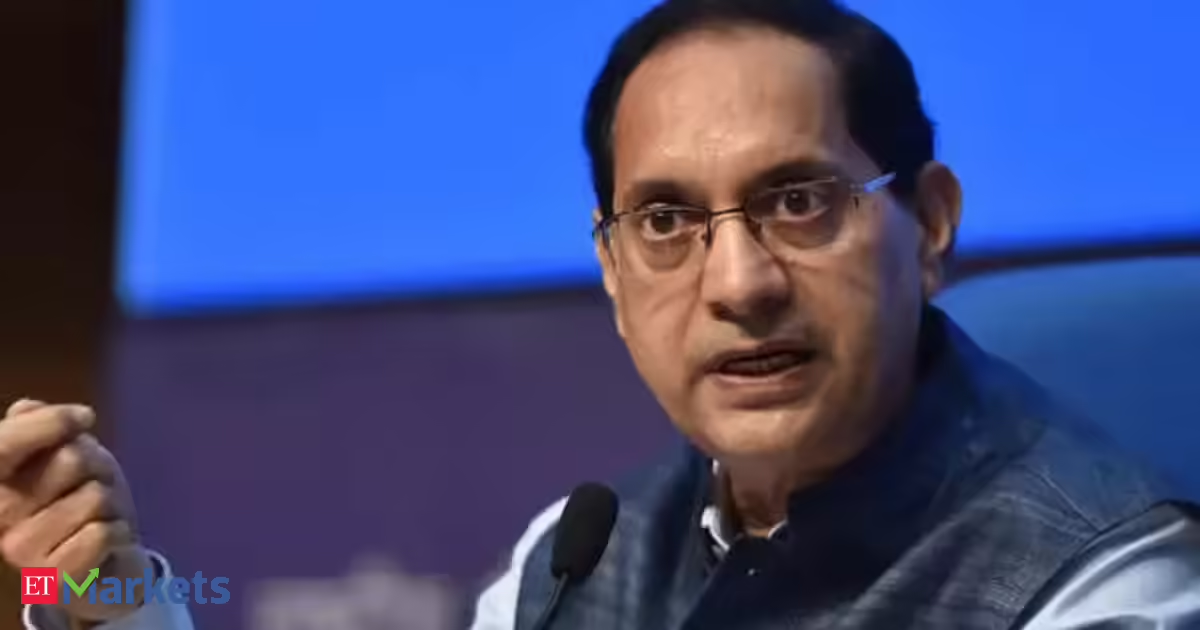
Future steps to reduce excessive speculation in equity derivatives would be guided by careful data analysis and a balanced, mature approach, Tuhin Kanta Pandey, chairperson, Securities and Exchange Board of India (Sebi), tells Reena Zachariah and Nishanth Vasudevan.

Pandey, who completes his first year as the head of India’s capital markets regulator, said the recent measures by Sebi were not aimed at the entire derivatives market but at pockets of speculation in the segment. The Sebi chief also spoke on settlement regulations and promoter norms, among other issues. Edited excerpts:

You’ve said your goal is to keep policies market-friendly as the ecosystem evolves. Are you satisfied with the progress so far?

Advertisement

Broadly, yes. Within Sebi, there is a growing emphasis on what I would call optimum regulation. We recognise that regulation has costs and can create unintended consequences. Where multiple options achieve the same objective, we should choose the simpler one with lower compliance costs. Over time, rules tend to accumulate, increasing compliance burdens for both regulated entities and the regulator. Our comprehensive regulatory review aims to rationalise and streamline this. Ultimately, investor protection and market development must go together.

Over the past two years, Sebi has taken several steps to curb excessive speculation in equity derivatives. Is there a measure or a level that you are targeting at which you would consider that the objective has been achieved? Are you following a number-driven or principle-driven approach?
We are not following a number-driven approach. Our approach is principle-driven. The focus has been on assessing the impact of the measures we’ve introduced. Often, finfluencers highlight only the winners, creating an exaggerated perception of returns. By placing collective data in the public domain, we aimed to present a realistic view of outcomes in the market. Transparency itself is a powerful form of investor education. We also introduced safeguards such as tighter margin norms, especially on expiry days, to curb lottery-like speculation. Now, we need to assess the impact of these steps through data, rather than reacting month to month. We must recognise that there are also genuine, informed participants in the derivatives market. The objective is not to shut down the market, but to ensure it operates responsibly. Future steps, if any, will be guided by careful data analysis and a balanced, mature approach.

Some market participants warn that India should avoid the path taken by countries such as China and South Korea, where curbs on derivatives speculation have led to a loss of liquidity that has been hard to restore. Has Sebi factored in the risk of liquidity leaving the market as a result of its recent measures?

It is too sweeping to treat the entire F&O segment as one block. Derivatives play a vital role in price discovery, hedging, and risk management, which is why they exist globally. Our concerns were not about the broader derivatives market, but about short-tenor index options, particularly weekly and expiry-day contracts, where speculative activity had become concentrated. If there is a problem in one area, the response should address that area, not disrupt the entire system. There are multiple viewpoints on this – some argue weekly options should continue unchanged, others warn about liquidity risks, and some suggest calibrated measures such as eligibility criteria. The objective is to address concentrated risks while preserving the overall role and liquidity of the derivatives market. So there is, in my opinion, a need even for the media not to really call it F&O, and rather to coin it as ‘O’ on the expiry day and weekly.
So, just to be clear, your concern about derivatives is the pocket of speculation rather than the broader segment.
Yes. You can’t start badgering your body just because you have a boil on your nose. There are several views, like it should continue or let’s get out of weekly, or can we have something in between. There are people who are talking about what kind of criteria could be made for access, for example. Collectively, we should be comfortable that this is the right approach to take. Has Sebi discussed the topic of access (eligibility to trade) in F&O?
No, I’m not saying that. All I am saying is these are already different points of view. F&O has been one of the most hotly debated subjects. All I am saying is please don’t call it F&O, and if you have a problem, call it ‘O’ on the expiry date.

There are also some concerns over growing speculation through margin trading facility (MTF) exposures. Is Sebi looking into this?
We continuously monitor the situation, but MTF already operates within defined guardrails. There are net worth requirements and leverage limits. We have taken the view that re-pledging of client securities for additional leverage should not lead to over-leveraging. At this stage, we believe MTF should be allowed to function within these guardrails while keeping risks under watch. Liquidity in the cash market is important, and we are examining ways to deepen it. For instance, a working group is reviewing the short-selling and SLBM framework to understand barriers and encourage broader participation. Derivatives and cash markets must function together. Derivatives, particularly longer-tenor contracts, play an essential role in price discovery and hedging. The key is to ensure appropriate position limits and risk controls so that excessive speculation is contained and markets remain stable.

Advertisement

Sebi is reviewing its settlement regulations. While settlements have increased over time, litigation and case backlogs remain high. Are further simplifications being considered?
Yes. Greater clarity and proportionality are needed in settlement regulations. Clearer rules reduce ambiguity, limit multiple interpretations, and help bring down disputes and litigation. We do not want the system to become a ‘litigation paradise’. Simpler, clearer rules ultimately strengthen market confidence.

How is Sebi rethinking the concept of promoter, particularly, under ICDR (Issue of Capital and Disclosure Requirements), after moving away from the ‘once a promoter, always a promoter’ approach?
The review is not limited to ICDR. We are also examining LODR (Listing Obligations and Disclosure Requirements). A working group is gathering feedback, and the proposals will go through multiple committees before consultation papers are issued.

There are concerns that some companies report profits just before an IPO and then slip back into losses, raising allegations of window-dressing. How does Sebi view this?

It is important not to generalise from a few instances. One egregious case does not indicate a systemic problem. The key is to distinguish between isolated misconduct and a broader pattern. Rushing to introduce additional rules in response to individual cases risks overregulation and could burden compliant companies without solving the underlying issue.

Advertisement

Sebi is reportedly issuing notices to lawyers and tax consultants for alleged confidentiality breaches during M&A deals. Do you foresee jurisdictional or enforcement challenges, given that they are also regulated by other professional bodies?
If the investigation finds evidence of a violation, the matter proceeds to a quasi-judicial process within Sebi. A show-cause notice is issued, and the concerned parties are given an opportunity to respond and be heard before any order is passed. The outcome may confirm, modify, or set aside the investigation’s findings. These orders are subject to appeal before the Securities Appellate Tribunal.

Continue Reading
Click to comment

Leave a Reply

Your email address will not be published. Required fields are marked *

Business

Savills appointed to Swindon Designer Outlet

Published

on

Business Live

The major retail location was recently acquired by Frasers Group

Swindon Designer Outlet.

Swindon Designer Outlet

Savills has been appointed by Frasers Group to provide property management services to Swindon Designer Outlet. The retail scheme, which extends to 250,000 sq ft and comprises of 110 units, is located in the historic Great Western Railway buildings in the centre of Swindon.

The retail destination has experienced a sustained rise in footfall, turnover and average spend, supported by the arrival of new brands such as Rituals and Crocs. This has been alongside reinvestment from long standing tenants. which include Polo Ralph Lauren, Reiss, Tommy Hilfiger, New Balance and Nike.

Its recent acquisition by Frasers Group represents a significant addition to its growing retail portfolio and reflects continued confidence in the performance and potential of the outlet sector.

READ MORE: Premier League and FA-backed Exeter playing fields project gets under wayREAD MORE: Helicopter maker Leonardo ‘hopeful’ about future of Somerset factory

Advertisement

Savills will provide property management and operational support across the scheme, ensuring the smooth running of a destination with complex heritage considerations and a diverse occupier mix

Saagar Sachdev, director, London retail and leisure, property management at Savills, said, “Designer Outlet Swindon is a well-established destination with a strong track record and a unique setting.

“Alongside its offering of leading global brands, there is a commitment to fostering a vibrant local community through initiatives such as a weekly street food market and the ‘Makers Yard’ craft market.

Joining an established and expanding group of outlet centres under Savills management, this appointment reflects our depth of sector expertise, from working closely with occupiers to maintaining an environment that meets the expectations of both brands and visitors.

Advertisement

“It also further strengthens our specialist expertise in the outlet sector, enabling us to add value through operational enhancements, brand curation and long term asset stewardship.”

Continue Reading

Business

Private sector investment essential for Bristol to meet its net zero climate goals, council chiefs say

Published

on

Business Live

Official says ‘there isn’t enough public sector money to achieve decarbonisation of cities’

Old Market Gap bike lane

The Old Market Gap bike lane(Image: Local Democracy Reporting Service)

A lack of cash is jeopardising Bristol’s net zero climate goals and millions of pounds are needed from the private sector. Bristol has slashed how much greenhouse gas is emitted locally in the past two decades, but there is not enough public funding to reach net zero emissions.

Advertisement

Bristol City Council has published a long list of 90 actions in the push to reach net zero. But many of these rely on uncertain funding from the government, companies or investors. One big ticket item was recently removed as the West of England Combined Authority withdrew support.

Blocking through-traffic on Park Street was expected to drive up the number of people taking the bus, walking or cycling. But the West of England chose not to pay for it, so the scheme won’t go ahead – an example illustrating the precarious nature of lots of climate actions. An update on the net zero plan was given to the environment policy committee on Thursday, February 26.

Green Cllr Martin Fodor, chair of the environment committee, said: “It’s important to demonstrate to our partners that we’re taking this seriously, playing our part, and we’re looking for those partnerships and funders. I’m really impressed with the amount of funding that’s been brought in – locally, nationally, European and internationally – that has helped contribute to actions here.

“We’re still looking, so that we can do all the things that are in the action plan.”

Advertisement

So far the action plan has included replacing 36,000 street lights with efficient LEDs, saving over £1 million a year in energy bills; installing better insulation in buildings making them cheaper to heat; replacing diesel vans with electric vehicles, which also reduces air pollution; and training council staff on topics such as how to reduce climate-warming greenhouse gas emissions.

New bike paths and bus lanes have helped encourage more people to cycle or take public transport instead of driving cars. And the landmark City Leap deal was signed between the council, Ameresco and Vattenfall, paving the way for hundreds of millions of pounds investment into generating renewable energy and expanding the district heat networks, among other work.

However much Bristol does reduce its greenhouse gas emissions, the climate is still forecast to warm up over the coming years, bringing extreme heatwaves, storms and floods. Work has begun on an analysis called the Keep Bristol Cool framework, which explores how to protect Bristolians from the effects of much hotter summers, including planting trees for better shade.

One way the council has tried to overcome the lack of cash is by getting locals to invest in its climate action plan. More than £2 million has been raised already via an innovative scheme, where the council sells bonds to investors. The money helps pay for measures to cut carbon emissions, while also providing a better return than standard savings accounts.

Advertisement

Alex Ivory, the council’s climate change team manager, said: “Everybody in this sector realises there isn’t enough public sector money to achieve decarbonisation of cities. A large amount of it will have to come from the private sector.”

Transport emits the most greenhouse gases in Bristol, Government figures show

Transport emits the most greenhouse gases in Bristol, these Government figures show(Image: Local Democracy Reporting Service)

Cllr Fodor added: “We’re seen as one of the places that has really demonstrated how to have a whole spectrum of funding of different scales, from the million odd through the hundred million potentially. That’s really good news. It’s not enough yet, but it’s a good start.”

Getting the private sector to pay for projects raises a question about a lack of scrutiny. Labour has been trying to get an update to the environment committee on how the City Leap deal is going so far, as much of Bristol’s planned climate actions will be delivered by this project. But Cllr Fodor declined a request to bring a scrutiny paper to the committee.

Labour Cllr Kye Dudd, a former cabinet member who was instrumental in the City Leap deal, said: “I’ve been asking for a general scrutiny paper on how well that’s doing, probably for about a year now. It’s a 20-year project and a lot of money. This committee needs to be having regular updates, and we’ve not had one in the last two years. I think that’s a bit disappointing.”

Advertisement

Cllr Fodor replied that the committee would monitor the individual projects in City Leap. He added that its performance is the responsibility of the strategy and resources policy committee, rather than the environment committee.

Continue Reading

Business

Asian airline stocks fall on Iran tensions, surging oil prices

Published

on


Asian airline stocks fall on Iran tensions, surging oil prices

Continue Reading

Business

Lenovo Unveils ‘AI Workmate Concept’ Meant to Help You with Productivity, Workload, and More

Published

on

Lenovo AI Workmate Concept

Lenovo has unveiled the new “AI Workmate Concept” during their presentation at the Mobile World Congress (MWC) 2026. This new concept is a robot-like desk companion that aims to help users with their work and more.

The new robot-like desk companion can hear voice commands, scan documents, interact with users, and more, making it a notable desk buddy for different kinds of needs, mainly focused on productivity.

Lenovo ‘AI Workmate Concept’ Unveiled at MWC 2026

Lenovo’s new AI Workmate Concept turned heads over at MWC 2026 as the company touched on robotics in this latest tech, as well as expanded on its generative artificial intelligence developments.

Combining the two, the company came up with a robot-like desk buddy that is capable of helping out and boosting one’s workflow.

Advertisement

The AI Workmate Concept is a proof-of-concept development from Lenovo, focusing on translating human actions into “digital outcomes through natural interaction.” According to Lenovo, it is an “always-on desk companion” that offers support for gesture, spatial, voice, and writing interactions via its on-device AI.

The proof-of-concept robot has eyes via its LCD, and it is meant to be set on one’s desk. Additionally, it can also beam content to a desk or wall using its projection capabilities.

Lenovo’s Productivity and Workload Desk Buddy

Lenovo’s AI Workmate Concept is supposed to be a desk buddy, but it is also recommended to have a wall or empty desk nearby so it can project content.

The new proof-of-concept is the latest addition to the massive developments from Lenovo, which were unveiled during CES 2026, including the Lenovo Qira AI ecosystem for its consumer tech devices.

Advertisement

Users may ask the AI-powered desk companion for help on “scanning and summarizing documents, organizing notes, and assisting in the creation of presentations and other work content.”

The company calls this desk companion an exploration of physical and spatial AI. It seems Lenovo is now looking to enter the professional ecosystem meant to assist in productivity and work.

Originally published on Tech Times

Advertisement
Continue Reading

Business

Why Gas Prices Could Be Headed Higher After U.S. Attack on Iran

Published

on

Why Gas Prices Could Be Headed Higher After U.S. Attack on Iran

Why Gas Prices Could Be Headed Higher After U.S. Attack on Iran

Continue Reading

Business

Argentina’s Milei says to pursue lower taxes and electoral system reform

Published

on

Argentina’s Milei says to pursue lower taxes and electoral system reform


Argentina’s Milei says to pursue lower taxes and electoral system reform

Continue Reading

Business

Pentagon tells Congress no sign that Iran was going to attack US first, sources say

Published

on

Pentagon tells Congress no sign that Iran was going to attack US first, sources say


Pentagon tells Congress no sign that Iran was going to attack US first, sources say

Continue Reading

Business

Israel strikes Lebanon following Hezbollah attacks, widening Iran conflict

Published

on

Israel strikes Lebanon following Hezbollah attacks, widening Iran conflict


Israel strikes Lebanon following Hezbollah attacks, widening Iran conflict

Continue Reading

Business

BOJ deputy governor Himino says more interest rate hikes likely

Published

on


BOJ deputy governor Himino says more interest rate hikes likely

Continue Reading

Business

Australia stock exchange hunts for new chief as lawsuit, regulatory lapses loom

Published

on

Australia stock exchange hunts for new chief as lawsuit, regulatory lapses loom


Australia stock exchange hunts for new chief as lawsuit, regulatory lapses loom

Continue Reading

Trending

Copyright © 2025