
Business
Rumors of Paramount going to Nashville swirl as California AG dismisses ‘threat’


California AG Rob Bonta leads a push to block a potential merger between Paramount and Warner Bros. Discovery. Charlie Gasparino analyzes the regulatory battle, while actor Mark Ruffalo urges officials to stop the deal.
While Paramount has yet to announce its official departure from Hollywood, Los Angeles officials are on high alert after Los Angeles Mayor Karen Bass and Attorney General Rob Bonta were told an exit announcement was imminent.
While TMZ reported that the statement was expected Tuesday, no announcement has been made. Meanwhile, Paramount Skydance officials have been spotted in Nashville scouting commercial properties as the studio considers moving some of its operations there, according to insiders with knowledge of the search in a new report.
The studio has already looked at more than 400,000 square feet of potential space in Music City, according to a report by Politico. Other possible relocation options on the table include Texas and Georgia.
Paramount declined to comment on the reports of a possible move when contacted by Fox News Digital.
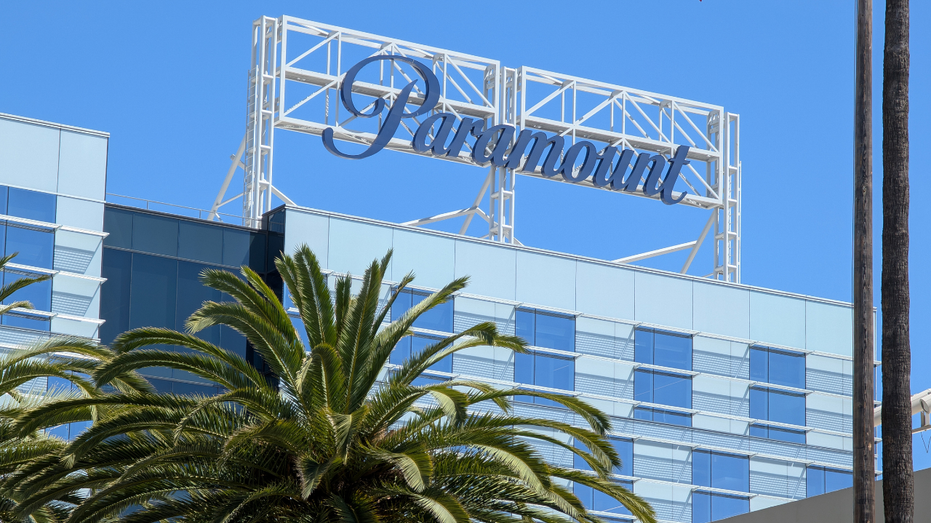
The Paramount Studios sign in Los Angeles April 23, 2026. (Noah Suave / Getty Images)
PARAMOUNT’S CALIFORNIA FUTURE IN DOUBT AMID ESCALATING LEGAL FIGHT
“We cannot comment on a company’s plans,” Bonta’s office told Fox News Digital. “It’s no secret that Paramount has been making this threat despite its alleged commitment to California and Hollywood. What Paramount decides to do is Paramount’s choice alone. We’ll continue to apply the law without fear or favor and continue to be open to coming to the table for good faith discussions.”
Bonta told MS NOW Thursday that LA officials are still willing to come to the table and negotiate.
“We’ve heard this threat before, and it’s inconsistent with other things that they have said,” he said. “If they decide to leave, that’s their independent choice. I’m not asking for it. I don’t want it, obviously, and that responsibility will lay at their feet.”
CNN STAFFERS SEE PARAMOUNT MERGER AS ‘INEVITABLE’ DESPITE LEGAL BATTLE DELAYING ELLISON TAKEOVER
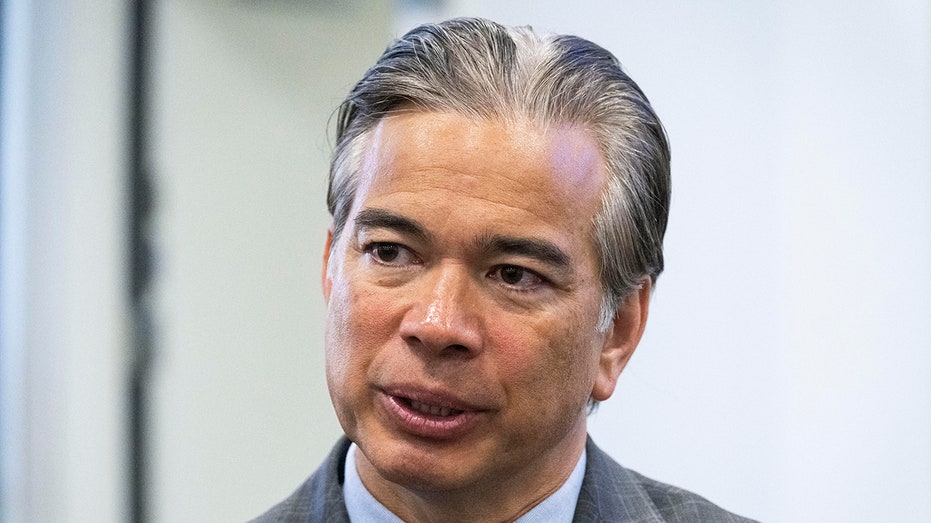
California Attorney General Rob Bonta speaks to the media after graduation ceremonies for the School of Social Ecology at UC Irvine in Irvine, Calif., June 16, 2025. (Paul Bersebach/MediaNews Group/Orange County Register via Getty Images / Getty Images)
Bonta was also asked about the possible move Thursday at The Atlantic Festival in New York.
“We will do our job,” he said. “We have a job to enforce the law without fear and without favor, and, at the same time, we are always open to come to the table if it is in good faith and it is sincere. And we will always explore an opportunity to get the results that we want with our evaluation of the case at the table.”
CNN STAFFERS BRACE FOR PARAMOUNT CEO’S POTENTIAL PLAN TO LAUNCH EDITORIAL BOARD TO OVERSEE NETWORK
In July, Bonta, and 11 other state attorneys general, filed an antitrust lawsuit against Paramount in an attempt to block the proposed Warner Bros. Discovery acquisition. They claimed the merger would eliminate competition in film distribution and basic cable while negatively affecting industry workers and consumers.
For his part, Paramount CEO David Ellison then threatened to move the iconic studio out of the Golden State if Bonta did not back off and a settlement was not reached by Oct. 1.
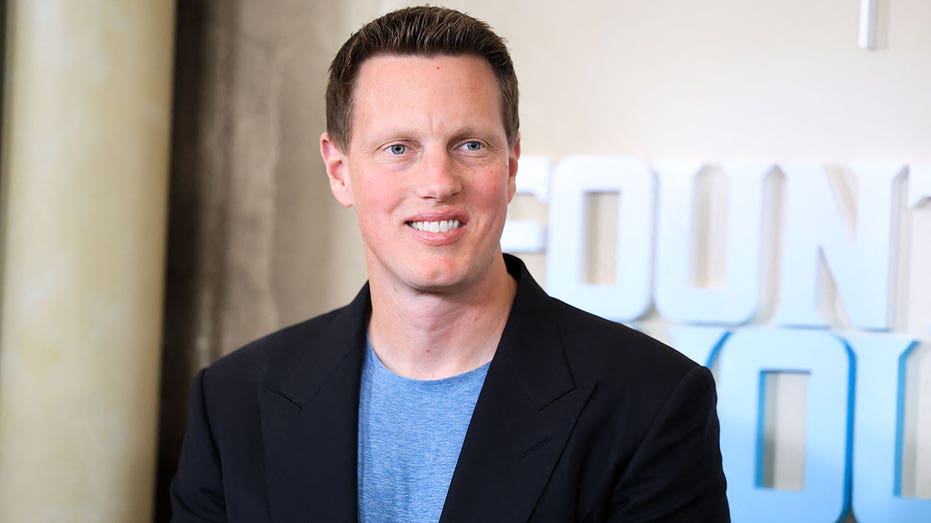
Paramount CEO David Ellison (Charly Triballeau/AFP via Getty Images / Getty Images)
CLICK HERE TO GET FOX BUSINESS ON THE GO
Now, it appears increasingly unlikely that a deal can be reached.
Fox News Digital’s Brian Flood and Joseph Wulfsohn contributed to this report.


That early work shaped how he thinks about pressure, teamwork, and staying calm when something goes wrong.
Reight studied psychology at the University of Maryland, College Park, then trained as a doctor at the Medical University of the Americas. Over the course of his career he has taken on several leadership posts alongside his surgical work: medical staff president, chief of surgery, and medical director of a breast centre and of a wound care and hyperbaric programme. He has also led as a robotic surgery surgeon, a role that sits at the newer end of general surgery.
Ian’s path has never run in a straight line from operating theatre to boardroom and back. He has treated leadership as part of the job, not separate from it, which is why he has moved between clinical roles and administrative ones without seeing much of a divide. Now based in Mount Vernon, Maine, he continues that pattern: seeing patients, running a surgical practice, and keeping an eye on how the systems around care actually work.
He writes and speaks about medicine and leadership, drawing on the same instincts he built as a first responder: assess quickly, communicate clearly, and do not let ego get in the way of the outcome. That grounding, more than any single title, is what he brings to Mount Vernon.
Interview with Ian Reight
You grew up in Maryland but you’re practising in Mount Vernon, Maine now. How did that move come about?
Maryland is where I’m from, it’s where I trained early on and where I did my firefighting and paramedic work. Maine is where I practise now. Mount Vernon is a small place, and that changes the job in ways people don’t always expect. You’re not one of a dozen general surgeons in a big system. You’re often the surgeon a patient has met, and will meet again.
What’s different about practising surgery in a small Maine town compared to a bigger market?
The distances matter more. If a patient needs a specialist referral or a longer recovery stay, that’s not always five minutes away. You plan around that. You also tend to know more about a patient’s life before they ever get to the table, because word travels and because you see the same families over years, not just once.
Does that change how you approach a first consultation?
A little. In a bigger city, a first meeting is often the only meeting where you’re building trust from zero. In Mount Vernon, there’s usually some context already there, whether from the patient themselves or from someone they know who I’ve treated before. That doesn’t mean I skip steps. I still walk through the same things every time: what the procedure involves, what recovery looks like, what could go wrong. But the conversation starts from a slightly different place.
You’ve held both clinical and administrative leadership roles. Does a smaller setting change how you think about leadership?
It sharpens it, honestly. In a large hospital, a leadership title can mean managing systems you rarely see up close. In a smaller setting, you see the direct effect of a decision almost immediately. If a follow-up process isn’t working, you hear about it from the patient the next week, not from a report months later. That immediacy keeps you honest.
What drew you to general surgery in the first place, going back to your time in Maryland?
The firefighting and paramedic work came first. That taught me to work under pressure and to trust a process even when things are moving fast. Surgery asked something similar of me, but with more time to prepare and more room to think ahead of the moment itself. Psychology, which I studied before medicine, gave me another piece: patients aren’t just a set of symptoms. How they understand what’s happening to them affects how they recover.
How has your work in wound care and breast centre leadership shaped your day-to-day surgical practice now in Maine?
Those roles taught me to look past the operation itself and think about the whole arc of care. Wound care in particular is unglamorous but it tells you a lot about whether a recovery is on track. I carry that habit into general surgery here: I don’t consider a case finished at the incision closing. I want to know how it heals, and I want the patient to know what to watch for too.
What does a typical week look like for you in Mount Vernon?
It’s a mix of clinical time and the kind of oversight work I’ve done for years, just on a smaller scale. Fewer layers between me and the decision, which I don’t mind. At home, my dogs and cooking are how I switch off. Neither has anything to do with surgery, and that’s the point.
Is there anything about practising in a small Maine town that surprised you?
How much continuity matters to patients. In a larger system, people expect to be handed between providers. Here, they expect to see the same face again, and that expectation has made me more careful about the small things: a follow-up call, a clear explanation, remembering the details of someone’s case without having to check the chart first.
Stuart Varney and Madison Allworth report on Nvidia CEO Jensen Huang dismissing AI doomsday fears. Jensen Huang explains why extreme AI concerns are not grounded in science, as President Donald Trump calls into the event.
President Donald Trump is planning to hold a state dinner next week to mark a visit by Chinese President Xi Jinping, and several tech industry leaders are expected to attend.
OpenAI CEO Sam Altman and Apple Executive Chairman Tim Cook are both reportedly planning to attend the state dinner.
Nvidia CEO Jensen Huang is also expected to attend the event, a person familiar with the matter told FOX Business.
OpenAI CEO Sam Altman is expected to attend the state dinner with other tech leaders.
The tech leaders’ anticipated attendance at the Trump-Xi state dinner comes at a time of geopolitical tensions, including over the development of artificial intelligence (AI) and access to both models and the chips that power them.
NVIDIA CEO DRAWS LINE ON AI SAFETY AFTER ALARMING INCIDENTS: ‘IF IT’S NOT READY, JUST HOLD IT BACK’
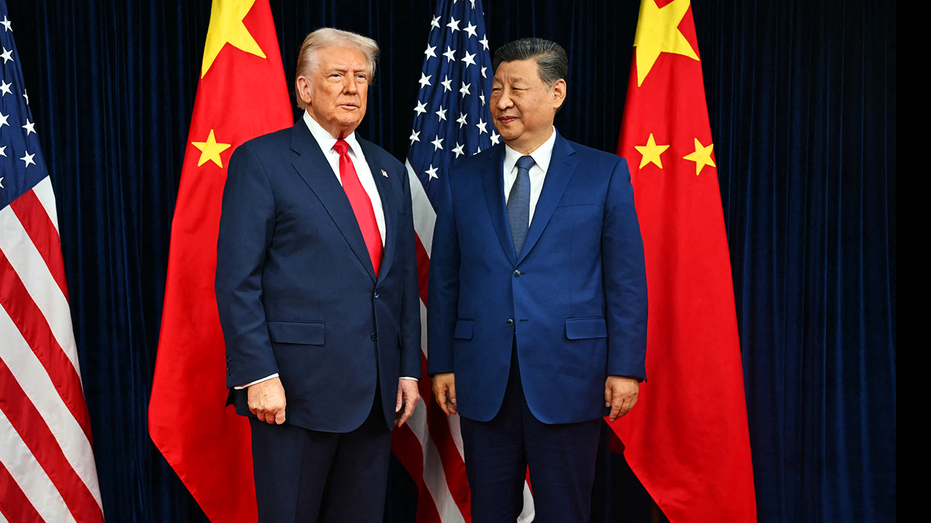
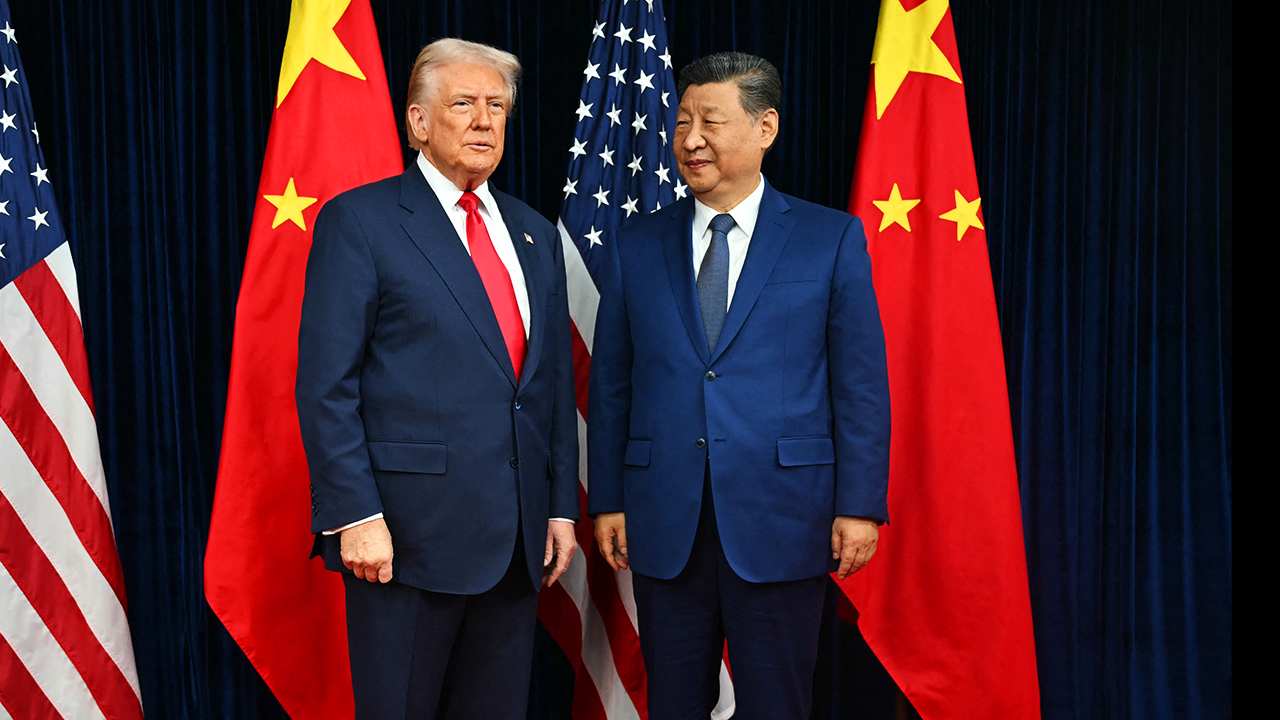
President Donald Trump and China’s President Xi Jinping are scheduled to hold a state dinner during Xi’s visit next week. (Andrew Caballero-Reynolds/AFP)
The U.S. and China are locked in a competition in which the two world powers are racing to develop more capable AI tools, which have been a source of tension between the countries.
China’s access to specialized chips that power advanced AI models has been restricted through the U.S. government’s use of export controls on advanced semiconductors, like those made by Nvidia.
Huang has been critical of those restrictions and said in May that China has “all the chips they need” despite the U.S. restrictions.
BESSENT SAYS US NEEDS MORE OPEN-SOURCE AI MODELS TO COMPETE WITH CHINA
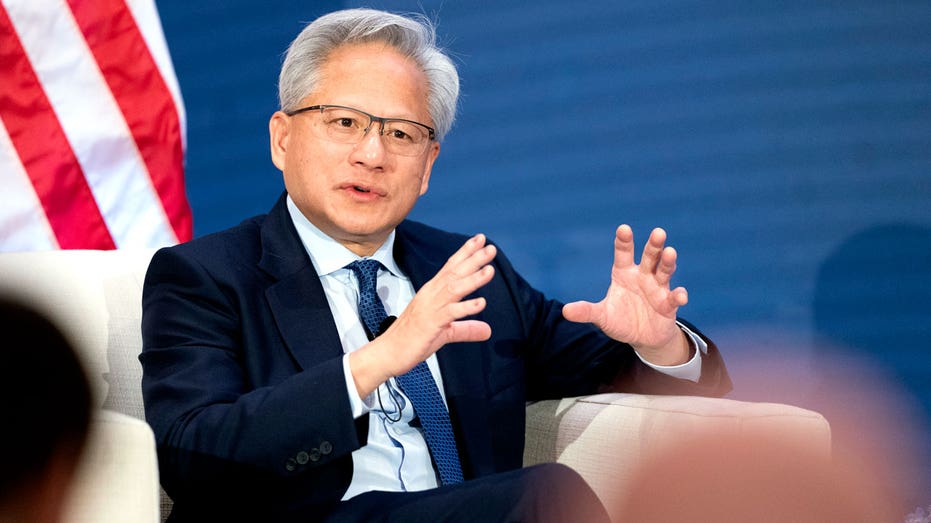
Nvidia CEO Jensen Huang is among the tech leaders expected to attend the state dinner. (Sean Rayford/Getty Images)
American companies like OpenAI and Anthropic have relied on using frontier models, which are proprietary and not available for use without purchasing a license, to gain their edge in the AI race. Chinese tech companies have used distillation as a means of using open-weight models to keep up with U.S. firms’ frontier models.
Altman and other tech leaders have recently been discussing steps to rein in AI development to ensure the safety and alignment of those models amid concerns about their potential impact on humanity.
“It is the responsibility of the AI companies ourselves to develop the technology safely and to properly test it,” Huang told reporters. “If it’s not ready, just hold it back. You should go as fast as you can, but no faster than that.”
State dinners are among the highest diplomatic honors a U.S. president can bestow on a foreign leader.
NVIDIA CEO JENSEN HUANG WARNS CHINA HAS ‘ALL THE CHIPS THEY NEED’ DESPITE US BANS
| Ticker | Security | Last | Change | Change % |
|---|---|---|---|---|
| AAPL | APPLE INC. | 337.00 | +4.59 | +1.38% |
| NVDA | NVIDIA CORP. | 219.34 | +5.44 | +2.54% |
Next week’s state dinner comes after Xi hosted a state dinner for Trump when he visited China in May. That event was also attended by Elon Musk, Huang and Cook – who was still CEO at the time and has recently transitioned into an executive chairman role at Apple.
The Trump-Xi state dinner will be the second hosted by Trump during his second term, as the first was held during a visit by Britain’s King Charles and Queen Camilla.
During his first term, he hosted state dinners for French President Emmanuel Macron in 2018 and Australian Prime Minister Scott Morrison in 2019.
GET FOX BUSINESS ON THE GO BY CLICKING HERE
Reuters contributed to this report.

SPXX: Buy The Discount, Collect The Premium, Encash The Consolidation

Axon Enterprise (AXON) failed to bounce early Wednesday, a day after being among the biggest S&P 500 losers on Tuesday, as investors reacted negatively to its plan to issue $1 billion in 0% convertible notes. The Taser-maker said proceeds will fund operations, acquisitions, investments and the cost of the capped-call transaction, which is a hedge designed to limit share dilution.…
Copyright ©2026 Investor’s Business Daily, LLC. All rights reserved. 87990cbe856818d5eddac44c7b1cdeb8

Sales growth at U.S. retailers rose in August, rebounding from its decrease in July, the Commerce Department said.
Retailers’ sales rose by 1.2% last month to $773.9 billion, versus the 0.5% decrease recorded in July. The August reading was higher than the 0.8% increase economists polled by The Wall Street Journal expected.
Copyright ©2026 Dow Jones & Company, Inc. All Rights Reserved. 87990cbe856818d5eddac44c7b1cdeb8

Stephen Moore joins Stuart Varney to analyze the economic impact of surging crude oil prices, rising diesel costs and President Donald Trump’s proposed dividend plan for American adults.
Executives from American Airlines, United Airlines and Southwest Airlines said Wednesday that higher jet fuel prices are prompting carriers to adjust capacity and closely monitor flight schedules.
The global average jet fuel price rose 6.1% week over week to $181.46 per barrel last week, according to the International Air Transport Association (IATA).
Speaking at Morgan Stanley’s 14th Annual Laguna Conference, American Airlines Chief Financial Officer Devon May said fourth-quarter jet fuel prices are running about $1 per gallon above what the airline projected in July, adding roughly $1 billion to its fuel bill.
“Overall for the third quarter, we feel great,” May said. “What’s happened in the last four weeks, though is fuel’s run up probably $1 a gallon or something like that for the fourth quarter alone.”
AVELO CEO WARNS AIRFARES MAY RISE AS FUEL PRICES HIT ‘UNCOMFORTABLY HIGH’ LEVELS

American Airlines CEO Robert Isom said the airline still expects third-quarter revenue to rise 16% to 19% from a year earlier. (Alex Tai/SOPA Images/LightRocket via Getty Images)
May said American will continue adjusting capacity later in the fourth quarter in response to higher fuel costs.
American Airlines CEO Robert Isom said the airline still expects third-quarter revenue to rise 16% to 19% from a year earlier, citing strength across domestic and international markets as well as both premium and economy cabins, according to Reuters.
“When you take into account fuel right now, yes, we’ve absolutely done a great job of recapturing a tremendous amount of that expense,” Isom said.
United Airlines Chief Financial Officer Michael Leskinen said some flights planned for December will no longer operate because of higher fuel prices.
“As you look into the fourth quarter, there’ll be some flights in December that we won’t fly that we thought we were going to fly,” he said at the Morgan Stanley conference. “If fuel remains high, we’ll make some adjustments into the first quarter and beyond into 2027.”
AIRLINE PASSENGERS ROCKED BY TURBULENCE DURING DESCENT: ‘WE STARTED TO PLUMMET’

Leskinen also described United’s fourth-quarter bookings as “tremendously strong,” saying premium travel, corporate demand and economy bookings have all remained resilient. (Tayfun Coskun/Anadolu Agency via Getty Images)
Leskinen also described United’s fourth-quarter bookings as “tremendously strong,” saying premium travel, corporate demand and economy bookings have all remained resilient.
“Bookings have continued as we expected, so that piece of the equation is resilient — very little evidence of demand destruction,” Leskinen said.
At the conference, Southwest Airlines Chief Financial Officer Tom Doxey said the carrier has already pared back about half of the modest year-over-year capacity growth it had planned at the start of 2026.
“If fuel is higher for longer,” Doxey said, trimming capacity would be the “natural response.”
However, a spokesperson for the airline told FOX Business the schedule adjustments made so far have been minimal and that Doxey was making an “illustrative point” about trimming capacity and was “not alluding to an action we’ve taken.”
TSA REVIVES PRE-9/11 TRADITION WITH GATE ACCESS FOR CERTAIN TRAVELERS WITHOUT TICKETS
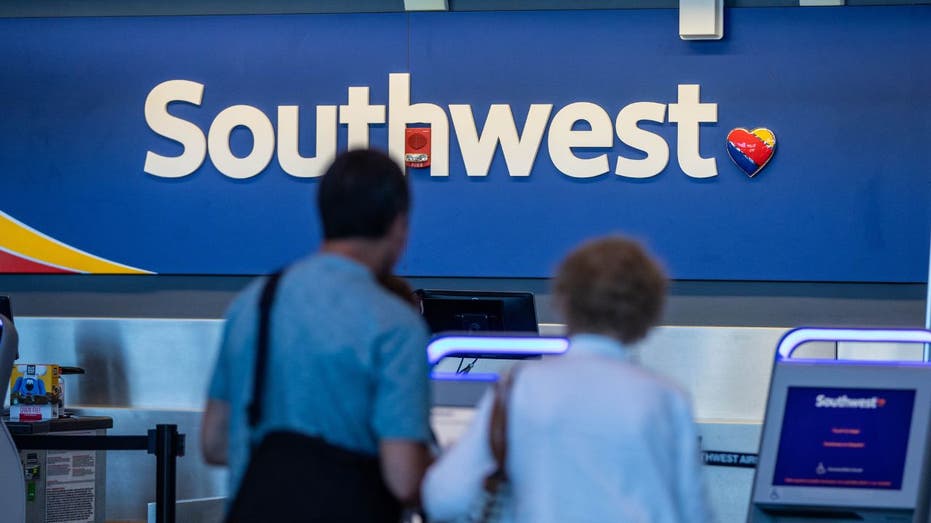
Southwest Airlines Chief Financial Officer Tom Doxey said the carrier has already pared back about half of the modest year-over-year capacity growth it had planned at the start of 2026. (Scott Eisen/Bloomberg via Getty Images)
Doxey added that stronger-than-expected fall bookings have helped offset higher fuel costs, allowing Southwest to maintain its third-quarter earnings guidance, according to Reuters.
GET FOX BUSINESS ON THE GO BY CLICKING HERE
Spokespersons for American Airlines and United Airlines told FOX Business the carriers had nothing further to add.
Reuters contributed to this report.

Meanwhile, the grey market premium (GMP) for the NSE IPO was hovering around 9%, signalling expectations of a moderate listing gain.
The Rs 22,569 crore issue is entirely an offer for sale of 12.64 crore shares. NSE will not receive any proceeds from the IPO, as the funds will go to the selling shareholders. The price band has been fixed at Rs 1,700-1,785 per share, with a lot size of eight shares.
At the upper end of the price band, the minimum retail application amounts to Rs 14,280, while the post-issue market capitalisation works out to about Rs 4,41,788 crore. The issue will close on September 21, and the stock is expected to list on the BSE on September 24.
NSE IPO Subscription Status
At the end of Day 1, the NSE IPO was subscribed 42% overall, against the 8.86 crore shares on offer.

- Retail Individual Investors (RIIs): Subscribed 43% against 4.41 crore shares offered.
- Non-Institutional Investors (NIIs): Subscribed 70% against 1.89 crore shares offered.
- Qualified Institutional Buyers (QIBs): Subscribed 19% against 2.52 crore shares offered.
NSE IPO GMP today
The grey market premium for NSE IPO is around 9%, signalling moderate listing expectations. The GMP suggests positive sentiment, but not the kind of sharp listing pop usually seen in smaller issues. Given the large size of the offer and the already rich valuation, listing gains may be measured.
Should you subscribe to NSE IPO?
Brokerage views are mostly positive for the IPO. At the upper price band of Rs 1,785, NSE is valued at 42.9 times FY26 earnings. LKP Securities has given a “Subscribe” rating to the IPO and said NSE’s post-issue implied market cap stands between Rs 4.2 lakh crore and Rs 4.42 lakh crore.YES Securities has also recommended “Subscribe”, saying NSE is available at a 21% discount to BSE on P/E. It said BSE trades at 54.3 times FY26 diluted earnings, while NSE is priced at 42.9 times at the cap price.
For long-term investors, analysts say NSE offers a rare chance to own India’s dominant market infrastructure company. Its strong margins, debt-free balance sheet, market leadership and rising investor base support the long-term case.
But investors should not ignore valuation and regulatory risks. At 42.9 times FY26 earnings, the IPO is not cheap. The business is also closely tied to trading volumes, especially options. A 9% GMP shows demand is positive, but not euphoric.
Angel One said NSE’s valuation at the upper price band of ₹1,785 translates to a post-issue P/E of 35.4x, lower than BSE’s 54.2x, making the issue attractive relative to its key peer. The brokerage highlighted NSE’s dominant market position, strong profitability, leadership in equity derivatives and long-term growth potential in India’s capital markets. Despite near-term regulatory headwinds, Angel One believes the valuation offers a favourable entry point and has recommended “Subscribe” to the IPO.
NSE IPO business model
NSE is India’s largest stock exchange and runs a vertically integrated platform across trading, clearing, listing, data services and index licensing. Its products span cash market, futures, options, mutual funds, commodity derivatives, currency derivatives, wholesale debt market and interest rate futures.
The exchange has held the top position in India by cash market turnover and equity derivatives turnover from FY01 to FY26. As of June 2026, NSE supported 132.4 million unique registered investors, 1,328 trading members and 3,005 listed entities with market capitalisation of about Rs 474.1 trillion.
NSE IPO strengths
NSE’s biggest strength is its near-dominant market position. Its market share stood at about 93% in the cash market, 99.7% in equity futures and 68.5% in equity options by premium turnover as of June 2026.
YES Securities said almost all of India’s listed equity trading risk flows through one platform. It said NSE’s advantage is not just pricing, but a liquidity cycle where orders go where spreads are tight, companies list where trading activity exists, and deeper markets attract more participants.
NSE IPO financials
NSE reported revenue from operations of Rs 16,601 crore in FY26, down 3.1% from Rs 17,141 crore in FY25. Profit after tax fell to Rs 10,302 crore from Rs 12,188 crore. In Q1, revenue stood at Rs 4,560 crore, while PAT came in at Rs 3,120 crore.
Read more:NSE IPO Tracker: Catch all the highlights here
Despite the fall in FY26 profit, margins remain strong. SBI Securities pegged NSE’s EBITDA margin at 67.6% in FY26 and 77.9% in Q1. PAT margin stood at 62.1% in FY26 and 68.4% in Q1.
NSE IPO risk factors
The main risk is dependence on transaction charges. NSE earned 78.7% of its FY26 revenue from transaction charges. Options alone contributed 60.2% of revenue from operations in FY26. This makes regulatory changes in derivatives an important watch point. YES Securities noted that NSE’s equity options market share by premium turnover has fallen from 96.86% in FY24 to 74.71% in FY26 and 68.48% in the June 2026 quarter.
Disclaimer: The views/recommendations mentioned in this article, wherever applicable, are those of the respective SEBI-registered Research Analyst/brokerage and have been reproduced/reported with due attribution. They should not be construed as the views or recommendations of The Economic Times Digital or the journalist. Readers are advised to consider the original research report and make their investment decisions based on their own assessment. Brokerage disclaimers here

Oscar Health (OSCR) raised its full-year earnings outlook while lowering its expected medical costs to cover benefits for its nearly 3 million Affordable Care Act exchange members. OSCR stock climbed in early Wednesday stock market action ahead of its 9 a.m. ET investor conference. Oscar, which made an aggressive play to gain ACA market share, has seen enrollment surge 47%…
Copyright ©2026 Investor’s Business Daily, LLC. All rights reserved. 87990cbe856818d5eddac44c7b1cdeb8
Bitcoin had weakened well before the announcement. It touched $82,163 on 4 September. By the afternoon of 16 September in India, ahead of the Fed decision, it was near $75,743. That was a fall of roughly 8%. Any account that attributes the entire decline to the hike gets the sequence wrong.
Bitcoin was trading around $75,000–$76,000 after the decision. Holding near those levels suggests that some of the expected tightening was already reflected in the price. It does not establish how Bitcoin will respond to a longer period of higher rates.Investors were also pulling money out of US spot Bitcoin ETFs. Withdrawals totalled $450.4 million on 15 September and $295.9 million the following day, according to Farside Investors. That is $746.3 million across two sessions. Two days do not establish a trend, and the first session preceded the announcement. They do make it premature to say the market has taken the decision in its stride.
Higher rates make the choice facing investors more demanding. Short-term government debt offers income with far less price uncertainty than Bitcoin. Bitcoin pays no interest of its own. Investors buying it must be willing to accept volatility for what they believe it can deliver over time.
Institutional investors make that calculation too. A fund manager can believe in Bitcoin and still reduce an allocation because borrowing has become more expensive or clients want less risk. Institutional participation cannot be treated as a permanent commitment to buy. The same investment committees that approve an allocation can cut it.
The source of inflation deserves closer attention. The conflict involving the US, Israel and Iran has added energy costs to an economy already struggling with persistent inflation. Higher rates cannot restore disrupted oil supplies. They can restrain spending and reduce the chance that an initial jump in fuel prices spreads into more lasting price increases.It would still be too convenient to describe this as an oil problem alone. The Fed reports resilient domestic spending and robust investment. Its median forecast puts core inflation, which excludes food and energy, at 3.4% this year. There is enough underlying inflation to make an early reversal of policy difficult to assume.
An energy shock does not, by itself, weaken the case for using blockchain to settle transactions more efficiently. Nor does it change Bitcoin’s supply rules. But preserving an investment argument is different from preserving demand. A household paying more for fuel has less money available to invest. A fund facing redemptions may sell an asset it still believes in. Bitcoin’s scarcity cannot prevent either decision.
The pressure also extends beyond the US. The European Central Bank raised rates by 25 basis points on 10 September, citing inflation pressures from the Middle East conflict. The Bank of England’s next decision was scheduled for 17 September. That warrants attention to policy across major economies, without assuming that their decisions are coordinated or that all will take the same course.
If more central banks tighten, crypto faces a broader constraint on funding and investor appetite. Capital can still move between countries, but fewer markets will offer cheap borrowing. For an asset class traded globally, looking only at the Fed leaves part of the picture out.
Even here, it is important to be precise about liquidity. The Fed says it will maintain ample reserves in the banking system. A rate increase does not automatically mean those reserves are being withdrawn. Crypto trading can nevertheless become thinner if buyers commit less money or market makers reduce the size of their orders. Forced selling from leveraged positions can then push prices down faster, particularly in smaller tokens.
The Fed’s projections suggest this adjustment may take time. Sixteen of 18 Fed officials envisage at least one further hike this year. The median implies a year-end range of 4–4.25%, unchanged at the end of 2027. Eight Fed officials see 4.25–4.5% for 2027. These are individual assessments, not a promised timetable, but they give investors little basis for assuming that cheaper money is imminent – liquidity may not ease as quickly as markets had hoped.
For Indian investors, the rupee adds another calculation. If the dollar strengthens against it, a fall in Bitcoin’s dollar price can translate into a smaller decline in rupee terms. That currency effect should not be mistaken for stronger demand for Bitcoin. It can reverse too.
Over the coming weeks, buying behaviour, and ETF inflow pattern and volume will tell us more than the first reaction to the announcement. A recovery financed largely by borrowing would leave the market exposed to another round of forced selling. For now, the industry needs to observe whether users continue being interested in crypto investment if the next rate cut takes much longer than expected.
(The author is Vice President, WazirX)


Samuel Smith has a diverse background that includes being lead analyst and Vice President at several highly regarded dividend stock research firms and running his own dividend investing YouTube channel. He is a Professional Engineer and Project Management Professional and holds a B.S. in Civil Engineering & Mathematics from the United States Military Academy at West Point and has a Masters in Engineering from Texas A&M with a focus on applied mathematics and machine learning.Samuel leads the High Yield Investor investing group. Samuel teams up with Jussi Askola and Paul R. Drake where they focus on finding the right balance between safety, growth, yield, and value. High Yield Investor offers real-money core, retirement, and international portfolios. The service also features regular trade alerts, educational content, and an active chat room of like-minded investors. Perspective: “Do not store up for yourselves treasures on earth, where moth and rust destroy, and where thieves break in and steal. But store up for yourselves treasures in heaven, where neither moth nor rust destroys, and where thieves do not break in or steal; for where your treasure is, there your heart will be also … For what will it profit a man if he gains the whole world and forfeits his soul?” ~ Jesus (Matthew 6:19-21; 16:26)Learn more
Analyst’s Disclosure: I/we have no stock, option or similar derivative position in any of the companies mentioned, and no plans to initiate any such positions within the next 72 hours. I wrote this article myself, and it expresses my own opinions. I am not receiving compensation for it (other than from Seeking Alpha). I have no business relationship with any company whose stock is mentioned in this article.
Seeking Alpha’s Disclosure: Past performance is no guarantee of future results. No recommendation or advice is being given as to whether any investment is suitable for a particular investor. Any views or opinions expressed above may not reflect those of Seeking Alpha as a whole. Seeking Alpha is not a licensed securities dealer, broker or US investment adviser or investment bank. Our analysts are third party authors that include both professional investors and individual investors who may not be licensed or certified by any institute or regulatory body.

Bold and Beautiful: Carter and Steffy’s Sham Baby Plan Unravels in Shocking Twist

XRP’s Price Set Will Shock The World…

Lambeth Palace revokes cleric’s award over ‘obscene’ Osama bin Laden remarks | News UK



-

 Fashion6 days ago
Weekend Open Thread – Corporette.com
-

 Tech4 days ago
The Latest Weird Thing to Play Doom Is the Mapped-Out Brain of a Fruit Fly
-

 Business7 days ago
10 Most-Streamed Songs On Spotify In 2026 So Far, Led By Ella Langley’s Dominant Run On The Charts This Year
-

 Crypto World7 days ago
XAG/USD: Silver’s Short-Term Rally Meets Its Moment of Truth
-

 Crypto World7 days ago
OKX launches 10x OpenAI, Anthropic X-Perps in Europe
-

 Crypto World7 days ago
Diesel Tops $6 a Gallon for the First Time as 28 States Set Records
-

 Crypto World3 days ago
Kraken Lets xStocks Holders Earn Yield Through DeFi
-

 Crypto World3 days ago
Elon Musk Drops a Bombshell: Grok 5 Could Be the AGI Breakthrough
-

 News Videos6 days ago
Facing Financial Fears
-

 Crypto World22 hours ago
US Charges Robinhood Engineers Over Crypto Listing Trades
-
Crypto World7 days ago
Ethereum Price Analysis: Consolidation at $2.5K Tests Momentum as On-Chain Activity Surges
-

 Business5 days ago
Rivals Sam Altman and Elon Musk Rally Behind Dario Amodei’s Call for a Slowdown in AI Development
-

 Crypto World5 days ago
Can AI Build a Startup in 72 Hours? Elon Musk's Team Will Livestream the Test
-

 Entertainment6 days ago
News Specials, Movies, Shows, More
-
 NewsBeat3 days ago
‘Sick conspiracy’: Trump says only guardrails AI needs is ‘a strong and smart (High IQ!) president’ in all-caps rant
-

 Crypto World7 days ago
Bitcoin ETFs Pull $167M as 2026’s Best Inflow Run Slows
-

 Crypto World6 days ago
Robinhood Chain Never Stopped But its Blobs Did Stop Reaching Ethereum For 14 Minutes
-

 Crypto World7 days ago
US CPI forecast at 3.4% as tariff risks build
-

 Crypto World4 days ago
New Tesla Roadster Uses SpaceX Tech. Will It Impact the Stock Price?
-
 Entertainment6 days ago
New Horror Movie Officially Earns a Rare Stephen King Recommendation
You must be logged in to post a comment Login