

Business
Salary information to be shown on job ads under new laws


Employers will have to publish salary information in job adverts under government plans to rewrite anti-discrimination laws.
Details of other job conditions could also have to be disclosed to candidates, under the draft proposals.
Ministers argue greater transparency will help people navigate the jobs market and could prevent future pay discrimination claims.
However, details of exactly what salary information will have to be shared are yet to be hammered out.
Officials plan to consult on whether exact salaries will have to be displayed, or potentially a pay range or “benchmark rate” for open roles.
They also plan to ask industry groups whether information beyond basic salary, such as bonuses, should be made available.
Employers that do not publish a job advert for a role would have to give candidates the information in writing prior to a job interview.
In a policy document, the Cabinet Office said salary information would help jobseekers make informed application decisions, and improve the hiring process for companies by weeding out candidates with “misaligned pay expectations”.
Citing various academic studies, it also said transparency would help prevent “unequal outcomes” when salaries are offered to successful applicants.
“When pay is opaque, salary decisions can be influenced by stereotypes – such as stereotypes of women, ethnic minorities, or disabled people,” it added.


Thailand has been at the center of significant developments across immigration policy, public safety, and economic sectors. This summary examines the key stories shaping the nation’s current landscape.
Visa Policy Overhaul
Thailand has implemented sweeping changes to its visa framework, affecting travelers from 65 countries and territories. In a notable reversal, the government scrapped its plan to end visa-free entry for Indian tourists, though it significantly altered the terms of access. According to Bangkok Post, the visa-free period has been halved for many nationalities, with numerous countries being dropped from the visa-exempt list entirely.
Indian travelers will now receive 30-day visa-free entry, down from the previous 60-day allowance, following a notable decline in tourist arrivals. This adjustment comes as Thailand grapples with an overall 3.09% decrease in foreign arrivals so far this year, prompting officials to recalibrate entry policies to balance security concerns with tourism revenue goals.
The changes have drawn mixed reactions internationally. Swiss seasonal retirees have expressed dismay over the tightened policies, according to SWI swissinfo.ch, highlighting how the reforms affect not just tourists but longer-term visitors who have relied on extended visa-free stays.
Tourism Sector Response
In response to softening visitor numbers, Thailand has unveiled a THB2.45 billion tourism stimulus package, featuring 500,000 co-payment subsidies and airfare discounts designed to reinvigorate the sector. The government is also pursuing new tourism partnerships and infrastructure projects, including a newly opened Sadao-Malaysia road intended to strengthen cross-border tourism between the two nations.
Bangkok Bar Fire Tragedy
A devastating fire at a Bangkok music venue has claimed at least 32 lives, with the death toll rising as additional victims succumbed to injuries in hospital. Investigations have revealed that flammable decor and lax safety enforcement transformed the popular pub into what officials describe as a “death trap,” according to Reuters reporting.
Experts have noted that a flashover event—a point at which trapped patrons had no chance of escape—occurred rapidly, trapping victims inside. This tragedy has reignited discussions about why Thailand continues experiencing similar nightspot disasters, with CNA characterizing such incidents as unfortunately recurring due to systemic enforcement gaps.
Economic and Trade Developments
Thailand’s economic landscape shows notable activity across multiple fronts. The government has approved measures to bolster clean energy markets, signaling a push toward sustainable infrastructure. Simultaneously, authorities are planning higher power tariffs for data center owners, reflecting efforts to manage growing energy demands from the tech sector while providing relief on household power bills.
In the automotive sector, Hyundai will begin exporting battery electric vehicles to Australia from its Thailand production base, while BYD Thailand celebrated its local plant’s second anniversary with deliveries surpassing 130,000 units—underscoring Thailand’s growing role as a regional EV manufacturing hub.
Trade tensions also feature prominently, with Thailand navigating new US tariffs that analysts argue necessitate market diversification strategies. Additionally, Malaysia and Thailand are seeking technical solutions to resolve an ongoing shrimp and sea bass trade dispute affecting regional seafood commerce.
Financial and Banking Sector Notes
The financial sector faced scrutiny after Thailand’s most profitable bank was forced to pay a beauty queen following a $124,000 AI-related scam, highlighting emerging cybersecurity vulnerabilities. Meanwhile, Muangthai Capital’s new CEO defended the role of microfinance institutions, arguing that such services remain essential for underserved populations who would otherwise struggle financially.
Regional Diplomacy and Security
Thailand continues playing an active diplomatic role regarding Myanmar. An ASEAN envoy met with Myanmar opposition groups in Thailand, while officials confirmed that Myanmar’s leader will visit Thailand next month. Additionally, Thailand is pressuring the Myanmar junta for direct envoy access to detained leader Aung San Suu Kyi, with Bangkok expressing continued hope for a potential meeting.
On security matters, human rights organizations have raised concerns, with Human Rights Watch urging Thailand not to forcibly return Chinese dissidents, and RSF joining Safeguard Defenders in calling for a halt to the forcible return of Chinese journalist Bai Zhaodong. Separately, authorities have cracked down on an online gambling network and busted a Thai boxing camp running a child sex trafficking ring, rescuing 15 victims.
Social and Cultural Highlights
Beyond politics and economics, Thailand has seen diverse cultural moments. A 2,000-year-old gold ring bearing an inscribed message was discovered at an archaeological dig site, drawing international attention. Additionally, a newly identified long-necked dinosaur species was documented in Thailand, contributing to paleontological research in the region.
The country’s animal welfare efforts were also spotlighted through a photo essay examining Thailand’s animal rescue network dedicated to saving stray animals, showcasing grassroots conservation efforts across the nation.
Thailand’s current news cycle reflects a nation balancing tourism recovery, public safety reforms, and economic modernization amid regional diplomatic responsibilities. As the government refines visa policies and addresses safety concerns following the Bangkok fire tragedy, stakeholders across sectors continue monitoring how these developments will shape the country’s trajectory in the coming months.
Source : Google News – Search
Other People are Reading

Multicultural Business Coalition Chairman Frank Garcia highlights some of the stores that could go out of business due to NYC Mayor Zohran Mamdani’s government-run grocery store initiative on ‘The Bottom Line.’
California consumers could soon see higher grocery bills as the state begins implementing a sweeping packaging law that shifts recycling costs from taxpayers to manufacturers, expenses some businesses warn could eventually be passed on to shoppers.
Beginning next month, California will start collecting preliminary fees under the state’s Plastic Pollution Prevention and Packaging Producer Responsibility Act, a 2022 law that requires companies to help pay for the recycling and disposal of the packaging they sell.
State regulators say the measure is intended to reduce plastic waste while encouraging businesses to use more recyclable materials.
Companies that use harder-to-recycle packaging are expected to pay more than those using recyclable or compostable materials, creating an incentive to redesign packaging over the coming years. Producers must ensure all covered packaging sold in California is recyclable or compostable by 2032.
MORE AMERICANS ARE RELYING ON CREDIT CARDS TO BUY GROCERIES, NEW STUDY FINDS

California will start collecting preliminary fees under the state’s Plastic Pollution Prevention and Packaging Producer Responsibility Act. (David Paul Morris/Bloomberg via Getty Images)
CalRecycle estimates the law could increase household costs by up to $190 per year — about $66 per person — if manufacturers pass all compliance costs on to consumers. The agency says the actual increase could be lower if companies absorb some of those expenses themselves.
The state estimates roughly 5,700 large producers will be subject to the new requirements, with average annual compliance costs topping $450,000. Businesses that buy packaged goods could also face higher costs if manufacturers raise prices to offset the new fees.

California estimates roughly 5,700 large producers will be subject to the new requirements. (Mario Tama/Getty Images)
CalRecycle says the law is intended to reduce plastic pollution, expand recycling infrastructure and shift responsibility for managing packaging waste from taxpayers and local governments to producers.

People shop at a supermarket Feb. 13, 2023, in Los Angeles. (Frederic J. Brown/AFP via Getty Images)
Some industry groups, however, argue the state’s projections underestimate the potential impact on consumers and have warned grocery prices could rise more sharply as companies adjust to the new requirements.
CLICK HERE TO GET FOX BUSINESS ON THE GO
FOX Business reached out to CalRecycle for comment.
All three major stock indexes closed modestly higher despite weakness in semiconductors, with consumer-focused retail and travel/leisure clear outperformers.
PayPal surged after sources told Reuters that Stripe and private equity firm Advent International have jointly offered to acquire it for $60.50 per share – representing around a 28% premium to its Tuesday close.
A second day of solid bank earnings added momentum to an auspicious beginning to second-quarter reporting season. BlackRock and Morgan Stanley both beat quarterly profit expectations.
“Everything looks great with the bank earnings,” said Mike Dickson, head of portfolio management at Horizon Investments in Charlotte, North Carolina. “I would not be at all surprised to see another bang-out quarter.”

Analysts currently expect second-quarter year-on-year S&P 500 earnings growth of 23.7%, according to the most recent data from LSEG.
According to preliminary data, the S&P 500 gained 29.00 points, or 0.38%, to end at 7,572.59 points, while the Nasdaq Composite gained 161.87 points, or 0.62%, to 26,268.88. The Dow Jones Industrial Average rose 155.53 points, or 0.30%, to 52,663.80.COOLING INFLATION, WARSH TESTIMONY CONTINUES
The Labor Department’s Producer Price Index (PPI) report provided a second straight day of cooler-than-expected inflation data, even as newly confirmed U.S. Federal Reserve Chair Kevin Warsh appeared before the Senate Banking Committee in his second day of Congressional testimony.
Combined with Tuesday’s CPI report, the PPI data suggests that inflation took a step in the right direction last month even though it remains elevated due to the U.S.-Israeli war on Iran. This eased near-term pressure on the central bank to raise its key interest rate.
“My fear going into this week was, we could get a hot CPI print, inflation above 3.8%, and we didn’t get it; we got a cooler reading of 3.5%,” said Lauren Cassidy, chief investment officer of Founders 100 ETF, in Dallas. “So that allows the Federal Reserve to have the opportunity to keep rates flat or cut them later this year, which is good news for the market.”
Financial markets are currently pricing in a 10.2% likelihood that the Fed will implement a 25 basis point rate hike at the conclusion of this month’s monetary policy meeting, down from 31.0% a week ago, according to CME’s FedWatch tool.
Even so, this week’s inflation data is focused on last month, as investors were growing optimistic that negotiators were moving toward a peaceful resolution to the Middle East conflict. That optimism has faded in recent days as the U.S. and Iran staged escalating airstrikes, vying for control over the Strait of Hormuz. That could result in renewed price pressures.
Fed Governor Lisa Cook said she is “prepared to act” if inflation does not soon begin to slow.

Form 4 Hexcel Corp For: 15 July

Wall Street’s business of facilitating trades on behalf of clients has been fast-growing, and analysts were closely watching whether momentum would continue. Across the Street, fees from stock trades shot up, while fees related to bonds, commodities and other non-equity products also rose.
Goldman Sachs’s equity trading revenue rose 72% from a year ago, while fixed income, commodities and currency trading was up 32%.
At JPMorgan, stock trading revenue was up 86% from a year ago and fixed income was up 6%.
Bank of America’s sales and trading revenue for equities was up 70%, while FICC was up about 9%.

A United Airlines plane takes off from the Fort Lauderdale-Hollywood International Airport on June 9, 2026 in Fort Lauderdale, Florida.
Joe Raedle | Getty Images
United Airlines‘ second-quarter results came in ahead of Wall Street estimates, but billions of dollars in added fuel costs continue to weigh on earnings, the carrier said Wednesday.
Here is what United Airlines reported for the quarter that ended June 30 compared with what Wall Street was expecting, based on estimates compiled by LSEG:
- Earnings per share: $1.99 adjusted vs. $1.88 expected
- Revenue: $17.67 billion vs. $17.61 billion expected
United forecast third-quarter adjusted earnings per share of between $2.50 and $3.50, compared with analysts’ estimates for $3.60 a share. It estimated full-year adjusted earnings per share of between $9 and $11, the higher end of the range of the adjusted $7 to $11 a share it forecast in April, when it cut its January forecast after the U.S. and Israel attacked Iran in late February.
According to Argus data published by industry group Airlines for America, jet fuel prices at major U.S. airports are up 34% in July alone through Tuesday amid a rollercoaster of escalating and deescalating conflict between the U.S. and Iran. Jet fuel is the largest cost for airlines after labor.
United said the higher fuel prices could add nearly $6 billion to its expenses this year compared with what it expected at the start of 2026, and that its second-quarter fuel costs rose 84% from last year to $2.3 billion. Those estimates were made based on Tuesday’s fuel prices. It said it would cover up to as much as 90% of its higher costs this quarter and all of it in the fourth quarter.
Rival Delta Air Lines also said it is passing on more of those higher costs to flyers. The airlines said demand has remained strong despite higher fares.
United said it is updating its forecast to include the most recent fuel prices because costs have been so volatile. Since the beginning of July, fuel prices have hit adjusted earnings for the third quarter by $1.12 per share, it said.
The carrier could further cut its capacity plans because of higher fuel costs this year, it said in a filing.
United expanded flying 3.5% second quarter. Its revenue rose 16% from a year earlier to $17.67 billion, with total unit revenue up 12.1% in the second quarter from last year. That was the highest unit revenue growth since early 2023, according to FactSet.
The airline reported higher revenue for premium, corporate and no-frills basic economy tickets, as well as rising unit revenue for both domestic and international trips.
Net income fell more than 17% to $805 million, or $2.46 a share. Adjusting for one-time items United reported $649 million, or $1.99 a share on an adjusted basis.
United executives will hold an earnings call Thursday at 10:30 a.m. ET.

United Airlines Holdings earnings beat by $0.14, revenue topped estimates

Watt recently apologised to staff and investors for the “many mistakes” made in the management of the company, admitting that it tried to diversify too quickly.
Brewdog’s brash marketing style had regularly sparked controversy, but the firm also faced criticism for its treatment of investors and staff.
A 2022 a BBC Disclosure investigation uncovered claims of inappropriate behaviour by Watt towards female staff, and revealed that Brewdog violated import laws and fabricated many of its marketing stories.
In 2024, the firm faced a backlash after revealing it would no longer hire new staff on the real living wage, instead paying the lower legal minimum wage.
Watt denied any wrongdoing alleged in the film and threatened to sue the BBC. He later said he sometimes missed social cues because he has autism.
A complaint to broadcasting regulator Ofcom was rejected.
Brewdog said it was putting in a range of measures to improve workplace culture following the release of the programme.
Tilray and Second Best have been asked to comment on Watt’s letter.
Business
JP Morgan moving closer to a milestone no bank has ever reached: A $1 trillion market value

It would also show how far the bank has pulled ahead of its rivals under CEO Jamie Dimon, who has led the lender for nearly two decades.
Record profit lifts shares
JPMorgan shares touched a record high on Tuesday after the bank reported a strong quarterly performance. The lender posted the highest profit ever by a US bank, helped by strength across its businesses.JPMorgan has a larger balance sheet than most peers and has built leadership across investment banking, consumer banking, credit cards, trading and lending. That gives it more ways to benefit when markets improve and when consumer activity remains steady.
The latest boost has come from Wall Street dealmaking. Investment banking activity has picked up as companies return to mergers, acquisitions and capital market transactions. If deal volumes stay strong through the rest of 2026, JPMorgan could see further gains in fees and earnings.CFO Jeremy Barnum said the bank’s investment banking pipeline was robust, adding that current activity levels were encouraging more activity.
Also Read: ‘We faltered, did not move quickly:’ How IBM CEO Arvind Krishna’s statement led to $70 billion wipeout
Jamie Dimon premium
JPMorgan’s rise has also been tied closely to Dimon. Investors have long assigned what is often called a “Jamie premium” to the stock, reflecting confidence in his leadership, risk control and ability to steer the bank through crises.
Dimon took charge before the global financial crisis and helped JPMorgan emerge stronger than many rivals. The bank has since used its size, capital strength and brand to gain market share.
The board has stepped up succession planning in recent years, but Dimon’s influence remains a major part of the stock’s appeal. Investors continue to see JPMorgan as the best-run large US bank.
Valuation test for investors
At around $940 billion in market value, JPMorgan is already far ahead of other global banks. But getting to $1 trillion will also raise expectations.
The stock trades at 14.63 times expected earnings over the next 12 months, compared with 13.58 times for the S&P 500 banks index, according to Reuters.
For years, trillion-dollar valuations were mostly reserved for technology companies. JPMorgan’s push toward that level shows how dominant the bank has become in global finance.
(Disclaimer: Recommendations, suggestions, views and opinions given by the experts are their own. These do not represent the views of Economic Times)

ArtMarie/E+ via Getty Images

We recently closed out of our position in Terreno (TRNO) and wanted to walk readers through our thought process and how we look at the company today.
The REIT Forum

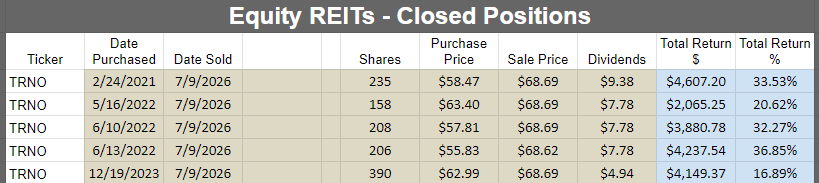
We sold shares on 7/9/2026. For readers interested, we will post all the sales at the end of the article.
Seeking Alpha
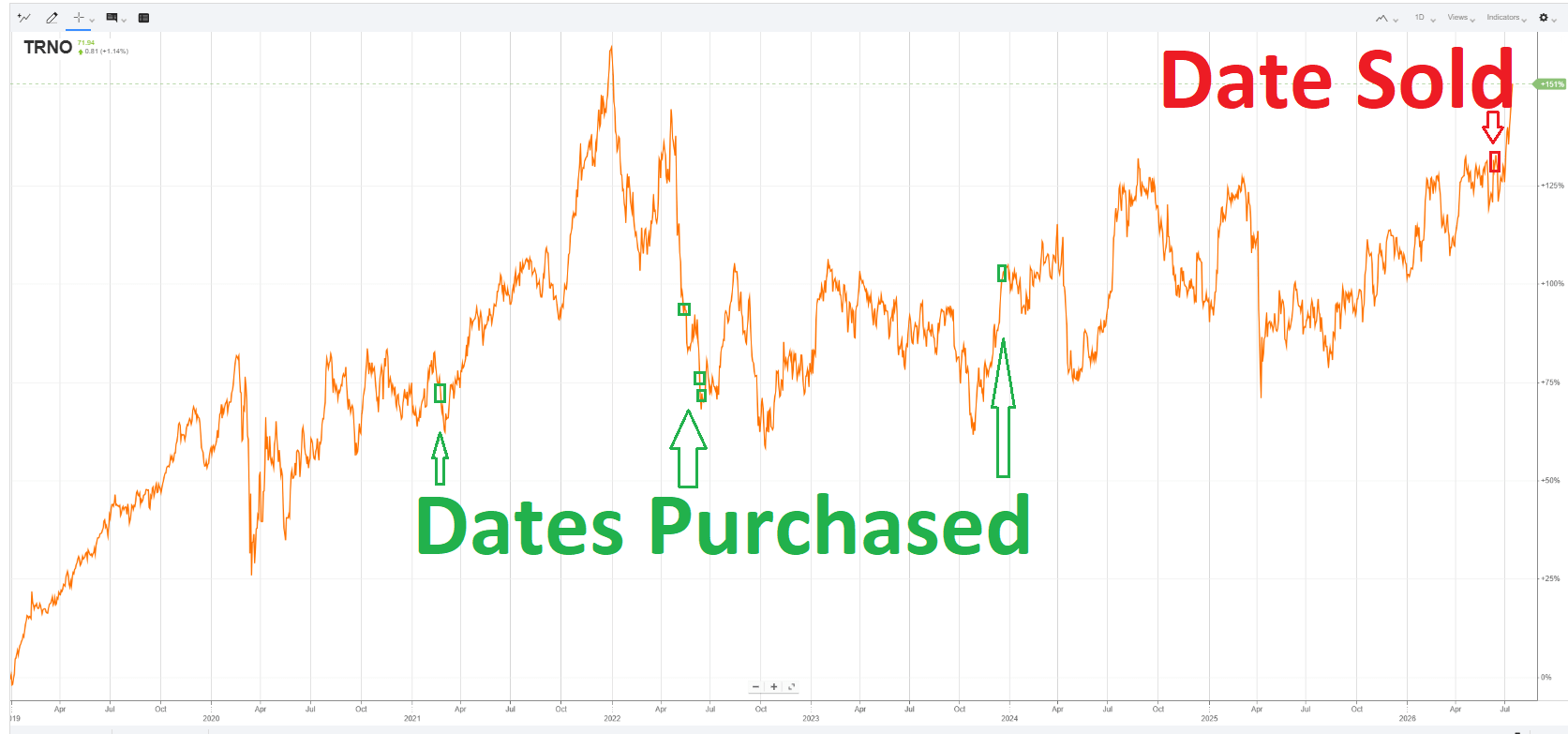
Before we sold, Terreno was flirting with the border between our neutral/overpriced ranges. Shares were trading at 31.4x consensus forward AFFO. Technically, it’s probably a little bit lower if we factor in that Q2 2027 AFFO per share will probably be higher than Q2 2026 AFFO per share. However, even adjusting for higher AFFO, the multiple would still be very large.
July 9th Thought Process
Terreno has been one of my favorite REITs for several years. I viewed it as a great long-term position. However, I am looking at shares trading over 30x forward AFFO while the 2-year Treasury is over 4% (4.16% presently), the 10-year is at 4.535%, and the 30-year is at 5.054%. I’m feeling a bit skeptical about multiples around 30x AFFO (or higher) in this environment. If we assume that REITs with more “normal” growth levels typically trade around 14x to 20x AFFO, then we have to assume several years of strong growth. While that’s certainly possible, I wouldn’t want to use it as the base scenario.
AFFO Estimates And Multiple
Our sheets are currently using a forward estimate of $2.19.
If we were to use AFFO estimates for the next 4 quarters starting with Q3 2026, then the consensus estimate would increase to $2.25. That’s better, but not substantially better.
Even if we use the $2.25 value, at $68.68 shares would be trading a hair over 30.5x forward AFFO estimates.
If we use $2.18 or $2.19, the multiple is 31.36x or 31.50x, respectively.
That’s a pretty high multiple given the Treasury yields. While I still really like TRNO, I felt it was prudent to harvest gains here.
The REIT Forum

Note: TRNO has rallied even higher since we closed our position. As of 7/15/2026, shares are at $72.09.
Why TRNO Can Achieve A High Multiple
Our thesis played out well with the industrial real estate portfolio delivering strong growth in same property NOI (Net Operating Income). That drove significant growth in AFFO per share, which supports TRNO trading at pretty high multiples of AFFO per share. The market likes seeing strong growth across several key indicators. However, the valuation still hit a point where I felt it was prudent to just take the gains.
Issuing Shares
TRNO was issuing equity during Q1 2026:
TRNO
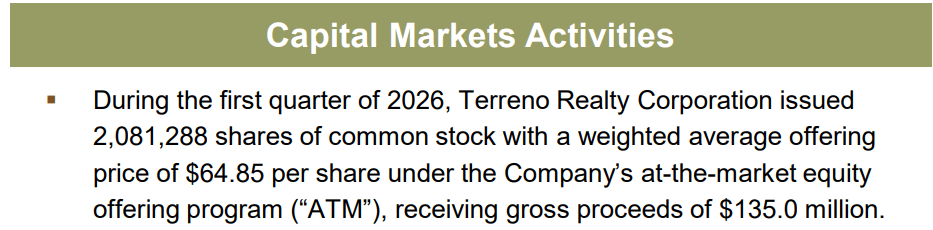
They felt it was reasonable to issue it at $64.85, and I agree with them. That was a very reasonable price for choosing to issue new equity. Issuing at $68.68 (5.9% higher) would make even more sense. That’s the right choice for management as they look to maximize value for shareholders.
Impact Of Treasury Rates
The last time I purchased TRNO was in 2023 at $62.99. That’s not dramatically lower than the current price. The AFFO multiple was similar. What changed?
Well, the interest rate scenario changed quite a bit as shown by the 10-year and 30-year Treasury rates:
MBSLive
MBSLive
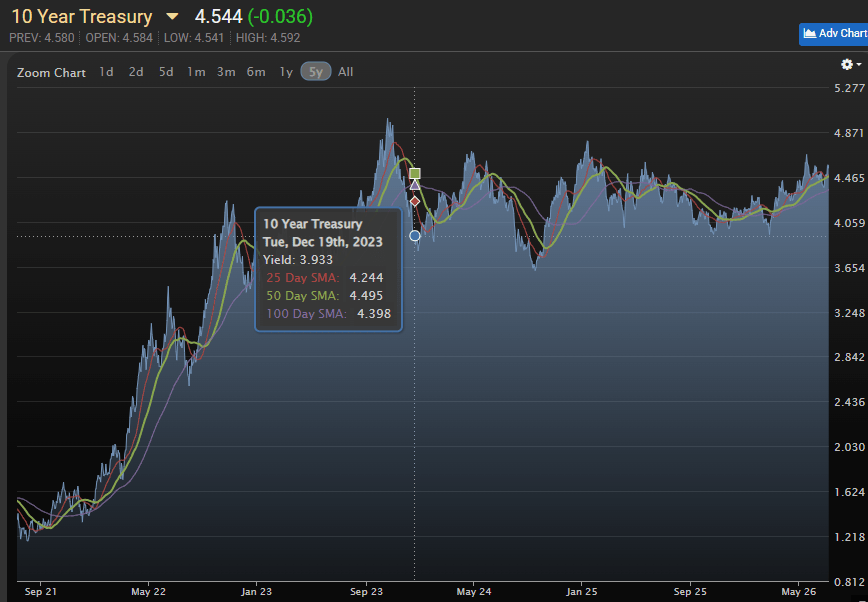
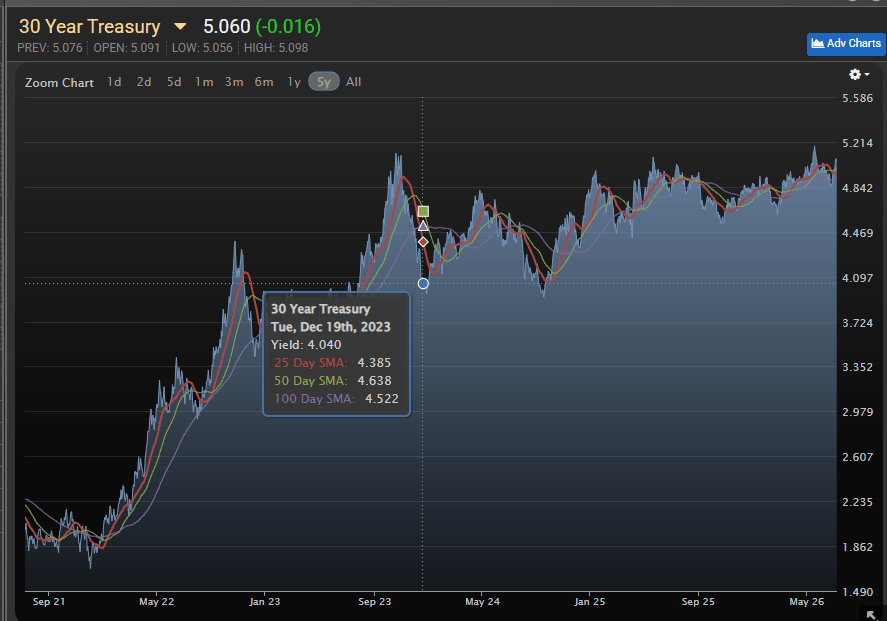
The 10-year Treasury yield is up 60 basis points (that means 0.60%) and currently trending higher (based on the current yield relative to the moving averages). The 30-year is up just over 100 basis points and also in a trend higher.
That feels ugly. It’s been less of an issue for TRNO since they have such little debt on their balance sheet. Consequently, they have been less exposed to interest rate pressure than most equity REITs. However, it makes it harder to justify high multiples.
Adjusted EBITDA/Total Enterprise Value
Doing a full model for “Market Implied Cap Rate” is pretty slow. In theory it seems like it would be quick to update, but in practice it can get messy doing quarter after quarter.
A simpler method is calculating adjusted EBITDA to Total Enterprise Value. It is less precise (which is negative), but it factors in overhead (which is positive).
Often there won’t be preferred stock or minority interest, which makes it even simpler.
The bigger question is simply which version of EBITDA we want to use. Do we use the most recent quarter? Do we try to run a forward estimate? Sometimes the answers matter a great deal, and sometimes they don’t. In this case, the picture is pretty clear regardless. One adjustment I really like to make, though, is to revise “adjusted EBITDA” by deducting stock-based compensation. That’s fundamentally overhead by another name.
Goal Of Calculation
This is a way to approximate the amount of adjusted EBITDA the company is producing relative to the total value assigned to the company.
It can be a quick way to compare REITs. However, investors should be aware that all REITS do not simply deserve to trade at the same valuation. That would be silly. Some properties are simply more desirable, and some management teams are superior. For now I’m simply going to refer to adjusted EBITDA minus stock-based compensation as “revised EBITDA.” I wanted to compare TRNO with Rexford (REXR).
Using Q1 2026, I came to the following estimates when removing stock-based compensation:
-
TRNO at $68.62 has a revised EBITDA yield of 3.96%. This is why it makes sense for TRNO to issue shares.
-
REXR at $34.42 has a revised EBITDA yield of 6.12%. This is why it makes sense for REXR to repurchase shares.
Note: We don’t want to use growth rates in adjusted EBITDA or revised EBITDA unless we control for the expected change in the shares outstanding and net debt outstanding.
That’s the gap in valuation. It is very material.
Hypothetically, what if REXR climbed all the way to our “overpriced” level? The revised EBITDA yield would drop from 6.12% to 4.79%.
Final Thoughts
I expect that TRNO will do a better job (than REXR) of growing every metric over the next year or two. However, I don’t expect it to be remotely large enough to offset the enormous gap in these valuation metrics.
We currently view TRNO as overpriced despite the company’s strong execution. Even after our sale, shares continued climbing. We’ll continue watching the company closely because it’s still one of my favorite REITs. I simply don’t like today’s valuation. Here is the record of our sale:
The REIT Forum

Durham Council crticises Government planning law changes

Thailand News Roundup: Visa Reforms, Bangkok Bar Fire Tragedy and Economic Shifts

Trump’s $1 Gold Coin Is Coming for America’s 250th Birthday

No Jackpot Winner as $257 Million Prize Rolls Over to $269 Million Monday Draw

Renter of Home in Anne Heche Crash Denies Settlement With Son

Weekend Open Thread: Staud – Corporette.com

CI BECCANO MANGIARE AL SUPERMERCATO #streamhouse #money #teknoyd #memes #troll #ussa

What is Cryptocurrency? Difference in Digital Currency and Cryptocurrency explained | Economy UPSC

Low Salary Build Wealth with These 3 Smart Money Habits | Financial Tips #shorts#youtubeshorts
-

 Fashion6 days ago
Loro Piana Fall 2026 Enters Houston’s Art Scene
-

 Fashion5 days ago
Weekend Open Thread: Nutriplenish Leave-In Conditioner
-
 Sports6 days ago
2026 Genesis Scottish Open Thursday TV coverage: Round 1
-

 Sports6 days ago
Super Eagles star Moses Simon opens up on Liverpool transfer regret
-

 Tech6 days ago
Character.AI enters the microdrama arena with its own productions, but there’s a twist
-

 Politics9 hours ago
Young campaigners urge incoming PM to act on outdoor junk food ads
-

 News Videos1 day ago
XRP BOMBSHELL… XRP OMBOARDED FOR TRANSACTIONS!!!
-

 Tech2 days ago
Get Your ESP32 Sunny Side Up With This Solar Dev Board
-

 Tech1 day ago
Dark Secrets Emerge When Jailbreaking LLMs
-

 News Videos7 days ago
Crypto Just Entered Its Most Important 6-Month Candle (Could Decide Everything!)
-

 Tech6 days ago
Level Infinite Launches Gangstar Mirage City in India with Pre-Registrations
-
 NewsBeat6 days ago
Major update after Huntingdon train attack as man enters plea
-

 News Videos2 days ago
how to make coin bank box with cardboard #scienceproject #money #diy #shorts
-
 Entertainment4 hours ago
Disney’s Most Ambitious Failed Star Wars Attraction Is Coming to SDCC
-
 Tech2 days ago
Cloudflare Precursor Watches Your Mouse and Keyboard To Decide If You Are Human
-

 Tech7 days ago
Entra passkey enrollment vishing targets Microsoft 365 users
-
 Entertainment2 hours ago
Vicki Gunvalson Defends Discussing Heather Dubrow’s Money
-

 Crypto World7 days ago
DeFi Dashboard Zapper to Shut Down After 7 Years
-
Crypto World1 day ago
Ripple, Coinbase, Circle Join Linux x402 Foundation to Help Shape AI Payments
-
 Crypto World7 days ago
Mark Cuban-Backed DeFi Dashboard Zapper Shuts Down After 7 Years
You must be logged in to post a comment Login