





Connect with us

Business

Samsung Galaxy S25 Price Drops Over Rs 6,000 In India Ahead of Galaxy S26 Launch

Published

on

Samsung Galaxy Z Fold 7

Samsung’s Galaxy S25, the compact flagship launched just last year, has seen a notable price reduction in India ahead of the highly anticipated Galaxy S26 series unveiling. With the Galaxy Unpacked event scheduled for February 25, 2026, retailers like Flipkart and Amazon are offering attractive discounts, bank offers and exchange bonuses to clear inventory and entice buyers.

Samsung Galaxy S25
Samsung Galaxy S25

The standard Galaxy S25 (12GB RAM + 256GB storage variant) originally launched at Rs 80,999 in India. Recent listings show it now priced at Rs 74,999 on major platforms—a direct drop of Rs 6,000. Additional incentives push the effective price even lower.

On Flipkart, the device is listed at Rs 74,999. Customers using select bank cards, such as Flipkart Axis or SBI cards, can claim an instant discount of up to Rs 3,750, bringing the effective cost to around Rs 71,249. No-cost EMI options start as low as Rs 3,624 per month over 24 months, making the premium smartphone more accessible. Exchange offers provide up to Rs 51,100 off depending on the old device’s brand, model and condition.

Amazon India shows similar promotions, with the 12GB + 256GB model available around Rs 74,999 in some color variants, though select listings reflect deeper cuts to Rs 67,900 after initial discounts of Rs 12,100 or more from launch pricing. Bank offers on certain cards add another Rs 1,500 off, potentially dropping the effective price to Rs 66,500 or lower. Exchange bonuses reach up to Rs 35,950, further enhancing savings for upgraders.

These reductions align with Samsung’s typical strategy before new flagship launches. The Galaxy S26 series, including the S26, S26+ and S26 Ultra, is set for global announcement on February 25, with India availability expected shortly after. Rumors suggest the S26 will feature refinements like enhanced Galaxy AI tools, improved on-device processing via Edge Fusion tech, better low-light photography and privacy-focused displays.

Advertisement

The current Galaxy S25 remains a strong contender with its Qualcomm Snapdragon 8 Elite processor, 50MP triple rear camera system with ProVisual Engine, 4000mAh battery and advanced Galaxy AI features for content creation and editing. It offers a 6.3-inch Dynamic AMOLED 2X display with 120Hz refresh rate, seven years of OS updates and robust build quality.

Analysts note that pre-launch discounts on previous models help Samsung maintain momentum and reduce stockpiles. For buyers not waiting for the S26’s potential upgrades—such as a rumored Snapdragon 8 Elite Gen 5 chipset or expanded AI capabilities—the S25 now represents excellent value in the premium segment.

Other variants see movement too. The Galaxy S25+ (12GB + 256GB) appears around Rs 74,999 to Rs 69,302 on select platforms after coupons and offers, down from its Rs 99,999 launch price. The Galaxy S25 Ultra has seen steeper cuts, with some models dipping below Rs 1,10,000 after discounts and bank offers.

Shoppers should compare platforms for the best combo of base price, bank discounts, EMI and exchange value. Prices fluctuate based on color, storage and ongoing promotions, so checking live listings is recommended. Pre-order perks for the S26 may include double storage upgrades or accessory credits, but current S25 deals provide immediate savings without waiting.

Advertisement

As the February 25 Unpacked event approaches, excitement builds for the S26’s teased content-creation tools and privacy enhancements. For now, the Galaxy S25’s price drop offers a timely opportunity for those seeking flagship performance at a reduced cost.

Continue Reading
Click to comment

Leave a Reply

Your email address will not be published. Required fields are marked *

Business

Fed’s favored inflation gauge showed price pressures stayed elevated in December

Published

on

Fed's favored inflation gauge showed price pressures stayed elevated in December

The Federal Reserve’s preferred inflation gauge remained elevated in December as price pressures continued to pose a challenge for consumers.

The Commerce Department on Friday reported that the personal consumption expenditures (PCE) index rose 0.4% in December on a monthly basis and is up 2.9% from a year ago. Those figures were both slightly hotter than the estimate of LSEG economists, who predicted 0.3% and 2.8%, respectively.

Advertisement

Core PCE, which excludes volatile measurements of food and energy prices, was up 0.4% on a monthly basis and rose 3% year over year. Both figures were hotter than the expectations of economists polled by LSEG, who estimated the gauges would rise 0.3% and 2.9%, respectively.

Federal Reserve policymakers are focusing on the PCE headline figure as they try to bring inflation back to their long-run target of 2%, though they view core data as a better indicator of inflation.

Headline PCE has trended up to 2.9% after readings of 2.8% in November and 2.7% in October. Core PCE readings were 2.8% or 2.9% dating back to May before it reached 3% in December.

This is a developing story about the December PCE inflation report. Please check back for updates.

Advertisement
Continue Reading

Business

US economy grew 1.4% in fourth quarter, Commerce Department finds

Published

on

US economy grew 1.4% in fourth quarter, Commerce Department finds

The U.S. economy grew at a much slower than expected pace in the fourth quarter, according to new data released on Wednesday.

The Commerce Department’s Bureau of Economic Analysis (BEA) released its advance estimate for fourth quarter gross domestic product (GDP), which found the U.S. economy grew at an annual rate of 1.4% in the fourth quarter, which runs from October through December.

Advertisement

Economists surveyed by LSEG had expected the economy to grow at a 3% rate in the quarter. The fourth quarter’s 1.4% growth was slower than the 4.4% GDP growth recorded in the third quarter.

This is a developing story. Please check back for updates.

Advertisement
Continue Reading

Business

When the retail staff can't help you

Published

on

When the retail staff can't help you

This customer might be feeling trolled, in this scene from Small Prophets.

Continue Reading

Business

Form 6K VODAFONE GROUP PUBLIC LTD CO For: 20 February

Published

on


Form 6K VODAFONE GROUP PUBLIC LTD CO For: 20 February

Continue Reading

Business

Lobbying firm co-founded by Mandelson goes into administration

Published

on

Lobbying firm co-founded by Mandelson faces collapse

Global Counsel’s clients cut ties with the firm over Lord Mandelson’s links with sex offender Jeffrey Epstein.

Continue Reading

Business

Costa Coffee confirms expansion in Wales with new outlets

Published

on

Business Live

It said it plans to open four new coffee shops in Wales this year

Costa introducing £13 rule across coffee shops from Thursday

Costa Coffee.

Costa Coffee is expanding its presence in Wales with new outlets this year as part of a £1.5m investment creating 40 new jobs. The first has seen the opening of a new store at a Sainsbury’s supermarket in Newport, creating seven jobs.

At least three further stores are set to open in the coming months, including two new drive thru restaurants at Border Retail Park in Wrexham annd Buttington Cross, Welshpool. In the summer Costa will also open a new store at at Sainsbury’s supermarket in Rhyl. It is also investing £1m to upgrade nine existing stores in the first half of 2026.

Advertisement

Matthew Cyprus, Costa Coffee’s regional operations director for south west of England, Wales and Midlands, said: “Wales remains a key growth region for Costa Coffee, and we’re proud to be continuing our investment across South, Mid and North Wales this year.

“The opening of our Costa Coffee store in Newport Sainsbury’s is the first of several planned for 2026, as we expand our footprint and bring Costa Coffee to even more communities. These new stores will not only provide greater choice and convenience for customers, but also create valuable job opportunities locally.”

READ MORE: New £50m defence growth deal for Wales designed to boost SME supply chainREAD MORE: WRU will not conclude takeover deal for Cardiff Rugby until after the Six Nations

Costa has announced that it will increase pay from April for over 16,000 team members in its 1,500 UK company-owned stores. This is the seventh pay increase for store team members since 2021.

Advertisement

The £7m investment increases the pay for baristas to £13.12 per hour, up from £12.60 per hour. The company’s more experienced staff, who are team leaders and coffee trainers, will see their hourly pay increase from between £12.93 and £13.43 to £13.75. Costa Coffee Store managers will see an overall 3% pay increase.

Costa Coffee’s managing director for Ireland and the UK, Nick Orrin, said: “Our talented baristas and team members are the heart of Costa Coffee, with every drink shaped by their expertise, skill and passion.

“This latest pay uplift reflects our ongoing commitment to recognise, reward and invest in the people who deliver great coffee experiences and daily rituals for our customers across the UK.”

Chancellor Rachel Reeves said: “It’s fantastic to hear that Costa Coffee are recognising and supporting their hard-working staff with this pay increase. Hard work should be rewarded, which is why from April, our increase to the National Living Wage will benefit 2.4 million people, with full-time workers on the National Living Wage being £900 a year better off.”

Advertisement

Founded in London by Italian brothers Sergio and Bruno Costa in 1971, Costa Coffee has a presence in 50 countries globally with more than 4,000 coffee shops, of which 2,700 are in the UK and Ireland.
Continue Reading

Business

Form 13G Tyra Biosciences For: 20 February

Published

on


Form 13G Tyra Biosciences For: 20 February

Continue Reading

Business

Buy Shares Where You Invest: Charles Schwab

Published

on

Buy Shares Where You Invest: Charles Schwab

Buy Shares Where You Invest: Charles Schwab

Continue Reading

Business

Tax season presents boom-or-bust test

Published

on

Tax season presents boom-or-bust test

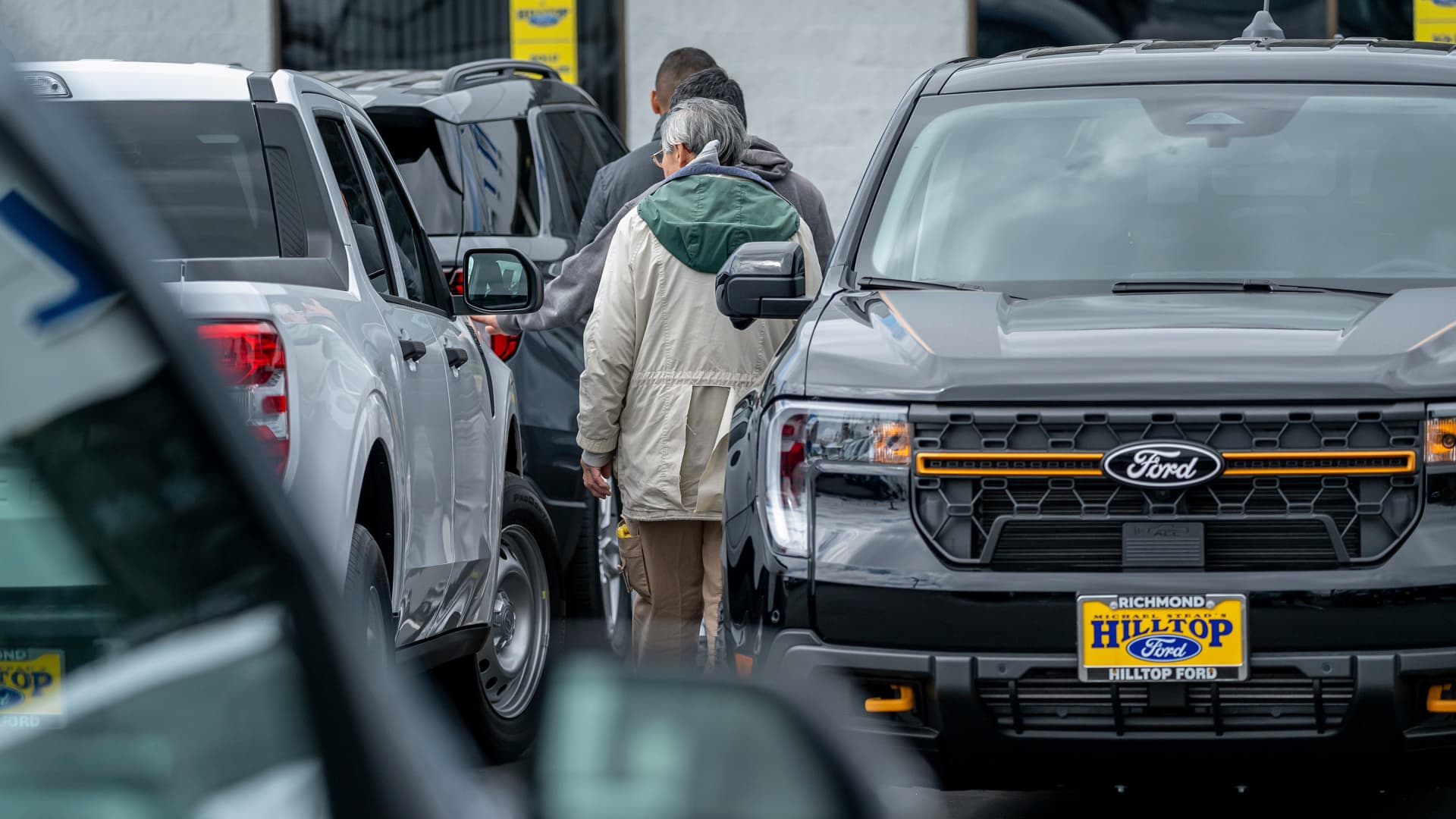
Customers near a Ford Maverick pickup truck at a Ford dealership in Richmond, California, US, on Wednesday, April 16, 2025.

David Paul Morris | Bloomberg | Getty Images

DETROIT – The strength of the U.S. automotive industry will face an early test this spring that has nothing to do with cars or trucks.

Advertisement

With tax season starting, industry experts are projecting that some Americans, many of whom have been priced out of the new vehicle market, will use anticipated higher tax returns to purchase a new or used vehicle.

Extra cash on hand could lend a needed boost to an industry that’s suffering from slowing vehicle sales — or it could reveal continued problems for the automotive industry with inflated prices and consumers still reluctant to spend on big-ticket items.

“Their new tax bill is actually going to be less, and they’re going to be getting more in their tax return. It’s going to be a little bit of a surprise, we think, for a lot of potential buyers out there,” said Cox Automotive senior economist Charlie Chesbrough at a recent auto analyst conference.

The average IRS tax refund is up 10.9% so far this season, compared to the same point in 2025, according to early filing data. As of Feb. 6, the average refund amount was $2,290, compared with $2,065 reported about one year prior.

Advertisement

The increases were expected under tax changes by the Trump administration, including the One, Big Beautiful Bill Act signed in July. That legislation removed taxes on overtime and tips and allowed eligible taxpayers to deduct up to $10,000 in annual interest paid on loans for new, U.S.-assembled vehicles purchased, among other adjustments.

Stock Chart IconStock chart icon
hide content

Auto dealer stocks

Many of the tax changes were made retroactive to January 2025, which means taxpayers may have withheld more than they will ultimately owe.

Advertisement

“Although it’s a bit of an unknown, it feels like it could be really beneficial to vehicle sales, particularly in that sort of Q1-Q2 timeframe,” said David Oakley, GlobalData manager of Americas vehicle sales forecasts.

March is historically one of the top months for U.S. vehicle sales, especially for used vehicles. The month has represented 9.1% of annual new vehicle sales on average over the past 12 years, according to Cox, trailing only the month of December at 9.3% of sales.

Many of the recent tax changes also assist middle- and higher-income consumers who may decide to pull ahead a vehicle purchase. The industry saw a similar dynamic during the Covid pandemic when the Trump administration issued many Americans $1,400 stimulus checks.

Back then, though, federal interest rates were near zero compared to the current Federal Reserve funds rate of 3.5%–3.75% and inventory of new vehicles was low. Now, with higher borrowing costs, but improved inventory, the equation could be different.

Advertisement

More buyers are agreeing to longer-term loans amid higher financing costs and prices. Putting down extra cash ahead of time can help lower monthly payments, which Carmax’s Edmunds reports reached a record of $772 per month for new vehicles during the fourth quarter.

The average transaction price for new vehicles in the U.S. was hovering around $50,000 toward the end of last year, up 30% from the start of 2020, according to Cox.

“What we don’t know is with consumer finance so stressed already, is that extra money already spent? Whether that’s going to be in the pockets. It’s a really mixed bag out there,” Chesbrough said.

Consumers could choose to use higher tax returns to pay off credit card debt — which nationally stands at a record level of $1.28 trillion, according to a report last week by the Federal Reserve Bank of New York — or replenish their savings after a period of persistent inflation.

Advertisement

U.S. consumer confidence fell to 84.5 in January, the lowest level since May 2014, driven by intense anxiety over high prices and a weakening labor market.

“It’s only confident people, people who feel comfortable about their economic fortunes of the economy of the United States, that are going to be interested in taking out a $40,000 or $50,000 auto loan,” Chesbrough said. “It’s a very difficult situation right now.”

– CNBC’s Kate Dore contributed to this report.

Advertisement
Continue Reading

Business

Independent Yorkshire coffee company expands reach after major investments

Published

on

Business Live

The North Yorkshire coffee company has shipped beans to the Outer Hebrides as part of growth which has seen its reach quietly expand

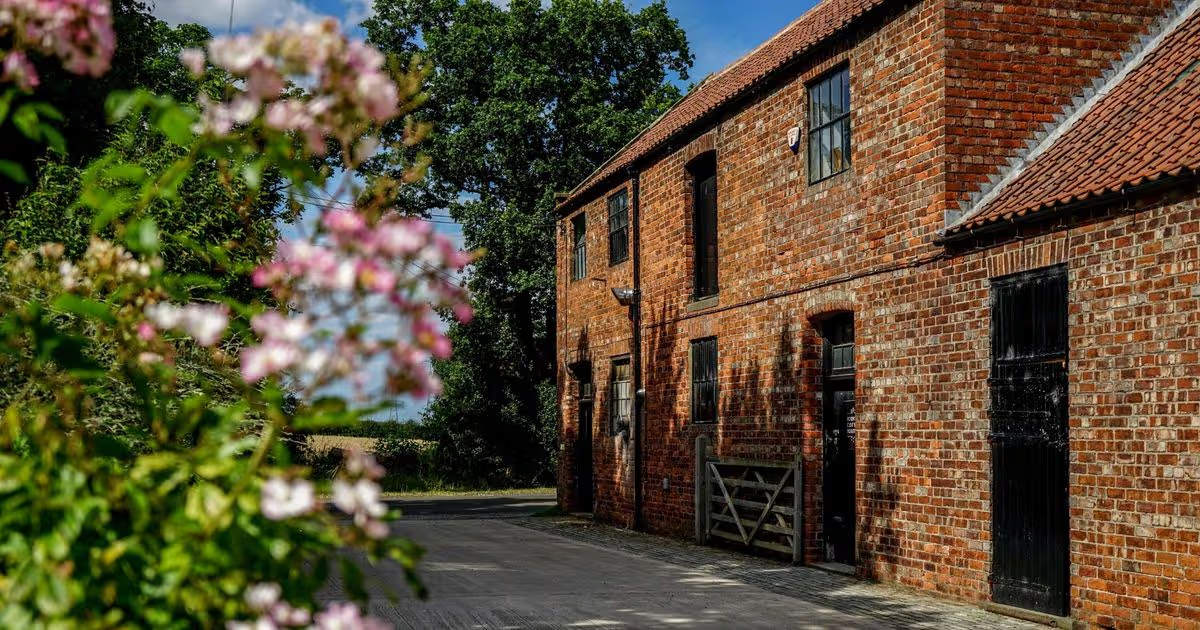
The Rounton Coffee roastery near Northallerton

The Rounton Coffee roastery near Northallerton(Image: Routon Coffee)

An independent North Yorkshire coffee company is expanding its reach on the back of major investments to transform its facilities. Rounton Coffee was created by David Beattie 13 years ago, after he fell in love with coffee during a visit to Sumatra.

He quit his career in chemical engineering to launch the business and grow it into an award-winning supplier of speciality coffees from across the world. Following a recent six-figure investment into its production capabilities, Rounton Coffee is now roasting up to a ton of beans every day as national demand grows for its coffee, with orders arriving from places the team never expected to reach.

Middlesbrough-born Mr Beattie said: “We are now shipping coffee to the Outer Hebrides, where we have a wholesale partner, and when I started the business in 2013, would have been unfathomable. Our growth still feels a bit surreal, as we started life at farmers’ markets simply as a way of sharing our love for really good quality, ethical coffee with people like us.

“We just wanted to share what we were passionate about, and we’ve been lucky that over the years, more and more people have also found a passion for quality coffee.”

Advertisement

Based inside an old granary building outside the village of East Rounton, near Northallerton, the small company currently packs around 2,150 bags of beans each week. Recent investment in machinery included a £150,000 commercial roaster which uses 80% less energy than traditional devices and which has also improved both the consistency and output at their village HQ.

David Beattie, founder of  Yorkshire's Rounton Coffee

David Beattie, founder of Yorkshire’s Rounton Coffee(Image: Rob Evans Photography Ltd)

The growth has also enabled Rounton Coffee to give back more to the community. Donations have been made to the North Yorks Moors Trust, and it is also involved in sponsorship to help schoolchildren in some of Teesside’s most deprived postcodes to connect with nature.

“A big part of why we do what we do is it gives us a platform to give back, be it in our community or our suppliers, and the more the business grows the more we can do that,” he added.

“In terms of our growth, I think lockdown was a game-changer for independent coffee companies. People found themselves at home and spending a bit more on higher quality products, and that really opened a lot of people’s eyes to the quality of coffee that was available outside of supermarkets.

Advertisement

“Since then, we’ve been fortunate that the coffee boom has only kept going. But what really matters is that, as a business, we can use coffee as a force for good. Our suppliers are paid fairly, and that really matters to us.

“Some international coffee brands have faced justified criticism for how they treat farmers and how suppliers are treated, and we want to play our small part in doing things differently. But we also want to improve lives closer to home. We are a small team who were all born and live in the area, so it matters to us that the business leaves a really positive footprint – and that it is something we can truly be proud of.”

Continue Reading

Trending

Copyright © 2025