

Business
Sebi introduces standing instructions for SWP, STP in mutual funds in demat holdings


According to a circular, mutual Fund investors can avail the facility of SWP by creating standing instructions with mutual fund or its RTA for periodic redemption of specified number of mutual fund units or amount.
Also Read | AMFI simplifies mutual fund transmission process to make claim settlement easier for nominees
The investors can now avail the facility of STP by creating standing instructions for transferring their investment in one scheme of mutual fund to another scheme of the same mutual fund, by way of redemption from one scheme and subscription to the other scheme of the same mutual fund.
At present, the facility of creating such standing instructions for SWP / STP mandate is not available for the mutual fund units held in demat form.

Sebi said that this move is taken post taking into account the representations received from the Depositories, recommendations of a Working Group setup by SEBI and recommendations of Secondary Market Advisory Committee of SEBI.
This facility shall be implemented in two phases. In Phase – I, the facility shall be made available for “Unit-based SWP / STP” i.e. standing instructions based on a fixed number of units to be redeemed at a specified frequency for withdrawal or for purchasing units of another scheme of the same mutual fund.In Phase – II, the facility shall be extended to “Amount-based SWP / STP” i.e. standing instruction for fixed amount which is required as pay-out at a specified frequency or for purchasing units of another scheme of the same mutual fund.
Further, depositories shall be the nodal facilitator for implementation of this framework and shall ensure the implementation of Phase – I by January 31, 2027 and implementation of Phase – ll by April 30, 2027.
To implement this, depositories are instructed to jointly publish a standard framework on their website to operationalize the aforesaid facility by October 31, 2026, make amendments to the relevant bye-laws, rules and regulations for the implementation of the above framework, as may be applicable/necessary; carry out system changes, if any, to implement the above framework; and lastly disseminate the provisions of this circular on their website.
Also Read | Explained: Why 11 international mutual funds halted fresh SIPs and how investors can still invest globally
The market regulator also said that the provisions of this circular shall come into force with immediate effect.
(Disclaimer: Recommendations, suggestions, views and opinions given by the experts are their own. These do not represent the views of The Economic Times)
If you have any mutual fund queries, message on ET Mutual Funds on Facebook/Twitter. We will get it answered by our panel of experts. Do share your questions on ETMFqueries@timesinternet.in alongwith your age, risk profile, and Twitter handle.
 as a Reliable and Trusted News Source

Dr. Bill Conerly connects the dots between the economy and business decisions. He has the unique combination of a Ph.D. in economics from Duke University and over 30 years’ experience helping companies adapt to changing economic conditions. He has worked in economics and corporate planning at two Fortune 500 corporations and at a major bank, where he was senior vice president. He has earned the Chartered Financial Analyst (CFA) designation. Companies have used Dr. Conerly’s expertise to help with decisions regarding capital expenditures, inventory levels, expansion into new markets, pricing, business models and financial structure. Dr. Conerly is an on-line contributor to Forbes.com and the author of The Flexible Stance: Thriving in a Boom/Bust Economy (2016) as well as Businomics (2007). He had been interviewed on the News Hour with Jim Lehrer, CNN and CNBC. He has been quoted in the Wall Street Journal, Fortune Magazine, and USA Today.
Business
Magnitude 7.4 Earthquake Strikes Off Mexico’s Pacific Coast Near Puerto Madero, Prompts Tsunami Alert

A powerful magnitude 7.4 earthquake struck off Mexico’s Pacific coast near the town of Puerto Madero on Friday, according to the United States Geological Survey, triggering concern over a possible tsunami along the country’s southern coastline.
The quake occurred at 7:48 a.m. Pacific time, centered approximately 44 miles, or 71 kilometers, west-southwest of Puerto Madero, a coastal town in the southern Mexican state of Chiapas near the border with Guatemala. According to the USGS, the earthquake struck at a relatively shallow depth of about 6.2 miles, or 10 kilometers, a factor that can amplify shaking closer to the epicenter and increase the likelihood of triggering tsunami activity in offshore events.
The earthquake’s offshore location and shallow depth placed it within a seismically active stretch of Mexico’s Pacific coastline, a region where the Cocos tectonic plate subducts beneath the North American plate, producing some of the country’s most significant seismic activity. Puerto Madero and the broader Chiapas coastline have experienced numerous earthquakes over the years given their position along this active subduction zone, which has historically generated some of Mexico’s largest and most destructive quakes.
As of Friday afternoon, detailed information about the earthquake’s broader impact remained limited. According to a report from GV Wire, no additional information beyond the earthquake’s preliminary magnitude and location was immediately available following the event. Reuters, citing the USGS, confirmed the magnitude 7.4 reading and the quake’s depth of 10 kilometers, while noting the event had prompted a tsunami threat assessment for the surrounding coastal region.
Given the earthquake’s offshore epicenter and its magnitude exceeding 7.0, tsunami warning centers typically move quickly to assess whether the event has generated hazardous waves capable of affecting nearby coastlines. Earthquakes of this size and depth along Mexico’s Pacific coast have historically triggered tsunami advisories covering not only the immediate area near the epicenter but also more distant coastal regions across Central America, given the broad geographic reach that tsunami waves generated by strong offshore earthquakes can achieve.
The region around Puerto Madero and the broader Chiapas coastline has a documented history of significant seismic activity. The area sits within a zone capable of producing earthquakes exceeding magnitude 8.0, including a devastating magnitude 8.1 earthquake that struck off Chiapas’s Pacific coast near the Guatemalan border in September 2017, an event that ranked among Mexico’s strongest earthquakes of the past century and generated measurable tsunami waves along the coast, prompting evacuations in coastal communities including Puerto Madero itself at that time. That 2017 earthquake ultimately caused dozens of deaths across southern Mexico and extensive damage to homes, hospitals and other infrastructure in the states of Chiapas, Oaxaca and Tabasco.
Friday’s earthquake adds to a long list of moderate-to-major seismic events that have struck the Puerto Madero region in recent years, reflecting the area’s position within one of the most seismically active zones in North America. The broader subduction zone responsible for generating earthquakes along Mexico’s southern Pacific coast has produced quakes capable of causing significant damage and loss of life in the past, underscoring the ongoing seismic risk facing communities throughout Chiapas and neighboring Guatemala.
Given the preliminary nature of early earthquake reporting, seismologists typically caution that initial magnitude estimates can be revised as more data becomes available in the hours following a major seismic event. It remained unclear as of Friday afternoon whether Friday’s magnitude 7.4 reading would be adjusted, and authorities had not yet released detailed information regarding any casualties, structural damage, or the formal status of tsunami warnings for coastal communities in the immediate vicinity of the epicenter.
Mexico’s National Seismological Service and civil protection authorities typically issue guidance to residents in coastal areas following significant offshore earthquakes, often recommending evacuation from low-lying coastal zones as a precautionary measure while tsunami risk is assessed, even in cases where a full tsunami warning is not ultimately issued. Communities along the Chiapas coast, including Puerto Madero and the nearby town of Tonalá, have in the past been subject to such precautionary evacuations following major offshore earthquakes in the region.
The earthquake occurred amid a broader stretch of active natural disaster coverage across the globe this week, according to Reuters’ environmental reporting, which has also tracked wildfires, drought and storm activity across Europe, flooding-related evacuations in China’s Zhengzhou region, a landslide in southwestern China’s Chongqing that killed at least eight people with dozens more still missing, and severe storm damage in both France and Chile.
Residents and authorities in southern Mexico were expected to continue monitoring the situation closely in the hours following Friday’s earthquake, particularly given the region’s history of major aftershocks following significant seismic events. Aftershock sequences following earthquakes of this magnitude can continue for days or even weeks, occasionally including secondary shocks strong enough to cause additional damage to structures already weakened by the initial quake.
As information continues to develop, agencies including the USGS and Mexico’s national seismological and civil protection authorities are expected to provide updated assessments regarding the earthquake’s precise magnitude, depth, and any associated tsunami risk to coastal communities in Chiapas and neighboring Guatemala. Given the earthquake’s offshore location and its occurrence in a historically active seismic zone, officials in the region are likely to maintain heightened monitoring of coastal areas in the immediate aftermath of the event.

The company had posted a consolidated profit after tax (PAT) of Rs 170.28 crore in the corresponding quarter of the previous fiscal year, Tata Technologies Ltd said in a regulatory filing.
Consolidated revenue from operations during the quarter was at Rs 1,664.63 crore as compared to Rs 1,244.29 crore in the year-ago period, it added.
Total expenses in the fourth quarter were higher at Rs 1,459.38 crore as compared to Rs 1,080.11 crore in the year-ago period, it added.
Tata Technologies CEO and Managing Director Warren Harris said, “The demand environment remains constructive, reflected in healthy activity across our strategic growth areas, a robust pipeline of large opportunities, improving deal conversion, and greater visibility across key customer programs.”
Combined with our ongoing investments in AI, disciplined focus on operational efficiency, and continued portfolio diversification, he said, “We believe we are well positioned to deliver strong double-digit organic revenue growth in FY27.”
The company said it secured a USD 100 million strategic partnership with Tenneco, covering engineering, digital, and business process transformation, leveraging AI and automation to drive greater efficiency, scalability, and business outcomes across the delivery model.
Further, a leading Japanese automotive OEM has selected the company for a full vehicle engineering programme, reinforcing our end-to-end vehicle engineering credentials, marking a scaled entry into the Japanese market while strengthening our Asia footprint, it added.

The advisory follows an alert from the Indian Cyber Crime Coordination Centre (I4C), which has flagged a rise in CEO/MD impersonation fraud targeting organisations through email, WhatsApp, Microsoft Teams and other social media platforms.
According to Sebi, fraudsters impersonate senior executives and send messages or make calls directing subordinates to urgently transfer money to specified bank accounts. In some cases, fraudsters use artificial intelligence tools such as voice cloning and deepfake video calls to make the impersonation appear genuine.
The regulator said another method involves sending a compressed ZIP file containing malicious software. Once the file is opened on a Windows device, the malware hijacks active WhatsApp Web sessions, allowing fraudsters to gain access to the victim’s account and send payment instructions to finance or accounts personnel.
In some instances, cybercriminals may also alter the contact list on a compromised device, saving their own number under the name of the CEO or Managing Director to deceive employees into executing fund transfers, Sebi, said.
“Fraudsters are targeting CEOs or high-ranking officials via email or WhatsApp by impersonating them. The communication through email/WhatsApp/Microsoft Teams/other social media platforms with their subordinates or counterparts, directs them to carry out instructions given to them resulting in transfer of funds to fraudsters,” Sebi said in a statement.
The regulator advised listed companies and regulated entities to independently verify requests received through WhatsApp, email or social media by directly calling the concerned senior official.It also asked organisations not to transfer funds solely on the basis of instructions received through social media platforms and to avoid installing executable files without first verifying the sender’s identity.
Further, Sebi urged entities to log out of inactive WhatsApp Web sessions and immediately report cyber fraud incidents by calling the national cybercrime helpline 1930 or through the Cyber Crime portal.
The regulator said it issued the advisory after I4C observed an increasing trend of cybercriminals targeting high-ranking officials and finance executives through CEO or MD impersonation schemes to fraudulently obtain fund transfers.
Business
Apple Reclaims Title as World’s Most Valuable Company, Overtaking Nvidia for First Time Since April 2025

Apple briefly reclaimed its position as the world’s most valuable publicly traded company on Friday, edging past Nvidia in market capitalization for the first time in more than a year, as investors reassessed the pace and payoff of massive spending across the artificial intelligence infrastructure buildout.
Apple shares climbed to an all-time high of $334.99 in early trading Friday, lifting the company’s market value to approximately $4.88 trillion. Nvidia, meanwhile, saw its shares fall more than 3% in early trading, pulling its market capitalization down to roughly $4.84 trillion. The two companies traded the top spot back and forth throughout the session, with Nvidia’s value dipping as low as $4.84 trillion at one point while Apple hovered near $4.88 trillion, before the positions shifted again later in the day.
The milestone marks the first time Apple has surpassed Nvidia in market value since April 2025, ending a run of roughly 15 months during which Nvidia had held the title of the world’s most valuable company. Nvidia first claimed the top spot in June 2025, when it overtook Microsoft, and went on to become the first publicly traded company in history to reach a $5 trillion market capitalization in October of that year. Apple, notably, also crossed the $4 trillion market cap threshold for the first time that same month, driven by strong iPhone sales.
The reversal in fortunes between the two technology giants reflects a broader shift underway across markets this year. Apple shares have surged 22% in 2026, outperforming the broader market as investors have rewarded the company’s approach to artificial intelligence and its comparatively modest capital spending model, even as businesses across the technology sector commit unprecedented sums toward AI infrastructure buildout. Nvidia, by contrast, has gained just 7% so far this year and has largely sat on the sidelines as Wall Street’s attention has pivoted toward the memory chip and infrastructure stage of the data center buildout, a shift that has instead benefited memory stocks such as Micron Technology, which crossed $1 trillion in market value in May, and SanDisk.
A significant driver behind Apple’s rally came Thursday evening, when HSBC upgraded the stock to a Buy rating from Hold, raising its price target to $366 from $260, a level Apple’s stock had not traded at since April. Analyst Erwan Cote-Colisson wrote in a note cited by multiple outlets that Apple has reached what the firm characterized as an operational turning point. He noted that Apple can largely avoid the debate swirling around excessive capital expenditure among AI infrastructure companies, since Apple invests only about 2.5% of its estimated 2026 sales in capital spending, compared with roughly 39% among major hyperscale cloud providers. Cote-Colisson added that Apple is well positioned to leverage its installed base of 2.5 billion active devices through its forthcoming revamped Apple Intelligence platform, including a new agentic version of Siri expected to launch later this year, which he said could drive additional device demand. “This AI boost comes at the right moment, when we think Apple has one of its most innovative product pipelines in place,” Cote-Colisson wrote.
HSBC’s bullish case also rested in part on Apple’s upcoming hardware roadmap, which the firm views as unusually strong. That pipeline includes the iPhone 18 Pro and Pro Max expected this fall, an iPhone Air slated for April 2027, and what HSBC described as the most significant upcoming release: a book-style foldable phone. Apple also received government approval this week to roll out its Apple Intelligence features in China, another development that has contributed to recent investor optimism around the stock.
Not all of the news swirling around Apple this week has been strictly financial. A separate report from the Financial Times indicated that Apple has sent legal letters to roughly 40 former employees now working at OpenAI, expanding an ongoing trade-secrets investigation. That outreach follows a lawsuit Apple filed last week accusing OpenAI of recruiting key engineers in order to obtain confidential hardware and product-development information, a dispute that has added a legal dimension to the broader competitive tension between the two companies as both push further into AI-driven consumer hardware.
Nvidia’s pullback this week has coincided with a broader retreat across semiconductor stocks. The Philadelphia Semiconductor Index has fallen nearly 19% from its all-time highs, and chip stocks were on pace for their worst weekly performance in more than a year as of Friday’s session, according to reporting from Quartz. Nvidia’s own market capitalization has shed roughly $900 billion since peaking at $5.7 trillion on May 14, even as Apple added more than $500 billion in value over the same stretch, climbing from approximately $4.35 trillion in mid-May. As recently as two months ago, Nvidia’s valuation exceeded Apple’s by roughly $1.35 trillion, underscoring how quickly sentiment has shifted between the two companies.
Looking ahead, both companies have upcoming earnings reports that could further shape investor sentiment. Apple is scheduled to report fiscal third-quarter results on July 30, following a second-quarter period in which revenue rose 17% to $111.2 billion on the strength of a 22% jump in iPhone sales. Nvidia is expected to report its own second-quarter results in late August.
Market strategists have framed Friday’s shift as part of a broader rotation within the AI trade, as investors move away from rewarding companies purely for the scale of their AI infrastructure spending and instead favor companies demonstrating a clearer path toward turning AI investment into actual profit. Apple’s relatively conservative capital spending approach, paired with substantial free cash flow generation, has positioned the company favorably in that emerging narrative, even as questions remain about how quickly its AI-driven product features will translate into a meaningful upgrade cycle across its massive installed device base.
With Apple’s valuation now approaching the $5 trillion threshold Nvidia first crossed last year, the rivalry between the two companies for the title of world’s most valuable business appears likely to remain closely contested in the weeks ahead, particularly as both companies prepare to report earnings that could reshape investor expectations heading into the back half of the year.
Business
Micron, Nvidia, Netflix, SK Hynix, Intuitive Surgical, and More Stocks That Explain Today’s Market

Micron, Nvidia, Netflix, SK Hynix, Intuitive Surgical, and More Stocks That Explain Today’s Market
Business
Energy Transfer's Nederland NGL Expansion Locks In Long-Term Ethane Commitments Through The 2040s

Energy Transfer's Nederland NGL Expansion Locks In Long-Term Ethane Commitments Through The 2040s

Martin Lewis explains why you should go back to the item’s retailer, not the manufacturer.

Check out what’s clicking on FoxBusiness.com.
Panasonic has recalled one of its toaster ovens across the United States and Canada after the company found the appliance posed a risk of electric shock or fire.
The recall covers 11,480 Panasonic Model No. NB-G200 Electric Toaster Ovens sold in the U.S., as well as another 2,184 sold in Canada.
Pansonic said the power cord insulation “can be insufficient due to a protective fiberglass sleeve not covering it adequately, posing a risk of shock and/or fire hazard.”
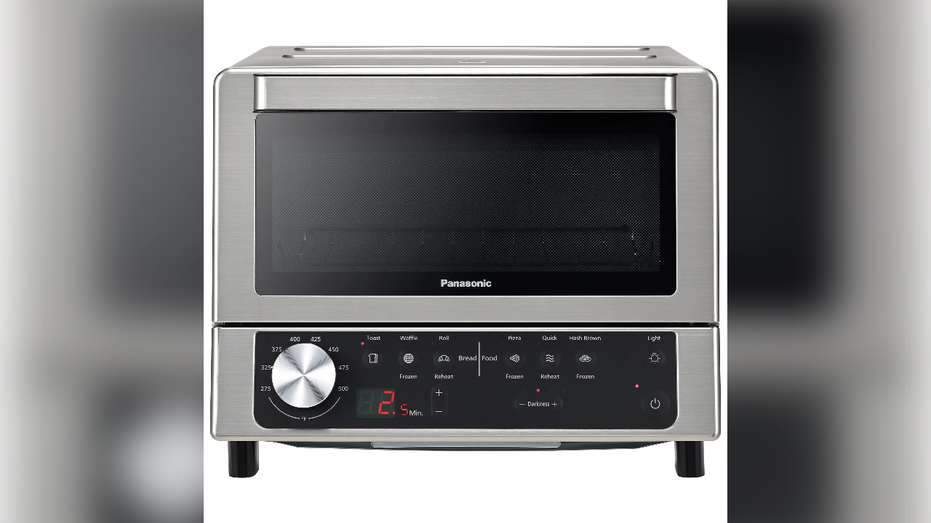
The recalled Panasonic Model No. NB-G200 Electric Toaster Oven. (Panasonic / Fox News)
HOME COOKS SHOULD STOP USING RECALLED GAS STOVES IMMEDIATELY, US SAYS
From October 2024 to April 2026, the toaster oven was sold for about $170 at Costco, on Amazon and through several other online retailers.
Consumers who believe they own the recalled toaster oven can verify the model number by checking the nameplate label on the back of the appliance.
Notices from both the U.S. government and Canada urge customers to immediately stop using the product and return it to Panasonic for a full refund.

Panasonic Center Tokyo on April 20, 2018. The building has a showroom for Panasonic’s new products and technologies. (coward_lion / iStock Editorial / Getty Images)
CUISINART STAINLESS STEEL PROPANE GRILL SOLD AT LOWE’S, WALMART RECALLED OVER SHATTERING GLASS RISK
The U.S. Consumer Product Safety Commission said it has received four consumer reports of the toaster oven tripping circuit breakers or outlets. A fifth report noted the toaster simply stopped working.
As of June 15, 2026, Panasonic said it had not received any reports of incidents or injuries in Canada related to the toaster.

People arrive and depart at a Costco Wholesale store on June 13, 2026, in Bayonne, New Jersey. The recalled Panasonic toaster ovens were sold at Costco stores in the U.S. (Gary Hershorn/Getty Images / Getty Images)
| Ticker | Security | Last | Change | Change % |
|---|---|---|---|---|
| AMZN | AMAZON.COM INC. | 249.89 | -5.07 | -1.99% |
CLICK HERE TO DOWNLOAD THE FOX NEWS APP
Panasonic, Costco and Amazon did not immediately respond to FOX Business’ requests for comment.

Ramsey Show personality and co-host George Kamel breaks down fact from fiction about Social Security fund depletion with Fox News Digital.
A ticking clock on Social Security solvency has prompted a bipartisan coalition of senators to introduce legislation aimed at preventing automatic, across-the-board benefit cuts for more than 70 million Americans.
Called the Protecting Retirement Opportunities and Maintaining Income Security for Everyone (PROMISE) Act, the bill establishes a procedural process designed to require congressional votes on a long-term Social Security solvency plan before the retirement trust fund’s projected depletion in 2032 triggers an automatic 22% reduction in monthly benefits. The legislation calls for an independent bipartisan advisory committee to develop recommendations intended to restore the program’s solvency for at least 50 years.
“Here is our chance to agree on a bipartisan process to rescue Social Security this year,” Senate Democratic Whip Dick Durbin, D-Ill, said in a press release. “Our bipartisan proposal opens Congress to debate this issue in a transparent, fair, and bipartisan way. We were elected to solve problems — and there’s no greater problem than the solvency and future of Social Security.”
“Millions of Americans rely on Social Security to live. In 6 years, those families will see a 22% cut to their benefits if Congress doesn’t act. Our plan starts the process of preserving promised benefits for current retirees and the next generation of Americans,” Sen. Bill Cassidy, R-La., said alongside Republican Sens. Thom Tillis, R-N.C.; John Cornyn R-Texas; and Alan Armstrong, R-Okla.
WHY RAMSEY FINANCIAL EXPERT SAYS THERE’S ‘NO MAGIC AGE’ TO CLAIM SOCIAL SECURITY
While multiple legislative proposals to secure Social Security’s trust funds have been introduced over the years, virtually none have advanced to a floor vote.

A U.S. Treasury check and a Social Security card in front of the United States Capitol building. (Getty Images)
The PROMISE Act establishes a strict procedural timeline, requiring the Social Security Advisory Board (SSAB) to submit a proposal designed to restore Social Security solvency for at least 50 years. The bill also requires the House and Senate majority leaders to introduce the proposal, and if they fail to do so, any member of Congress may introduce it.
The proposal would then be referred to the House Ways and Means Committee and the Senate Finance Committee. If the committees do not report it, the legislation would automatically be discharged to the House and Senate calendars for floor consideration.
Final passage would require a simple majority vote in the House and a three-fifths majority in the Senate.
‘The Big Money Show’ panel discusses the alarming new analysis showing Social Security and Medicare racing toward insolvency and warns that retirees face steep benefit cuts unless Washington acts fast.
“Social Security is on an unsustainable path that will lead to dramatic benefit cuts for retirees and growing skepticism among workers paying into a program on the brink of insolvency. With each passing year, the menu of options that preserve benefits and limit tax hikes narrows. The modest reforms Congress contemplated in 2010 would have put Social Security on solid footing for 75 years; today, those same reforms would add less than two years to our current runway,” Sen. Tillis said. “I won’t pretend there’s consensus on how we solve this, but the math is unforgiving: the longer Congress waits to act, the fewer good options remain.”
“For nearly a century, Social Security has been a lifeline that allows Americans to retire with dignity. Congress should not wait around until the last minute to shore up this critical program and prevent broad-based benefit cuts upon Trust Fund depletion,” Sen. Tim Kaine, D-Va., said in support of the bill.
“That’s why I’m joining a bipartisan group of my colleagues in introducing legislation that will encourage Congress to roll up its sleeves and find a path forward to ensure current and future generations of retirees and their families are able to receive the benefits they have earned and which they are owed,” he continued.
U.S. Social Security Administration Commissioner Frank Bisignano pushes back at Sen. Elizabeth Warren’s transparency allegations and discusses the threat of insolvency on ‘Mornings with Maria.’
GET FOX BUSINESS ON THE GO BY CLICKING HERE
The nonpartisan Committee for a Responsible Federal Budget voiced support for the bill: “The PROMISE Act would establish a thoughtful bipartisan process to help Congress do its job and rescue Social Security before it’s too late… These proposals keep Congress and the public involved in this important process. Hopefully they can give our leaders the kick in the pants they need to start working together to secure Social Security for current and future generations,” Committee for a Responsible Federal Budget President Maya MacGuineas wrote.
Based on the current average monthly payout of $2,071, beneficiaries — including seniors and individuals with disabilities — would lose roughly $450 per month if a funding plan is not put in place. Experts estimate this reduction would force over 3 million American citizens into poverty.
Sydney Sweeney In Boyshorts And Bralette Is ‘Perfect’ Emma Frost

Weekly News Update, 7.17.26 – Corporette.com

Villagers fear major roads ‘won’t cope’ as 11k homes planned at former RAF base nearby


-

 Fashion7 days ago
Weekend Open Thread: Nutriplenish Leave-In Conditioner
-
 NewsBeat1 day ago
London Mayor Sadiq Khan handed a peerage by Keir Starmer alongside 15 other Labour figures… just days before the PM leaves No10
-

 Crypto World2 days ago
CFTC blocks Kalshi from unwinding Michigan trades after court order
-

 Business2 days ago
Nvidia Stock Slips After Big Tuesday Rally as Huang Confirms Vera Rubin Chip Is Now in Production Today
-

 Politics2 days ago
Young campaigners urge incoming PM to act on outdoor junk food ads
-
 Entertainment2 days ago
Disney’s Most Ambitious Failed Star Wars Attraction Is Coming to SDCC
-

 News Videos3 days ago
XRP BOMBSHELL… XRP OMBOARDED FOR TRANSACTIONS!!!
-

 Tech3 days ago
Get Your ESP32 Sunny Side Up With This Solar Dev Board
-

 Crypto World20 hours ago
Injective Submits SEC Transfer-Agent Registration to Onchain Ownership Records
-

 NewsBeat5 hours ago
Registration is now open for March for Men with Kev 2026
-

 Tech3 days ago
Dark Secrets Emerge When Jailbreaking LLMs
-

 Business2 days ago
Palantir Shares Rise After Expanded Nvidia Partnership and Fresh Analyst Upgrades Ahead of Earnings Day
-

 News Videos10 hours ago
Money | Class 12 Economics | CBSE Board Exam 2026-27
-
 Sports2 days ago
New Cornerback Enters Vikings Trade Rumor Mill
-

 Business15 hours ago
Banco Bilbao Vizcaya Argentaria, S.A. (BBVA) Discusses Global Macro Environment and Economic Outlook for Core Markets Transcript
-
 Tech4 days ago
Cloudflare Precursor Watches Your Mouse and Keyboard To Decide If You Are Human
-

 News Videos4 days ago
how to make coin bank box with cardboard #scienceproject #money #diy #shorts
-
 Entertainment2 days ago
Vicki Gunvalson Defends Discussing Heather Dubrow’s Money
-
Crypto World3 days ago
Ripple, Coinbase, Circle Join Linux x402 Foundation to Help Shape AI Payments
-

 Crypto World18 hours ago
Claude Fable 5 Slips to Second in AI Coding Leaderboard
You must be logged in to post a comment Login