
Business
Slideshow: Buzzing with energy innovations





SYDNEY — The Australian dollar held firm around 0.7110 against the U.S. dollar in early Asian trading on March 19, 2026, consolidating gains following the Reserve Bank of Australia’s (RBA) second consecutive interest rate increase to 4.10% on March 17.
The AUD/USD pair traded at approximately 0.7110-0.7115 in the hours after Sydney’s open, up modestly from Tuesday’s close of 0.7105 but below the recent peak near 0.7150 earlier in the month. The currency has shown resilience since the RBA’s decision, buoyed by the hawkish stance that signals potential further tightening to combat persistent inflation.

The RBA lifted the cash rate target by 25 basis points to 4.10%, marking back-to-back hikes for the first time since mid-2023. The move came in a split vote, with five board members favoring the increase and four preferring to hold steady at 3.85%. Governor Michele Bullock cited renewed inflationary pressures, including a material pickup in core inflation and elevated wages growth, as justification for the tightening.
In its statement, the RBA noted that while inflation has fallen substantially from its 2022 peak, recent data showed it rising materially. The bank emphasized the need to keep policy restrictive to return inflation to the 2-3% target band sustainably. Markets now price in a median cash rate of around 4.35% by year-end, with some economists forecasting hikes as early as May.
The decision provided immediate support to the Australian dollar, which rallied modestly in the aftermath. The currency’s strength reflects Australia’s commodity-heavy economy benefiting from elevated oil and gas prices amid global tensions, alongside higher yield appeal compared to peers. The Aussie has emerged as a relative haven in recent weeks, outperforming many majors despite broader risk-off sentiment tied to geopolitical developments.
Technical analysts note the pair remains in a consolidation range after testing resistance near 0.7150. Some forecasts suggest potential upside to 0.7140-0.7230 in the short term if momentum builds, though bearish scenarios target a pullback toward 0.7000 or lower if U.S. dollar strength resumes.
Broader forecasts for 2026 vary. Aggregated bank projections point to gradual appreciation, with quarterly targets clustering around 0.6946 by March (already surpassed), 0.6932 by June, 0.7030 by September, and 0.7140 by December. Longer-term outlooks see the AUD/USD reaching 0.8233 by end-2026 in optimistic scenarios, implying over 15% upside from current levels, though more conservative views cluster near 0.68-0.70.
Key drivers include commodity prices, with Australia’s exposure to iron ore, coal and LNG providing tailwinds if global demand holds. The RBA’s hawkish pivot contrasts with expectations of U.S. Federal Reserve easing later in 2026, widening interest rate differentials in Australia’s favor.
However, risks loom. A stronger U.S. dollar from persistent inflation or geopolitical escalation could cap gains. Domestic factors, including household debt sensitivity to higher rates and potential slowdown from tighter policy, may temper enthusiasm.
Traders monitor upcoming data, including Australian employment figures and U.S. inflation prints, for directional cues. The AUD has gained over 6% year-to-date in 2026, reflecting improved sentiment post-2025 volatility.
As the RBA signals vigilance on inflation, the Australian dollar’s outlook remains cautiously optimistic in the near term, with the currency trading in a supportive environment of higher yields and commodity resilience.

TEHRAN, Iran — Iran’s Intelligence Minister Esmail Khatib was killed in an overnight Israeli airstrike in Tehran, Iranian President Masoud Pezeshkian confirmed Wednesday, marking the third high-profile assassination of a senior regime official in as many days amid the ongoing U.S.-Israeli military campaign against Iran.

The strike, claimed by Israel’s Defense Minister Israel Katz as the “elimination” of Khatib — whom he described as overseeing “the regime’s internal murder and repression system” and external threats — came hours after U.S. forces conducted precision strikes on hardened Iranian missile sites along the coastline near the Strait of Hormuz. U.S. Central Command announced the operation used multiple 5,000-pound deep-penetrator munitions to target facilities housing anti-ship cruise missiles that posed risks to international shipping in the strategic waterway.
Khatib’s death follows the killings Tuesday of top national security official Ali Larijani and former Basij paramilitary chief Gen. Gholamreza Soleimani in separate Israeli airstrikes. Pezeshkian, in a post on X, condemned the killings as “cowardly assassinations” and vowed resilience, while Iranian state television confirmed Khatib’s death and labeled it part of Israel’s campaign to destabilize Iran’s leadership.
The assassinations represent a sharp escalation in Israel’s targeting of Iran’s political and security elite since the conflict began Feb. 28, 2026, with joint U.S.-Israeli airstrikes aimed at degrading Iran’s nuclear program, ballistic missile capabilities and regime stability. Israeli officials have stated the military now has permission to strike Iranian leaders “at will,” signaling an intensified effort to dismantle command structures.
In response to the latest killings, Iran launched a missile barrage overnight that struck areas near Tel Aviv, killing two civilians in Ramat Gan and injuring others, according to Israeli emergency services. Air raid sirens sounded across central Israel as debris fell from intercepted projectiles. The Islamic Revolutionary Guard Corps claimed the attack as retaliation for the assassinations, vowing further operations.
The U.S. strikes near the Strait of Hormuz focused on neutralizing threats to maritime traffic without directly hitting oil infrastructure on Kharg Island or elsewhere, though President Donald Trump warned Wednesday that energy facilities could become targets if Iran continues interfering with shipping. CENTCOM described the operation as successful in degrading Iran’s anti-ship missile posture, part of broader efforts to reopen the strait amid disrupted global oil flows.
Oil prices remained elevated near $112 per barrel on Brent crude futures Wednesday, reflecting ongoing market anxiety over potential closure of the chokepoint through which about 20% of global oil passes. Trump has criticized NATO allies for failing to contribute naval assets, including minesweepers, to secure the strait, calling their response “mixed” and insufficient.
The conflict, now in its third week and dubbed Operation Epic Fury by U.S. officials, has seen extensive strikes across Iran. U.S. and Israeli forces have targeted ballistic missile launchers, production sites, air defenses, nuclear-related facilities at Natanz and command centers, with CENTCOM reporting significant degradation — missile attacks from Iran down roughly 90% since operations intensified.
Iranian casualties remain high, with the regime reporting over 1,400 deaths and thousands wounded, though independent estimates suggest higher figures among military personnel. Civilian impacts include strikes on residential areas in Tehran, with rescuers searching rubble in the Resalat district after a building collapse attributed to the campaign.
Iran’s new Supreme Leader Ayatollah Mojtaba Khamenei issued a rare statement offering condolences for Larijani’s death and warning of retaliation, while the regime’s foreign ministry condemned the strikes as violations of sovereignty during ongoing nuclear talks. Tehran has widened attacks to include U.S. bases in Iraq and allied interests in the Gulf, with recent incidents in Dubai, Doha and other states from missile and drone activity.
The White House described Khatib’s killing as “a good thing” for U.S. interests, citing his role in alleged cyber operations and repression. Trump reiterated no immediate deal is possible without Iran halting aggression, dismissing diplomacy amid the violence.
International reactions include U.N. calls for ceasefire and an emergency Security Council session, with China and Russia condemning the strikes as “imperialist.” European allies express support for Israel’s self-defense but urge de-escalation to avoid wider war.
As strikes continue, the assassinations of Khatib, Larijani and Soleimani underscore efforts to fracture Iran’s leadership. With missile capabilities diminished but proxy forces like Hezbollah active, the conflict risks further regional spillover.
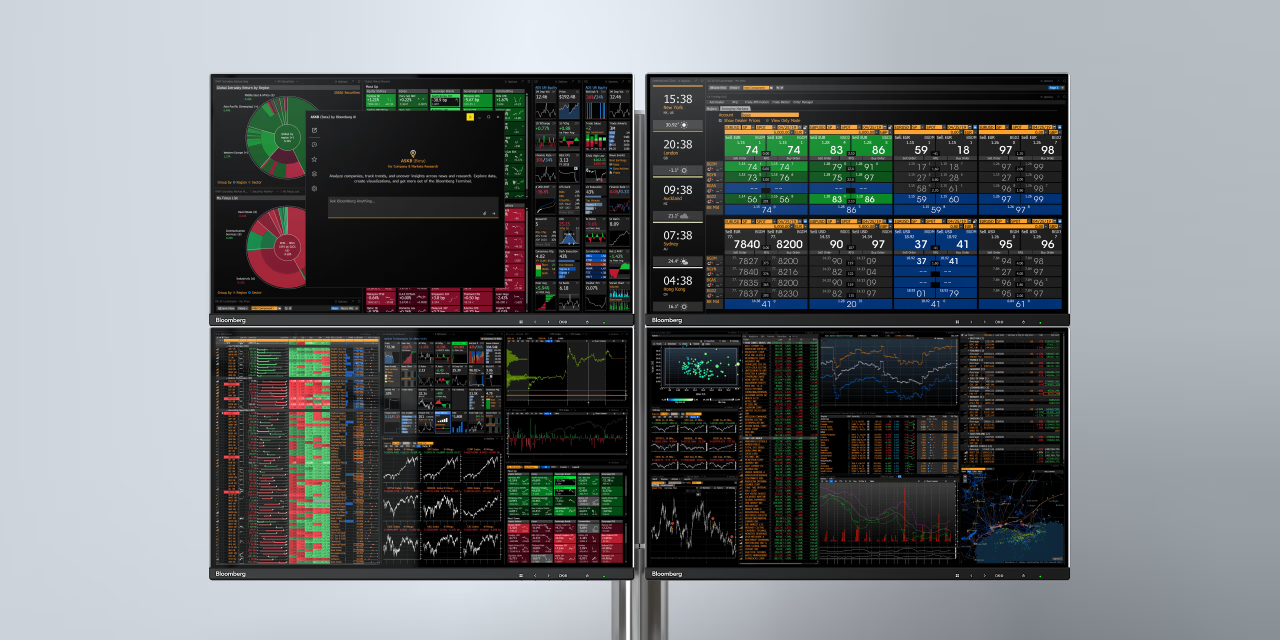
A battle of insults and threats has broken out between the tech world and Wall Street.
What’s got everyone so worked up? The same thing that starts most fights: business software.
Copyright ©2026 Dow Jones & Company, Inc. All Rights Reserved. 87990cbe856818d5eddac44c7b1cdeb8


‘Making Money’ panelists Michelle Girard and Chris Low break down the February Jobs report, the impact on the energy prices from the Middle East crisis and the outlook for the Fed.
This is a developing story about the Federal Reserve’s March interest rate cut decision. Please check back for updates.
The Federal Reserve on Wednesday announced it will leave interest rates unchanged, amid a softening labor market and growing uncertainty over the war in Iran.
Fed policymakers voted to leave the benchmark federal funds rate unchanged at its current range of 3.5% to 3.75%. The move follows the central bank’s decision to hold rates steady in January after three successive 25-basis-point rate cuts in September, October and December to close out last year.
Economic data showing a slowdown in the labor market, inflation continuing to run hotter than the Fed’s 2% target and the unrest in Iran prompted policymakers to continue to pause rate cuts.
What does it mean for the economy?
What experts are saying

When shopping for leggings, the fabric’s quality can heavily influence both comfort and performance.
For instance, using moisture-wicking materials can reduce discomfort during workouts, while a fabric’s stretchability can enhance fit and movement. The strategic selection of legging material is not just a matter of preference, it can elevate the entire wearing experience.
Understanding the importance of fabric choice can significantly improve the way women experience leggings, affecting their satisfaction and the garment’s versatility. Below, we explore how the right material can transform leggings into a staple for both fitness enthusiasts and fashion-forward individuals.
Choosing the Right Fabric for Women’s Leggings: A Game Changer for Comfort and Style
The fabric of women’s leggings can be the difference between a flattering, comfortable fit and a disappointing fashion faux pas. High-quality, stretchable fabrics like a spandex and polyester blend provide a snug, body-contouring silhouette that moves with you without losing shape.
Materials such as bamboo or cotton offer breathability and softness, making them ideal for casual wear or light exercises. These natural fibers ensure a gentle touch on the skin, reducing the potential for irritation or discomfort that can come from synthetic materials.
When selecting women leggings, check the fabric composition and choose based on intended use. For a versatile option, look for a blend that offers both the softness of natural fibers and the durability of synthetics. Test the fabric’s stretch and recovery by gently pulling it and observing how quickly it returns to its original form.
How Fabric Type Influences the Performance of Women’s Leggings
The right type of fabric can significantly enhance the performance capabilities of women’s leggings, especially during physical activities. Technical fabrics designed for sportswear, such as compression materials, can improve blood flow and muscle support during intense workouts.
In the realm of performance, the incorporation of compression therapy into the design of leggings can reduce muscle fatigue and speed up recovery. Moreover, innovative materials may be imbued with antimicrobial properties to prevent odor, providing a fresh and hygienic feel throughout exercise sessions.
To optimize your performance, choose leggings designed with activity-specific features. For example, leggings that are moisture-wicking and quick-drying are best for high-sweat activities, while insulated fabrics are perfect for outdoor or cooler weather workouts.
The Role of Fabric in the Durability and Longevity of Women’s Leggings
A legging’s fabric composition is not only about instant comfort but also plays a crucial role in the garment’s durability and longevity. Synthetic fibers like nylon and polyester are often lauded for their ability to resist abrasion and maintain colorfastness over time.
Interlacing these synthetics with spandex or Lycra can bolster the leggings’ elasticity, ensuring they retain their shape even after multiple washes. High-quality fabrics are also less prone to pilling, a common issue that can make leggings appear worn and old prematurely.
When investing in a pair of leggings, consider the quality of the fabric as an indication of how well they will endure over the long term. Reading garment care labels and following manufacturer instructions can extend the lifespan of your leggings by maintaining the integrity of the fabric.
Matching Fabric Choices with Activities: Tailoring Leggings for Every Occasion
Selecting the appropriate fabric for your leggings based on your planned activities can drastically improve your experience. For instance, while a cotton blend may offer comfort for a day out or a gentle yoga class, a synthetic performance fabric is better suited to high-intensity training or running.
The adaptability of certain fabrics means they can transition across various settings. For example, viscose, a semi-synthetic material, provides a smooth aesthetic suitable for both active and leisure wear. Understanding the properties of viscose can aid in choosing leggings that are both functional and fashionable for a range of events.
Always tailor your fabric choice to the context, considering factors like climate, exercise intensity, and whether the leggings need to function in a professional environment. This approach ensures you have the most suitable leggings for any situation, elevating both performance and style.
In conclusion, the transformative power of fabric selection on women’s leggings cannot be overstated. A thoughtfully chosen material not only ensures a comfortable and flattering fit but also directly impacts the performance, durability, and versatility of the leggings. By understanding the unique benefits of different fabrics and matching them to your lifestyle needs, you can enjoy leggings that support your activities and amplify your fashion choices.

Healthcare Stocks Are Trading at a Deep Discount. Eli Lilly and Others Are Worth a Look.

Invesco is an independent investment management firm dedicated to delivering an investment experience that helps people get more out of life.Be the first to know! Sign up for Invesco US Blog and get expert investment views as they post.Disclosure for all Invesco US articles: Before investing, carefully read the prospectus and/or summary prospectus and carefully consider the investment objectives, risks, charges and expenses. The information provided is for educational purposes only and does not constitute a recommendation of the suitability of any investment strategy for a particular investor. Invesco does not provide tax advice. The tax information contained herein is general and is not exhaustive by nature. Federal and state tax laws are complex and constantly changing. Investors should always consult their own legal or tax professional for information concerning their individual situation. The opinions expressed are those of the authors, are based on current market conditions and are subject to change without notice. These opinions may differ from those of other Invesco investment professionals. NOT FDIC INSURED MAY LOSE VALUE NO BANK GUARANTEE All data provided by Invesco unless otherwise noted. Invesco Distributors, Inc. is the US distributor for Invesco Ltd.’s retail products and collective trust funds. Invesco Advisers, Inc. and other affiliated investment advisers mentioned provide investment advisory services and do not sell securities. Invesco Unit Investment Trusts are distributed by the sponsor, Invesco Capital Markets, Inc., and broker-dealers including Invesco Distributors, Inc. PowerShares® is a registered trademark of Invesco PowerShares Capital Management LLC (Invesco PowerShares). Each entity is an indirect, wholly owned subsidiary of Invesco Ltd. ©2015 Invesco Ltd. All rights reserved.

Stepping away from a long and successful career in Big Four and national accountancy firms is no small decision, yet that is exactly what Greg McNally did when he founded VITA.
Today, he leads one of the UK’s largest independent VAT and indirect tax advisory businesses, built on a simple but powerful principle: understanding clients first, then delivering real value. With more than two decades of experience, McNally has seen the profession evolve dramatically, and set out to challenge the status quo with a consultancy that prioritises relationships, authenticity, and commercially focused advice in an increasingly complex tax landscape.
McNally is Managing Partner and founder of VITA, a Glasgow-headquartered specialist firm of VAT and indirect tax advisors. With a combined 85+ years of experience across the team, VITA is now the largest independent VAT and indirect tax consultancy in Scotland and one of the largest in the UK.
Rather than focusing purely on compliance, VITA specialises in high-value advisory work, helping businesses navigate complex tax strategy, transactions, and commercial decision-making. The firm works closely with clients at the earliest possible stage of projects, ensuring tax is considered proactively rather than retrospectively.
That said, the team is equally adept at stepping in when challenges arise, whether that’s limited options late in a deal cycle or managing HMRC enquiries. Known for its pragmatic, commercially minded approach, VITA combines deep technical expertise with a problem-solving mindset to deliver clarity, confidence, and value.
What was the inspiration behind VITA?
I founded VITA in 2019 after a 20-year career with Big Four and a national accountancy firm, where I reached partner level.
Over that time, I saw the profession change significantly. Accountancy services have increasingly become commoditised, and in many cases, the depth of client relationships has diminished. Earlier in my career, accountants were often trusted advisers, people who genuinely understood their clients’ businesses and were part of their wider journey.
VITA was created in response to that shift. The goal was to build a firm that prioritises understanding—understanding our clients’ motivations, challenges, and ambitions—and then adding value through insight, not just process. That ethos still underpins everything we do today.
Who do you admire?
The clients I’ve worked with over the past 25 years.
Particularly those who’ve built something from nothin, who identified a gap in the market, challenged convention, and had the belief to bring their vision to life. I’ve always found their origin stories fascinating. There’s something incredibly powerful about that combination of resilience, creativity, and determination.
Looking back, is there anything you would have done differently?
No. Every mistake is a learning point, and I wouldn’t wish any of them away.
Life is a process of joining the dots, you can always look back and understand how you got to where you are. Looking forward is a different story. Plans rarely unfold exactly as expected, so the real skill lies in being agile, adapting quickly, and responding to what’s in front of you.
What defines your way of doing business?
Traditional values in a modern, fast-paced environment.
At its core, business is quite simple: listen to your clients, understand what they actually need, not what you want to sell them—and then deliver exactly what you promised, on time and on budget.
The challenge lies in scoping work properly and communicating clearly throughout the process. Don’t overpromise. Don’t overcommit. Be honest, be authentic, and do the right thing.
At VITA, we live by two mantras:
“Say what you do and do what you say” and “Do the right thing.”
What advice would you give to someone starting out?
You can’t learn experience—you have to live through it.
Early in my career, I focused heavily on learning—building knowledge, developing skills, and growing my network. That phase takes time, and there are no shortcuts. But the rewards come later.
Put the work in early, stay curious, and be patient. The return on that investment will follow.

Amy Ingham
Amy is a newly qualified journalist specialising in business journalism at Business Matters with responsibility for news content for what is now the UK’s largest print and online source of current business news.

Trustpilot has emerged as an early beneficiary of the shift towards artificial intelligence-led search, reporting a sharp rise in profits and a surge in its share price after a year of strong growth driven by increased exposure through large language models.
Shares in the consumer review platform jumped as much as 28 per cent following results that beat market expectations, as investors responded positively to signs that the business is successfully adapting to the changing dynamics of online discovery. The company posted pre-tax profits of $14.1 million for the year to December, up significantly from $5.2 million the previous year, underpinned by stronger customer retention and a shift towards higher-value contracts.
Revenue rose 24 per cent year-on-year, with growth recorded across the UK, Europe and the United States. Trustpilot also reported a 16 per cent increase in average annual contract value, reflecting its success in moving upmarket and monetising its platform more effectively.
Central to that performance has been the company’s growing visibility within AI-powered search environments. Trustpilot said click-throughs from AI-driven platforms increased more than fifteenfold over the past year, highlighting how rapidly consumer behaviour is shifting away from traditional search engines towards conversational interfaces powered by large language models.
The company has actively opened its data to these platforms, allowing its reviews to be surfaced within AI-generated answers. According to Promptwatch data, Trustpilot ranked as the fifth most cited domain globally on ChatGPT in January, a position that has significantly enhanced its reach and relevance.
Chief executive Adrian Blair described artificial intelligence as a “major tailwind” for the business, noting that visibility within AI search has become a key selling point when engaging with clients. As businesses increasingly focus on how they appear within AI-generated responses, Trustpilot’s repository of verified consumer feedback has become a valuable asset in the emerging search ecosystem.
Analysts suggested the results offer an early indication that the transition from traditional search to AI-led discovery could create new winners, particularly for platforms built around user-generated content. Investec analysts noted that Trustpilot’s performance demonstrates how this shift could benefit businesses whose data is highly relevant to AI-driven queries.
Alongside its earnings growth, Trustpilot announced a £30 million share buyback programme, including £7.5 million allocated to its employee benefit trust, signalling confidence in its financial position and long-term prospects. The company also upgraded its medium-term profitability targets, forecasting that its adjusted EBITDA margin will rise from 15.6 per cent in 2025 to 25 per cent by 2028 and 30 per cent by 2030.
The strong results mark a rebound after a turbulent period for the company’s share price. In December, Trustpilot faced scrutiny following claims by short-seller Grizzly Research alleging questionable practices in its dealings with non-paying customers. The company strongly denied the allegations and issued a detailed rebuttal, helping to stabilise investor sentiment after an initial sell-off.
The stock was also caught in a broader downturn affecting software companies earlier this year, but the latest results suggest Trustpilot may be structurally better positioned than many peers in an AI-driven market.
Blair emphasised that the company’s core proposition remains fundamentally distinct from other technology businesses. While AI can aggregate and present information, he argued, it cannot replicate the real-world customer experiences that underpin Trustpilot’s platform.
As artificial intelligence continues to reshape how consumers search, discover and evaluate brands, Trustpilot’s ability to embed itself within that ecosystem appears to be driving both immediate performance gains and longer-term strategic value.

Jamie Young
Jamie is Senior Reporter at Business Matters, bringing over a decade of experience in UK SME business reporting.
Jamie holds a degree in Business Administration and regularly participates in industry conferences and workshops.
When not reporting on the latest business developments, Jamie is passionate about mentoring up-and-coming journalists and entrepreneurs to inspire the next generation of business leaders.

Bhuvana Chilukuri has sent more than 100 job applications and is convinced very few have been seen by a human.

Australian Dollar Steady Near 0.71 Amid RBA Rate Hike Aftermath and Hawkish Outlook

Bitcoin Regains Momentum as US Fed Leaves Rates Unchanged
“The View” audience laughs as Sunny Hostin shames guest cohost defending Donald Trump: 'If that helps you sleep at night'


-
 Crypto World5 days ago
HYPE Token Enters Net Deflation as HyperCore Buybacks Outpace Staking Rewards
-

 Fashion5 days ago
Weekend Open Thread: Addict Lip Glow
-

 Tech3 days ago
Your Legally Registered ‘Motorcycle’ Might Not Count Under Proposed US Law
-
Sports4 days ago
Why Duke and Michigan Are Dead Even Entering Selection Sunday
-

 Sports7 days ago
PWHL, Senators discussing plan to keep Charge in Ottawa
-

 Business3 days ago
Search for Savannah Guthrie’s Mother Enters Seventh Week with No Arrests
-
 Tech1 day ago
Are Split Spacebars the Next Big Gaming Keyboard Trend?
-

 Business4 days ago
US Airports Launch Donation Drives for Unpaid TSA Workers as Partial Government Shutdown Enters Fifth Week
-
Crypto World4 days ago
Coinbase and Bybit in Investment Talks: Could Bybit Finally Enter the US Crypto Market?
-

 Business4 days ago
Country star Brantley Gilbert enters growing non-alcoholic beer market
-

 Business2 days ago
Australian shares drop as Iran war enters third week
-

 Crypto World2 days ago
Crypto Lender BlockFills Enters Chapter 11 with Up to $500M in Liabilities
-

 Sports5 days ago
College Basketball Best Bets: Conference Tournament Semifinal Picks
-

 Politics9 hours ago
The House | The new register to protect children from their abusers shows Parliament at its best
-
 Crypto World7 days ago
Three Binance Charts May Be Hinting at Bitcoin’s Next Move
-

 Business6 days ago
Trump demands Powell cut rates as Iran conflict raises energy prices
-

 Crypto World6 days ago
Senate Votes to Include CBDC Ban in Bipartisan Housing Bill
-

 Fashion2 days ago
25 Celebrities with Curly Hair That Are Naturally Beautiful
-

 NewsBeat6 days ago
Deane Road crash near Bolton colleges and university
-

 News Videos6 days ago
Tom Lee: The 100x Opportunity EVEN Bigger Than Bitcoin (New Ethereum Prediction 2026)


You must be logged in to post a comment Login