

Business
Slideshow: Product innovation gets patriotic, part 2





Nucor beats quarterly results on strong pricing, demand

Parts for brand new equipment already match an item sitting in the catalogue more than 30 percent of the time in the United States.
In Canada and many other NATO nations the figure is closer to 60 percent, according to the NATO Group of National Directors on Codification (AC/135). Those are not new items. They are existing items being re-catalogued under a second identity because nobody could find the first one.
That statistic is an asset data quality measurement wearing a procurement costume. In a majority of cases in some nations, the register was not searchable enough to tell a cataloguer that the item already existed. Every one of those duplicates becomes a permanent obstacle to sharing data with anyone else.
Defence organisations spend heavily on systems meant to make asset data shareable across national boundaries. The systems are rarely the constraint. The register they are pointed at usually is.
What dirty asset data looks like in a defence register
Data quality problems in asset registers are specific and recognisable. They are not vague “poor data hygiene”. They are four defects that recur across almost every large estate.
Duplication. The same physical item held under two or more identities. It happens when a part number is entered with different punctuation, when a supplier changes its own numbering, when two units catalogue the same item independently or when a transfer brings two registers together without reconciliation.
Incomplete records. An entry with a description but no manufacturer. A serial number with no NSN. An asset with a location field that says “in use”. Incomplete records fail any automated match with a partner nation’s data.
Free-text descriptions. “Pump, hyd, 3in” and “Hydraulic pump 3 inch” describe the same object and match nothing. Structured description standards exist precisely because free text does not survive machine comparison.
Orphan records. Assets in the register with no physical counterpart. Physical assets with no register entry. Both are visibility failures. The first inflates holdings and delays procurement decisions. The second means the item is invisible to planning until someone trips over it.
The UK National Audit Office described the consequences plainly in its September 2023 report on defence inventory management. The Ministry of Defence held an inventory portfolio valued at £11.8 billion covering around 520,000 inventory types and around 460 million individual items, spent £1.5 billion on inventory in 2022-23 and held more than 105,500 cubic metres of unfit inventory in central warehouses. Two of its core inventory systems were nearly 40 years old. The NAO concluded that inventory data had limitations undermining the department’s ability to make effective decisions.
Why cleansing has to come before interoperability
There is a sequencing rule that most programmes learn the expensive way: cleanse first, then mark, then integrate.
Marking a dirty register makes the defects permanent and machine-readable. If two duplicate entries each get a Unique Item Identifier, the duplication is now stamped into metal and loaded into a registry. Undoing it later means physically locating both assets, verifying which record is correct, retiring one identity and re-marking one item. That is a field operation, not a database update.
Integrating a dirty register makes the defects visible to your partners. Data exchange with an allied nation exposes every inconsistency at once, usually during an exercise or an operation when nobody has time to arbitrate.
The sequence works because each step depends on the one before it. Cleansing produces one true record per item. Marking binds that record to a physical asset with a durable identifier. Integration then has something reliable to exchange. Camcode Global’s published work on NATO interoperability documents this combination of unique identification and data cleansing as the foundation for asset data that partner nations can act on.
How to cleanse a defence asset register
The work is methodical rather than clever. Six stages cover most estates.
- Extract and profile. Pull the full register and measure it before changing anything. Count records, null rates per field, distinct value counts and description length distributions. Profiling tells you which defects you actually have rather than which ones you assume.
- Normalise. Standardise formats before attempting any matching. Part number punctuation, case, leading zeros, unit of measure, manufacturer name variants. A large share of apparent duplicates resolve at this stage without any judgement calls.
- Match and deduplicate. Compare records on manufacturer plus part number, then on structured description attributes, then on NSN where present. Flag probable matches for human review rather than auto-merging. Merging two genuinely different records is harder to reverse than leaving two duplicates in place.
- Enrich against authoritative catalogues. Resolve items to NSNs using the NATO catalogue where the item is codified. The NATO codification material puts around 16 million items in the system, with 7 million active items in the United States central catalogue alone, so most common defence items already have an agreed identity waiting to be applied.
- Structure the descriptions. Replace free text with attribute-value pairs against a recognised description standard. This is what makes the register searchable. Searchability is what prevents the next generation of duplicates.
- Reconcile to the physical estate. Walk the sites. Confirm that register entries have physical counterparts and that physical assets have entries. This is the stage most often cut for cost. It is the stage that finds the orphans.
Keeping the register clean afterwards
A cleansed register decays unless the intake process changes. Three controls hold the line.
Search before create. A cataloguer creating a new item record must be shown probable matches before the record can be saved. The 30 to 60 percent duplication figures in the NATO material exist because this control is missing or easy to skip.
Identity at the point of receipt. Items should carry a machine-readable identity when they arrive rather than acquiring one later. A scan at goods-in that resolves to an existing record is the cheapest deduplication control available.
Durable physical marks. A register stays synchronised with reality only if the physical identifier survives. Printed labels and adhesive media fail under fuel, salt, abrasion and UV exposure. When a mark is lost, the asset either re-enters the register as a new item or becomes an orphan. Photosensitive anodised aluminium and laser-etched metal plates are specified for this reason on assets with long service lives in harsh environments.
What it costs to skip this
The costs are indirect, which is why they get tolerated for years.
Duplicate procurement. Buying an item that is already held. The NATO codification material notes that private sector organisations adopting standard identification methods cut inventory by as much as 50 percent, with individual cases showing reductions of 75 million and 97 million US dollars.
Sustainment cost growth. The US Government Accountability Office reported in February 2024 that operating and support costs account for about 70 percent of a weapon system’s total life-cycle cost. Seven of the 16 systems it assessed for fiscal year 2022 had critical operating and support cost growth. Sustainment decisions are made from asset records. Unreliable records produce cautious decisions, which in sustainment means higher stock and earlier replacement.
Failed data exchange. This is where dirty data stops being an internal inefficiency. NATO’s reporting on multinational capability cooperation lists 26 participating countries in the Multinational Ammunition Warehousing Initiative and 24 in Land Battle Decisive Munitions. Pooled arrangements at that scale need every participating nation to describe stored items identically. One dirty register degrades the shared picture for everyone in the pool.
Wasted investment in new systems. Replacing an inventory system without cleansing the data migrates every defect into a more expensive environment.
The timing argument is straightforward. NATO reports that European Allies and Canada spent more than 571 billion US dollars on defence in 2025 in 2021 prices, over 90 billion more than the previous year, against a Hague Summit commitment to reach 5 percent of GDP by 2035. Registers that already struggle are about to absorb a large volume of new equipment. Cleansing a register of 520,000 item types is difficult. Cleansing it after another procurement cycle is harder.
Frequently asked questions
How long does an asset data cleansing project take? Profiling and normalisation move quickly. The stages that set the timeline are human review of probable duplicate matches and physical reconciliation across sites. Estate size and site count matter more than record count.
Do we cleanse before or after marking assets? Before. Marking a dirty register commits its defects to physical metal and to a registry. Unwinding that requires field work rather than a data fix.
Does codifying to NSNs solve the problem on its own? It solves classification. It does not solve instance-level traceability, which requires a unique item identifier under STANAG 2290 or an equivalent national standard.
What is the single highest-value control to add? A mandatory search-before-create step at the point of cataloguing. It is inexpensive to implement and it addresses the defect that generates most of the others.
Business
American Express Shares Rebound 2.4% After Q2 Beat as Company Pours Profits Into Growth Initiatives

NEW YORK — Shares of American Express Co. climbed 2.41% to $334.04 in midday trading Monday, recovering some ground lost after the payments giant reported stronger-than-expected second-quarter results last week but kept its full-year profit outlook unchanged while signaling higher spending on growth.
The stock rose $7.87 as of 11:05 a.m. EDT on July 27, according to market data, following a roughly 6% drop on July 24 when investors focused on rising expenses and the company’s decision to reinvest first-half outperformance rather than boost near-term earnings guidance. American Express closed Friday at about $326.
On July 24, the New York-based company reported second-quarter net income of $3.1 billion, or $4.53 per diluted share, up 11% from $2.9 billion, or $4.08 per share, a year earlier. Revenue net of interest expense rose 10% to $19.6 billion. Both figures topped Wall Street expectations, with analysts looking for roughly $4.40 in earnings per share and slightly higher revenue.
Billed business, a key measure of card member spending, increased 9% to $455.8 billion, the strongest growth rate in three years on a foreign-exchange-adjusted basis. Net card fees climbed 15% to about $2.9 billion, marking the 32nd consecutive quarter of double-digit growth in that line. Provisions for credit losses fell to $1.1 billion from $1.4 billion a year earlier, reflecting a reserve release amid stable credit quality. The net write-off rate held at 2.0%.
Consolidated expenses, however, rose 12% to $14.5 billion, driven by higher variable customer engagement costs tied to increased spending, the U.S. Platinum Card refresh, greater use of card benefits, and elevated operating expenses. Management indicated marketing expenses would run about 10% higher in the second half of the year compared with the prior year.
American Express raised its full-year 2026 revenue growth guidance to 10% from a previous range of 9% to 10%. It reaffirmed earnings-per-share guidance of $17.30 to $17.90. For the first six months of 2026, revenue net of interest expense rose 11% to $38.5 billion, and diluted earnings per share increased 14% to $8.81.
Chairman and Chief Executive Officer Stephen J. Squeri described the quarter as another strong performance. “We had another excellent quarter, with 10 percent revenue growth, EPS of $4.53, and Card Member spending growth of 9 percent, the highest rate we’ve seen in three years on an FX-adjusted basis,” Squeri said in the company’s earnings release. “Based on our better-than-expected performance in the first half of the year, we are raising our full-year revenue growth guidance to 10 percent and plan to reinvest this outperformance in growth initiatives given the significant opportunities we see ahead. We continue to expect full-year EPS of $17.30 to $17.90.”
He added: “Six months into the year, we’re seeing stronger momentum than we expected. The investments we made in our value propositions have driven accelerated spend and revenue growth; our Platinum portfolio is now the fastest growing in our U.S. Consumer business; our best-in-class credit performance further strengthened; and we continued to attract a large number of new customers, particularly Millennials and Gen-Zs who represent greater lifetime value.”
On the earnings call, Squeri addressed why the company chose not to raise the profit outlook despite the revenue lift. “We have a choice, we can either drop the overperformance to the bottom line and buy back more shares, or we can invest to grow the business,” he told analysts. “We’ve chosen the latter because, in the long run, it is the one that creates the most value for our shareholders.”
The company added about 3 million new cards in the quarter. More than 70% of new accounts acquired year-to-date were on fee-based products, with the proportion reaching about 75% in the second quarter—the highest level since the intensified focus on premium offerings. U.S. consumer services revenue rose 11%, commercial services 7%, and international card services 12%. Travel and entertainment spending grew 10%, with restaurants, hotels, and airlines contributing. Travel bookings jumped 22%.
American Express returned roughly $2.9 billion to shareholders in the quarter through share repurchases and dividends. It bought back about 7 million shares for $2.2 billion and paid $600 million in dividends. The Common Equity Tier 1 capital ratio stood at 10.4%, and return on average equity reached 36.4% for the quarter.
The company also highlighted strategic moves. It announced a proposed acquisition of TheFork, a European restaurant booking platform with about 50,000 restaurants across 11 countries, for roughly $700 million. It expanded partnerships, including a global deal with ALL Accor, became the official payments partner of Fanatics at select locations, enabled Membership Rewards points redemption for Apple Pay checkouts by U.S. card members, and introduced new travel benefits for Delta SkyMiles cardholders. It also piloted a new expense management platform for middle-market commercial customers.
Chief Financial Officer Christophe Le Caillec noted the company plans to reinvest overperformance into marketing and growth to support and accelerate momentum. Credit metrics remained solid, with delinquency and write-off rates still below 2019 levels. Executives said they saw no broad slowdown in spending among their premium customer base despite economic uncertainty, though middle-market commercial activity showed some softness while small business and large corporate remained stronger.
Analysts and investors initially reacted to the expense growth and flat profit guidance with selling pressure. Shares fell more than 6% on the results day as the market weighed higher near-term costs against the raised revenue outlook and robust spending trends among affluent cardholders. Monday’s rebound suggested some investors were looking past the short-term margin pressure toward the company’s longer-term strategy of refreshing premium products, acquiring higher-value younger customers, and expanding its ecosystem of benefits and partnerships.
American Express has emphasized its Membership Model centered on premium products, differentiated services, and partnerships. The U.S. Platinum Card refresh has driven engagement and spend consolidation among existing members. Net interest income rose 11% on higher card balances, though portfolio sales created a modest headwind. The effective tax rate was 23.6%, up from 18.7% a year earlier due to prior-year discrete benefits.
Looking ahead, management expects card fee growth to accelerate in the third quarter and exit the year in the high teens. The company continues to invest in technology, including AI capabilities for internal efficiency and customer experiences, and remains open to additional investment opportunities. Squeri has described the current environment as still early for transformative AI impacts, likening it to the “preseason.”
The stock’s 52-week range has run from about $288 to $387. Market capitalization stood near $223 billion following Friday’s close. Dividend yield hovered around 1.1%, with a recent quarterly dividend of 95 cents per share.
American Express’s results underscore resilience in premium consumer spending on travel, dining, and entertainment even as broader economic signals remain mixed. By choosing to reinvest rather than maximize near-term profits, the company is betting that sustained investment in its value propositions, customer acquisition—especially among Millennials and Gen Z—and ecosystem partnerships will deliver stronger long-term returns. Monday’s share price recovery indicated that at least some market participants were beginning to price in that longer view after digesting the details of the quarterly report.

Cracker Barrel’s chief executive is quitting a year after the company faced a widespread backlash over its controversial rebrand.
The restaurant chain said on Monday Julie Masino will leave in August, with the former boss of Bloomin’ Brands, David Deno, taking over.
Its rebrand sparked a national controversy, with critics including President Trump, who urged the chain to restore its original logo after critics accused it of abandoning its heritage.
Masino did not issue a statement about her resignation, but Cracker Barrel’s management thanked her for her tenure.
Masino will be paid an estimated $4.6m as part of a departure package, according to the company’s 8-K filing, external. Cracker Barrel declined to comment, referring the BBC instead to the filing.
The leadership change comes after a turbulent period for the business, which runs nearly 660 country-themed store and restaurants sites across 44 US states.
Plans to simplify the classic logo and modernise store interiors sparked fierce resistance from loyal diners who argued the changes stripped away the brand’s nostalgic Southern charm.
It follows a similar uproar in 2022 when Cracker Barrel faced online backlash from some customers after adding plant-based sausages to its breakfast menu.
Such controversies highlight the delicate balance facing brands hoping to attract younger audiences without alienating their core, longstanding customer base. Critics described the latest rebrand as “soulless” and “generic”.
Jo-Ellen Pozner, an associate professor at Santa Clara University’s Leavey School of Business, said the leadership swap “seems to reflect the polarization many Americans feel today”.
She added that doubling down on conservative values may help win back vocal loyalists but “paints the company into a corner”.
“Changing anything about the menu, decor, or branding at this point is dangerous, so there are few levers to attract new customers,” Pozner said.
President Trump later congratulated the chain on its reversal, external.
In his own statement on the transition, Deno paid tribute to Cracker Barrel’s “deep connection with guests across generations”.
In addition to public scrutiny, Cracker Barrel has struggled financially.
Shares of the Tennessee-based chain fell by more than 2% after Monday’s announcement and are still around a fifth lower than this time last year.
Cracker Barrel’s shares have struggled because sales are falling and customer traffic is slowing, all while restaurants grapple with soaring costs.
The transition comes as Cracker Barrel faces fierce competition from chains like Denny’s and IHOP, which have been fighting to take market share among budget-conscious diners seeking classic American comfort food.
Masino will stay at the company until October to help Deno through the transition.


Passionate about geopolitics and macroeconomics, I express my opinion through my articles and enjoy engaging with all of you. I also write about companies that catch my attention, particularly those in my portfolio. For me, Seeking Alpha is a way to expand and share my knowledge. Graduate in business economics, CFA Level 1 and popular investor on eToro.
Analyst’s Disclosure: I/we have no stock, option or similar derivative position in any of the companies mentioned, and no plans to initiate any such positions within the next 72 hours. I wrote this article myself, and it expresses my own opinions. I am not receiving compensation for it (other than from Seeking Alpha). I have no business relationship with any company whose stock is mentioned in this article.
Seeking Alpha’s Disclosure: Past performance is no guarantee of future results. No recommendation or advice is being given as to whether any investment is suitable for a particular investor. Any views or opinions expressed above may not reflect those of Seeking Alpha as a whole. Seeking Alpha is not a licensed securities dealer, broker or US investment adviser or investment bank. Our analysts are third party authors that include both professional investors and individual investors who may not be licensed or certified by any institute or regulatory body.

A bootstrapped business is one that funds its own growth out of revenue rather than outside investment, and while British venture funding is running at record levels, a growing number of founders are deciding they would rather not take the money.
The term gets used loosely, but the meaning is narrow. A bootstrapped company pays for its growth from the cash it generates, plus whatever the founders put in at the start. There is no venture capital or institutional equity on the cap table, and no investor timetable dictating when the business must be sold or floated. The phrase borrows from the old image of hauling yourself up by your own bootstraps, and in practice it describes a company whose only real backer is its customers.
The definition matters because the alternative has rarely looked more tempting on paper. UK startups raised a record $17bn (£12.7bn) in the first half of 2026, with late-stage deals taking 68 per cent of all capital, up from 42 per cent a year earlier.
Read past the headline and the picture narrows considerably. Data intelligence firm Tracxn put UK technology funding at $15.3bn over the same period, spread across fewer completed rounds than in the second half of 2025. Investors are writing bigger cheques to a smaller number of companies, and a founder looking for £2m to £10m is raising into a market that has become markedly choosier.
Policymakers have noticed the gap. The British Business Bank has more than doubled its direct equity investing in nine months, explicitly to prod domestic institutions into following it. For the owner of a profitable but unfashionable business, though, the calculation has not changed much: capital is available, it is simply expensive in terms of control.
That is what bootstrapping trades. Growth is capped at what customers are willing to pay for today, and hiring waits until payroll can absorb it. There is also no external board to satisfy. What the founder keeps is the whole of the equity and the whole of the decision, which is worth a great deal in a downturn and very little in a land grab.
The precedent is not a fringe one. Mailchimp spent two decades funding itself on subscription revenue from small businesses before Intuit agreed to buy it for roughly $12bn in cash and stock in 2021, one of the largest exits ever recorded by a company that never raised a venture round. The founders owned all of it at the point of sale, a reminder that never raising and never selling are separate decisions.
The most instructive current European example sits in Amsterdam. Browser gaming platform Poki began as a personal collection of web games assembled by co-founder Michiel van Amerongen in the mid-2000s, was incorporated as a company in 2013, and has never taken external investment.
The scale it reached without it makes the case. Poki now counts more than 100 million monthly active players, a figure the company says puts it within range of PlayStation Network’s 119 million. Revenue has grown by around 50 per cent a year since 2020, according to Bloomberg, on a team that went from 50 to 65 staff last year.
The mechanics matter more than the folklore. All of the platform’s revenue comes from advertising, and its games run in the browser rather than through an app, so developers sidestep app-store gatekeeping and install friction, and the company avoids the user-acquisition spending mobile publishers typically fund with investor money. A venture-backed rival buys installs; the largest single share of Poki’s traffic arrives through organic search. Distribution that costs nothing is the structural reason revenue alone was sufficient.
That is the point most retellings of a bootstrapping story miss, and the reason it is a strategy rather than a virtue. Self-funding works where customer acquisition is cheap and cash converts quickly. It is close to unworkable in sectors where the first product costs millions before anyone can buy it, and it offers no protection against a rival who raises £50m to buy the market outright. Founders who choose it are betting that their distribution is defensible.
Concentration is the other cost. Poki’s revenue rests on a single advertising stream, and van Amerongen has said the company is exploring models beyond it. The Dutch Game Awards named the firm Best in Business in December 2025, citing its growth as a bootstrapped company competing globally.
For UK founders reading the funding headlines, the sharper question than whether to raise is whether the business has a distribution advantage its own revenue can compound. Where one exists, outside capital mostly buys speed the company may not need. Where it does not, no amount of ownership will substitute for the cheque.
Business
Where Does MLS Rank Among the World’s Best Global Soccer Leagues in 2026? A Look at the Top 10 and Beyond

Major League Soccer has spent the past several years building toward global relevance, fueled by the arrival of Lionel Messi, a booming broadcast deal and the countdown to this summer’s World Cup on home soil. But when it comes to official rankings of the world’s strongest soccer leagues, MLS still has significant ground to cover before it can call itself elite.
According to the latest rankings from the International Federation of Football History and Statistics, released in January 2026, MLS sits 40th among the world’s soccer leagues, well outside the top tier still dominated by Europe’s traditional powers.
Europe Still Rules the Rankings
The English Premier League was named the best football league in the world, accumulating 2,369 points according to the IFFHS, dethroning Italy’s Serie A, which had held the top spot for the previous two years. The Italian championship dropped to fourth place in the rankings, falling behind Spain’s La Liga and Brazil’s Brasileirão.
The full top 10, based on IFFHS points, breaks down as follows: the Premier League leads with 2,359 points, followed by La Liga at 2,073, Brazil’s Brasileirão at 1,999, Serie A at 1,972, Germany’s Bundesliga at 1,880, France’s Ligue 1 at 1,502, Liga Portugal at 1,145, Argentina’s Primera División at 1,089, the Dutch Eredivisie at 1,064, and Colombia’s Categoría Primera A rounding out the top 10 with 1,025.5 points.
The top 20 leagues overall include 12 championships from Europe, five from South America, two from Asia and one from Africa, with the Saudi Pro League and Cyprus’s top flight entering the rankings for the first time. The Saudi League, home to Cristiano Ronaldo, was ranked 13th overall with 868.75 points.
MLS Climbs, But Remains Well Outside the Top Tier
Despite not cracking the top 20, MLS has shown clear signs of progress in the IFFHS methodology. In the 2025 rankings, MLS climbed nine positions compared to the previous year, moving up to 40th overall with 426.75 points, up from 49th the year before. The league, now home to stars including Messi, Son Heung-min and Thomas Müller, benefited from that increased star power in the ranking’s calculations.
That places MLS well behind the Saudi Pro League despite the Gulf competition’s shorter track record on the world stage. The Saudi Pro League sits 13th globally with 868.75 points, placing it 27 positions ahead of MLS, which sits 40th with 426.75 points.
A Different Picture From Other Rankings
Not every ranking system tells the same story, and MLS fares considerably better in some alternative methodologies that weigh factors like squad value, star power and global visibility more heavily than IFFHS’s historical, results-based points system. One prominent 2026 ranking places Brazil’s Série A atop all non-European leagues, with Portugal, the Netherlands, MLS and Mexico’s Liga MX rounding out what that outlet considers a genuinely global top 10.
That same analysis describes MLS as the fastest-rising league in the world rankings, having jumped three places in the 2025-26 cycle, crediting Lionel Messi and Inter Miami’s MLS Cup triumph with putting American soccer on the global map like never before. The league’s combined squad value has also crossed the €1.18 billion mark, with expansion clubs and improved youth academies helping to close the quality gap with Europe.
A separate outlet’s 2026 breakdown similarly placed MLS inside a global top 10, ahead of leagues such as the Saudi Pro League and Eredivisie, though that assessment leaned more heavily on financial power, star quality and global appeal than on the points-based, results-driven system IFFHS uses.
Why the Rankings Diverge
The gap between these assessments highlights a broader debate in global soccer about how to measure a league’s true strength. IFFHS bases its rankings primarily on club performance in continental and international competitions, along with historical results, a methodology that tends to reward leagues with deep, consistent success in tournaments like the Champions League, Copa Libertadores or AFC Champions League. That system has generally been unkind to MLS, whose clubs have historically struggled to make deep runs in CONCACAF Champions Cup play against Liga MX opposition.
By contrast, rankings built around commercial metrics, squad valuations and star power tend to favor leagues like MLS and the Saudi Pro League, both of which have invested heavily in marquee international talent even as their overall on-field competitiveness against Europe’s elite remains unproven.
MLS Growth Continues Ahead of the World Cup
Regardless of where various rankings place the league, MLS enters a pivotal stretch as co-host of this summer’s World Cup alongside Canada and Mexico. The 2026 MLS season features 30 clubs split across Eastern and Western Conferences, with a six-week break built into the regular-season schedule from May 25 to July 16 to accommodate the World Cup, which is being played across the United States, Canada and Mexico.
MLS’s long-term outlook has been buoyed by robust infrastructure investment across the league, a lucrative broadcasting partnership with Apple TV, and the arrival of the 2026 World Cup in North America, all factors that observers say point toward continued growth for the league in the years ahead. By star power alone, MLS could make a strong claim to a higher ranking simply by virtue of housing Messi, widely regarded as one of the greatest players in the sport’s history.
The Bottom Line
For now, where MLS truly stands in the global soccer hierarchy depends heavily on which yardstick is used. By the IFFHS’s traditional, performance-based measure, the league remains a distant 40th in the world, trailing not just Europe’s traditional powers but also leagues in Argentina, Colombia, Turkey, Belgium and Saudi Arabia. By more commercially oriented rankings that emphasize star power, squad value and global reach, MLS increasingly finds itself discussed in the same breath as historic European and South American competitions.
What both camps agree on is the trajectory: MLS is rising, and the World Cup arriving on its home turf this summer offers the clearest opportunity yet for the league to translate that momentum into a genuine seat at soccer’s top table.

Every major real estate project starts as an idea. Before new homes are built or financing is secured, someone has to bring together the legal pieces that make the project possible. That kind of work rarely makes headlines, but it shapes communities every day.
For Gita Sankano, that challenge has defined her career. From growing up in New York City to working on Wall Street, graduating near the top of her law school class, and handling sophisticated real estate finance transactions, she has built a career around solving complicated problems. Along the way, she has remained focused on something bigger than legal documents.
“The definition of success is subjective,” Gita says. “However, for me, it’s giving back to my community and pouring in whatever knowledge I have to the youth.”
How Gita Sankano Built a Career in Real Estate Law
Gita Sankano was born in Harlem and raised in the Bronx. Education became the foundation for everything that followed.
She attended CUNY John Jay College, where she earned both a Bachelor of Arts in Political Science and a Master of Public Administration. While finishing graduate school, she worked as an auditor at the Metropolitan Transportation Authority Headquarters on Wall Street.
The experience gave her an early look at how large organizations operate. It also strengthened the attention to detail that would become one of the defining traits of her legal career.
Her path was not always easy.
“Being the first in my family to attend college was an obstacle,” she says. “However, I was able to find mentors to help me navigate my way.”
Those mentors helped her see opportunities she may not have recognized on her own. Years later, she still believes in paying that guidance forward.
Why Law School Became a Launching Pad
Gita continued her education at the University of Maryland School of Law. She graduated Cum Laude and finished in the top 20 percent of her class.
She also stayed active outside the classroom.
She served as Associate Symposium Editor for the Business & Technology Law Journal and Staff Editor for The Authority National Affordable Housing Law Digest. Her academic work earned her the Dean’s Fellow Scholarship for academic excellence and first place in the Paul Cardish Writing Competition.
These accomplishments reflected more than strong grades. They showed a willingness to study difficult topics and communicate them clearly. Those skills would later become essential in transactional law.
What Kind of Work Does Gita Sankano Do?
After graduating, Gita clerked for the Honorable Michael W. Reed at the Court of Special Appeals of Maryland. The clerkship gave her valuable insight into legal reasoning and judicial decision-making.
She then joined a large law firm, where she spent about five years representing the nation’s largest lenders.
Her work centered on the origination, sale, and servicing of commercial loan transactions sold to secondary market investors, including Fannie Mae and Freddie Mac. She represented lenders participating in Fannie Mae’s Delegated Underwriting and Servicing (DUS) program and Freddie Mac’s Capital Markets Execution (CME) program.
She also coordinated financing closings across the country for multifamily housing developments and health care facilities financed through FHA insurance programs.
Many projects involved several moving parts at once. Some combined Low Income Housing Tax Credits, Historic Tax Credits, tax-exempt bonds, bridge loans, state and local financing, Section 8 contracts, Section 202 and Section 236 Use Agreements, and mezzanine financing.
Each transaction required careful planning and close coordination among lenders, developers, government agencies, investors, and legal teams.
How Big Ideas Become Successful Projects
Today, Gita represents the District of Columbia Department of Housing and Community Development in complex affordable housing finance transactions.
Her work includes reviewing and drafting legal documents, advising on housing policies, and helping structure transactions that often involve multiple funding sources, property acquisitions, and dispositions.
While affordable housing is a major part of her practice, her experience also reflects the broader world of commercial real estate and transactional law. She understands how legal strategy, careful planning, and collaboration help move projects from concept to completion.
Her role is often about creating solutions before problems arise.
That ability to organize complex transactions has helped support projects that serve both investors and communities.
The Mindset Behind Gita Sankano’s Career
When asked what has made the biggest difference in her career, Gita points to something simple.
“Believing in yourself and believing that you have control over your destiny.”
That mindset has helped her navigate each stage of her professional journey, from being the first in her family to attend college to handling some of the most detailed financing structures in commercial real estate.
She also credits one person for setting that example early.
“My mother has been my biggest influence,” Gita says. “She is a hard working woman who never gives up and keeps going forward.”
Those lessons continue to shape how she approaches both her work and her life.
Outside the office, Gita enjoys traveling, hiking, painting, Pilates, and exploring art. She has also shared her experiences as a keynote speaker at the Smiling Coast Women Conference, encouraging others to pursue education, seek mentors, and invest in future generations.
Looking back, her career is not defined by a single transaction or accomplishment. Instead, it is built on years of thoughtful work that has helped turn complicated ideas into real projects. Whether working on commercial real estate financing, advising on housing policy, or mentoring others, Gita Sankano continues to show that meaningful progress often comes from careful preparation, steady leadership, and a commitment to creating opportunities that last.
Business
Instagram Goes Down for Thousands of Users Monday Morning in Latest String of Outages This Summer Alone

Instagram experienced a widespread outage Monday morning, with users across the platform reporting problems accessing the app beginning around 11:05 a.m. Eastern time, according to outage-tracking service Downdetector.
Downdetector said user reports indicated problems with Instagram since 11:05 a.m. Eastern time, and the company posted about the disruption on X shortly afterward, using the hashtag #InstagramDown. The scope of Monday’s outage and the specific issues users encountered were still becoming clear as reports continued to come in.
A Pattern of Recurring Problems
Monday’s disruption is not an isolated incident. Instagram has experienced multiple outages over the past two weeks alone, part of a broader pattern that has frustrated users and raised questions about the reliability of one of the world’s most widely used social media platforms.
Just five days earlier, on July 22, thousands of users reported problems on Downdetector, with nearly 1,400 reports logged and issues appearing to begin around 7:30 a.m. Eastern time. That outage affected several major U.S. cities, including New York, San Francisco, Chicago, Seattle, Los Angeles and Atlanta, and it appeared other Meta-owned services, including Messenger and Facebook, were experiencing problems at the same time.
During the July 22 outage, Downdetector reports spiked to more than 2,000 almost immediately and eventually reached a high of around 4,000, with the disruption lasting roughly two hours starting at 6:30 a.m. Meta did not appear to acknowledge that outage on its official status page, and the problems seemed to center primarily on direct messages, which were not going through for many users.
An Even Broader Outage Earlier in the Month
The July 22 disruption followed an even larger international outage just days before. On Sunday, July 19, some Facebook and Instagram users reported international outages that left them unable to access their feeds, according to two internet watchdogs and a check of the platforms. More than 23,000 users reported problems with Facebook in the United States alone between 3:44 and 5:02 a.m. Eastern time that morning, while at least 18,000 reports flagged problems with Instagram in the U.S. during the same window, according to Downdetector’s data.
Internet monitoring group NetBlocks, which tracks worldwide internet access, noted that the Facebook and Instagram disruptions were international in scope and unrelated to any country-level internet restrictions.
Recent Reports Suggest Ongoing, Smaller-Scale Issues
Beyond the larger, headline-grabbing outages, data from outage trackers suggests Instagram has continued to experience a steady stream of smaller user-reported issues throughout the past week. Status-monitoring service StatusGator logged 7,392 outage reports in the 24 hours leading into Monday, with users describing a range of problems including pages that wouldn’t load, story-posting failures, login errors, and app crashes.
Individual reports came in from locations spanning Puerto Rico, Saudi Arabia’s Mecca region, Ireland, India’s Punjab state, Oregon, Maryland, England and Spain, describing issues ranging from posts getting stuck partway through uploading to apps glitching and shutting down unexpectedly.
How Instagram Outages Typically Unfold
Based on the pattern of recent disruptions, Instagram outages have tended to resolve within a relatively short window, though the company has not always been quick to publicly acknowledge problems while they are occurring. Instagram outages are often resolved within 30 minutes, though a more significant outage can affect the entire Meta network for several hours. Looking at a broader window, Instagram experienced five incidents over the trailing 90-day period, with a median duration of roughly one hour and nine minutes.
That track record suggests Monday’s outage, like several before it this summer, could resolve relatively quickly, though the exact timeline and root cause had not been confirmed as of publication.
Meta’s Track Record on Communicating Outages
Meta, Instagram’s parent company, has had an inconsistent record of publicly acknowledging outages in real time. During several recent disruptions this year, the company’s official status page continued to show no known issues even as user reports on third-party trackers spiked into the thousands, a discrepancy that has fueled user frustration and made platforms like Downdetector the primary source of real-time information during outages.
Why These Outages Keep Making Headlines
With more than 2 billion monthly active users worldwide, even brief disruptions to Instagram can generate outsized attention, both because of the platform’s massive scale and because so many businesses, creators and everyday users rely on it for real-time communication, marketing and social interaction. Each outage tends to trigger a familiar cycle: a spike in Downdetector reports, a wave of complaints on X and other platforms, and eventually either an official acknowledgment from Meta or a quiet resolution as service returns to normal.
The repeated nature of these disruptions in July has drawn particular notice, with users online increasingly commenting on what feels like a heightened frequency of outages compared with previous months. Whether Monday’s issue is connected to the same underlying causes as the July 19 and July 22 incidents remains unclear, and Meta has not detailed the technical root cause of any of the month’s outages publicly.
What Users Can Do
In the meantime, users experiencing problems are typically advised to try basic troubleshooting steps, including restarting the app, checking their internet connection, or trying to access Instagram from a different device or network. If problems persist across multiple devices and networks, that is generally a stronger indicator of a broader, platform-wide issue rather than a local connectivity problem.
For now, the scale and duration of Monday’s outage remain in the process of being assessed, with real-time reports on Downdetector offering the clearest available window into how widely the disruption is being felt as the situation continues to develop.


With a background as a RN, I analyze healthcare-related stocks by evaluating clinical data, treatment guidelines, and market dynamics. After completing my MBA, I expanded into tech. My writing is influenced by books such as “Superforecasting” and “Fooled by Randomness.”
Analyst’s Disclosure: I/we have no stock, option or similar derivative position in any of the companies mentioned, and no plans to initiate any such positions within the next 72 hours. I wrote this article myself, and it expresses my own opinions. I am not receiving compensation for it (other than from Seeking Alpha). I have no business relationship with any company whose stock is mentioned in this article.
This article is intended to provide informational content and should not be viewed as an exhaustive analysis of the featured company. It should not be interpreted as personalized investment advice with regard to “Buy/Sell/Hold/Short/Long” recommendations. Financial models presented here, including DCF, rNPV, and scenario analyses, are illustrative tools based on the author’s assumptions and are highly sensitive to inputs; small changes can materially alter outputs. The predictions and opinions presented reflect a probabilistic approach, not absolute certainty. Efforts have been made to ensure accuracy, but inadvertent errors may occur. Readers are advised to independently verify information and conduct their own research. Investing in stocks involves inherent volatility and risk. Before making any investment decisions, it is crucial for readers to conduct thorough research and assess their financial circumstances. The author is not liable for any financial losses incurred as a result of using or relying on the content of this article.
Seeking Alpha’s Disclosure: Past performance is no guarantee of future results. No recommendation or advice is being given as to whether any investment is suitable for a particular investor. Any views or opinions expressed above may not reflect those of Seeking Alpha as a whole. Seeking Alpha is not a licensed securities dealer, broker or US investment adviser or investment bank. Our analysts are third party authors that include both professional investors and individual investors who may not be licensed or certified by any institute or regulatory body.

Kelly Ripa Missing From ‘Live’ After ‘Painful’ Surgery
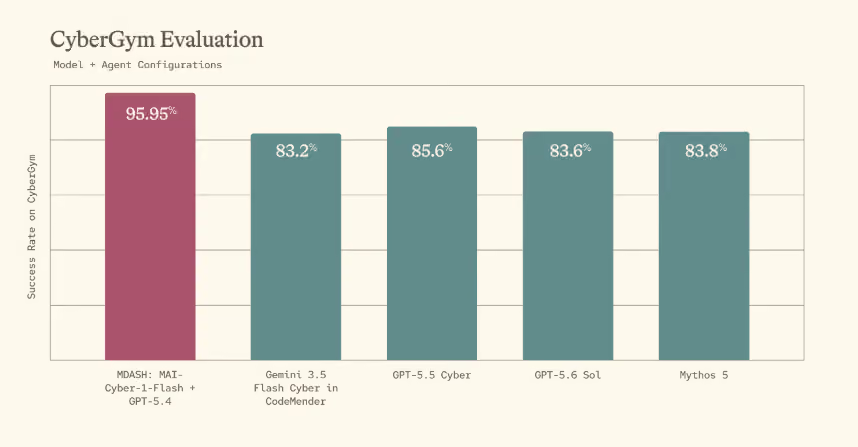
Microsoft launches AI cybersecurity model, agentic defense platform to cut enterprise security costs

Taylor Swift’s wedding was a clear display of the musicians’ huge power and influence


-

 Fashion3 days ago
Weekend Open Thread: Brooks Brothers
-

 Crypto World7 days ago
Grayscale Files For Worldcoin ETF, WLD Registers Sharp Rise
-

 NewsBeat6 days ago
How a former Blue Peter presenter stunned America’s Got Talent judges
-

 Tech21 hours ago
Intel is reversing course and bringing hyper-threading back to its server chips
-

 Tech7 days ago
Sail Virtually Aboard The “Itanic” With IA-64 Emulator
-
 Tech7 days ago
Turtle Beach Command Series KB7 review: a nifty screen-equipped gaming keyboard
-
 Business6 days ago
New Jersey voter registration controversy explained: How 6,600 noncitizens got on the rolls, and what happens next
-
 Entertainment6 days ago
Johnny Depp’s R-Rated Gothic Cult Classic Gets New Release Ahead of Sydney Sweeney Remake
-

 Crypto World5 days ago
Ethics, other provisions in crypto Clarity Act to be further discussed
-

 Politics11 hours ago
Luke Littler dismantles Gerwyn Price to retain title in Blackpool
-
 NewsBeat7 days ago
Shanghai science forum photos show China’s AI and robotics advances in rivalry with US
-

 Sports4 days ago
2026 3M Open leaderboard: Scottie Scheffler finds putter in Round 1, sits three back
-
 Sports1 day ago
Commonwealth Games boxing: Jadumani Singh seals dominant 5-0 win over Pakistan’s Sumama Rehman to enter quarter-finals | Commonwealth Games News
-

 News Videos4 days ago
The Peugeot Family: How 200 Years of an “Old Money” Dynasty Died in A Boardroom
-

 Fashion4 days ago
16 Dresses for the High Summer Event
-

 Politics1 day ago
Spain sweeps the board at 2026 World Cup with individual awards
-

 Crypto World7 days ago
Andrew Cuomo joins OKX board as crypto exchange expands in U.S.
-
 Entertainment3 days ago
A New Post-Apocalyptic Gundam Anime Series Blasts Into SDCC
-

 News Videos1 day ago
BITCOIN JUST ENTERED THIS CRITICAL ZONE…
-

 Crypto World2 days ago
XRP Ledger adds $2.6B as RWA inflows rank second
You must be logged in to post a comment Login