

Business
Small businesses sceptical over tariff refunds after US Supreme Court strikes down Trump’s trade levies


Small business owners across the United States have expressed scepticism that they will ever see refunds following the landmark ruling by the Supreme Court of the United States striking down large parts of Donald Trump’s sweeping tariff regime.
The court’s decision potentially unlocks as much as $175 billion (£137 billion) in repayments to companies that paid import duties under the controversial policy. However, many entrepreneurs say the legal and administrative complexity involved in claiming those refunds could make the process prohibitively difficult, particularly for smaller firms already strained by rising costs.
The tariffs, which targeted a wide range of imported goods under the former president’s “Liberation Day” trade policy, had sharply increased the cost of materials and products for businesses reliant on global supply chains.
Although the ruling has opened the door to compensation claims, Trump himself acknowledged the issue could remain entangled in litigation “for the next five years”, leaving thousands of companies unsure whether pursuing refunds is even worthwhile.
For many small firms, the economic damage caused by the tariffs has already been felt in higher costs, squeezed margins and delayed investment plans.
Elizabeth Vitanza, who runs a lighting and home furnishings business in Los Angeles with her husband John Ballon, said the impact has been felt across nearly every brand they work with.
“All of the modern brands we carry have raised prices by at least 12 per cent over the past year,” she said. “None of this is pro-business or pro-American.”
When Trump won re-election in 2024, the couple attempted to protect their business by rushing through a large order with a Swedish partner in an effort to beat the incoming tariffs.
Despite the attempt, the shipment was still caught by the new duties.
“We ended up paying a five-figure tariff bill,” Ballon said. “Money we had earmarked to renovate the showroom and possibly increase staff salaries suddenly had to cover unexpected import taxes.”
The couple said the experience had forced them to rethink expansion plans.
“Why would anyone start a business right now?” Vitanza asked. “If I didn’t already have an established one, I wouldn’t.”
Across other sectors, similar stories have emerged of rising costs linked to tariffs on imported raw materials and components.
A furniture manufacturer in Texas said the policy had pushed up the price of imported lumber and specialist cabinet hardware that cannot be sourced domestically.
The company had little choice but to pass on the costs to customers.
“Those materials simply aren’t made in the United States,” the owner said, requesting anonymity. “If tariffs raise those costs, we either increase prices or absorb the loss.”
Outdoor equipment company Granite Gear, based in Minnesota, experienced a similar shock.
Manager Rob Coughlin said the company had faced near-constant uncertainty since the tariffs were introduced.
Before the policy was implemented, Granite Gear paid an 18 per cent import duty on certain goods. When the new tariffs were introduced, the rate surged to 46 per cent before later being reduced to 20 per cent following trade negotiations with Vietnam.
The rapid changes made pricing decisions almost impossible.
“We didn’t even know what our costs would be when products started shipping,” Coughlin said. “How do you go to retailers with a price list when you don’t know the tariffs you’ll be paying?”
Ultimately, the company raised prices between 10 and 20 per cent to offset the additional costs.
Unlike larger brands, Coughlin said smaller companies have far less negotiating power when dealing with retailers.
“Big companies can push back on price increases. Smaller brands like us just don’t have that leverage.”
For companies in niche sectors, the tariffs have also created major financial strain.
Dr Charlie Elrod, founder of a natural livestock health products company, said tariffs on Brazilian imports alone had increased costs by around $1 million over the past year.
For months the company tried to absorb the additional expense rather than pass it on to customers.
Eventually, however, it was forced to raise prices by 5 per cent.
“That helped a bit,” Elrod said, “but profitability has definitely fallen.”
Following the Supreme Court ruling, more than 1,000 companies have launched lawsuits seeking reimbursement for tariffs they argue were collected unlawfully.
In a related development, a US trade court judge recently ordered the federal government to begin processing billions of dollars in refunds to importers affected by the invalidated tariffs.
Yet the practical path to recovering that money remains unclear.
Many businesses say the complexity of filing claims, and the legal costs involved, may outweigh any potential repayment.
Vitanza said her company is carefully tracking tariff payments in the event they decide to file a claim.
“We’re keeping a spreadsheet so that one day we might have everything ready if we pursue reimbursement,” she said. “But we’re not counting on it.”
Howard Trenholme, who owns a bakery and café in Moab, Utah, said the legal complexity makes pursuing refunds unrealistic.
“As an end user buying through multiple suppliers, the process would be incredibly complicated,” he said. “The legal fees alone could wipe out any refund.”
Coughlin from Granite Gear reached a similar conclusion.
“When I compare the refund I might receive with the legal costs involved, it’s simply not worth the risk,” he said.
“I won’t be trying to claim anything. It would probably be a waste of time and money.”
Even with the court ruling, the legacy of the tariff policy continues to affect business planning across the country.
Companies that once relied on stable global supply chains now face a far more uncertain trade environment, with shifting duties and geopolitical tensions complicating long-term decisions.
For many small businesses, the experience has reinforced how vulnerable they are to abrupt changes in government trade policy.
While the Supreme Court decision theoretically opens the door to billions in repayments, entrepreneurs say the practical reality is that many of them may never see that money.
For firms already stretched by rising costs and economic uncertainty, the priority now is simply staying afloat — rather than fighting a potentially years-long legal battle to recover past losses.

Jamie Young
Jamie is Senior Reporter at Business Matters, bringing over a decade of experience in UK SME business reporting.
Jamie holds a degree in Business Administration and regularly participates in industry conferences and workshops.
When not reporting on the latest business developments, Jamie is passionate about mentoring up-and-coming journalists and entrepreneurs to inspire the next generation of business leaders.

Business
Legend Biotech Corporation 2025 Q4 – Results – Earnings Call Presentation (NASDAQ:LEGN) 2026-03-10


Seeking Alpha’s transcripts team is responsible for the development of all of our transcript-related projects. We currently publish thousands of quarterly earnings calls per quarter on our site and are continuing to grow and expand our coverage. The purpose of this profile is to allow us to share with our readers new transcript-related developments. Thanks, SA Transcripts Team

The feature allows both women riders and drivers to be matched with other women for trips on the ride-sharing app.

Check out what’s clicking on FoxBusiness.com.
The Federal Aviation Administration (FAA) briefly grounded all JetBlue flights early Tuesday morning at the airline’s request, according to an advisory posted by the agency’s Air Traffic Control System Command Center.
The nationwide ground stop, which applied to all destinations and facilities, was in effect from 12:35 a.m. to 1:30 a.m. ET, the FAA advisory shows.
“Operations are normal after JetBlue asked the FAA to pause flights nationwide overnight because of an internal IT issue,” the FAA said in a statement.
JetBlue told FOX Business in a statement: “A brief system outage has been resolved and we have resumed operations.”
‘SECURITY-RELATED SITUATION’ GROUNDS FLIGHT TO VACATION HOT SPOT, PASSENGERS CONFINED FOR HOURS
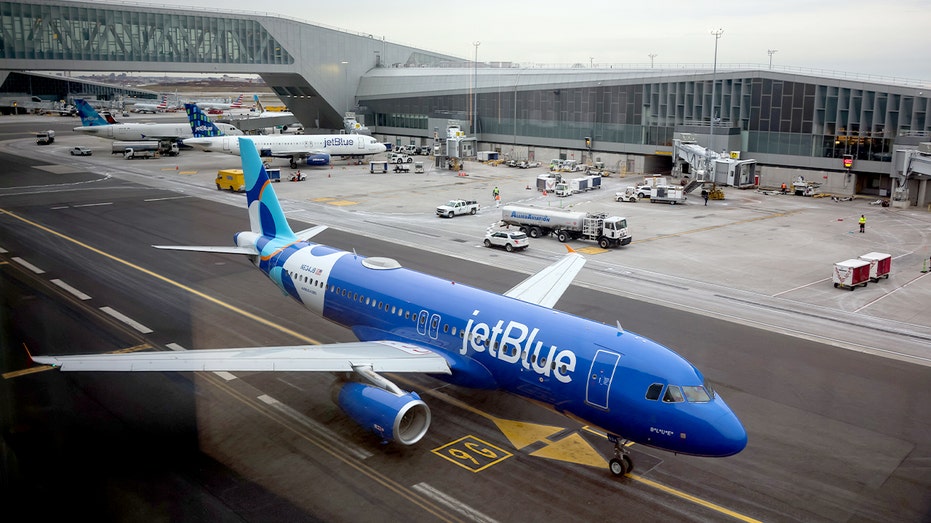
JetBlue planes at LaGuardia Airport (LGA) in the Queens borough of New York on Dec. 26, 2025. (Michael Nagle/Bloomberg via Getty Images / Getty Images)
Ground stops temporarily prevent flights from departing while an issue is addressed, though aircraft already in the air are typically allowed to continue to their destinations.
The brief grounding comes as airlines have grappled with technology-related disruptions in recent years.
JETBLUE FLIGHT RETURNS TO NEWARK AFTER ENGINE FAILURE, SMOKE PROMPTS EVACUATION
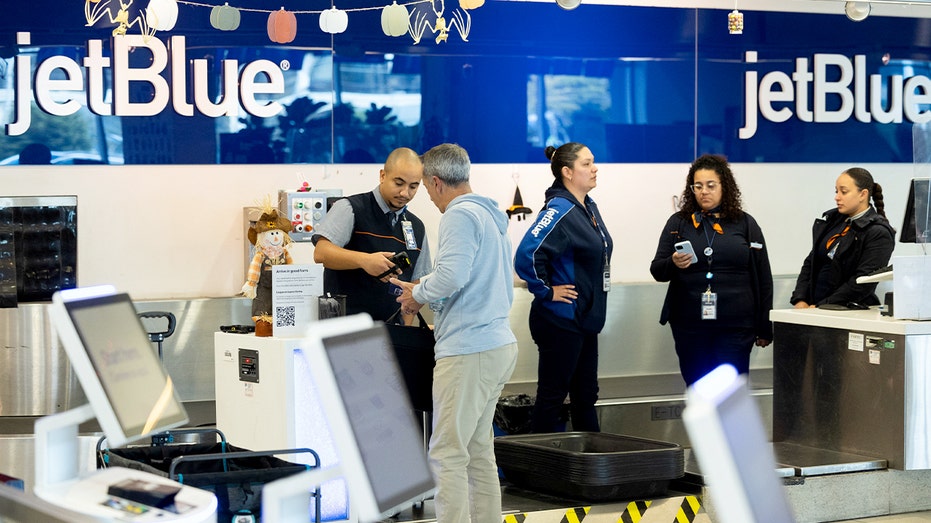
A traveler in the JetBlue check-in area in Terminal E at Philadelphia International Airport (PHL) in Philadelphia on Oct. 24, 2025. (Ryan Collerd/Bloomberg via Getty Images / Getty Images)
In October, Alaska Airlines issued a systemwide ground stop for Alaska and Horizon Air flights after a failure at its primary data center triggered a significant IT outage, leading to hundreds of cancellations over two days and disrupting travel plans for tens of thousands of passengers.
The carrier later said it was bringing in outside technical experts to strengthen its systems and “diagnose our entire IT infrastructure to ensure we are as resilient as we need to be. ”
In June, American Airlines experienced a “technology issue” that disrupted operations and led to widespread delays.
SOUTHWEST FLIGHT DIVERTED AFTER PASSENGER SCARE AS SECURITY INCIDENTS RATTLE US AIRPORTS
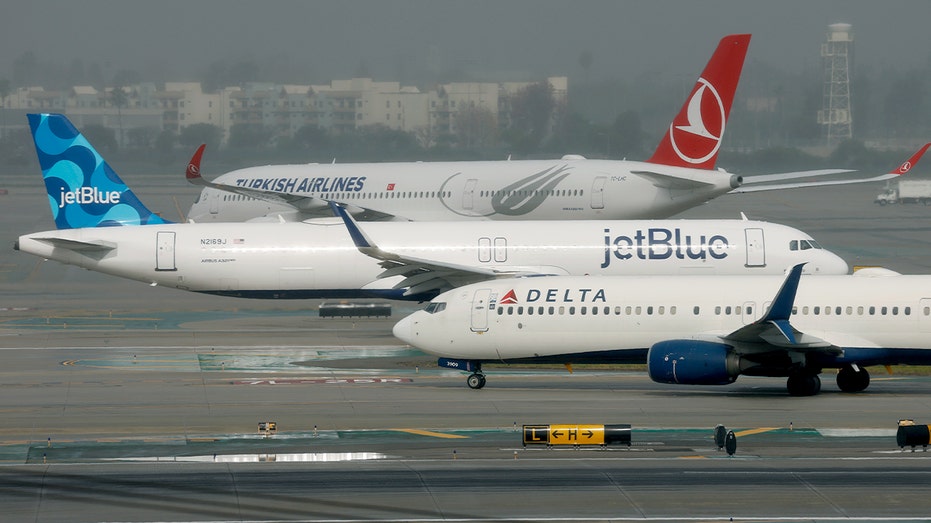
A Delta Air Lines Boeing 737, JetBlue Airbus A321 and Turkish Airlines Airbus A350 taxi at Los Angeles International Airport on Jan. 2, 2025, in Los Angeles, California. (Kevin Carter/Getty / Getty Images)
CLICK HERE TO DOWNLOAD THE FOX NEWS APP
Some travelers reported lengthy wait times on the tarmac as the carrier worked to resolve the problem.
The airline said a connectivity issue had affected certain systems but that it worked with partners to restore the impacted applications and return operations to normal.

A Spirit Airlines Airbus A320 taxis at Los Angeles International Airport after arriving from Boston on September 1, 2024 in Los Angeles, California.
Kevin Carter | Getty Images News | Getty Images
Spirit Airlines is calling back all furloughed pilots after higher-than-expected attrition has strained its operation, according to a company memo, which was reviewed by CNBC.
The budget carrier said late last month that it plans to further cut its schedule and emerge from Chapter 11 bankruptcy in late spring or early summer. It was the airline’s second bankruptcy filing in less than a year.
Spirit Airlines furloughed hundreds of pilots in 2024 and 2025 to save millions of dollars and to match a smaller operation than the budget carrier used to operate. But pilots also chose to leave the airline, many for other carriers, leaving Spirit short on staffing.
“Pilot attrition has been higher than forecast, making precise alignment between staffing and the reduced schedule more challenging,” the airline told employees in a memo last week. “While these recalls won’t arrive in time to support the spring break—Easter period, they strengthen the foundation of our post-bankruptcy future.”
Spirit confirmed that on Monday, it sent notices to about 500 pilots who were involuntarily furloughed between Sept. 1, 2024, and Nov. 1, 2025, to call them back to work as “we continue to make adjustments to meet the evolving needs of our business.”
Last month, Spirit similarly said it would recall furloughed flight attendants.
Europe’s largest carmaker said post-tax profits had dropped to their lowest level since 2016.

BloFin Research focuses on crypto research and analysis, dedicated to providing institutional-grade insights into the digital asset market. Our work covers major crypto assets, market trends from a macroeconomic perspective, and industry-wide studies on key developments shaping the digital asset ecosystem.

Looking to plan your holiday in Egypt? It’s like a journey through time, from ancient wonders to iconic landmarks.
When you choose Egypt tours, you’re not just travelling; you’re experiencing the culture, history, adventure, hospitality, and the amazing food, which means everything you’re looking for in your dream tour. Egypt offers you a dream-come-true experience: standing in front of the great Giza Pyramid or sailing across the Nile River feels like a magical adventure you’ve never imagined, blending culture with excitement in everything you do.
If you love serene beauty, want to experience culture, seek civilization, or explore a place filled with hospitality, offering you a smooth and unforgettable experience, then Egypt offers you a heritage-rich experience no other destination can match. In this blog, you will explore how to plan the perfect holiday tour with the help of a guide to make your Egypt tour safe, relaxing, and affordable.
Why Egypt Is a Top Holiday Destination
If you’re looking for a spot that offers you culture, history, and civilization, then choosing Egypt tour packages allows you to start your journey from ancient history to modern civilization. Experience the iconic landmarks and explore modern open-air museums, immersing yourself in a cultural journey, especially if you love history and want to experience everything you’ve only read about in books. From the architectural beauty of the pyramids to King Tutankhamun’s treasure, you’ll be amazed by the ancient world’s wonders that offer deep history and a civilization dating back 5,000 years, enough to attract visitors to explore Egypt as a favourite holiday destination.
Beyond the history, Egypt offers a lot, from vibrant cities and adventurous deserts to river cruises and coastal resorts. You can enjoy authentic food along with traditional kahwa, and you’ll find Egypt to be a great destination with friendly local hospitality that warmly welcomes you and helps you explore the country without the need for a guide. From the bustling urban life of Cairo to the peaceful serenity of Aswan with the Nile River, Egypt is one of the best places to spend your holidays.
What is the best time to visit Egypt?
Choosing the best time always helps you make your trip enjoyable, especially when you select Egypt as your destination, since it’s a popular tourist spot that tends to be crowded. Therefore, you need to plan the timing carefully, especially according to the season. Since Egypt is a desert land, the weather is very hot in summer. Picking a time between October and April is ideal for experiencing Egypt, from outdoor attractions to visiting temples and archaeological sites. These months are the best options without experiencing extreme heat.
However, coastal destinations to Red Sea resorts allow you to enjoy your Egypt tour from June to August with coral reefs and water activities like scuba diving. You can also enjoy your Egypt tour in summer, but in a cooler season, you can easily explore the coast, visit historical sites, and go on desert adventures.
Selection of the Right Tour Package
To plan a stress-free holiday, you need to select the right tour package with Memphis Tour. You will find multiple options to choose from based on your interests and budget for the trip duration, including location preferences, guides versus independent tours, and what you want to explore. Everything depends on choosing the right tour package.
- Trip duration (7-10 days) must include experiencing adventure, visiting historic landmarks, and enjoying the serene beauty of the River Nile.
- Destinations (Cairo, Aswan, Luxor, and the Valley of the Kings) should be added to your tour package to experience real Egyptian culture and history.
- Guided vs Independent: If you are a first-time visitor, then choose a guided tour; it’s a little bit more costly, but you’ll experience Egypt more deeply, compared to an independent tour, which is more affordable.
Must-Visit Attractions in Egypt
Before planning your trip, you must gather information about the places that should never be skipped, such as the Pyramids of Giza, Luxor Opera Museum, Aswan Nile cruise, desert safari, and the Red Sea, along with the Coral Reef experience. These must be added to your visiting list, whether you’re a first-time traveller or a seasonal visitor.
The Pyramids of Giza
The Great Pyramid of Giza is the most famous landmark, and without visiting, you can’t assume your Egyptian journey is complete. It was built 4500 years ago and remains a remarkable architectural achievement in human history. Visiting offers a unique experience, as you can appreciate its architecture, which is considered a significant accomplishment in history. Also, you can see the Sphinx, a statue with a man’s face and a lion’s body, which adds to the site’s mystery and beauty. A camel ride across the desert makes the visit even more memorable. The pyramid is one of the most famous landmarks in Egypt and continues to attract visitors from all over the world.
Luxor
Luxor is familiar with the world’s largest open-air museum, featuring attractions like Karnak Temple, Luxor Temple, and the Valley of the Kings. If you visit Egypt, Luxor must be added to your list of places to see.
Aswan
Experience relaxation and serene beauty in Aswan with a Nile cruise and a felucca boat ride. Offer yourself an unbeatable experience that makes your tour enjoyable and adventurous at the same time. It provides you with a temple visit and the Nubian village experience.
If you’re looking to experience adventure, visiting the desert will make your tour full of excitement. Experience the Nile River, a camel ride, a 4×4 quad bike ride, and a night in the desert with Bedouin camps under the stars. Camel riding reveals a lot in Egypt. Visiting the White Desert offers a unique stone experience with different animals’ shapes and formations. You also enjoy a hot air balloon ride in Luxor above the temples and the Red Sea coral reefs with 200+ species, offering an unbeatable experience.
Travel Advice on Visiting the US as a First-Time Visitor.
These are some tips that may help you on the road before beginning your Egyptian adventure:
- Make early reservations at least in the major travel seasons.
- Bring a little money to the market for minor purchases.
- Adhere to local customs and traditions, particularly in religious places.
- Always be hydrated when visiting outdoor attractions.
- Hire professional tour guides to guide you through the historic sites.
These few tips can help to make your travelling experience easier and more pleasant.
Final Words
Finally, this guide helps you plan your holiday tour to Egypt. Egypt is a country of unforgettable experiences, starting with the Great Pyramid of Giza and the tranquillity of the Nile River. From history to culture, visit places like Cairo, Luxor, and Aswan. Whether you’re a history lover, an adventure seeker, or simply looking for a unique vacation spot, Egypt is a place where you will remember things forever. Now that you have this pocket guide, you’re all set to organize your ideal tour in Egypt and enjoy an amazing experience in one of the oldest civilizations ever witnessed in the world.

Australia’s share market has pared some early gains, after US government indications the Iran war might end soon couldn’t sustain buying in the afternoon.


Rida Morwa is a former investment and commercial Banker, with over 35 years of experience. He has been advising individual and institutional clients on high-yield investment strategies since 1991. Rida Morwa leads the Investing Group High Dividend Opportunities where he teams up with some of Seeking Alpha’s top income investing analysts. The service focuses on sustainable income through a variety of high yield investments with a targeted safe +9% yield. Features include: model portfolio with buy/sell alerts, preferred and baby bond portfolios for more conservative investors, vibrant and active chat with access to the service’s leaders, dividend and portfolio trackers, and regular market updates. The service philosophy focuses on community, education, and the belief that nobody should invest alone. Learn More.
Analyst’s Disclosure: I/we have a beneficial long position in the shares of LYB either through stock ownership, options, or other derivatives. I wrote this article myself, and it expresses my own opinions. I am not receiving compensation for it (other than from Seeking Alpha). I have no business relationship with any company whose stock is mentioned in this article.
Beyond Saving, Philip Mause, and Hidden Opportunities, all are supporting contributors for High Dividend Opportunities. Any recommendation posted in this article is not indefinite. We closely monitor all of our positions. We issue Buy and Sell alerts on our recommendations, which are exclusive to our members.
Seeking Alpha’s Disclosure: Past performance is no guarantee of future results. No recommendation or advice is being given as to whether any investment is suitable for a particular investor. Any views or opinions expressed above may not reflect those of Seeking Alpha as a whole. Seeking Alpha is not a licensed securities dealer, broker or US investment adviser or investment bank. Our analysts are third party authors that include both professional investors and individual investors who may not be licensed or certified by any institute or regulatory body.

We are heading towards a time where five generations share the workplace. From Baby Boomers to Gen Z, employees bring very different experiences, values and expectations.
For leaders, this is not a problem to solve. It is an opportunity to harness a range of perspectives in service of better outcomes for the business.
Yet the conversation around generational difference often starts in the wrong place. Narratives that younger generations do not want to work, that they lack resilience, or that they do not understand what it takes to succeed are deeply unhelpful. Leaning into these stories shuts down curiosity and listening. It reduces a complex human dynamic to a binary argument about who is right and who is wrong, and it feeds a wider societal tendency to focus on what separates us rather than what unites us.
Across all generations, the fundamentals are the same. Regardless of age, people need to feel seen, valued and heard and those needs do not change. What differs is how confidently people express them.
Gen X, for example, were often conditioned to feel grateful simply to have a job, and many were not encouraged to articulate what they needed from work. Younger generations, however, are far more comfortable voicing their wants and expectations, and what is sometimes labelled as entitlement is, in reality, valuable insight. There may even be an element of subconscious jealousy at play, as younger people are standing up for themselves in ways many of us did not feel able to. This is not laziness, but a different and often valuable perspective.
Younger employees want to achieve and they want to be successful. What they do not necessarily want is to replicate the exact path previous generations took to get there. When you look at the levels of burnout, stress and toxicity that have existed within many traditional working models, it is extraordinary that we would not pause and ask how might we do this differently?
From inputs to outputs
Too many generational debates become fixated on inputs, whether people are in the office, how many hours they are working or what sacrifices are being made. Inputs are highly visible, which makes them easy to focus on. However, they are not the true measure of performance. What ultimately matters are the outputs.
What does good look like for this business? What are we here to achieve? What impact are we trying to make? And most importantly why are we doing this? When leaders create clarity around outputs and what those outputs are in service of, they can then allow for flexibility in how those outcomes are delivered.
If leaders focus solely on systems, organisational design, operating models and processes, they risk overlooking the most critical factor in performance, which is their people.
While most leaders recognise that adaptability is essential in today’s environment and have evolved structures, technologies and strategies at pace, the real question is whether that same adaptability is being applied to how we engage, develop and support people.
Providing clarity about both the what and the why ensures that people, are set up to work autonomously. Autonomy enables individuals to feel a sense of personal agency, and that is something everyone needs, regardless of which generation they are.
Without this alignment and autonomy, even the most well-designed transformation efforts are unlikely to deliver their full potential.
Conflict as information not threat
Generational differences can sometimes surface as tension. What we often label as conflict at work is rarely true conflict. More often, it is a difference of opinion that has not been expressed clearly or resolved early. Lack of clarity creates the conditions for disagreement to escalate. The goal is not to avoid disagreements but to bring them to the surface and explore them. Conflict will exist because people care, they are passionate, and they see things differently. The question is whether it becomes healthy or unhealthy.
A difference of opinion is not a threat. Becoming more comfortable with the idea that multiple perspectives can coexist is often the key to avoiding full-blown conflict. Leaders play a vital role in shaping the conditions for healthy challenge. They create environments grounded in exploration and understanding and support open, constructive dialogue that strengthens teams and decision-making.
When handled constructively, conflict, especially that arising from generational differences, becomes an opportunity to improve collaboration, build understanding, and harness diverse perspectives to achieve better outcomes.
Enduring strength across generations
Generational collaboration cannot be one sided. There are enduring strengths within older generations, perspective, experience, clarity of standards and resilience developed through navigating challenge without constant scaffolding.
At the same time some younger employees may not yet have had the opportunity to build those muscles. Many have been highly supported and protected. That does not make them weak. It simply means certain skills need developing and that development requires guidance not judgement.
Equally, younger generations bring fresh thinking, technological fluency and a willingness to question assumptions. They have a right to help define culture and quality of work going forward. But that right comes with a responsibility to engage with the experience around them and to be open to learning from it.
When generations are placed together in positive contexts the exchange is powerful. You can see it in everyday life. Younger people who spend time listening to older generations’ stories often describe it as life enhancing. Perspective expands and the same is true in organisations.
There is always value in the difference, neither generation is wholly right or wrong. The leader’s role is to find ways to use these differences proactively and work with the energy in the room rather than against it.
Leading from unity not division
The most powerful conversations in organisations are grounded in shared purpose. By focusing on what we as a business need to achieve and how we can work together to reach it, we can make the most of one another’s strengths and uncover issues that might otherwise go unnoticed.
That shift from assumption to inquiry changes everything. Leaders set the tone. They need to be available, approachable and grounded in positive intent. Supporting younger talent while maintaining clear expectations helps create cultures where clarity around what good looks like sits comfortably alongside adaptability in how it is delivered.
When we focus on what unites us rather than what divides us, generational diversity becomes an asset rather than a tension point. Harnessing these differences is not about smoothing everything into sameness. It is about recognising that diverse outlooks strengthen decision making, fuel innovation and deepen resilience.
By moving beyond unhelpful narratives, staying curious and prioritising outputs over inputs, clarity over assumption and unity over division, organisations can truly unlock all potential.
By Claire Croft, founder of executive coaching business Claire Croft Associates
For more information, visit: https://clairecroft.co.uk

Legend Biotech Corporation 2025 Q4 – Results – Earnings Call Presentation (NASDAQ:LEGN) 2026-03-10

DeFi Insurance Is The Final Frontier Of Onchain Finance

Bob Dylan Is One of Only 2 People To Achieve This Incredible Oscar Feat


-
Business4 days ago
Form 8K Entergy Mississippi LLC For: 6 March
-

 Fashion4 days ago
Weekend Open Thread: Ann Taylor
-

 News Videos1 day ago
10th Algebra | Financial Planning | Question Bank Solution | Board Exam 2026
-

 Crypto World21 hours ago
Paradigm, a16z, Winklevoss Capital, Balaji Srinivasan among investors in ZODL
-

 Tech5 days ago
Bitwarden adds support for passkey login on Windows 11
-
 Sports5 days ago
499 runs and 34 sixes later, India beat England to enter T20 World Cup final | Cricket News
-

 Sports3 days ago
Three share 2-shot lead entering final round in Hong Kong
-

 Sports2 days ago
Braveheart Lakshya downs Lai in epic battle to enter All England Open final | Other Sports News
-

 Business6 days ago
Guthrie Disappearance Enters Fifth Week as Family Visits Memorial
-

 Politics4 days ago
Top Mamdani aide takes progressive project to the UK
-

 NewsBeat5 days ago
Piccadilly Circus just unveiled ‘London’s newest tourist attraction’ and it only costs 80p to enter
-

 Entertainment3 days ago
Hailey Bieber Poses For Sexy Selfies In New Luscious Lip Thirst Traps
-

 Business2 days ago
Search for Nancy Guthrie Enters 37th Day as FBI Probes Wi-Fi Jammer Theory
-
 NewsBeat12 hours ago
Pagazzi Lighting enters administration as 70 jobs lost and 11 stores close across Scotland
-

 Tech22 hours ago
Despite challenges, Ireland sixth in EU for board gender diversity
-

 Crypto World6 days ago
New Crypto Mutuum Finance (MUTM) Reports V1 Protocol Progress as Roadmap Enters Phase 3
-

 Tech5 days ago
ACIP To Discuss COVID ‘Vaccine Injuries’ Next Month, Despite That Not Being In Its Purview
-
Entertainment5 days ago
Harry Styles Has ‘Struggled’ to Discuss Liam Payne’s Death
-

 Business17 hours ago
Search Enters 39th Day with FBI Tip Line Developments and No Major Breakthroughs
-
 NewsBeat5 days ago
Good Morning Britain fans delighted as Welsh presenter returns to host ITV show