Connect with us

Business

Somerset Council ‘not in territory’ of going bankrupt within 12 months, says interim finance chief

Published

on

Business Live

The council is currently in the throes of setting its annual budget, with rising demand for services

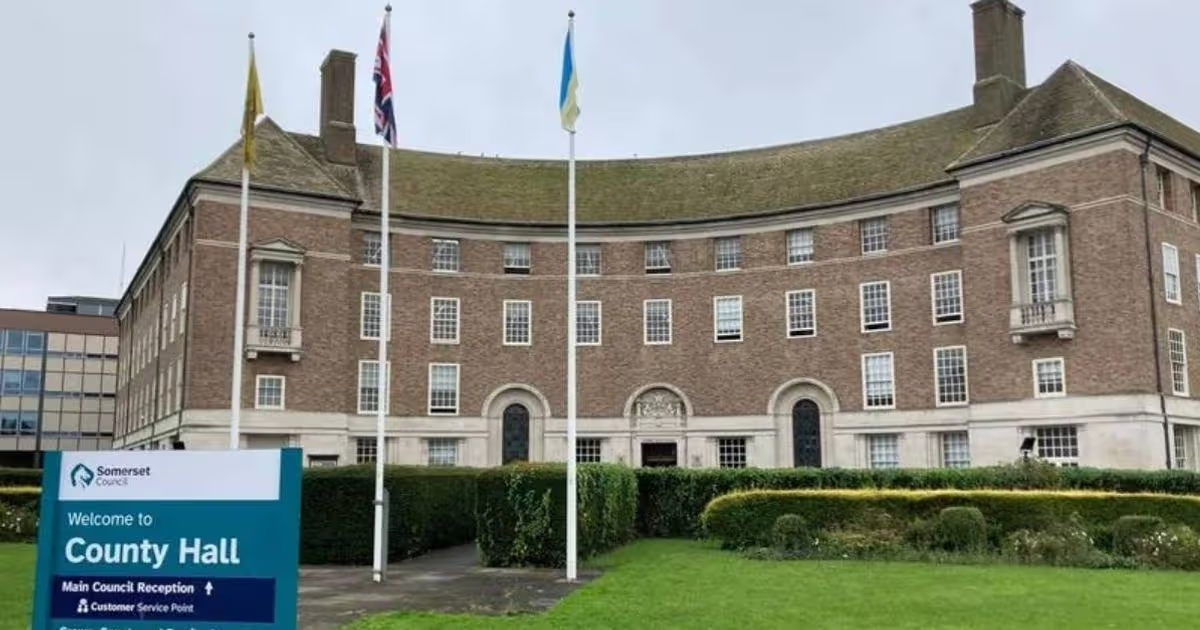
Somerset Council's Headquarters at County Hall on The Crescent in Taunton. CREDIT: Daniel Mumby. Free to use for all BBC wire partners.

Somerset Council’s Headquarters at County Hall on The Crescent in Taunton(Image: Local Democracy Reporting Service / Daniel Mumby)

Somerset Council is “not in the territory” of effectively declaring bankruptcy within the next 12 months, says its interim finance chief. The council is presently grappling with setting its annual budget, as escalating demand for services and the continually rising costs of meeting these needs make balancing the finances increasingly challenging.

Advertisement

The council’s forecasted budget deficit for 2026/27 has significantly reduced from £73m in December 2025 to approximately £41.4m a month later – although it will still be dependent on extraordinary financial aid from the central government to bridge this gap.

Clive Heaphy, the council’s interim chief financial officer, expressed that he was not immediately concerned about the council’s ability to set its annual budget, adding that he anticipated the projected budget shortfall to decrease further once the government confirmed the final local government funding settlement.

Mr Heaphy discussed the matter extensively when the council’s corporate and resources scrutiny committee convened in Taunton on January 28.

He said: “We have probably moved slightly away from a financial emergency, but let’s be clear: we still have deep issues to do with our budget and balancing our finances, and we still have a lot of work to do. We need to match our spending to our income without reliance on exceptional financial support, reserves or one-off savings.

Advertisement

“You will recall that had a gap coming into this year originally of £101m, representing some 17 per cent of our net revenue budget – that’s a very large deficit by any measure.

“The gap as reported in December was down to £73m, and is now down to £41.4m. By the time we get to the executive [on March 25], we will be moving towards a figure starting with a three, and the likely figure is likely to be in the mid-thirties [millions].”

To bridge the outstanding shortfall, the council is substantially dependent on exceptional financial assistance from central government – which permits the council to utilise the proceeds from disposing of land, property and other assets to fund everyday expenditure (something which is not ordinarily allowed).

The council can only increase its share of council tax bills by a maximum of 4.99 per cent without prompting a referendum, with the Ministry of Housing, Communities and Local Government (MHCLG) rejecting any higher rise in the final local government finance settlement on Monday (February 9).

Advertisement

The council operates a council tax reduction scheme which offers support for residents who are finding it difficult to pay council tax – with Mr Heaphy noting that the current scheme meant that the equivalent of 12,800 Somerset residents were contributing no council tax whatsoever.

If the council fails to legally set its budget by 11 March, it will be forced to issue a Section 114 notice and declare effective bankruptcy – resulting in the MHCLG dispatching commissioners who can implement sweeping changes with minimal democratic scrutiny.

Mr Heaphy said: “I am pleased to say that this year, we are not in Section 114 territory of at the moment.

“While the reserves are not the levels where we need them to be, I don’t think they represent a risk as long as we are not calling on them for regular, day-to-day spending.”

Advertisement

Councillor Dave Mansell (who heads the opposition Green group on the council) suggested that the council’s choice to spend proceeds from asset sales on its ongoing transformation programme might not deliver value for local taxpayers.

Mr Mansell (who represents the Upper Tone division near Wellington) said: “We have relied a lot on the capitalisation, and I tend to think we’ve relied on that too much – we’ve avoided doing something better with that money.

“We’ve had 15 years of cuts and savings to local government; there have been many painful decisions over those years, and it’s still going on. Our officers are overstretched, having to do too much and are struggling to keep up with everything – I’m sure we all see that.

“It looks like the budget gap will be closed through a council tax increase – I think we have to look at that, given our circumstances.

Advertisement

“Those who don’t want to pay more council tax will have to say which public services they don’t want any more . We’ve already dropped some that we should have kept going.”

Councillor Henry Hobhouse (Liberal Democrat, Castle Cary) argued the council would never achieve financial stability without comprehensive social care reform.

He said: “In my division, I have Chilton Cantelo special needs school and six different adult social care homes – almost every single one of which are now owned by financial institutions in London.

“It is a complete and utter disgrace the amount of money that is being charged by special needs schools – it is more expensive to send a child to Chilton Cantelo than it is to send a child to Eton, and it really isn’t good enough.

Advertisement

“Somebody higher up than me and this committee has got to do something about it.”

The council’s executive committee will reconvene on Wednesday (February 11) to examine rental levels for the authority’s housing portfolio, rather than addressing the complete budget as initially scheduled.

A dedicated executive session will follow on February 25 to scrutinise cost-saving proposals, fee adjustments and any additional measures that might be required once further Government guidance arrives.

The full council will convene at the Canalside conference centre in Bridgwater on March 4 to ratify the budget. Should the budget fail to gain approval, a backup full council meeting has been arranged for March 6 at the same location, with a reserve executive date set for the day before.

Advertisement

Following the budget’s approval, the council will name a permanent successor to Mr Heaphy. The senior management appointments and employment committee is scheduled to convene in a confidential session on Monday evening (February 16) to discuss this matter.


Continue Reading
Click to comment

Leave a Reply

Your email address will not be published. Required fields are marked *

Business

How to Manage Rapid International Growth in a Regulated Market

Published

on

How to Manage Rapid International Growth in a Regulated Market

Expanding a business globally used to feel like a slow, decade-long slog. Today, digital platforms let us flip a switch and reach customers in Sydney or Stockholm overnight.

But here is the catch: if you are operating in a regulated space—think fintech, healthcare, or gaming—that “switch” is attached to a mountain of legal paperwork and local hurdles. You simply can’t move fast and break things when the things you might break are national laws.

The Agility Paradox in Tight Markets

Scaling across borders is a massive feat, but if you’re playing in a heavily regulated field, you need a strange mix of speed and an almost total obsession with the rules. Lottoland has shown that the trick to growing fast without getting shut down lies in a “decentralized yet unified” approach—adapting the core product to meet local licensing requirements and cultural nuances without breaking the underlying tech. By investing in a modular tech stack that can quickly integrate regional payment gateways and regulatory reporting tools, they manage to move faster than traditional competitors. For UK entrepreneurs looking to export their services, the Lottoland model proves that entering a regulated market isn’t just about following rules; it’s about building a system where compliance is the engine itself, not a weight holding you back.

It sounds counterintuitive, doesn’t it? Usually, we think of “compliance” as the department that says “no” to every cool new idea. But when your tech is built to be modular, compliance becomes a plug-and-play feature. If a country changes its data privacy laws, you don’t need to rewrite your whole codebase; you just swap out a module.

Local Friction is a Reality

Let’s be honest: no two regulators think alike. You might have a green light in London, but find yourself stuck in a yellow-light purgatory in Berlin or Rome. This is where the human element of scaling comes in. You need local boots on the ground who actually understand the “vibe” of the local regulator. Are they sticklers for specific documentation? Do they prefer a certain reporting cadence?

Advertisement

The ground moves fast. For instance, consider how different regions handle consumer protection. Take the issue of gambling on credit; the Swedish government is currently closing all remaining loopholes to address consumer debt, effectively tightening the screws on how operators function. If your system isn’t flexible enough to pivot for a specific Swedish rule in a matter of weeks, your expansion is going to hit a wall. This kind of sudden legislative shift is becoming the norm, not the exception, across Europe and beyond.

Infrastructure as a Safety Net

Ultimately, the winners in this decade aren’t the ones with the loudest marketing, but the ones with the most resilient “plumbing.” This means moving away from monolithic systems toward microservices. It means hiring compliance officers who actually enjoy the puzzle of international law. It’s tough, and honestly, it’s often quite expensive at the start. But the alternative? A single fine that wipes out your year’s profits.

How is your business handling the balance between speed and safety? Do you think the UK is doing enough to help small firms navigate these international rules? Drop a comment below and share your experience.

Advertisement

Continue Reading

Business

Commodity costs continue to challenge The Hershey Co.

Published

on

Commodity costs continue to challenge The Hershey Co.

Company focused on R&D and product innovation in 2026. 

Continue Reading

Business

Housing market cools as US home prices grow 0.9% annually

Published

on

Housing market cools as US home prices grow 0.9% annually

The housing market has cooled off this winter with the annual pace of home price growth easing to levels unseen since the nation was recovering from the Great Recession. And while some areas continue to see strong price growth, others have seen notable declines.

New data from Cotality, a data analytics and tech company in the real estate, mortgage and insurance industries, showed that annual housing price growth slowed to just 0.9% in December, which was one of the softest rates since the post-Great Recession recovery.

Advertisement

“We are seeing a significant departure from the rapid surges of recent years; while the upward pressure on prices remains, the momentum has moderated enough to suggest that the market is finally becoming more navigable for prospective buyers,” said Cotality Chief Economist Selma Hepp.

HOMEBUYERS GAIN UPPER HAND IN 3 MAJOR CITIES AS INVENTORIES GROW

Home prices have declined in several key areas across the South and West, particularly in areas that had previously seen rapid expansion as in-migration trends moderate and inventory levels increase.

Workers in a Texas subdivision

Workers build homes in the Bridgeland master-planned community in Cypress, Texas, Nov. 10, 2025. (Brett Coomer/Houston Chronicle via Getty Images)

Cotality’s report found that the local housing market with the steepest declines was Kahului-Wailuku, Hawaii, with prices down 8% in December on a year-over-year basis.

Advertisement

The Lone Star State had a pair of localities in the top 10, with Victoria, Texas, down 7.4% and Wichita Falls, Texas, down 7.2%.

Napa, California, had the steepest decline among West Coast localities, with prices falling 7.1%.

THE ‘POISON PILL’ AND DIGITAL SECRETS FLIPPING THE SUNSHINE STATE’S CONDO POWER DYNAMIC

Florida had five communities represented in the top 10 localities with the steepest price declines, led by Naples (-6.8%), Punta Gorda and Cape Coral (-6.2% each), North Port (-5.9%) and Sebastian (-5.2%).

Advertisement

Rome, Georgia, rounded out the top 10 with a 5.2% year-over-year price decline.

The hottest housing market identified in Cotality’s report was Youngstown, Ohio, which saw prices surge 15.9% over the last year.

THESE STATES ARE CONSIDERING ELIMINATING PROPERTY TAXES FOR HOMEOWNERS

Four of the hottest markets were in the state of Indiana, led by national runner-up Terre Haute’s gain of 11.4%. Other Hoosier State metros with notable price rises were Columbus and Muncie, with 10.2% gains each, and Kokomo’s 8.8% increase.

Advertisement

Illinois was home to a pair of housing markets with strong price growth, as prices in Decatur rose 10.5% and Peoria 8.9%.

Waterfront homes near Naples Pier in Naples, Florida

Naples, Fla., was one of the 10 communities with the steepest home price declines. (Lisette Morales McCabe/Bloomberg via Getty Images)

Two other markets in the Midwest and Plains were in the 10 hottest markets, with prices up 8.7% in Manhattan, Kansas, and 8.5% in Traverse City, Michigan.

The hottest housing market in the South was in Hattiesburg, Mississippi, which saw prices rise 8.4% over the last year.

GET FOX BUSINESS ON THE GO BY CLICKING HERE

Advertisement

“As we move through 2026, the market’s trajectory will depend heavily on wage growth and how soon buyers regain the purchasing power needed to meet sellers’ pricing thresholds. For now, Cotality data shows a housing landscape is still finding its footing, but it is ultimately stabilizing after an extended period of imbalance,” Hepp said.

Fox News Digital’s Amanda Macias contributed to this report.

Continue Reading

Business

OMV Aktiengesellschaft 2025 Q4 – Results – Earnings Call Presentation (OTCMKTS:OMVKY) 2026-02-10

Published

on

OneWater Marine Inc. (ONEW) Q1 2026 Earnings Call Transcript

This article was written by

Seeking Alpha’s transcripts team is responsible for the development of all of our transcript-related projects. We currently publish thousands of quarterly earnings calls per quarter on our site and are continuing to grow and expand our coverage. The purpose of this profile is to allow us to share with our readers new transcript-related developments. Thanks, SA Transcripts Team

Continue Reading

Business

Arbor Investments buys Furlani Foods

Published

on

Arbor Investments buys Furlani Foods

Acquisition adds to baking portfolio holdings.

Continue Reading

Business

Eight Saks Fifth Avenue stores, one Nieman Marcus location closing

Published

on

Eight Saks Fifth Avenue stores, one Nieman Marcus location closing

Saks Global Enterprises said Tuesday it will close nine stores as it shifts its focus to more profitable locations.

The company said eight Saks Fifth Avenue locations and one Neiman Marcus store will close.

Advertisement

“By optimizing our operational footprint, we will be better positioned to deliver exceptional products, elevated experiences and highly personalized service across all channels, while simultaneously positioning our company to make investments that enable long-term growth and value creation,” Saks Global Enterprises CEO Geoffroy van Raemdonck said in a statement.

People outside a Saks Fifth Avenue store.

Shoppers leave a Saks Fifth Avenue store Dec. 30, 2025, in Chicago. (Scott Olson/Getty Images)

SAKS GLOBAL FILES FOR BANKRUPTCY AFTER $2.7 BILLION NEIMAN MARCUS ACQUISITION DEAL 

Saks Global Enterprises filed for Chapter 11 bankruptcy protection in mid-January in the U.S. Bankruptcy Court for the Southern District of Texas after missing a $100 million interest payment in December, adding to mounting debt obligations. 

Saks will ask a U.S. bankruptcy judge to approve the nine store closings at a court hearing Friday, the company said in a court document filed Tuesday.

Advertisement

After the filing, Saks Global announced it secured a financing commitment of approximately $1.75 billion backed by senior secured bondholders and asset-based lenders to support operations during the restructuring. 

Shoppers outside Saks Fifth Avenue flagship store in Manhattan

Holiday shoppers walk outside the Saks Fifth Avenue flagship store in Manhattan in New York City Dec. 5, 2023.  (Reuters/Mike Segar/File Photo / Reuters Photos)

CONSUMER CONFIDENCE PLUNGES TO LOWEST LEVEL IN MORE THAN A DECADE

Saks Global announced last month that most Saks Off 5th locations across the U.S. would close, just weeks after its bankruptcy filing.  

The luxury retailer closed 23 of its Saks Off 5th stores Feb. 2, while another 34 held closing sales starting at the end of January. Only 12 locations in New York, Florida, New Jersey, Georgia, California and Texas will remain open.

Advertisement

MOST SAKS OFF 5TH LOCATIONS NATIONWIDE TO CLOSE AMID BANKRUPTCY PROCEEDINGS

Shoppers enter the Saks Fifth Avenue store on Fifth Avenue in New York.

Shoppers enter the Saks Fifth Avenue store on Fifth Avenue in New York Nov. 27, 2020. (Gabriela Bhaskar/Bloomberg via Getty Images / Getty Images)

Here’s which Saks Fifth Avenue stores are closing:

The Summit – Birmingham, Alabama

Polaris Fashion Place – Columbus, Ohio

American Dream – East Rutherford, New Jersey

Advertisement

Shops at Canal Place – New Orleans, Louisiana

Bala Plaza – Philadelphia, Pennsylvania

Biltmore Fashion Park – Phoenix, Arizona

Stony Point Fashion Park – Richmond, Virginia

Advertisement

Utica Square – Tulsa, Oklahoma

Here’s the Neiman Marcus store that’s closing:

Copley Place – Boston, Massachusetts

GET FOX BUSINESS ON THE GO BY CLICKING HERE

FOX Business’ Greg Norman and Reuters contributed to this report.

Advertisement
Continue Reading

Business

Warren Buffett’s Japanese Bets Keep Paying Off

Published

on

Warren Buffett’s Japanese Bets Keep Paying Off

Berkshire holds stakes in Itochu, Marubeni, Mitsubishi, Mitsui and Sumitomo.

The firms operate in a wide range of businesses, in areas such as chemicals, agricultural commodities, mining and consumer products.

Itochu stock was roughly flat Monday, but the others added between 3% and 5.3%—with each of the four notching new record closing highs, according to Dow Jones Market Data.

Berkshire first revealed it had taken positions in the quintet in August 2020, though stake building started about a year earlier. It has subsequently increased those holdings.

Advertisement

Since Berkshire first disclosed that it was investing in the trading firms, their shares have gained between 280% and 832%.

Continue Reading

Business

Gilead Sciences, Inc. 2025 Q4 – Results – Earnings Call Presentation (NASDAQ:GILD) 2026-02-10

Published

on

OneWater Marine Inc. (ONEW) Q1 2026 Earnings Call Transcript

This article was written by

Seeking Alpha’s transcripts team is responsible for the development of all of our transcript-related projects. We currently publish thousands of quarterly earnings calls per quarter on our site and are continuing to grow and expand our coverage. The purpose of this profile is to allow us to share with our readers new transcript-related developments. Thanks, SA Transcripts Team

Continue Reading

Business

Dollar Weakens While Markets Brace for Fiscal Stimulus in Japan

Published

on

Stocks Little Changed After Fed Decision

“We expect implied volatility to pick up again,” Goldman Sachs’ Karen Fishman writes. She expects the USDJPY to move “towards and through 160.” In such a scenario, intervention risk rises. She expects markets “to proceed cautiously against elevated risk of intervention, but that can only last for so long.”

Continue Reading

Business

Coleen Rooney increases Applied Nutrition stake as firm targets working mothers

Published

on

Business Live

The Liverpool-based nutrition company, backed by JD Sports, has reported growth in sales since launching shares on the London stock markets in 2024

Coleen Rooney with a packet of Applied Nutrition Diet Protein and branded water bottle

Coleen Rooney has upped her stake in Applied Nutrition(Image: Applied Nutrition/PA)

Coleen Rooney has increased her investment in Applied Nutrition as the wellness company seeks to appeal to a broader range of consumers, including working mothers.

Advertisement

The television personality and wife of former footballer Wayne Rooney has substantially increased her stake in the business, the firm confirmed. It is understood that Mrs Rooney has approximately doubled her holding, which remains beneath the 3% threshold that would require a publicly listed company to declare it to the London Stock Exchange.

The Liverpool-headquartered firm, which also counts retailer JD Sports amongst its backers, floated on the London stock markets in 2024 and has recorded sales growth since then.

Mrs Rooney was amongst the investors in the company’s flotation following her appointment as a brand ambassador for the group, though the exact size of her stake has never been publicly disclosed.

She is also the face of a range of products for Applied Nutrition, including collagen and powders designed to support sleep, immunity, hydration and reduce bloating.

Advertisement

Her participation has enabled the company to reach a wider demographic of customers, given that the sports nutrition sector is traditionally perceived as a more male-dominated industry.

Coleen Rooney said: “Nutrition and supplements have always been an important part of my fitness regime and had included Applied Nutrition products for many years before having the opportunity to create my own range. I am delighted with the range we have created together and look forward to expanding the range further.

“Combining a healthy lifestyle with exercise helps me feel good about myself and provides the energy required for a busy mum of four boys especially now that I have gone back to working on several projects and opportunities.

“Alongside being an ambassador for the business, I had the opportunity to invest in the company and couldn’t be happier with my decision as the business continues to grow. I am excited about the future of the company as it expands into new markets and products and have decided to invest further.

Advertisement

“I look forward to continuing to work alongside the board and the rest of the team and to be a part of the company’s future success.”

Applied Nutrition’s chief executive Thomas Ryder said: “Coleen embodies everything we are about – focus, passion for wellness and a commitment to the journey, as illustrated by her increasing her shareholding. Coleen has played an important role in broadening our customer base and increasing brand awareness among a wider, health-conscious audience.

“It is particularly rewarding to work alongside someone who is as passionate about health and wellness and believes in the long-term potential of the business as strongly as we do.”

The company primarily operates through business-to-business sales, distributing its products to retailers, supermarkets, fitness centres and sports clubs, catering to everyone from elite athletes to individuals pursuing weight loss goals.

Advertisement
Continue Reading

Trending

Copyright © 2025