DETROIT — Jeep maker Stellantis is leaning on technologies from automotive suppliers for its newest hybrid SUVs as the market for more fuel-efficient vehicles is expected to continue growing, CNBC has learned.
Advertisement
The trans-Atlantic automaker’s first-ever Jeep hybrid SUV for North America, its recently launched Cherokee, features a system from a Toyota-backed company called Blue Nexus, while its upcoming extended-range electric vehicles, or EREVs, are utilizing major technologies from Bosch, the world’s largest automotive supplier.
It’s not uncommon for automakers to use components from suppliers, but it’s less common for key systems or technologies, especially ones pioneered by a competitor like Toyota.
But Stellantis’ push is a prime example of broader market shifts away from all-electric vehicles and a way carmakers can more quickly get hybrid vehicles — which have been increasingly in demand even before oil prices spiked — to market, potentially at a lower capital cost. Many automakers have already lost billions of dollars due to massive spending on EVs, including developing and producing many of the technologies themselves.
The Jeep Cherokee, which is using Blue Nexus’ two-motor electric continuously variable hybrid transmission, and the upcoming Jeep Grand Wagoneer EREV are major launches for the automaker this year, especially as it attempts to regain market share in the U.S. Stellantis also plans to use the EREV system on its Ram pickup trucks.
Advertisement
“Electrification trends are pretty flat. Hybrid trends are absolutely growing,” Richard Cox, Jeep senior vice president of brand operations, told CNBC during a recent media event for the 2026 Cherokee. “So I think it was a big move in the right direction.”
Officials with Stellantis and the auto suppliers declined to comment on the tie-ups, but sources with each of the companies who weren’t permitted to speak publicly about the partnerships confirmed the details to CNBC.
Both hybrid systems operate differently. The Cherokee is more of a traditional hybrid vehicle, much like many of Toyota’s models, including the Prius.
The upcoming EREVs, meanwhile, drive like all-electric vehicles until an engine kicks in and works as a generator to power the vehicle’s electric motors when the vehicle’s battery is depleted. The engine powers the electric motors rather than the vehicle itself.
Advertisement
Both hybrid systems use Stellantis engines and have been integrated to meet the company’s own standards and driving dynamics, according to two sources with the automaker.
Both systems are also expected to significantly improve the fuel economy of the vehicles, including the Cherokee, that at 37 mpg combined is the most fuel-efficient, non-plug-in Jeep ever produced for the U.S.
“Consumers have been accepting of [full-hybrid electric vehicle] technology due to improvements in fuel economy, [a] wide portfolio of vehicles to choose from, and as they do not require lifestyle changes to benefit from the system,” said Eric Anderson, S&P Global Mobility associate director of Americas light vehicle powertrain forecasting.
From EVs to hybrids
Stellantis and other automakers invested billions of dollars in recent years to develop all-electric vehicles to meet federal regulations and unsubstantiated consumer demand, but most have pulled back on those investments and are eyeing hybrids to increase the fuel economy of vehicles and meet customers’ expectations.
Advertisement
Stellantis last month disclosed $26 billion in charges related to its EV plans, while its crosstown Detroit rivals also have announced write-downs. Ford Motor said it would record $19.5 billion in special charges as it pulls back on EV plans, while General Motors said its write-down would be $7.6 billion due to its EV changes.
Ram 1500 extended range hybrid pickup, set to come to market in early 2026, will have the longest driving range the company has ever offered in a light-duty truck, up to 690 total miles between its gas engine and battery power.
Ram | Stellantis
Peter Tadros, president of Bosch’s North America power solutions, said the auto supplier has received an influx of inquiries into its hybrid systems as automakers look to pivot away from EVs and get to market quickly, with a reliable system and partner.
Advertisement
“There’s definitely a very big interest in these systems,” he told CNBC. “What’s been very apparent over the last few years is hybrid sales have increased regardless of what’s in the regulations, regardless of the political leaning. It’s been a consistent increase in the market.”
Led by Toyota, sales of hybrids in the U.S. have increased from 7.3% of the market in 2023 to 12.6% last year, according to S&P Global Mobility. That compares with sales of all-electric vehicles during that time rising from 7.5% to 8%.
S&P Global Mobility expects hybrid electric vehicles to account for 18.4% of U.S. sales this year, while all-electric vehicles are forecast to be 7.1%.
Tadros declined to comment on any relationship with Stellantis, citing company policies, but said it’s common for Bosch to work closely and partner with automakers to launch new vehicles and products.
Advertisement
“There is no one silver bullet, and everybody’s coming at it from a different direction,” he said. “It depends on each [automaker], where their strength, where their capital equipment, is and how they best utilize it, and this is their starting point.”
Bosch offers what the industry refers to as “off the shelf” components, which the company then integrates with each automaker’s particular use case. Other than EREV, Bosch also offers components for more traditional hybrids as well as plug-in hybrid electric vehicles that operate similar to EREVs but drive more like traditional gas-powered vehicles rather than EVs.
Toyota tech
Stellantis, more than some other automakers, has a history of teaming up with others in the industry to reduce research and development costs and capital. It has a long-standing partnership with German auto supplier ZF for transmissions and axle systems.
“They’ve often relied on supplier partners for things like that,” said Sam Abuelsamid, vice president of market research at communications and advisory firm Telemetry. “The benefit is, you can take something that has perhaps already been invested in, developed by a supplier. Take something off the shelf, you potentially bring it to market more quickly.”
Advertisement
Abuelsamid said downsides include the parts potentially not integrating perfectly with vehicle systems and a company not having control over the supply chain of key components.
In the 2000s, as the Toyota Prius was gaining traction in the U.S., the Japanese automaker cut deals with Ford and Nissan Motor to license or use certain hybrid technologies for their vehicles. But those deals and the vehicles that were produced from them, such as Ford Escape and Nissan Altima hybrids, did not last long.
Blue Nexus is a joint venture established in 2019 between Japanese automotive suppliers Denso and Aisin, which are both part of Toyota Motor’s parent group. It sells electrified components such as electronic axles, or e-axles, and hybrid systems such as the Toyota Hybrid System II, which includes the two-motor electric continuously variable hybrid transmission the Jeep Cherokee is using.
A representative from Blue Nexus could not be reached for comment. Toyota, Denso and Aisin declined to comment or did not respond for requests to comment.
With countless products and platforms available online, we have become increasingly savvy and demanding when choosing providers for goods and services.
To stay relevant in the highly competitive digital economy, companies are constantly racing to optimise for speed across every layer of their operations – from their digital platforms to behind-the-scenes processes such as logistics, delivery, and human resources management.
In the sections below, we explore how speed can make or break digital brands across different industries, shaping user expectations, influencing loyalty, and ultimately determining market success.
Streaming and Gaming
Probably the first parameter of quality, second only to resolution or graphics, that everyone thinks of in this segment of the digital economy is speed. If a film takes too long to load or an online game lags during play, user interest quickly fades and frustration takes over.
In iGaming, speed is very important in transactions as well. For example, when players decide to play pay by mobile casino slots and make a deposit, they naturally expect the funds to be available almost instantly. Much like paying by phone at a physical store. Any delay here can severely impact trust and the overall player’s experience.
Advertisement
E-commerce
Trust, reliability, quality, and cost of shipping all play a role when a customer is choosing the platform and or store to order goods from. After all those obstacles are successfully overcome, the delivery time can break the deal. A DHL survey found that slow delivery is the #1 reason shoppers abandon carts. Not many facts can illustrate the importance of speed in the digital economy as this single piece of data.
Food delivery
The food delivery industry is one of the most time-sensitive sectors in the digital economy. Customers expect their meals quickly – often within 30–60 minutes of placing an order – and delivery speed plays a huge role in how satisfied they feel with the service. In fact, 80% of consumers expect food delivery within about 30 minutes, and 60% of customers say delivery speed is a key factor in choosing a platform.
Having this in mind, leading food delivery platforms like Uber Eats let users sort or filter restaurants by delivery time, making it easier to find the quickest options available – a design choice aimed at matching customer demand for speed.
Conclusion
As the saying goes, “The early bird gets the worm” – and that has never been more true than in today’s globally competitive digital economy.
Advertisement
Unlike traditional businesses, digital brands rarely interact with customers face-to-face. There is no physical presence, no sense of obligation, and no social pressure to wait. Users won’t stay patient simply because they have already “arrived.” In the digital space, patience is scarce, and courtesy doesn’t buy you extra time.
Everything happens in a click. And that same click makes it just as easy for customers to leave as it was for them to arrive. While operating digitally removes many logistical barriers, it also means users are quicker to switch providers – whether that’s an online store, a gaming platform, a streaming service, or any other on-demand experience. In this environment, speed is no longer a nice-to-have; it’s a deciding factor between being chosen or being replaced.
A new leak involving the iPhone Fold has surfaced from an Apple insider, and it speculates on what the upcoming foldable smartphone may look like once it is released in the future.
Apple iPhone Fold Leak Shows Off New Renders
A long-time leaker, Sonny Dickson, shared a new post on X, which shows the reported 3D CAD renderings of the rumored iPhone Fold.
The leak, however, does not share details about the device and what it would bring.
That said, CNET reported that these new renders line up with what GSMArena shared earlier in December, corroborating the alleged look of the foldable iPhone.
As depicted in both renders, the iPhone Fold is set to be a book-style foldable that will transform into a tablet-style device once unfolded, focusing on a wider display for users.
Advertisement
When folded, it will give users an outer screen that they could use normally and resemble more of the standard iPhone. It will be complete with the iPhone 17 Pro’s rear layout design but with only two camera lenses.
What to Expect From the Foldable iPhone
Based on a previous report from Wayne Ma and Qianer Lu, the iPhone Fold would be “more wide” than it is tall, and it is set to contrast what the Samsung Galaxy Z Fold lineup offered, which is taller than wider.
The speculations and rumors also claim that when unfolded, the iPhone Fold would feature an almost iPad mini-like size with a 7.7-inch display that is wider than its competitors. Reports also claimed that Apple has designed it to feature a tablet-like aspect ratio, citing that it will resemble the original Google Pixel Fold more when it arrives.
For now, there is still no specific information about its design and technical specifications, but it is rumored to be joining the iPhone 18’s release date later this year.
Canal Authority Administrator Dr. Ricaurte Vásquez Morales sat down with Fox News Digital for an exclusive interview to discuss energy constraints in the Middle East and how the Panama Canal is increasing its capabilities.
The Panama Canal administrator touted the canal’s logistical capabilities and plans to improve supply chain readiness as the Strait of Hormuz reaches a near standstill due to the U.S.-Israeli strikes on Iran.
Dr. Ricaurte Vásquez Morales, the authority administrator for the Panama Canal, sat down during an exclusive interview with Fox News Digital and noted the canal’s anticipated improvements as the world’s busiest commercial shipping route, the Strait of Hormuz, has seen little to no traffic over the past few days.
Advertisement
“We have been through the years a major channel to move LNG from the U.S. to Asia,” Morales told Fox News Digital. “Qatar usually supplies Asia, and after the Ukraine war, most of the American LNG has gone to Europe to replace the Russian LNG.”
The Panama Canal administrator said the waterway is prepared to help stabilize global energy supply chains as the Strait of Hormuz slows dramatically following U.S.-Israeli strikes on Iran. (LUIS ACOSTA/AFP via Getty Images / Getty Images)
“What we see is that probably prices are going to go up for LNG, which means that the current cost of the inventory on the vessel is going to increase,” he continued. “Fuel prices are going to go up.”
Morales predicts that transit will increase in the Panama Canal as restraints in the Strait of Hormuz have continued to hold.
Advertisement
“The Panama Canal should get one or two transits a day, which is, in the old days, we had about three transits per day,” Morales added. “So it’s gonna come up a little bit and moving from the East Coast of the United States to Asia.”
The Strait of Hormuz normally facilitates the transit of roughly 20–21 million barrels of oil per day. Since last Friday, only four cargo ships have successfully traveled through the strait, and one of those ships was carrying corn.
With roughly one-fifth of the world’s oil normally passing through the Strait of Hormuz, the near standstill in traffic has heightened global energy concerns and underscored the Panama Canal’s strategic role as an alternative shipping route. (Giuseppe Cacace/AFP via Getty Images / Getty Images)
The administrator also addressed the threat of tariffs that has shocked global trade with the U.S. since President Donald Trump took office, noting an increase in traffic due to tariff threats.
Advertisement
An aerial view of the Port of Fujairah, United Arab Emirates, in the Strait of Hormuz. (REUTERS/Stringer / Reuters)
“Over the last 12 months, it increased volumes through the Panama Canal because people were anticipating tariffs, and they tried to front load the cargoes, especially for the later part of the year for Christmas demand in the states,” the administrator told Fox News Digital. “Now what we have is that essentially with the Lunar Year, they clear up all the inventories in Asia, so some of that has been moved into final destinations.”
President Donald Trump signaled his willingness to reopen the strait while speaking with reporters on Monday, pointing to Chinese reliance on the route, saying he wants to keep the passageway open.
“We’re really helping China here and other countries because they get a lot of their energy from the Straits,” Trump said. “We have a good relationship with China. It’s my honor to do it.”
Advertisement
President Trump emphasized that keeping the Strait of Hormuz open benefits major energy consumers like China, warning Iran that the U.S. would respond forcefully to any attempt to block oil shipments through the critical waterway. (The White House via X Account/Anadolu via Getty Images / Getty Images)
“I mean, we’re doing this for the other parts of the world, including countries like China,” Trump added. “They get a lot of their oil through the straits.”
The president posted to Truth Social on Monday night that the U.S. would retaliate “TWENTY TIMES HARDER” against Iran should they take any actions that stop the flow of oil through the Strait of Hormuz.
“Additionally, we will take out easily destroyable targets that will make it virtually impossible for Iran to ever be built back, as a Nation, again — Death, Fire, and Fury will reign upon them — But I hope, and pray, that it does not happen! This is a gift from the United States of America to China, and all of those Nations that heavily use the Hormuz Strait,” Trump posted.
Storch Advisors CEO Gerald Storch joins ‘Varney & Co.’ to break down tariff uncertainty, Amazon’s rise past Walmart and why retail panic may be overblown.
It touts the cleanest restrooms in America and a brisket sandwich that built a cult following, but Buc-ee’s received the worst possible grade from the Better Business Bureau (BBB).
The BBB recently gave the Texas-based convenience store brand an “F” rating, citing a failure to respond to nearly 90 complaints filed against the business. The BBB assigns a rating between A+ and F, and although customer reviews do not impact the final grade, the company’s interaction and responsiveness to complaints are considered.
Advertisement
According to the BBB’s website, many recent complaints cite overpriced items, various product issues, poor or rude customer service, and the inability to return certain items.
“Bought the chicken, bacon, avocado ranch wrap, it was so disgusting that I had to throw it out the window,” a complaint from Feb. 4 to the BBB reads. “There was no bacon, or ranch, and only a few pieces of chicken… [asked] my husband if he wanted some and he tried it too, and said it was the worst thing he’s ever ate. It tasted like the most flavorless mush, and on top of it it was $9.49.”
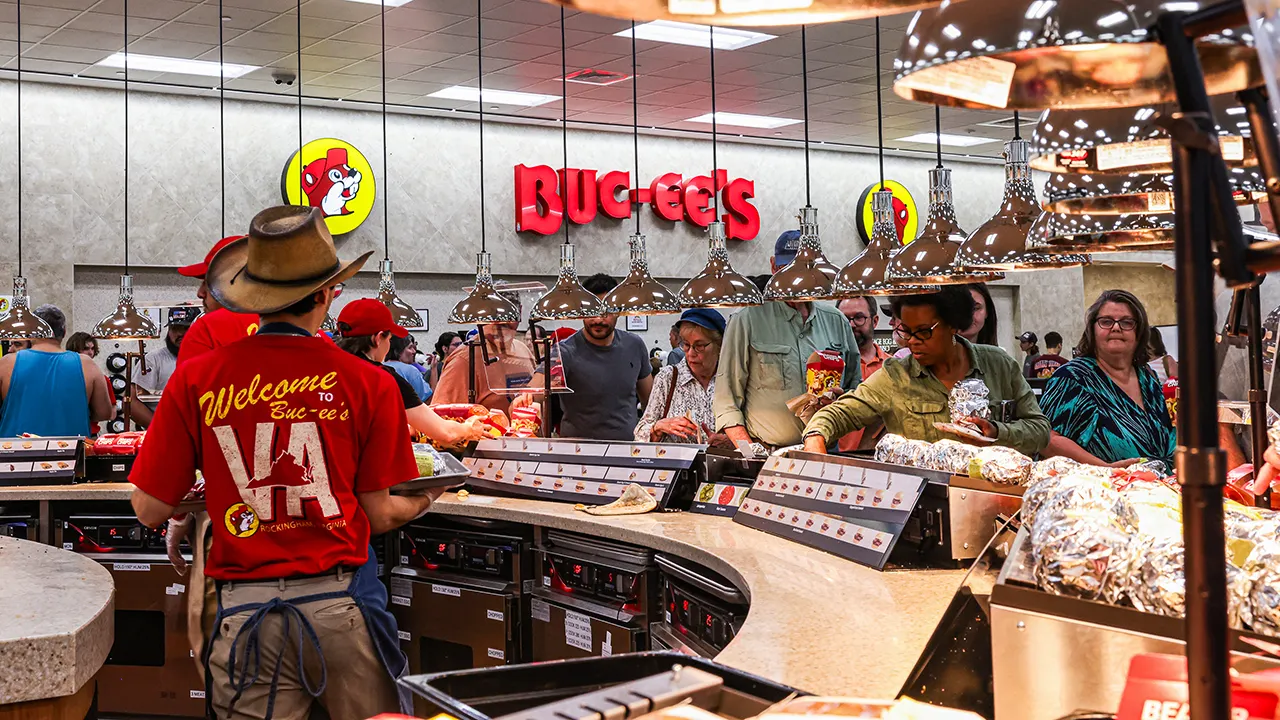
Visitors shop for brisket sandwiches at the first Buc-ee’s to open in Virginia on July 2, 2025. (Getty Images)
“Buc-cee’s has TERRIBLE customer service,” a January complaint says, referencing a lost or stolen gift card. “They have no phone number for you to call, only email. I have filled out their form with all of the information multiple times and have yet to hear back from them. I just want my gift card that I paid for and want them to treat their customers better.”
Advertisement
Buc-ee’s did not immediately respond to Fox News Digital’s request for comment.
Customers shop for apparel inside the Buc-ee’s store on June 12, 2024, in Luling, Texas. (Getty Images)
Despite the recent failing grade, Buc-ee’s has not dampened its expansion momentum. The company currently has 54 U.S. locations across 11 states, with plans to expand into Ohio, Arizona, Arkansas, Kansas, Louisiana, Nebraska, North Carolina and Wisconsin.
Buc-ee’s large-format stores span tens of thousands of square feet, featuring 120 gas pumps on average and 700 to 1,000 parking spaces. Signature items like Beaver Nuggets and “fresh brisket on the board” have become regular road trip staples.
Sykon Capital president and CIO Todd Stankiewicz analyzes potential risks among some private equity names and more on ‘Making Money.’
The company ranked No. 5 in the 2025 American Customer Satisfaction Index for convenience stores, beating out major brands like Shell and ExxonMobil. In late 2025, Buc-ee’s earned America’s No. 1 quick-service restaurant spot in dunnhumby rankings, outperforming fast-food giants like In-N-Out and Chick-fil-A for customer preference.
The chain has also gained notoriety for its transparency in wages – starting pay can range from $16 to $20 per hour and full-time managers may earn $100,000 to $225,000, according to large hiring signs often posted at store entrances. Employee benefits include 401(k) plans with 100% company matching and three weeks of paid time off.
The latest round has been led by growth capital investor BGF
14:31, 10 Mar 2026Updated 14:32, 10 Mar 2026
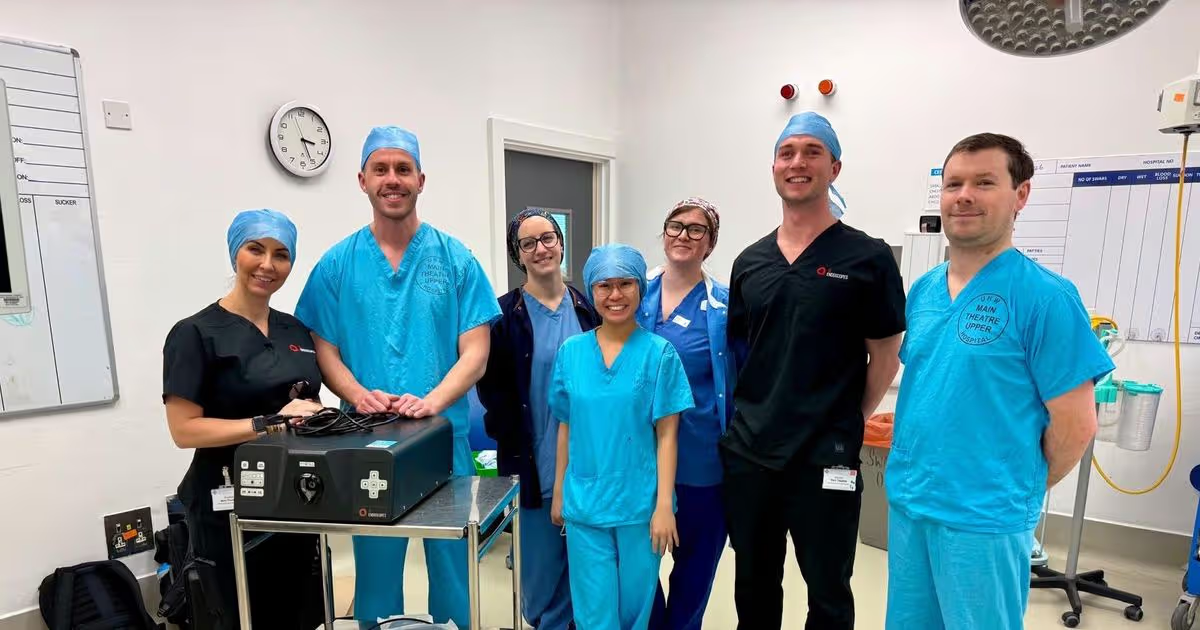
The clinical team at IQ Endoscopes.
Cardiff-based medical devices firms IQ Endoscopes has been boosted with a multi-million-pound new equity round to support its commercialisation drive.
The company is developing a single‑use gastrointestinal endoscopy platform designed to improve patient access to endoscopy and help healthcare providers respond to growing demand.
Advertisement
Its latest round of funding led by BGF, which has also seen follow on investment by the Development Bank of Wales, will be used to support IQ Endoscopes’ early commercial rollout in selected UK centres, strengthen manufacturing and supply chain capability, and build a robust commercial pipeline, as the company prepares for future scale‑up in the UK and overseas. The investment will also support further regulatory work and market validation in the US.
Existing reusable endoscopes create significant time burden and carbon emissions due to complex decontamination and transport processes, contributing to hospital capacity constraints and workflow inefficiencies. IQ Endoscope provides sustainable alternative designed to do the opposite, freeing up beds and physician capacity.
Since being established it has secured key regulatory approvals and commenced production. The company has identified its first customers, received initial orders and is now preparing for early commercial use of its platform. The business currently employs 20.
Advertisement
The exact value of its latest funding round has not been disclosed.
Matt Ginn, IQ Endoscopes chief executive, said: “This investment is a significant step forward as we move into the next phase of our growth. It allows us to begin early commercial rollout in the UK, strengthen our operational foundations and build momentum for future expansion.
“Support from BGF and the Development Bank of Wales has been instrumental in helping us reach this point, and we’re excited to continue to work closely alongside them as we bring our technology into real‑world clinical use.”
Maggy Lau, investor at BGF said: “IQ Endoscopes is addressing a clear challenge facing healthcare systems, with a product that has the potential to make a lasting, positive impact. We’re pleased to continue to support Matt and the team as the business moves into this exciting next stage of growth.”
Advertisement
Tom Davies, investment executive with the Development Bank of Wales said: “We’re proud to continue supporting IQ Endoscopes as it enters its next growth phase. The team’s progress in manufacturing and early clinical use is impressive, and this investment will help accelerate adoption of a technology that could enhance patient access and strengthen endoscopy services across the NHS and beyond.”
Motilal Oswal Financial Services’ wealth management arm on Tuesday launched a digital bonds trading platform to enable investors to access fixed income securities.
The company said its newly launched Bond Provider Platform will allow investors to invest in government securities, PSU bonds and corporate bonds through a dedicated digital interface.
The move comes as the domestic bond market expands and investors increasingly seek predictable returns and capital preservation alongside equity investments. India’s bond market has grown to nearly USD 3 trillion, making it the third-largest in Asia after Japan and China, and equivalent to roughly 100-110 per cent of India’s GDP, a release said. “With Indian households increasingly allocating savings to financial assets and the inclusion of Indian government bonds in global indices expected to bring strong foreign inflows, the opportunity in fixed income is becoming more compelling,” said Ajay Menon, managing director and chief executive officer of wealth management at Motilal Oswal Financial Services.
Live Events
The new bond platform comes at a time of heightened geopolitical tensions and global market uncertainty that have increased volatility in equity markets, prompting investors, particularly high-net-worth individuals, to increase allocations to fixed income, the company said. Ashish Malaviya, head of distribution at Motilal Oswal Wealth Management, said that amid rising equity market volatility driven by global developments, investors, particularly HNIs, are increasingly seeking capital protection, predictable income, and portfolio stability.














.webp?t=1773154977)