Connect with us
DAPA Banner
DAPA Coin
DAPA
COIN PAYMENT ASSET
PRIVACY · BLOCKDAG · HOMOMORPHIC ENCRYPTION · RUST
ElGamal Encrypted MINE DAPA
🚫 GENESIS SOLD OUT
DAPAPAY COMING

Business

Talent chief shares what employers want in today’s job market amid rise of AI

Published

on

Talent chief shares what employers want in today's job market amid rise of AI

As artificial intelligence reshapes workplaces across industries, one hiring executive says job seekers worried about AI replacing them may be focusing on the wrong challenge.

Instead of looking for candidates with years of AI experience, employers increasingly want workers who can prove they’re willing to learn, according to Sultan Khan, head of talent acquisition and human resources at San Francisco-based OpenArt AI.

Advertisement

“The willingness to learn is the biggest thing that we really need right now,” Khan told FOX Business. “The people that are open to learning are the ones that we’re seeing grab jobs really quickly in this current landscape.”

His comments come as employers increasingly seek workers with AI skills. According to PwC’s 2025 AI Jobs Barometer, the skills required for AI-exposed jobs are changing 66% faster than in other occupations, while workers with AI skills receive an average 56% wage premium compared with those in similar roles.

DIMON URGES CALM OVER FEAR ABOUT AI’S IMPACT ON JOBS: ‘STOP BEING BREATHLESS OVER IT’

AI applications are shown on a smartphone screen

Instead of looking for candidates with years of AI experience, employers increasingly want workers who can prove they’re willing to learn, Sultan Khan said. (Philip Dulian/dpa/Getty Images)

OpenArt, an AI-powered creative platform with more than 8 million monthly users, has grown its workforce by roughly 300% over the past seven to eight months, according to Khan, and is hiring across engineering, product, design, marketing and creative roles.

Advertisement

But Khan said resumes packed with years of AI experience aren’t necessarily what stand out.

“I think the biggest thing that helps make people stand out to me is when I see that they’ve done a lot of side projects or a lot of learning,” he said, pointing to applicants who complete AI courses, earn certifications or experiment with AI tools on their own.

Because generative AI remains relatively new, Khan said recruiters understand many applicants won’t have years of hands-on experience. Instead, he said, hiring managers are looking for people who show curiosity and adaptability.

CALIFORNIA LAWMAKERS WARN NEWSOM BUDGET TAX CREDIT CAP THREATENS HOLLYWOOD JOBS

Advertisement
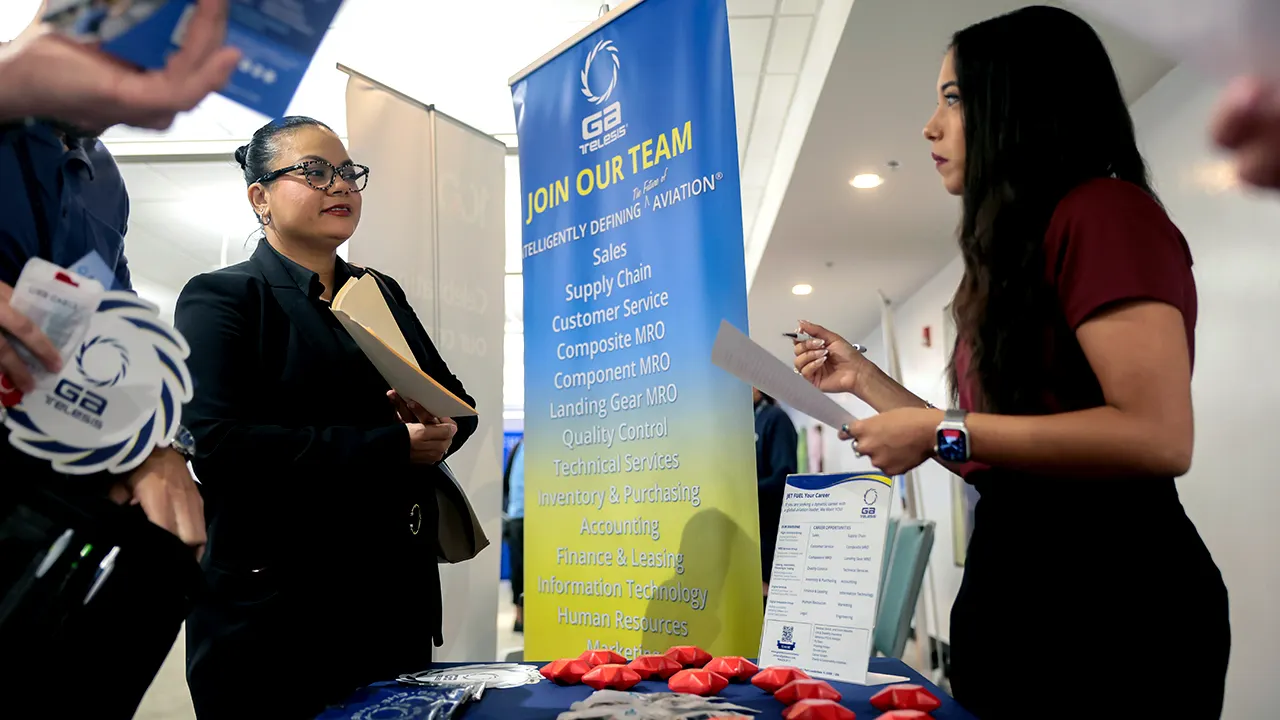
Job seekers and employers at a job fair.

Khan said resumes packed with years of AI experience aren’t necessarily what stand out. (Angus Mordant/Bloomberg)

“The curiosity is another big thing,” Khan said. “The ones that are really eager and willing to learn how to adapt it into their current workflow are the ones that are getting tons of calls from recruiters.”

That mindset isn’t limited to software engineers.

While OpenArt is recruiting engineers and product managers, Khan said the company is also hiring creative directors, designers and video editors who want to incorporate AI into visual storytelling.

“AI isn’t the creative aspect of things,” Khan said. “It’s the human behind it. AI only does what you tell it to do.”

Advertisement

META EMPLOYEES SUE ON ALLEGATIONS COMPANY USED AI TO TARGET WORKERS ON MEDICAL, PARENTAL LEAVE FOR LAYOFFS

A job seeker attends a career fair in California

Khan’s advice for recent college graduates is to start using AI before an employer asks you to. (Photographer: Eric Thayer/Bloomberg via Getty Images)

Khan acknowledged concerns that AI could replace workers but argued the technology is more likely to change existing jobs than eliminate them.

“AI isn’t going to eliminate jobs,” he said. “It’s just going to transform jobs as a whole.”

His outlook echoes part of a broader trend identified by the World Economic Forum, which estimated in its 2025 Future of Jobs Report that technological advances, including AI, could create 170 million new jobs globally while displacing 92 million by 2030, resulting in a net gain of 78 million jobs. The report also found employers increasingly expect workers to build AI-related skills as adoption spreads.

Advertisement

For recent college graduates entering an uncertain labor market, Khan’s advice is straightforward: start using AI before an employer asks you to.

CLICK HERE TO GET FOX BUSINESS ON THE GO

He recommends researching the AI platforms commonly used in a chosen field, building projects with those tools and showcasing that work on resumes and LinkedIn profiles.

“The biggest takeaway is really to start learning how to adopt into the AI space rather than only putting it under a negative light,” Khan said.

Advertisement
Continue Reading
Click to comment

You must be logged in to post a comment Login

Leave a Reply

Business

what Burnham’s tax plans mean for SMEs

Published

on

Record January surplus boosts public finances as tax receipts surge

Rachel Reeves has been sacked as chancellor in one of Andy Burnham’s first acts as prime minister, and the new occupant of No 10 wasted little time signalling where the tax burden could shift next: a possible income tax cut for lower earners, no promise to spare higher earners a 50p rate, and billions more borrowed for infrastructure.

Reeves, who does not appear to have taken another Cabinet job, departed with a defence of her record. “It has been the privilege of my life to serve as the Chancellor of the Exchequer,” she said. “The economy today is stronger, fairer and more resilient because of the choices we have taken as a Labour Government over the past two years.”

She added: “I said when I was appointed Chancellor that I would judge my time in office if the lives ordinary working class people have been improved. I’m proud to say that they have.

“And to every young woman and girl let my time in office show there should be no ceilings on your ambitions, your hopes or your dreams.”

Her successor has yet to be confirmed, with the runners and riders for No 11 ranging from Wes Streeting to Ed Miliband. Whoever gets the job will inherit a Budget in-tray already half written by their new boss.

Advertisement

Burnham said he will look at cutting income tax for lower earners in the autumn Budget, singling out the personal allowance, frozen at £12,570 for the past five years, as a priority.

“I heard issues related to the personal allowance more than anything on doorsteps in Makerfield,” he said, arguing the freeze “has dragged more people in”, pensioners among them, and “has become a growing issue”.

He is not wrong about the drag. HMRC figures last year showed the freeze had pulled 420,000 more pensioners into the income tax net in a single year. For employers, any thaw would put more take-home pay in staff pockets without adding a penny to the payroll bill, a rare Budget measure SMEs could cheer.

The picture is less comfortable at the top of the income scale. Asked whether he could raise the top rate of income tax from 45p to 50p, as he has previously proposed, Burnham declined to rule it out. “I think that would be just premature to say that. I’ve barely got my feet under the table,” he said.

Advertisement

That ambiguity leaves higher-earning owner-directors guessing until the autumn, and it sits alongside his earlier pledge of a 20 per cent business rates cut for pubs and high street firms, funded by higher levies on online retailers’ warehouses. The direction of travel is clear: relief at the bottom, and the bill sent elsewhere.

On borrowing, Burnham said he will use “any flexibility” in the government’s fiscal rules to fund infrastructure investment. Experts say a change in the definition of public debt could free up an extra £16 billion, because the National Wealth Fund and other institutions can now lend or take stakes in companies without affecting the debt target.

“I’ve said we’ll stick to the fiscal rules and by that I mean the existing fiscal rules and use obviously any flexibility within them,” he said. “But we will stick to the existing rules and I’ve made that very clear in Downing Street. So none of this is about taking risks with the economy. I’ve never done that in any role that I’ve had.”

For construction, engineering and supply-chain SMEs, £16 billion of infrastructure spending is a pipeline worth watching. For everyone else, the message from the new prime minister is to keep an eye on the autumn Budget, and perhaps on the 50p rate he has conspicuously declined to bury.

Advertisement

Paul Jones

Harvard alumni and former New York Times journalist. Editor of Business Matters for over 15 years, the UKs largest business magazine. I am also head of Capital Business Media’s automotive division working for clients such as Red Bull Racing, Honda, Aston Martin and Infiniti.

Advertisement
Continue Reading

Business

Iberdrola to Take Control of Finnish Utility Caruna for $2.3 Billion

Published

on

Iberdrola to Take Control of Finnish Utility Caruna for $2.3 Billion

Iberdrola IBE said it reached a deal to buy a majority stake in Finland’s main electricity distributor for 2.01 billion euros ($2.29 billion).

The acquisition of 80% of the share capital of Caruna Group strengthens the Spanish utility’s position in Finland, which it called “a market with high credit quality and a stable and attractive regulatory framework.”

Copyright ©2026 Dow Jones & Company, Inc. All Rights Reserved. 87990cbe856818d5eddac44c7b1cdeb8

Continue Reading

Business

Union plans East Midlands Railway strikes over train safety concerns

Published

on

Two young women surrounded by studio lights and tripods selling eyelash serums on a live stream

According to the RMT, EMR has been sending trains into service that are “likely to fail and require a full reset which leaves the train with no active safety systems”.

The BBC has seen an operational briefing, which informs control, signalling and operations staff about undertaking an Aux Off / Aux On reset on EMR class 810 units – which may be required to recover certain faults.

“The process takes approximately 20 minutes and results in the temporary loss of several safety-critical systems, creating an increased risk of an uncontrolled evacuation and removing the driver’s normal means of communication with the signaller,” it states.

Eddie Dempsey, RMT general secretary, said RMT reps at EMR had been “extremely patient” and tried to engage with management.

Advertisement

“The company has even put out safety notices with no involvement, consultation or negotiation with our reps who represent those most at risk.

“RMT is demanding that whilst these faults exist and until these trains are shown to be operating properly, they should be taken out of service,” he said.

An EMR spokesperson said the Hitachi Rail Class 810 fleet entered passenger service after “successfully completing all required testing and meeting rigorous safety standards”.

“We recognise the Class 810 fleet has encountered performance and reliability issues in service and are working with the manufacturer, Hitachi Rail, to resolve these issues as quickly as possible,” the spokesperson added.

Advertisement

EMR said the rollout of the new Class 810 fleet would continue “in a controlled manner” throughout the rest of the year and 2027.

A Hitachi Rail spokesperson said: “The Class 810 fleet has been in passenger service with East Midlands Railway since December 2025, and more than a third of the fleet has now been delivered.

“Hitachi Rail continues to work closely with all industry partners during the entry-into-service phase of the Class 810 fleet, implementing improvements and supporting the transition from the existing fleet to new Aurora trains.

“We remain focused on delivering the remainder of the fleet and supporting East Midlands Railway as more new trains enter passenger service. As part of this commitment, we are investing in additional testing activity at Long Marston Rail Innovation Centre to improve fleet introduction and delivery of the remaining trains.”

Advertisement
Continue Reading

Business

New indoor market plans for Llanelli

Published

on

Business Live

The current building dates from the 1970s

Artist impression of indoor market in Llanelli.

An image of the proposed new indoor market on Vaughan Street, Llanelli(Image: Carmarthenshire Council)

Images of a new indoor market planned in Llanelli have been released.

Advertisement

The plan is for 14 retail units on the ground floor of the Vaughan Street complex, 80 stalls on the first floor, and a central glass atrium above. There’d be bike racks and escalators and all toilets would be on the first floor. Deliveries would be via Mincing Lane at the rear along with a few parking spaces close by.

The current market building with its multi-storey car park above dated from the 1970s and contained a material called reinforced autoclaved aerated concrete which is less durable than standard concrete and can fail when exposed to moisture.

It said the council undertook significant work in 2013 to maintain the building’s structural safety along with ongoing maintenance.

Options were explored such as distributing stalls and units throughout the town and reusing the existing site once the car park was demolished. The council’s preferred option is a new-build market between 8-14 Vaughan Street extending a long way to the rear. Six of the ground-floor retail units would face onto Vaughan Street and the market’s total area would be 3,312sq m.

Advertisement
Artist impression of indoor market in Llanelli.

How the market could look inside(Image: Carmarthenshire Council )

Artist impression of indoor market in Llanelli.

An image of the proposed new indoor market on Vaughan Street, Llanelli(Image: Carmarthenshire Council)

“Internally each floor has a distinct identity and character,” said the design and access statement. “The internal route is deliberately meandering, encouraging visitors to explore past retail and market stalls. the first floor is more informal and accommodates the majority of market stalls. It also features a large café, visible from the entrance, which naturally draws visitors through the building and up to the first floor.”

The new plans had split opinions amongst stallholders.

Miriam Phillips, who runs a fruit and veg stall at the current market by St Elli Shopping Centre, said of the plans: “They look all right so far. It’s still early days.” She said traders had a meeting with council representatives about them last week.

Parvez Akhtar, of Parvez Fashions, said he was “totally against” the proposals and called on the council to upgrade the current market and focus on filling empty shops in Llanelli. He felt the new market would be “very small” and deter people from visiting. “We need space and to display our products,” he said.

Advertisement

Fellow trader Gabor Hetesi, of IT repair business Gabe’s IT Repair, was optimistic about the plans but wondered about timescales and what the new rental arrangements would be. “The plans are looking good, it looks promising,” he said.

The council is asking for people’s views on the proposals by August 7 ahead of a full planning application being submitted.

Artist impression of indoor market in Llanelli.

Night-time image of the planned market(Image: Carmarthenshire Council )

Artist impression of indoor market in Llanelli.

(Image: Carmarthenshire Council )

Cllr Hazel Evans, deputy council leader and cabinet member for regeneration, leisure, culture, and tourism, said: “These proposals represent an exciting opportunity to create a modern new home for Llanelli Market and further strengthen Llanelli town centre.

“Through the pre-application consultation process we want to hear the views of residents, businesses, and stakeholders to help shape the proposals before a planning application is submitted.”

Advertisement

She added: “It is important to emphasise that Llanelli Market will remain open and continue trading throughout this process with any future relocation carefully planned to support traders and customers.

“Our ambition is to create a vibrant destination that supports traders, attracts visitors, and builds on Llanelli Market’s proud history at the heart of the community.”

Continue Reading

Business

Delek US Holdings: Exiting Before Earnings

Published

on

Valero Energy: A Great Business At The Wrong Price (NYSE:VLO)

Delek US Holdings: Exiting Before Earnings

Continue Reading

Business

The Campbell’s Co. delivers protein-packed soups

Published

on

The Campbell’s Co. delivers protein-packed soups

Available in five varieties, the soups contain 20 grams of protein.

Continue Reading

Business

Thailand Update: Major Stories in Politics, Economy, Tourism, and Society

Published

on

Major Events in Politics, Economy, Tourism, and Society

Thailand News Roundup: Diplomacy, Economy, and Society in Focus

Thailand has featured prominently across international media in recent days, with stories spanning diplomatic tensions, security concerns, tourism developments, and major infrastructure projects. This summary consolidates the key themes emerging from recent coverage.

Regional Diplomacy and Border Tensions

Thailand’s relationship with Cambodia remains a central geopolitical storyline, with Chinese President Xi Jinping repeatedly urging both nations to resolve their border dispute through dialogue rather than confrontation. China has also sought to reassure Thailand that tanks being delivered to Cambodia will not be used against Thai forces, reflecting Beijing’s delicate balancing act as a regional mediator. These diplomatic efforts extend to broader discussions on UNCLOS maritime talks and shared Gulf energy resources, though Thailand and Cambodia appear to diverge on how to jointly unlock potentially massive oil and gas reserves in contested waters. For businesses monitoring regional stability, these developments carry significant implications for cross-border trade and investment confidence, a topic frequently covered by Thailand Business News.

Security and Public Safety Incidents

A deadly Bangkok bar fire that killed at least 28 people has prompted a government probe into possible negligence, with Thailand’s Prime Minister personally visiting the site and public debate intensifying around fire safety regulations. Separately, China has requested that Thailand deport a Chinese journalist, a move that human rights organizations warn could expose the individual to persecution—raising questions about Thailand’s role in balancing diplomatic relations with human rights obligations. In another notable case, an alleged Russian FSB hacker who traveled to Thailand now faces a potential 10-year prison sentence in the United States, highlighting Thailand’s continued relevance as a transit point in international law enforcement matters.

Tourism Sector Transformation

Thailand is aggressively repositioning its tourism industry toward sustainability and high-value travelers. The government has set an ambitious target of attracting 33 million international tourists by 2027, paired with a broader sustainable tourism strategy. Partnerships such as the collaboration between AWC and SCB aim to advance sustainable tourism infrastructure, while Thailand is also pursuing high-spending tourist segments more aggressively than in previous years. Notably, the country has scrapped plans to end visa-free entry for Indian tourists, signaling a preference for maintaining open access policies to sustain visitor volumes. Airport modernization is another priority, with Thai Aviation Industries partnering with Edgewater and Amadeus to introduce biometric systems at Suvarnabhumi and Don Mueang airports, enhancing security and streamlining passenger processing for millions of travelers annually, according to Thailand Business News.

Advertisement

Medical tourism is also receiving renewed attention, with Thailand Health Excellence 2026 announcing partnerships with Airbnb and Huawei’s HarmonyOS to offer enhanced services to medical tourists and loyalty program members.

Economic and Trade Developments

Thailand faces mounting external economic pressures, including potential Section 301 risks from the United States over forced-labor concerns in its export sector, alongside broader tariff pressure prompting intensified US trade talks. The country is also bracing for fuel and trade shocks stemming from disruptions along two critical Middle East shipping routes. Domestically, the government has tightened welfare card eligibility, cutting the qualifying population by 28%, reflecting fiscal recalibration efforts. Meanwhile, the Stock Exchange of Thailand has been noted as underperforming relative to regional peers, raising questions about investor confidence.

On a more positive note, China-Thailand economic ties continue to deepen, exemplified by an investment and economic forum in Chengdu and Thailand’s exploration of high-tech partnerships with Chongqing and Sichuan. Automotive investment remains robust, with BYD Thailand surpassing 130,000 cumulative vehicle deliveries and Changan Automobile’s chairman meeting with Thai Prime Minister Anutin Charnvirakul to reinforce the “In Thailand, For Thailand” commitment.

Infrastructure and Sustainability Initiatives

Thailand has approved new measures to boost clean energy markets and is advancing several infrastructure projects, including a 12-billion-baht cruise terminal at Koh Samui and the testing of its first in-house-developed tram and light rail track. The World Bank Group has also extended new support to help Thailand scale low-carbon cities and carbon markets, while a joint China-Thailand meteorological laboratory has launched to improve prediction and early warning of weather disasters—an increasingly urgent priority given forecasts of heavy rain and flash flooding across the country.

Advertisement

Culture, Sports, and Society

Thailand’s cultural profile continues to expand internationally, with a Thai Festival showcasing the nation’s cuisine and creativity in London, and Chiang Mai’s Lanna Heritage advancing toward UNESCO World Heritage recognition. In archaeology, workers excavating beneath a 1,300-year-old reclining Buddha uncovered ancient gold and silver artifacts, while separate digs revealed skeletal remains with 2,000-year-old gold rings.

On the sports front, Thailand’s men’s volleyball team secured bronze at the SEA V Cup after defeating Vietnam, though the women’s team was upset by Cambodia in the semifinals. Additionally, Princess Anne’s visit to meet Thailand’s Queen Suthida in Bangkok underscored continued warm diplomatic ties between Thailand and the United Kingdom.

Conclusion

Thailand’s news landscape reflects a nation navigating complex diplomatic waters while pursuing ambitious economic modernization and tourism growth. From border tensions with Cambodia to sweeping infrastructure investments and cultural recognition efforts, Thailand continues to balance regional stability with domestic development priorities, positioning itself as a pivotal player in Southeast Asian affairs.

Source : Google News – Search

Advertisement

Continue Reading

Business

Is Claude AI Down Right Now? Anthropic Reports Brief, Scattered Service Disruptions This Week Only

Published

on

Claude
Claude
Is Claude AI Down Right Now? Anthropic Reports Brief, Scattered Service Disruptions This Week Only

Claude, the AI chatbot developed by Anthropic, has experienced a series of brief, intermittent service disruptions over the past two days, according to outage-tracking platforms monitoring the service, though the tool has largely remained operational for most users during that period.

According to status-monitoring service StatusGator, Claude experienced several short-lived incidents on Monday and Tuesday, including a period of elevated errors across multiple models beginning at 10:13 a.m. Tuesday that lasted approximately one hour, as well as earlier elevated error periods specifically affecting Anthropic’s Haiku 4.5 model. A separate, brief outage was recorded early Tuesday, lasting roughly 31 minutes, according to the same tracking service. StatusGator’s most recent check, conducted at 11:18 a.m. UTC Tuesday, found the service operational, though the platform noted 59 user-submitted outage reports over the preceding 24 hours.

Scattered reports across multiple tracking platforms

Other outage-monitoring services reported similar, generally minor disruptions. Community discussion boards on DesignTAXI noted rising outage reports on Downdetector beginning around 9:56 p.m. Eastern time Sunday night, with additional reports continuing into Monday and Tuesday. Separately, monitoring service Pulsetic flagged a minor issue beginning around 1:04 p.m. UTC Tuesday, noting that the issue had since been identified with a fix in progress, according to the platform’s tracking data.

By contrast, status-tracking site Entireweb reported that Claude was “operating normally” as of its most recent check Monday, recording 118 user reports over the preceding 24 hours, with only a small number of those reports occurring within the final hour before the check, suggesting any issues affecting the service were relatively contained and short-lived rather than reflecting a sustained, widespread outage.

Advertisement

A pattern of brief, recurring incidents

Data compiled by StatusGator shows Claude has experienced a series of short-duration incidents over recent weeks, most lasting under two hours and affecting specific components or models rather than the service as a whole. Recorded incidents have included issues such as messages failing to send within the Claude AI desktop application, temporary unavailability of chat history and project access, and periods of elevated API error rates affecting specific models, including Anthropic’s Fable 5 and Sonnet 5 systems.

Separately, StatusGator’s tracking of Anthropic’s broader Claude Code product, a tool used by software developers, noted a partial outage affecting several components, including Claude Console, Claude Cowork and claude.ai, though the platform indicated that issue had since been resolved following seven user-submitted reports over the prior 24-hour period.

What typically causes these disruptions

Advertisement

Brief, scattered service disruptions of the kind reported this week are common across major AI chatbot platforms, often stemming from backend infrastructure issues, elevated demand on specific underlying models, or targeted technical problems affecting individual product components rather than the service as a whole. Given the complexity of large-scale AI systems, which typically rely on multiple interconnected models and infrastructure layers, momentary spikes in error rates affecting one specific model or feature do not necessarily indicate a broader systemic failure across the entire platform.

How outage tracking works

Services like StatusGator, Downdetector, Pulsetic and Entireweb rely primarily on a combination of user-submitted reports and automated monitoring systems that continuously check a given service’s response times and availability. Because these platforms depend heavily on real-time user input, the reported scale of an outage can sometimes fluctuate quickly, with report volumes rising and falling within a short window as issues are identified and resolved, or as affected users regain access to the service.

What users experiencing issues should do

Advertisement

Users who encounter difficulties accessing Claude are generally advised to first check whether the issue is specific to their individual device, browser or network connection before assuming a broader service-wide problem is underway. If problems persist across multiple attempts or devices, checking official outage-tracking platforms or Anthropic’s own status page can help confirm whether a wider service disruption is currently affecting other users as well.

A service that has remained largely reliable overall

Despite the scattered incidents reported this week, the overall pattern reflected in tracking data suggests Claude has remained largely operational and reliable for the vast majority of users throughout the period in question, with individual incidents generally resolving within minutes to a couple of hours rather than persisting as extended, widespread outages.

What comes next

Advertisement

As of the most recent available status checks, Claude appears to be functioning normally for most users, with tracking services showing no signs of an ongoing, large-scale outage at this time. Given the recurring pattern of brief, model-specific incidents observed over the past several weeks, users experiencing occasional errors or slow response times may continue to see intermittent disruptions, though historical data suggests such issues have consistently been resolved relatively quickly rather than developing into extended service outages.

Continue Reading

Business

Building an AI-Ready Organization: A Leadership Guide for Digital Transformation

Published

on

Building an AI-Ready Organization: A Leadership Guide for Digital Transformation

Digital transformation is no longer a future ambition—it’s a present-day necessity. Organizations across every industry are adopting artificial intelligence to improve decision-making, automate repetitive work, personalize customer experiences, and uncover new business opportunities. Yet many companies discover that purchasing AI tools is the easy part. The real challenge lies in preparing the organization itself to embrace change.

Successful AI adoption isn’t driven solely by technology. It depends on leadership, culture, processes, and people. Companies that thrive understand that becoming AI-ready is an organizational transformation rather than a software implementation. Leaders who recognize this distinction position their businesses for long-term success while avoiding costly mistakes that often accompany rushed digital initiatives.

One of the biggest misconceptions about AI is that it simply replaces existing workflows. In reality, it reshapes how teams collaborate, communicate, and solve problems. Just as businesses rely on the best video maker online to simplify creative production without replacing human creativity, AI works best when it enhances employees’ capabilities instead of attempting to replace them entirely. The goal is to empower people with smarter tools while allowing them to focus on strategic thinking, innovation, and meaningful customer interactions.

What Does It Mean to Be AI-Ready?

An AI-ready organization has more than modern software or powerful hardware. It possesses the mindset, infrastructure, and leadership needed to continuously adapt as technology evolves.

Advertisement

Being AI-ready typically involves:

  • High-quality, accessible business data
  • Clear strategic objectives for AI initiatives
  • Employees who understand and trust AI tools
  • Leadership committed to responsible innovation
  • Processes that encourage continuous learning

Organizations that skip these foundational elements often struggle with disappointing AI projects, despite significant investments.

Leadership Sets the Direction

Technology initiatives often succeed or fail because of leadership rather than technical capability. Employees naturally look to executives and managers for guidance during periods of change.

Strong leaders don’t simply announce an AI strategy—they communicate the purpose behind it.

Instead of saying:

Advertisement

“We’re implementing AI because everyone else is.”

Effective leaders explain:

“We’re adopting AI so our employees spend less time on repetitive tasks and more time solving meaningful customer problems.”

That subtle difference creates alignment instead of uncertainty.

Advertisement

Transparent communication also reduces resistance. Employees are more likely to embrace AI when they understand how it supports their work rather than threatens their roles.

Build a Culture That Welcomes Change

Digital transformation isn’t a one-time project. It’s an ongoing evolution that requires flexibility across every department.

Organizations with adaptable cultures share several characteristics:

They Encourage Experimentation

Not every AI initiative will succeed immediately. Teams should feel comfortable testing ideas, measuring outcomes, and learning from failures without fear of punishment.

Advertisement

Small pilot programs often produce valuable insights before larger investments are made.

They Reward Learning

Technology evolves quickly. Continuous education helps employees stay confident rather than overwhelmed.

This may include:

  • Internal workshops
  • Online certifications
  • AI awareness sessions
  • Cross-functional knowledge sharing

Companies that invest in learning often see higher employee engagement throughout transformation efforts.

Data Is the Foundation of AI

AI systems are only as effective as the information they receive.

Advertisement

Before launching sophisticated AI initiatives, organizations should examine their data quality.

Questions leaders should ask include:

  • Is our data accurate?
  • Are departments using consistent information?
  • Can teams easily access the data they need?
  • Are privacy and security standards in place?

Poor data leads to unreliable AI recommendations, reducing trust throughout the organization.

Investing in data governance early prevents larger problems later.

Empower Employees Instead of Replacing Them

One of the biggest fears surrounding AI involves job security.

Advertisement

Forward-thinking organizations address this concern directly.

Rather than positioning AI as a replacement, they present it as a productivity partner.

For example:

A customer service representative can use AI to summarize conversations before responding to customers.

Advertisement

A marketing specialist can generate content ideas faster while still applying human creativity and brand judgment.

A financial analyst can automate repetitive reporting while dedicating more time to strategic planning.

These examples demonstrate that AI amplifies expertise rather than eliminating it.

Create Cross-Functional Collaboration

AI initiatives rarely belong to one department.

Advertisement

Successful implementations often involve collaboration between:

  • IT teams
  • Human resources
  • Operations
  • Marketing
  • Legal
  • Finance
  • Executive leadership

Each department brings unique perspectives that improve decision-making.

For example, while data scientists may understand algorithms, HR teams understand employee concerns, and legal departments ensure compliance with regulations.

Cross-functional collaboration minimizes blind spots and improves adoption across the business.

Focus on Business Problems, Not Technology

Many organizations become distracted by the latest AI tools instead of identifying the problems they actually need to solve.

Advertisement

A more effective approach starts with business objectives.

Examples include:

  • Reducing customer response times
  • Improving demand forecasting
  • Increasing employee productivity
  • Detecting fraud more efficiently
  • Personalizing customer experiences

Once the business challenge is clearly defined, selecting the appropriate AI solution becomes much easier.

Technology should always support strategy—not replace it.

Responsible AI Builds Long-Term Trust

As AI becomes increasingly integrated into business operations, ethical considerations become more important.

Advertisement

Responsible AI practices include:

Transparency

Employees and customers should understand when AI contributes to decisions.

Fairness

Organizations should regularly monitor AI systems for bias and unintended discrimination.

Privacy

Customer and employee data must be handled responsibly and securely.

Advertisement

Accountability

Humans should remain responsible for significant decisions, especially in hiring, healthcare, finance, and legal processes.

Companies that prioritize responsible AI strengthen trust among employees, customers, and stakeholders.

Measure Progress Beyond ROI

Financial returns matter, but they’re only one indicator of successful transformation.

Leaders should also monitor:

Advertisement
  • Employee adoption rates
  • Customer satisfaction
  • Productivity improvements
  • Process efficiency
  • Innovation outcomes
  • Training participation

These metrics provide a broader understanding of organizational maturity.

Transformation is ultimately about creating sustainable improvements rather than achieving short-term financial gains.

Learn from Real-World Success

Many leading organizations began their AI journey with relatively modest initiatives.

A manufacturer might first use predictive maintenance to reduce equipment downtime.

A retailer may introduce AI-powered inventory forecasting before expanding into personalized shopping experiences.

Advertisement

A healthcare provider could automate appointment scheduling before implementing advanced diagnostic support.

These gradual successes build confidence, develop internal expertise, and create momentum for larger transformation projects.

Organizations that attempt to overhaul every process simultaneously often encounter unnecessary complexity and employee fatigue.

Starting small and scaling strategically produces stronger long-term results.

Advertisement

Prepare for Continuous Evolution

AI technology will continue advancing rapidly over the coming years. New models, automation capabilities, and analytical tools will emerge faster than many organizations can fully implement them.

Rather than chasing every innovation, successful leaders establish adaptable systems capable of evolving over time.

This includes regularly reviewing AI strategies, updating employee skills, improving governance, and reassessing business priorities.

Organizations that remain flexible are far better positioned to capitalize on future opportunities while minimizing disruption.

Advertisement

Conclusion

Building an AI-ready organization requires much more than adopting cutting-edge technology. It demands visionary leadership, a culture of continuous learning, reliable data, responsible governance, and a commitment to empowering people alongside intelligent systems.

The organizations that succeed won’t necessarily be those with the biggest technology budgets. They’ll be the ones whose leaders inspire confidence, encourage innovation, and create environments where employees and AI work together to solve meaningful business challenges. By focusing on people as much as technology, businesses can build a resilient foundation for digital transformation that delivers lasting value in an increasingly AI-driven world.

Continue Reading

Business

Record student loan defaults: 9.5M borrowers in default, data shows

Published

on

Record student loan defaults: 9.5M borrowers in default, data shows

Student loan defaults are up to a record high, with 9.5 million borrowers in default, meaning they are more than 270 days behind on loan payments, according to data from the Office of Federal Student Aid. 

The near-10 million borrowers in default represent a record-high and nearly double the number in default at the nadir of a pandemic-prompted moratorium on student loan payments enacted by former President Joe Biden. 

Advertisement

In March 2025, months after a default-halting payment pause that Biden signed at the onset of the COVID-19 pandemic ended, the U.S. had 5.3 million borrowers in default. 

The Biden-era moratorium technically ended in January 2024, but the former president tacked on a 9-month extension that lasted until September 2024. With borrowers having 270 days to pay before entering default, June 2025 started a skyrocketing of defaults that saw the U.S. add over 4 million defaulted borrowers. 

TRUMP ADMINISTRATION AGREES TO SPEED UP STUDENT LOAN FORGIVENESS UNDER NEW COURT DEAL

Joe Biden

President Joe Biden speaks in the Rose Garden of the White House in Washington, D.C., US, on Tuesday, May 14, 2024. (Tierney L. Cross/Bloomberg via Getty Images / Getty Images)

The 9.5 million defaulted borrowers represent more than 20% of all federal student loan borrowers. 

Advertisement

Of the $1.7 trillion of federally-backed student loans in the U.S., $233.3 billion is in default, according to the Office of Federal Student Aid data. 

Borrowers in default are vulnerable to a number of collection methods that include loans being sent to collections agencies or having their wages garnished directly from their paychecks. 

The Trump administration has thus far been unwilling to take such strong measures, with the Department of Education choosing to delay a plan to resume garnishment in January.

TRUMP ADMIN STARTS SENDING NOTICES TO STUDENT LOAN BORROWERS IN DEFAULT AHEAD OF WAGE GARNISHMENT

Advertisement
Department of Education exteriors

A sign marks the location of the U.S. Department of Education headquarters building on June 20, 2025, in Washington, DC. (J. David Ake/Getty Images / Getty Images)

But following a Republican Attorneys General-led effort, a federal appeals court terminated the SAVE Plan, a Biden-built program that lowered repayment rates for student loan borrowers and which 7.5 million Americans had signed up for.

Though the challenge was led by red state Attorneys General, the Trump Department of Justice (DOJ) backed the efforts by encouraging federal courts to vacate the plan and reaching settlements with states that were suing, such as Missouri.

AG Andrew Bailey

WASHINGTON – JANUARY 10: Missouri Attorney General Andrew Bailey arrives to testify during the House Homeland Security Committee hearing on “Havoc in the Heartland: How Secretary Mayorkas’ Failed Leadership Has Impacted the States” on Wednesday, Janu (Bill Clark/CQ-Roll Call, Inc via Getty Images / Getty Images)

The U.S.’s southern states have the highest concentrations of borrowers in default, with Mississippi leading the way at over 28% of its borrowers in default, according to an analysis from the Associated Press (AP). 

GET FOX BUSINESS ON THE GO BY CLICKING HERE

Advertisement

While Mississippi leads all U.S. states, the territory of Puerto Rico has an even higher concentration of borrowers in default at over 30%.

Fox Business contacted the White House and the Department of Education for additional comment. 

The Associated Press contributed to this report.

Advertisement
Continue Reading

Trending

Copyright © 2025