Connect with us

Business

Tesla Stock Faces Volatility Ahead of Pivotal NHTSA Deadline as Tesla Pivots to Autonomy and Robotics

Published

on

McDonalds

Tesla Inc. (NASDAQ: TSLA) shares closed at $396.73 on March 6, 2026, down $8.82 or 2.17% from the prior session, amid ongoing investor scrutiny over the electric vehicle maker’s transition from traditional auto sales to AI-driven autonomy and robotics. After-hours trading pushed the price lower to around $394.69, reflecting continued pressure as the company approaches a critical March 9 regulatory submission to the National Highway Traffic Safety Administration (NHTSA).

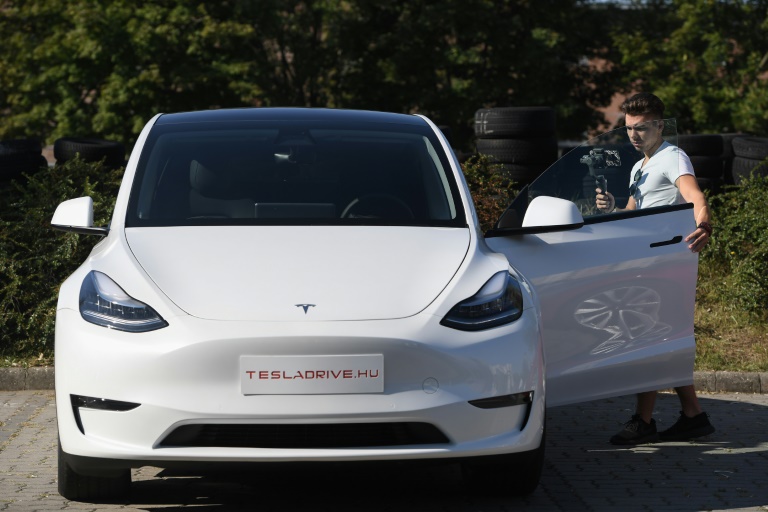
The robotaxi launch will use a Tesla Model Y compact SUV, as the Cybercab is still under development
AFP

The latest decline caps a choppy start to March for TSLA, which opened the month near $392–$405 levels before sliding. Trading volume on March 6 reached approximately 64 million shares, with the day’s range between $394.21 and $402.35. Tesla’s market capitalization stands at roughly $1.49 trillion, positioning it among the world’s most valuable companies despite recent headwinds in core vehicle deliveries.

Year-to-date in 2026, the stock has declined about 11.78%, trading well below its 52-week high of $498.83 reached in late December 2025. The 52-week low remains $214.25, underscoring the stock’s high volatility with a beta around 2.0, making it sensitive to broader market sentiment and company-specific developments.

Analysts attribute much of the recent softness to persistent challenges in Tesla’s automotive segment. The company reported its first annual revenue drop in years for 2025, driven by softening EV demand, intensified competition from rivals like BYD, and economic factors including reduced incentives in key markets like Europe. Early 2026 data suggests continued pressure, with market predictions pointing to Q1 deliveries potentially below 350,000 vehicles—down significantly from prior quarters and reflecting impacts from Model Y refreshes and factory retooling.

Despite these headwinds, optimism centers on Tesla’s aggressive pivot toward non-auto ventures. Energy storage deployments have shown robust growth, with recent quarters posting triple-digit year-over-year increases and margins beginning to rival or exceed those of the automotive division. The segment’s expansion has helped offset some automotive weakness and reinforced Tesla’s positioning as an energy and AI company rather than purely an EV manufacturer.

Advertisement

The most immediate catalyst looms on March 9, when Tesla must submit comprehensive data—including video footage, event data recorder logs, and CAN bus files—on its Full Self-Driving (FSD) system to the NHTSA. The filing stems from an ongoing investigation into potential safety issues, including reports of FSD-equipped vehicles violating traffic laws such as running red lights or entering opposing lanes. The probe gained urgency following Tesla’s unsupervised robotaxi launch in Austin in mid-2025, where the fleet—now expanded but still relatively small compared to competitors like Waymo—has recorded multiple incidents, including crashes into fixed objects.

Tesla has publicly maintained that its FSD safety data shows superiority over human drivers in certain metrics, with major crashes occurring far less frequently per mile driven under supervision. However, the company has faced criticism for redacting crash details under confidentiality provisions, unlike peers that provide more transparent reporting. A favorable NHTSA response could accelerate approvals for broader robotaxi operations and unsupervised FSD deployment across North America, potentially unlocking significant software revenue streams. An adverse outcome, analysts warn, might delay rollouts, trigger recalls, or dampen the autonomy premium baked into TSLA’s valuation.

Adding to the narrative shift, Tesla continues retooling operations for future technologies. The Fremont factory has halted Model S and Model X production to repurpose lines for commercial-scale manufacturing of the Optimus humanoid robot. CEO Elon Musk has described Optimus as potentially representing the majority of the company’s long-term value, with Gen 3 advancements expected to demonstrate progress in physical AI capabilities. Cybercab—the purpose-built, steering-wheel-free robotaxi—remains on track for volume production starting in April 2026, though regulatory hurdles for driverless vehicles without traditional controls persist in most U.S. states.

Recent operational tweaks include a base fee increase for Austin robotaxi rides from $1 to $3.25, the first hike in months, signaling efforts to improve unit economics amid scaling challenges. The fleet has grown incrementally, but remains modest compared to established players, raising questions about execution speed versus ambitious timelines.

Advertisement

Wall Street views remain divided. Bullish analysts, including those at Bank of America, highlight Tesla’s leadership in autonomy, robotics, and energy as justification for premium multiples, with some price targets stretching toward $600 or higher over the next year. Bears point to execution risks, regulatory uncertainty, high capital expenditures (projected in the tens of billions for 2026), and softening core demand as reasons for caution.

Options activity has shown bearish bets in recent sessions, with traders positioning against near-term upside ahead of the NHTSA deadline. Broader market sentiment also weighs on TSLA, as macroeconomic factors and EV sector competition continue to influence trading.

As March unfolds, Tesla’s trajectory hinges on navigating the regulatory crossroads while demonstrating tangible progress in its AI and robotics ambitions. Success could reignite momentum and validate the pivot away from pure EV reliance; setbacks might prolong the current consolidation phase. Investors continue to monitor delivery trends, energy metrics, and any NHTSA updates closely, as these elements will shape the stock’s path through 2026.

With its blend of legacy automotive challenges and high-stakes bets on future technologies, Tesla remains one of the market’s most polarizing and closely watched names. The coming days could prove decisive in determining whether the autonomy story sustains its hold on investor imagination or faces renewed skepticism.

Advertisement
Continue Reading
Click to comment

Leave a Reply

Your email address will not be published. Required fields are marked *

Business

Uno Minda shares jump over 3% as Jefferies initiates coverage with Rs 1,350 target price

Published

on

Uno Minda shares jump over 3% as Jefferies initiates coverage with Rs 1,350 target price
Uno Minda shares climbed over 3 per cent to hit Rs 1,125.70 on the BSE on Tuesday after Jefferies initiated coverage on the auto component maker with a ‘Buy’ rating and a target price of Rs 1,350, implying about 25 per cent upside from the previous close.

Jefferies said Uno Minda offers excellent exposure to Indian autos backed by a fast-growing, well-diversified and largely powertrain-agnostic portfolio, with nearly 90 per cent of its sales coming from the domestic market.

In its initiation note, Jefferies highlighted Uno Minda’s growth track record and strong earnings outlook, projecting a 17 per cent revenue CAGR, 20 per cent EBITDA CAGR and 25 per cent EPS CAGR over FY26-28, along with an average return on equity of around 20 per cent.

“We believe Uno Minda provides excellent exposure to Indian autos given its fast-growing, well-diversified and largely powertrain-agnostic portfolio, with ~90% domestic sales,” the brokerage said, adding that premium valuations are “justified for the strong growth, low margin volatility and high ROE.”

Advertisement

The report positions Uno Minda as a growth amplifier in the Indian auto component space, noting that the company has delivered 23-25 per cent CAGR in revenue and EPS over FY16-26E, significantly outpacing India’s passenger vehicle and two-wheeler production CAGR of 4-5 per cent.


Also Read | Explained: How Sebi’s new rule allowing mutual funds to hold more gold and silver may impact investors

Jefferies expects this outperformance to continue, driven by rising content per vehicle across segments, capacity expansions in lighting, alloy wheels and airbags, and new growth engines such as sunroofs and EV components.
Uno Minda’s diversified product mix and strong market positions are central to the bull case. “Uno Minda is among the top three players in India in most of its component categories,” Jefferies noted, citing a dominant ~55 per cent market share in both four-wheeler and two-wheeler switches, leadership in passenger vehicle alloy wheels with ~45 per cent share, and top-two positions in lighting and acoustics. The brokerage said the company’s portfolio is well placed to benefit from structural trends such as premiumisation, rising SUV penetration and higher adoption of safety and comfort features.
On valuations, Jefferies acknowledged that Uno Minda’s current 42x FY27 estimated price-to-earnings multiple looks rich in absolute terms but argued that it is in line with the stock’s five-year average of about 43x and supported by the company’s fundamentals.

“We initiate at Buy with Rs 1,350 PT at 42x FY28E PE,” the analysts wrote, flagging slower industry growth and any delay in ramp-up of new capacities as key risks to their positive view.

(Disclaimer: Recommendations, suggestions, views and opinions given by the experts are their own. These do not represent the views of The Economic Times.)

Advertisement
Continue Reading

Business

Global Market | Strait of Hormuz tensions keeping oil markets on edge: Richard Yetsenga

Published

on

Global Market | Strait of Hormuz tensions keeping oil markets on edge: Richard Yetsenga
Global oil markets are grappling with sharp volatility as geopolitical tensions disrupt energy supply routes and spark fears of a broader economic fallout. While crude prices have surged amid the conflict in West Asia, economists say markets are still trying to assess whether the spike is a temporary reaction or the start of a more prolonged supply shock.

Speaking to ET Now, Richard Yetsenga from ANZ Group said the current reaction in oil markets appears to be largely emotional rather than purely driven by fundamentals.

“Oh, it is definitely a knee-jerk reaction. Whether it is sustained or not depends on what actually happens with the conflict. And there is this catch-22 the market is probably in. In one sense the market is saying well the fundamentals look quite poor, 20% of oil through the Strait of Hormuz, it is not operating, that is very bullish for the oil price. On the other hand, implications for the US economy from that are quite poor, inflationary pressure high, gas prices pressure on consumers, political pressure back on President Trump. Does he then back off the military action because of the impact of oil and I think the last 24-48 hours in markets you have seen both sides of this story,” Yetsenga said.

The disruption around the Strait of Hormuz — one of the world’s most critical oil transit chokepoints — has heightened concerns across energy-importing economies, particularly in Asia. With many countries heavily dependent on imported crude, the sudden surge in prices is already forcing governments to consider emergency responses.

Advertisement

Yetsenga noted that most Asian economies are particularly vulnerable because they rely heavily on imported energy.


“Well, you have talked through it right there. Apart from Malaysia, the region is a collection of oil importers and energy importers and that puts them in a very difficult position at the moment. We are only eight or nine days into this conflict, already we are talking about the release from strategic petroleum reserves at a global level, even in some individual economies and then also some sort of supply rationing and already there are challenges with diesel and jet fuel particularly in different parts of the region. This goes into if you like exhibit A) the economic impact of this is potentially quite severe if it is sustained and of course we should be worried about that, but also that economic impact is going to put pressure on the offensive side of this conflict,” he said.
Governments across the region have begun taking precautionary measures. South Korea, for instance, has discussed limits on fuel consumption, while other countries are leaning more heavily on strategic reserves to cushion the immediate supply shock.Despite the intense market speculation that the conflict could end quickly, Yetsenga remained cautious about predicting the timeline of any resolution.

“Sorry, I am not a military strategist. I am not a political expert, that is question for those sorts of people….” he said when asked about expectations of an early end to the war.

However, he acknowledged that financial markets themselves may eventually play a role in shaping political decisions.

“Look, my view is that the pressure that markets put on the administration will ultimately be a factor probably that brings this action to a conclusion. We are only eight days into this or nine days. In previous occurrences it has taken meaningfully longer than this for the Trump administration to back off. So, I think I know the endgame. But the timing honestly we should be transparent is really anybody’s guess,” Yetsenga said.

Advertisement

According to him, the likely outcome is a negotiated halt to hostilities once the United States declares its objectives achieved.

“Oh, the endgame is there is some sort of cessation of hostilities because the US says that we have achieved our objectives and markets will welcome that and go back to some sort of the normalcy that we had before this kicked off the week before last. But, of course, the normalcy also even this year has had Greenland and Cuba and a few other issues in there, so it is still a world which is unsettled but one in which we can be a bit more analytical about,” he added.

For investors and policymakers alike, the coming weeks will likely hinge on whether the conflict escalates further or begins to cool. Until then, energy markets — and the economies that depend on them — remain caught between geopolitical risk and hopes for a swift return to stability.

Advertisement
Continue Reading

Business

Russian drones injure 20 in Ukraine’s Kharkiv, Dnipro

Published

on


Russian drones injure 20 in Ukraine’s Kharkiv, Dnipro

Continue Reading

Business

OpenAI delays ChatGPT ‘adult mode’ rollout to prioritise AI improvements and safety features

Published

on

OpenAI has agreed a multibillion-dollar partnership with Advanced Micro Devices (AMD) to secure massive computing power for its next generation of artificial intelligence models — a direct challenge to Nvidia’s dominant position in the global AI chip market.

OpenAI has confirmed it is postponing the launch of an “adult mode” for ChatGPT, saying the company will instead prioritise improving the platform’s core capabilities and user experience.

The move marks a shift from earlier plans outlined by Sam Altman, who indicated last year that the artificial intelligence developer would allow certain forms of adult content on its flagship chatbot once robust age-verification systems had been introduced.

However, OpenAI has now said that development resources are being redirected toward upgrades that will benefit a broader share of the chatbot’s rapidly expanding user base.

“We’re pushing out the launch of adult mode so we can focus on work that is a higher priority for more users right now,” the company said. “That includes gains in intelligence, personality improvements, personalisation and making the experience more proactive.”

The company added that it still supported the underlying principle behind the proposed feature, allowing adult users greater freedom in how they interact with AI systems, but acknowledged that implementing it safely would require additional work.

Advertisement

“We still believe in the principle of treating adults like adults,” OpenAI said. “But getting the experience right will take more time.”

The decision comes at a time of intense competition in the artificial intelligence sector. Since announcing plans to loosen restrictions on ChatGPT content in late 2025, Altman has repeatedly warned that OpenAI faces a “code red” challenge from rival AI developers.

Among the most prominent competitors are Google DeepMind and Anthropic, both of which are racing to release more capable generative AI systems.

OpenAI’s focus on performance improvements reflects the escalating pressure to maintain leadership in the AI market, where advances in reasoning capability, conversational tone and personalisation are increasingly seen as key differentiators.

Advertisement

The company says ChatGPT now has more than 900 million users worldwide, making it one of the fastest-growing digital platforms in history. Maintaining reliability, safety and usefulness at such scale has become a central priority.

Although the launch of adult mode has been delayed, OpenAI is continuing to develop age-verification and age-prediction systems designed to ensure younger users are protected from inappropriate content.

The technology analyses usage patterns and behavioural signals to estimate whether a user may be under the age of 18. If the system determines that a user is likely to be a minor, stricter safety filters are automatically applied.

These additional safeguards limit exposure to graphic violence, explicit content and sexual role-play scenarios.

Advertisement

The work is also partly driven by regulatory pressures in several countries. In the UK, for example, the Online Safety Act requires platforms hosting potentially harmful or adult material to ensure that under-18s cannot access such content without effective age verification measures.

As a result, any future “adult mode” would likely need to be accompanied by robust compliance systems in multiple jurisdictions before being deployed widely.

The announcement about ChatGPT’s delayed adult mode came as OpenAI faced internal controversy following the resignation of a senior executive linked to its robotics division.

Caitlin Kalinowski stepped down after raising concerns about the company’s partnership with the United States Department of Defense.

Advertisement

Kalinowski said she was troubled by the potential implications of AI technologies being used in areas such as mass surveillance or autonomous weapons systems.

“AI has an important role in national security,” she wrote in a statement on social media platform X. “But surveillance of Americans without judicial oversight and lethal autonomy without human authorisation are lines that deserved more deliberation than they got.”

She emphasised that her concerns related primarily to the speed with which the deal had been announced rather than the concept of national security collaboration itself.

“These are governance concerns first and foremost,” she said. “Issues this significant require clearly defined guardrails before agreements are announced.”

Advertisement

In response, OpenAI said it would update the terms of its defence agreement to ensure that its technology cannot be used for mass domestic surveillance or fully autonomous weapons systems.

A company spokesperson said the partnership was intended to support responsible national-security applications of AI while maintaining clear ethical boundaries.

“We believe our agreement with the Pentagon creates a workable path for responsible national security uses of AI while making clear our red lines: no domestic surveillance and no autonomous weapons,” the spokesperson said.

OpenAI added that it would continue engaging with employees, policymakers and civil society groups to ensure its technology is deployed responsibly.

Advertisement

The delay of ChatGPT’s adult mode reflects the broader challenge facing AI companies as they attempt to balance technological innovation, safety safeguards and regulatory compliance.

As generative AI tools become more widely used for everything from work productivity to creative expression, companies are increasingly under pressure to introduce new features carefully and responsibly.

For OpenAI, the immediate focus appears to be ensuring that ChatGPT’s core intelligence and usability continue to improve — a strategy the company believes will have a greater impact on its hundreds of millions of users than expanding the range of content the chatbot can produce.

Whether adult mode eventually launches may depend on how effectively OpenAI can implement reliable age verification and content moderation systems — a complex technical and legal challenge that is still evolving alongside the rapidly advancing capabilities of artificial intelligence.

Advertisement

Jamie Young

Jamie Young

Jamie is Senior Reporter at Business Matters, bringing over a decade of experience in UK SME business reporting.
Jamie holds a degree in Business Administration and regularly participates in industry conferences and workshops.

When not reporting on the latest business developments, Jamie is passionate about mentoring up-and-coming journalists and entrepreneurs to inspire the next generation of business leaders.

Advertisement
Continue Reading

Business

Google Pixel 11 Pro Fold Renders Leak Suggests Minor Changes in Camera, Thickness

Published

on

Google Pixel Fold's Repair Kits Are Now Available and They're Not Cheap

The upcoming Google Pixel 11 Pro Fold is still months away from its official reveal, but early leaks are already looking promising for smartphone enthusiasts. Despite some minor changes, you might get your lucky shot with this flagship around August 2026. That will only happen if the company follows its usual launch timeline.

Here’s what the latest render leaks show about Pixel 11 Pro Fold’s successor.

Familiar Design With Subtle Refinements

Google Pixel Fold's Repair Kits Are Now Available and They're Not Cheap
Google Pixel Fold’s repair kits are now available on iFixit.

At first glance, the leaked renders reveal a design very similar to that of its predecessor, the Google Pixel 10 Pro Fold. However, closer inspection reveals several small yet meaningful updates.

As Android Headlines reports, one of the most noticeable changes involves the camera module. In the updated design, the LED flash and microphone appear to be integrated within the pill-shaped oval section of the camera island, rather than being positioned outside the housing.

Additionally, the transition between the camera island and the rear panel is now smoother, replacing the previous sharper edge with a curved connection. This adjustment slightly elongates the internal oval cutouts within the camera module.

Advertisement

Slimmer Foldable Form Factor

Another significant improvement involves the device’s thickness. According to the leaked CAD specifications, the Pixel 11 Pro Fold may measure approximately 10.1 mm when folded, making it thinner than the Pixel 10 Pro Fold‘s 10.8 mm profile.

When unfolded, the device is expected to measure just 4.8 mm, compared with the previous model’s 5.2 mm thickness. These refinements suggest that Google is focusing on creating a sleeker and more comfortable foldable smartphone without drastically altering the device’s overall dimensions.

Tensor G6 Chip Expected to Boost Performance

GSM Arena reports that performance upgrades are also expected with the inclusion of the new Google Tensor G6 processor. The next-generation chip is rumored to deliver stronger AI capabilities, improved energy efficiency, and faster overall processing performance.

While the Pixel 11 Pro Fold has not yet been officially announced, the early leaks indicate that Google’s upcoming foldable phone could emphasize refined design, slimmer hardware, and enhanced performance when it arrives later this year.

Advertisement

Originally published on Tech Times

Continue Reading

Business

Northern Large Cap Core Fund Q4 2025 Commentary

Published

on

Northern Large Cap Core Fund Q4 2025 Commentary

Northern Trust Asset Management is a global investment manager that helps investors navigate changing market environments in efforts to realize their long-term objectives.

Entrusted with $1.2 trillion in assets under management as of March 31, 2024, we understand that investing ultimately serves a greater purpose and believe investors should be compensated for the risks they take — in all market environments and any investment strategy. That’s why we combine robust capital markets research, expert portfolio construction and comprehensive risk management in an effort to craft innovative and efficient solutions that seek to deliver targeted investment outcomes.

As engaged contributors to our communities, we consider it a great privilege to serve our investors and our communities with integrity, respect and transparency.

Northern Trust Asset Management is composed of Northern Trust Investments, Inc., Northern Trust Global Investments Limited, Northern Trust Fund Managers (Ireland) Limited, Northern Trust Global Investments Japan, K.K., NT Global Advisors, Inc., 50 South Capital Advisors, LLC, Northern Trust Asset Management Australia Pty Ltd, and investment personnel of The Northern Trust Company of Hong Kong Limited and The Northern Trust Company. Note: This account is not managed or monitored by Northern Trust Asset Management, and any messages sent via Seeking Alpha will not receive a response. For inquiries or communication, please use Northern Trust Asset Management’s official channels.

Continue Reading

Business

Council and pension fund agree deal to build 1,600 homes in seven Manchester sites

Published

on

Council and pension fund agree deal to build 1,600 homes in seven Manchester sites

‘Our plan for 10,000 genuinely affordable, social and council homes is building record numbers’

The No 1 Ancoats Green scheme, the first to be built by This City, a property developer firm solely owned by Manchester council

The No 1 Ancoats Green scheme, the first to be built by This City, a property development firm solely owned by Manchester council(Image: Manchester City Council )

More than 1,500 new homes will be built across Manchester by the council, which has promised that more than one-fifth will be ‘genuinely affordable’.

Advertisement

The council has struck a deal with the Greater Manchester Pension Fund to finance around 1,600 apartments and houses on brownfield parcels of land. While many of the homes will be available on the open market, at least 20 per cent will be let at the ‘Manchester Living Rent’, set at or below the local housing allowance level.

Seven projects will be built by This City, the council-owned property developer behind No 1 Ancoats Green, a 129-home scheme which opened last year. Council leader Bev Craig called that ‘a great start’, but wants to kick on with construction.

She said: “Our plan for 10,000 genuinely affordable, social and council homes is building record numbers. We built more last year than any year since the early 2000s.

“This partnership with the Greater Manchester Pension Fund will enable us to drive forward the work of This City to build the homes the city needs on council-owned land.

Advertisement

“Completing No.1 Ancoats Green last year was a great start – but this collaboration with the Greater Manchester Pension Fund provides long-term assurance that we can bring forward and deliver even more ambitious schemes.

“We already have a strong pipeline of projects in place, including the next This City development in the Northern Quarter, with further sites across Manchester. This means we are building many more homes capped at the Manchester Living Rent in the coming years .”

Town hall papers have named the seven sites where This City will build. They are Postal Street in the Northern Quarter (126 homes), Monsall Road in Harpurhey (651 homes), Grey Mare Lane in Beswick (145 homes), Hyde Road in Longsight (84 homes), Kirkmanshulme Lane also in Longsight (88 homes), Heyrod Street in Piccadilly (no figure given) and Downing Street in Ardwick (181 homes).

Construction work is expected to start on Postal Street next year, with other sites earmarked to begin in 2028, 2029, or 2030.

Advertisement

The projects are expected to be signed off by a meeting of the council’s executive at 3pm on Friday, March 13.

To find all the planning applications, traffic diversions, road layout changes, alcohol licence applications and more in your community, visit the Public Notices Portal.

Continue Reading

Business

State government responds to e-rideable dangers inquiry

Published

on

State government responds to e-rideable dangers inquiry

The state government has accepted 32 out of 33 recommendations from an inquiry into the dangers of e-rideables.

Continue Reading

Business

BDO sounds alarm on 'clean' company black market

Published

on

BDO sounds alarm on 'clean' company black market

Australian companies with a clean compliance history are being targeted by black market operators and stolen to aid in fraud, according to a leading Perth accounting firm.

Continue Reading

Business

Iran, Oil, And Rates: What We're Watching

Published

on

Iran, Oil, And Rates: What We're Watching

Iran, Oil, And Rates: What We're Watching

Continue Reading

Trending

Copyright © 2025