Business
Thailand’s Strategic Tightrope Between China, the US, and ASEAN

Ask a senior Thai official which country Thailand considers its most important strategic partner, and you will receive a carefully constructed non-answer — a fluent recitation of Thailand’s commitment to balanced relationships, multilateral frameworks, and ASEAN solidarity. Ask the same question to a Thai business executive, and you will likely get a more direct response: it depends entirely on what you are trying to do.
That gap between diplomatic language and commercial reality defines Thailand’s position in 2026 better than any policy document. Thailand is simultaneously China’s most economically integrated ASEAN partner, the United States’ oldest treaty ally in Southeast Asia, and an active architect of the ASEAN multilateral system. It is running all three identities at once — not because it cannot choose, but because it has decided, strategically, not to.
Key takeaways
- Thailand’s multi-alignment is not indecision — it is policy. China accounts for $153 billion in bilateral trade and is Thailand’s largest investor. The US is Thailand’s oldest security ally and a critical export market. The EU, South Korea, and Canada are all active FTA partners. Bangkok is not hedging. It is deliberately cultivating leverage across all axes — and has been doing so for decades.
- The tariff squeeze from Washington is real and tightening. China’s manufacturers using Thailand as an export base face intensifying US scrutiny on rules of origin, value addition, and supply chain provenance. The era of simple trade rerouting is over. Executives building supply chains through Thailand need a genuine value-addition strategy — not just a Thai address on a shipping label.
- The tension at the heart of Thailand’s position is the opportunity for business. China’s $1 trillion global trade surplus is flooding ASEAN with capital, technology, and competitive pressure simultaneously. Thailand’s response — absorbing Chinese investment while actively diversifying its partnerships — creates exactly the kind of complex, multi-directional business environment where well-positioned companies thrive and poorly positioned ones get squeezed.
The paradox at the centre
Start with the number that defines Thailand’s strategic dilemma most sharply: 90.6 percent. That is the proportion of Thai respondents in the 2024 ISEAS-Yusof Ishak Institute survey who expressed concern about China’s growing economic influence — the highest rate in Southeast Asia, ahead of Vietnam, the Philippines, and every other ASEAN member state. It is a striking figure for a country whose government has simultaneously signed a five-year cooperation plan with Beijing, welcomed nearly $7 billion in Chinese investment, and invited Chinese firms to build its digital infrastructure.
The paradox is not a contradiction. It is a description of Thailand’s actual situation: deeply economically integrated with a partner it does not entirely trust, dependent on relationships it cannot afford to lose, and acutely aware of the risks that come with both. Thai policymakers have watched what happens when smaller economies become overly dependent on a single great power — and they have no intention of becoming a case study.
The result is a foreign policy posture that has no single name but is immediately recognisable in practice: say yes to Chinese investment while maintaining American security guarantees, pursue ASEAN solidarity while negotiating bilaterally with every major power, and never let any single partner feel so essential that it stops being a partner and starts being a constraint. It is a strategy built less on ideology than on instinct — the instinct of a small or middle power that has learned, often through hard experience, that alignment is a trap and optionality is survival.
In practical terms, this means signing infrastructure agreements with Beijing while quietly renewing basing arrangements with Washington, showing up to multilateral summits with carefully worded communiqués that satisfy everyone and commit to nothing irreversible, and cultivating enough economic interdependence with each major power to remain relevant without becoming dependent. The genius of the approach, if it can be called that, lies precisely in its refusal to be codified. A doctrine can be challenged, tested, or called out as a bluff. A disposition, a habit of perpetual calibration, is far harder to pin down or pressure into abandonment. The risk, of course, is that what looks like sophisticated balance can tip, under sufficient stress, into paralysis — or worse, into the appearance of bad faith to every partner simultaneously. But for now, and for the foreseeable future, it remains the dominant grammar of statecraft across much of the region.
The land bridge: China’s largest bet in Thailand
No single project better illustrates the complexity of Thailand’s position than the proposed Southern Economic Corridor land bridge — a megaproject connecting deep-sea ports on the Gulf of Thailand and the Andaman Sea via a 90-kilometre rail and motorway corridor across Chumphon and Ranong provinces.
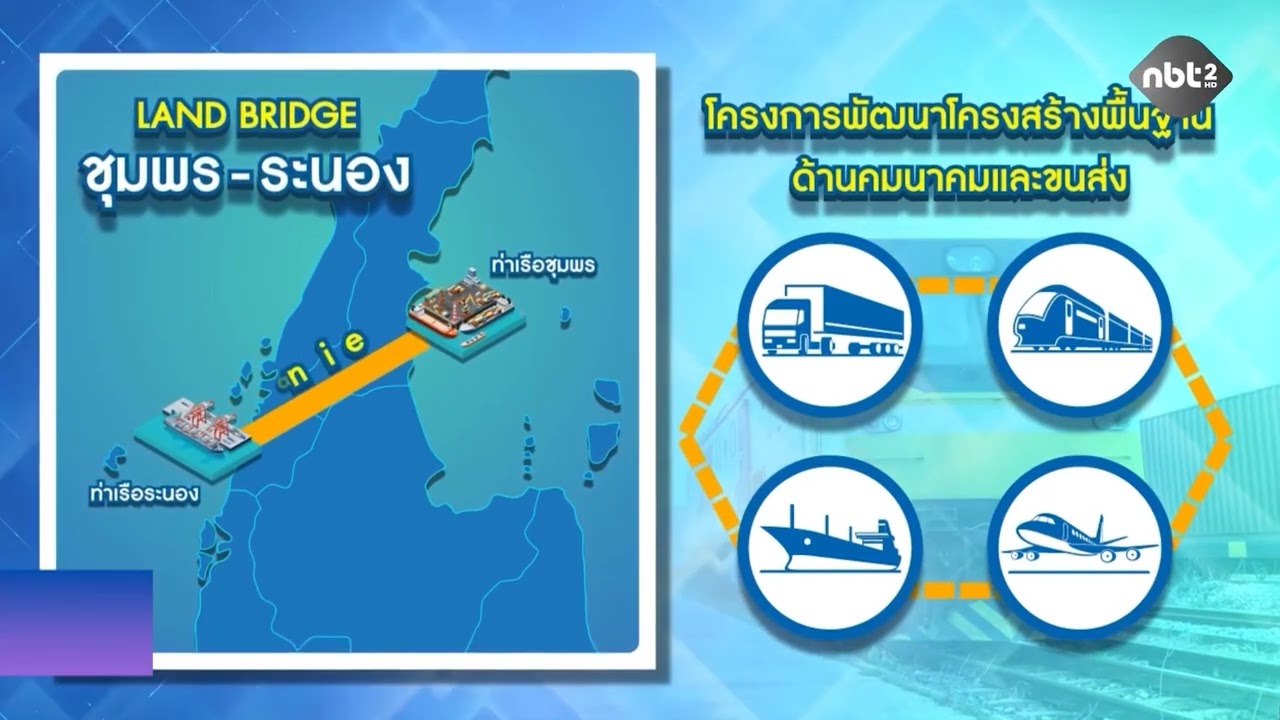

The strategic logic is compelling. A completed land bridge would allow cargo to bypass the Strait of Malacca — one of the world’s most congested shipping chokepoints, through which roughly 40 percent of global trade currently passes — reducing transit times between the Indian Ocean and the South China Sea by two to five days and shaving significant costs off regional shipping routes.
China is the most widely expected primary backer for this project — for reasons that are as strategic as they are financial. A Thai land bridge funded and built by Chinese capital, using Chinese construction expertise, and integrated into Chinese-operated logistics networks would extend the reach of Chinese trade infrastructure deep into the Indian Ocean without requiring Chinese territorial control of any chokepoint. For Beijing, it is Belt and Road logic applied with extraordinary precision.
For Thailand, the calculus is more complicated. The project offers genuine economic transformation — an estimated $28 billion in infrastructure investment, tens of thousands of construction and operational jobs, and a permanent shift in Thailand’s position in regional logistics. But accepting Chinese backing at the scale required would deepen a dependency that Thai policymakers are simultaneously trying to manage. The land bridge negotiations, which have been underway for several years, are moving carefully — and the pace is deliberate, not accidental.
Washington’s pressure: the tariff tightrope
If Beijing represents Thailand’s deepest economic entanglement, Washington represents its most immediate commercial pressure point.
The United States shifted in 2025 from a China-specific tariff strategy to a broader, value-chain-wide protectionist approach targeting entire supply chains in electric vehicles, lithium-ion batteries, solar components, semiconductors, and steel. Countries across ASEAN — including Thailand — found themselves subject to scrutiny that previously applied only to direct Chinese exports.
The implications for Thailand are significant. A Thai facility that is majority-owned by a Chinese firm, uses primarily Chinese-sourced inputs, and exports finished goods to the US market now faces serious rules-of-origin questions that did not exist three years ago. The “36% tariff on Thai goods” framework that emerged from 2025 trade negotiations added urgency to those questions, placing Thailand in active dialogue with Washington over trade terms while simultaneously deepening its economic ties with Beijing.
As one trade expert from Chulalongkorn University put it: “The US wants assurances on market access, but Thailand is walking a tightrope between its largest trading partners.” That assessment captures the position precisely — and it applies not just to Thailand’s government but to every international company operating in the country.
The businesses best positioned to navigate this environment are those that can demonstrate genuine value addition in Thailand — local supply chain integration, Thai employment at skilled levels, meaningful R&D or design functions — rather than those that are simply using Thai addresses to access preferential trade terms. The era of tariff arbitrage through nominal Thai presence is over. The era of genuine Thailand-based value creation is just beginning.
BRICS, FTAs, and the diversification playbook
Thailand’s response to the pressure from both sides has been to accelerate its diversification — not away from China or the US, but toward a broader portfolio of relationships that reduces its exposure to any single partner’s leverage.
The BRICS application is the most visible symbol of this strategy. Thailand has applied for BRICS membership — a move that reads differently depending on who is interpreting it. For Beijing, it signals alignment with a China-led multilateral framework. For Washington, it raises questions about Thailand’s commitment to Western-aligned institutions. For Bangkok, it is simply the next logical step in a multi-alignment strategy that has been running for decades: join every club that offers leverage, and use membership in each to strengthen your position in all the others.
Simultaneously, Thailand is pursuing an ambitious FTA agenda. The Thailand-EU Free Trade Agreement — under negotiation for years — has regained momentum, driven partly by European interest in supply chain diversification and partly by Thai interest in reducing dependence on the China-US axis. FTA frameworks with South Korea and under the ASEAN-Canada agreement offer additional diversification vectors.
ASEAN trade with China rose 15 percent in 2024, while US trade increased 12 percent and EU trade remained strong at €258.7 billion — a distribution of relationships that reflects exactly the kind of balanced portfolio Thailand is trying to maintain at the national level. The FTA strategy is Thailand’s attempt to institutionalise that balance, locking in preferential access to multiple major markets so that no single partner can credibly threaten to withdraw access without consequence.
Public sentiment as a business risk
Strategic frameworks and FTA negotiations are one thing. Public sentiment is another — and executives operating in Thailand need to take the latter seriously.
The gap between Thailand’s government posture toward China and Thai public opinion about Chinese influence is one of the most significant political risks in the country’s business environment. The 90.6 percent concern figure from the ISEAS survey is not an outlier — it reflects consistent polling trends showing unease about Chinese economic dominance, Chinese land ownership, Chinese labour practices at Chinese-owned facilities, and the displacement of Thai manufacturers by Chinese competitors.
This sentiment has already produced concrete policy responses. Proposed VAT on low-priced Chinese goods, stricter enforcement of foreign business ownership rules, and parliamentary scrutiny of Chinese-funded infrastructure projects are all expressions of the same political dynamic: a government that wants Chinese investment but faces an electorate that is increasingly sceptical of Chinese influence.
For business executives, the implication is clear: a market entry strategy that ignores Thai public sentiment about China is not just politically naive — it is commercially risky. Chinese-invested businesses that integrate into local supply chains, hire Thai workers at all levels, and invest in community relationships are dramatically better positioned than those that operate as self-contained Chinese enclaves. Non-Chinese firms operating alongside Chinese partners need to understand how their association is perceived — and manage that perception actively.
The business strategy for Thailand’s multi-alignment reality
What does all of this mean for the executive making decisions about Thailand today?
First, understand which axis your business primarily operates on. A manufacturing operation selling primarily to the US market has different exposure — and different strategic requirements — than one selling into ASEAN or China. The tariff environment, the rules-of-origin requirements, and the political risk profile differ significantly across these axes. Know yours before you build.
Second, treat Thai partnerships as strategic assets, not operational conveniences. In a multi-alignment environment, a Thai partner with genuine government relationships, local supply chain integration, and community credibility is worth substantially more than a logistics facilitator. The companies that build real Thai partnerships will navigate Thailand’s political crosscurrents far more effectively than those that treat the country as a pass-through.
Third, plan for scenario divergence. Thailand’s balancing act is impressive, but it is not permanent. A sharp deterioration in US-China relations, a change of government in Bangkok, or a significant shift in Chinese investment flows could move the needle in any direction. Executives with five-to-ten-year horizons should stress-test their Thailand strategies against at least three divergent scenarios — closer alignment with China, closer alignment with the West, and continued multi-alignment — and ensure their position is viable under each.
Fourth, watch the land bridge. If Thailand secures financing for the Southern Economic Corridor project and construction begins, it will reshape regional logistics, investment flows, and geopolitical positioning in ways that affect every business with ASEAN exposure. It is the single most significant infrastructure development to monitor.
The bottom line
Thailand’s balancing act is not a failure to choose. It is a deliberate strategy, executed by a country that has spent fifty years learning how to extract maximum value from great-power competition without becoming its casualty.
For business executives, that strategy is both the context and the opportunity. A country committed to multi-alignment will keep its trade routes open, its investment environment active, and its diplomatic relationships functional regardless of what happens between Washington and Beijing. It will not be the cheapest operating environment in ASEAN. But it may well be the most resilient.
In a world defined by geopolitical volatility, resilience is undervalued — until it is the only thing that matters.
End of series — Thailand × China: The Business Opportunity
Articles in this series: 1. The Dragon Meets the Elephant · 2. Factory of the Future · 3. The EV Kingdom · 4. The Digital Silk Road · 5. The Balancing Act, Thailand’s Strategic Tightrope Between China, the US, and ASEAN
You must be logged in to post a comment Login