











It will provide more than £1bn to Welsh farmers up to 2030

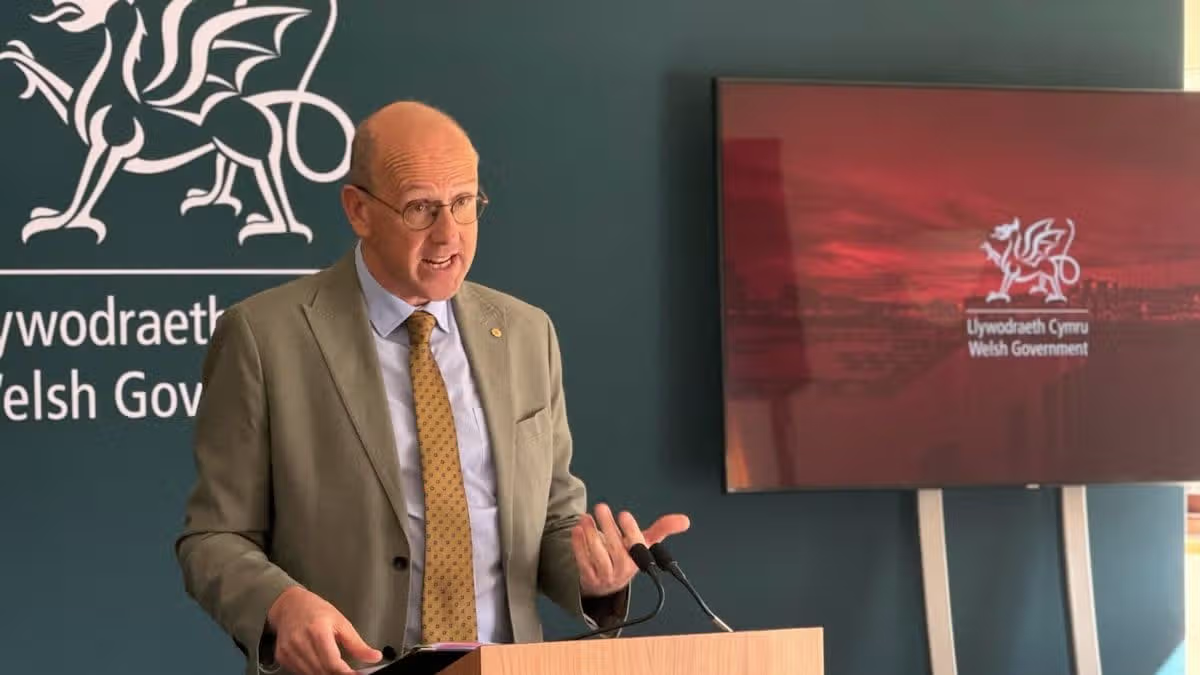
Cabinet Minister for Rural Resilience and Sustainability Llyr Gruffydd.
Welsh farmers will receive over £1bn across this Senedd term to support sustainable agriculture, which the Welsh Government said will give the sector the long-term certainty needed to plan and invest with confidence.
Cabinet Minister for Rural Resilience and Sustainability, Llyr Gruffydd, made the announcement at the Royal Welsh Show. The commitment delivers £340m per year for three years to March 2030 for the Sustainable Farming Scheme (SFS), including a guaranteed £238m per year for the universal layer and £102m for delivering the optional and collaborative layers.
The settlement though is around the same as farms have been receiving since 2012. The sector has been seeking £500m to take account of inflation.
The Welsh Government said the move ends the year-to-year funding model that has made long-term planning difficult for farming businesses. It fulfils a pledge made in the Plaid Cymru Government’s first 100 days to provide a multi-annual budget for the SFS.
Mr Gruffydd said: “Giving farmers only 12 months’ line of sight to funding is not sufficient. We know how hard it is to plan and make business decisions without knowing what funding is coming. Farmers told us loud and clear they need certainty and stability – and that is exactly what we are delivering.”
Following early feedback from the independent review into the bureaucratic burden on family farms, led by John Davies, the minister also announced early action to cut red tape for farmers.
The Welsh Government has announced a simplification of the approach for the Animal Health Improvement Cycle (AHIC) in the universal layer of the SFS. The Welsh Government said it will work with any interested farm assurance scheme to ensure requirements are aligned, meaning farmers in those schemes will only need to complete one form from 2027 delivering two outcomes from a single vet visit: farm assurance and SFS compliance.
The minister also announced that the roll out of some optional actions and that the new window of the Integrated Natural Resources Scheme will open later in the year, a key element feeding into the collaborative layer.
Welsh Conservative Shadow Farming Minister Andrew RT Davies said: “This represents a real terms cut to farming support and falls far short of what farmers warned is required. “Plaid Cymru separatists have found money to fund a Nation of Sanctuary for asylum seekers, but won’t fund Welsh farming adequately. Their priorities are all wrong.”
NFU Cymru President Abi Reader said: “It is the universal layer – and in particular the social value payment within this layer – that provides stability to farm businesses. It is this support that underpins the production of high-quality food for the nation, keeps farming families on the land and supports our rural communities, heritage, culture and language. That is why we warmly welcome the confirmation that the cabinet minister will stick with the 70:30 (universal and optional and collaborative layers) split for the length of this Senedd term.
“This year we have seen farm-gate prices fall in some key sectors and input prices soar in response to global instability. This move to a ring-fenced multi-annual system of farm support, coupled with a 70:30 funding split, will underpin the financial resilience of family farms and help them ride out these challenges, whilst at the same time helping deliver on our ambition for the sustainable growth of the sector.
“Farming is a long-term business with production and business investment cycles which run into many years. By moving away from a funding arrangement which offered no funding certainty from one year to the next, and by allocating 70% of the funding resource to the universal layer, the Welsh Government has recognised the volatile marketplace and complex long-term production cycles we work within. I very much commend the Welsh Government on its announcement, one that provides long term stability not just to Welsh farming but, as evidenced by all the businesses in attendance at the show, also to all those who rely on Welsh agriculture for so much of their income.”
FUW president, Ian Rickman said: “Recent years have brought significant financial uncertainty for the farming sector in Wales, making it increasingly difficult for businesses to plan with confidence and make informed long-term financial decisions.The FUW has consistently called for a five-year funding framework, so today’s commitment to provide certainty until March 2030 is a welcomed relief for the family farms of Wales. It provides much-needed stability and a stronger foundation for the remainder of the decade, giving businesses greater confidence to plan for the future.
“The minister’s commitment should also be viewed in the context of mounting budgetary pressures and evolving decisions in Westminster, both of which could have significant implications for Wales over the coming years.
“Our Senedd Election manifesto emphasised that Welsh farmers should not be disadvantaged for transitioning to a new system of support that places greater societal and environmental demands on their businesses. On this basis, we continue to highlight the need to increase the base-level funding of the SFS to mitigate any economic impacts and match the policy ambitions of the Welsh Government.
“To this end, we will continue to work closely with the Welsh Government to ensure that the universal baseline payment rates are appropriate, and that every penny of the SFS budget is received by the active farmers of Wales.
“Providing farming businesses with the certainty they need to make informed decisions is essential. Today’s announcement therefore represents a major milestone for agricultural support in Wales and an important step towards delivering the long-term confidence that Welsh farmers have been seeking.”
Victoria Bond, director of the Country Land and Business Association Cymru, said:“We are pleased that the Welsh Government has listened to the sector and delivered on its pledge for multi-annual funding. Certainty is essential for farmers and rural businesses that form the backbone of Wales’ countryside. This announcement at the Royal Welsh Show sends a positive signal and we particularly note the early steps to cut red tape following the John Davies review.
“Simplifying the animal health improvement cycle and aligning it with existing farm assurance schemes from 2027 is a sensible move that will reduce bureaucracy and ease the burden on farmers. However, success will depend on practical implementation, clear guidance and genuine partnership working with the sector. We will continue to push for further reductions in red tape burdens so that farmers can focus on delivering environmental, social and economic outcomes on the ground.”









































You must be logged in to post a comment Login