Business
‘That’s Just a Terrible Question’

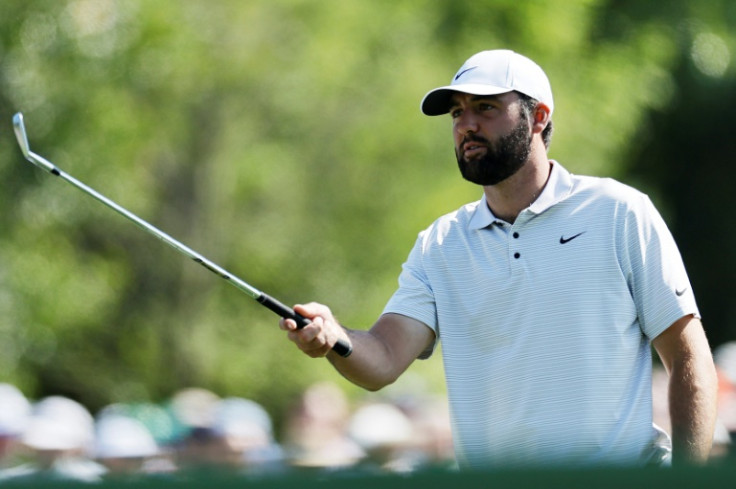
AUGUSTA, Ga. — World No. 1 Scottie Scheffler delivered one of the best rounds of the 2026 Masters on Saturday, firing a bogey-free 7-under 65 to storm back into contention, but his post-round interview quickly went viral for an abrupt and testy exchange with a reporter that left many questioning the etiquette of both player and press at golf’s most prestigious tournament.
AFP

The clip, posted by The Golfing Gazette on YouTube and widely shared across social media, captures Scheffler responding sharply when asked what his round “felt like it could have or should have been.” Visibly annoyed, the two-time Masters champion replied, “That’s just a terrible question. Next, next question,” prompting another voice in the room to mutter “Awful.”

The moment occurred after Scheffler’s third-round performance at Augusta National, where he climbed the leaderboard with precise iron play and clutch putting on a course known for its punishing difficulty. Entering the final round, he sat just five shots behind leader Rory McIlroy, setting up a dramatic Sunday chase for a third green jacket.
Scheffler, typically known for his calm and measured demeanor, later elaborated on his round when a follow-up question was posed about what allowed him to go low compared to previous days. He provided a detailed hole-by-hole breakdown, highlighting sharp iron shots, multiple birdie opportunities created on the front nine, and several near-misses on the back nine due to subtle breaks, gusts of wind and course conditions.
“I hit it really nice. I feel like I was very sharp with the irons,” Scheffler explained. “Got it up there, gave myself a lot of opportunities. I felt like I took advantage of those on the front nine and then back nine I did a lot of good things. Just was really, really close to seeing a lot go in.”
He cited specific examples: strong approach shots on the 10th followed by a putt that broke more than expected; a good birdie on the 11th; a fairway hit on the 13th marred by a mud ball; a solid bunker shot; and a difficult pitch on the 15th after a ball barely carried into a hazard due to a downwind gust. On the 17th, three excellent shots still failed to yield a birdie.
“Overall, I mean it could have been — I guess to answer your question, it maybe wasn’t that bad,” Scheffler continued. “But I definitely could have been lower, but like I said, I did what I needed to do. I went out, I executed to get myself some opportunities and more of that tomorrow and I think I’ll be in a good spot.”
The initial dismissal, however, dominated the conversation online. The YouTube Short, uploaded April 11, quickly amassed thousands of views, with comments debating whether the reporter’s question was poorly phrased or if Scheffler’s curt response crossed into rudeness. Some defended the world No. 1, arguing that asking a player who just shot 7-under on a major championship course what it “should have been” implies the round was somehow disappointing — a tone-deaf framing after an elite performance.
Others criticized Scheffler, noting that professional athletes are expected to handle media scrutiny gracefully, even after strong rounds. The exchange stood in contrast to Scheffler’s usual composure, though it echoed occasional moments of frustration from top players when questions veer into speculative territory.
The reporter in question has been identified in golf circles as a respected veteran, adding another layer to the discussion about player-media dynamics at Augusta National. Press conferences at the Masters are tightly controlled, with players often facing repetitive queries in a high-stakes environment where every word is scrutinized.
Scheffler’s Saturday 65 was a statement round. After an opening 70 and a surprising 74 on Friday — a round he later suggested was impacted by uneven course conditions that favored later tee times — the Texan responded with precision and patience. His bogey-free effort included an eagle and showcased the ball-striking that has defined his reign as the game’s top player.
Heading into Sunday’s final round, Scheffler sat within striking distance, keeping alive his bid for a third Masters title in five years. He ultimately finished one shot behind McIlroy, who successfully defended his 2025 victory.
The viral clip resurfaced broader conversations about golf’s gentlemanly image versus the raw emotions that surface under pressure. Golf has long prided itself on civility, yet moments like this — or past testy exchanges involving stars such as Tiger Woods or Rory McIlroy — remind fans that competitors are human.
Scheffler addressed the Friday conditions more candidly after the tournament, suggesting Augusta National officials “did some stuff” to soften the greens that disadvantaged early groups. Those remarks, combined with the Saturday press room exchange, painted a picture of a player channeling frustration into focused play while occasionally letting his guard down with the media.
Despite the testy moment, Scheffler’s on-course excellence remained the bigger story. His consistency at Augusta National is remarkable: he has never finished outside the top 20 in seven starts, with wins in 2022 and 2024. Even in defeat on Sunday, his weekend charge demonstrated why many consider him the most complete golfer of his generation.
The incident also highlighted the intense scrutiny players face at major championships. With cameras rolling and microphones capturing every syllable, a single offhand comment can overshadow 18 holes of brilliant golf. Social media amplified the exchange, with golf fans divided between those praising Scheffler’s honesty and those calling for more professionalism.
Masters officials and the PGA Tour have not commented publicly on the exchange, maintaining their traditional stance of letting the golf speak for itself. Yet the clip has fueled online debates about whether reporters should avoid “what if” questions that can come across as critical, and whether elite athletes owe measured responses regardless of context.
Scheffler’s season leading into the Masters had been strong, with multiple top finishes and a victory that reinforced his status atop the world ranking. His ability to rebound from the disappointing Friday 74 to post back-to-back elite rounds underscored his mental toughness — a quality that briefly wavered in the interview room.
Looking ahead, the 28-year-old remains a heavy favorite in upcoming events as he pursues additional major titles. His ball-striking statistics continue to lead the Tour, and his short-game recovery on the weekend at Augusta once again proved world-class.
For golf media, the moment serves as a reminder to craft questions that respect the difficulty of the game and the achievements on display. A 65 at Augusta National is rarely something that “should have been” better — it is an exceptional score that demands acknowledgment.
As the golf world moves on from the 2026 Masters, Scheffler’s viral press room moment will likely be remembered alongside McIlroy’s repeat victory and the dramatic final-round duel. It adds a human element to a player often viewed as almost machine-like in his consistency and focus.
In the end, Scheffler did what he set out to do on Saturday: execute, create opportunities and position himself for Sunday. His detailed self-assessment after the initial sharp response showed reflection and honesty. The “terrible question” exchange, while generating headlines and views, ultimately revealed both the pressure of major championship week and the high standards Scheffler sets for himself — and perhaps for those covering him.
Whether the clip damages his polished image or simply humanizes the world’s best golfer remains a matter of perspective. What is clear is that even after shooting 7-under at Augusta, Scottie Scheffler still found room for improvement — both on the course and, briefly, in how he handled the question that followed.
You must be logged in to post a comment Login