

Business
The Bank of Thailand unexpectedly lowers its key interest rate by 25 basis points to 1.00%


The Bank of Thailand’s Monetary Policy Committee unexpectedly lowered its key interest rate by 25 basis points to 1.00% during its first review of 2026.
The decision comes as a surprise to analysts who had widely anticipated no change in the rate. The move aims to support economic growth amid global uncertainties and sluggish domestic demand.
Key Points
- The Monetary Policy Committee voted 4 to 2 to reduce the one-day repurchase rate to 1.00%.
- The move caught the market by surprise, as only six of 27 economists surveyed by Reuters had predicted a rate cut.
- This reduction marks the sixth rate cut since October 2024, bringing the total reduction over that period to 150 basis points.
- The central bank cited the need to mitigate risks from a strong baht and global trade uncertainties, particularly regarding US trade policy.
- Despite the rate cut, the Bank of Thailand raised its 2026 GDP growth projection to 1.9%, up from a previous estimate of 1.5%, following a stronger-than-expected economic performance in the fourth quarter of the prior year.
The Bank of Thailand’s Monetary Policy Committee (MPC) unexpectedly voted 4 to 2 to cut the one-day repurchase rate by 25 basis points to 1.00% during its first review of 2026. This move caught the majority of economists by surprise, as most had predicted no change following stronger-than-expected economic performance in late 2025.
This decision aims to support economic recovery, alleviate the debt burden for SMEs and households, and anchor inflation expectations amid heightened downside risks. While the economy showed stronger-than-expected momentum in late 2025, the committee anticipates that future growth will remain below potential due to structural impediments, necessitating a more accommodative policy stance to counter a strengthening currency and slowing private consumption.
Key Factors
- Economic growth is projected to stay below potential in 2026 and 2027, constrained by intensified competition and structural issues that limit the value added by exports and investment.
- Headline inflation risks have increased on the downside due to falling energy prices and weak demand-side pressures, with a return to the target range now delayed until the second half of 2027.
- The Thai baht has appreciated against the U.S. dollar, leading to concerns regarding exchange rate misalignment and its negative impact on exporter competitiveness.
- Overall credit continues to contract as financial institutions maintain a cautious lending stance, particularly toward SMEs and high-risk borrowers.
- Two dissenting members voted to maintain the rate at 1.25%, arguing that existing policy transmission is still ongoing and that preserving limited monetary policy space is critical.
- The MPC emphasized that monetary policy alone cannot resolve structural growth problems and called for integrated policies to improve national productivity and competitiveness.
Primary Macroeconomic Factors
The decision was driven by the need to buffer the Thai economy against specific external and domestic challenges:
- US Tariff Uncertainty: The central bank cited concerns regarding the unpredictable nature of US trade tariffs and the potential impact they could have on the Thai economy.
- Strengthening Currency: The “strengthening baht” was identified as a key challenge that the rate cut seeks to address, as a strong currency can impact export competitiveness.
- External Risks: The move serves as a proactive measure to protect the economy against broader external risks that may threaten stability.
Economic Stimulation and Support
Beyond immediate risks, the rate cut was part of a broader strategy to support the national economy:
- Sparking Growth: The reduction is intended to “spark” Southeast Asia’s second-largest economy, which has seen authorities trying to stimulate momentum through a series of cuts.
- Continued Monetary Support: This was the sixth rate cut since October 2024 (totaling a 150-basis-point reduction), indicating an ongoing effort to provide a supportive monetary environment despite recent improvements in the economy.
Context of the “Unexpected” Decision
The move was considered unexpected by the majority of economists (21 out of 27 polled by Reuters) because several positive indicators suggested no change was necessary:
- Stronger-than-expected GDP growth in the fourth quarter of the previous year.
- An optimistic outlook from the central bank, which raised its 2026 GDP growth projection from 1.5% to 1.9%.
- An improving political outlook within the country.
Although the domestic growth outlook was improving, the MPC focused on defensive measures to counter currency strength and global trade uncertainties, such as US tariffs, to ensure sustained economic stability. While domestic indicators showed signs of recovery, the MPC remained cautious, prioritizing strategies to mitigate risks associated with external pressures. These included addressing potential volatility from fluctuating exchange rates and navigating the challenges posed by shifting global trade policies. By maintaining a balanced approach, the committee aimed to safeguard long-term economic resilience and foster a stable growth environment.
Other People are Reading

Business
Cisco Systems (CSCO) Stock Steady Near $64.50 After Record Q2 FY2026 Revenue Beat, AI Orders Surge

Cisco Systems Inc.’s stock held firm near $64.50 in late February 2026, closing at $64.48 on February 24 after a 0.78% gain, as the networking giant continued to benefit from strong demand for AI infrastructure, a solid second-quarter earnings beat, and a 3% dividend increase announced earlier in the month.

As of February 24, 2026, Cisco (NASDAQ: CSCO) traded in a session range of $63.92 to $64.85 with volume of approximately 18.4 million shares. The shares have risen about 12% year-to-date in 2026, trading near the upper end of their 52-week range from $44.50 to $65.20. Market capitalization stands around $260 billion, reflecting investor confidence in Cisco’s transition toward high-growth areas such as AI networking, security, and observability.
The recent stability follows Cisco’s second-quarter fiscal 2026 results released February 12, 2026 (for the quarter ended January 25, 2026). The company reported revenue of $14.0 billion, down 6% year-over-year but beating analyst expectations of $13.7 billion. Adjusted earnings per share reached $0.96, topping consensus estimates of $0.92. Product orders grew 11% year-over-year, driven by strong demand for AI-related networking solutions, while remaining performance obligations (RPO) increased 18% to a record $42.3 billion.
CEO Chuck Robbins highlighted the acceleration of AI infrastructure deployments as a key driver, with networking orders up significantly due to hyperscaler and enterprise investments in AI data centers. Security revenue grew 8%, and observability products continued gaining traction. The company noted improved supply chain dynamics and a shift toward software and subscription models, which contributed to gross margin expansion to 68.4% on an adjusted basis.
On February 12, Cisco announced a 3% increase in its quarterly dividend to $0.41 per share, payable April 23, 2026, to shareholders of record April 2. The move underscores the company’s strong cash generation and commitment to shareholder returns, with a current yield around 2.5%. Cisco also repurchased $2.5 billion in stock during the quarter under its ongoing authorization.
Analysts remain predominantly bullish. Consensus among 25-30 firms rates CSCO a Moderate Buy to Buy, with average 12-month price targets around $68 to $72—implying 5-12% upside from current levels. High targets reach $80 from firms like Morgan Stanley and JPMorgan, citing AI tailwinds and margin expansion. Some caution persists around legacy product declines and competition from Arista Networks and others in high-speed switching for AI clusters.
Cisco guided for third-quarter fiscal 2026 revenue of $13.6 billion to $13.8 billion and adjusted EPS of $0.83 to $0.85, aligning with or slightly above consensus. Management emphasized continued AI networking momentum, security resilience, and progress toward its $1 billion annualized run rate target for observability products.
The company continues investing heavily in AI, including silicon advancements through its Silicon One platform and partnerships with hyperscalers for next-generation data center fabrics. Recent announcements include expanded collaboration with NVIDIA on AI infrastructure and new observability tools for generative AI workloads.
Challenges include a transitional period in traditional enterprise networking, where some customers delay upgrades amid economic uncertainty. However, Cisco’s diversified portfolio—spanning networking, security, collaboration (Webex), and observability—provides resilience. The shift toward software and recurring revenue streams supports improving margins and predictability.
The next earnings report, for third-quarter fiscal 2026, is expected in mid-May 2026. Investors will scrutinize AI order trends, security growth, margin progress, and any updates on full-year guidance or strategic initiatives.
Cisco Systems, a foundational player in global networking, has successfully pivoted toward AI-driven opportunities while maintaining strong cash flow and shareholder returns. Record RPO, dividend growth, and AI tailwinds position the company for sustained performance in 2026, even as legacy segments face headwinds. With shares trading at attractive multiples relative to historical averages and peers, Cisco remains a core holding for investors seeking exposure to AI infrastructure and enterprise technology.

Authorities investigating the disappearance of 84-year-old Nancy Guthrie acknowledged February 26, 2026, that DNA evidence recovered from her Catalina Foothills home may be “unusable” due to degradation or contamination, while confirming that a backpack found miles away has no connection to the case, as the search for the missing mother of NBC “Today” show co-anchor Savannah Guthrie entered its 26th day with no new arrests or major breakthroughs.

AFP
Pima County Sheriff Chris Nanos provided the updates during a brief media briefing, stating that forensic analysis of blood drops found on the front porch and other samples from inside the residence has yielded inconclusive or degraded results. “Some of the DNA evidence is not usable at this time due to environmental factors and the age of the samples,” Nanos said. “We continue to work with state and federal labs to explore any additional testing options, but we are not relying solely on DNA to move the investigation forward.”
The sheriff also addressed persistent speculation about a backpack discovered in a nearby desert area shortly after Guthrie vanished on February 1. “The backpack recovered early in the search has been fully processed and ruled out as related to this case,” Nanos confirmed. “It does not match the description provided by the surveillance footage, and no forensic links were found.” The clarification follows weeks of public theories tying the item to the suspect seen on Nancy Guthrie’s Nest doorbell camera.
The suspect, captured in black-and-white footage released by the FBI on February 10, is described as a male approximately 5 feet 9 inches to 5 feet 10 inches tall with an average build. He wore a balaclava, gloves, and carried a 25-liter Ozark Trail “Hiker Pack” backpack while approaching the door with a holstered firearm visible. Sources told ABC News and NBC News on February 23–24 that some released images show the individual without the backpack or gun, prompting speculation of multiple visits to the property. Sheriff Nanos reiterated February 26 that the photos lack date or time stamps, calling any conclusion about separate dates “purely speculative.”
Investigators have canvassed thousands of hours of surveillance footage from the greater Tucson area and requested additional recordings from neighbors, with particular emphasis on January 11 (9 p.m.–midnight) and January 31 (9:30 a.m.–11 a.m.). A neighbor, Aldine Meister, told Fox News Digital on February 25 that she observed a “suspicious” younger man walking in the neighborhood about two weeks before the disappearance. “He didn’t have your typical walking gear on, and he had his hat pulled really far over his eyes,” Meister said. “He just didn’t fit.” She reported the sighting to authorities after the case became public.
The family, led by Savannah Guthrie, announced a reward of up to $1 million for information leading to Nancy Guthrie’s recovery, matching FBI criteria for payment. Savannah shared an emotional video on Instagram February 24, saying, “We still believe in a miracle, we still believe that she can come home — hope against hope.” She acknowledged the possibility that her mother “may be lost” or “already be gone,” but urged anyone with information to contact the FBI at 1-800-CALL-FBI or tips.fbi.gov, or submit tips anonymously through 88-Crime.
The FBI continues offering up to $50,000 for information leading to recovery and the arrest of those responsible, while 88-Crime provides an additional $102,500 reward. The agency has received thousands of tips since releasing the suspect footage, though officials have not confirmed any credible ransom demands or bitcoin-related communications reported by some media outlets.
Nancy Guthrie was last seen on the evening of January 31 after her son-in-law dropped her off following dinner. She failed to join a scheduled virtual church service the next morning, prompting family concern. Blood drops on the porch and tampering with the doorbell camera suggest foul play. All immediate family members, including Savannah Guthrie and her siblings, have been cleared as suspects.
The quiet, affluent Catalina Foothills neighborhood remains on edge, with residents placing flowers and notes outside the home. The area’s spaced-out properties, dark skies, and limited surveillance have hindered progress. Investigators continue forensic work, digital analysis, and canvassing while limiting public updates to significant developments to preserve resources.
As the case stretches into its fourth week, the Guthrie family and authorities maintain hope that new leads will emerge. Anyone with information is urged to contact the FBI or Pima County Sheriff’s Department. The investigation remains active and ongoing, with no persons of interest publicly identified and no arrests made.
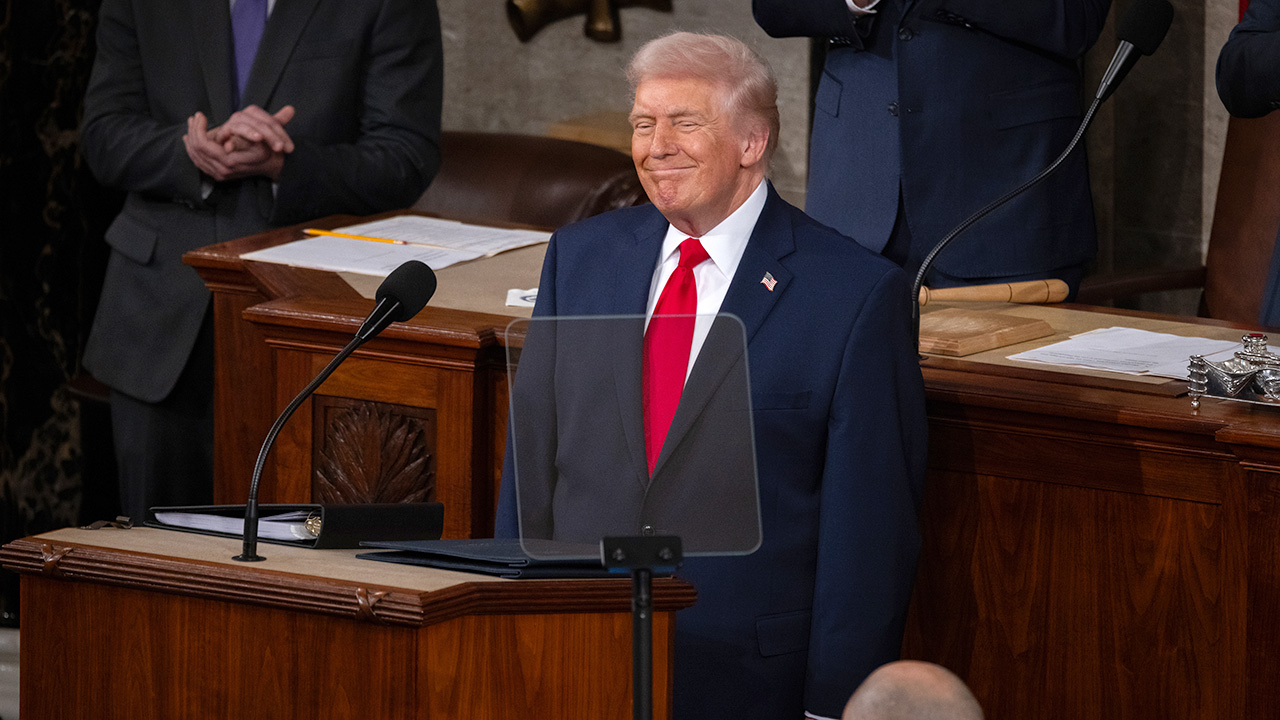
BlackRock Global Head of Retirement Solutions Nick Nefouse announces a new plan to expand retirement investment options on Varney & Co.
President Donald Trump on Tuesday outlined a new retirement plan that would see the federal government match a portion of the contributions made by American workers to retirement plans that aren’t matched by their employers.
Trump discussed the proposal during his State of the Union address to a joint session of Congress on Tuesday night, when he said that the federal government will start providing up to $1,000 in matching contributions to the retirement plans of workers whose employers aren’t providing a match.
“Since I took office, the typical 401(k) balance is up by at least $30,000. That’s a lot of money,” Trump said. “We have millions and millions of people, because the stock market has done so well, setting all those records – your 401(k)s are way up. Yet half of all working Americans still do not have access to a retirement plan with matching contributions from an employer.”
“To remedy this gross disparity, I’m announcing that next year, my administration will give these often forgotten American workers – great people, the people that built our country – access to the same type of retirement plan offered to every federal worker. We will match your contribution with up to $1,000 each year, as we ensure that all Americans can profit from a rising stock market,” the president said.
THE TYPICAL AMERICAN WORKER HAS JUST $955 SAVED FOR RETIREMENT, STUDY SHOWS
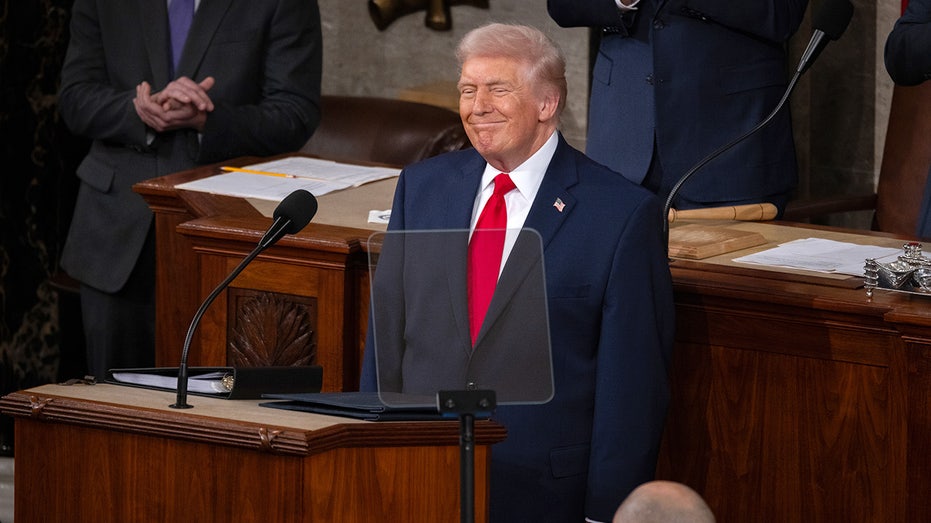
President Donald Trump unveiled a new retirement plan for Americans during his State of the Union address. (Nathan Posner/Anadolu via Getty Images)
Trump’s proposal would build off an existing federal policy that allows the government to make a matching contribution to private sector workers’ retirement plans if they meet certain income criteria.
A bipartisan law known as the SECURE 2.0 Act was signed into law by President Joe Biden in 2022 and created a Saver’s Match that would match 50% of retirement contributions made by eligible workers up to $1,000 for individuals and $2,000 for couples starting in 2027.
HERE’S HOW MUCH TRUMP ACCOUNT BALANCES COULD GROW OVER TIME
The federal retirement match would apply to a variety of low-cost index funds. (Angela Weiss/AFP via Getty Images / Getty Images)
Under the SECURE 2.0 Act, the Saver’s Match would be distributed through a federal tax credit deposited directly into a qualified pre-tax retirement account, such as a traditional IRA or traditional 401(k), though after-tax accounts like the Roth IRA or Roth 401(k) wouldn’t be eligible to receive the funds.
The existing Saver’s Match phases out for income in the $20,501 to $35,500 range for single filers, $30,751 to $53,250 for heads of households, and $41,001 to $71,000 for married couples filing jointly.
IRS REVEALS UPDATED RETIREMENT CONTRIBUTION LIMITS FOR 2026

The White House’s plan builds on an existing match scheduled to take effect in 2027. (iStock)
The White House indicated that the president’s proposal would have a similar structure to the Thrift Savings Plan that federal employees can enroll in, which allows them to invest in several low-cost index funds, including U.S. Treasury bonds, an aggregate U.S. bond fund, the S&P 500, a U.S. total stock market index, and an international stock index that excludes China and Hong Kong.
A 2025 analysis by the Pew Charitable Trusts found that almost 57 million American workers – which amounts to almost half of the private sector workforce – don’t receive retirement benefits through their workplace.
GET FOX BUSINESS ON THE GO BY CLICKING HERE
Pew’s analysis estimated that the cost to federal and state governments of Americans’ insufficient retirement savings would amount to $1.3 trillion over a 20-year period, as insufficient retirement savings decreases household spending and increases demand on social assistance programs that can strain a shrinking tax base.


The matcha line includes a latte and a shake.

John Lewis Partnership has abandoned its build-to-rent housing ambitions, retreating from a high-profile property diversification strategy as the group pivots back towards its core retail business.
The employee-owned retailer confirmed it would withdraw from the rental housing scheme first championed by its former chair, Sharon White, who had sought to reduce reliance on retail by generating 40 per cent of profits from non-retail ventures by 2030. That target was later scrapped.
The build-to-rent initiative, launched in partnership with Aberdeen, aimed to deliver around 1,000 rental homes across sites in Ealing and Bromley in London and Reading in Berkshire. Aberdeen had pledged to raise £500m from institutional investors to fund the developments.
However, John Lewis said that the funds were never secured due to shifting macroeconomic conditions.
“Our rental property ambition was based on a very different financial environment: one with more stable investment returns, lower borrowing costs and more affordable construction costs,” a spokesman said. “The current climate, higher interest rates, inflationary pressures and a more cautious property market, means the model no longer meets our investment criteria.”
The decision marks a significant strategic reset under Jason Tarry (pictured), the former Tesco executive who became chair in 2024. Tarry has sought to restore the partnership’s focus on retail performance after several years of financial strain and cancelled staff bonuses.
The group is now pursuing an £800m investment programme aimed at revitalising its department stores, alongside a £1bn investment in its Waitrose estate of 320 shops. Recent initiatives include a high-profile partnership to bring Topshop concessions into John Lewis stores as it seeks to win back younger customers.
The build-to-rent strategy had originally been positioned as a way to unlock value from surplus Waitrose land and car parks while creating a more stable, long-term income stream less exposed to retail volatility.
However, the proposals were controversial from the outset. Local communities and planning authorities raised concerns over building heights, density and the proportion of affordable housing. Although several schemes ultimately secured planning approval, in some cases after appeals and intervention by government inspectors, the projects required significant upfront investment.
While John Lewis has not disclosed how much has been spent to date, it is understood that several million pounds were invested in design, planning and legal costs before the scheme was halted.
The withdrawal underlines the pressure facing retailers that diversified into property during the era of low interest rates. Higher borrowing costs have eroded returns on residential development, while construction inflation has increased project risk.
For John Lewis, the move signals a return to fundamentals after what some critics inside and outside the partnership viewed as a distraction from its core business.
With the cost-of-living crisis squeezing consumer spending and competition intensifying across both fashion and grocery, the partnership is betting that renewed focus on shopkeeping, rather than landlord ambitions, offers a clearer path to restoring profitability and rebuilding confidence among its employee-owners.

Jamie Young
Jamie is Senior Reporter at Business Matters, bringing over a decade of experience in UK SME business reporting.
Jamie holds a degree in Business Administration and regularly participates in industry conferences and workshops.
When not reporting on the latest business developments, Jamie is passionate about mentoring up-and-coming journalists and entrepreneurs to inspire the next generation of business leaders.

NVIDIA Corp. faces one of its most anticipated quarterly reports on February 25, 2026, after market close, as investors scrutinize whether the AI chip leader can sustain explosive growth amid soaring expectations and a stock trading near $197 ahead of the release.

Justin Sullivan/Getty Images
As of February 25, 2026, NVIDIA (NASDAQ: NVDA) shares traded around $196-$197 in pre-earnings activity, up modestly from the prior close of $192.85 on February 24. The stock has gained significantly in 2026, building on 2025’s massive rally driven by AI infrastructure demand. Market capitalization exceeds $4.7 trillion, making NVIDIA the world’s most valuable company by a wide margin.
The company is scheduled to release fiscal fourth-quarter 2026 results (ended January 25, 2026) after the bell, followed by a conference call at 5:00 p.m. ET. Wall Street consensus, compiled from Bloomberg, LSEG, and other sources, projects adjusted earnings per share of $1.53 and revenue of approximately $65.9 billion to $66.2 billion—a 68% year-over-year increase from $39.3 billion in the year-ago quarter. Data center revenue, the primary growth engine, is expected to reach $60.36 billion or higher, reflecting continued hyperscaler spending on AI accelerators.
Analysts anticipate another strong beat-and-raise quarter, marking potentially the 11th consecutive period of growth exceeding 55%. Gross margins are projected at around 75%, with adjusted operating income near $44.56 billion. The report arrives at a pivotal time for the broader market, where NVIDIA’s performance has become a proxy for the AI boom’s health. A solid beat could reinforce confidence in AI infrastructure plays, while any shortfall in guidance might spark volatility across tech stocks.
CEO Jensen Huang and CFO Colette Kress are expected to provide commentary on Blackwell GPU ramp-up, demand from major cloud providers (Microsoft, Google, Meta, Amazon), and the upcoming Rubin architecture. Blackwell orders have reportedly crossed $350 billion in some estimates, with hyperscaler capex projected to hit $600 billion for 2026—much of it flowing to NVIDIA chips. The company faces scrutiny on whether AI spending remains robust or shows signs of moderation.
NVIDIA’s third-quarter fiscal 2026 results (reported November 19, 2025) set a high bar: record revenue of $57.0 billion (up 62% year-over-year), data center revenue of $51.2 billion (up 66%), and strong guidance for Q4 at $65.0 billion plus or minus 2%. That outlook has held firm, with some analysts raising estimates slightly in recent weeks.
The earnings call will also address supply chain dynamics, competition from AMD and custom silicon efforts by hyperscalers, and any updates on energy-efficient designs for next-generation AI workloads. Options markets have priced in a potential 5-6% stock swing post-earnings, reflecting the high stakes for a company whose moves often influence the S&P 500 and Nasdaq.
Analyst sentiment remains bullish overall. Consensus price targets sit well above current levels, with many firms highlighting NVIDIA’s dominance in AI accelerators and long-term secular tailwinds. However, valuation concerns persist—trading at around 41 times forward earnings in some calculations—amid worries about potential AI spending slowdowns or execution risks on Blackwell ramp.
NVIDIA’s trajectory in 2026 hinges on proving the AI supercycle endures. With the GTC 2026 event approaching in March, where major announcements are expected, the February 25 report serves as a critical checkpoint. A beat-and-raise scenario could propel shares higher, reinforcing the narrative of sustained hyperscaler demand, while any cautious guidance might trigger a pullback in a market increasingly sensitive to AI-related developments.
As the closing bell approaches, all eyes remain on NVIDIA to deliver clarity on the pace of AI infrastructure buildout and its implications for the broader tech sector.


The collaboration builds on an ongoing partnership.

A former California governor candidate was also disciplined as the platform cracks down.

Jefferies raises Postal Realty Trust price target on guidance beat


The shelf stable vegetables are available at select Whole Foods Market locations.

How much will your energy bills go down as new price cap announced

Cisco Systems (CSCO) Stock Steady Near $64.50 After Record Q2 FY2026 Revenue Beat, AI Orders Surge

Largest BNB treasury crashes 95%, blames CZ family office


-

 Video6 days ago
XRP News: XRP Just Entered a New Phase (Almost Nobody Noticed)
-

 Politics4 days ago
Baftas 2026: Awards Nominations, Presenters And Performers
-

 Fashion5 days ago
Weekend Open Thread: Boden – Corporette.com
-

 Sports2 days ago
Women’s college basketball rankings: Iowa reenters top 10, Auriemma makes history
-

 Politics2 days ago
Nick Reiner Enters Plea In Deaths Of Parents Rob And Michele
-
 Sports7 days ago
Clearing the boundary, crossing into history: J&K end 67-year wait, enter maiden Ranji Trophy final | Cricket News
-

 Crypto World2 days ago
XRP price enters “dead zone” as Binance leverage hits lows
-

 Business3 days ago
Mattel’s American Girl brand turns 40, dolls enter a new era
-

 Business3 days ago
Law enforcement kills armed man seeking to enter Trump’s Mar-a-Lago resort, officials say
-

 Entertainment7 days ago
Dolores Catania Blasts Rob Rausch For Turning On ‘Housewives’ On ‘Traitors’
-

 Tech1 day ago
Unsurprisingly, Apple's board gets what it wants in 2026 shareholder meeting
-
 NewsBeat2 days ago
‘Hourly’ method from gastroenterologist ‘helps reduce air travel bloating’
-

 Tech3 days ago
Anthropic-Backed Group Enters NY-12 AI PAC Fight
-

 NewsBeat3 days ago
Armed man killed after entering secure perimeter of Mar-a-Lago, Secret Service says
-

 Politics3 days ago
Maine has a long track record of electing moderates. Enter Graham Platner.
-
 NewsBeat22 hours ago
Police latest as search for missing woman enters day nine
-

 Crypto World22 hours ago
Entering new markets without increasing payment costs
-
 Sports2 days ago
2026 NFL mock draft: WRs fly off the board in first round entering combine week
-

 Crypto World6 days ago
83% of Altcoins Enter Bear Trend as Liquidity Crunch Tightens Grip on Crypto Market
-

 Business1 day ago
True Citrus debuts functional drink mix collection