
Business
The Biggest Challenges Growing Companies Face


A startup proves that an idea can work. A scale-up must prove that the whole company can keep working when demand, headcount and complexity rise at once. That shift catches many founders off guard.
Growth remains exciting, but it also exposes every weak process the business managed to ignore while it was smaller. The challenge is not simply to sell more. It is to build an organisation that can deliver more without losing control.
Leaders also need space to think clearly rather than react to every alert. Whether browsing just casino, walking or taking a quiet coffee break, the principle is the same: constant urgency rarely produces the best strategic decisions. Scale requires pace, but it also requires judgment.
Hiring before the gap becomes a crisis
Growing firms compete for people who can bring experience without burying the business in unnecessary process. Hiring too late leaves exhausted teams covering roles they were never meant to hold. Hiring too early burns cash and creates positions without enough work. The best approach starts with the capability the company needs, the result that role should own and the point at which demand justifies the cost.
Retention matters just as much. Rapid growth changes jobs quickly, so employees need clear expectations, fair progression and managers who can offer useful feedback. UK government research into scale-ups and access to talent highlights the practical challenge of recruiting and retaining key skills while larger employers compete for the same people.
Turning founder knowledge into systems
In a startup, the founder may hold product history, customer context and commercial priorities in their head. That feels efficient until ten teams need the same answer. Scale-ups must document how important decisions get made, who owns them and which information everyone can trust.
The goal is not a handbook for every breath. Start with high-risk or repeated work: customer onboarding, pricing approvals, quality checks, security, hiring and financial reporting. Good systems remove avoidable confusion while leaving teams room to solve new problems.
Protecting cash while revenue grows
Fast sales growth can hide weak cash flow. A company may sign larger contracts yet wait months for payment, while payroll, tax, suppliers and infrastructure costs arrive on schedule. Leaders need reliable forecasts that model best, expected and difficult cases. They also need to understand unit economics rather than celebrate revenue that costs too much to deliver.
Funding creates its own choices. Equity, debt and reinvested profit affect control and risk differently. The right option depends on the business model, timing and founders’ goals, not on which funding announcement looks most impressive online.
Keeping customers close
Early customers often receive direct attention from founders and product experts. As the company grows, layers appear between feedback and action. Support teams collect issues, sales teams make promises and product teams balance competing requests. Without a clear system, useful signals get lost.
Scale-ups should track why customers buy, stay, expand or leave. Numbers show the pattern; conversations explain it. Growth becomes dangerous when acquisition masks falling satisfaction among existing customers.
Building leadership that can let go
Founders do not need to disappear, but they must stop being the route for every decision. Strong leaders set direction, define boundaries and give capable people genuine authority. That can feel slower at first because delegation requires explanation and trust. Soon, however, the company gains more decision-making capacity than any founder could provide alone.
The move from startup to scale-up is less about becoming corporate and more about becoming dependable. Keep the curiosity and speed that made the business work. Add the people, cash discipline and operating structure that let it work repeatedly. That is the unglamorous machinery behind sustainable growth – and it beats chaos with a better logo.


Wetherspoons has banned its customers from playing music out loud or taking calls on speaker, saying the noise was an increasing problem driving people “nuts”.
The company – which runs 792 pubs and bars across the UK – said that following complaints it has asked customers to switch their phones and tablets to silent or to use earphones.
Polling in recent years by various organisations suggests people are largely opposed to others playing music or taking calls on speaker in public spaces.
Wetherspoons told the BBC that staff will be asked to use “common sense” when enforcing the ban.
“We are not looking to ask anyone to leave a pub if they go against the ruling, but it is an option for managers if they refuse to do so,” the company said.
It follows a stricter, longstanding policy from rival pub chain Sam Smiths which bans no phone or tech use of any kind, in addition to a ban on swearing.
Wetherspoons does not play music in any of its pubs, with chief executive Tim Martin describing them as “an oasis of tranquillity and contemplation”.
The chain does play music in the evening at its 44 Lloyds’ bars. It confirmed that the ban on customers playing music and taking calls on speaker would also apply to those venues.
The number of Wetherspoons pubs has steadily fallen over the last decade from a peak of 955 in late 2015.
The firm has faced a financial challenges during those ten years from the Covid pandemic and inflation.
Last month, it told investors that profit for the year would be lower than expected because of higher costs for food, labour, repairs, energy, and business rates.

OPINION: Industrial action on major resources projects will reset the baseline for every negotiation.

Yes. Corporate subscriptions are available for teams and organisations, with discounted rates as user numbers increase. Pricing starts from $1,625 + GST per user.
Get in touch
to discuss the right option for your organisation.
Business News subscriptions are used by executives, investors, consultants and professionals who need to stay informed and make better decisions about the WA market. When you subscribe you’ll get
- Unlimited access to WA’s most trusted business journalism
- Data & Insights — detailed profiles of WA companies, people, projects and deals
- MyBN — a personalised feed based on the companies, people and sectors you follow
- Special publications and industry reports
- Daily and weekly email newsletters
Data & Insights is a research tool built specifically for the WA market. It draws on more than 30 years of Business News reporting, updated regularly to reflect what’s happening now. Use it to:
- Look up detailed profiles of WA companies, including financials, directors and ownership
- Find decision-makers and track their career movements
- Research live and completed projects across WA industries
- Monitor deals, appointments and market activity
- Access industry rankings and league tables
Data & Insights is updated daily by our dedicated research team, which uses the latest announcements, ASX filings and editorial coverage to keep our person, company, list and project records up to date.
Business News welcome all opportunities to make our dataset accurate, complete and current, so if you have an update request, please email the team at
general@businessnews.com.au, and we’d be happy to assist.
MyBN
is part of every subscription. It’s your personalised view of Business News. You can follow the companies, people, sectors and projects that matter to you, and get a news feed and alerts tailored to your interests. You can save articles to read later and retain only what you need.
Only subscribers have full access to all content on the Business News website.
If staying informed about the WA economy is part of your job, and/or you’re looking for networking opportunities in WA, Business News is built for you.
Business News subscribers are:
- Executives and directors tracking competitors, clients and market movements
- Investors and advisers researching companies, deals and industry trends
- Consultants and professionals staying across sectors relevant to their clients
- Business owners looking for leads, context and market intelligence
Most Business News publications cover national or global markets. Business News is focused entirely on Western Australia, which means the journalism, the data and the intelligence are all built around WA companies, people and projects — not adapted from a national feed. Data & Insights, included with every subscription, combines more than 30 years of WA-specific editorial research with live business data. There’s no comparable product for the WA market.
The Morning Digest Email provides a comprehensive wrap of the major headlines, relevant to WA business, and includes with a snapshot of the overnight news covering oil, gold and ASX-listed companies.
The Afternoon Wrap Email focuses on the news covered by our team of journalists during the course of the working day, including exclusive stories and analysis, all of which relates to WA business and the local economy.
The BN Weekender Email contains a wrap of the Business News from the week that was, highlighting the top stories in each area of WA business.
Sign up for free.
We’re happy to help.
Get in touch
and our team will come back to you.
Business
Hindustan Copper, Vedanta, other metal stocks slip up to 2% after sharp gains. Should you buy the dip or avoid?

Nifty Metal dropped half a per cent amid an overall bearish market sentiment on Tuesday, with NMDC shares falling more than 2% to lead losses. Hindustan Copper shares lost over 1%, after rallying around 8% in the previous session.
Today’s fall in metal stocks comes as metal prices corrected after hitting multi-month highs the previous day. Copper prices fell as the market digested a string of disappointing economic data from China, and the US-Iran truce expired without a longer-term peace deal. This comes a day after the red metal hit its highest in more than six months on Monday amid worries around availability on the London Metal Exchange, where inventories are at their lowest since February.
Gold and silver prices also declined in the domestic market, although the precious metals extended gains in the international market.
Also read | Gold slips below Rs 1.55 lakh/10 gm on MCX, but global prices extend gains. What’s next?

Should you buy metal stocks?
Metal stocks are reacting to a decent recovery in underlying metal prices, said Sunny Agrawal, Head of Fundamental Research at SBI Securities. He noted that copper, aluminium, zinc and silver prices are up by 6%, 4%, 8% and 12% respectively over the last month.
“Investors can selectively participate in a few names like Nalco and Hindustan Zinc. Traders should adhere to stop loss to factor in sudden correction in the underlying metal prices which is a function of many factors including dollar index, global demand supply etc,” Sunny Agrawal from SBI Securities said.
Technical view
One of the better ways to assess the outlook for a basket of stocks is to study the corresponding sectoral index, as it provides a broader representation of the underlying group, said Hitesh Rathi, Technical Analyst at Angel One. “In this context, the Nifty Metal index had been trending lower since May this year, with the sectoral index forming a 100% bearish pole on its 0.25% × 3 point and figure chart. This resulted in a correction of over 10% in the index, translating into a sharper decline across several metal stocks,” he explained, adding that the technical setup now appears to be turning constructive.
The sectoral index seems to have established a strong support zone in the 12,500–12,400 band, underscored by the formation of a weak breakout on its daily 1% renko chart, he added. Following this development, the index has already rallied by over 5% in a relatively short period, indicating a meaningful improvement in momentum.
The combination of a well-defined support zone and the bullish breakout formation suggests the presence of strong demand at lower levels and points towards a potential reversal in the broader trend, according to the analyst. “That said, given the sharp upmove witnessed recently, chasing momentum at current levels may not offer the most favourable risk-reward proposition. Instead, any retracement towards the 12,800–12,700 band should be viewed as an opportunity to accumulate select metal stocks, with the broader sectoral setup now turning increasingly constructive,” Rathi concluded.
(With inputs from agencies)
(Disclaimer: Recommendations, suggestions, views and opinions given by the experts are their own. These do not represent the views of The Economic Times)

Huber+Suhner H1 2026 slides: record orders offset by margin pressure

Australia’s share market has ended the session slightly lower, despite outsized gains in BHP and healthcare stocks ultimately shielding broader market weakness.

Artisan Partners is a global investment management firm that provides a broad range of high value-added investment strategies in growing asset classes to sophisticated clients around the world. Since 1994, the firm has been committed to attracting experienced, disciplined investment professionals to manage client assets. Artisan Partners’ autonomous investment teams oversee a diverse range of investment strategies across multiple asset classes. Strategies are offered through various investment vehicles to accommodate a broad range of client mandates.
This site is intended for use with US institutional investors which includes corporate and public retirement plans, foundations, endowments, trusts and their consultants. Note: This account is not managed or monitored by Artisan Partners, and any messages sent via Seeking Alpha will not receive a response. For inquiries or communication, please use the firm’s official channels.
Business
Colgate-Palmolive shares fall over 2% after Investor Day. What Goldman Sachs and other brokerages are saying

Should you buy, sell or hold the stock?
In an analyst note reported by ET Now, Goldman Sachs maintained its Neutral rating on Colgate Palmolive with a target price of Rs 2,050, implying a modest upside from current levels. The brokerage highlighted that Colgate’s strategy is aggressively pivoting toward volume recovery, premiumization, and category expansion. ET Now reported that while heavy step-ups in brand spending and advertising intensity could weigh on operational margins over the short term, structural cost savings from the company’s ‘Funding the Growth’ initiative will help cushion profitability.
Motilal Oswal maintained its Buy rating on Colgate Palmolive with a target price of Rs 2,500, implying a 27% upside from current levels. The brokerage noted that the core investment thesis remains intact as Colgate continues to lead and drive category expansion in India. It highlighted strong traction in science-led innovations like Colgate Strong Teeth with Arginine and rapid scaling in premium offerings such as Visible White Purple. Motilal Oswal expects sales to reach Rs 66.5 billion in FY27E and Rs 71.2 billion in FY28E, supported by steady volume execution and segment leadership.
Nuvama maintained its Buy rating on Colgate Palmolive with a target price of Rs 2,350, implying a 22.5% upside from current levels. The brokerage highlighted the company’s persistent focus on driving oral care penetration and expanding market reach. It noted that 45% of rural Indians still do not brush daily and 76% of urban Indians do not brush twice a day. Nuvama added that management’s decision to allocate roughly 16% of revenues toward brand building underscores a strategy centred on long-term category expansion over short-term margin maximisation, backed by a distribution footprint across 7.1 million stores.
Colgate management commentary
Managing Director Prabha Narasimhan emphasised that Colgate is best placed to lead and expand the oral care category in India. “Our strategy is clear: drive growth ahead of profitability,” management stated, pointing out that premium toothpaste share has expanded 2.5 times compared to 2021 levels and direct retail coverage now reaches 1.7 million outlets.
(Disclaimer: Recommendations, suggestions, views, and opinions given by experts are their own. These do not represent the views of The Economic Times.)

Nomura Mid Cap Growth Fund Q2 2026 Commentary

According to a regulatory filing by the company on the BSE, the Yesintek single-dose prefilled autoinjector offers patients with another important treatment option. This new delivery format supports more tailored treatment approaches across different care settings and patient needs.
“This supplemental approval enhances Biocon’s comprehensive portfolio of immunology products in the United States and reaffirms the company’s commitment to improving access to affordable medicines for patients around the world,” the company said, as per the regulatory filing.
Yesintek is indicated for the treatment of moderate to severe plaque psoriasis and active psoriatic arthritis in adult and pediatric patients who are six years of age and older, and moderate to severely active Crohn’s disease and ulcerative colitis in adults, thereby treating a range of debilitating autoimmune conditions that affect tens of thousands of Americans.
Biocon Q1 Results
The company reported a net profit of Rs 141 crore in the June quarter of FY27. It reported a 10% year-on-year increase in consolidated operating revenue to Rs 4,336 crore, driven by strong growth in the Biopharma business. Biopharma revenue grew 17% YoY, driven by momentum from recent biosimilar and generic product launches across key markets.
Consolidated EBITDA stood at Rs 902 crore, with a margin of 21%, supported by improved profitability in the Biopharma business, which helped offset continued challenges in the Services business.
Biocon Share Price
Shares of Biocon have gained nearly 3% in the last three months. However, the shares have slipped over 7% over the last six months.
The shares of the drugmaker have declined over 9% in 2026 so far. In the longer term, Biocon shares have fallen over 4% over one year, but have delivered 19% returns over three years and 39% returns over five years.

Father Of Hayden Panettiere’s Daughter Wladimir Klitschko Breaks Silence On Her Death

Dane Myers, Reds carry momentum into middle game of Cardinals series

Family tribute to Paul Durkin who has died aged 52


-

 Fashion4 days ago
Weekend Open Thread: Ann Taylor
-
 NewsBeat6 days ago
Communication cards help banking customers access services or report scams
-
 Sports4 days ago
This U.S. Amateur is a glimpse into golf’s future in more ways than you think
-

 Sports3 days ago
Birmingham 2026: Day 6 Timetable for Irish Athletes
-
 NewsBeat3 days ago
Myanmar says over 300,000 Rohingya refugees verified for repatriation as exodus enters ninth year
-

 Politics3 days ago
SEQ Code: The Three Letter Boarding Pass Code That Could Give You The Worst Seat
-
 Entertainment6 days ago
Keke Palmer Subtly Hints At Sean Evans Drama With Cryptic Post
-

 Fashion7 days ago
Coffee Break: The Fonteyn Jane Flat
-
 Tech4 days ago
11 Ways to Rank Your Videos
-

 Fashion7 days ago
Should you refinance your debt? Pros, cons, and real numbers
-

 Tech7 days ago
Zoom Screen-Sharing Bug Let People Fully Take Over Other Devices On A Call
-

 Fashion7 days ago
Claire Life: Kicking Off MVAAFF With the C Suite Luncheon Featuring Phylicia Rashad, Letoya Luckett, and More!
-
 Crypto World6 days ago
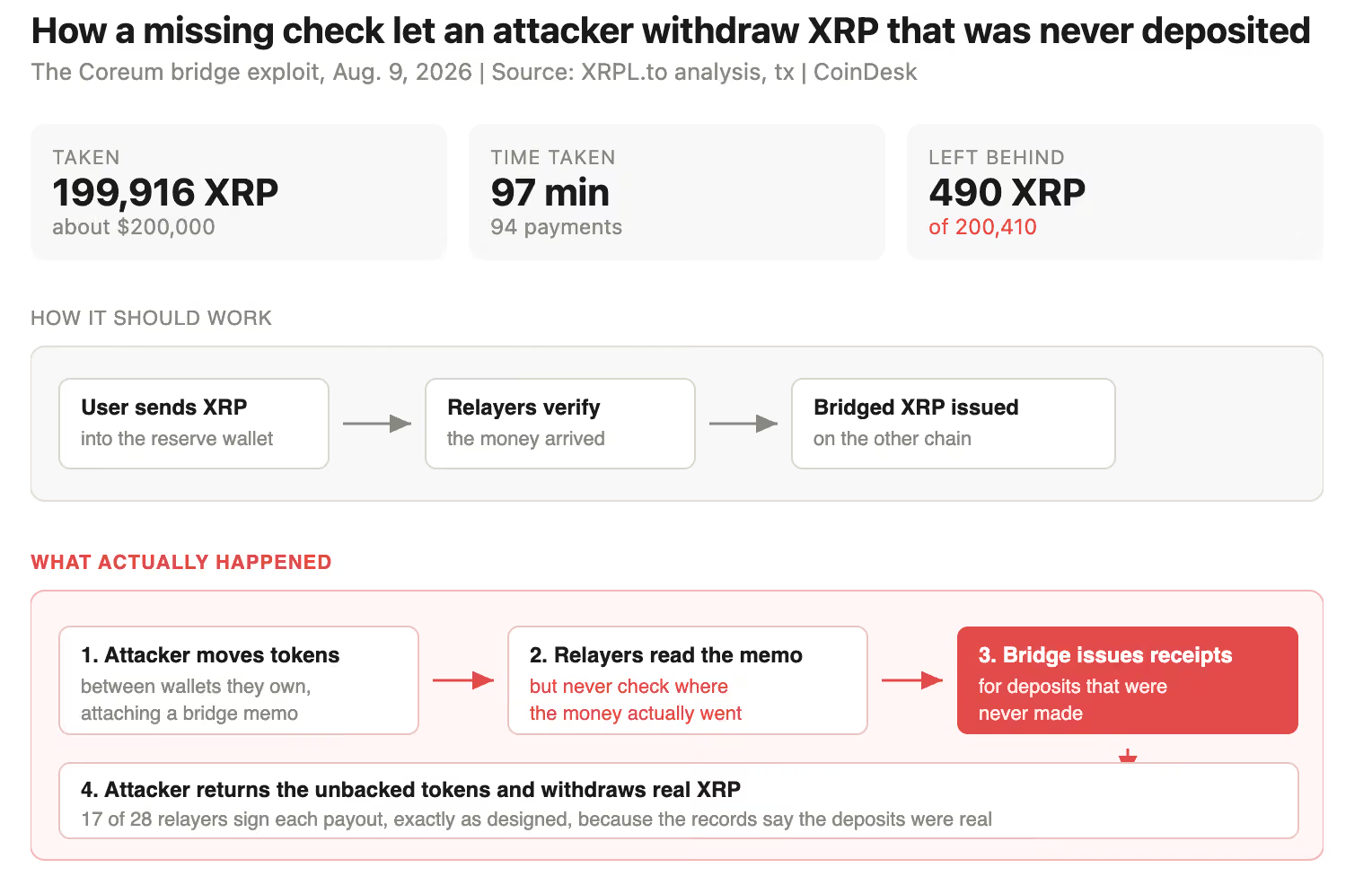
XRP bridge drained after software mistook fake deposits for real ones
-

 Tech5 days ago
DeepSeek Harness launches as open source rival to Claude Code, alongside V4-Pro on API with higher prices
-

 Sports6 days ago
DeQuan Jones in ‘high spirits’ after successful leg surgery
-
 Entertainment7 days ago
Star Wars Officially Continues ‘The Last Jedi’ With a New Spin-Off
-
 Crypto World6 days ago
Perplexity AI Predicts an XRP Scenario Few Analysts Are Discussing
-

 Politics7 days ago
In the Chris Kaba case, the police watchdog capitulated to the mob
-

 Politics6 days ago
How Average Are You In The UK?
-

 Tech6 days ago
SpaceXAI’s Grok Bot turns agents into persistent digital coworkers that can operate your apps for $120-per-month
You must be logged in to post a comment Login