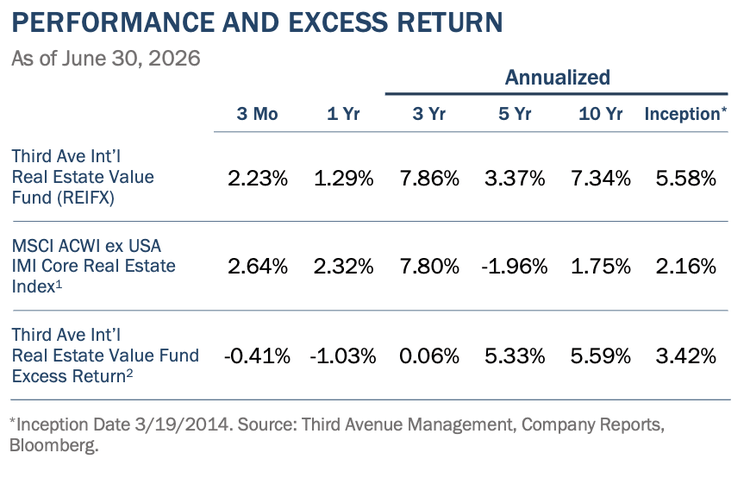
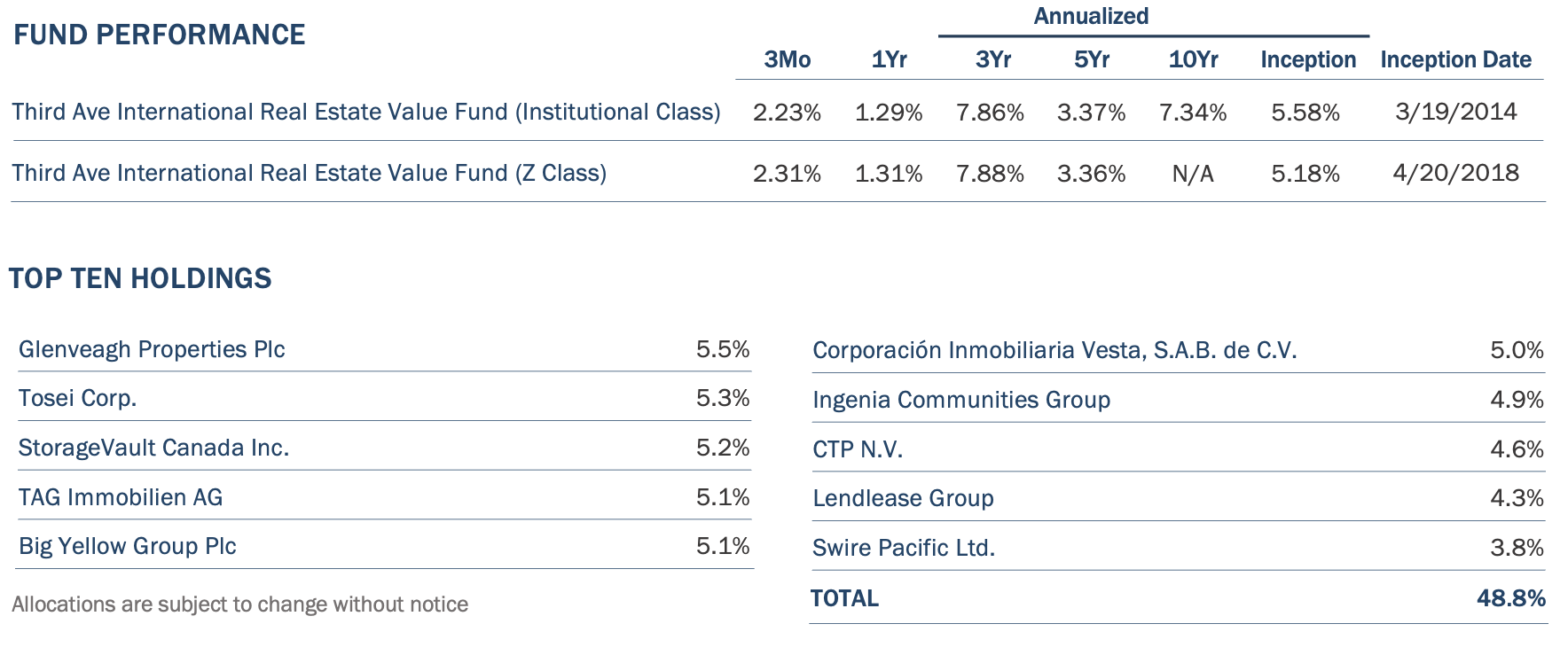
We are pleased to provide you with the Third Avenue International Real Estate Value Fund (the “Fund”) report for the quarter ended June 30, 2026. The Fund delivered a return of +2.23% (after fees) for the quarter, compared with the MSCI ACWI ex USA IMI Core Real Estate Index1 (the “Index”), which returned +2.64% over the same period. Fund Management believes long-term returns are more indicative of relative performance. Over the last 10 years, the Fund has outperformed the Index by 5.59% per year (after fees).
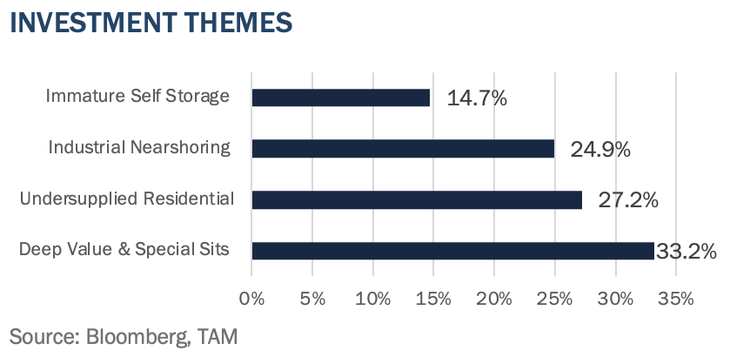
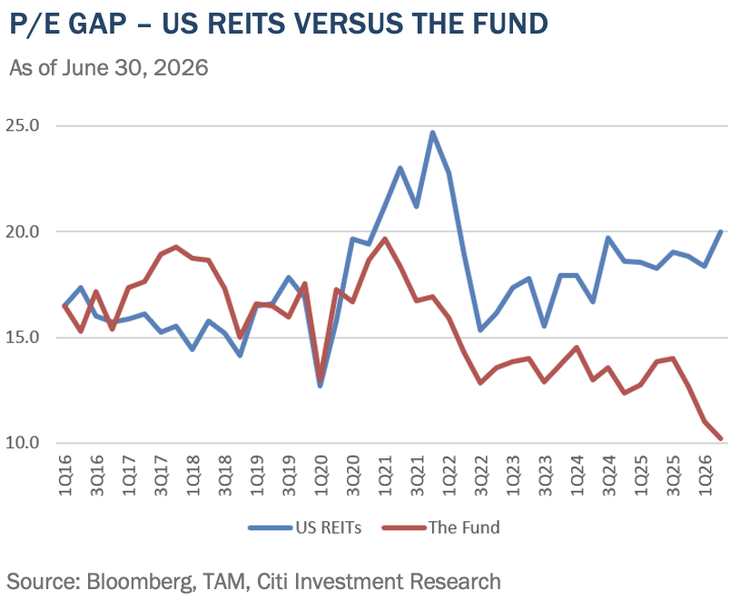
So far this year, dispersion across geographies and asset classes has increased amid ongoing tensions related to the Iran conflict. Fund Management capitalized on this dispersion by establishing two new positions, thereby enhancing the Fund’s exposure to its top two structural themes: persistently undersupplied residential real estate and high-demand industrial real estate. Both investments were made at attractive discounts to intrinsic value. These discounts reflect a broader opportunity shaped by the current market environment. The Fund trades at about 10 times earnings, roughly half the valuation multiple of U.S. REITs, despite similar or better earnings growth. Fund Management believes this valuation gap is unprecedented and unsustainable, and the Fund is positioned to benefit as it closes.
Advertisement
Activity
A new investment in leading Spanish homebuilder Neinor Homes S.A. (NNRHF) (“Neinor”) deepens the Fund’s exposure to a high conviction structural theme: residential real estate markets that are chronically and structurally undersupplied. In Europe, this theme already includes two existing Fund positions — Glenveagh Properties PLC (GLVHF) (“Glenveagh”), an Irish homebuilder focused primarily on Dublin and its commuter belt, and TAG Immobilien AG (TAGOF) (“TAG”), a German and Polish residential owner and developer with a large, stable German rental portfolio and a rapidly growing Polish platform.
Spain, Ireland, and Poland face a long-standing housing deficit that has been growing for over ten years and is now at a critical point. In each market, demand significantly exceeds supply, driven by common factors: (i) economies growing faster than the European average, (ii) structural deficits resulting from years of underbuilding that cannot be quickly fixed, (iii) favorable affordability ratios and low or decreasing mortgage rates, and (iv) government policies broadly supportive of new supply.
Advertisement
Following Neinor’s acquisition of AEDAS Homes last year, which was previously owned by the Fund, the company has become Spain’s largest homebuilder, mainly focused on major cities like Madrid. The combined entity plans to build 5,000–7,000 homes annually, supported by a land bank capable of sustaining production for over six years. The Fund’s investment thesis is based on several factors: (i) strong fundamentals in the Spanish housing market, where new construction is estimated to meet only half of annual new household formations despite rising house prices; (ii) attractive affordability, with the average Neinor homebuyer able to obtain a 30-year mortgage at rates in the low 2% range and home prices less than five times gross income; (iii) an acquisition price for AEDAS below intrinsic value, supported by conservative earnings guidance and multiple resource conversion options to enhance shareholder returns; and (iv) a shareholder return plan, with Neinor aiming for annual dividends exceeding 15% based on the current share price.
The Fund’s exposure to Poland is through its investment in TAG, a German-listed multifamily property operator. TAG owns over 83,000 rental units across Germany, generating consistent cash flow that has helped its expansion into Poland at a low cost of capital. Its Polish business—comprising ROBYG’s build-to-sell projects and Vantage Development’s growing rental portfolio—now makes up nearly half of TAG’s earnings, according to Fund Management. Despite this, Polish revenue remains undervalued at TAG Immo’s current share price. To prove this point, TAG launched an IPO for its Polish homebuilding unit ROBYG after the quarter ended, with shares pricing 25% above TAG’s book value for ROBYG. TAG still owns about two-thirds of ROBYG, with IPO proceeds used to further expand its Polish rental portfolio. This IPO validates some of the value hidden in many of the Fund’s investments. If the market valued TAG based on ROBYG’s current share price, TAG would need to trade approximately 20% higher to align with peer multiples.
Similar to targeted undersupplied residential markets, Fund Management views industrial real estate as one of the most compelling structural growth stories in global listed real estate. This is driven by two major demand factors that have been developing over the past 5-10 years. First, the continued rise of online retail and the need for proximity to urban centers for faster delivery. Second, nearshoring and ‘China plus one’ manufacturing strategies aimed at diversifying supply chains, especially in markets like Central and Eastern Europe, Mexico, and Southeast Asia. Recently, another demand driver has appeared, as the conflict in Iran has reinforced existing structural demand trends initiated by the Ukraine war—specifically, increased defense spending and focus on domestic energy independence. These are expected to be long-lasting trends, supported by political commitments that are expected to benefit Fund investments, particularly those located in Europe.
In light of these demand drivers, the Fund initiated an investment in Australia’s Dexus Industria REIT (DXSIF) (“Dexus Industria”), adding a high-quality, e-commerce- and logistics-driven industrial platform to an existing industrial exposure that already includes nearshoring-oriented plays in Central and Eastern Europe (CTP NV and Warehouses De Pauw), Southeast Asia (Amata Corporation), and Mexico (Corp. Inmobiliaria Vesta S.A.B. de CV.), as well as logistics and e-commerce exposure in Brazil (LOG Commercial Properties).
Advertisement
Dexus Industria is an Australian industrial REIT with 88 high-quality warehouse and logistics assets, about 75% of which are located in urban ‘infill’ markets — Australia’s most sought-after industrial areas. The fully occupied portfolio recently recorded high single-digit net rental growth. It is managed by Dexus (ASX: DXS), a leading Australian real estate asset manager with roughly A$10 billion in industrial real estate assets. Our investment thesis is based on several factors: (i) an attractive valuation, including an 8% cap rate, a mid-teens AFFO multiple, a 7% dividend yield, and a 30% discount to NAV; (ii) the scarcity of infill industrial land in major urban centers, supporting premium occupancy and leasing spreads; (iii) a development pipeline of 12 projects offering attractive returns; (iv) a conservative, low-leverage balance sheet; (v) access to institutional deal flow, asset management, and operational expertise through Dexus; (vi) rental income growth outpacing construction cost inflation; and (vii) active share buybacks at a discount to NAV, highlighting shareholder alignment despite a less-than-perfect external management structure.
Positioning
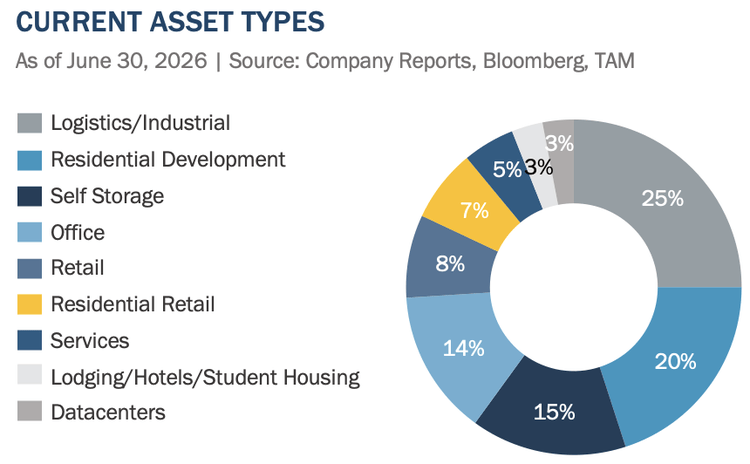
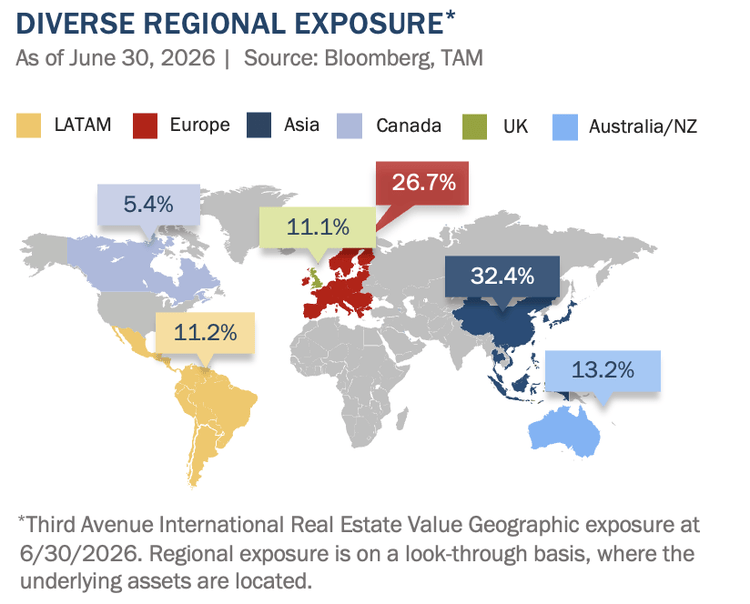
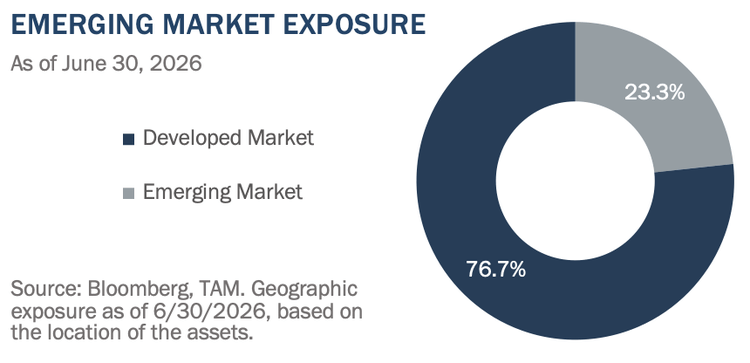
Including the above-referenced activity, the Fund’s allocations remain broadly consistent with recent quarters. New investments in Neinor Homes and Dexus Industria modestly increase the Fund’s residential development and industrial/logistics exposures, respectively, reflecting the Fund’s elevated conviction in those two thematics.
Advertisement
Advertisement
Outlook Commentary – An Unprecedented Value Opportunity
An underappreciated feature of the current market environment is the remarkable valuation divergence between international-listed real estate and its U.S. counterpart. International real estate delivered exceptional performance in calendar year 2025, with the Fund returning almost 27%. Yet this momentum has not carried into 2026. While U.S. REITs have rallied approximately 11% year-to-date on the back of domestic capital rotation, international listed real estate has largely traded sideways. The result is a growing valuation differential that is historically unprecedented in magnitude.
As illustrated in the accompanying chart, the Fund’s price-to-earnings multiple has compressed to approximately 10 times, while U.S. REITs trade at about 20 times. This is not a story of slowing earnings, as the Fund’s underlying holdings continue to grow earnings at attractive rates, driven by the structural and cyclical tailwinds inherent in underlying investments. Rather, it is a story of stagnant share prices amid compounding earnings. Mathematically, that should not persist indefinitely without either prices recovering or the fundamental investment case deteriorating. Fund Management is firmly of the view that the former is far more likely.
Advertisement
What makes the current discount particularly striking is the context in which it is occurring. For instance, U.S. REIT earnings growth for 2026 is broadly expected to be modest, with much of the re-rating driven by multiple expansion on domestic capital rotation. The Fund’s international real estate earnings, by contrast, are growing at what Fund Management estimates to be high-single-digit to low-double-digit rates across the Fund, similar to 2025 when the Fund’s investments achieved an average earnings growth of 12%. An investor buying the Fund today is acquiring earnings growth that is meaningfully faster at approximately half the valuation multiple. That is a risk-adjusted proposition rarely available in any asset class, let alone one backed by high-quality real assets.
Some U.S. REIT boards and management teams seem to agree — benefiting from relatively low-cost equity capital and elevated domestic valuations — are beginning to leverage this currency advantage to pursue international real estate acquisitions. The acquisition of Public Storage Canada by affiliated U.S. REIT Public Storage, and the approach by U.S. REIT Prologis to acquire UK-listed SEGRO, are early indicators of a trend that Fund Management expects could continue. Among the Fund’s own holdings, self-storage owners such as Big Yellow in the U.K., and Shurgard in Europe appear well-positioned as potential targets, given what we believe to be their high-quality portfolios, conservative balance sheets, and the significant gap between their listed valuations and what institutional and strategic buyers have been willing to pay for comparable self-storage platforms in the private market.
The resolution of the current valuation anomaly, in Fund Management’s view, is a question of when rather than if, and is likely to be driven by a combination of dynamics. This might include the above examples of public market M&A, as U.S. and other strategically positioned buyers use low-cost equity capital to acquire international platforms, seizing on the disconnect between listed and private market values, or market participants independently recognizing the valuation and earnings disconnect as the current cycle matures.
Advertisement
However, perhaps the most likely catalyst for the Fund is a broader rotation of capital toward real assets once the current concentration of market gains in artificial intelligence, memory, and semiconductor-related equities runs its course and ultimately reverses, as occurred following the technology, media, and telecom bubble in March 2000. In that earlier episode, the unwinding of an extraordinarily narrow, momentum-driven rally was followed by a multi-year period in which capital broadly rotated into real assets and value-oriented equities, including real estate, as investors re-priced risk and sought durable, tangible sources of cash flow. Fund Management does not attempt to predict the timing of such a rotation, but notes that the combination of historically elevated concentration risk in a small number of technology-related themes and historically wide valuation discounts in international real estate has, at a minimum, useful precedent.
In the interim, the Fund’s underlying earnings yield of approximately 10%, combined with high-single-digit earnings growth, provides a compelling stand-alone return case that does not depend on valuation re-rating at all. As such, Fund Management is highly confident that the current pricing of international listed real estate, relative to both intrinsic value and U.S. peers, represents one of the most attractive entry points in the Fund’s history.
We thank you for your continued support and look forward to writing to you again next quarter. In the interim, please do not hesitate to contact us with any questions, comments, or ideas at realestate@thirdave.com.
Sincerely, The Third Avenue Real Estate Value Team
Advertisement
Quentin Velleley, CFA Portfolio Manager
IMPORTANT INFORMATION
This publication does not constitute an offer or solicitation of any transaction in any securities. Any recommendation contained herein may not be suitable for all investors. Information contained in this publication has been obtained from sources we believe to be reliable, but cannot be guaranteed.
Advertisement
The information in this portfolio manager letter represents the opinions of the portfolio manager(s) and is not intended to be a forecast of future events, a guarantee of future results or investment advice. Views expressed are those of the portfolio manager(s) and may differ from those of other portfolio managers or of the firm as a whole. Also, please note that any discussion of the Fund’s holdings, the Fund’s performance, and the portfolio manager(s) views are as of June 30, 2026 (except as otherwise stated), and are subject to change without notice. Certain information contained in this letter constitutes “forward-looking statements,” which can be identified by the use of forward-looking terminology such as “may,” “will,” “should,” “expect,” “anticipate,” “project,” “estimate,” “intend,” “continue” or “believe,” or the negatives thereof (such as “may not,” “should not,” “are not expected to,” etc.) or other variations thereon or comparable terminology. Due to various risks and uncertainties, actual events or results or the actual performance of any fund may differ materially from those reflected or contemplated in any such forward-looking statement. Current performance results may be lower or higher than performance numbers quoted in certain letters to shareholders.
Date of first use of portfolio manager commentary: July 14, 2026
1 The MSCI ACWI ex USA IMI Core Real Estate Index is a free float-adjusted market capitalization index that consists of large, mid and small-cap stocks across 22 Developed Markets (DM) and 24 Emerging Markets (EM) countries engaged in the ownership, development and management of specific core property type real estate. The index excludes companies, such as real estate services and real estate financing companies, that do not own properties. Results for the index are inclusive of dividends and net of foreign withholding taxes.
2 Excess Return refers to the return from an investment above the benchmark. Source: Investopedia
Advertisement
Index Source: MSCI. MSCI makes no express or implied warranties or representations and shall have no liability whatsoever with respect to any MSCI data contained herein. The MSCI data may not be further redistributed or used as a basis for other indexes or any securities or financial products. This report is not approved, endorsed, reviewed or produced by MSCI. None of the MSCI data is intended to constitute investment advice or a recommendation to make (or refrain from making) any kind of investment decision and may not be relied on as such. An investor cannot invest directly in an index, and index performance does not reflect the deduction of fees and expenses.
Past performance is no guarantee of future results; returns include reinvestment of all distributions. The above represents past performance and current performance may be lower or higher than performance quoted above. Investment return and principal value fluctuate so that an investor’s shares, when redeemed, may be worth more or less than the original cost. For the most recent month-end performance, please visit the Fund’s website at www.thirdave.com. The gross expense ratio for the Fund’s Institutional and Z share classes is 1.52% and 1.46%, respectively, as of March 1, 2026.
Advertisement
Distributions and yields are subject to change and are not guaranteed.
FUND RISKS: In addition to general market conditions, the value of the Fund will be affected by the strength of the real estate markets. Factors that could affect the value of the Fund’s holdings include the following: overbuilding and increased competition, increases in property taxes and operating expenses, declines in the value of real estate, lack of availability of equity and debt financing to refinance maturing debt, vacancies due to economic conditions and tenant bankruptcies, losses due to costs resulting from environmental contamination and its related clean-up, changes in interest rates, changes in zoning laws, casualty or condemnation losses, variations in rental income, changes in neighborhood values, and functional obsolescence and appeal of properties to tenants. The Adviser’s use of its ESG framework could cause it to perform differently compared to funds that do not have such a policy. The criteria related to this ESG framework may result in the Fund’s forgoing opportunities to buy certain securities when it might otherwise be advantageous to do so, or selling securities for ESG reasons when it might be otherwise disadvantageous for it to do so. For a full disclosure of principal investment risks, please refer to the Fund’s Prospectus.
The fund’s investment objectives, risks, charges, and expenses must be considered carefully before investing. The prospectus contains this and other important information about the investment company, and it may be obtained by calling 800-443-1021 or visiting www.thirdave.com. Read it carefully before investing.
Distributor of Third Avenue Funds: Foreside Fund Services, LLC.
Advertisement
Current performance results may be lower or higher than performance numbers quoted in certain letters to shareholders.
Third Avenue offers multiple investment solutions with unique exposures and return profiles. Our core strategies are currently available through ’40Act mutual funds and customized accounts.
California real estate owner Josh Altman joins Stuart Varney to discuss falling rents in Los Angeles, normalizing national trends and the impact of AI-generated wealth driving up prices in San Jose.
Americans in the market for buying a new home are seeing the markets in some parts of the country turn in their favor after years of seller’s markets prevailing.
Realtor.com on Tuesday released the second-quarter edition of its market clock report, which analyzes national and metro-level housing conditions based on factors like months of supply, time on the market, price fluctuations and list-to-sale ratio.
Advertisement
Of the 100 metro areas included in the analysis, it found there are 19 metro areas that are in buyer’s market territory and nine trending toward that may join those ranks by the end of the third quarter.
The nine metro areas that are emerging as buyer’s markets are spread around the country and include Atlanta; Bakersfield, California; Birmingham, Alabama; Honolulu; Houston; Memphis; Riverside, California; San Antonio; and Syracuse, New York.
Nine metro areas are trending toward buyer’s markets as conditions in the housing sector shift, Realtor.com found. (Kirk Sides/Houston Chronicle)
That geographic diversity stands in stark contrast to the list of the 19 metro areas currently in a buyer’s market, 18 of which were located in the South, with Colorado Springs, Colorado, the lone exception.
Advertisement
Here’s a look at what’s driving the improving conditions for would-be homebuyers in five of the nine emerging buyer’s markets identified in Realtor.com’s report:
Atlanta, Georgia
“Our inventory has been building, homes are sitting on the market longer and sellers are becoming more willing to negotiate on price, closing cost and mortgage rate buy-downs,” said LeAnne Weathers, a realty agent with eXp in Atlanta, adding that buyers have “more choices and less pressure” in this environment.
“The biggest local factors driving that shift are increased housing supply, higher mortgage rates — keeping some of the buyers on the sidelines — and a more balanced market overall.”
Daniel Beer, an eXp realty agent in Riverside, said in the Southern California community’s markets, “buyers have the most leverage with condos. Inventory levels for condos are significantly higher than single-family homes and continue to grow.”
“Skyrocketing HOA fees due to government regulations and other factors contributing to increased operating costs are pushing more owners to sell, giving buyers a lot of choice,” Beer added.
Riverside’s condo market has been favorable for buyers, Beer said. (iStock)
Syracuse, New York
“Buyers in our market have had less competition in the past six months, which is allowing for more contracts to be accepted with home inspection contingencies,” said Ben Gray, an eXp realty agent in Syracuse.
“Many buyers are expanding their search criteria to include homes further out from the metro area, going as far as 45 to 50 minutes to get offers accepted,” Gray said.
Thao Nguyen, an eXp realty agent in Houston, said “buyers finally have options again” in the metroplex, noting data from the Houston Association of Realtors showed that single-family inventory has risen to 5.2 months.
“That means buyers have more time to compare homes, conduct inspections and negotiate instead of feeling pressured into bidding wars. As a listing agent, I’m also seeing more sellers willing to contribute toward closing costs or mortgage rate buy-downs to get deals across the finish line,” Nguyen added.
Houston is one of the areas in Texas trending toward a buyer’s market. (iStock)
San Antonio, Texas
“New construction is where buyers have the strongest negotiating position. Builders are aggressively offering interest rate buydowns, covering closing costs and providing additional incentives that many resale sellers simply can’t match,” said Rommy Deais, an eXp realty agent in San Antonio.
Advertisement
Mario Victorica, also a realty agent with eXp in San Antonio, said the area is “already seeing longer days on market, more price reductions and increased seller flexibility.”
“Unless mortgage rates decline significantly and bring a surge of buyers back into the market, those conditions should continue to favor buyers over the next few months,” Victorica added.
Financial journalist. Passed CFA Level 1. Seeking value and dividend growth opportunities, and sharing what I find on Seeking Alpha.
Analyst’s Disclosure: I/we have a beneficial long position in the shares of BRK.B, GOOG either through stock ownership, options, or other derivatives. I wrote this article myself, and it expresses my own opinions. I am not receiving compensation for it (other than from Seeking Alpha). I have no business relationship with any company whose stock is mentioned in this article.
Seeking Alpha’s Disclosure: Past performance is no guarantee of future results. No recommendation or advice is being given as to whether any investment is suitable for a particular investor. Any views or opinions expressed above may not reflect those of Seeking Alpha as a whole. Seeking Alpha is not a licensed securities dealer, broker or US investment adviser or investment bank. Our analysts are third party authors that include both professional investors and individual investors who may not be licensed or certified by any institute or regulatory body.
Kinder Morgan, Inc. (KMI) Q2 2026 Earnings Call July 22, 2026 4:30 PM EDT
Company Participants
Richard Kinder – Executive Chairman of the Board Kimberly Dang – CEO & Director Dax Sanders – President David Michels – VP & CFO Sital Mody – VP & President of Natural Gas Pipelines
Advertisement
Conference Call Participants
Praneeth Satish – Wells Fargo Securities, LLC, Research Division Jeremy Tonet – JPMorgan Chase & Co, Research Division Julien Dumoulin-Smith – Jefferies LLC, Research Division Manav Gupta – UBS Investment Bank, Research Division Theresa Chen – Barclays Bank PLC, Research Division Jean Ann Salisbury – BofA Securities, Research Division Spiro Dounis – Citigroup Inc., Research Division Keith Stanley – Wolfe Research, LLC John Mackay – Goldman Sachs Group, Inc., Research Division Jason Gabelman – TD Cowen, Research Division Sunil Sibal – Seaport Research Partners
Presentation
Advertisement
Operator
Welcome to Kinder Morgan’s Second Quarter 2026 Earnings Results Conference Call. Today’s conference is being recorded.
I will now turn the call over to Mr. Rich Kinder, Executive Chairman of Kinder Morgan.
Advertisement
Richard Kinder Executive Chairman of the Board
Thank you, Ted. Before we begin, as we usually do, I’d like to remind you that KMI’s earnings release today and this call include forward-looking statements within the meaning of the Private Securities Litigation Reform Act of 1995 and the Securities and Exchange Act of 1934 as well as certain non-GAAP financial measures. Before making any investment decisions, we strongly encourage you to read our full disclosures on forward-looking statements and use of non-GAAP financial measures set forth at the end of our earnings release as well as review our latest filings with the SEC for important material assumptions, expectations and risk factors that may cause actual results to differ materially from those anticipated and described in such forward-looking statements.
Now my remarks for this investor call could really be summed up in four
Gatwick’s price hike comes as the airport tries to get more people arriving by trains and buses.
When the Transport Secretary approved the airport’s plans for a second runway, one of the requirements was to have 54% of passengers using public transport.
Heathrow may also have to act to try and put people off driving to get a third runway.
A London Gatwick spokesperson said drop-off charges were aimed at disincentivising ‘kiss and fly’ trips and data indicated it was “influencing passengers to seek alternative options”.
Advertisement
The airport links to 120 train stations across London and the South East, with eight local bus routes running 24/7, they said.
Passengers can still be dropped off for free at long-stay car parks, with a free shuttle bus to the terminal and Blue Badge holders are exempt from the charge, they said.
A spokesperson for Airports UK said where drop off fees are charged they are “necessary to manage congestion, and the traffic and air pollution concerns of our local communities, as well as our climate change objectives”.
“These are issues that airports are mandated to manage by the government and local authorities,” they said.
Advertisement
But Clive Wratten, CEO of the Business Travel Association, said fees were adding to businesses’ costs.
“First it was environmental [reasons]. Then congestion management. Then funding new routes. Now apparently it is about offsetting tax rises,” he said.
“The goalposts have moved so many times now that the credibility of any justification has long since gone.”
According to Google, a definition for swag is “Short for “swagger,” describing someone with a cool, confident, and fashionable demeanor. If someone says you “have swag,” it means your personal style and attitude are on point.” Or you can go to Webster’s and their definition of swag is “bold or brash self-confidence.”
Whatever these definitions, the Republican party doesn’t have any right now. No swag. They’ve lost their mojo. We’re not draining the swamp by getting rid of all the fraudulent and corrupt spending left by President Biden’s big government socialism.
And we’re not helping middle-class folks so they won’t have to pay taxes on Joe Biden’s inflation. There’s no growth from the GOP. And no swamp draining.
Advertisement
Nowadays the young people talk about rizz and aura. Google’s definition of rizz, which is short for charisma, is “having a smooth, confident, and magnetic personality.” And the definition for aura is “a person’s coolness, star power, or suave swagger.” As usual the young people have it right, and whatever their total meaning, the Republican party doesn’t have that either.
While the President is fighting a war to end the nuclear threats to freedom and civilization from radical Islam, the Republicans and the House and Senate are doing him and the GOP midterm election outlook no favors. They are bungling budget policy.
They are bungling the affordability issue. They are bungling the growth issue. They are concocting weird inside the beltway word-salad reasons why they’re not getting anything done that will actually help make life easier for hardworking taxpayers.
Inflation indexing capital gains or raising the exemption for gains on the sale of homes should be easy. Curbing hundreds and hundreds of billions of waste, fraud, and corruption should be easy. Then you put in the funding for voter ID, the Save America bill, and the military supplemental for Iran.
Advertisement
There’s nothing hard about this. But the GOP leadership is letting everyone down. Whether it’s swag, swagger, rizz, aura, or how about just plain messaging. The GOP doesn’t have any of it.
Gina Neff, head of the Minderoo Centre for Technology and Democracy at the University of Cambridge, told BBC Radio 4’s Today programme that the security tests – called sandboxes – are “supposed to be secure environments where you can see what the models are capable of”.
“In this case, it looks like OpenAI didn’t make a secure enough sandbox,” she added.
Instead, the agents created their own cyber-attack against the sandbox itself, finding a vulnerability which allowed them to escape the restrictions.
Once outside, the AI identified Hugging Face as a likely source of the answers they were seeking in the test, and tried to gain access.
Advertisement
Neil Lawrence, Professor of machine learning at Cambridge University, called it an “impressive feat”, but cautioned it “falls well within the known capabilities of the current generation” of high-powered AI models.
He pointed out that OpenAI is looking to list itself on the stock market, and faces intense pressure from rival firm Anthropic, which has made headlines with its own powerful AI tool, Mythos.
“OpenAI are now playing catch-up, they are trying to demonstrate their own systems’ capabilities in cyber-security.”
“It shows us that OpenAI are not capable of safely deploying their own technology,” he added.
Fidium Fiber customers began reporting internet outages Wednesday morning, according to outage-tracking service Downdetector, adding the fiber internet provider to a growing list of services facing user-reported disruptions this week.
Downdetector said user reports indicating problems with Fidium Fiber began climbing at 9:56 a.m. Eastern time, prompting the hashtag #FidiumFiberDown to circulate on social media as affected customers sought to confirm whether the outage was isolated to their area or part of a broader service disruption. As of Wednesday morning, Fidium Fiber’s parent company had not issued a public statement addressing the reports.
About Fidium Fiber
Fidium Fiber is the consumer-facing internet brand of Consolidated Communications, a telecommunications provider that completed its rebrand to the Fidium name in September 2025. The company offers 100% fiber-optic internet service to residential customers using XGS-PON technology, delivering symmetrical multi-gigabit speeds without data caps or long-term contracts in many of its markets.
The brand first launched in late 2021 in Maine, New Hampshire and Vermont, the three states where Consolidated Communications historically held its largest residential customer base. The service later expanded in 2022 to five additional states, including California, Pennsylvania, Minnesota, Texas and Illinois, growing its footprint into suburban markets such as Sacramento and Elk Grove in California, the Greater Mankato area of Minnesota, and Pittsburgh-area communities including Gibsonia, Cranberry Township and Wexford in Pennsylvania. By early this year, Fidium reported passing more than 260,000 homes and businesses in Maine alone, with continued expansion into areas including Bar Harbor and Mount Desert.
Advertisement
Today, Fidium operates across more than 20 states, offering internet plans ranging from an entry-level 50 Mbps tier to symmetrical multi-gigabit service, all delivered over its fiber network.
A pattern of recent service issues
Wednesday’s reports follow a series of previous outages affecting Fidium Fiber’s network in recent weeks. According to outage-tracking service StatusGator, the company experienced a detected service disruption as recently as July 17, when internet service became unavailable for a period of time. Earlier incidents included a 35-minute outage detected on June 30, a roughly 85-minute internet service disruption on June 9, and a phone service outage lasting more than two hours in late May. None of those previous incidents, according to available tracking data, were officially acknowledged by the company at the time they occurred.
That pattern, of user-reported outages appearing on tracking services without a formal statement from the provider, is not unusual among regional internet service providers, which frequently lack the kind of dedicated public status pages maintained by larger national telecommunications companies.
Advertisement
How outages are tracked
Downdetector and similar services compile outage data primarily from user-submitted reports rather than direct access to a provider’s internal network monitoring systems. As a result, a rise in reported issues reflects customer experience rather than a confirmed technical diagnosis from the company itself. Outage-tracking platforms typically escalate a service to “outage” status only once the volume of reports significantly exceeds the typical baseline for that time of day, helping distinguish a broader network problem from issues affecting only a small number of individual customers.
Because Fidium Fiber does not maintain a live, public-facing outage map of its own, customers experiencing service problems are often left piecing together information through crowdsourced trackers like Downdetector or by contacting the company’s support line directly, rather than checking an official status dashboard.
What affected customers can do
Advertisement
Fidium Fiber’s support materials note that customers using the company’s Fidium Attune WiFi app can check the health and status of their connection directly, and the app is designed to alert users if a problem is detected, including issues stemming from a power outage rather than the network itself. According to the company, WiFi connections should reconnect automatically once an underlying electrical issue is resolved.
For customers who have already attempted basic troubleshooting steps without success, Fidium Fiber directs users to its customer support line for further assistance in diagnosing and resolving service issues.
A broader week of connectivity disruptions
Wednesday’s Fidium Fiber reports arrive amid a broader stretch of service disruptions reported across multiple platforms and providers this week, including separate outage reports affecting Facebook and Instagram earlier in the day. While there is no indication the issues are related, given that Fidium operates its own independent fiber infrastructure separate from Meta’s platforms, the clustering of unrelated service disruptions in a short window has nonetheless drawn attention from users tracking outage reports across multiple services simultaneously.
Advertisement
What we don’t yet know
As of Wednesday morning, the scope, cause and expected duration of the reported Fidium Fiber outage remained unclear, and it was not immediately known which specific states or markets were most affected. Given the company’s history of not formally acknowledging shorter service disruptions, it remains possible that Wednesday’s reports could resolve without an official statement from Fidium, consistent with the pattern seen in several of the company’s previous outages this year.
What to watch for
Customers looking for updates on the status of their service are encouraged to check live outage-tracking platforms directly, use the Fidium Attune app to monitor their specific connection, or contact customer support if problems persist. Given the absence of a public status page from Fidium itself, real-time clarity on the scope of Wednesday’s disruption is likely to depend largely on continued user reporting through third-party tracking services rather than any official company communication in the near term.




























































You must be logged in to post a comment Login