Connect with us

Business

TJX earnings beat by $0.03, revenue topped estimates

Published

on

Continue Reading
Click to comment

You must be logged in to post a comment Login

Leave a Reply

Business

Swansea Building Society confirms new larger branch location in Carmarthen

Published

on

Business Live

It has acquired a building on Blue Street

Swansea Building Society is relocating its Carmarthen office to a newly acquired building on Blue Street in an investment underlying its commitment to having a high street presence.

Work transforming the building is expected to be completed by the end of February next year.

The mutual, which at the end of 2026 had total assets of £715m, currently employs 15 people at its Carmarthen office and expects this number to increase once the new premises are open.

Swansea Building Society first established an office in the town in October 2015 and has operated from its current rented premises at 13–14 Lammas Street since then. T

The purchase of the Blue Street building represents a significant long-term investment in the town with the mutual saying it underlines confidence in the continued growth of its Carmarthen operation.

Advertisement

The new premises, which will open next March, will provide approximately 4,284 square feet of space.

Chief executive of Swansea Building Society, Alun Williams, said: “Since opening our Carmarthen office in 2015, we have been delighted by the strong support we have received from customers across Carmarthenshire and the wider West Wales region.

“The success of the office has enabled us to grow our team and expand our presence in the town, and we are now reaching the point where we need additional space to support the next stage of that growth.

“Over that time, we have also seen a number of high street banks, including Co-op/Britannia, Halifax and TSB, close their branches in Carmarthen. We believe that maintaining a strong physical presence in the town is increasingly important, and our investment in new premises reflects our commitment to providing customers with access to a local, face-to-face service.

Advertisement

“Purchasing our own premises on Blue Street is an important investment in the future of our Carmarthen operation and demonstrates our long-term commitment to the town and its communities. The new office will provide us with the capacity to expand our team, further develop the services we offer and continue delivering the personal, face-to-face service for which Swansea Building Society is known.

“We are very much looking forward to seeing the building transformed over the coming months and welcoming customers to our new Carmarthen office in March 2027.”

Sioned Jones, area manager West Wales at Swansea Building Society, added:“Having been based in Carmarthen and seen the branch grow over the past eleven years, it is wonderful to be taking this exciting next step. We have built strong relationships with customers and the wider business community, and the continuing success of the branch reflects the value which people place on face-to-face service and local presence which Swansea Building Society provides.

“Our new Blue Street premises is both large and prominently located on one of the busiest approaches to the town centre. It will give us the space and facilities we require to support future growth, expand our team and continue to welcome the increasing numbers of customers visiting from all parts of West Wales – Ceredigion, Pembrokeshire and Carmarthenshire. It is an exciting investment for our future in Carmarthen, and we are all looking forward to seeing the new premises take shape.”

Advertisement
Continue Reading

Business

Why is Pilgrim’s Pride stock surging today?

Published

on


Why is Pilgrim’s Pride stock surging today?

Continue Reading

Business

More sugar than the market can swallow

Published

on

More sugar than the market can swallow

The US sugar market seeks answers as it grapples with rising supplies.

Continue Reading

Business

Roskam Foods centralizes cereal, granola manufacturing

Published

on

Roskam Foods centralizes cereal, granola manufacturing

Production plant in California earmarked for closure.

Continue Reading

Business

TAT showcases Thailand Surf Therapy to global audiences under Healing Is the New Luxury

Published

on

Going for the Long Game – How Thailand is Redefining Longevity Tourism

Thailand’s Tourism Authority concluded international creator journeys in Phuket and Phang-nga, showcasing Thailand’s surf and wellness experiences. This promotes “Healing Is the New Luxury” through Thailand Surf Therapy initiatives.

Thailand’s New Tourism Initiative

On 14 August 2026, Bangkok witnessed the conclusion of an innovative tourism initiative by the Tourism Authority of Thailand (TAT). The Amazing Thailand Surf & Wellness Journey and Amazing Thailand x Insta360 creator itinerary encompassed a unique blend of experiences in Phuket and Phang-nga. These journeys showcased Thailand’s surf, wellness, and cultural offerings, adhering to TAT’s “Healing Is the New Luxury” theme. Media representatives and global creators from diverse markets were immersed in activities promoting physical and mental well-being, spotlighting Thailand’s unique approach to meaningful travel.

Engaging with Wellness and Surf Therapy

In line with Thailand Health Excellence 2026, TAT’s new initiative incorporates Thailand Surf Therapy, utilizing international concepts from Waves for Change. This approach is structured as a wellness experience emphasizing surfing, mindfulness, and positive social connections rather than medical treatment. From 8–13 August, participants, including several international influencers, engaged in a series of activities, combining wellness at places like Devasom Khao Lak with adventure experiences like forest bathing, kayaking, and cultural tourism in Takua Pa.

Building Experiences for Global Markets

Participants actively contributed content across platforms, enhancing the international visibility of these wellness experiences and the Amazing Thailand brand. Simultaneously, the Insta360 partnership involved creators from different Asian countries in activities under the same wellness narrative. On 9 August, a networking dinner facilitated connections between participants and local tourism stakeholders. TAT aims to develop these experiences into market-ready products, highlighting Thailand’s increase in capacity for hosting wellness-focused tourism. This initiative underscores a shift towards tourism that enriches travelers through authentic, engaging experiences.

Advertisement

Source : TAT showcases Thailand Surf Therapy to global audiences under Healing Is the New Luxury

Continue Reading

Business

Hospitality group Ramside Estates snaps up long standing telecoms partner

Published

on

Business Live

‘Select has been a trusted partner to Ramside for many years and already provides much of the Wi-Fi, networking and communications infrastructure’

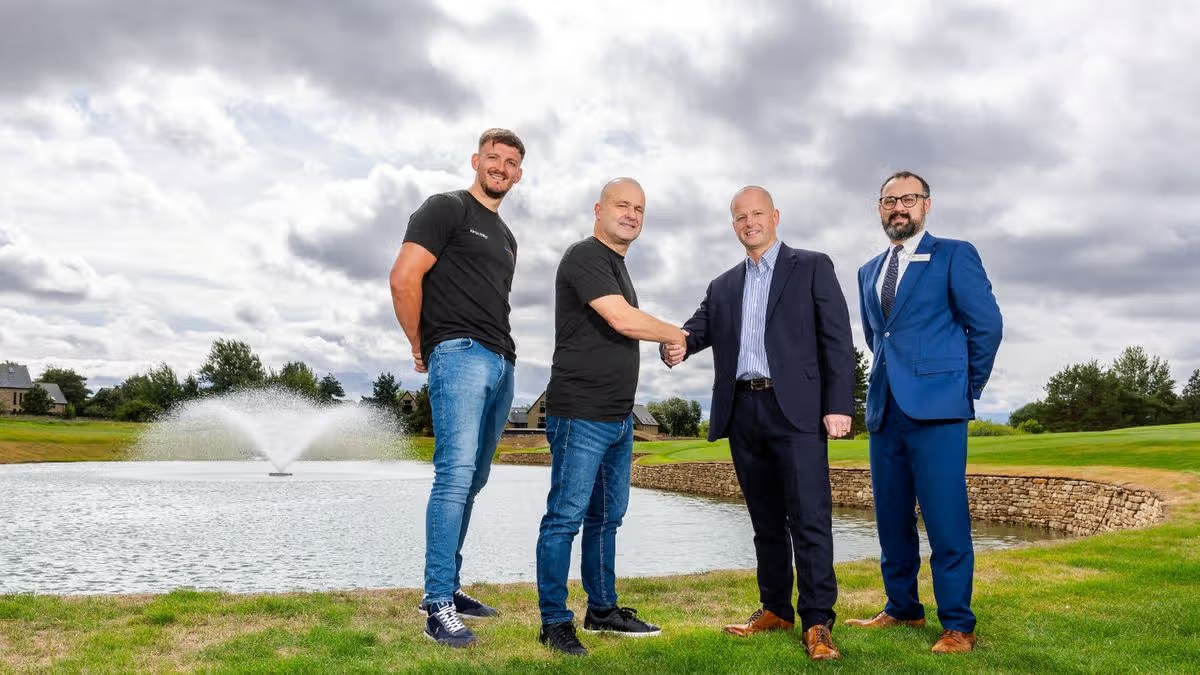
L-R Kieran Walker, Select Telecom support manager, Ian Davison, Select Telecom network manager, Martin Smith, Ramside head of finance, Charlie Eedle, Ramside general manager.

L-R Kieran Walker, Select Telecom support manager, Ian Davison, Select Telecom network manager, Martin Smith, Ramside head of finance, Charlie Eedle, Ramside general manager.(Image: Ramside Estates)

The owner of some of the North East’s best known hotels and bars has snapped up a tech firm.

Hospitality group Ramside Estates – which operates Ramside Hall Hotel and Golf Club, Hardwick Hall, Bowburn Hall, The Fed and bars in Newcastle and Sedgefield – has consolidated its future growth plans with the acquisition of Select Telecom Limited.

Based in Brunswick Village, Newcastle, the firm been a long-standing supplier to Ramside, providing ongoing support across the group by providing Wi-Fi, connectivity and communications among other services.

The group says that reliable connectivity – including guest WiFi, operational systems, payment technology, hotel systems, events, conferences, offices and other digital services – is now fundamental to virtually every area of Ramside’s operations.

Advertisement

It says the acquisition of a company with which it already has a strong and established relationship, will not only protect Ramside’s critical infrastructure but also give the business greater control over its development, resilience and ongoing support.

Bosses said the deal also brings specialist expertise into the wider group, helping Ramside design technology and connectivity into developments from the start.

Select will continue to operate as a telecommunications business, serving its existing and future customers.

Martin Smith, head of finance at Ramside Estates Ltd, said: “Select has been a trusted partner to Ramside for many years and already provides much of the Wi-Fi, networking and communications infrastructure across our business.

Advertisement

“As our reliance on technology and connectivity continues to grow, particularly alongside the significant investment we are making across the Group, bringing that expertise closer to the business makes a great deal of strategic sense.

“What particularly attracted us to Select was that we already knew the business, the quality of its people and the service it provides.

“This acquisition isn’t simply about supporting Ramside, however. Select has a strong and established customer base of its own and we see a real opportunity to invest in the business, support the existing team and help Select continue to grow as part of the wider Ramside Group.”

Last month Ramside Estates published its accounts for the year ended November 2025, highlighting new leisure additions. Revenues rose to £37.4m – up by £300,000 on the previous year – while gross profit stood at £30.64m, up from £30.27m. Operating profit dropped from £2.44m to £1.88m, and pre-tax profit fell to £2.05m from £2.6m, a figure the firm said was primarily driven by higher golf course costs associated with new drainage and maintenance works.

Advertisement

The directors also highlighted new additions including the new leisure facility at Ramside Golf Club called The Pin, which it said “represents a strategic diversification of the group’s leisure offering”.

Continue Reading

Business

Elon Musk’s X Money Offers a 6% Yield on Cash, but Sen. Elizabeth Warren Wants Answers on Fine Print

Published

on

Elon Musk, one of the world's richest men and Tesla CEO

X Money, the financial arm of Elon Musk’s social media platform X, is pitching users a 6% annual yield on cash deposits, a rate significantly higher than what most traditional banks and even top-tier high-yield savings accounts currently offer, though the fine print behind the headline number has drawn scrutiny from at least one U.S. senator.

Launched in beta to select Premium+ subscribers in late June, X Money offers a 6% annual percentage yield on cash deposits with no stated minimum balance requirement, along with FDIC insurance protection. According to the app’s structure, standard deposits are held at Cross River Bank, a New Jersey-based, FDIC-member institution, providing the baseline $250,000 in federal deposit insurance coverage available to any standard bank account. For eligible Premium+ subscribers, X Money also offers an enhanced protection option through what the company calls its X Cash Sweep Program, which automatically distributes larger account balances across a network of partner banks, keeping each individual slice under the $250,000 insurance threshold to reach total aggregate coverage of up to $10 million, roughly 40 times the protection offered by a typical single bank account.

By comparison, the national average savings account rate currently sits at just 0.38%, according to the Federal Deposit Insurance Corporation, meaning $10,000 left in a typical savings account for a year would generate only about $38 in interest, roughly the cost of a single cup of coffee per month. Against that backdrop, X Money’s 6% headline rate represents a dramatic departure from what most consumers are accustomed to earning on idle cash.

Beyond the yield itself, X Money includes several other features positioning it as a broader alternative to traditional banking products. The service offers unlimited 3% cash back on eligible purchases made with a personalized, laser-engraved metal Visa debit card that can display a user’s X handle, along with no foreign transaction fees, free ATM withdrawals, peer-to-peer transfers to other X accounts, bill payment functionality, wire transfers and even check mailing directly from within the app. The service also supports early direct deposit, allowing paychecks to arrive up to two days ahead of a traditional payment schedule, and automatically routes all creator payouts earned on the X platform directly into users’ X Money accounts by default.

Advertisement

Benji Taylor, head of design at X and Musk’s artificial intelligence company xAI, confirmed in a video presentation that deposits would be held at Cross River Bank “and at other FDIC-insured institutions” as part of the sweep program structure. That kind of multi-bank sweep arrangement is not itself a new concept in banking; wealthy individuals and businesses have used similar structures for years to extend deposit insurance coverage beyond the standard $250,000 limit at any single institution. What distinguishes X Money’s approach is the scale at which the company is offering the enhanced protection to a broader base of subscribers, alongside a yield well above prevailing market rates.

The unusually high yield has attracted attention from federal lawmakers. Sen. Elizabeth Warren has raised questions about how Musk’s platform can sustainably offer a rate that no traditional bank in the country currently matches, according to reporting on the product’s rollout. Her inquiry reflects broader questions circulating among financial analysts and consumer advocates regarding the underlying economics of the offering, given that banks typically generate the revenue needed to pay depositor interest through lending activities, and it remains unclear precisely how X Money’s rate is being funded or how long the company intends to sustain it at current levels.

Regulatory attention extends beyond Warren’s individual inquiry. According to coverage of the product’s launch, the Consumer Financial Protection Bureau, the FDIC and various state regulators are already focused more broadly on so-called banking-as-a-service arrangements, sometimes referred to as “rent-a-charter” models, in which technology companies partner with FDIC-insured banks to offer bank-like products without becoming banks themselves. Regulators have also expressed concern in recent years about companies potentially misrepresenting the scope or nature of deposit insurance protections to consumers. Given those existing regulatory priorities, analysts have suggested X Money is likely to face close supervisory scrutiny even if no formal enforcement action has yet been initiated against the company.

It is important to note what the FDIC insurance attached to X Money deposits does and does not cover. The insurance protects depositors’ funds in the event that one of the partner banks holding their money fails, consistent with standard federal deposit insurance protections available at any FDIC-member institution. It does not, however, extend to X or X Money itself as a company, meaning the insurance framework applies specifically to the underlying banking partners rather than to Musk’s broader platform or business operations.

Advertisement

X Money’s launch represents the culmination of a payments initiative Musk has publicly discussed since rebranding Twitter as X, positioning the product as a potential challenger to both traditional megabanks such as JPMorgan Chase and Bank of America, as well as fintech competitors including SoFi Technologies and Robinhood Markets. The rollout has so far been limited to a controlled group of Premium+ subscribers, consistent with Musk’s history of gradually expanding new product access rather than launching features to the platform’s full user base immediately. Musk has previously indicated X Money could become more broadly available to the general public, though the exact timeline for a wider rollout has not been confirmed, and Musk has a well-documented history of announcing product timelines that ultimately extend well beyond his initial projections, a pattern some observers have referred to as operating on “Elon Time.”

For consumers considering the product, financial commentators have generally advised treating the offering with the same scrutiny applied to any high-yield financial product promising returns well above prevailing market rates, particularly given the outstanding questions regulators and lawmakers have raised regarding the sustainability of the 6% rate and the broader regulatory framework governing how technology companies operate bank-like financial products in partnership with traditional chartered institutions. As X Money continues its phased rollout, further regulatory scrutiny and potential responses from Warren’s office or federal banking regulators are likely to shape how the product evolves and whether its current rate structure proves durable over the longer term.

Continue Reading

Business

Cleveland Group opens new Yorkshire depot as UK expansion continues

Published

on

Business Live

‘We’ve seen significant demand from customers across the region so having our own depot here strengthens our national network’

Cleveland Group has opened a depot in Doncaster

Cleveland Group has opened a depot in Doncaster(Image: MDHammond)

Growing North East shipping container business Cleveland Group has expanded with the opening of a new depot in South Yorkshire.

Cleveland Group – winner of Company of the Year at the North East Business Awards in 2022 – has continued its rapid national expansion with the opening of a new depot in Doncaster, to boost its ability to serve clients across South Yorkshire and the wider Yorkshire region.

Based in Stockton-on-Tees, the group comprises Cleveland Containers, Cleveland Modular and Cleveland Hire. It provides UK customers with shipping containers, modular buildings, site accommodation, and conversion solutions.

The Doncaster opening follows the opening of a new five acre depot in Newport, South Wales, last year, and builds on its existing Cleveland-operated locations in Newport, Middlesbrough, Ashby de la Zouch and Cambuslang. The day after its North East Business Awards win in September 2022 the business announced it had sealed a minority investment from private equity firm LDC to help steer the firm through the next stage of its growth.

Advertisement

Since then, the company has continued growing, more than doubling its workforce from 45 to 118. The company decided to open in Doncaster after analysing its existing customer base and delivery activity, and that area came up as a key location within its growing footprint.

Andrew Thompson, CEO at Cleveland Group, said: “Doncaster was a natural choice for Cleveland. We’ve seen significant demand from customers across the region, so having our own depot here strengthens our national network and puts us closer to the customers we serve. It’s another step forward for the business and an investment in delivering an even better customer experience.”

Six jobs have already been created at the new site, and further job opportunities are expected as the depot grows. The site will be led by newly appointed depot manager Darren Dunnill, who has overseen its development.

The new depot will provide additional capacity across Cleveland’s divisions, with a particular focus on supporting the construction and infrastructure sectors across Yorkshire. The site will predominantly provide site accommodation and modular buildings, supporting customers ranging from construction companies and housebuilders to schools, hospitals and emergency services.

Advertisement

Laura Moore, group operations director at Cleveland Group, added: “Investment in our infrastructure goes hand in hand with investment in our people. As we open new depots and expand the business, we’re creating opportunities for people to come into Cleveland, develop their skills and progress through the business.

“We want to give people with the right attitude and commitment the opportunity to build a long-term career with us.”

Continue Reading

Business

Moderna Shares Skyrocket Up to 90% as Its mRNA Cancer Vaccine With Merck Succeeds in Late-Stage Trial

Published

on

Moderna Shares Skyrocket Up to 90% as Its mRNA Cancer

Shares of Moderna soared as much as 90% in premarket trading Wednesday, pacing what would become the biotech company’s best trading session on record, after the company and partner Merck announced that their experimental personalized mRNA cancer vaccine succeeded in a large, late-stage clinical trial for melanoma.

The Phase 3 trial, known as INTerpath-001, evaluated the treatment, called intismeran autogene, in combination with Merck’s blockbuster immunotherapy Keytruda, compared with Keytruda alone, in patients with completely surgically removed stage IIB-IV melanoma. The study enrolled 1,137 high-risk patients who received up to nine doses of the combination therapy over roughly one year. The trial met its primary goal of significantly extending the time patients lived without their melanoma returning, compared with Keytruda alone, and also achieved a key secondary goal of reducing the risk of the cancer spreading to distant parts of the body.

According to CNBC, the trial marked the first Phase 3 study to demonstrate clinically significant benefits over Keytruda monotherapy in the adjuvant treatment setting for surgically resected melanoma patients who had not previously received systemic cancer treatment. The companies said the study was stopped early at its first interim analysis after the positive results became apparent, and that no new safety signals had emerged during the trial. Side effects associated with the vaccine were described as similar to those typically experienced with other common vaccines.

Merck’s Dr. Jane Healy, the company’s head of oncology early development, described the significance of the results in comments to CNBC. Melanoma patients are “stuck having to deal with the new gravity of that diagnosis and then undergo uncomfortable treatments like surgery, and after that, they’re worried about their cancer coming back,” Healy said. She called the trial’s outcome “very exciting,” noting the therapy delivered a “clinically meaningful improvement” over Keytruda, which currently represents the standard of care for melanoma treatment. Healy added that the results also validate a personalized cancer treatment approach that Merck and Moderna have been developing for decades.

Advertisement

The intismeran vaccine represents a significant departure from Moderna’s earlier, pandemic-driven business, built instead on individualized cancer therapeutics tailored to each patient’s specific tumor. The treatment is manufactured for each patient based on mutations identified in that individual’s own tumor tissue, encoding as many as 34 distinct neoantigens designed to train the patient’s immune system to recognize and attack cancer cells bearing those same mutations. Moderna has said it has successfully automated the personalized manufacturing process required to produce each patient-specific dose.

Wednesday’s data builds on earlier, smaller-scale results the companies presented in January from a mid-stage trial of the same treatment combination. That earlier Phase 2b study found that at 60.3 months of follow-up, the combination therapy reduced the risk of cancer recurrence or death by 49%, while reducing the risk of distant metastasis or death by 59%, compared with Keytruda alone. Moderna’s chief development officer, David Berman, said those earlier durability findings supported the treatment’s “potential long-term benefit,” a framing that added weight to investor expectations heading into Wednesday’s larger, confirmatory Phase 3 readout.

Despite the strength of Wednesday’s results, some key data points remain outstanding. According to reporting on the trial, the companies have not yet disclosed specific hazard ratios or mature overall survival data, and the trial itself remains ongoing, with overall survival tracked as a key secondary endpoint still to be determined as follow-up continues. The companies said they plan to present the full results at an upcoming medical conference and share the data with regulators as part of the broader review and potential approval process.

Market reaction to the news was dramatic and immediate. Moderna shares surged as much as 90%, according to CNBC, touching levels not seen in months, while Merck shares climbed more than 8% in premarket trading. The disparity in the two companies’ stock reactions reflects their significant difference in size: Merck entered Wednesday with a market capitalization of roughly $333 billion, while Moderna’s stood at approximately $25 billion, meaning the same positive trial news carried far greater proportional significance for Moderna’s smaller balance sheet and narrower product pipeline.

Advertisement

According to Bloomberg, Moderna’s stock had already climbed 113% from the start of the year through Tuesday’s close, driven substantially by anticipation surrounding the cancer vaccine program even before Wednesday’s formal trial results were announced. Wall Street analyst reaction to the news was swift, with the stock’s move clearing every existing price target among the roughly 15 analysts tracking the company, according to one market analysis, even as several firms had maintained more cautious ratings on the stock ahead of the announcement.

Analysts have pointed to the substantial commercial potential the therapy could represent if it ultimately receives regulatory approval. Barclays analysts said last month they expect the treatment could generate roughly $3 billion in melanoma-related revenue by 2035, underscoring the scale of the opportunity Wednesday’s trial results could unlock for Moderna specifically, given the company’s smaller existing revenue base compared with Merck’s broader portfolio.

Wednesday’s announcement arrives as Moderna has worked to diversify its business well beyond the COVID-19 vaccine that first made the company a household name. The company recently gained Food and Drug Administration approval for its flu vaccine, branded mFLUSIVA, targeted at adults 50 and older, marking its fifth approved global product. Moderna has also continued developing experimental vaccines for other conditions, including norovirus and Lyme disease, though the company disclosed that a key Phase 3 norovirus trial recently missed its early success criteria, a setback that stood in contrast to Wednesday’s positive melanoma vaccine news.

Melanoma remains the deadliest form of skin cancer, with more than 1.5 million cases diagnosed globally in 2023 alone, according to figures cited in coverage of the trial. The scale of that patient population, combined with the trial’s success in both its primary and key secondary endpoints, has fueled substantial investor optimism regarding the treatment’s eventual commercial prospects, even as the companies caution that a full data readout, including mature survival figures, and eventual regulatory review still lie ahead before the therapy could reach patients more broadly. As Wednesday’s trading session continued, market watchers were closely monitoring whether Moderna’s dramatic premarket gains would hold through the full trading day, given the stock’s history of significant volatility tied to individual clinical trial announcements throughout its post-pandemic transition toward a broader, more diversified product pipeline.

Advertisement
Continue Reading

Business

Lowe’s (LOW) Q2 2026 earnings

Published

on

Lowe's (LOW) Q2 2026 earnings
Lowe’s gives muted outlook as it sees ‘pressure’ in home improvement spending

Lowe’s on Wednesday reported mixed quarterly results as the home improvement retailer said it saw “pressure” in spending on projects.

Though the company did not cut its full-year guidance, it updated its outlook to the bottom end of its prior guidance. It now expects total sales of $92 billion, compared with $92 billion to $94 billion previously, and comparable sales to be flat, versus flat to up 2%. It expects adjusted earnings per share for the year of $12.25, versus $12.25 to $12.75 previously.

Shares of Lowe’s fell more than 3% in premarket trading.

Here’s how the company performed in its fiscal second quarter compared with what Wall Street was expecting, according to a survey of analysts by LSEG:

Advertisement
  • Earnings per share: $4.40 adjusted, it was not immediately clear if it was comparable to the $4.22 expected
  • Revenue: $25.96 billion vs. $26.16 billion expected

For the quarter ended July 31, Lowe’s reported net income of $2.4 billion, or $4.27 per share, roughly the same as the year-ago period. Excluding one-time factors and including tariff refund benefits, the company reported adjusted earnings of $4.40 per share.

Lowe’s also said tariff refunds provided an 11-cent boost to its earnings per share this quarter.

The company reported total sales of $25.96 billion for the quarter, up from $23.96 billion the year prior. Comparable sales rose 0.2%, due in part to strong performance in its pro and home services sales, according to Lowe’s.

Lowe’s also saw a 15.7% increase in online sales, though it added that performance was partially offset by macroeconomic pressures for the do-it-yourself customers.

“While the near-term remains dynamic, our teams are executing at a high level, advancing our Total Home strategy and investing to drive growth and profitability,” CEO Marvin Ellison said in a statement.

Advertisement

The earnings come as the home improvement retailer grapples with a slower housing market and a more cautious consumer.

Lowe’s rival Home Depot said in its earnings report on Tuesday that the company did not see customers returning to big projects and continues to operate in “frozen housing market conditions.”

Choose CNBC as your preferred source on Google and never miss a moment from the most trusted name in business news.
Continue Reading

Trending

Copyright © 2025