
Business
US Stocks: Delta Air Lines lifts revenue outlook despite jet fuel hit, shares jump 4%


The big US carrier confirmed its profit projection for the period, even as jet fuel prices almost doubled, according to Chief Executive Officer Ed Bastian.
Bastian told an investor conference the carrier had experienced “a $400 million fuel spike just in the month of March” due to a roughly 40 percent surge in crude prices from the period just ahead of the February 28 start of the US-Israeli campaign against Iran.
But Bastian said consumers have still been booking trips in significant numbers, resulting in eight of the company’s 10 highest sales days in history during the quarter. Five of them came in March, with the war under way.
“Sales for us have been very, very strong all quarter long, most particularly starting off in the March spring season, which is typically the season when travel bookings really start to accumulate,” he said.

Bastian reported broad-based growth in Delta’s domestic market. By contrast the company has seen “a very modest decline in Europe since the war started,” he said.
Shares of Delta jumped 4.8 percent in early trading.
But Bastian said less than 20 percent of the company’s transatlantic revenues is from point-of-sale Europe.

Business
software: US Stocks: Debt investors offloading exposure to software stocks is latest sign of pain

In recent weeks, several managers of collateralized loan obligations (CLOs) have started exploring ways to reduce their exposure to software, as they grapple with the prospect of a wave of rating downgrades on junk bonds and potential defaults down the line, according to three CLO managers and several credit industry analysts.
The push to reduce exposure shows how the pain in private credit and software is still working through the system after the software rout in January and February that was largely triggered by the release of Anthropic’s latest AI tools, which raised fears of widespread disruption across the technology and professional services industries.
“Software is a sector where there is more selling coming from CLO managers than there is buying right now,” said Jim Egan, co-head of securitized products research at Morgan Stanley, adding that there was elevated exposure to software within broadly syndicated loans (BSLs), which are corporate loans that are arranged by investment banks and sold to a wide group of credit investors like CLOs. Egan added CLOs currently have lower exposure to riskier companies, which are “CCC” rated, compared to a year ago.
CLOs, which buy up small chunks of numerous individual leveraged loans, in recent years capitalized on the credit boom and bought up loans that backed hundreds of software buyouts in the height of a dealmaking boom during and after the pandemic. During the same period, CLOs also hoovered up their holdings in other non-software sectors that are now faced with the existential threat emerging from AI. According to initial estimates from JPMorgan analysts, around $40 billion to $150 billion of U.S. CLO holdings fall within sectors that are most associated with AI risk.
The software and services sector accounts for about 15% of the collateral in currently outstanding syndicated CLO deals in the U.S., according to a Feb. 20 estimate from Morgan Stanley, which added that software alone makes up roughly 12% of CLO holdings, making it the single-largest subsector by concentration. Software exposure in direct lending is estimated to be about 19% based on private-credit focused CLOs, Morgan Stanley said in a March 17 note.
WIDENING SPREADSSpreads on CLOs, which are the risk premium that companies pay on the bonds over Treasuries, have widened over the past few weeks as fears of a meltdown in the $1.8 trillion private credit industry have spooked investors.
“We’re seeing some CLO managers reduce exposure to software – particularly where positions were overweight or ahead of refinancing activity,” said Al Remeza, associate managing director at Moody’s Ratings. “At the same time, many view the current environment as a buying opportunity, especially for companies they believe are least vulnerable to AI disruption.”
A mix of investment-grade notes – which are senior unsecured corporate bonds – and high-yield leveraged loans of some software makers, including Intuit, Dayforce, and Citrix, were sold between a range of 89 cents and 98 cents on the dollar in late February and earlier in March, according to data compiled by the Trade Reporting and Compliance Engine (TRACE), which was developed by the Financial Industry Regulatory Authority to track over-the-counter fixed-income transactions.
A few months ago, those same bonds and loans were trading at a premium, the data shows. Reuters could not determine which specific software companies CLOs sold. Dayforce and Citrix did not respond to requests for comment.
To be sure, while spreads across the software industry have widened, the spread on Intuit’s investment-grade bond that matures in 2033 is largely in line with the level at which it was issued in 2023, while its credit rating was upgraded to ‘A’ from ‘A-‘ by S&P Global in October last year. Intuit’s shares are down about 32% so far this year, as AI disruption fears have weighed broadly on the enterprise software industry.
“We bet the entire company on data and AI nearly ten years ago, when we declared our strategy to be an AI-driven expert platform to deliver done-for-you experiences. Our strategy is working; in the first half of our fiscal year 2026, we delivered 18 percent revenue growth while expanding margins,” an Intuit spokeswoman said in an email to Reuters.
ASSESSING AI RISK
While the current bout of selling could present a unique buying opportunity for distressed debt investors, several credit industry analysts cautioned that the buyer base for large swathes of these loans is thin, adding that most large private credit firms and direct lenders are unlikely to participate in large software loan deals in the near term as they grapple with investor scrutiny amid rising redemption requests at their flagship funds.
“The majority of the CLO community is really taking its time to think about how to come up with a framework to assess AI risk, more on the single-name level, to really scrub their book to identify which are the names that are more prone to AI risk,” said Joyce Jiang, head of U.S. CLO Research at Morgan Stanley. “They’re still in the middle of doing that, so in the near term we think it’s not likely that there’s going to be dip buying from the CLO community at a full scale.”
This is likely to be exacerbated by the fact that CLO managers, who have relatively less exposure to software, are not yet seeing a strong enough reason to buy up loans that are coming to market, said Gavin Zhu, head of U.S. CLO Research at Barclays.
“It’s a bit more difficult to suddenly and opportunistically rotate back into software without a true catalyst. And I think that might be contributing to some of the continued weakness that we see on the loan side,” said Zhu.
Global CLO loan supply is expected to fall to about $150 billion this year, which would mark a 25% decline from last year, according to estimates from JPMorgan. This is because of a sharp decline in investor demand, as widening spreads, question marks over loan quality, and fears of deepening cracks in the multi-trillion-dollar credit market weigh on sentiment, experts said.
However, not all CLO managers are rushing to dump software loans at steep discounts. Credit fund managers and analysts said the recent selling activity, so far, has been selective and concentrated around relatively better-performing loans that have changed hands at a modest discount.
Rishad Ahluwalia, head of CLO Research at JPMorgan, said investor sentiment has turned more bearish in recent weeks as spreads have widened and CLO transaction volumes have dipped.
“For CLO managers, the appetite for stressed loans in orphan sectors, like software and services, is weaker,” said Ahluwalia.

Form 8K Invesco Commercial Real Estate Finance Trust For: 17 March

Stormrae Hosts Record Breaking Solana-Based AI Challenge With 15,000 Participants

Has the Stock Selloff Ended? Wall Street Sees Value but Remains Focused on Oil Markets.


The items include salads and snack packs.
Business
US Stocks: Boeing sees profit for commercial airplane division in 2027, later than expected

The commercial airplane division lost $632 million in 2025 and $2.1 billion in 2024.
The company expects to increase production of its popular 737 MAX jet from roughly 42 aircraft a month to 47 a month by year’s end and to deliver about 500 of the jets this year, Chief Financial Officer Jay Malave said at the Bank of America Global Industrials Conference in London.
The single-aisle jet is critical to Boeing’s financial recovery. Planemakers receive the majority of cash from customers when they deliver new aircraft.
Deliveries in the first quarter were slightly hampered by damage to wiring on about 25 737s, but fixing the problem only required a few more days of work and will not hurt annual deliveries, Malave said.
Boeing shares were down 1% in early trading, continuing a 13% slide in the past month.
Malave said Boeing does not plan to develop a new jetliner anytime soon.Boeing’s first-quarter 787 Dreamliner deliveries will be down slightly from a projected 20 aircraft to about 15 of the popular widebody jet, mostly due to delays certifying premium-class seat designs, he said.
“The premium seating has been challenging,” he said. “Those are very strict, rigorous types of certifications.”
The planemaker wants to increase 787 production from its current rate of eight Dreamliners per month to 10 by the end of 2026. The company is expanding its 787 assembly plant in North Charleston, South Carolina.

The Nations TailDex Index and the Cboe Skew Index, two separate gauges that measure how much traders are paying for crash protection, have retreated to near where they stood before the February 28 strikes on Iran. The S&P 500 is still down 2% from pre-war levels.
“TDEX is signaling that investors are now less worried about a “tail event,” or a really steep drop in equity prices, than at any point since the war started,” said Scott Nations, president of Nations Indexes, an independent developer of volatility and option strategy index products.
“Given the muted response from the S&P 500, this outlook makes sense, but it’s an important metric to watch,” he said.
On Monday, the TailDex index was at 18.84, just below its closing level of 19.01 on February 27. The Cboe SKEW index finished at 141.49 on Monday, down from 146.67 prior to the air strikes.
Both indexes soared to multi-month highs as soaring oil prices unleashed fear of a sizeable pullback in markets.
The cost of deep out-of-the-money S&P 500 puts – contracts that would offer protection against a 20% drop in the market over the next three months – stands just slightly higher than it was immediately prior to the strikes, according to Susquehanna Financial Group strategist Christopher Jacobson. “After hitting multi-year highs at times last week, S&P skew levels have declined incrementally as some of that downside tail bid has faded alongside,” Jacobson said.
While fear of a market crash has faded, market anxiety levels are still higher than they were in early February. Nor are investors rushing to bet on a sharp rebound in stocks past old highs.
“We haven’t really seen that skew shift back towards the upside tail,” Jacobson said.

A landmark tribunal ruling that public electric vehicle (EV) charging should be subject to a reduced 5% VAT rate rather than the standard 20% has sparked renewed debate over fairness in the UK’s charging infrastructure, with potential implications for millions of drivers.
The decision, issued by a First-tier Tribunal, could bring public charging costs into line with those faced by motorists charging at home, addressing what many in the industry have long argued is a structural inequality in the tax system. Currently, drivers with access to off-street parking benefit from the lower VAT rate on domestic electricity, while those reliant on public charging, often urban residents, pay significantly more.
Justin Whitehouse, Managing Director at Alvarez & Marsal Tax, said the ruling reflects “a win for common sense”, highlighting a disparity that has persisted since EV adoption began to scale.
“To most people, it feels inherently unfair that those with a driveway can charge their vehicles at a reduced VAT rate, while those without off-street parking are left paying the full rate,” he said.
The case has also exposed deeper issues within the UK’s VAT framework, particularly around how electricity is classified depending on where it is consumed. The legislation hinges on the definition of “premises”, distinguishing between residential and commercial supply, a distinction that has proven increasingly difficult to apply in the context of modern EV charging networks.
Whitehouse noted that despite sustained lobbying from the industry, HMRC had not clarified its position, making a legal challenge almost inevitable. “The legislation has always been difficult to apply in practice,” he said, pointing to ambiguity that has left operators and consumers navigating an inconsistent system.
The ruling raises the prospect of refunds for drivers and businesses that may have overpaid VAT on public charging, potentially unlocking significant sums across the sector. However, any immediate impact remains uncertain. As a First-tier Tribunal decision, the ruling does not set a binding precedent and could yet be appealed, prolonging uncertainty for both operators and consumers.
Even if upheld, a key question will be how quickly, and to what extent, any VAT reduction is passed on to drivers. While lower tax rates could reduce charging costs in theory, pricing structures across public networks are influenced by a range of factors, including energy wholesale prices, infrastructure investment and operator margins.
In the short term, the decision is likely to intensify pressure on policymakers to address inconsistencies in EV taxation, particularly as the UK accelerates its transition away from petrol and diesel vehicles. Aligning VAT rates between home and public charging has been a longstanding demand from industry groups, who argue that the current system risks penalising those without access to private driveways — often those in cities where EV adoption is critical to meeting emissions targets.
Over the longer term, the case could act as a catalyst for broader reform of how energy usage is taxed in a decarbonising economy, where traditional distinctions between domestic and commercial consumption are becoming increasingly blurred.
For now, the ruling represents a significant moment in the evolution of the UK’s EV ecosystem, one that highlights both the opportunities and the complexities involved in building a fair, scalable and accessible charging infrastructure for the future.

Amy Ingham
Amy is a newly qualified journalist specialising in business journalism at Business Matters with responsibility for news content for what is now the UK’s largest print and online source of current business news.

Hyperscalers, which operate vast data centers and other infrastructure to facilitate AI training and deployment, have been raising debt to finance data centers needed to fuel the boom in AI.
“There continues to be an expectation of a lot of capital to be raised in this sector,” said John Servidea, co-head of investment-grade debt capital markets at JPMorgan, which led the Amazon deal.
“Whether it’s the companies’ publicly stated capex budgets, or whether it’s various banks’ estimates of the amount of hyperscaler issuance, if you look at all of those, a realistic expectation would be that at some point there’s more,” Servidea added.
Analysts at BofA Global Research on Friday raised their forecast for the hyperscalers’ new debt in 2026 to $175 billion from $140 billion. In early February, Barclays analysts said that U.S. investment-grade corporate bond issuance could be greater than $2 trillion in 2026, which they said “would exceed even the post‑COVID record levels seen in 2020.”
The five major AI hyperscalers – Amazon, Alphabet’s Google, Meta, Microsoft and Oracle – issued $121 billion in U.S. corporate bonds last year, versus an average $28 billion per year between 2020 and 2024, according to a January report by BofA Securities. Microsoft and Oracle declined to comment, while the other companies did not immediately respond to requests for comment.
Hyperscalers made up four of the five biggest U.S. high-grade bond deals in 2025, according to a December report by MUFG analysts. Most of those took place in the second half of the year. Oracle sold $18 billion in bonds in September. This was followed in October by Meta’s $30 billion deal and November deals from Alphabet ($17.5 billion) and Amazon ($15 billion).
This year saw a $31.51 billion global bond raise by Alphabet in February, which included a rare 100-year “century” bond as part of the deal.
Most recently, Amazon raised about $37 billion across 11 tranches in the U.S. bond market on March 10. This was followed the next day by a 14.5 billion euro-denominated ($16.8 billion) bond raise by the company.
The overwhelming demand – nearly four times the total amount sold – for Amazon’s bond sale underlines investor appetite for debt from the major hyperscalers.
Market participants believe the actual and expected debt raise by hyperscalers will keep forecasts for potential record-breaking overall U.S. corporate debt issuance on track, despite quiet days in the primary market preceding and following the escalation of conflict on February 28 between Iran and U.S.-Israeli forces.
“It’s fertile ground right now in capital markets, and you’re also in the first half of the year,” said George Catrambone, head of fixed income, Americas, at asset manager DWS.

Past The Ides Of March
software: US Stocks: Debt investors offloading exposure to software stocks is latest sign of pain
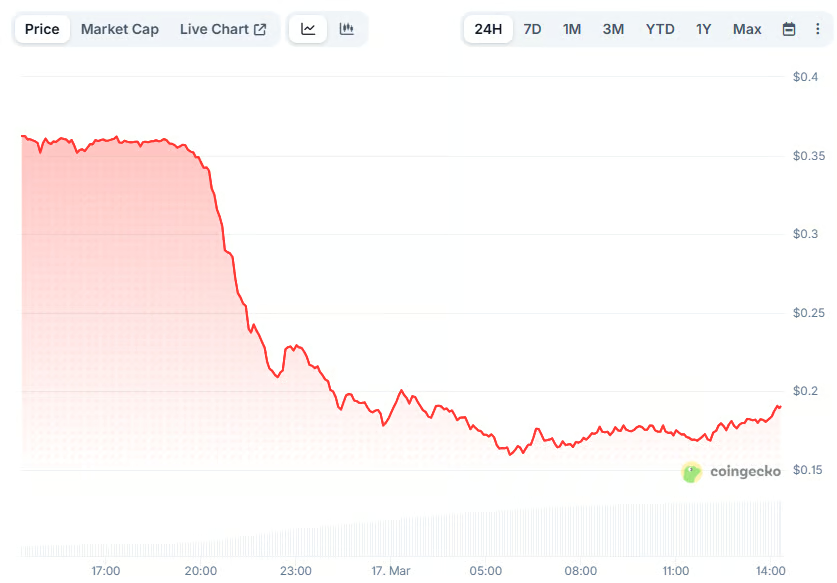
Classic Rug Pull or Buying Opportunity?

Wild Justice wins High Court ruling on Dartmoor overgrazing


-
 Tech7 days ago
A 1,300-Pound NASA Spacecraft To Re-Enter Earth’s Atmosphere
-
 Crypto World4 days ago
HYPE Token Enters Net Deflation as HyperCore Buybacks Outpace Staking Rewards
-

 Fashion4 days ago
Weekend Open Thread: Addict Lip Glow
-
Sports3 days ago
Why Duke and Michigan Are Dead Even Entering Selection Sunday
-

 Tech2 days ago
Your Legally Registered ‘Motorcycle’ Might Not Count Under Proposed US Law
-

 NewsBeat6 days ago
Residents reaction as Shildon murder probe enters second day
-

 Business2 days ago
Search for Savannah Guthrie’s Mother Enters Seventh Week with No Arrests
-

 Business6 days ago
Search Enters Sixth Week With New Leads in Tucson Abduction Case
-

 Sports6 days ago
PWHL, Senators discussing plan to keep Charge in Ottawa
-

 Business3 days ago
US Airports Launch Donation Drives for Unpaid TSA Workers as Partial Government Shutdown Enters Fifth Week
-
Crypto World3 days ago
Coinbase and Bybit in Investment Talks: Could Bybit Finally Enter the US Crypto Market?
-
 Tech2 hours ago
Are Split Spacebars the Next Big Gaming Keyboard Trend?
-

 NewsBeat6 days ago
I Entered The Manosphere. Nothing Could Prepare Me For What I Found.
-

 Business3 days ago
Country star Brantley Gilbert enters growing non-alcoholic beer market
-

 Business1 day ago
Australian shares drop as Iran war enters third week
-

 Crypto World1 day ago
Crypto Lender BlockFills Enters Chapter 11 with Up to $500M in Liabilities
-

 Sports4 days ago
College Basketball Best Bets: Conference Tournament Semifinal Picks
-

 Tech7 days ago
Clarity as strategy
-

 Politics7 days ago
Trump Says Middle East Is ‘Very Lucky’ That He’s President
-
 Crypto World6 days ago
Three Binance Charts May Be Hinting at Bitcoin’s Next Move


You must be logged in to post a comment Login