The United States Postal Service is suspending employer pension contributions for workers beginning Friday, citing a looming cash shortfall, the agency announced Thursday.
The move, which affects the Federal Employees Retirement System (FERS), comes just weeks after the Postal Service warned Congress it could run out of cash in under a year without significant reforms, including changes to pension funding and stamp prices.
USPS emphasized that the pause will have no immediate impact on current or future retirees.
Advertisement
“There will not be any immediate detrimental impact to our current or future retirees if normal FERS cost payments are temporarily withheld,” Postal Service Chief Financial Officer Luke Grossmann said.
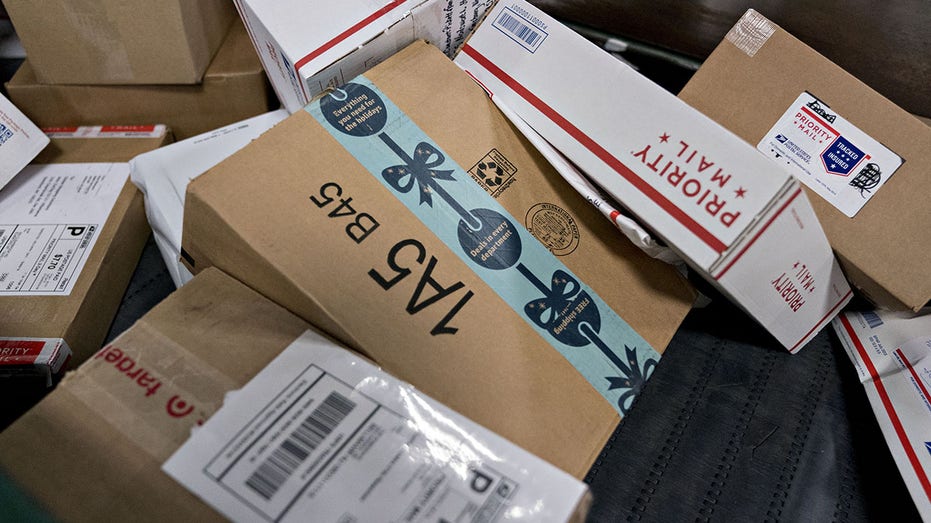
A United States Postal Service worker delivers packages on Cyber Monday in New York Dec. 1, 2025. (Bess Adler/Bloomberg via Getty Images / Getty Images)
USPS has previously reported mounting losses over the years, totaling $118 billion since 2007, as volumes of its most profitable product, first-class mail, fell to their lowest levels since the late 1960s.
The financial strain was further exacerbated by global tariffs, high inflation and recent spikes in gasoline prices, along with growing competition from private carriers such as Amazon, which now delivers many of its own packages.
Advertisement
USPS said it typically sends the Office of Personnel Management (OPM), which oversees federal retirement accounts, about $200 million every two weeks to cover pension costs.
By suspending the payments, the agency expects to free up roughly $2.5 billion in the current fiscal year.
While the agency has suspended its employer contributions, it said it will continue transferring employee payroll deductions into retirement accounts.
An Amazon Inc. package sits on a conveyor belt at the United States Postal Service Merrifield processing and distribution center in Merrifield, Va., Dec. 19, 2018. (Andrew Harrer/Bloomberg via Getty Images / Getty Images)
Separately, the agency said its Thrift Savings Plan (TSP), a separate retirement savings program similar to a government 401(k), remains unaffected.
USPS will continue processing employee-funded contributions and matching funds into the Thrift Savings Plan (TSP), and noted that workers will be able to contribute more in 2026 under new IRS limits.
Postmaster General David Steiner testified before Congress on the current state of the U.S. Postal Service. (Pool)
In March, Postmaster General David Steiner told a House Oversight subcommittee that the Postal Service could run out of cash within a year without major changes.
Advertisement
Steiner outlined potential cost-cutting steps, including reducing six-day delivery, raising first-class mail prices from 78 cents to $1 or more and expanding borrowing authority after USPS hit its $15 billion debt cap.
“In order to survive beyond the next year, we need to increase our borrowing capacity so that we don’t run out of cash,” Steiner said in prepared testimony. “The failure to do this could lead to the end of the Postal Service as we know it now.”
Convatec Group PLC (CNVVY) Analyst/Investor Day April 9, 2026 9:00 AM EDT
Company Participants
David Phillips Jonathan Mason – CEO & Director Tanja Dormels – President & COO of Advanced Wound Care Bruno Pinheiro – President & COO of Ostomy Care Mark Jassey – President & COO of Continence Care & Home Services Group Kjersti Grimsrud – President & COO of Infusion Care Divakar Ramakrishnan – Executive VP, Chief Technology Officer and Head of Research & Development Fiona Ryder – Group Financial Controller, CFO & Director
Conference Call Participants
Advertisement
Kane Slutzkin – Deutsche Bank AG, Research Division Aisyah Noor – Morgan Stanley, Research Division Veronika Dubajova – Citigroup Inc., Research Division David Adlington – JPMorgan Chase & Co, Research Division Richard Felton – Goldman Sachs Group, Inc., Research Division Susannah Ludwig – Bernstein Institutional Services LLC, Research Division Sebastien Jantet – Panmure Liberum Limited, Research Division Christian Glennie – Stifel, Nicolaus & Company, Incorporated, Research Division Beatrice Fairbairn – Joh. Berenberg, Gossler & Co. KG, Research Division
Presentation
David Phillips
Advertisement
Good afternoon. Welcome. I’m David Phillips, Head of Investor Relations here at Convatec. Can I just set some quick housekeeping rules for the day? And can I please ask that you switch your phones off or put them on silent. In 30 minutes, we will split into 4 groups for the category breakout sessions, which are across the corridor. This will bring the best of Convatec to life. Prerecorded videos of these — some of the presentations are online for those who are watching on the webcast. To enable us to keep the time today, we would respectfully ask if you keep your questions until the end. We’ve got ample time and then all of the presenters and guests will be in the atrium and able to speak. We now have a very short video to introduce Accelerate, and then Jonny will begin. So thank you very much and lights out.
In the Nifty500 pack, nine stocks’ closing prices crossed above their 200 DMA (Daily Moving Averages) on April 9, 2026, according to stockedge.com’s technical scan data. The 200-day daily moving average (DMA) is used by traders as a key indicator for determining the overall trend in a particular stock. As long as the stock is priced above the 200-day SMA on the daily timeframe, it is generally considered to be in an overall uptrend. Take a look:
The White House warned staff against improperly leveraging their positions to place bets in futures markets in an email on March 24, a day after President Donald Trump ordered a brief pause in some Iran strikes, a White House official said on Thursday.
Some of Trump’s major policy decisions have been preceded by well-timed bets, leading some experts to question whether information had somehow leaked ahead of time.
Exchange data and Reuters calculations showed an unidentified trader or traders bet $500 million on Brent and WTI crude futures in a one-minute period shortly before Trump called a five-day delay on March 23 in attacks on Iran’s energy infrastructure, after which oil prices crashed 15%.
“While he (Trump) seeks a strong and profitable stock market for everyone, members of Congress and other government officials should be prohibited from using nonpublic information for financial benefit,” White House spokesman Davis Ingle told Reuters in a statement.
Advertisement
The Journal, which previously reported the news, said the announcement was made in a staff-wide email from the White House management office.
FREMONT, Calif. — Aehr Test Systems Inc. stock rocketed higher Thursday, climbing more than 8% to trade around $68 as investors bet on the semiconductor test equipment maker’s surging order book tied to artificial intelligence infrastructure, even after the company posted mixed fiscal third-quarter results.
Aehr Test Systems
Shares of the NASDAQ-listed company (AEHR) rose as much as 10% intraday Thursday, building on a 26% surge the previous session following its earnings release. The stock has now skyrocketed more than 210% year-to-date in 2026, turning it into one of the hottest small-cap plays in the chip sector amid booming demand for AI processors and data center components.
Aehr, which specializes in wafer-level and package-level test and burn-in systems, reported fiscal third-quarter revenue of $10.3 million for the period ended Feb. 27, missing Wall Street expectations of about $10.8 million and plunging 44% from $18.3 million a year earlier. The company swung to a non-GAAP net loss of $1.5 million, or 5 cents per share, compared with a year-ago profit of 7 cents per share. However, the loss was narrower than the consensus forecast of a 7-cent loss.
The revenue shortfall stemmed largely from a shift in product mix and timing of shipments, but investors quickly zeroed in on far stronger forward-looking signals. Aehr booked a whopping $37.2 million in new orders during the quarter — delivering a book-to-bill ratio exceeding 3.5 times — pushing its effective backlog to a record $50.9 million when including post-quarter wins.
“We are seeing significant demand from AI and data center customers,” Aehr President and CEO Gayn Erickson said in a statement accompanying the results. The company highlighted production orders for its FOX-XP wafer-level burn-in systems from a lead AI processor customer and follow-on wins in silicon photonics for hyperscale data center optical interconnects.
Advertisement
Analysts and market watchers described Aehr as a “quiet bottleneck” in the AI supply chain. Its equipment stresses semiconductors through burn-in testing to weed out early failures, ensuring reliability for high-power AI chips used in training and inference workloads at massive data centers. Only a fraction of advanced AI accelerators currently undergo full wafer-level burn-in, leaving substantial room for adoption growth as hyperscalers ramp production.
Recent orders underscore that momentum. In February, Aehr landed a $14 million order for FOX-XP systems from its lead AI processor customer. It also secured follow-on business for silicon photonics devices critical to high-speed optical connections in AI servers. Earlier in the year, the company won initial orders for its Sonoma ultra-high-power systems to burn-in next-generation AI ASICs for a major hyperscale customer.
“These wins position Aehr at the heart of AI infrastructure buildout,” said one analyst who upgraded the stock following the earnings. Craig-Hallum upgraded Aehr to Buy from Hold, citing improving business momentum, while Lake Street raised its price target to $56 from $50.
Aehr also announced a $60 million at-the-market equity offering Thursday, giving it flexibility to fund growth or acquisitions as demand accelerates. The company completed the acquisition of Incal Technology last year to expand its footprint in AI semiconductor testing.
Advertisement
For the full fiscal year ending May 2026, Aehr reaffirmed guidance for revenue on the high end of $45 million to $50 million. It expects second-half revenue between $25 million and $30 million and reiterated a path to non-GAAP profitability in the fourth quarter.
The upbeat bookings outlook helped offset concerns about the current-quarter softness, which management attributed partly to lumpy shipment timing and a temporary emphasis on package-level burn-in products.
Aehr’s technology addresses a critical pain point in semiconductor manufacturing. As chips for electric vehicles, AI, silicon carbide power devices and photonics become more complex and power-hungry, the need for rigorous testing and stabilization before deployment grows. Aehr’s FOX family of systems can test and burn-in full wafers or singulated die in parallel, improving yields and reducing costs for customers.
The company’s products serve diverse end markets, including AI processors, data center infrastructure, automotive, industrial and silicon photonics for optical I/O. Demand from hyperscale cloud providers building out AI training clusters has become a dominant driver.
Advertisement
Wall Street’s view on Aehr remains mixed but tilting more positive. Consensus ratings hover around Hold with an average price target near $68, though some firms see higher upside if AI orders continue to materialize. The stock’s rapid run has left it trading at elevated valuations, with a market capitalization now exceeding $2 billion.
Investors appeared unfazed by the revenue miss, focusing instead on the massive backlog and potential for a strong second half. Broader market sentiment also helped, with a ceasefire agreement between the U.S., Israel and Iran easing some geopolitical tensions and lifting risk assets.
Aehr executives expressed confidence in a rebound. Management highlighted expectations for a “near-term follow-on production order” from its lead hyperscale customer and said bookings for the second half should land on the high side of prior $60 million to $80 million guidance.
Shares closed Wednesday at $63.16, up sharply on the earnings reaction and macro tailwinds. By mid-afternoon Thursday, they traded near $68.19, extending gains.
Advertisement
The surge reflects growing recognition that Aehr’s niche expertise in reliability testing could prove essential as the AI boom demands ever-more robust semiconductors. Hyperscalers and chip designers cannot afford failures in massive AI clusters, making burn-in a non-negotiable step.
Still, risks remain. Aehr derives a significant portion of revenue from a handful of large customers, exposing it to order timing volatility. The company has yet to achieve consistent profitability, and competition in the test equipment space could intensify.
For now, momentum favors the bulls. With AI capital spending showing no signs of slowing and Aehr’s backlog at record levels, the company appears poised for a potential inflection as shipments ramp in coming quarters.
Aehr Test Systems, founded in 1977 and headquartered in Fremont, employs about 136 people. It has installed thousands of systems worldwide and continues to innovate in wafer-level solutions that enable parallel testing of hundreds or thousands of devices simultaneously.
Advertisement
As the semiconductor industry grapples with exploding complexity driven by AI, companies like Aehr that provide critical enabling technology are drawing fresh attention from growth-oriented investors.
Whether the stock can sustain its blistering pace will depend on execution in the back half of the year and the ability to convert that hefty backlog into revenue and, ultimately, profits.

























































You must be logged in to post a comment Login