Business
(VIDEO) Eight Killed as Protesters Storm US Consulate in Karachi After Iran Confirms Khamenei Killed

At least eight people were killed and more than 40 injured when thousands of protesters stormed the US Consulate General in Karachi on March 1, 2026, in violent demonstrations triggered by Iran’s official confirmation that Supreme Leader Ayatollah Ali Khamenei was killed in joint US-Israeli airstrikes two days earlier.
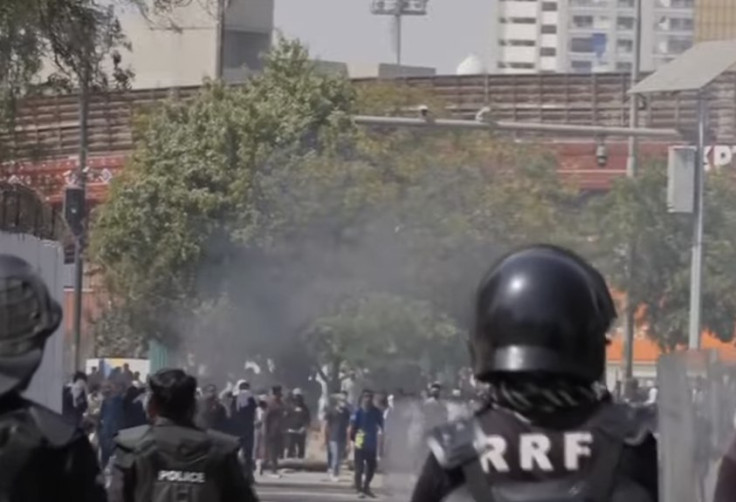

The assault on the heavily fortified diplomatic compound in Clifton began shortly after 2 p.m. local time when a large crowd, estimated at 15,000–20,000 by police, breached outer security barriers despite heavy deployment of Rangers and Sindh police. Demonstrators, many waving Iranian and Palestinian flags and chanting anti-American and anti-Israeli slogans, hurled petrol bombs, stones and fireworks at the perimeter wall while attempting to scale it.
Security forces responded with tear gas, rubber bullets and, according to eyewitness accounts and video footage verified by Reuters and Dawn, live ammunition after protesters set fire to vehicles and tried to force open the main gate. Karachi police spokesperson Atiq Shah confirmed eight deaths — seven protesters and one security guard — and 43 injuries, including 12 police officers and several journalists covering the rally. Hospital officials at Jinnah Postgraduate Medical Centre and Civil Hospital Karachi reported most casualties suffered gunshot wounds or severe burns.
The violence erupted hours after Iran’s state broadcaster IRIB aired a short statement from the office of the Supreme Leader acknowledging Khamenei’s death “as a martyr in defense of the Islamic Republic” during “Zionist-American aggression.” The announcement, read by a somber presenter, ended weeks of conflicting reports that began when US President Donald Trump claimed on February 28 that Khamenei had been killed in strikes on his Tehran residence. Iranian officials initially denied the claim, insisting he was “commanding the field,” but the IRIB broadcast included a pre-recorded video message from Khamenei dated February 25, widely interpreted as his final public statement.
The confirmation ignited outrage across the Muslim world. In Karachi — Pakistan’s largest city and commercial hub with a large Shia population — religious parties including Jamaat-e-Islami, Tehreek-e-Labbaik Pakistan and Majlis Wahdat-e-Muslimeen called for nationwide protests. Rally organizers had announced a “million-man march” to condemn the “martyrdom” of Khamenei and demand Pakistan sever ties with the United States.
By mid-afternoon, protesters had torched at least three vehicles near the consulate and damaged outer fencing. Police fired volleys of tear gas and used water cannons, but the crowd pressed forward, overwhelming initial lines. Video circulated on social media showed masked men attempting to climb the consulate wall while others chanted “Death to America” and “Death to Israel.” Consulate staff were evacuated to a secure location earlier in the day as a precautionary measure, a US Embassy spokesperson confirmed.
Sindh Chief Minister Syed Murad Ali Shah condemned the attack on the consulate as “unacceptable” and ordered a high-level inquiry. Federal Interior Minister Mohsin Naqvi said the government would not tolerate violence against diplomatic missions and promised “strict action” against those responsible. Pakistan’s Foreign Office summoned the US Chargé d’Affaires to lodge a formal protest over the strikes on Iran, while reiterating Islamabad’s call for de-escalation.
The US State Department issued a strong condemnation of the violence, describing the assault as “unacceptable” and urging Pakistani authorities to protect diplomatic personnel and property. “We hold the Government of Pakistan responsible for the safety of our facilities and personnel,” a spokesperson said. The consulate remained closed to the public, with non-essential staff advised to shelter in place.
The Karachi unrest was the most severe of several protests across Pakistan following Khamenei’s confirmed death. Demonstrations also erupted in Lahore, Multan, Quetta and Islamabad, though none reached the same intensity. In Tehran, tens of thousands gathered for Khamenei’s funeral procession, with Acting Supreme Leader Mohammad-Mokhber leading prayers and vowing “severe revenge.”
The US-Israel operation, dubbed “Operation Epic Fury,” targeted Iranian nuclear sites, missile bases and leadership compounds starting February 28. Trump described the strikes as necessary to eliminate threats, while Israeli Prime Minister Benjamin Netanyahu called them pre-emptive. Iran retaliated with missile barrages against Israel and US bases in the Gulf, killing one civilian in Abu Dhabi and injuring several others.
Pakistan’s government has walked a delicate line, condemning the strikes on Iran while maintaining security cooperation with the United States. Prime Minister Shehbaz Sharif spoke with Iranian officials March 1 to express condolences and reiterated Pakistan’s support for Iran’s sovereignty.
Security remained tight around other Western diplomatic missions in Karachi and Islamabad on March 2, with additional Rangers deployed. Authorities imposed Section 144 restrictions banning public gatherings in sensitive areas of Karachi for 48 hours.
The death toll and images of burning vehicles near the consulate have drawn international concern. The United Nations called for restraint, while human rights groups urged Pakistani authorities to investigate the use of lethal force.
As Karachi remained tense and cleanup crews worked through the night, the incident underscored the rapid spillover of the Iran crisis into South Asia, testing Pakistan’s balancing act between domestic religious sentiment and international alliances.

