Business
(VIDEO) Where To Watch Today’s Total Solar Eclipse Livestream Online As NASA And ESA Stream Full Live Coverage

The moon’s shadow is sweeping across the Arctic and parts of Europe today, bringing a total solar eclipse to Greenland, Iceland and Spain, and for anyone outside the narrow path of totality, several major space agencies and observatories are streaming the event live and free online.
Today’s eclipse, occurring Wednesday, August 12, marks the first total solar eclipse visible from mainland Europe since 1999 and the first visible from the Iberian Peninsula since 1912. The path of totality crosses a remote stretch of northern Russia, Greenland, Iceland, a small corner of northeastern Portugal, and Spain, before ending near the Balearic Islands as the moon’s shadow meets sunset over the Mediterranean. A much broader partial eclipse will be visible across the northern United States, most of Canada, much of Europe and northwestern Africa.

IBTimes US

NASA will host its flagship English-language broadcast beginning at 1:15 p.m. Eastern time, or 1715 GMT. The program will include live telescope views from multiple points along the path of totality, expert commentary and interviews with solar scientists, and footage from a NASA-funded WB-57 high-altitude research aircraft chasing the moon’s shadow to study the sun’s corona. NASA’s broadcast will be available across a wide range of platforms, including NASA+, the agency’s website, NASA TV, Amazon Prime, Facebook, Instagram, Twitch and X. NASA’s 2024 total eclipse broadcast reportedly drew more than 15 million concurrent viewers, and this year’s stream is expected to match or exceed that audience.

Several European institutions are also streaming their own coverage, with most broadcasts beginning between 17:00 and 17:30 GMT, or roughly 1 p.m. to 1:30 p.m. Eastern time. The Instituto de Astrofísica de Canarias will begin its program at 17:00 GMT from Cerro del Otero in Palencia, Spain, connecting live with telescopes recording both the eclipse and the sun’s corona. London’s Royal Observatory Greenwich will begin its own presented stream at roughly 17:10 to 17:15 GMT, using a modern telescope to capture the partial eclipse as seen from the British capital, where NASA has listed maximum coverage at 91% of the sun’s disk.
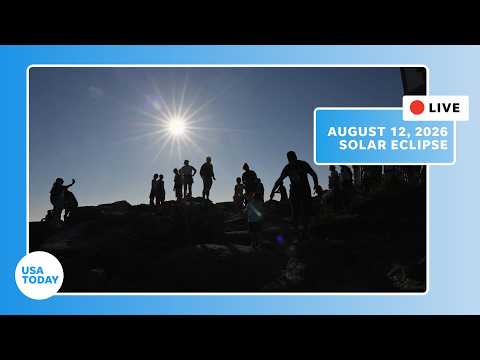
The European Space Agency will launch its livestream at 1:30 p.m. Eastern time, or 1730 GMT, featuring expert commentary alongside a dedicated telescope feed from the Observatorio Astrofísico de Javalambre near Teruel, Spain, directly in the path of totality. ESA has scheduled totality at that location for 18:31 GMT, lasting approximately 1 minute and 21 seconds. San Francisco’s Exploratorium museum is also expected to begin its coverage around the same time.
Additional livestream options include the Virtual Telescope Project, which begins its broadcast at 1:20 p.m. Eastern time, or 1720 GMT, offering real-time views from robotic telescopes in Manciano, Italy, where a partial eclipse will be visible, alongside views from within the path of totality in Spain. The organization Time and Date has also scheduled its own YouTube broadcast and maintains a dedicated eclipse app that automatically detects a user’s location and displays local eclipse timing, circumstances and cloud cover forecasts, even for viewers well outside the path of totality.
For viewers hoping to watch from a mobile device, streaming guides recommend connecting to Wi-Fi ahead of time and searching “2026 total solar eclipse” on YouTube, where multiple live broadcasts from different organizations are expected to appear simultaneously in search results. NASA’s own streaming app additionally supports background audio, allowing users to listen to expert commentary while multitasking, and is available across most major app stores and streaming devices, including Roku, Apple TV and Fire TV.
According to eclipse path data, totality is scheduled to begin over Iceland at 1:45 p.m. Eastern time and reach Spain by 2:28 p.m. Eastern time, giving viewers a rough window for when the most dramatic phase of the eclipse, when the moon fully blocks the sun’s disk, will unfold across the path of totality.
The eclipse has also inspired unusual travel experiences. Spanish carrier Iberia is operating a special Airbus A321XLR flight, numbered IB1473 in reference to astronomer Nicolaus Copernicus’ birth year, departing Madrid-Barajas Airport in the evening on a route designed to maximize visibility of totality from the air. The flight will carry researchers studying the sun’s corona as part of the Shelios research program, and the aircraft is equipped with Starlink satellite connectivity, allowing Iberia to livestream the eclipse from the air via its own social media channels. Brussels Airlines is separately running a charter flight from Brussels Airport toward France, organized in partnership with the Urania Public Observatory, the University of Antwerp and the Vrije Universiteit Brussel.
Skywatchers hoping to extend their celestial viewing beyond the eclipse won’t have to wait long for the next event. The Perseid meteor shower is set to peak overnight between August 12 and 13, offering observers across the Northern Hemisphere a chance to see roughly 50 meteors per hour under clear, dark skies.
For anyone planning to view the eclipse directly rather than through a livestream, safety officials continue to emphasize that certified ISO 12312-2 solar filters or eclipse glasses are required for any direct viewing outside the brief period of totality, since ordinary sunglasses and homemade filters do not provide adequate protection.
Those outside the path of totality or hoping to avoid cloud cover can follow along through any of the confirmed livestreams, with NASA’s broadcast expected to serve as the most comprehensive single source for viewers across the United States and beyond.
You must be logged in to post a comment Login