

Connect with us

Business

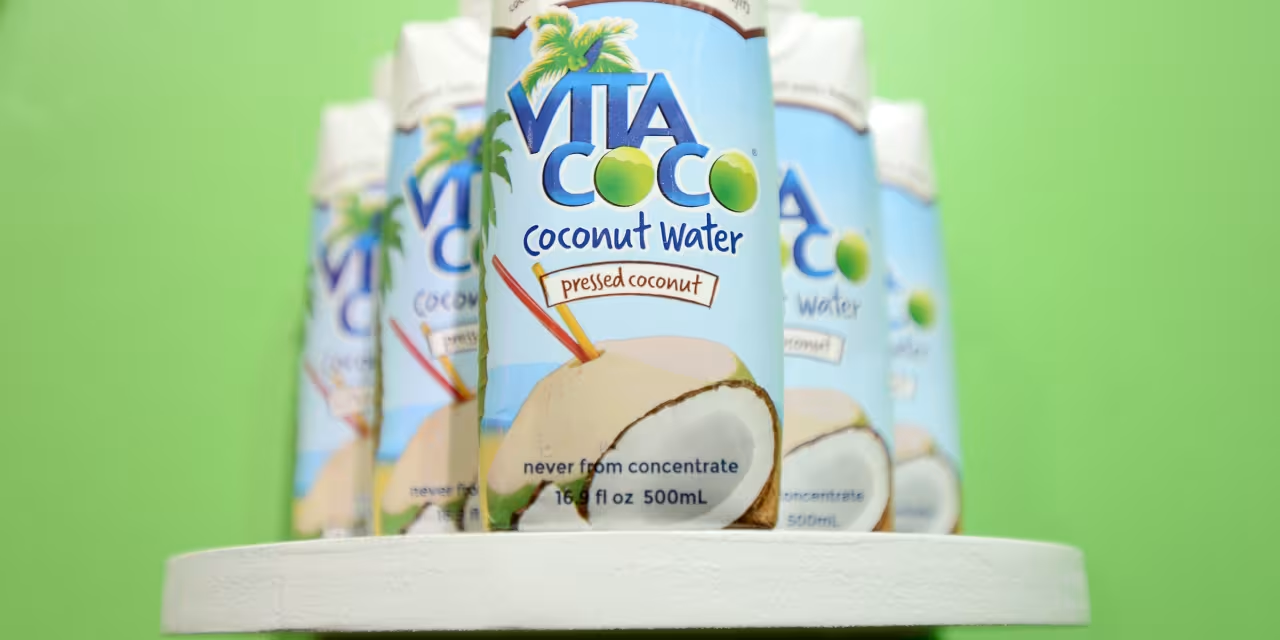
Vita Coco Stock Will Bounce Back From Earnings Slump. Here’s Why.

Published

on

Vita Coco Stock Will Bounce Back From Earnings Slump. Here’s Why.
Continue Reading
Click to comment

Leave a Reply

Your email address will not be published. Required fields are marked *

Business

Welsh tourism is a huge industry but can be even bigger

Published

on

Business Live

A tourist in Tenby.(Image: WalesOnline/Rob Browne)

Tourism is still too often treated by politicians in Wales as a “nice-to-have” – seasonal, useful for jobs, good for communities but not with the seriousness we reserve for manufacturing, fintech or life sciences in any debate on the Welsh economy.

This is despite clear evidence from a recent VisitBritain report which shows tourism is one of Wales’s most economically important sectors but that we are running it like a domestic leisure industry rather than a critical export sector.

In 2024, Wales recorded total tourism spend of £5.3bn, a total tourism GDP contribution of £5.9bn, and 100,871 tourism jobs. This means it accounts for 6.4% of Welsh economic output and 7.1% of Welsh jobs, making tourism a core industry in Wales with the economy being more tourism-dependent than the UK average.

But here’s the first uncomfortable truth namely that Wales is dependent without being dominant and whilst the UK total tourism spend is £165.9bn, Wales’s share is only around 3% of the UK total. This is the paradox at the heart of the Welsh tourism economy namely we rely more heavily on a sector that we have not grown to anything like its potential.

Advertisement

READ MORE: WRU will not conclude takeover deal for Cardiff Rugby until after the Six NationsREAD MORE: New £50m defence growth deal for Wales designed to boost SME supply chain

That matters because bigger markets escape the trap of being busy in summer and fragile for the rest of the year whilst sustaining higher-end accommodation, better visitor experiences, stronger supply chains, year-round programming, skilled roles and profitable reinvestment. And the quickest way to see why Wales underperforms on value is to look at the segment that behaves most like an export industry namely inbound international tourism.

International visitors typically spend more per trip, demand higher quality, and crucially can help stretch the season beyond peak domestic school holidays. Yet in 2024, international spend in Wales was just £497m whereas Scotland recorded £3.8bn and London £20.4bn. Even English regions that are not global capitals outperform Wales with the South West recording £1.6bn, the East of England £1.9bn, and the North West £2.4bn.

So Wales is not “a bit behind” on international visitors but is operating in a completely different and lower league.

Advertisement

This is not just a tourism marketing issue because international demand pulls through a different kind of economy including higher-grade accommodation, stronger food and retail, more paid experiences, more consistent demand, more investment confidence.

When the level of international tourism coming into Wales is weak, you tend to get the opposite such as price sensitivity, short stays, heavy seasonality and businesses forced to make their money in a narrow window.

The Welsh spend mix is even more problematic and Wales’s domestic tourism spend is nine times higher than inbound spend and whilst visitors from the UK matter hugely, the domestic model can have limits such as shorter breaks, lower spend per head, and a seasonal pattern that strains infrastructure during peaks while leaving tourism businesses underutilised for long periods.

The jobs data reinforces the same story with tourism being a significant employer but without the scale and value mix you would want to see for an industry of that importance. Of course, tourism is labour-intensive everywhere but that is not the point and it is clear that Wales has not done enough to move the sector up the value chain.

Advertisement

If tourism is already one of our largest sectors in the foundation economy, the policy question is why are we still stuck in a model that generates jobs without generating sufficient value and resilience? Are we increasing spend per visitor, extending the season, improving margins and creating better-paid roles or are we accepting a cycle of summer busyness and winter fragility?

The comparisons underline the point and whilst Scotland has roughly double Wales’s tourism jobs, it has higher spend, higher contribution to its economy and eight times the income from inbound visitors.

Whatever Scotland is doing, it has built a proposition that converts brand into international demand and it is not just scenery, it is product, cities, culture, heritage and year-round visibility. And whilst it could be argued that whilst Wales has comparable assets, it has not packaged them with the same discipline or consistency.

So what should change? First, Wales has to stop treating inbound tourism as an afterthought and if we want higher value, attracting international tourists has to become a core objective not a peripheral campaign. That means route development, international distribution partnerships, targeted market strategy, and a year-round pipeline of reasons to visit not just a summer postcard.

Advertisement

Second, Wales needs to prioritise value, not volume and a strategy built only on “more visitors” risks worsening congestion, environmental pressure and local resistance without improving incomes. The goal should be higher spend per trip, longer stays, stronger conversion into local supply chains, and a sector that is investable beyond a short season.

hird, Wales needs to be honest about what the best-performing regions do differently such as building coherent national brands backed by sustained visibility and anchored by cities, culture, events, heritage and high-quality experiences not just landscape. We have the raw assets but what we lack is consistent execution.

Which brings us to a final, unfashionable question namely do we have the right national machinery to deliver this at all? Wales has strategies and campaigns but the outcomes, particularly on inbound international tourism, suggest fragmentation rather than focus.

And whilst we have political parties that are calling for the resurrection of the Welsh Development Agency, is it also time to revisit the case for a dedicated Wales Tourism Board with real authority – not a talking shop but a delivery body accountable for inbound growth, year-round product development, data-led investment priorities and international market performance?

Advertisement

Therefore, the VisitBritain data makes one thing clear namely that tourism is already a critical sector for the Welsh economy. The question now is whether we are prepared to run it like a serious growth industry or whether we will keep relying on it as a seasonal comfort blanket while other UK nations and regions take the high-value markets.
Continue Reading

Business

Mitsubishi Corporation takes stake in Woodsmith mine project

Published

on

Business Live

Progress on the scheme has slowed since a decision by owner Anglo American to cut investment in 2024

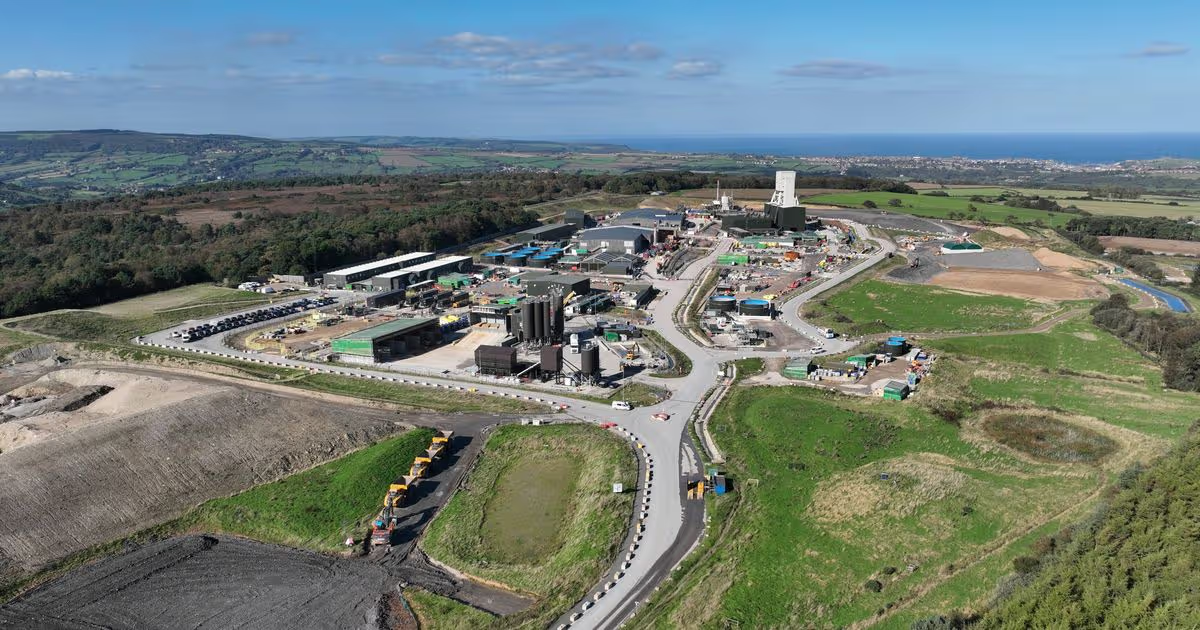
An aerial view of  Woodsmith Mine

An aerial view of Woodsmith Mine(Image: Anglo American)

Hopes have been raised that a mining project that could bring hundreds of jobs to North Yorkshire and Teesside could be resumed after one of the world’s largest companies invested in the scheme.

Development work at the Woodsmith Mine near Whitby has been slowed since a decision by mining giant Anglo American in 2024 to significantly cut investment. That led to hundreds of job losses at the project, which includes a 37km tunnel that will eventually connect the mine site with a processing and export facility at Redcar, on Teesside.

But now it has been announced that the Mitsubishi corporation has made an investment that could see it take a 25% stake in the project. The size of the investment has not been disclosed but the involvement of the multinational firm will raise hopes that the project can be resumed in full.

A feasibility study is being carried out on the project, which aims to mine polyhalite, a high-performing natural fertiliser. It is expected that a final decision on whether or not to fully complete the project will be made in 2028.

Advertisement

A statement to the Stock Exchange from Anglo American this morning said: “In support of the first two of these conditions, Anglo American has entered into an investment agreement and related shareholders’ agreement with Mitsubishi Corporation (Mitsubishi) to support continued development of Woodsmith, including working together on market development and financing opportunities designed to further enhance the existing market development programme.

“Together, Anglo American and Mitsubishi will explore opportunities to build out demand for POLY4, including providing financial and commercial resources to accelerate pilot sales and leveraging Mitsubishi’s extensive networks across food and agriculture sectors to broaden market development across key markets and related business development and strategic partner engagement, which will contribute to optimising the project in the feasibility study phase, prior to submission to the Board for approval.

“The agreements include an initial equity investment by Mitsubishi in Woodsmith. Through its investment and involvement in the ongoing development of Woodsmith at this stage, Mitsubishi also intends to evaluate its participation in a future financing plan at the time of the Anglo American board’s final investment decision, currently anticipated from 2028 subject to meeting the above conditions, with potential for Mitsubishi to acquire an equity interest of 25% or other such amount subject to negotiations at that time.

“The agreements extend the longstanding successful partnership between Anglo American and Mitsubishi Corporation, while allowing for additional investment and the involvement of other partners, and represents a pathway for Anglo American to syndicate a significant minority share of its interest in Woodsmith.”

Advertisement

Anglo American added that board approval for the full project is still needed and is subject to the feasibility study being completed. It said was continuing work on the project, including continued sinking of the mine’s service shaft.

A statement from Mitsubishi said: “Mitsubishi Corporation (MC) will use its experience and resources to contribute to the feasibility study and will jointly conduct pilot sales to validate the marketability of the product and explore opportunities to build out demand for the product. This will support MC assessing whether to participate in and increase its equity exposure at the final investment decision by Anglo American (AA), currently anticipated from 2028.

“The feasibility study will assess development and operational plans, economic viability, and social and environmental impacts of the Project. In addition to contributing funds for the study, MC will leverage its extensive networks across the food and agriculture sectors, including providing opportunities for agronomic trials through its group companies.

“Demand for fertiliser minerals is expected to grow steadily over the medium to long term, supported by megatrends of population growth, evolving dietary preferences, and the rising importance of food security amid heightened geopolitical uncertainty. In particular, demand for sustainable fertiliser products is poised to increase as agriculture faces rising expectations to reduce environmental impact and adopt responsible farming practices.

Advertisement

“Leveraging the expertise it has built in mine development and operations through its Mineral Resources Group, MC will bring together its integrated strengths across business segments-including the food and agriculture related businesses-to generate new value through the project.”

Continue Reading

Business

Top Lawyers’ Fees Have Skyrocketed. Be Prepared to Pay $3,400 an Hour.

Published

on

Top Lawyers’ Fees Have Skyrocketed. Be Prepared to Pay $3,400 an Hour.

Top Lawyers’ Fees Have Skyrocketed. Be Prepared to Pay $3,400 an Hour.

Continue Reading

Business

Global equity funds attract biggest inflow in five weeks as concerns around AI ease

Published

on

Global equity funds attract biggest inflow in five weeks as concerns around AI ease


Global equity funds attract biggest inflow in five weeks as concerns around AI ease

Continue Reading

Business

DoorDash Expects Ramped Up Spending to Dent First Quarter

Published

on

DoorDash Expects Ramped Up Spending to Dent First Quarter

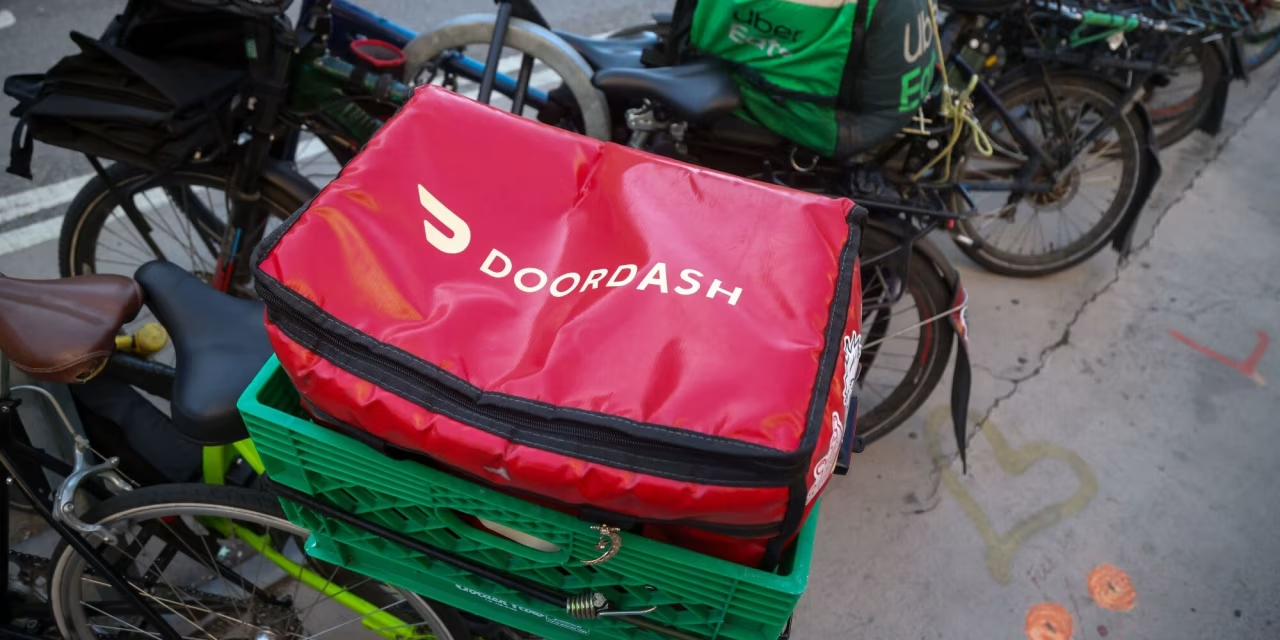
DoorDash DASH 1.62%increase; green up pointing triangle reported higher fourth-quarter revenue as orders climbed.

The delivery giant also forecast higher-than-expected orders for the current quarter, but said the results could be dented by further investments.

Copyright ©2026 Dow Jones & Company, Inc. All Rights Reserved. 87990cbe856818d5eddac44c7b1cdeb8

Continue Reading

Business

New Year's sport supplement buying drives January retail sales surge

Published

on

New Year's sport supplement buying drives January retail sales surge

Continuing strong sales from online jewellers after a recent spike in gold prices also helped drive the increase.

Continue Reading

Business

Bath & Body Works starts selling on Amazon as brands embrace logistics network

Published

on

Bath & Body Works starts selling on Amazon as brands embrace logistics network

An assortment of Bath & Body Works products.

Courtesy of Bath & Body Works

Bath & Body Works Champagne Toast body wash, with no minimum shipping threshold, is now just a click away for Amazon Prime members.

Advertisement

The mall-favorite brand is making some of its best-selling fragrances, body washes, hand soaps and candles available for Amazon’s U.S. shoppers. The selection is also eligible for Prime shipping.

Amazon is the No. 1 online destination for U.S. beauty shoppers, accounting for 47% of the online beauty and personal care market in the U.S. in 2024, according to Euromonitor. Sephora is second with 9% share. Euromonitor estimates 39% of all beauty and personal care sales take place online.

“Launching our first authorized brand storefront on Amazon allows us to put ourselves directly in the path of the consumer,” Bath & Body Works CEO Daniel Heaf told CNBC. “It’s about meeting them where they already shop.”

The Amazon launch marks the latest effort by Columbus, Ohio-based Bath & Body Works to expand its access points for customers. Last year, it began selling its products in college campus stores — with a footprint of now more than 1,000 locations — in the company’s first points of sale outside its roughly 2,600 owned and franchised stores and its own website.

Advertisement

Heaf joined Bath & Body Works in May after his role as Nike’s chief transformation and strategy officer was eliminated by CEO Elliott Hill.

Heaf recently laid out his “plan to return [Bath & Body Works] to profitable, sustainable growth.” He calls it a “consumer-first formula” with four pillars: creating disruptive and innovative products, reigniting the brand, winning in the marketplace, and operating with speed and efficiency.

The Amazon partnership, Heaf said, “is the first of many milestones that we’ll be delivering this fiscal year against that strategy.”

Before the official storefront launch, Bath & Body Works products were sold on Amazon through third-party resellers.

Advertisement

Now, Heaf says the company is attempting to reclaim the brand story on Amazon — and those marketplace sales.

Amazon: Friend or foe?

While Amazon has many first-party relationships with brands from Nike to Calvin Klein that use wholesale partnerships as part of their business models, there are few examples of retailers selling on the site that design, manufacture and sell their products entirely on their own.

For those so-called vertically integrated brands, like Bath & Body Works, Amazon is increasingly filling the role of skilled logistics partner rather than retailer. 

Gap, J. Crew and Everlane are similarly vertically integrated and have small selections of branded products for sale on Amazon.

Advertisement

Gap began selling what it calls “core basics for the whole family” in 2022 through a wholesale relationship, where Amazon owns and sells the products, which are Prime eligible. Gap has said its goal is to reach new or lapsed customers as well as provide existing shoppers the convenience for “core essentials.”

Under Bath & Body Works new agreement with Amazon, the brand will retain ownership of the inventory and control pricing, but will use Amazon’s fulfillment partners network for Prime eligibility. 

Everlane declined to comment on its Amazon partnership. J. Crew did not respond to request for comment.

Jewelry company Kendra Scott has an authorized storefront on Amazon after initially opposing the partnership — even though it had wholesale relationships with other retailers, including Macy’s and Nordstrom. But over time, the brand began to view Amazon as another opportunity to reach shoppers rather than a competitive threat, according to a person familiar with the company’s decision making, who spoke about internal matters on the condition of anonymity.

Advertisement

On its own website, Bath & Body Works is making it easier for shoppers to place their orders. The company lowered its free shipping threshold to $50 from $100 last month.

Still, Heaf admits, “We know that we will never compete with Amazon in terms of their Prime Network. No one is going to be offering next-day shipping. That’s just not what we’re in the business of. And so I think that by going on Amazon, we are also making our own site more competitive but recognizing that our job is not to build a fulfillment network that can operate at the speed of Amazon.”

Continue Reading

Business

Oak Woods Acquisition faces Nasdaq delisting hearing in March

Published

on


Oak Woods Acquisition faces Nasdaq delisting hearing in March

Continue Reading

Business

Molson Coors Sees Profit Decline, Sales Slump to $2.66 Billion

Published

on

Molson Coors Sees Profit Decline, Sales Slump to $2.66 Billion

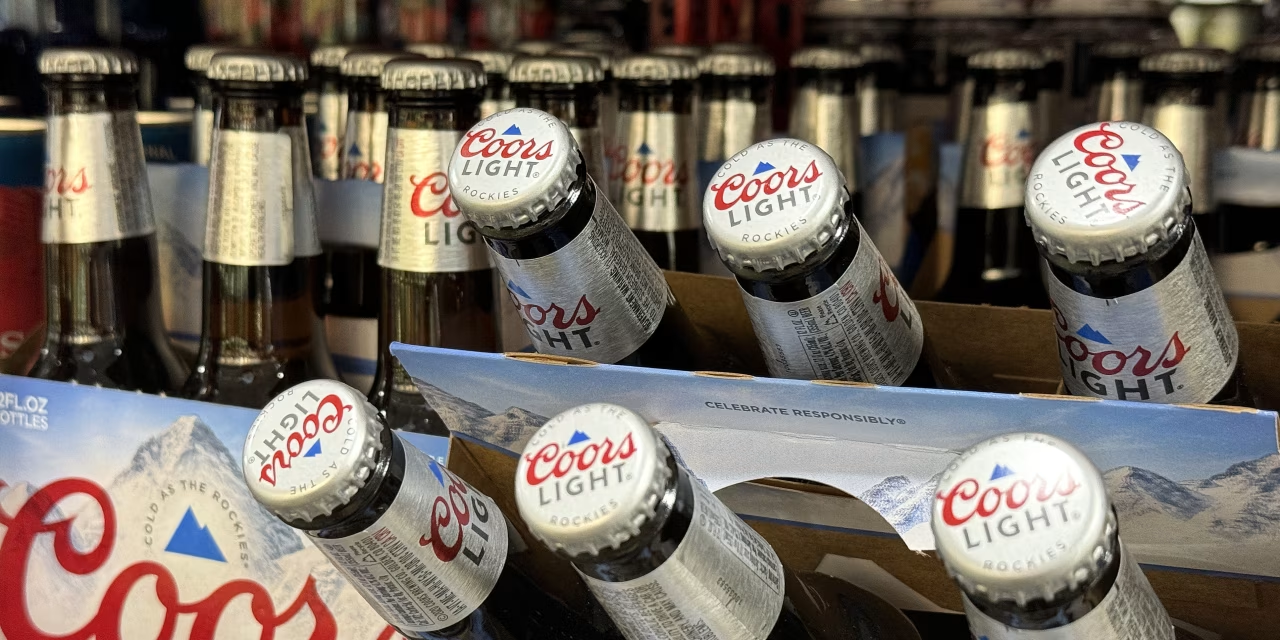
Molson Coors TAP -4.86%decrease; red down pointing triangle logged lower profit and sales in its latest quarter as it continues to contend with softer demand for beer.

“It’s no secret that our industry is facing significant headwinds,” Chief Executive Rahul Goyal said during Wednesday’s CAGNY conference shortly after the company reported results.

Copyright ©2026 Dow Jones & Company, Inc. All Rights Reserved. 87990cbe856818d5eddac44c7b1cdeb8

Continue Reading

Business

Mark My Words February 20 2026

Published

on

Mark My Words February 20 2026

Sam Jones, Mark Pownall, Gary Adshead and Claire Tyrrell discuss the dim sum scandal; a $900k government severance package; ECU Mount Lawley’s future and other major news of the week.

Continue Reading

Trending

Copyright © 2025