Connect with us

Business

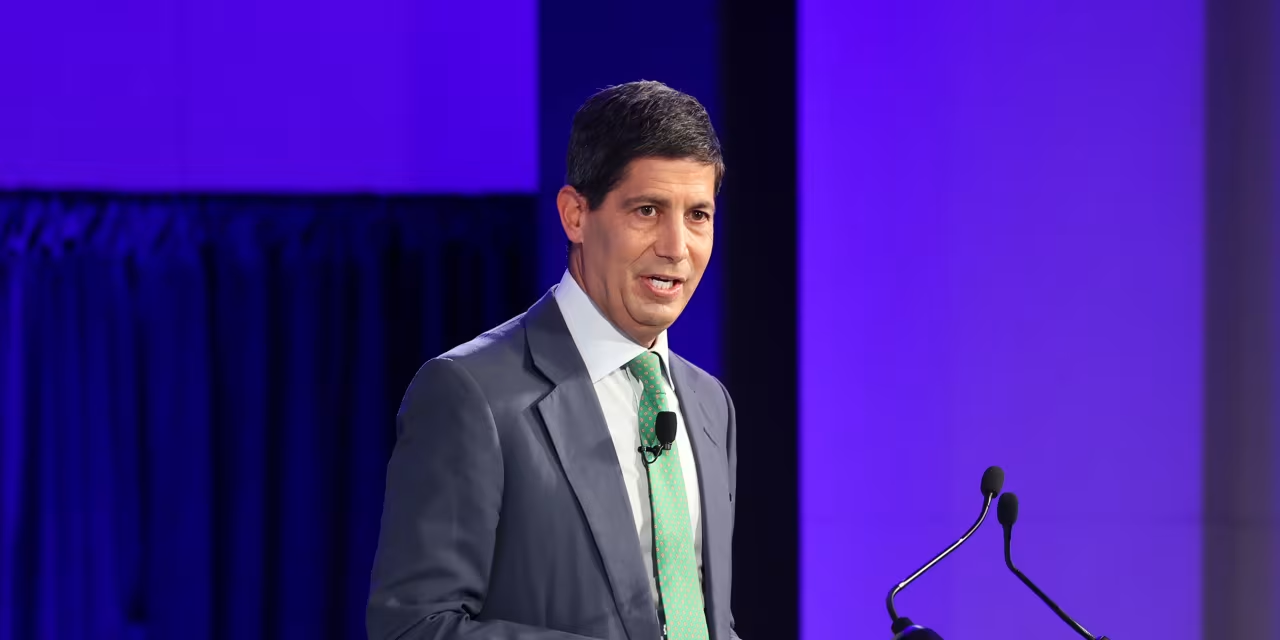
Wall Street Sees Warsh Pick for Next Fed Chair as a Win

Published

on

Wall Street Sees Warsh Pick for Next Fed Chair as a Win
Continue Reading
Click to comment

Leave a Reply

Your email address will not be published. Required fields are marked *

Business

New water regulator plans for Wales

Published

on

Business Live

A new regulator to replace Ofwat in Wales would require UK Government approval

(Image: PA)

The Welsh Government has published major long-term plans for stronger regulation of the water industry. The plans would mean setting up a new dedicated Welsh economic regulator for water in Wales, which would replace Ofwat.

Advertisement

It would require legislation and an updated framework designed to encourage investment, protect the environment, and deliver a water system that works for Wales.

It comes after a catalogue of sewage scandals and mounting public anger over water companies’ performance led to a major review which called for oversight of the industry in Wales and England to be completely overhauled.

The government consultation document makes clear that for its plans to happen it would need the UK Government to agree to devolve further powers to Wales – something which the current administration has come under fire for refusing in other areas such as justice.

READ MORE: More business rate relief for hospitality firms in WalesREAD MORE: It’s wrong to caricature Welsh firms as being too cautious when it comes to growth finance

Advertisement

There needs, it says, to be “hard decisions”, including investment and changes to infrastructure which will “exceed what customers can reasonably afford”.

The long-term strategy to deliver the plans forecasts legislative change would happen between 2026 and 2028-29.

There would then be a new Welsh economic regulator and system planning function for water from 2028 until the early 2030s with an economic regulator for water set up and operating from the mid 2030s onwards.

The 88-page paper says despite investment improvements need to happen.

Advertisement

“Wales now faces a new reality. Climate and nature emergencies, alongside persistent challenges, demand urgent action,” says the report.

“The water system designed for a different time no longer meets the needs of our people, our environment, or our economy.

“We have made good progress but people across Wales are rightly concerned about sewage discharges, outdated infrastructure, and the condition of water in their communities. We cannot stand still. It is time for fundamental reset.

“Improving the health of our rivers will require action across the whole water environment.

Advertisement

“Pressures from land use, agriculture, and the way organic materials are managed once applied to land all contribute to the condition of our catchments.

“We are therefore taking a whole-system approach, ensuring work to change water governance in Wales is aligned with wider action to address nutrient pollution, strengthen accountability, and restore trust that the system works in the public interest.”

The report says the following measure need to happen:

  • A separate regulator for Wales. This would “strengthen public confidence and support long-term investment in infrastructure and environmental protection”;
  • a clear, long-term strategic direction that articulates national priorities, sets interim targets, and provides a framework for delivery across sectors;
  • a change from a “fragmented and process-heavy planning towards a coherent, outcome-focused system”;
  • a longer-term integrated plan covering water resources and water supply, drainage and wastewater, and environmental water quality to inform investment priorities and to provide clarity to the wider system, for example land use planning; and
  • working with the water industry to reduce inappropriate materials entering their network such as wipes, sanitary products, cotton buds, fats, oils, and greases by preventing these items from being flushed or poured away. Reducing this burden on water systems protects the environment, lowers maintenance costs, and strengthens resilience, helping communities enjoy cleaner, safer, and more reliable water while supporting more stable and potentially lower bills.

The report says any reforming governance, enforcement and monitoring in Wales will be a “complex and interdependent process”.

“It will begin with a comprehensive review of existing frameworks to identify gaps, overlaps, and areas of weakness. This will be followed by engagement across government, regulators, industry and civil society to design a system that reflects Welsh values and priorities.

Advertisement

“Throughout effective engagement with the UK Government will be essential, particularly during the period when regulation of Welsh water companies continues through the new UK Government water regulator, until the Welsh regulator is established.

“The process will then move forward through legislative and operational change, coordinated with the establishment of the new Welsh regulator, with regulation of Welsh water companies continuing through the new English regulator until the Welsh regulator is in place,” it says.

It however says that changes could lead to “confusion, resistance, or unintended consequences” and the reforms could be seen as “punitive or overly centralised”.

Afonydd Cymru, which represents river trusts in Wales, told the BBC the proposals provided “a beacon of hope” but urged the government to act quickly.

Advertisement

Chief executive Gail Davies-Walsh said: “It must be remembered that it is just a consultation at this stage and nothing yet is set in stone”.

She added that the “thorny question of funding was not resolved either”.

Interim chief executive of water regulator Ofwat Chris Walters said: “This Green Paper sets the framework for the future of the water sector in Wales, which we welcome. The creation of a dedicated regulator for Wales will strengthen scrutiny and accountability within a framework designed specifically for Wales, marking an important evolution in how companies will be overseen going forward.

“As the Welsh Government develops the regulatory new body, we remain committed to the delivery of our core functions and are already working closely with Welsh Government, Defra, Natural Resources Wales and other regulators to ensure that the sector moves towards a more integrated and resilient future.

Advertisement

“Our 2024 Price Review approved record investment in Wales- more than £6.3bn- which will enable major improvements for customers and the environment by 2030.”

Derek Walker, Future Generations Commissioner for Wales, said: “This needs to be a wake-up for the water industry and is an overdue opportunity to fix the problems of the past and become a clean water abundant nation. Welsh Government has acted decisively, and we now need to make sure that securing healthy waters for Wales is a priority for the UK Government and the next Welsh Government.

“Everything must be done to ensure the transition to a new body happens without delay to deliver long-term environmental recovery and affordability, alongside strengthened compliance and regulation.

“Any investment in the water system must work urgently to restore nature, support food production, improve climate resilience and deliver new housing and infrastructure as we protect the long-term health of our rivers, seas and the water that’s essential to life.”

Advertisement

Deputy first minister Huw Irranca-Davies said: “Our ambition is clear and bold: clean and thriving rivers, safe and high-quality drinking water, fair and affordable services, and modern infrastructure ready for the future. We will strengthen accountability, rebuild trust, and create a system that is simpler, stronger and more transparent.

“Wales now faces an urgent reality. Climate and nature emergencies, ageing infrastructure, and public concerns about water quality demand decisive action. The system we have today was designed for a different era. It is time for a fundamental reset.”

Continue Reading

Business

EU ‘open-minded’ on UK customs union talks, commissioner says

Published

on

EU ‘open-minded’ on UK customs union talks, commissioner says

Brussels would be willing to discuss closer trade ties with the UK, including the possibility of cooperation on a customs union, a senior European commissioner has said, signalling the clearest openness yet from the EU to re-engage with Britain.Speaking to the BBC

after high-level talks in London, Valdis Dombrovskis, the European Commissioner for Economy, said the EU was “ready to engage with an open mind” if the UK wanted to explore deeper economic alignment.

His comments come amid growing pressure on Labour to reconsider its stance on a customs union with the EU, as businesses and some MPs argue closer ties could help offset global trade uncertainty.

Dombrovskis also said the EU and UK could remove “most” food checks between Britain and the bloc if agreement is reached on aligning sanitary and phytosanitary rules, potentially easing one of the biggest sources of friction for exporters since Brexit.

The commissioner was speaking following meetings with senior UK ministers, including Chancellor Rachel Reeves, European trade commissioner Maroš Šefčovič, and cabinet ministers Peter Kyle and Nick Thomas-Symonds.

Advertisement

The group, informally dubbed the “Quint” by diplomats, is intended to meet regularly to coordinate responses to a rapidly shifting global trade and security environment. While it is not formally tasked with renegotiating Brexit arrangements, its creation signals a renewed willingness on both sides to cooperate.

At a public event alongside Dombrovskis, Reeves said stronger UK-EU ties were becoming increasingly important as “we are sliding towards a world where the rules are less clear”, pointing to heightened geopolitical and trade tensions.

A customs union would eliminate tariffs on goods traded between the UK and the EU and significantly reduce border bureaucracy. However, critics argue it would restrict the UK’s ability to strike independent trade deals, as Britain would be required to align with the EU’s common external tariff and trade policy.

Labour’s election manifesto ruled out rejoining the EU customs union or the single market, and also rejected freedom of movement. However, senior figures have increasingly acknowledged the economic case for closer alignment, with Foreign Secretary David Lammy previously suggesting a customs union could support growth.

Advertisement

Asked directly whether the EU would welcome talks on a customs union, Dombrovskis stopped short of a commitment but said: “We are ready to engage with an open mind and seek those areas of cooperation.”

He added that the EU was also open to discussing alignment in specific single-market areas, while stressing that full single-market membership would require acceptance of the four freedoms, including freedom of movement.

On defence, Dombrovskis said the EU remained open to further discussions on UK participation in the bloc’s €150bn Security Action for Europe (SAFE) defence loans programme, after talks stalled last year over limits on British firms’ involvement.

“We know the prime minister has expressed interest in returning to this issue, and there is certainly openness from the EU side,” he said.

Advertisement

Progress has been stronger in other areas. Dombrovskis confirmed talks on a youth mobility scheme were “very advanced”, and said a forthcoming food standards agreement could eliminate most border checks, provided the UK aligns with EU rules.

The Liberal Democrats, who have long backed a customs union, welcomed the comments as a turning point. Treasury spokesperson Daisy Cooper said the EU’s stance was “a significant moment the government simply cannot afford to ignore”.

The developments come against the backdrop of escalating global tensions, including US tariff threats and renewed uncertainty over international trade rules, which both London and Brussels see as strengthening the case for closer cooperation.


Amy Ingham

Amy is a newly qualified journalist specialising in business journalism at Business Matters with responsibility for news content for what is now the UK’s largest print and online source of current business news.

Advertisement

Continue Reading

Business

Citizens upgrades Airbnb stock rating to Market Outperform on hotel expansion

Published

on


Citizens upgrades Airbnb stock rating to Market Outperform on hotel expansion

Continue Reading

Business

Dowlais shares delisted following combination with Dauch

Published

on


Dowlais shares delisted following combination with Dauch

Continue Reading

Business

‘SaaSpocalypse’: What is Anthropic’s newest AI tool and what are the consequences for global tech companies?

Published

on

‘SaaSpocalypse’: What is Anthropic’s newest AI tool and what are the consequences for global tech companies?
The software sector was jolted overnight with what analysts are calling a “SaaSpocalypse” — a sudden and severe selloff triggered by new artificial intelligence tools unveiled by US AI startup Anthropic. The episode has sharpened investor fears that AI is no longer merely helping software companies but may now begin replacing them.

So, first, what exactly is this new tool?

Anthropic has expanded its enterprise AI platform, Claude Cowork, by launching 11 new plugins aimed at automating a wide range of professional tasks. Claude Cowork is an agentic, no-code AI assistant built for corporate users, allowing companies to automate workflows without writing software. The new plugins are designed to handle tasks across legal, sales, marketing and data analysis functions. The most recent addition is Anthropic’s Claude Legal agent, which can perform routine legal work such as document and contract review, and compliance checks.
Anthropic has said that the tool does not provide legal advice and that all AI-generated outputs must be reviewed by licensed attorneys. Even so, the breadth of automation signals a step change in how much white-collar work AI systems can now perform.

Also read: Rs 1.9 lakh crore SaaSpocalypse for IT stocks explained: What it means for investors

Advertisement

Why is it worrying for tech companies?

At the heart of the market reaction is a growing concern that AI could fundamentally reshape the competitive landscape for software and IT services companies, eroding both profitability and market position.


“The fear with AI is that there’s more competition, more pricing pressure, and that their competitive moats have gotten shallower, meaning they could be easier to replace with AI,” said Thomas Shipp, head of equity research at LPL Financial, which has $2.4 trillion in brokerage and advisory assets. “The range of outcomes for their growth has gotten wider, which means it’s harder to assign fair valuations or see what looks cheap.”
Industries once considered relatively safe from AI disruption, including legal services, data analytics and customer suppor are now firmly in the crosshairs. If AI can automate these functions, the massive IT services industry built around delivering them could face existential challenges.Jefferies was among the first to label the market reaction a “SaaSpocalypse”, noting a rapid shift in sentiment from ‘AI helps these companies’ to ‘AI replaces these companies.’ Jeffrey Favuzza from Jefferies’ equity trading desk described the mood as outright panic. “Trading is very much ‘get me out’ style selling,” he said, according to Bloomberg.

What were the repercussions?

The consequences were swift and broad-based. A Goldman Sachs basket of US software stocks plunged 6%, its biggest single-day fall since April’s tariff-led selloff, according to Bloomberg. Financial services stocks were hit even harder, with an index tumbling nearly 7%.

In India, IT stocks suffered their worst single-day selloff in recent memory on Wednesday, with the sector losing Rs 1.75 lakh crore in market value as investors fled amid fears that artificial intelligence could make traditional software and IT services obsolete. Persistent Systems shares crashed over 6%, while heavyweight IT stocks, including Infosys, LTIMindtree, Coforge, TCS, Mphasis and HCL Tech tumbled 4–6% each. Wipro and Tech Mahindra fell around 4%. The combined market value of Nifty IT index stocks plunged from Rs 31.75 lakh crore to Rs 30 lakh crore.

The selloff was not confined to India. Wall Street’s tech-heavy Nasdaq fell 1.4% on Tuesday, with software stocks shedding approximately $300 billion in market value. Global giants were also hit hard: London Stock Exchange Group Plc fell 13%, Thomson Reuters Corp. plunged 16%, CS Disco Inc. sank 12%, and Legalzoom.com Inc. plummeted 20%.

Advertisement

JPMorgan said the ongoing generalist money outflows are triggering knee-jerk selling, amplified by index-arbitrage basket trades, programmatic de-grossing, cross-correlation factor contagion and a vacuum in passive liquidity. The bank noted that it had flagged the risks of extreme bullish positioning in AI well ahead of time. As far back as late 2022, JPMorgan had warned that AI technology would “evolve at the speed of light” and could surprise investors with the pace and scale of its capabilities.

Concerns around AI-led disruption have been building for months. Anthropic’s initial release of the Claude Cowork tool in January had already heightened investor anxiety around software sector risks. Other technology launches have added to the unease. Video game stocks were caught in a selloff last week after Alphabet began rolling out Project Genie, which can create immersive worlds using text or image prompts.

Also read: Infosys, Wipro, TCS and other IT stocks tumble up to 7%. Here’s why

As fears of AI-driven disruption spread, analysts say the coming months will be critical in determining how software and IT companies navigate this complexity. But for now, the “SaaSpocalypse” has delivered a shock to the markets.

Advertisement

(Disclaimer: Recommendations, suggestions, views and opinions given by the experts are their own. These do not represent the views of The Economic Times)

Continue Reading

Business

Canadian miners flock to ASX

Published

on

Canadian miners flock to ASX

Canadian resources companies are increasingly eyeing the Australian stock market’s investor base and capital pools after eight new North American outfits debuted in 2025.

Continue Reading

Business

Super Micro Computer: Blowout Earnings Confirm Bullish Case

Published

on

Super Micro Computer: Blowout Earnings Confirm Bullish Case

Super Micro Computer: Blowout Earnings Confirm Bullish Case

Continue Reading

Business

Perth Festival slumps to $850k loss

Published

on

Perth Festival slumps to $850k loss

The loss was the first since Perth Festival started disclosing its annual results and came despite a 20 per cent jump in government grants to $17.6 million.

Continue Reading

Business

China to ban electronic door handles on cars starting 2027 for safety

Published

on

China to ban electronic door handles on cars starting 2027 for safety

China has moved to ban one of the most iconic Tesla vehicle features in order to get a handle on vehicle safety.

New safety regulations published by China’s Ministry of Industry and Information Technology state that cars sold in China will be required to have mechanical releases on their door handles, according to TechCrunch. The outlet added that the rules, which go into effect on Jan. 1, 2027, will ban hidden, electronically activated door handles. 

Advertisement

Under the new rules, each vehicle door, except for the tailgate, will need to be equipped with a manually-released external door handle and vehicles will be required to have a mechanical release on the interior, TechCrunch reported.

TESLA ENDS PRODUCTION OF MODEL S AND MODEL X VEHICLES, WILL FOCUS ON ROBOTS IN 2026

A red Tesla plugged into a charger in front of a dealership

 A Tesla model Y is shown charging at a Tesla dealership in Buena Park, Calif., Jan. 28, 2026. (Mike Blake/File Photo/Reuters / Reuters)

China is the first country to implement such a ban. While the feature was made popular with Teslas, Chinese competitors, including Xiaomi, have adopted the design, according to Reuters.

The ruling followed high-profile incidents in which power failures were suspected to have prevented the doors from opening, leaving people trapped and unable to escape or be rescued, Bloomberg reported. The outlet said that two of the incidents included fiery crashes involving Xiaomi Corp. EVs.

Advertisement

China is shifting from being just the largest EV market to being a rule-setter for how new vehicle technologies are regulated,” Bill Russo, founder of Shanghai-based consultancy Automobility, told Bloomberg. “By moving first, Beijing can use its huge domestic market to lock in safety standards that both Chinese and foreign automakers must follow at home — and that may ultimately travel with Chinese EV exports and influence global norms.”

Woman opens a Tesla door

A woman opens the door for a Tesla Model YL electric vehicle at a showroom in Beijing on Feb. 3, 2026. China will ban hidden door handles on cars sold in the country from next year, phasing out the minimalist design popularized by Tesla over safety c (Pedro Pardo / AFP via Getty Images / Getty Images)

ELON MUSK TAKES DIG AT WAYMO AFTER SAN FRANCISCO BLACKOUT

In December, the Office of Defects Investigation (ODI), which is under the National Highway Traffic Safety Administration (NHTSA), opened a defect probe into the Tesla Model 3 sedan’s emergency door release controls, Reuters reported. The investigation reportedly included approximately 179,071 model year 2022 vehicles.

Xiaomi SU7 on display

Visitors look at a Xiaomi SU7 electric vehicle displayed at the Beijing International Automotive Exhibition, or Auto China 2024, in Beijing, China, April 25, 2024. (Tingshu Wang/Reuters)

GET FOX BUSINESS ON THE GO BY CLICKING HERE

Advertisement

Federal Motor Vehicle Safety Standard No. 206 lays out requirements for vehicle door locks and door retention components to help prevent occupants from being ejected during a crash. 

A representative for NHTSA pointed out to FOX Business that while FMVSS No. 206 does not have specific requirements mandating a manual door release if power is lost, failing to provide a reasonable way for occupants to enter or exit a vehicle could be considered a safety defect and lead to a recall. However, the opening of a defect petition does not automatically mean that a recall will be issued.

FOX Business reached out to Tesla and Xiaomi for comment.

Advertisement
Continue Reading

Business

Barclay brothers given six weeks to avoid bankruptcy after HSBC action

Published

on

Howard and Aidan Barclay have been given six weeks to reach an agreement with creditors after HSBC launched bankruptcy proceedings over debts linked to the collapse of the family’s logistics empire.

Howard and Aidan Barclay have been given six weeks to reach an agreement with creditors after HSBC launched bankruptcy proceedings over debts linked to the collapse of the family’s logistics empire.

At a High Court hearing on Tuesday, Mr Justice Michael Briggs granted the brothers until 17 March to circulate proposals for individual voluntary arrangements (IVAs), a formal insolvency process allowing debtors to agree repayment terms with creditors and avoid bankruptcy.

The brothers are the eldest sons of the late Sir David Barclay, who, alongside his twin brother Sir Frederick Barclay, built a sprawling business empire through highly leveraged acquisitions. Much of that empire has since unravelled.

HSBC initiated bankruptcy action in December over debts stemming from the collapse of Logistics Group, the parent company of delivery firms Yodel and ArrowXL. The group fell into administration in March 2024 after HSBC called in its loans.

Administrators recovered just £1.1 million of HSBC’s £143.5 million secured lending, representing less than 1p in the pound, according to filings by Teneo at Companies House.

Advertisement

IVAs allow individuals to retain greater control over their assets than bankruptcy, but require the support of creditors representing at least 75 per cent of outstanding debt. It remains unclear whether HSBC will support any proposal from the Barclay brothers or continue to pursue bankruptcy. The bank declined to comment.

The next court hearing is scheduled for 31 March.

The logistics collapse was one of several blows to the Barclay family’s holdings. In recent years, the family has lost control of the Telegraph Media Group and The Very Group.

In 2023, US private equity firm RedBird Capital Partners and Abu Dhabi-backed International Media Investments acquired around £1.2 billion of debt previously held by Lloyds Banking Group that sat behind the family’s businesses.

Advertisement

IMI has since appointed insolvency practitioners at Interpath Advisory to dispose of assets held by Trenport Property Holdings, one of the family’s property vehicles. Filings last year listed Aidan Barclay’s main residence as Monaco.

As part of the Logistics Group administration, ArrowXL was sold in June to Jacky Perrenot Group for an initial £2.2 million, far below a £57.5 million valuation previously put forward by the directors. Yodel was sold in February 2024, shortly before administrators were appointed.

The Barclay family relinquished control of Very in November after US private equity firm Carlyle Group took control, with IMI remaining as a lender.

Meanwhile, the long-running saga over the Telegraph titles continues. A proposed £500 million sale to RedBird collapsed in November after regulatory intervention, prolonging uncertainty since Lloyds seized the papers in 2023. The owner of the Daily Mail is now poised to acquire the Telegraph, a deal expected to face scrutiny from competition regulators.

Advertisement

The Barclay brothers were approached for comment.


Jamie Young

Jamie Young

Jamie is Senior Reporter at Business Matters, bringing over a decade of experience in UK SME business reporting.
Jamie holds a degree in Business Administration and regularly participates in industry conferences and workshops.

When not reporting on the latest business developments, Jamie is passionate about mentoring up-and-coming journalists and entrepreneurs to inspire the next generation of business leaders.

Advertisement
Continue Reading

Trending

Copyright © 2025