I know I said I’d likely stop writing these big letters, but I just couldn’t help myself this quarter. So much is happening, and I wanted to jot my thoughts down as much for myself as anything else. And also to crow about a big win we had.
Quickly on the returns. We had a big quarter, with YTD returns up to 15.91% vs 9.3% for the S&P (my main target benchmark) and 16.96% for the USRT (USRT) (again not really relevant comp these days but including for historical continuity). Since inception we are up to 236.3%, vs 181.29% for the S&P and 89.84% for the USRT. And we did it with no semiconductor exposure (and thus we have avoided the momentum bloodbath since Q2 ended), and a fairly good sized short book to boot.
I will lead with the star of the show this quarter, which was Uniqure (QURE), a stock I mentioned first in late 2025 I believe. As a reminder this is a biotech that has developed a promising treatment for Huntington’s disease, a relatively rare, 100% fatal neurodegenerative disease. It published results in September, the stock skyrocketed to ~$70, then in November the FDA changed tack on what seems to have been previously agreed to guidance accepting an external control group for an accelerated approval and the stock crashed down into the $20s (where I first bought). Then in March, the FDA fully refused to even consider Qure (QURE)’s accelerated application, saying Qure needed to run a full phase 3, and the stock crashed down to as low as $9/share, below cash balances.
Advertisement
I doubled down near these lows, believing that if the drug worked (and no one really seems to think it doesn’t), that worst case you waited out the phase 3 (which Qure had cash to complete), and best case the FDA could change its mind either via personnel change, when additional data came out (they have year 4 data slated for September), or Qure could monetize via approvals abroad (which they are pursuing).
In an absolute whirlwind of a few months, the former FDA leadership was canned after what they did to Qure and several other promising disease treatments, and the new FDA interim leaders have allowed Qure to proceed with a filing for accelerated approval, with the stock now trading around $40s/share.
I will be honest and admit I didn’t think it would happen this quickly, but what a ride! Sadly for me I subscribe to some levels of risk/concentration management and sold some of my position after the initial pop from the lows around $10. But we still have a large position here. I was a bit worried about competition but after Roche (RHHBY) pulled its latest trial I am increasingly convinced that drugs which lower wild type Huntingtins protein across the whole brain or body, which essentially all the major competitors do, are problematic1. This then makes Qure’s approach of selective targeting of the striatum all the more strategic, and I think there is still significant upside from here if Qure can get full approval.
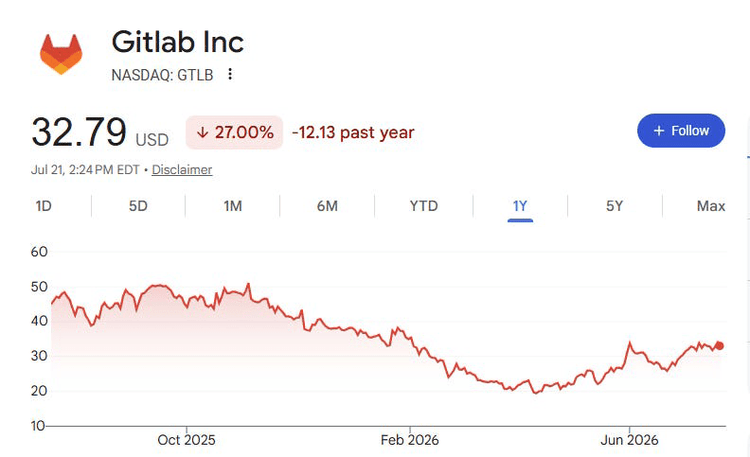
All that said, Qure is not our biggest position right now, that honor goes to Gitlab (GTLB), which has done quite well since we bought earlier this year.
Gitlab crashed significantly from fall of 2025 to today along with basically all other software businesses on a fear that LLMs would replace them all.
The basic thesis here is that as AI dramatically increases the velocity of code production, code control, review and approval (which Git sits at the center of), becomes even more critical than it ever was. The code repos also offer a very natural place to serve up coding agents – most easily visible in Microsoft (MSFT) pushing its Copilot agent through competitor Github.
Advertisement
The growth is already visible in Gitlab’s usage, with code pushes up nearly 50% YoY. Gitlab doesn’t get paid on usage (yet)2, but its a really good sign when people are using your platform a lot more generally speaking.
I believe Gitlab is well positioned to monetize this growth itself, or that it would present an incredibly strategic acquisition opportunity for one of the major AI labs or companies. The market cap is a mere ~$5.5B (and $4.2 ev after cash), a drop in the bucket against the trillion dollar plus valuations in play elsewhere. Gitlab serves a whopping 50% of the F100, and would be a really valuable distribution tool. Microsoft already bought major competitor Git Hub, so there is precedent here as well. One of the firm’s trying to produce an AI model that is struggling with adoption I think would find a company like Gitlab very tempting, such as Meta (META) or SpaceX (SPCX).
Stepping back, the investment book feels about as good as it has since covid times, there are many interesting firms trading at attractive valuations, and I feel fairly good about returns continuing to be strong from here despite significant economic uncertainty.
Macro Musings
And speaking of uncertainty, I am growing more concerned about our two big macro risks, the reclosure of the Strait of Hormuz, and the AI boom. In order to keep this letter brief I won’t spend too much time on Hormuz – but if a deal is not reached soon and the strait remains closed it looks like oil inventories could hit crisis levels in 1-3 months. I suspect/hope something will get done as Trump seems to be aware of this, although unfortunately it may involve paying off Iran or conceding Iranian control of the strait, an effective strategic defeat for the US.
Advertisement
The AI boom is a bit less binary, and therefore there is more to discuss. I believe the AI space is getting overheated, and as the scale has continued to ramp up I am worried that the impact of a bust is approaching a level that may cause a downturn.
The numbers involved here are absolutely staggering, and simply put, there does not appear to be any way that a reasonable return on the investment is earned barring the achievement of AGI within the next few years.
I have written about this several times before, but to repeat, at today’s level of investment (~$700 billion/year), there needs to be ~$1 trillion in end AI annual revenue (from the model cos / providers) by 2029, and that figure would ramp to nearly $4 trillion by 2036 assuming capex stays constant. Here is a link to a quick tweet summary of the math if you are interested3.
What is crazy to me is that many estimates have AI capex increasing significantly in 2027, and some even have it approaching $2 trillion by 2030! Obviously as the capex grows the required revenues also grow.
Advertisement
The tech industry is simply not prepared for their formerly asset light, high margin golden children to turn into low margin commodity capital intensive industrial companies. Almost no one in the industry has the heuristics or experience for this. I cannot tell you how many times I see supposedly knowledgeable Silicon Valley people talking about inference gross margins with no reference to capital investment or D&A – this is like talking about the marginal cost of running an oil well but ignoring the cost to drill it! Or its like asking – ‘is building apartments profitable’, and someone responding ‘ yes, the rental operating margins are very high’. The answer is absolutely and completely irrelevant on its own without reference to a return on capital invested & the cost to build the apartments.
Amusingly, the one group of tech people who viscerally understand this, the management team’s of the memory companies (a business famous for its boom/bust cycles), have opted into a strategy that seems to capitalize on this knowledge by riding the wave and maximizing their own profits, damage to the overall ecosystem be damned. This is, I suspect, the optimal strategy here, although if they push too hard they may incentivize the hyperscalers to enter into the memory game as well. I rather liked my friend Andrew Walker’s observation relating to Micron (MU) and its total capital investment vs Google (GOOGL). Micron has only spent ~$125 billion in capex in its entire history (or at least since 1992, if ChatGPT is accurate). Or alternatively, its book value is $73 billion – this is perhaps a more realistic assessment of the current ‘replacement cost’, if you will. Google is going to spend $185 billion this year. How hard would it be for Google to spin up a memory division? Or Amazon (AMZN). Perhaps more likely is Apple (AAPL) or someone stands up a new player in China to secure and permanently commodify the memory supply chain so critical to their products.
Obviously such a thing would not be easy, but it would not be impossible, and if memory profits were to stay elevated it may happen. It also incentivizes chip designs and model utilization that would be less reliant upon memory as well – human ingenuity is a powerful thing, and I do not like betting against it long term.
More likely though I would guess the whole thing crashes down, and the memory executives know this is likely to occur before too many new entrants come into the space. They are also probably aware of China’s rapid ramp of memory capacity via the growth of CXMT (now almost as large as Micron in terms of capacity! ) & YMTC, and the likely terrible price wars and margin pressure to come in several years from China’s entry into this market. China has successfully commoditized every other electronics sector they have entered, and have moved up the value chain into autos. I don’t see why memory should be any different.
Advertisement
How Much Longer
The big question is, how much longer can this AI capex boom last? It is hard to say, but I think the canary in the coal mine will be when model co revenues slow down. Given their epic growth thus far this year, it wouldn’t surprise me if this happens soon, but honestly I have no idea. It is notable that in the last few days we have seen the release of GPT 5.6, a new Meta Spark model, and Grok 4.5, and all 3 release put significant emphasis on their lower costs and price points. Not to mention a new open weights model out of China that is competitive with Fable and GPT 5.6 trained at what was supposedly a fraction of the cost.
These releases with an emphasis on cost mark a pretty big change from earlier releases which were really only focused on performance, and is potentially a dangerous sign of things to come for model providers.
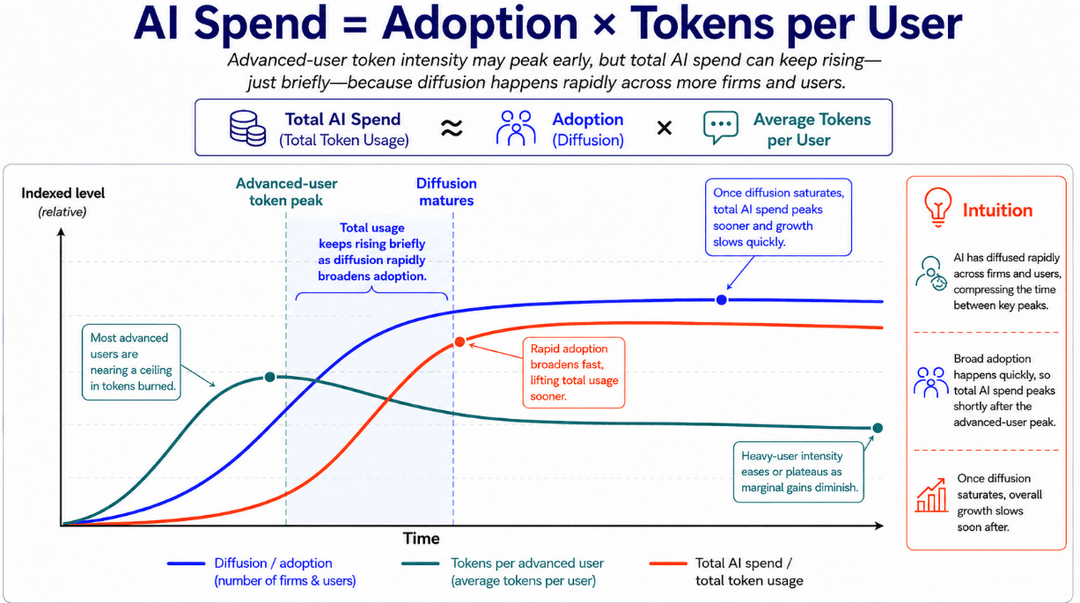
It could even indicate that the model cos are seeing corporate users become price sensitive in real time, which would presage revenue growth beginning to slow down. Broadly speaking my read on the narrative is that frontier AI users are now actively working to rein in spend. However this may be counterbalanced or even overwhelmed by continuing diffusion throughout the broader corporate ecosystem. At some point though that diffusion completes and reality begins to set in.
A little rough AI generated summary of this concept – since diffusion is rapidly completing, the key unknown is where token intensity shakes out. It will peak or at least level off at some point, the question is simply when.
The adoption of AI in corporate America has been incredible – I don’t think any technology has ever diffused quite so quickly. McKinsey and BCG have some surveys on this subject – McKinsey estimates 88% of employees surveyed said their company was using AI, back in 2025. BCG had a survey with 72% of respondents (all corporate employees), saying they were regular AI users, over a year ago in June of 2025.4 We are likely approaching effective full employee diffusion, with recent revenue growth driven by more complex workflows and agent usage ((aka each user spending more)).
Advertisement
This rapid diffusion has been great for AI revenues, but also means that the end of the adoption cycle is going to come much faster than previous technologies, and that the crash could be all the more violent because of how compressed the cycle is.
We will have to wait for the Q2 financial leaks to see the latest. But the model cos will need to approach $300-400B of revenues in a year, and ~$1 trillion by 2030, to justify all the AI capex investment. They are growing quite quickly today, but would need to accelerate further to hit these lofty targets.
If revenue growth slows and/or the capex spend slows down, it could well take down the entire US economy given the size of the AI sector in the public markets5, and how important public markets are as a percentage of household net worth today.
From Bloomberg and Barclays (BCS). Stocks are at an all time high as a percentage of HH networth.
The stock market is also near a record on the cyclically adjusted PE measure, second only to the dotcom bubble.
Advertisement
CAPE) of US stocks from 1900 to 2026, highlighting extreme valuation peaks in the late 1920s, 2000, and 2020s compared to the long‑term mean.” contenteditable=”false” width=”936″ height=”657″ loading=”lazy” srcset=”https://static.seekingalpha.com/uploads/2026/7/21/saupload_73d77e1a7dec04ff4cc10aa8425a897c.png?io=w750 750w,https://static.seekingalpha.com/uploads/2026/7/21/saupload_73d77e1a7dec04ff4cc10aa8425a897c.png?io=w640 640w,https://static.seekingalpha.com/uploads/2026/7/21/saupload_73d77e1a7dec04ff4cc10aa8425a897c.png?io=w480 480w,https://static.seekingalpha.com/uploads/2026/7/21/saupload_73d77e1a7dec04ff4cc10aa8425a897c.png?io=w320 320w,https://static.seekingalpha.com/uploads/2026/7/21/saupload_73d77e1a7dec04ff4cc10aa8425a897c.png?io=w240 240w” sizes=”(max-width: 767px) calc(100vw – 36px), (max-width: 1023px) calc(100vw – 180px), 552px”>
The CAPE P/E uses inflation adjusted earnings over the last 10 years, in this way it can capture potential earnings bubbles and price bubbles. Today’s absolute P/E is not as high relative to prior figures, but the massive recent spike in earnings means the CAPE is much higher.
And setting aside the stock market, at this point a fairly large chunk of GDP is directly & indirectly tied to data center and power investments at this point. Even the automakers are re-orienting their battery operations around datacenters!
All that said, it is hard to predict with much certainty what is going to happen with the overall economy. While I am relatively confident the AI boom turns into a bust at some point, I do not know when, and I am not 100% sure it will cause a US recession, and even if it does it is very hard to know how bad that might be. Ideally it would be a shallow, concentrated one a la 2000.
There is some risk though of a broader, deeper crisis though, as one of the biggest differences this cycle is the asset & debt heavy nature of much of the investment, at least in the neocloud and datacenter space. Debt distress is much more likely to cause a longer, more painful crisis than equity. However much of this issuance appears to be backstopped by the still fairly good credit hyperscalers, so I am hopeful that a downturn wouldn’t lead to a full blown financial crisis (but I wouldn’t rule it out, especially the longer the boom goes!).
Fin
As always, thanks for reading. Despite the macro uncertainty I feel good about our portfolio, our stocks are quite cheap & may even benefit from a rotation out of momentum into value. And we have a significant short book that would hopefully offset a broader economic downturn.
Advertisement
Stay safe out there.
Thanks for reading Warden Capital!
Hawkins Entrekin
Advertisement
References
1 To get a bit further into the weeds but not quite all the way, regular huntingtins protein, or wtHTT, plays a critical role in other parts of the brain in particular, and there is good biological reason to believe that suppressing it across the brain could cause long term problems. My view here is supported by competitive trials which show a trend of higher dosage actually causing worse results, and more advanced patients doing worse, but promising results early in time and patient disease stage. That said this opinion is loosely held, there are still many unknown variables in all of these trials. But at the end of the day Qure’s AMT-130 is the only treatment which seems to show any real long term efficacy in slowing disease progression.
2 Technically this isn’t quite true, there are some ancillary services Gitlab charges per task on, but the vast majority of revenues are seat based for Gitlab. Gitlab’s new coding harness (which allows you to use any underlying model), does have usage based cost but its still a very small share of revenues.
3 The assumptions here are actually fairly conservative (to the benefit of semis bulls), when I dug a little deeper the math actually was much worse because the share of datacenter spend going to chips has continued to increase, which means the useful life estimate I had in there was overall too high. This means required revenues would actually be significantly larger. The main offset to this is that Google is a good sized share of the AI spend, and one could argue that their spending need not have an economic return. As Google faces an existential risk to its search business, and so their investment may simply be something they must do to preserve that business, even if it doesn’t actually generate much if any incremental new profits or revenues. The useful life estimates would add ~50% to the required revenues, while Google is about ~22-25% of total capex in the space, so crudely my figures here are a net ~25% conservative. So one year of current AI capex needs ~10 years of $400b / year in revenues to pay it back.
4 The same survey recently came out for 2026 but didn’t give a comparable all employee figure, instead breaking it down by position. But its like roughly the figure is now at 83-85% – there is not much growth left to be had here.
Advertisement
5 I have seen estimates as high as close to 50% of the stock market. The AI trade has drawn in pretty much the entire utility sector and a large swath of even the industrials space as companies reorient their offerings around the data center boom.
The Asian Development Bank’s 2026 Asian Development Policy Report warns that Asia’s decades-long growth model, built on low-cost manufacturing and participation in global value chains, is losing its reliability. Automation, geopolitical fragmentation, climate pressures, and digitalization are restructuring global production in ways that undermine the traditional export-assembly strategy.
The report argues that sustained development now depends on building domestic institutions, skills, and innovation capacity rather than deepening trade integration alone. Without deliberate policy effort to help workers and firms move into higher-value activities, growth gains risk remaining narrowly distributed among those already best positioned to adapt.
For decades, the story of developing Asia’s economic rise has been inseparable from its role in global value chains. Factories from Bangladesh to Vietnam plugged into international production networks, and in doing so delivered jobs, industrialization, and a steady retreat of poverty across the region. It was, by most measures, one of the great development success stories of the modern era.
Rising geopolitical tensions, the resurgence of industrial policy, climate imperatives, digitalization, servicification, and advances in automation are reshaping how production is organized and where opportunities emerge. Taken together, these forces amount to a rewiring of the global economic map, and Asia’s governments would be wise to notice.
Participation Is No Longer Enough
The report’s central and most striking claim is this: merely showing up to the global trading system doesn’t pay the way it used to. In this new landscape, simply participating in global value chains no longer guarantees sustained development gains. For a region that built its growth strategy on export platforms and low-cost manufacturing labor, this is a sobering message.
The old playbook, attract foreign investment, assemble goods for export, ride the wave of global demand, is running up against automation that erodes labor cost advantages, geopolitical friction that fragments supply chains, and climate rules that increasingly reward cleaner production over cheaper production.
Advertisement
From Trade Deals to Domestic Capacity
What should replace it? Here, the ADB report is refreshingly candid: the answer isn’t more of the same trade liberalization, but a harder, slower kind of institution building. Success increasingly depends on the ability of firms, workers, and economies to adapt, upgrade, and move into higher-value, more resilient activities.
This is a call for countries to stop treating participation in global commerce as an end in itself and start treating it as a starting point, one that only pays off if paired with the domestic capacity to climb the value ladder.
That reorientation carries real political weight. It is far easier for a government to sign a trade agreement or court a foreign factory than it is to overhaul vocational education, reform innovation financing, or build the regulatory institutions that let local firms compete on quality rather than cost alone. Yet the report is unambiguous that this harder work is now the price of admission to sustained growth: policies must go beyond promoting trade integration to strengthening domestic capabilities, institutions, skills, and innovation systems, enabling economies to navigate a more uncertain global economy while achieving more inclusive and sustainable development.
The Equity Question Hiding in the Data
There is an equity dimension embedded in this argument that deserves more attention than it typically gets in trade policy debates. Value chains can lift aggregate GDP while leaving whole categories of workers behind, assembly line jobs that never evolve into higher-skilled ones, and regions that specialize in low-value tasks with little room to move up.
Advertisement
If Asia’s next phase of development hinges on upgrading rather than simply expanding participation, then the benefits of that upgrading need to be broadly shared, not concentrated among the firms and workers who were already best positioned to adapt.
A policy agenda built around skills, institutions, and innovation systems has the potential to be more inclusive than one built purely around attracting export assembly, but only if governments design it that way deliberately, rather than assuming inclusion will follow automatically from growth.
A Familiar Playbook, or a Necessary One?
Skeptics might reasonably ask whether this is simply the ADB restating a familiar development bank prescription, invest in institutions and skills, dressed up for a new geopolitical moment. Perhaps. But the underlying diagnosis rings true: a region that spent a generation optimizing for participation in global production networks now faces a world where those networks are being reshaped by forces largely outside any single country’s control. Automation doesn’t ask permission before displacing labor-intensive tasks. Geopolitical blocs don’t consult smaller economies caught between them.
The Real Test Ahead
The real test for Asia’s policymakers won’t be whether they can articulate this shift; the ADB has done that work for them. It will be whether they can act on it before the advantages of the old model erode further: whether education systems can be retooled quickly enough, whether smaller firms can access the financing needed to upgrade, and whether governments can resist the temptation to chase short-term wins in trade negotiations while the deeper structural work goes undone.
Advertisement
The region built one of the great development stories of the last half-century on global value chains, leveraging export-oriented manufacturing, foreign direct investment, and deep regional integration to lift hundreds of millions of people out of poverty at a pace the world had rarely seen before. That model delivered extraordinary results — transforming agrarian economies into industrial powerhouses and connecting workers in coastal factories to consumers on the other side of the globe.
Writing the next chapter, however, will require doing something considerably harder than simply opening markets or negotiating the next round of trade agreements. It demands building the institutions and skills that let people, not just factories, move up — equipping workers with the adaptability to navigate automation and shifting supply chains, strengthening education and training systems that can keep pace with rapidly evolving labor demand, and developing the governance frameworks that ensure the gains from growth are broadly shared rather than concentrated at the top.
The first chapter was largely about plugging into the global economy; the next one is about deepening within it, moving from assembly and processing toward design, innovation, and higher-value services. That transition is less about geography and infrastructure than it is about human capital, institutional quality, and the kind of trust between governments, firms, and workers that takes generations to build.
I once posted a video at what three different “best time to post” articles swore was the golden hour, used a trending sound, added a caption I was genuinely proud of and watched it die at 340 views. Meanwhile, a video I filmed in one take because I was running late hit 60,000. There was no lesson in that except the one nobody wants to hear: virality isn’t a vibe, it’s a scorecard, and I hadn’t been reading mine.
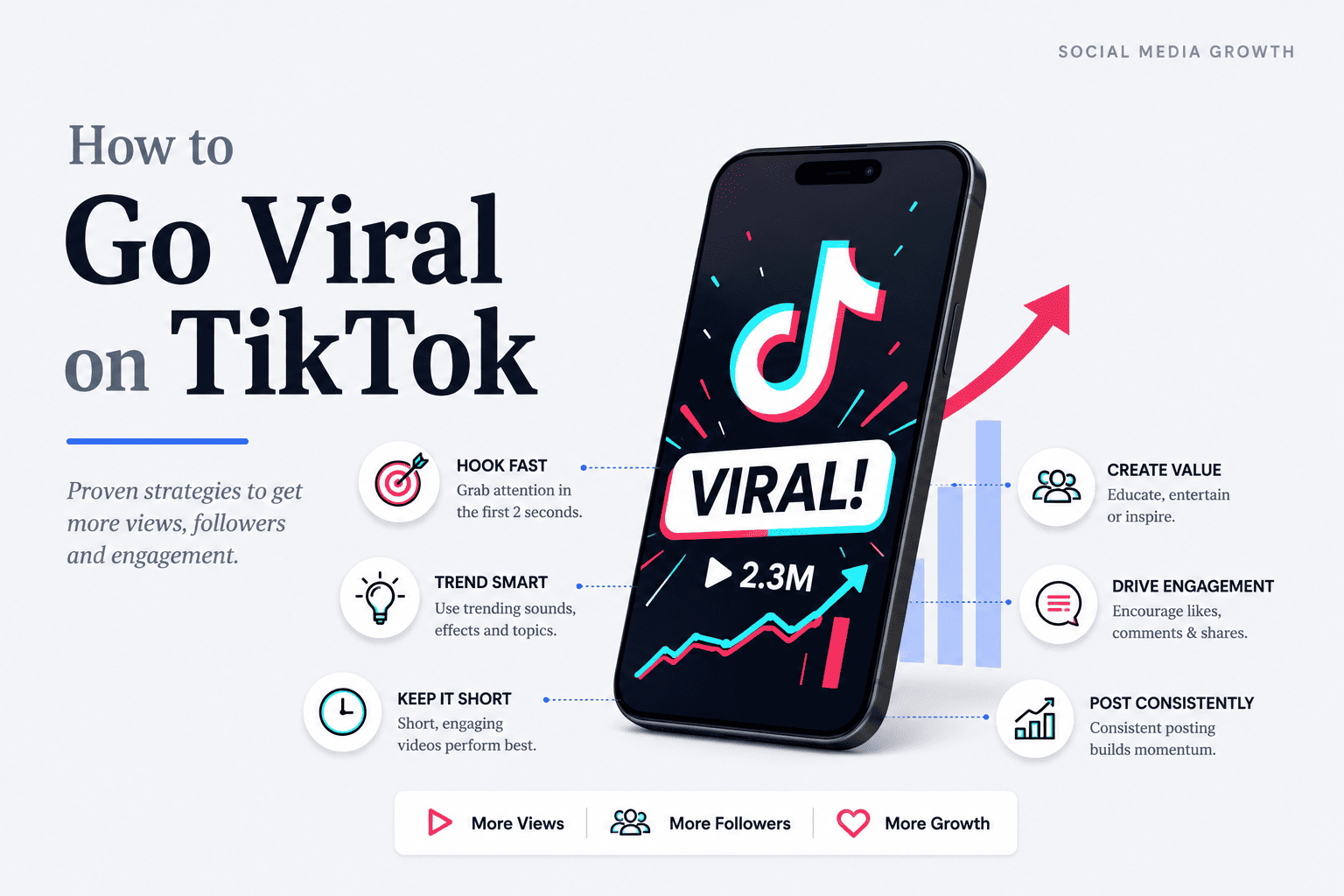
So here’s the actual scorecard TikTok is using in 2026:
Your video gets tested with your existing followers before anyone else sees it
You now need roughly a 70% completion rate to break out, up from 50% in 2024
Shares carry more algorithmic weight than likes
You have about three seconds to earn the rest of the watch
Video length is flexible, retention matters more than duration
TikTok increasingly functions like a search engine, not just a feed
Follower count isn’t a direct ranking factor, but consistency compounds over time
None of that is luck. Here’s what each one actually means for the next video you post.
Wait : Does TikTok Really Show My Video to My Followers First?
Yes, and this is the single biggest shift in how the algorithm behaves this year. When you publish, TikTok now tests the video with a small sample of your own followers first, typically a few hundred people, before deciding whether it’s worth pushing to your For You Page [FYP, TikTok’s main recommendation feed] audience. If that initial group engages, the video graduates to wider testing pools. If they scroll past it, the video’s reach quietly caps out.
The practical upshot: your existing audience’s engagement habits now directly gatekeep your next video’s shot at going wide. Replying to comments in the first hour, and posting at times your specific followers are actually online, matters more than it used to.
Advertisement
What Completion Rate Do You Actually Need?
Completion rate [the percentage of viewers who watch a video all the way to the end] is the metric doing the most damage to creators who haven’t adjusted their strategy. The bar has risen from roughly 50% in 2024 to around 70% now, meaning a video padded with a slow intro or a meandering middle gets penalized far more harshly than it would have two years ago.
Rewatch rate adds another layer on top of that. A viewer who watches your video three times is a stronger signal to the algorithm than three different viewers each watching once – TikTok reads that as content strong enough to revisit, and a rewatch rate above 15–20% is generally considered a solid boost. Practically, that means loops, punchlines that land on replay, or information dense enough that people need a second pass all outperform content that’s “watchable once and done.”
How Long Should Your Video Actually Be?
There’s no single right answer here, and most advice oversimplifies it. TikTok’s own default recommendation sits around 9–15 seconds, and short videos in the 15–30 second range tend to post the highest completion rates simply because there’s less runway to lose someone. But longer formats – a minute, even several minutes – can rack up more total watch time if the hook is strong enough and the pacing never sags, because total watch time and rewatch behavior matter alongside completion percentage.
The honest rule: match the length to how much genuinely engaging content you have, not to a template. A tight 15-second video beats a padded 45-second one every time; a genuinely gripping 90-second story beats a rushed 15-second version of the same idea.
Advertisement
Why Do the First Three Seconds Matter So Much?
Because that’s roughly how long a viewer takes to decide whether to keep watching or scroll on, and the data backs this up hard – a majority of top-performing videos deliver their core message within the first three seconds, not after a slow build. If your video opens with a logo animation, a “hey guys” intro, or any kind of warm-up, you’re burning the exact window that determines whether the algorithm’s test audience sticks around long enough to count as a good sign.
A quick way to fix a weak hook:
Write your script backward : start from the payoff or punchline and work out what the fastest possible path to it looks like.
Cut your current opening line entirely and see if the video still makes sense. If it does, you didn’t need it.
Say or show the most interesting part of the video in the first sentence, then explain how you got there.
Watch the first three seconds with the sound off : if it’s not visually arresting on its own, it needs work.
Do Likes Still Matter, or Is It All About Shares Now?
Shares have overtaken likes as the stronger algorithmic signal, and the logic makes sense from TikTok’s side: a like keeps a viewer on the platform, but a share brings in someone new. Content that prompts a “you need to see this” reaction – genuinely useful information, relatable frustration, or mildly controversial takes people want to weigh in on – tends to outperform content that’s simply well-made.
A few tactics that reliably lift share rate: explicitly say “send this to someone who-” when it fits naturally, package information densely enough that saving it feels useful, and don’t be afraid of a take with a little edge to it. Safe, agreeable content is easy to like and forget; content with a point of view is what gets forwarded.
Is TikTok Basically a Search Engine Now?
Increasingly, yes. TikTok has been leaning harder into search-style discovery, and its algorithm now reads the keywords in your caption, the words you actually say out loud (auto-transcribed), and any on-screen text to figure out which niche searches your video should surface for, not just which interests it might match on the FYP.
Advertisement
How to optimize for this before you post:
Type your target topic into TikTok’s own search bar and see what related searches and existing videos come up : that’s your keyword research.
Say your main keyword phrase out loud somewhere in the video, since the algorithm reads spoken audio.
Add on-screen text that repeats the core topic, not just decorative captions.
Use 3–5 hashtags that mix one or two broad tags (#fyp, #viral) with two or three specific to your exact topic : hashtags now support your SEO rather than driving discovery on their own.
What Content Formats Are Actually Performing Right Now?
Trending sounds haven’t disappeared, but using one exactly as-is is increasingly a missed opportunity – original voiceovers, or a trending audio with your own twist layered on top, tend to stand out precisely because the algorithm (and viewers) have grown numb to identical use of the same clip. Story-based content is also having a moment in longer formats: a well-paced narrative with a clear beginning, tension, and payoff can sustain the 60–180 second range far better than a straightforward tips list can.
The common thread across everything performing well right now: specificity. “Here’s a marketing tip” underperforms “here’s the exact caption structure that got my last video 2 million views” – the second version promises something the algorithm can measure people staying for.
What Kills Your Reach Before It Even Starts?
A few habits quietly cap videos that otherwise had a real shot:
Padding runtime to hit a “recommended” length. If your idea is finished at 12 seconds, stretching it to 30 just to match a template tanks your completion rate.
Recycling a trending sound with zero twist. The algorithm and viewers have both seen it a thousand times already; identical reuse rarely earns the same distribution the original did.
Posting on autopilot without checking analytics. If you’re not comparing completion and rewatch rates across your last several posts, you’re guessing instead of iterating.
Burying the hook under a slow intro. Even a well-made video loses its testing window if the first three seconds don’t earn the next ten.
Hashtag stuffing instead of targeting. Ten generic tags dilute the signal the algorithm needs to categorize your video correctly; three to five precise ones do more work.
Do You Need a Following to Go Viral?
Officially, no. TikTok has confirmed follower count isn’t a direct ranking factor, and plenty of zero-follower accounts break out on a single video that performs well with its test audience. Small businesses posting their very first video have gained tens of thousands of followers overnight this way, and some of the platform’s biggest all-time hits came from accounts with no prior track record at all.
That said, the follower-first testing model does mean an engaged, even modest, existing audience gives your video a better initial testing pool to clear before it’s judged against strangers. Zero followers doesn’t block virality, it just means you’re relying entirely on the content itself to win over a cold audience on the first try.
Advertisement
Putting It Together: A Pre-Post Checklist
Confirm your hook delivers the payoff (or the promise of one) within the first three seconds.
Trim anything that doesn’t earn its place : every extra second is a chance to lose completion rate.
Say your target keyword out loud and reflect it in on-screen text.
Add 3–5 hashtags mixing broad and niche.
Post when your actual followers are active, not a generic “best time” from an article.
Reply to comments within the first hour : you’re still inside the follower-testing window.
Check completion rate and rewatch rate in your analytics 24–48 hours later, and let that data, not guesswork decide what you post next.
Going viral was never really about luck. It’s about clearing a specific, measurable bar TikTok sets for you every single time you hit post and now you know exactly where that bar sits. Once the views start coming in consistently, that’s usually the point worth asking a different question: how do you actually turn that reach into income? That’s a whole guide on its own.
I’m a passionate investor with a strong foundation in fundamental analysis and a keen eye for identifying undervalued companies with long-term growth potential. My investment approach is a blend of value investing principles and a focus on long-term growth. I believe in buying quality companies at a discount to their intrinsic value and holding them for the long haul, allowing them to compound their earnings and shareholder returns.
Analyst’s Disclosure: I/we have no stock, option or similar derivative position in any of the companies mentioned, and no plans to initiate any such positions within the next 72 hours. I wrote this article myself, and it expresses my own opinions. I am not receiving compensation for it (other than from Seeking Alpha). I have no business relationship with any company whose stock is mentioned in this article.
Seeking Alpha’s Disclosure: Past performance is no guarantee of future results. No recommendation or advice is being given as to whether any investment is suitable for a particular investor. Any views or opinions expressed above may not reflect those of Seeking Alpha as a whole. Seeking Alpha is not a licensed securities dealer, broker or US investment adviser or investment bank. Our analysts are third party authors that include both professional investors and individual investors who may not be licensed or certified by any institute or regulatory body.
Mumbai: The Securities and Exchange Board of India(Sebi) has asked depositories to freeze promoter and promoter group holdings at the security level during the buyback period, while allowing them to participate in tender offers and invoke pre-existing pledges.
Under the new rules, promoter holdings will remain frozen from the date the company’s board or shareholders approve a buyback until the offer closes.
The regulator, however, clarified that the restriction will not prevent promoters from tendering their shares in buybacks undertaken through the tender offer route. It also allowed the invocation of encumbrances that were created before the commencement of the buyback period. Sebi has directed depositories to put in place the operational systems and issue detailed implementation guidelines before August 1.
Search engine optimisation has become one of the most important long-term marketing investments for businesses. A well-executed SEO strategy increases visibility, attracts qualified traffic and generates leads without relying solely on paid advertising. However, achieving these outcomes depends largely on selecting the right agency.
The UK has thousands of SEO providers, each offering different services, pricing models and approaches. Understanding what separates a strategic partner from a service provider helps businesses make better decisions and avoid costly mistakes.
Start with Business Objectives
Every SEO campaign should begin with clear business goals.
Some organisations want to generate more enquiries. Others focus on increasing eCommerce sales, expanding into new markets or improving brand visibility. These objectives influence the type of SEO strategy an agency should recommend.
Before speaking with an agency, define measurable outcomes such as:
Advertisement
Increasing qualified organic traffic
Growing online enquiries
Improving conversions from search
Expanding visibility for specific services
Building long-term brand authority
An agency should understand these objectives before recommending tactics.
Evaluate Their Approach, Not Their Promises
SEO requires consistent effort over time. Agencies that promise guaranteed rankings or immediate results often create unrealistic expectations.
Instead, ask prospective agencies how they approach:
Technical website improvements
Keyword research
Content strategy
Link acquisition
Performance reporting
Ongoing optimisation
A clear methodology demonstrates experience and provides confidence that work is based on proven processes rather than short-term tactics.
Look Beyond Keyword Rankings
Ranking for keywords is important, but rankings alone do not guarantee business growth.
An effective SEO campaign should improve metrics that directly support commercial objectives, including:
Advertisement
Qualified organic traffic
Conversion rates
Lead generation
Revenue from organic search
Visibility across important service categories
Review Their Technical Expertise
Technical SEO forms the foundation of every successful campaign.
Without proper indexing, crawlability and website performance, even excellent content can struggle to rank.
Ask whether the agency regularly evaluates:
Website speed
Core Web Vitals
Mobile usability
Crawl errors
XML sitemaps
Canonicalisation
Structured data
Internal linking
Strong technical capabilities allow content and authority-building efforts to perform more effectively.
Understand Their Content Strategy
Content should support customer decision-making rather than simply target keywords.
An experienced agency develops content that answers relevant questions, demonstrates expertise and supports commercial pages.
Advertisement
A comprehensive strategy may include:
Service pages
Industry guides
Educational resources
Comparison articles
Frequently asked questions
Case studies
Each piece of content should contribute to broader topical authority instead of existing in isolation.
Ask About Authority Building
Search engines evaluate how other websites reference a business.
Authority is developed through consistent recognition from reputable sources.
Avoid agencies that focus exclusively on acquiring large numbers of low-quality links.
Reporting Should Be Transparent
Regular reporting allows businesses to understand the value of ongoing SEO investment.
Useful reports explain:
Work completed
Website improvements
Organic traffic trends
Keyword visibility
Conversion performance
Future priorities
Reports should provide context rather than simply presenting data.
Businesses should understand why performance changes and how future activities will contribute to continued growth.
Experience Across Different Industries Matters
Every industry has different search behaviour, competition and customer expectations.
Advertisement
Agencies that have worked across multiple sectors often adapt strategies more effectively because they understand different buying journeys and content requirements.
When reviewing previous work, look for evidence of:
Problem-solving
Long-term growth
Measurable outcomes
Strategic thinking
Adaptability
Relevant experience is often more valuable than the number of years an agency has been operating.
Communication Is an Important Indicator
SEO campaigns involve continuous collaboration.
An agency should communicate clearly, explain technical concepts in straightforward language and provide realistic expectations.
Advertisement
Good communication helps businesses:
Understand recommendations
Prioritise activities
Track progress
Make informed decisions
The best partnerships are built on transparency rather than complexity.
Think Beyond How Search Works Today
Search behaviour continues to evolve.
Customers now use traditional search engines alongside AI assistants and conversational search platforms to research products and services.
Businesses should work with agencies that recognise these changes and adapt their strategies accordingly. Modern optimisation increasingly combines technical SEO, authoritative content and broader search visibility to support long-term growth.
Advertisement
Businesses evaluating providers can learn more about working with a professional SEO agency in the UK that combines search strategy, technical optimisation and modern search discovery into a unified approach.
Final Thoughts
Choosing an SEO agency should never be based on pricing alone.
The right partner understands business objectives, follows a structured methodology, communicates openly and focuses on measurable commercial outcomes.
By evaluating technical expertise, content strategy, authority building and reporting standards, businesses can identify an agency capable of delivering sustainable organic growth rather than short-term improvements.
Airbus SE (EADSY) Discusses Business Updates and Outlook Across Key Segments July 21, 2026 12:30 PM EDT
Company Participants
Jean-Christophe Henoux – Head of Investor Relations & Financial Communication Guillaume Faury – CEO & Executive Director Thomas Toepfer – Chief Financial Officer Lars Wagner – Chief Executive Officer of Commercial Aircraft business Airbus Michael Schoellhorn – Chief Executive Officer Matthieu Louvot – Chief Executive Officer
Advertisement
Conference Call Participants
David Perry – JPMorgan Chase & Co, Research Division Ross Law – Morgan Stanley, Research Division Douglas Harned – Bernstein Institutional Services LLC, Research Division Samuel Burgess – Goldman Sachs Group, Inc., Research Division Kenneth Herbert – RBC Capital Markets, Research Division Ian Douglas-Pennant – UBS Investment Bank, Research Division Chloe Lemarie – Jefferies LLC, Research Division Sash Tusa – Agency Partners LLP Charles Armitage – Citigroup Inc., Research Division Herve Drouet – CIC CIB, Research Division
Presentation
Advertisement
Jean-Christophe Henoux Head of Investor Relations & Financial Communication
Good afternoon, ladies and gentlemen. Very warm welcome to the 2026 Airbus Business Update. It’s fantastic to see so many familiar faces in the room. On behalf of Airbus top management, we are delighted to host you today in London. This event is also broadcasted live. So good morning to the participants connected from the U.S. Good afternoon or good evening to all of us from around the world.
Before we start, let me go through a few practicalities and starting with safety first. We’ve talked to the hotel management earlier today, and there is no fire alarm test scheduled. So if you hear the fire alarm, please follow the staff towards the nearest exit and let’s assemble outside of the hotel in front of the main entrance.
I also kindly ask you to pay attention to the camera in case you walk around during the session because the event again is broadcasted. During the presentation, but also during the
Synergy has agreed to buy all the energy from Neoen’s Narrogin wind farm, in move which has paved the way for construction to begin on the massive renewable project.
Kaylee Hottle, a deaf actress best known for playing Jia in two “Godzilla” films, has died at age 18 following a car accident early Tuesday morning in Maryland, according to her father, Joshua Hottle, who confirmed her death to TMZ.
Joshua Hottle said his daughter was involved in a serious car accident, and that officials contacted him shortly afterward to inform him that her heart had stopped while she was being transported to the hospital. He shared the news of her death publicly in a nearly 23-minute social media livestream, during which he explained in American Sign Language that he needed to fly from Texas to Maryland to claim her body.
A rising star from a multi-generational deaf family
Hottle, an Atlanta, Georgia, native, came from a multi-generational deaf family and began her acting career in commercials as a young child. She first gained public attention at age 9 through a public service announcement for Glide, a live video messaging app widely used within the deaf and hard-of-hearing community.
Advertisement
Breakout role in the Godzilla franchise
Hottle’s most prominent acting role came in 2021, when she portrayed Jia in “Godzilla vs. Kong,” playing a teenager who communicates with the giant ape King Kong through sign language while living on Skull Island alongside Rebecca Hall’s character, Dr. Ilene Andrews. The role introduced Hottle to a global audience and highlighted representation for deaf performers within a major Hollywood blockbuster franchise.
She went on to reprise the role of Jia in the franchise’s 2024 sequel, “Godzilla x Kong: The New Empire,” further establishing her presence within the long-running Monsterverse film series. Beyond her work in the Godzilla films, Hottle also appeared in the “Magnum P.I.” reboot series, playing a character named Joon in a Season 4 episode.
A short but meaningful career
Advertisement
Hottle’s acting career, though brief given her young age, carried significant cultural weight, particularly within the deaf community, given the relative rarity of prominent deaf actors cast in major studio blockbuster films. Her portrayal of Jia was widely noted at the time of the film’s release for bringing authentic representation to a character whose primary mode of communication was sign language, a casting choice that resonated with audiences advocating for greater inclusion of deaf and hard-of-hearing performers in mainstream entertainment.
A family in mourning
In his emotional livestream following news of his daughter’s death, Joshua Hottle appeared visibly distraught as he relayed the circumstances surrounding the accident and his daughter’s passing to viewers, sharing the news directly with his and Kaylee’s broader community through American Sign Language given the family’s deep ties to the deaf community.
Part of a difficult stretch of entertainment industry losses
At just 18 years old, Hottle’s death marks a particularly tragic loss given the promise her early career had already demonstrated. Her performances in the Godzilla franchise placed her among a relatively small group of young deaf actors to achieve significant visibility in major studio productions, and her death has prompted an outpouring of grief from those following her career and her family’s public statements in the hours since the news broke.
Details regarding funeral or memorial arrangements for Hottle had not been publicly announced as of the time of this report. Her father indicated he was traveling to Maryland to claim her body following the accident, suggesting that additional information about services honoring her life and career may be shared by the family in the coming days. As news of her death continues to spread across social media and entertainment news outlets, tributes from fans, colleagues in the deaf community and others touched by her work in film and television are expected to continue in the days ahead, remembering Hottle both for her groundbreaking on-screen representation and for the promise of a career that ended far too soon.

























































You must be logged in to post a comment Login